
Non-Woven Abrasives Market Size and Share
Market Overview
| Study Period | 2022 - 2032 |
|---|---|
| Market Size (2027) | USD 2.83 Billion |
| Market Size (2032) | USD 3.64 Billion |
| Growth Rate (2027 - 2032) | 5.16 % |
| Fastest Growing Market | Asia-Pacific |
| Largest Market | Asia-Pacific |
| Market Concentration | Medium |
Major Players *Disclaimer: Major Players sorted in no particular order Image © Mordor Intelligence. Reuse requires attribution under CC BY 4.0. | |
Non-Woven Abrasives Market Analysis by Mordor Intelligence
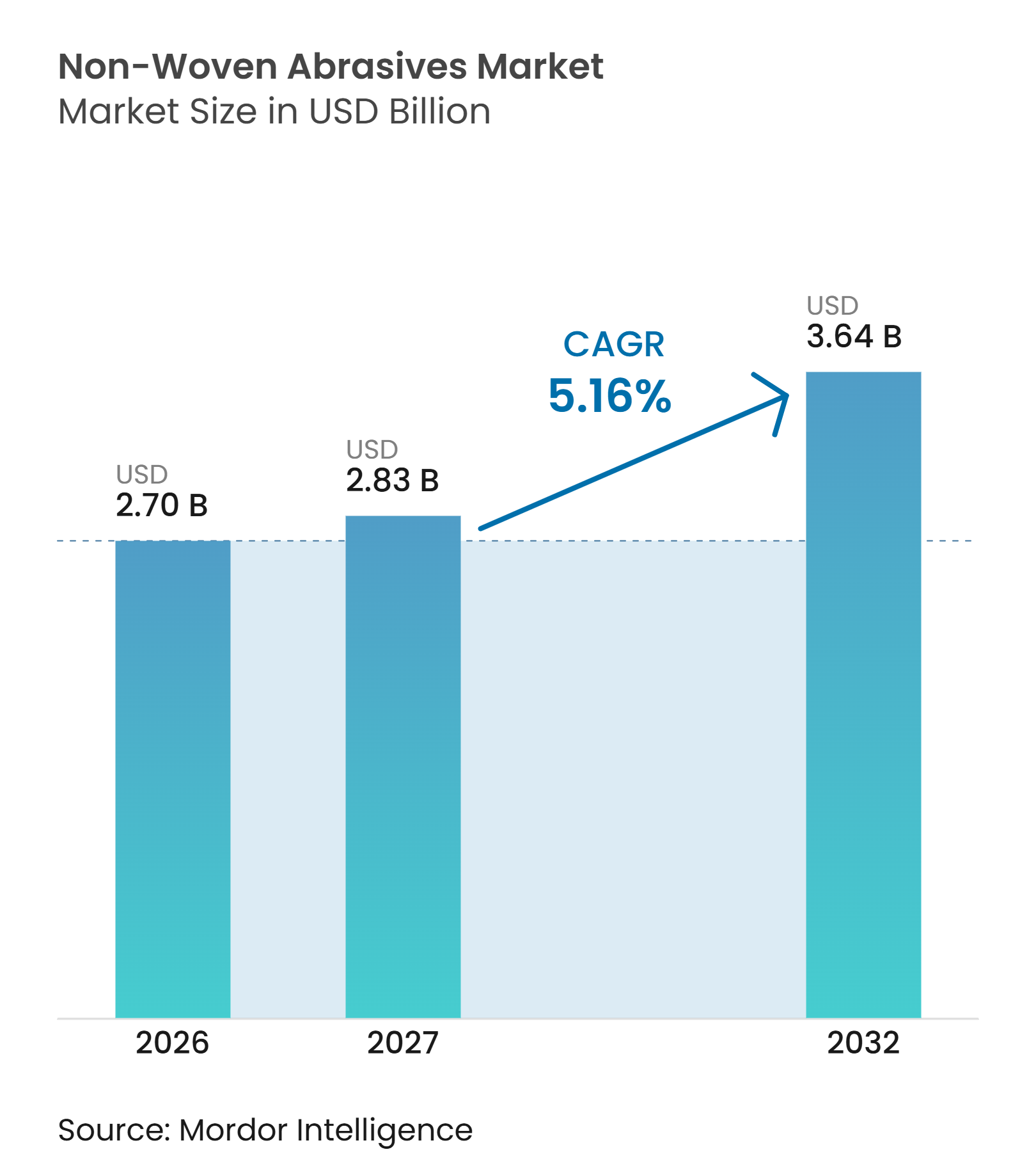
The Non-Woven Abrasives Market size was valued at USD 2.70 billion in 2026 and is estimated to grow from USD 2.83 billion in 2027 to USD 3.64 billion by 2032, at a CAGR of 5.16% during the forecast period (2027-2032). The non-woven abrasives market is driven by manufacturers that require repeatable surface conditioning rather than results dependent on individual operator technique. Automotive, semiconductor, and advanced metalworking end users specify grade-consistent media for defined process steps. This shift is extending demand beyond maintenance and repair work into controlled production environments. Suppliers with application engineering capabilities, broad product formats, and integrated supply chains are better positioned to support these requirements. Input cost exposure, competition from coated and bonded formats, and lengthy buyer qualification processes continue to influence purchasing decisions.
Key Report Takeaways
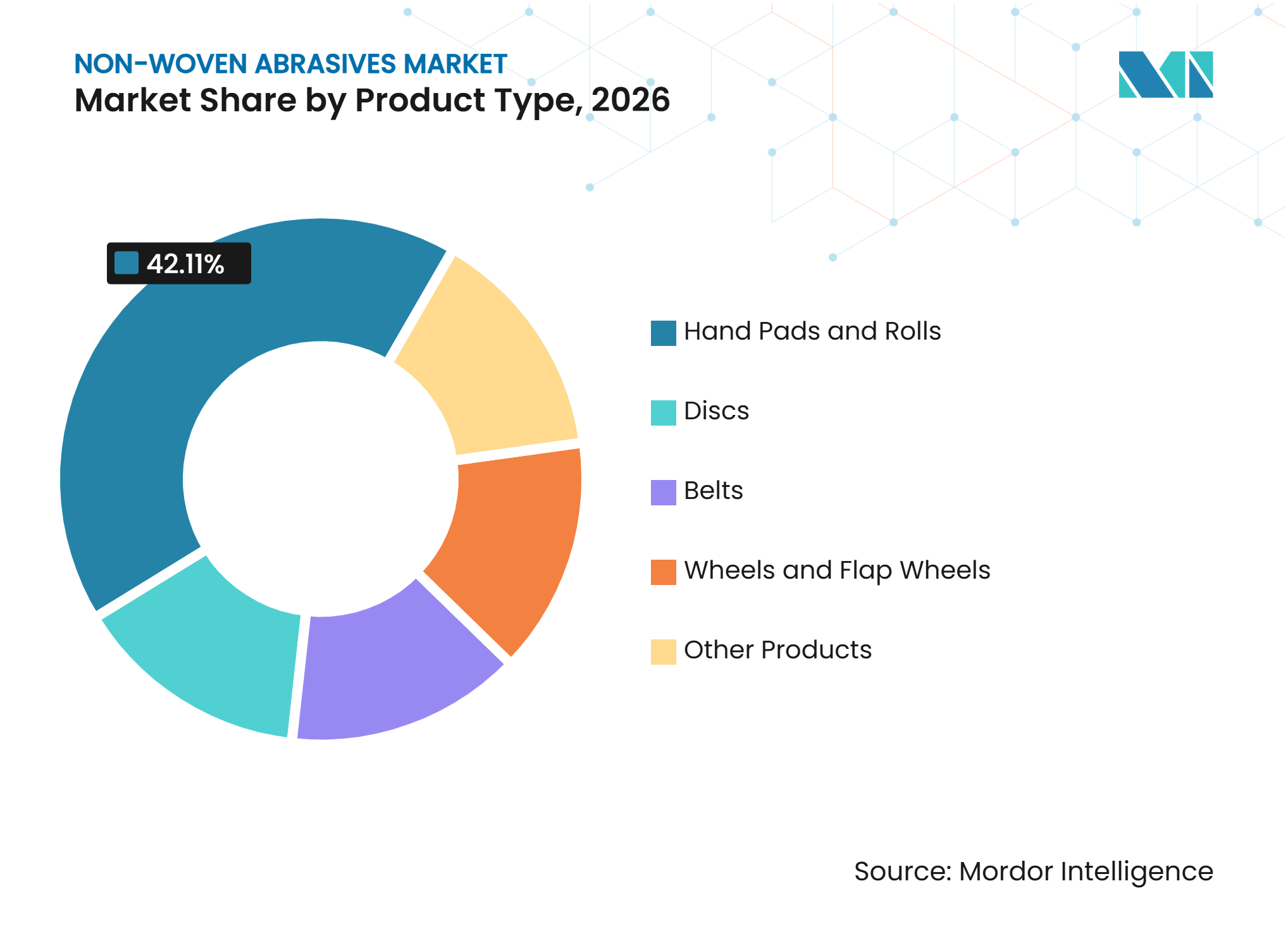
- By product type, Hand Pads and Rolls held 42.11% of the non-woven abrasives market share in 2026, while Discs are forecast to grow at a CAGR of 6.26% through 2032.
- By abrasive material, Aluminum Oxide held 54.05% of the non-woven abrasives market share in 2026, while Ceramic Alumina is forecast to grow at a CAGR of 6.78% through 2032.
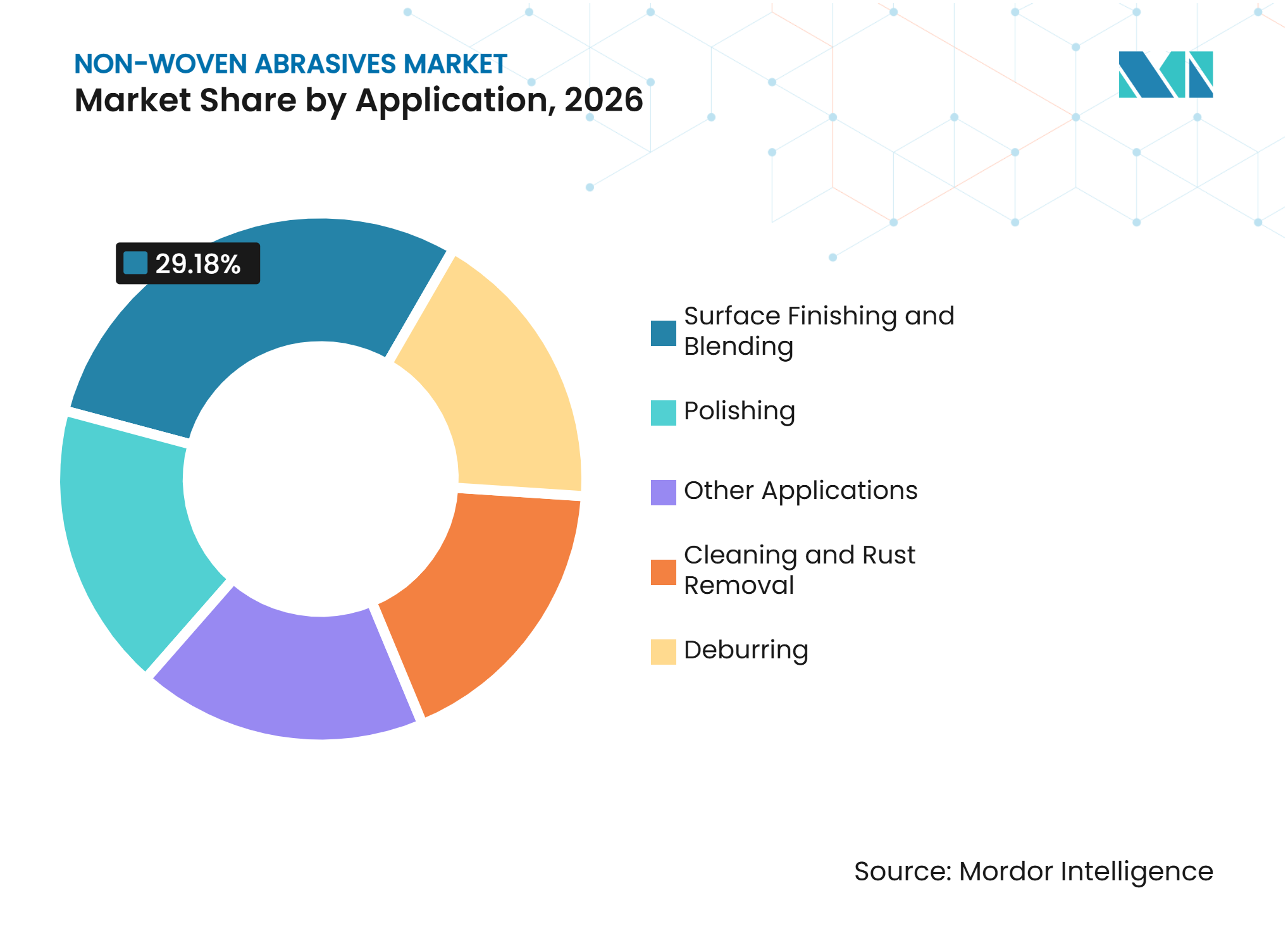
- By application, Surface Finishing and Blending accounted for 29.18% of the Non-Woven Abrasives Market size in 2026, while Polishing is forecast to grow at a CAGR of 6.91% through 2032.
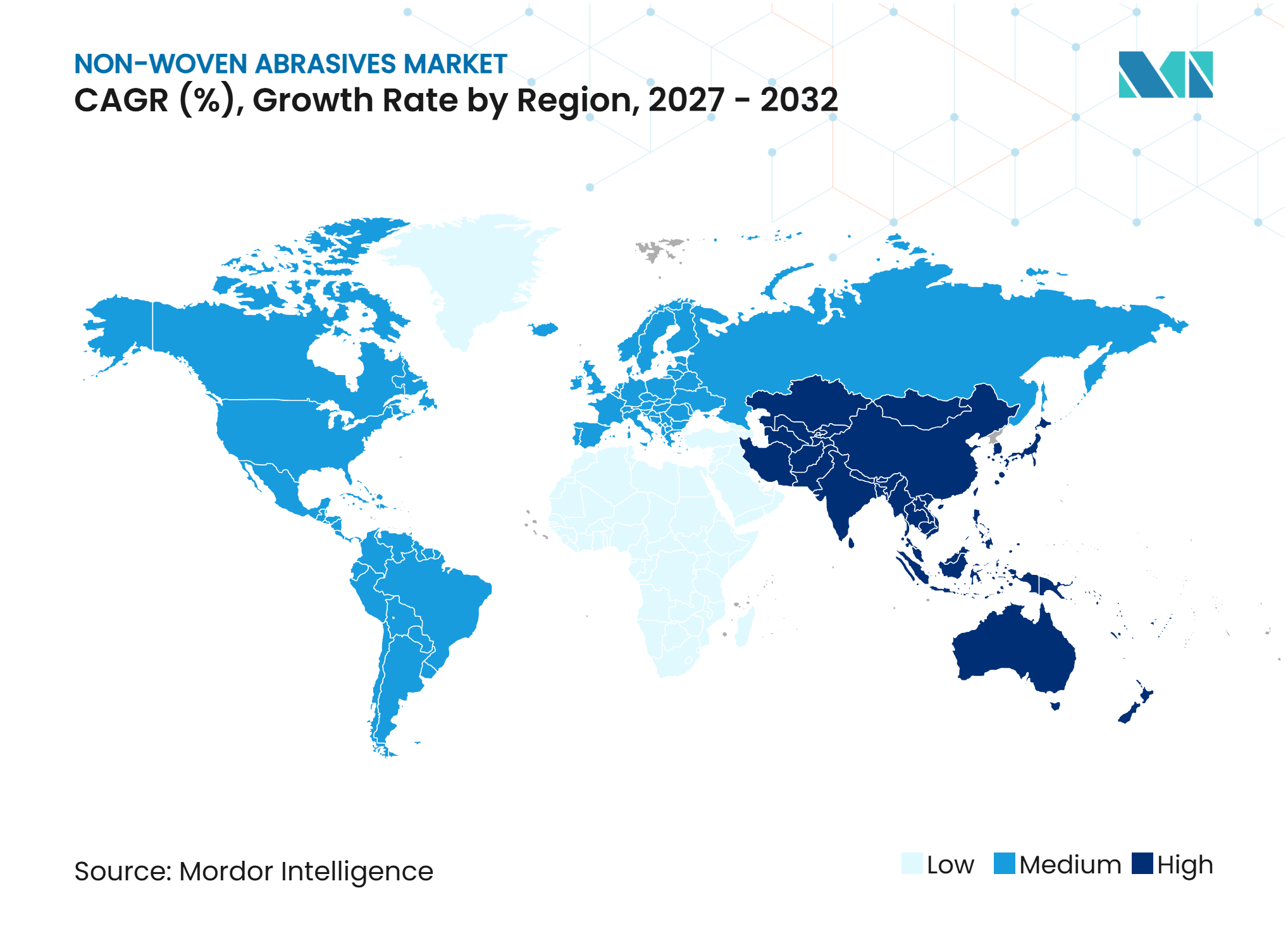
- By geography, Asia-Pacific held 40.21% of the non-woven abrasives market share in 2026 and is forecast to grow at a CAGR of 6.67% through 2032.
Note: Market numbers in this report are based on Mordor Intelligence's proprietary estimation framework, which combines nine months of actuals with Q4 projections for base year 2026.
Market Trends and Insights
Drivers Impact Analysis of Non-Woven Abrasives Market*
| Drivers | (~) % Impact on CAGR Forecast | Geographic Relevance | Impact Timeline |
|---|---|---|---|
| Manufacturing Automation and Robotic Finishing Adoption | +1.3% | Global, with Asia-Pacific and North America as primary uptake centers | Medium term (2-4 years) |
| Rising Automotive and Electric Vehicle Surface-Preparation Demand | +1.0% | Asia-Pacific core, with spillover to North America and Europe | Medium term (2-4 years) |
| Consistent Finishing in Electronics and Semiconductor Manufacturing | +0.9% | Asia-Pacific core and North America | Long term (≥ 4 years) |
| Stainless-Steel, Aluminum, and Lightweight-Metal Fabrication Growth | +0.7% | Global, with concentration in Germany, India, and China | Medium term (2-4 years) |
| Multi-Step-Reduction Abrasive Systems in Small Workshops | +0.6% | North America and Europe | Short term (≤ 2 years) |
| Source: Mordor Intelligence | |||
Manufacturing Automation and Robotic Finishing Adoption
Automated finishing cells require abrasive media that maintain cutting action and surface contact across repeated parts without operator adjustment. The open-web structure of non-woven media exposes fresh abrasive as a pad wears, supporting consistency in many surface-conditioning tasks. ABB stated in July 2025 that China's mid-market robotics segment, including polishing and basic surface operations, was expected to grow at 8% annually for three years. This expansion brings more mid-sized factories into the user base for machine-compatible finishing media. Collaborative robots also lower the automation threshold for smaller fabricators, broadening the range of buyers that can use standardized finishing processes. In the non-woven abrasives market, this shifts purchasing toward systems integrators and process engineers who assess total operating cost and qualification support alongside unit price.
Rising Automotive and Electric Vehicle Surface-Preparation Demand
Electric vehicle platforms require finishing work on battery housing sealing surfaces, motor end-cap interfaces, and power-electronics enclosure welds. These components often use aluminum and copper surfaces with tighter heat-damage tolerances than conventional steel-on-steel work. According to a 2025 automotive supplier study cited by Reuters, Chinese automotive brands averaged an 18-month development cycle, compared with 5.4 years for foreign brands. Faster platform development can reduce the time available for suppliers to establish process compliance on new components. Non-woven media can conform to complex geometries and reduce heat generation during aluminum and copper finishing. As electric vehicle fleets mature, battery-adjacent aluminum body structures also support demand for cleaning and blending products used in collision repair.
Growing Need for Consistent Finishing in Electronics and Semiconductor Manufacturing
Semiconductor manufacturing permits little surface variation in processes involving material removal and inter-layer polishing. Precision surface-preparation materials were identified as an innovation area at SEMI's 2025 Strategic Materials Conference as the market advances materials for advanced semiconductor manufacturing. DuPont's Ikonic 9000 Chemical Mechanical Planarization (CMP) pad series received a 2025 Edison Award from SEMI for its contribution to AI-driven efficiency in chip fabrication[1]. These developments indicate that finishing materials are being developed alongside demanding semiconductor process requirements. DISCO Corporation's record earnings in January 2026 were linked to demand for AI chips, indicating continued activity in wafer-grinding and dicing equipment. For the non-woven abrasives market, this supports process-critical uses in backend packaging and printed circuit board finishing, where specification compliance is central to commercial use.
Expansion of Stainless-Steel, Aluminum, and Lightweight-Metal Fabrication
Stainless-steel and aluminum fabrication require weld blending, heat-tint removal, and surface preparation before passivation. Non-woven products can support these steps where coated formats may leave embedded contamination. ESAB's 2025 annual filing described continued customer investment in fabrication technology and robotic welding solutions across industrial markets. Worthington Steel's 2025 annual report discussed the adoption of aluminum tailor-welded blanks using friction stir welding for lightweighting applications. Aluminum's thermal sensitivity can limit conventional grinding in multi-step finishing work. This supports non-woven specifications that remove material while limiting loading and smearing.
Restraints Impact Analysis of Non-Woven Abrasives Market*
| Restraints | (~) % Impact on CAGR Forecast | Geographic Relevance | Impact Timeline |
|---|---|---|---|
| Competition from Coated Abrasives and Conventional Grinding Wheels | -0.8% | Global | Medium term (2-4 years) |
| Volatility in Nylon, Resin, and Abrasive-Grain Input Costs | -0.9% | Global, with acute pressure in North America and Europe | Short term (≤ 2 years) |
| Process-Qualification Risk When Switching from Manual to Automated Finishing | -0.5% | North America and Europe | Medium term (2-4 years) |
| Source: Mordor Intelligence | |||
Competition from Coated Abrasives and Conventional Grinding Wheels
Coated abrasives and bonded grinding wheels retain a cost and stock-removal advantage in heavy-duty applications. PFERD TOOLS positions its CC-GRIND ROBUST product as an alternative to grinding wheels, flap discs, and fiber discs, with a focus on stock removal. The non-woven abrasives market is divided between specification-led finishing work and price-led general abrasion. In commodity applications, non-woven manufacturers face price pressure from lower-cost coated and bonded alternatives. Open-web structures trade aggressive stock removal for surface quality. Suppliers that use non-woven media in heavy-removal applications risk poor performance and customer attrition.
Volatility in Nylon, Resin, and Abrasive-Grain Input Costs
Non-woven abrasive products use nylon fiber, synthetic resin binders, and abrasive grain. Nylon 6 and nylon 66 markets faced tariff-related uncertainty in 2025, driven by uneven automotive recovery and elevated import costs. In September 2025, the U.S. Department of Commerce finalized antidumping and countervailing duty orders on sol-gel alumina-based ceramic abrasive grains from China. The order set an antidumping margin of 88.32% and a countervailing duty rate of 165.05% for Chinese producers[2]. Manufacturers that sourced ceramic grain from China have had to qualify alternative sources as demand for ceramic-grade products grows. Requalifying supply chains can increase costs and slow availability in affected product lines.
*Our forecasts treat driver/restraint impacts as directional, not additive. The impact forecasts reflect baseline growth, mix effects, and variable interactions.
Non-Woven Abrasives Market Segment Analysis
By Product Type:
Hand Pads Lead, Discs Drive Automation GainsHand Pads and Rolls held 42.11% of the non-woven abrasives market share in 2026. Their position reflects their utility in manual surface conditioning, automotive refinishing, metalworking repair, and general maintenance work. A single hand pad can support cleaning, blending, and final surface preparation without a tool change. This flexibility is important in field maintenance and low-volume fabrication where equipment options are limited. Discs are projected to grow at a CAGR of 6.26% between 2027 and 2032. Their geometry suits orbital sanders and robotic end-effectors, making them a preferred format for finishing-cell integrators.
3M has positioned Scotch-Brite products in multi-step workflows that pair Cubitron 3 performance abrasives with non-woven finishing discs. Belts serve continuous-pass production lines in stainless-steel fabrication and wood panel processing. Wheels and flap wheels support edge work, curved-profile weld blending, and die-cast part deburring. Mirka introduced MI231B abrasive films in January 2025 for crank and camshaft shaping and industrial polishing. This product activity supports demand for engineered media with application-specific geometry. The product mix may gradually shift toward machine-compatible formats as automation reaches smaller workshops, while hand-use formats will retain a substantial role where operator judgment remains important.



By Abrasive Material:
Aluminum Oxide Dominates, Ceramic Alumina Reshapes the Premium TierAluminum Oxide accounted for 54.05% of the non-woven abrasives market share in 2026. It remains widely used for general ferrous metalworking, maintenance, repair, and hand-pad applications due to its established cost-performance balance. Ceramic Alumina is forecast to expand at a CAGR of 6.78% from 2027 to 2032. Its growth is linked to automated finishing applications that require consistent performance during extended production runs. Aluminum oxide serves a large installed base that is more sensitive to product cost, while ceramic alumina supports process-critical workflows where cycle time and tool-change frequency matter more than unit abrasive cost.
Silicon Carbide is used on non-ferrous metals, plastics, and glass, where its sharp, friable grain produces clean surface breaks in soft or brittle materials. It retains a smaller share than aluminum oxide and ceramic alumina. The September 2025 U.S. duty orders on Chinese sol-gel alumina-based ceramic grain altered sourcing conditions for ceramic products. Alternative sources in the United States, Canada, and Europe may require 6 to 18 months of specification qualification. Klingspor invested in ceramic abrasive technologies for premium product lines during 2025. The non-woven abrasives market is therefore balancing a broad aluminum oxide base with growing demand for independently qualified premium grain systems.
By Application:
Surface Finishing Anchors Demand, Polishing Commands the Growth PremiumSurface Finishing and Blending held 29.18% of the non-woven abrasives market share in 2026. It covers weld-line blending, pre-paint preparation, mill-scale removal, automotive body work, and industrial equipment workflows. Polishing is forecast to advance at a CAGR of 6.91% from 2027 to 2032. Its growth reflects the rising importance of final surface condition in semiconductor packaging, power electronics, optical components, and high-specification automotive trim. Controlled non-woven media can bridge the gap between mechanical preparation and surfaces that must be free of contamination before bonding. SEMI highlighted precision surface-material innovation as a material priority for advanced semiconductor manufacturing in 2025.
Cleaning and Rust Removal support maintenance work in infrastructure, marine, and energy applications. In these uses, non-woven media can remove oxidation without substantially altering surface geometry. Deburring is gaining use in precision-machined aerospace and medical components, where quality systems such as ISO 9001 and AS9100 guide process controls. There is a broader shift toward specification-driven products in polishing and deburring. These applications require manufacturers to offer application engineering alongside the abrasive product. Producers that can support those process requirements are positioned to move beyond general-purpose blending and cleaning. General-purpose formats remain necessary, as many maintenance and fabrication users continue to prioritize flexibility and accessible product cost.

Geography Analysis
Asia-Pacific: Manufacturing Scale Supports Regional Demand
Asia-Pacific held 40.21% of the non-woven abrasives market share in 2026 and is projected to grow at a CAGR of 6.67% through 2032. China provides high demand linked to automotive and electric vehicle production. Japan and South Korea add precision requirements from semiconductor processing, electronics, and advanced automotive components. India contributes incremental output through metal fabrication and construction. ABB's July 2025 expansion of robotics offerings for China's mid-market customers indicated 8% annual value growth over three years in that segment. Automation in mid-sized plants can increase demand for repeatable finishing media.
Chinese vehicle manufacturers have reduced development cycles to 18 months, sustaining a flow of new surface-preparation specifications for component suppliers. CUMI commissioned a cutting and grinding wheel facility in Hosur in early 2026, doubling annual wheel capacity to more than 90 million units. This development reflects continued confidence in Indian fabrication, construction, and general engineering activity. Semiconductor and electronics requirements in Japan, South Korea, Taiwan, and China favor precision finishing and formal process control. Suppliers must also meet local qualification requirements and production standards that vary by customer and application. The regional combination of production scale and automated finishing capacity supports a broad base of use for the non-woven abrasives market.
North America: Reshoring and Aerospace Repair Support Demand
North American demand is supported by industrial and automotive manufacturing, aerospace maintenance, and the use of automated finishing in metalworking. GE Aerospace reported in February 2026 that it was using robots and lean methods to address a jet-engine repair backlog. Surface reconditioning of turbine and compressor components is part of this repair workflow. Mirka opened its first production facility outside Europe in Indianapolis in April 2025 to convert finished abrasive products closer to North American customers. Local conversion capacity can shorten supply lines and support application-specific service. Aerospace suppliers also operate within strict quality controls, including AS9100 requirements for applicable production processes.
The September 2025 duty orders on Chinese ceramic abrasive grain are influencing procurement decisions in the United States. Manufacturers are qualifying North American and European grain sources, which can increase input costs while creating openings for domestic suppliers. 3M reported USD 24.9 billion in fiscal 2025 sales and 2.1% adjusted organic growth across its portfolio. The scale of its industrial presence illustrates the breadth of demand served by the region's manufacturing base. Robotic repair and metalworking activity also create a need for media with repeatable grit exposure. The non-woven abrasives market benefits when suppliers can meet the region's quality, sourcing, and application-support requirements.
Europe, South America, and the Middle East and Africa: Distinct Industrial Bases Shape Demand
Europe is supported by German precision metalworking and automotive supply chains, Italian machinery and fabrication, and Scandinavian marine and maintenance activity. Klingspor launched the A 624 Supra grinding disc in August 2025 and continued investing in ceramic abrasive technologies for premium lines. These actions respond to demand for products with longer service life and fewer changeovers in production settings. Federation of European Producers of Abrasives (FEPA) standards establish technical expectations for abrasive grain size and performance across European markets. These standards raise the compliance threshold for suppliers seeking to enter specification-led purchasing. Europe's use of robotic welding and automated production supports steady demand for consistent finishing media.
South American demand is concentrated in Brazilian automotive, mining, and construction activity. Argentina contributes through metalworking and energy infrastructure, although currency volatility and irregular heavy-industry investment can affect purchasing cycles. The Middle East and Africa are supported by Saudi Arabia's Vision 2030 industrial diversification program, petrochemical processing, construction, and downstream metal fabrication. South Africa's mining and construction-equipment maintenance base provides stable, slower-growing demand. Across these regions, abrasive demand remains closely tied to industrial investment cycles. Large project pipelines can create faster demand movement than in more mature markets. This varied regional profile creates opportunities for suppliers to align product availability and technical support with local fabrication and maintenance needs.
Competitive Landscape
Market Concentration
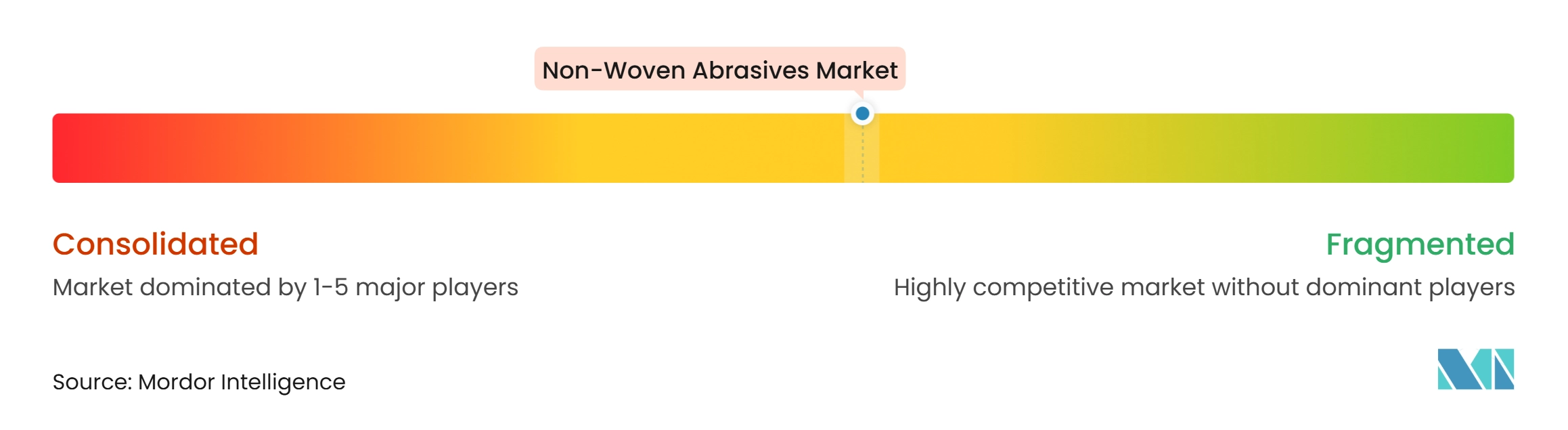
The non-woven abrasives market is moderately fragmented, with large diversified suppliers and regional specialists serving different application requirements. 3M, Saint-Gobain (through Norton), Mirka, Klingspor, and Sia Abrasives (a Bosch subsidiary) are prominent suppliers in premium finishing applications. Competition centers on breadth of formats, engineering support, local service, and product performance rather than on a single product category. 3M stated that its medium-term plan included USD 3.5 billion in research and development spending from 2025 to 2027 and 1,000 product launches. Its Scotch-Brite platform remains relevant in multi-step automated workflows. A 2025 US patent application describes non-woven abrasive articles using magnetizable particles aligned by applied magnetic fields during manufacture, illustrating how proprietary material design can differentiate premium products from commodity alternatives.
Mirka acquired Hermes Schleifmittel's bonded abrasives division in September 2025 and invested EUR 25 million in a formaldehyde-free production line in Jakobstad, Finland, in October 2025. Together with its Indianapolis facility, these moves expanded Mirka's portfolio and production footprint. Klingspor's investment in ceramic technology reflects the importance of premium-grain systems for production users. PFERD TOOLS developed digital access tools for customers, supporting product selection and procurement for smaller businesses. Portfolio expansion and localized capacity allow suppliers to cover more finishing steps within a customer relationship.
Smaller fabricators that use collaborative robots but lack application engineering support remain underserved. Large suppliers tend to direct the most sales effort toward major original equipment manufacturers. Digital distribution is becoming more relevant for small and medium-sized buyers that traditionally purchased through local distributors. Klingspor partnered with Zoro.com, while PFERD TOOLS launched a digital customer portal in 2025. Federation of European Producers of Abrasives (FEPA) membership includes major abrasive producers and supports common standards on grain size and performance. This technical baseline raises entry costs for new suppliers in specification-led applications. Material science, grain-structure engineering, and process optimization favor companies with sustained research capacity. The market continues to be shaped by the ability to meet technical standards, secure qualified inputs, and support customers through production changes.
Non-Woven Abrasives Industry Leaders
-
3M
-
Saint-Gobain
-
Walter Surface Technologies
-
Klingspor AG
-
August Rüggeberg GmbH & Co. KG
- *Disclaimer: Major Players sorted in no particular order
Non-Woven Abrasives Market Companies Covered in this Report
- 3M
- ARC Abrasives Inc.
- August Rüggeberg GmbH & Co. KG
- CUMI
- DEWALT
- Hermes Schleifmittel GesmbH
- Klingspor AG
- Mirka Ltd.
- Nippon Resibon Corporation
- Osborn GmbH
- Saint-Gobain
- SAIT ABRASIVI S.p.A.
- sia Abrasives Industries AG
- Valgro Engineers Pvt. Ltd.
- Walter Surface Technologies
Recent Industry Developments in Non-Woven Abrasives Market
- March 2026: Carborundum Universal (CUMI) commissioned a new cutting and grinding wheel facility at Hosur, India, using technology and assets acquired from Germany-based DRONCO GmbH. The plant, certified by the Organization for the Safety of Abrasives (oSa), doubled CUMI's total annual wheel production capacity from 45 million to over 90 million units, representing an investment of INR 83 crore (USD 10 million). This expansion added to the company's position in the Indian fabrication, construction, and general engineering markets.
- December 2025: Walter Surface Technologies acquired Hermes North America, the North American operations of Hermes Schleifmittel GmbH. The acquisition expanded Walter's coated and non-woven abrasive product portfolio, with non-woven abrasives playing a key role in robotic and automation-oriented finishing applications across North America. The transaction extended Walter's reach into industrial metalworking and finishing channels where Hermes had an established customer base. The European operations of Hermes Schleifmittel continue under separate ownership.
Global Non-Woven Abrasives Market Report Scope
Non-woven abrasives are three-dimensional, open-web materials made from synthetic fibers, such as nylon, infused with abrasive grains, including aluminum oxide, silicon carbide, or ceramic alumina, and bonded together using synthetic resins. These materials are widely used in surface finishing, polishing, and cleaning applications across industries such as metalworking, woodworking, and automotive manufacturing.
The non-woven abrasives market is segmented by product type, abrasive material, application, and geography. By product type, the market is segmented into hand pads and rolls, discs, belts, wheels and flap wheels, and other products. By abrasive material, the market is segmented into aluminum oxide, silicon carbide, ceramic alumina, and other abrasive materials. By application, the market is segmented into surface finishing and blending, cleaning and rust removal, deburring, polishing, and other applications. The report also covers market sizes and forecasts for non-woven abrasives across 15 countries in major regions. The market sizes and forecasts are provided in terms of value (USD).
Segmentation Overview
| Hand Pads and Rolls |
| Discs |
| Belts |
| Wheels and Flap Wheels |
| Other Products |
| Aluminum Oxide |
| Silicon Carbide |
| Ceramic Alumina |
| Other Abrasive Materials |
| Surface Finishing and Blending |
| Cleaning and Rust Removal |
| Deburring |
| Polishing |
| Other Applications |
| Asia-Pacific | China |
| India | |
| Japan | |
| South Korea | |
| ASEAN Countries | |
| Rest of Asia-Pacific | |
| North America | United States |
| Canada | |
| Mexico | |
| Europe | Germany |
| United Kingdom | |
| France | |
| Italy | |
| NORDIC Countries | |
| Rest of Europe | |
| South America | Brazil |
| Argentina | |
| Rest of South America | |
| Middle East and Africa | Saudi Arabia |
| South Africa | |
| Rest of Middle East and Africa |
| By Product Type | Hand Pads and Rolls | |
| Discs | ||
| Belts | ||
| Wheels and Flap Wheels | ||
| Other Products | ||
| By Abrasive Material | Aluminum Oxide | |
| Silicon Carbide | ||
| Ceramic Alumina | ||
| Other Abrasive Materials | ||
| By Application | Surface Finishing and Blending | |
| Cleaning and Rust Removal | ||
| Deburring | ||
| Polishing | ||
| Other Applications | ||
| By Geography | Asia-Pacific | China |
| India | ||
| Japan | ||
| South Korea | ||
| ASEAN Countries | ||
| Rest of Asia-Pacific | ||
| North America | United States | |
| Canada | ||
| Mexico | ||
| Europe | Germany | |
| United Kingdom | ||
| France | ||
| Italy | ||
| NORDIC Countries | ||
| Rest of Europe | ||
| South America | Brazil | |
| Argentina | ||
| Rest of South America | ||
| Middle East and Africa | Saudi Arabia | |
| South Africa | ||
| Rest of Middle East and Africa | ||
Key Questions Answered in the Report
What is current market size of Non-Woven Abrasives Market?
The Non-Woven Abrasives Market size was valued at USD 2.70 billion in 2026 and is estimated to grow from USD 2.83 billion in 2027 to USD 3.64 billion by 2032, at a CAGR of 5.16% during the forecast period (2027-2032).
Why is ceramic alumina gaining demand?
Ceramic Alumina is expected to grow at a CAGR of 6.78% through 2032 because automated finishing processes value consistent performance across long production runs. Its adoption is also affected by the need to qualify grain supply sources after the 2025 U.S. duty orders, which affect product availability, production planning, and the cost structure of manufacturers that relied on Chinese ceramic grain.
Which application is expanding most rapidly?
Polishing is projected to grow at a CAGR of 6.91% through 2032, supported by demand for surface finishing in semiconductor packaging, power electronics, optical components, and automotive trim. Surface Finishing and Blending remains the largest application with a 29.18% share in 2026, because weld-line blending and pre-paint preparation are recurring production steps.
Which region leads demand for non-woven abrasives?
Asia-Pacific accounted for 40.21% of demand in 2026 and is projected to grow at a CAGR of 6.67% through 2032, supported by automotive, electronics, semiconductor, and fabrication activities. China, Japan, South Korea, and India contribute different demand patterns across these uses, ranging from electric vehicle production to electronics, semiconductor processing, and fabrication.