
No-Till Seeders Market Size and Share
Market Overview
| Study Period | 2022 - 2032 |
|---|---|
| Market Size (2027) | USD 1.18 Billion |
| Market Size (2032) | USD 1.56 Billion |
| Growth Rate (2027 - 2032) | 5.74 % |
| Fastest Growing Market | Asia-Pacific |
| Largest Market | North America |
| Market Concentration | Medium |
Major Players *Disclaimer: Major Players sorted in no particular order Image © Mordor Intelligence. Reuse requires attribution under CC BY 4.0. | |
No-Till Seeders Market Analysis by Mordor Intelligence
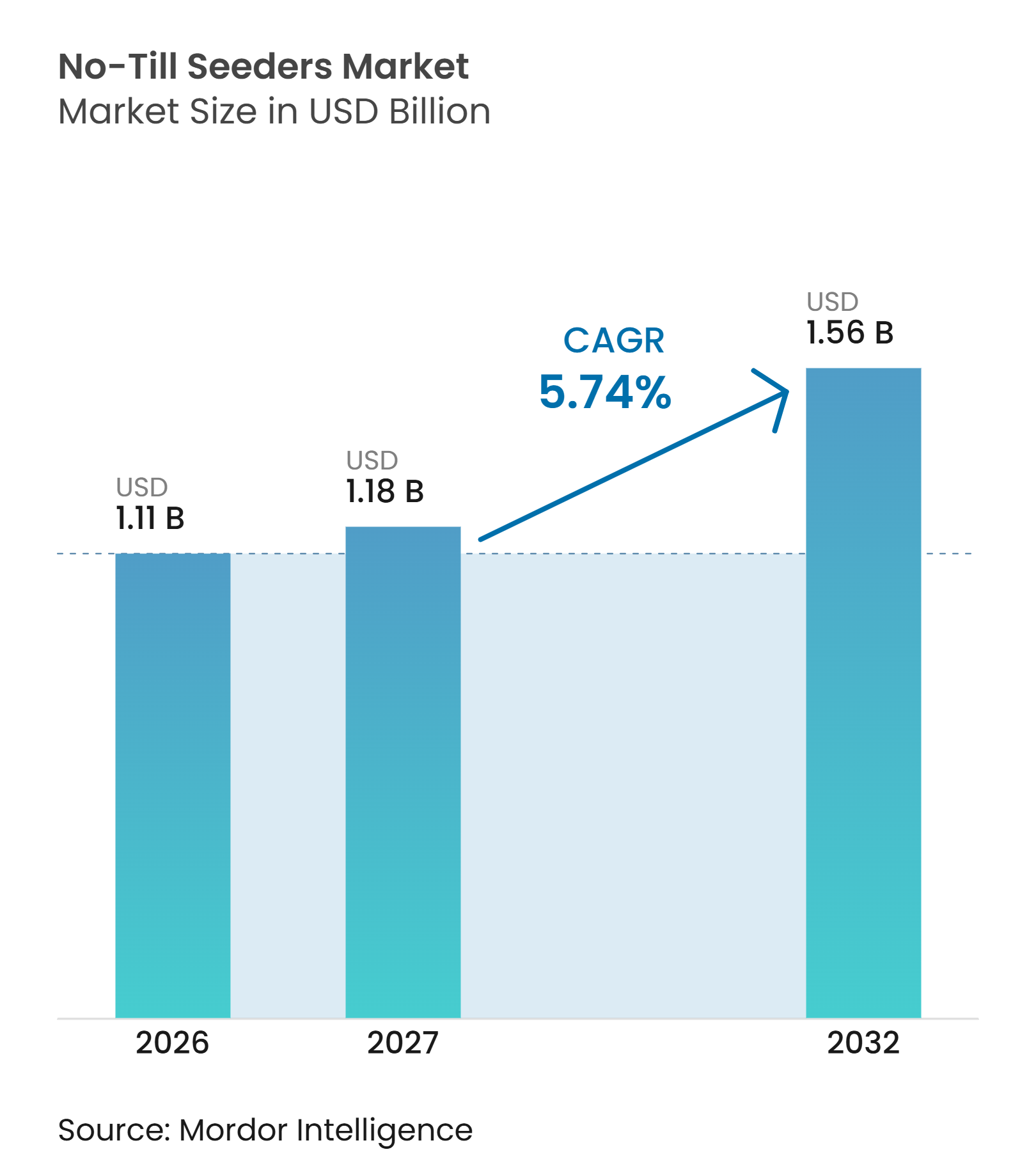
The no-till seeders market was valued at USD 1.11 billion in 2026 and is forecast to grow from USD 1.18 billion in 2027 to USD 1.56 billion by 2032, at a CAGR of 5.74% from 2027 to 2032. The no-till seeders market is supported by soil protection requirements, rising input costs, and shorter planting windows. Direct seeding reduces erosion, preserves soil moisture, and lowers energy and labor needs per hectare, influencing how growers assess equipment purchases. The market also benefits when farmers can combine residue handling, fertilizer placement, and seeding in fewer field passes, reducing overall operational costs and time spent in the field. Precision controls are becoming more important as they improve placement accuracy and allow manufacturers to offer upgrades rather than complete machine replacements, extending the useful life of existing equipment. High equipment costs and uneven service coverage remain key constraints for the market, particularly for smaller farms and developing agricultural regions where access to financing and technical support is limited.
Key Report Takeaways
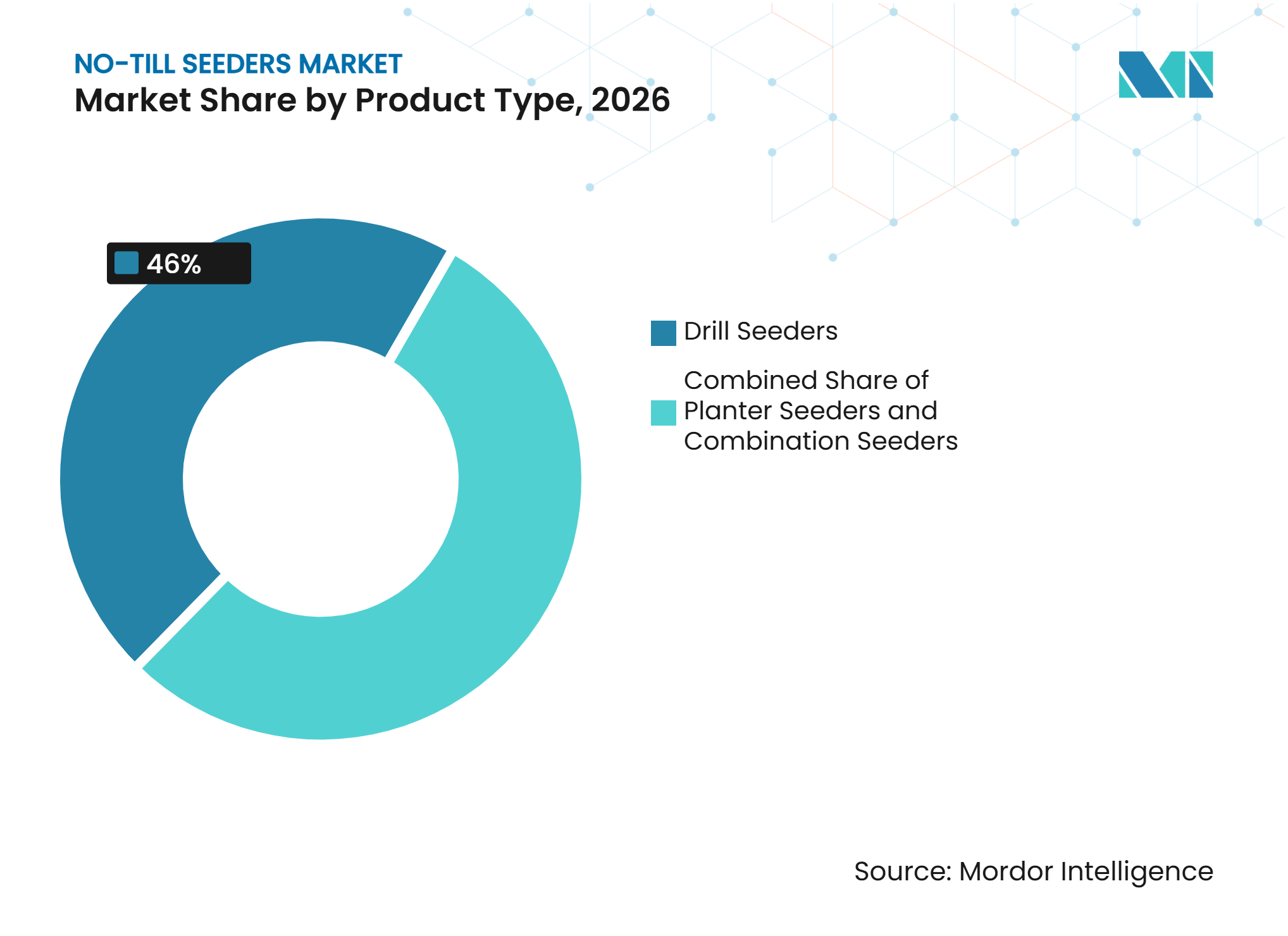
- By product, drill seeders were the largest segment and held 46.0% of the no-till seeders market share in 2026, while combination seeders are the fastest-growing segment and are forecast to expand at an 8.4% CAGR between 2027 and 2032.
- By opener design, single-disc openers were the largest segment and held 43.0% of the no-till seeders market size in 2026, while cross-slot and specialized openers are the fastest-growing segment and are forecast to expand at an 8.1% CAGR between 2027 and 2032.
- By seeding mechanism, pneumatic metering was the largest segment and held 58.0% of the market share in 2026, while vacuum precision metering is the fastest-growing segment and is forecast to expand at an 8.7% CAGR between 2027 and 2032.
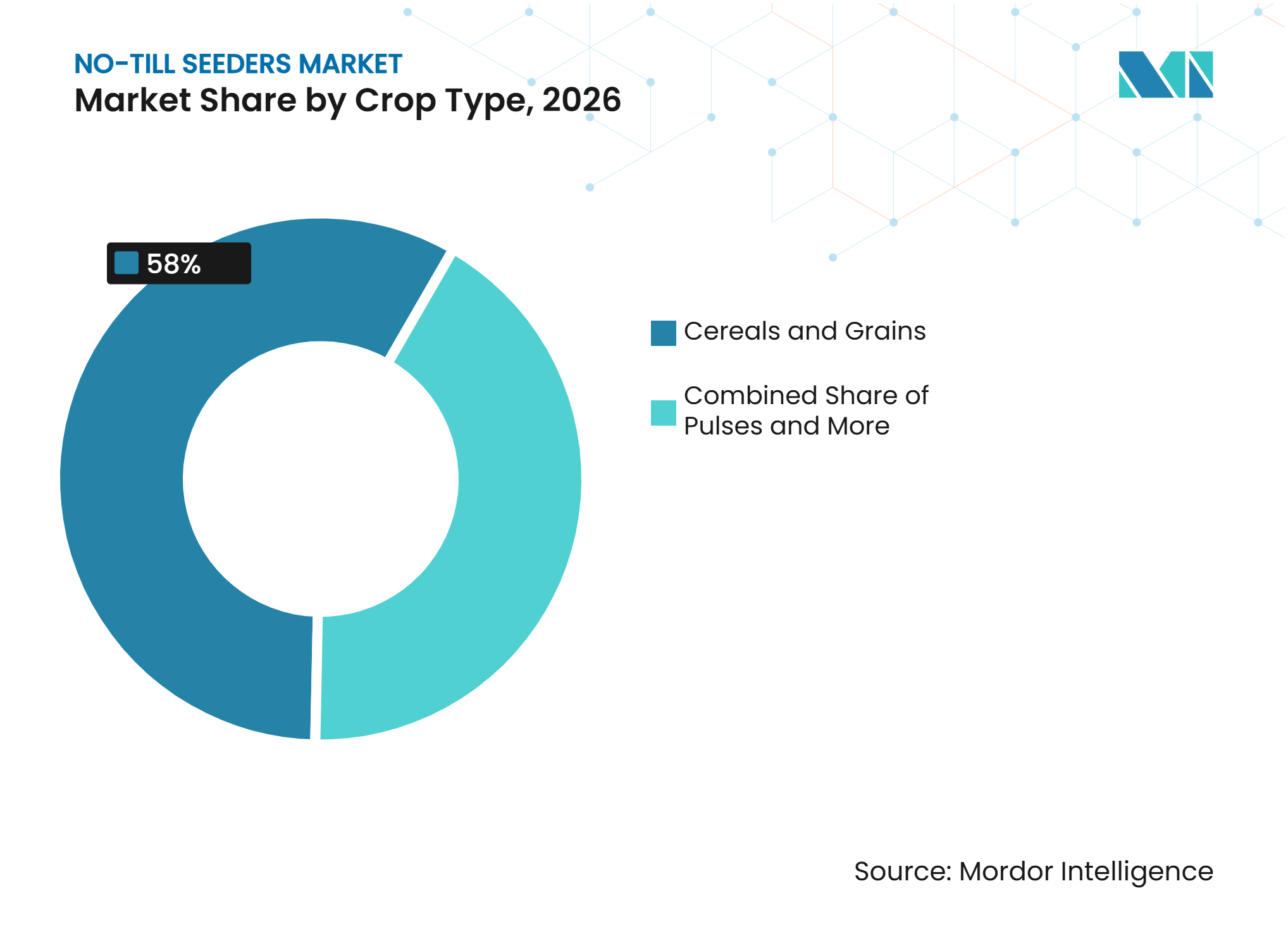
- By crop type, cereals and grains were the largest segment and held 58.0% of the market share in 2026, while cover crops and forage are the fastest-growing segment and are forecast to expand at an 8.6% CAGR between 2027 and 2032.
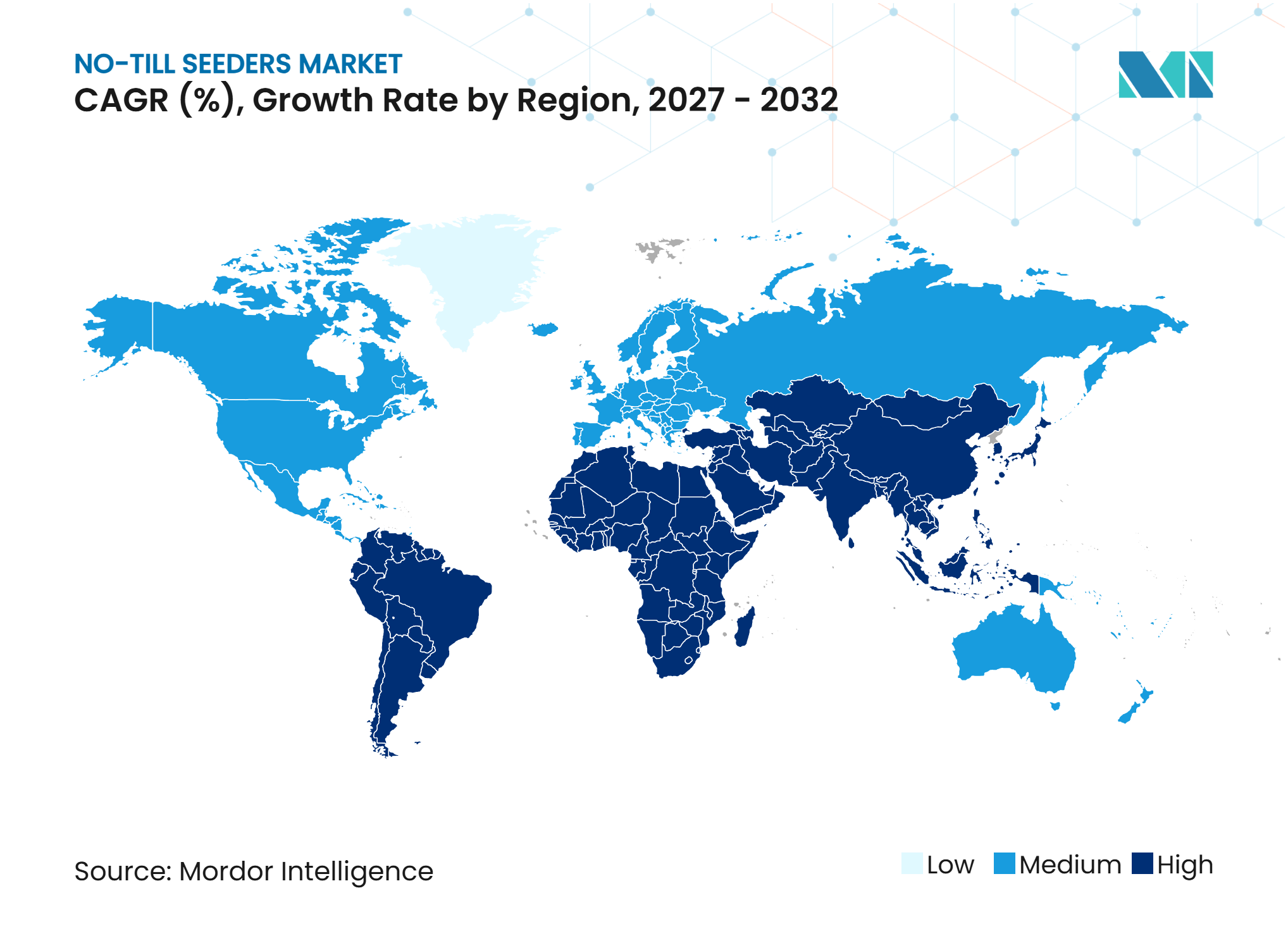
- By geography, North America was the largest region and held 29.0% of the market share in 2026, while Asia-Pacific is the fastest-growing region and is forecast to expand at a 7.2% CAGR between 2027 and 2032.
Note: Market numbers in this report are based on Mordor Intelligence's proprietary estimation framework, which combines nine months of actuals with Q4 projections for base year 2026.
Market Trends and Insights
Drivers Impact Analysis of No-Till Seeders Market*
| Driver | (~) % Impact on CAGR Forecast | Geographic Relevance | Impact Timeline |
|---|---|---|---|
| Soil Moisture Conservation and Erosion Control | +1.4% | Global | Long term (≥ 4 years) |
| Fuel, Labor, and Pass Reduction | +1.1% | Global, most pronounced in North America and South America | Medium term (2-4 years) |
| Conservation Incentives and Carbon-Smart Farming | +0.9% | North America and Europe | Medium term (2-4 years) |
| Precision Seeding and Digital Controls | +1.2% | North America, Europe, and early-stage gains in Asia-Pacific | Long term (≥ 4 years) |
| Residue-Load Adaptation for Double-Cropping Systems | +0.8% | Asia-Pacific, with spillover to South America | Long term (≥ 4 years) |
| Narrow Planting Windows and Climate Volatility | +0.7% | Global | Short term (≤ 2 years) |
| Source: Mordor Intelligence | |||
Soil Moisture Conservation and Erosion Control
The need to conserve soil moisture and reduce erosion is supporting the adoption of no-till farming, particularly in regions exposed to rainfall variability, dry periods, and intense precipitation. By placing seeds directly into untilled soil and retaining crop residues on the surface, no-till practices help limit soil disturbance, reduce runoff, and protect topsoil from erosion. According to a 2025 study published in Science of the Total Environment, which used the Agricultural Policy/Environmental eXtender model to assess the Bushy Creek Watershed in the Texas Blackland Prairies under projected climate scenarios, no-till management was projected to reduce annual soil evaporation by 46–52%, surface runoff by 27–33%, and soil erosion by 55–59% compared with baseline conventional tillage[1]. These findings highlight the potential of no-till practices to improve soil and water conservation under changing climatic conditions. Consequently, growers seeking to preserve soil moisture, limit erosion-related losses, and maintain rainfed crop production have an incentive to adopt no-till systems, supporting demand for compatible seeding equipment and related technologies.
Fuel, Labor, and Pass Reduction
The need to reduce fuel consumption, labor requirements, and field-operation time supports demand for the no-till seeders market. By placing seeds directly into untilled soil, no-till systems eliminate or reduce conventional tillage operations, lowering machinery use and the energy required for crop establishment. According to a 2025 field study published in Frontiers in Sustainable Food Systems, long-term zero-tillage practices in the Indo-Gangetic rice–wheat systems reduced total input energy by 14–21% compared with conventional establishment systems. The study recorded the lowest total input energy of 47,110 megajoules per hectare under a zero-till direct-seeded rice and residue-retaining wheat system, compared with 65,830 megajoules per hectare under conventional puddled-transplanted rice and conventionally tilled wheat. These findings demonstrate the potential for integrated zero-tillage practices to improve energy efficiency by reducing soil preparation and related field operations. Consequently, farmers and agricultural contractors seeking to lower fuel use, reduce labor demand, and complete sowing within shorter planting windows have an incentive to adopt no-till seeders, particularly in large-scale and mechanized farming operations.
Conservation Incentives and Carbon-Smart Farming
Government support for conservation practices and emerging carbon-farming frameworks can strengthen the business case for adopting no-till seeders by encouraging farming systems that reduce soil disturbance and improve soil management. In January 2025, the United States Department of Agriculture published technical guidelines for evaluating climate-smart agricultural practices associated with corn, soybean, and sorghum biofuel feedstocks, including no-till practices. In the European Union, the Carbon Removals and Carbon Farming Certification Regulation, adopted in 2024, established a voluntary framework for certifying carbon removals and carbon-farming activities under defined monitoring and verification requirements. These policy developments increase the relevance of documented conservation practices and verifiable field-management data for participating farmers. Where financial incentives, supply-chain programs, or carbon-farming payments are available, they can improve the economic case for investing in no-till seeders that support consistent residue management and reduced-tillage operations. However, the effect on equipment demand depends on the availability and eligibility criteria of specific incentive schemes, as neither framework guarantees direct payments for no-till seeder purchases.
Precision Seeding and Digital Controls
The integration of precision agriculture technologies is supporting demand for advanced no-till seeders by improving seed placement, application accuracy, and control over field operations. Global Navigation Satellite System (GNSS) guidance, automated calibration, and International Organization for Standardization (ISO) Bus (ISOBUS) connectivity help operators manage machine settings, reduce overlaps, and maintain consistent seeding performance across variable field conditions. In 2025, CNH Industrial N.V. announced plans to nearly double Precision Technology sales as a share of Agriculture net sales by 2030 and develop 90% of its precision technology systems in-house, reflecting growing investment in integrated agricultural technology[2]. In February 2025, John Deere introduced new planter upgrade options featuring ExactEmerge and MaxEmerge 5e electric-drive technologies. The company reports that ExactEmerge supports planting speeds of up to 10 miles per hour, while MaxEmerge 5e's turn compensation can improve seed population accuracy by up to 20%. Such developments support demand for technologically advanced seeding systems that combine accurate seed placement, operational efficiency, and compatibility with digital farm-management platforms.
Restraints Impact Analysis of No-Till Seeders Market*
| Restraint | (~) % Impact on CAGR Forecast | Geographic Relevance | Impact Timeline |
|---|---|---|---|
| High Upfront Capital and Financing Barriers | -1% | Global, most acute in India, China, South Africa, and parts of South America | Medium term (2-4 years) |
| Operator Training and Service Infrastructure Gaps | -0.8% | Asia-Pacific, Middle East and Africa, and emerging South American markets | Long term (≥ 4 years) |
| Residue Plugging and Seed-to-Soil Contact Variability | -0.7% | Asia-Pacific and South America | Long term (≥ 4 years) |
| Excess Moisture and Cool-Soil Penalties in Humid Regions | -0.5% | Northern Europe, parts of Canada, Japan, and South Korea | Medium term (2-4 years) |
| Source: Mordor Intelligence | |||
High Upfront Capital and Financing Barriers
High equipment costs and limited access to affordable financing can restrain adoption in the no-till seeders market, particularly among small and medium-sized farms in developing economies. A complete no-till seeding system may require a heavy-duty opener bar, an air cart, residue-management components, and precision-control electronics, while larger machines can also require high-horsepower tractors. In July 2025, KUHN specified a minimum tractor requirement of 200 horsepower for its MEGANT 802 R seed drill, illustrating the power and machinery investment that can accompany high-capacity seeding equipment. The financial barrier is particularly relevant in India, where a 2025 study published in Discover Internet of Things noted that more than 85% of farmers operate small or marginal holdings and may have limited capacity to invest in expensive machinery[3]. Custom-hiring services can reduce the need for individual ownership, but access depends on the availability, affordability, and geographic reach of suitable equipment. Consequently, high initial investment, tractor requirements, and financing constraints can delay purchases or limit adoption to larger farms and well-established service providers.
Operator Training and Service Infrastructure Gaps
Limited operator training and inadequate after-sales support can constrain the adoption and effective use of no-till seeders, particularly in emerging agricultural markets. Equipment performance depends on selecting suitable openers, setting seeding depth, managing crop residues, and calibrating seed and fertilizer delivery according to local soil and crop conditions. According to the International Center for Agricultural Research in the Dry Areas (ICARDA), a 2025 assessment of no-till seeder adoption in Morocco identified limited dealer networks, spare-parts availability, calibration support, and contractor services as barriers to expanding conservation agriculture. The assessment also highlighted the need for locally appropriate machinery and reliable technical support for smallholder farmers. Without trained operators and accessible maintenance services, incorrect settings or equipment downtime can reduce seeding consistency and undermine the economics of custom-hiring operations. Consequently, gaps in technical training, dealer coverage, and repair infrastructure can slow the adoption of no-till seeders, especially in regions where farmers depend on shared machinery or external service providers.
*Our forecasts treat driver/restraint impacts as directional, not additive. The impact forecasts reflect baseline growth, mix effects, and variable interactions.
No-Till Seeders Market Segment Analysis
By Product Type:
Drill Seeders Lead While Combination Seeders Gain GroundDrill seeders accounted for 46.0% of the no-till seeders market share in 2026, making them the largest product segment. Their leading position is supported by widespread use in broad-acre cereal and oilseed production, where consistent seed placement and efficient coverage of large fields are essential. High-capacity drill and air-seeder systems enable farmers to establish crops across extensive acreage while operating with minimal soil disturbance. Compatibility with large air carts, established dealer networks, and operator familiarity further support adoption among commercial grain farms in North America, Europe, and Australia. These advantages sustain demand for drill seeders among growers seeking reliable performance across large-scale no-till operations.
Combination seeders are forecast to be the fastest-growing product segment, expanding at an 8.4% CAGR between 2027 and 2032. These machines integrate seeding with operations such as fertilizer placement and residue management, helping farmers reduce field passes, labor requirements, and operating time. A 2025 review published in Sustainability examined integrated planting systems that clear crop residues, open furrows, and sow seeds in a single pass, highlighting their relevance to residue-intensive and double-cropping systems in Asia. Planter seeders also remain important for crops such as corn, soybeans, and sunflower, which require precise seed spacing and population control. As growers seek to improve operational efficiency and manage crop residues under varied field conditions, combination seeders are positioned to gain adoption through their ability to consolidate multiple establishment tasks.



By Opener Design:
Single-Disc Openers Lead While Specialized Designs Gain GroundSingle-disc openers accounted for 43.0% of the no-till seeders market share in 2026, making them the largest segment by opener design. Their adoption is supported by their ability to cut through crop residue and create a narrow seed furrow while minimizing soil disturbance. These characteristics suit broad-acre farming systems in North America and Australia, where growers seek efficient seeding across large fields with varying residue levels. Double-disc openers remain relevant for corn and soybean production because they can create consistent furrows and support accurate seed placement, while tine and hoe openers are used in conditions where soil penetration and residue handling influence equipment selection. The continued use of single-disc systems reflects their suitability for conservation-oriented crop establishment and established adoption among commercial grain producers.
Cross-slot and specialized openers are forecast to be the fastest-growing segment, with an 8.1% CAGR between 2027 and 2032. These designs can support precise seed placement and separate seed and fertilizer delivery within a single pass, depending on the system configuration. Such capabilities are relevant to residue-intensive fields and double-cropping systems, where farmers seek to improve nutrient placement without increasing the number of field operations. A 2025 review published in Results in Engineering examining pneumatic seed-metering devices found that 86% of the reviewed engineering studies focused on air-vacuum systems, reflecting continued research interest in precise seed metering. Specialized opener systems may therefore gain adoption among growers seeking precise establishment under challenging residue and soil conditions.
By Seeding Mechanism:
Pneumatic Metering Leads While Vacuum Precision Metering Gains Groundneumatic metering accounted for 58.0% of the no-till seeders market share in 2026, making it the largest segment by seeding mechanism. Its leading position reflects its suitability for high-capacity seeding systems that distribute seeds through airflow from centralized metering units to multiple openers across wide toolbars. Compatibility with large air carts and the ability to handle different seed types and seeding rates support its use in broad-acre grain production across North America, Australia, and South America. Pneumatic systems also enable bulk seed distribution across extensive fields, making them suitable for large commercial farms prioritizing operational capacity. Mechanical metering remains relevant where simpler machine configurations, straightforward calibration, and lower equipment costs are important considerations.
Vacuum precision metering is forecast to be the fastest-growing segment, expanding at an 8.7% CAGR between 2027 and 2032. These systems use controlled airflow to singulate seeds, supporting more consistent spacing and population control in crops such as corn, soybeans, and selected oilseeds. A 2025 review published in Results in Engineering examined pneumatic seed-metering technologies and highlighted the role of air-vacuum systems in improving metering accuracy and accommodating different seed characteristics. Precision metering can be particularly valuable for growers seeking uniform crop establishment while maintaining high operating speeds. As farms place greater emphasis on accurate seed placement and efficient use of seed inputs, vacuum-based systems are positioned to gain adoption in compatible precision-seeding applications.
By Crop Type:
Cereals and Grains Lead While Cover Crops and Forage Grow FastestCereals and grains accounted for 58.0% of the no-till seeders market share in 2026, making them the largest crop-type segment. Demand is supported by extensive wheat, rice, and maize cultivation across major production regions, including the North American Great Plains, the Indo-Gangetic Plain, and Brazil's Cerrado. The large acreage associated with these crops makes field capacity, reliable seed placement, and timely crop establishment important considerations when selecting no-till equipment. Oilseeds, particularly soybeans and canola, also contribute substantially to demand because direct seeding is widely used in conservation-oriented production systems across North and South America. Pulses represent another application, with growers in Canada, India, and Australia using reduced-tillage establishment practices to support soil conservation and operational efficiency. The scale of cereal and grain production continues to underpin demand for high-capacity no-till seeders.
Cover crops and forage are forecast to be the fastest-growing crop-type segment, with an 8.6% CAGR between 2027 and 2032. Interest in these crops is supported by soil-health objectives, erosion control, and the use of cover crops between commercial cropping cycles. In the United States, the Natural Resources Conservation Service promotes conservation practices through programs such as the Environmental Quality Incentives Program, which can provide financial and technical assistance for eligible cover-crop and soil-management practices. Establishing cover crops and forage in different residue and moisture conditions also increases the need for adaptable seeders capable of operating across varied planting windows. These applications broaden the role of no-till equipment beyond the establishment of major grain and oilseed crops.

Geography Analysis
North America was the largest regional market for the no-till seeders market and held 29.0% of the market share in 2026. Demand is supported by extensive cereal and oilseed cultivation, established conservation-agriculture practices, and investment in high-capacity seeding equipment. Large commercial farms prioritize machines that provide broad field coverage, accurate seed placement, and compatibility with precision technologies such as guidance systems and section control. Upgrades to existing planter and drill fleets also allow growers to improve operational accuracy without replacing all their equipment. Established dealer networks and machinery-service infrastructure further support adoption across major grain-producing areas in the United States and Canada.
Asia-Pacific is forecast to be the fastest-growing regional market, expanding at a 7.2% CAGR between 2027 and 2032. Demand is supported by conservation-agriculture initiatives and residue-management requirements in intensive rice–wheat cropping systems across India and other parts of the region. A 2025 study published in Frontiers in Sustainable Food Systems, based on a 15-year field experiment in the western Indo-Gangetic Plains, found that long-term conservation-agriculture practices improved energy-use efficiency by 32–38% compared with conventional systems. The study also found that zero-tillage practices combined with residue retention reduced energy inputs and greenhouse gas emissions. These findings demonstrate the potential benefits of conservation-oriented crop establishment in intensive farming systems. In India, Happy Seeder and Super Seeder technologies enable wheat planting into rice residues, supporting efforts to reduce residue burning and shorten the interval between crops. Adoption across the region will depend on suitable machinery, operator training, and access to equipment through ownership or custom-hiring services.
Europe's market is supported by interest in soil conservation, reduced tillage, and precision agriculture, particularly in major agricultural economies such as Germany, France, and the United Kingdom. In South America, Brazil and Argentina are important markets for direct-seeding systems, supported by large-scale grain production and established no-till practices. A 2025 chapter published in Advances in Agronomy documented the development of Brazil's no-tillage system over more than five decades, highlighting the role of farmers, agricultural businesses, and research institutions in its expansion. In Africa and Western Asia, demand potential is associated with soil-moisture conservation, erosion management, and efforts to improve crop establishment under variable rainfall conditions. However, adoption in these regions can be constrained by limited mechanization, financing, equipment availability, and access to trained operators and maintenance services.
Competitive Landscape
Market Concentration
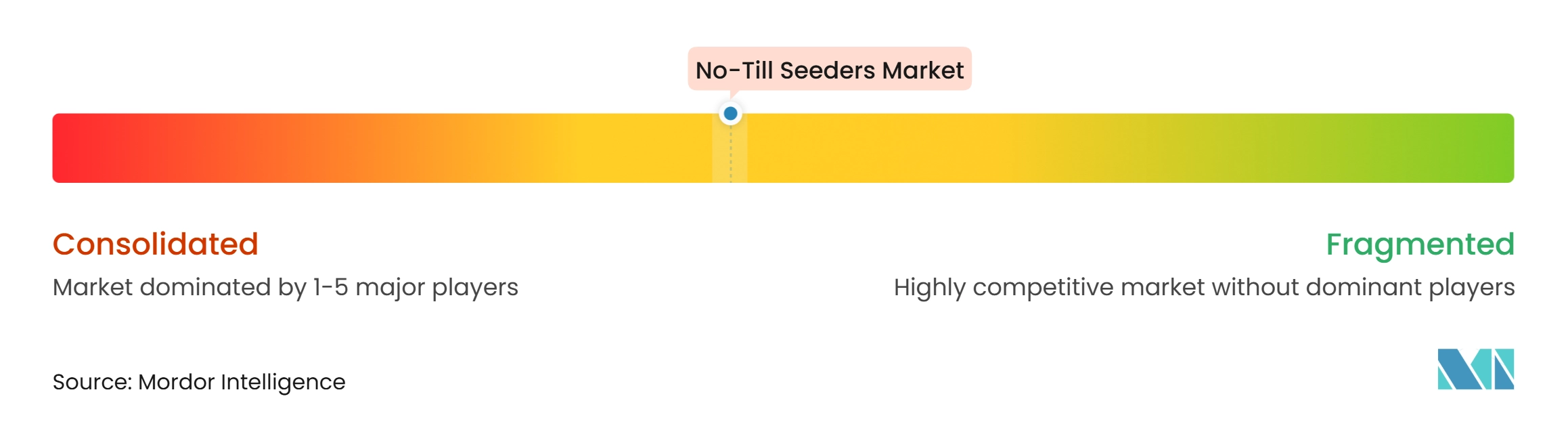
The no-till seeders market was moderately consolidated in 2026, with Deere & Company, CNH Industrial N.V., Great Plains Manufacturing, Inc. (Kubota Corporation), Bourgault Industries Ltd. (Linamar Corporation), and Väderstad AB identified as the five leading players. Their competitive positions are supported by broad seeding-equipment portfolios, established dealer networks, and experience serving large-scale grain and oilseed farms. Deere competes through its precision-enabled planting equipment and retrofit options, while CNH Industrial serves farmers through its Case IH and New Holland brands. Bourgault and Väderstad focus on specialized seeding systems, including high-capacity air seeders and equipment designed for residue management and reduced-tillage operations. Great Plains Manufacturing adds a range of drills and conservation-oriented seeding equipment. This structure allows leading manufacturers to compete through equipment performance, precision technology, dealer support, and configurations tailored to different farm sizes and cropping systems.
Product development and strategic partnerships are increasingly shaping competitive differentiation. In August 2026, Bourgault Industries announced a strategic alliance with CNH, under which Bourgault will supply co-branded seeding solutions through the Case IH and New Holland networks, expanding the reach of its seeding technology. In January 2026, Bourgault introduced updates to its Bourgault Intelligent Control system and launched the PLDX ParaLink Dual Xtreme opener and CDi50 air seeder, targeting improved depth control, operational flexibility, and seeding productivity. In May 2025, CNH Industrial outlined plans to nearly double Precision Technology sales as a proportion of Agriculture net sales and develop 90% of its precision technology systems in-house by 2030. Deere also introduced new planter upgrade options in February 2025, allowing farmers to add electric-drive planting technology to compatible existing equipment. These developments illustrate how manufacturers are combining product innovation, digital integration, retrofit solutions, and broader distribution networks to improve customer value and strengthen their market positions.
Long-term competitive positioning depends on delivering reliable seeding performance across different soil conditions, residue levels, crop types, and operating scales. Established manufacturers benefit from dealer coverage, spare-parts availability, and the ability to integrate guidance, metering, and machine-control technologies into their equipment. Regional specialists, including SeedMaster Manufacturing Ltd., Morris Equipment Ltd., Semeato S/A, and BEDNAR FMT s.r.o., compete through specialized product configurations and localized customer support. Opportunities remain for manufacturers offering modular equipment, adaptable opener systems, and cost-effective solutions for smaller farms and custom-hiring operators. At the same time, limited service coverage, high equipment costs, and inadequate technical support can weaken adoption in emerging markets. Consequently, competitive success in the no-till seeders market depends on combining durable equipment, agronomic suitability, precision capabilities, accessible maintenance, and effective dealer support rather than relying solely on machine capacity or product breadth.
No-Till Seeders Industry Leaders
-
Deere & Company
-
CNH Industrial N.V.
-
Great Plains Manufacturing, Inc. (Kubota Corporation)
-
Bourgault Industries Ltd. (Linamar Corporation)
-
Väderstad AB
- *Disclaimer: Major Players sorted in no particular order
No-Till Seeders Market Companies Covered in this Report
- Deere & Company
- CNH Industrial N.V.
- Great Plains Manufacturing, Inc. (Kubota Corporation)
- Väderstad AB
- Bourgault Industries Ltd. (Linamar Corporation)
- HORSCH Maschinen GmbH
- KUHN S.A. (Bucher Industries AG)
- SeedMaster Manufacturing Ltd.
- Morris Equipment Ltd. (Superior Farms Equipment Ltd.)
- Semeato S/A Indústria e Comércio
- BEDNAR FMT s.r.o.
- Landoll Company, LLC
- AMAZONEN-WERKE H. Dreyer SE & Co. KG
- LEMKEN GmbH & Co. KG
- Kverneland AS (Kubota Corporation)
Recent Industry Developments in No-Till Seeders Market
- August 2026: Bourgault Industries Ltd., a Linamar Corporation company, announced a strategic commercial alliance with CNH Industrial N.V. Under the agreement, Bourgault will supply co-branded seeding equipment through Case IH and New Holland dealer networks, extending access to its seeding technology across North America, Australia, and other international markets.
- June 2026: SeedMaster Manufacturing Ltd. opened a major expansion of its manufacturing facility in Emerald Park, Saskatchewan, Canada. The expansion included a new automated paint line using infrared technology and a metal-processing system combining laser and plasma cutting. The investment strengthens the manufacturing capabilities of the precision-seeding equipment producer.
- January 2026: Bourgault Industries Ltd. introduced the PLDX (ParaLink Dual Xtreme) opener, a patented dual-knife opener designed to improve seed-depth consistency across uneven terrain, including ruts, washouts, and rolling fields. The design incorporates a 1:1 depth-control ratio and adjustable knife spacing to support precise seed and fertilizer placement.
- January 2026: Bourgault Industries Ltd. launched the CDi50, a 50-foot air seeder designed for large-acre farming operations. The machine features two onboard tanks with a combined capacity of 450 bushels, configurable opener options, and multiple row-spacing choices.
Global No-Till Seeders Market Report Scope
The no-till seeders market includes equipment designed to sow seeds directly into untilled soil with minimal soil disturbance, including no-till drills, air seeders, and associated seed-metering and opener systems. It excludes conventional seed drills and tillage equipment not designed for direct seeding.
The No-Till Seeders Market Report is Segmented by Product Type (Drill Seeders, Planter Seeders, and Combination Seeders), by Opener Design (Single-Disc Openers, Double-Disc Openers, Tine and Hoe Openers, and Cross-Slot and Specialized Openers), by Seeding Mechanism (Mechanical Metering, Pneumatic Metering, and Vacuum Precision Metering), by Crop Type (Cereals and Grains, Oilseeds, Pulses, and Cover Crops and Forage), and by Geography (North America, South America, Africa, Asia-Pacific, and More). The Market Forecasts are Provided in Terms of Value (USD).
Segmentation Overview
| Drill Seeders |
| Planter Seeders |
| Combination Seeders |
| Single-Disc Openers |
| Double-Disc Openers |
| Tine and Hoe Openers |
| Cross-Slot and Specialized Openers |
| Mechanical Metering |
| Pneumatic Metering |
| Vacuum Precision Metering |
| Cereals and Grains |
| Oilseeds |
| Pulses |
| Cover Crops and Forage |
| North America | United States |
| Canada | |
| Mexico | |
| Rest of North America | |
| South America | Argentina |
| Brazil | |
| Chile | |
| Rest of South America | |
| Europe | Germany |
| United Kingdom | |
| France | |
| Spain | |
| Italy | |
| Russia | |
| Rest of Europe | |
| Asia-Pacific | China |
| Japan | |
| India | |
| Australia | |
| Singapore | |
| South Korea | |
| Rest of Asia-Pacific | |
| Middle East | Saudi Arabia |
| United Arab Emirates | |
| Turkey | |
| Rest of Middle East | |
| Africa | South Africa |
| Kenya | |
| Nigeria | |
| Rest of Africa |
| By Product Type | Drill Seeders | |
| Planter Seeders | ||
| Combination Seeders | ||
| By Opener Design | Single-Disc Openers | |
| Double-Disc Openers | ||
| Tine and Hoe Openers | ||
| Cross-Slot and Specialized Openers | ||
| By Seeding Mechanism | Mechanical Metering | |
| Pneumatic Metering | ||
| Vacuum Precision Metering | ||
| By Crop Type | Cereals and Grains | |
| Oilseeds | ||
| Pulses | ||
| Cover Crops and Forage | ||
| By Geography | North America | United States |
| Canada | ||
| Mexico | ||
| Rest of North America | ||
| South America | Argentina | |
| Brazil | ||
| Chile | ||
| Rest of South America | ||
| Europe | Germany | |
| United Kingdom | ||
| France | ||
| Spain | ||
| Italy | ||
| Russia | ||
| Rest of Europe | ||
| Asia-Pacific | China | |
| Japan | ||
| India | ||
| Australia | ||
| Singapore | ||
| South Korea | ||
| Rest of Asia-Pacific | ||
| Middle East | Saudi Arabia | |
| United Arab Emirates | ||
| Turkey | ||
| Rest of Middle East | ||
| Africa | South Africa | |
| Kenya | ||
| Nigeria | ||
| Rest of Africa | ||
Key Questions Answered in the Report
What is the size of the no-till seeders market?
The no-till seeders market was valued at USD 1.11 billion in 2026 and is forecast to grow from USD 1.18 billion in 2027 to USD 1.56 billion by 2032, at a CAGR of 5.74% from 2027 to 2032.
What limits wider equipment adoption?
High initial capital needs, limited credit access, operator training requirements, and uneven service networks remain key constraints.
Which product category leads no-till seeder demand?
Drill seeders held a 46.0% share in 2026, supported by use in cereal and oilseed broad-acre production.
What is driving adoption of no-till seeders?
Soil-moisture conservation, erosion control, fewer field passes, and shorter planting windows support adoption.