
Neurosurgical Drills Market Size and Share
Market Overview
| Study Period | 2020 - 2031 |
|---|---|
| Market Size (2026) | USD 682.53 Million |
| Market Size (2031) | USD 827.21 Million |
| Growth Rate (2026 - 2031) | 3.92 % |
| Fastest Growing Market | Asia-Pacific |
| Largest Market | North America |
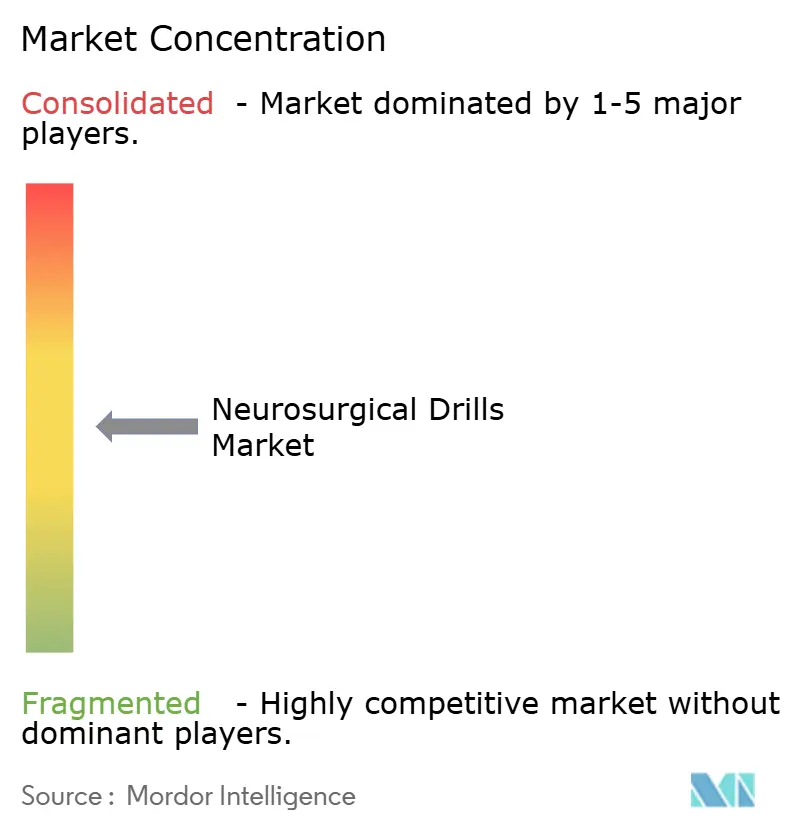
| Market Concentration | Medium |
Major Players *Disclaimer: Major Players sorted in no particular order Image © Mordor Intelligence. Reuse requires attribution under CC BY 4.0. | |
Neurosurgical Drills Market Analysis by Mordor Intelligence
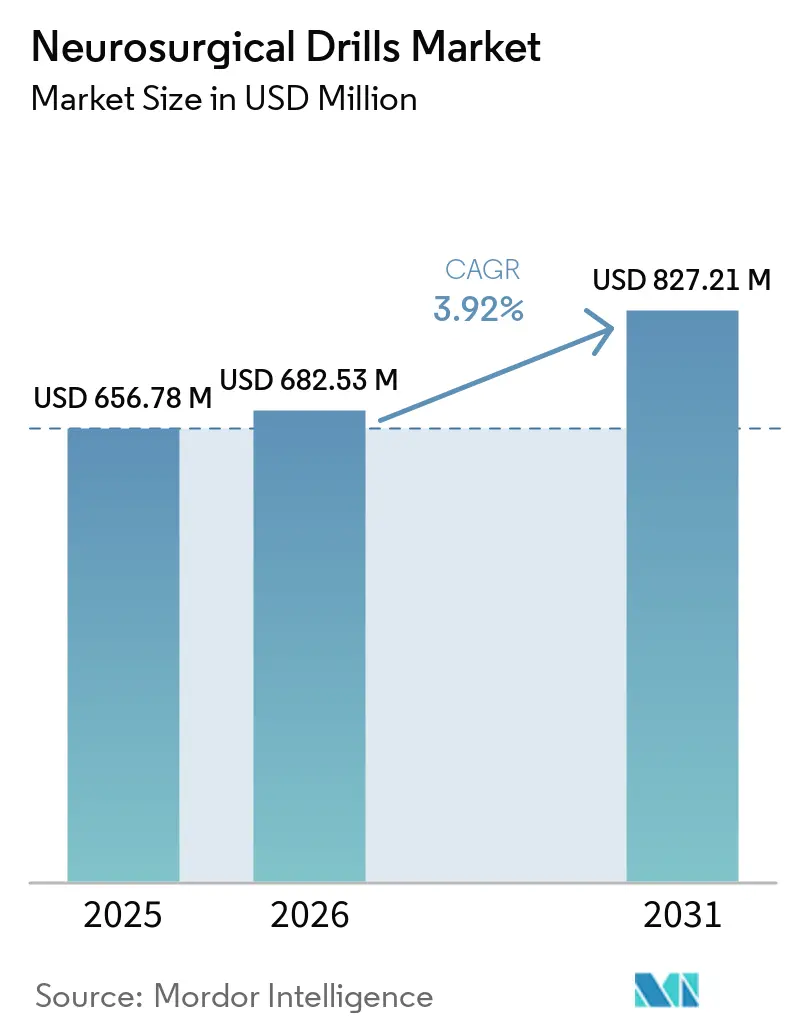
The Neurosurgical Drills Market size was valued at USD 656.78 million in 2025 and is estimated to grow from USD 682.53 million in 2026 to reach USD 827.21 million by 2031, at a CAGR of 3.92% during the forecast period (2026-2031).
The neurosurgical drills market is transitioning from stand-alone consoles to connected platforms that integrate high-speed motors, navigation-ready attachments, and single-use accessories. Neurological conditions affect more than 3 billion people and cause more than 11 million deaths annually, supporting sustained demand for equipment used in cranial and spinal care. Demand is shifting toward compact systems for ambulatory settings and integration with imaging and robotic guidance. Manufacturers are combining capital equipment with disposable burrs, perforators, and irrigation products to generate recurring revenue. Regulatory documentation, clinical safety, and service support remain key purchasing considerations in the neurosurgical drills market.
Key Report Takeaways
- By product type, high-speed drills and burr systems held 39.12% in 2025, while reamers and drivers are projected to grow at a 5.78% CAGR through 2031.
- By power source, electric corded systems held 43.56% in 2025, while battery-powered systems are projected to grow at a 6.25% CAGR through 2031.
- By application, cranial surgery held 47.88% in 2025, while spinal surgery is projected to grow at a 5.94% CAGR through 2031.
- By end user, hospitals held 47.34% in 2025, while ambulatory surgical centers are projected to grow at an 8.12% CAGR through 2031.
- By geography, North America held 42.80% in 2025, while Asia-Pacific projected to grow at a 7.66% CAGR through 2031.
Note: Market size and forecast figures in this report are generated using Mordor Intelligence’s proprietary estimation framework, updated with the latest available data and insights as of January 2026.
Global Neurosurgical Drills Market Trends and Insights
Drivers Impact Analysis*
| DRIVER | (~) % IMPACT ON CAGR FORECAST | GEOGRAPHIC RELEVANCE | IMPACT TIMELINE |
|---|---|---|---|
| Rising adoption of minimally invasive cranial and spine procedures | +1.0% | North America and Europe lead, while Asia-Pacific adoption is accelerating after 2025 | Medium term (2-4 years) |
| Integration of navigation, imaging, and robotic workflows | +0.8% | North America, Japan, South Korea, and China | Long term (≥ 4 years) |
| Expansion of cordless and battery-powered neurosurgical drills | +0.6% | Global, with the strongest penetration in North America and Germany | Short term (≤ 2 years) |
| Growth of bedside cranial access and neurocritical-care procedures | +0.4% | North America and Western Europe, with early gains in GCC hospital expansions | Short term (≤ 2 years) |
| Demand for lower-heat, lower-vibration, and high-torque drilling | +0.5% | Global, particularly Japan, Germany, and the U.S. academic medical centers | Medium term (2-4 years) |
| Growth of single-use and semi-disposable cutting accessories | +0.3% | North America, Australia, and expanding European markets | Short term (≤ 2 years) |
| Source: Mordor Intelligence | |||
Rising Adoption of Minimally Invasive Cranial and Spine Procedures
Minimally invasive procedures are reshaping equipment requirements in the neurosurgical drills market. Endoscopic skull-base surgery, tubular spinal decompression, and percutaneous pedicle fixation require compact instruments that operate through 15–20 mm working channels. As a result, drill size, control, and surgical access have become key product development priorities. A 2025 clinical study found that robotic-guided minimally invasive spine surgery can standardize pedicle screw accuracy and reduce radiation exposure. These capabilities support the demand for drills compatible with robotic systems.[1] CMS proposed adding 547 procedures, including neurosurgical indications, to the ASC Covered Procedures List, supporting investment in compact cordless systems for outpatient care.
Integration of Navigation, Imaging, and Robotic Workflows
Navigation and imaging are becoming increasingly integrated with cranial drilling workflows. In April 2026, Medtronic announced successful clinical cases using its Stealth AXiS Surgical System, which combines AI-enabled navigation with robotic guidance. In May 2026, ClearPoint Neuro reported that its Velocity Alpha MR High-Speed Surgical Drill System received CE marking after FDA 510(k) clearance in March 2026. The system operates at up to 80,000 rpm in magnetic environments of 3.0 Tesla or less. This capability enables drilling under real-time MR imaging without interrupting the imaging sequence. Such products highlight the growing importance of integration in the neurosurgical drills market.
Expansion of Cordless and Battery-Powered Neurosurgical Drills
Battery-powered equipment is gaining traction as surgical care expands beyond traditional operating rooms. Hubly Surgical commercially launched its Auto-Stop Drill in 2024 and received FDA 510(k) clearance in November 2025 for spinal decompression procedures, including laminectomy and laminotomy. The single-use device does not require a console, air line, or reprocessing cycle. These features can reduce setup requirements in intensive care and emergency settings. In March 2026, Premier designated the platform as a Breakthrough Technology for Neurosurgical Products, providing member hospitals with pre-negotiated access terms. This commercial arrangement can reduce institutional barriers to adoption.
Growth of Single-Use and Semi-Disposable Cutting Accessories
Single-use accessories are changing the revenue structure of the neurosurgical drills market. Burrs, perforators, and irrigation sleeves can eliminate autoclave cycles, reprocessing labor, and sterilization documentation. A 2025 preclinical study compared a tissue-selective Safety Burr with standard diamond and fluted burrs in cranial burr-hole procedures. Conventional burrs caused dural penetration injuries in 33% of cases, while the Safety Burr caused no dural injuries in the study. These findings support interest in cutting geometries designed to reduce tissue injury.[2] Disposable drill-bit cartridges and irrigation sleeves can generate recurring revenue independent of console replacement cycles. Manufacturers need sustainable consumable attachment strategies to protect recurring revenue streams. Otherwise, specialized accessory suppliers may serve installed platforms with lower-cost alternatives.
Restraints Impact Analysis*
| RESTRAINT | (~) % IMPACT ON CAGR FORECAST | GEOGRAPHIC RELEVANCE | IMPACT TIMELINE |
|---|---|---|---|
| High capital, maintenance, and sterile-processing costs | -0.8% | Global, with a stronger effect in cost-sensitive Asia-Pacific provincial hospitals and public systems in the Middle East, Africa, and South America | Long term (≥ 4 years) |
| Thermal injury, dural breach, and drill-skiving risks | -0.4% | Global, with greater concern in skull-base and pediatric cases | Medium term (2-4 years) |
| Shortage of trained neurosurgeons and specialized operating room staff | -0.6% | Most severe in Africa, Southeast Asia, and rural low- and middle-income countries | Long term (≥ 4 years) |
| Aerosolization, noise, and occupational exposure during high-speed drilling | -0.3% | Global, with the strictest occupational-health requirements in Europe and North America | Medium term (2-4 years) |
| Source: Mordor Intelligence | |||
High Capital, Maintenance, and Sterile-Processing Costs
Premium drill consoles can be difficult to purchase in public health systems operating under fixed procurement budgets. Navigation-ready systems also require investment in supporting equipment, training, maintenance, and service contracts. Germany recorded 222,158 inpatient neurosurgical procedures in 2023, while tender rules can extend procurement timelines for complex equipment. Framework agreements can also retain existing suppliers for 4–6 years. In China, India, and Brazil, hospitals must assess sterilization infrastructure and service expenses in addition to equipment prices. These costs limit adoption in segments of the neurosurgical drills market with constrained capital budgets.
Thermal Injury, Dural Breach, and Drill-Skiving Risks
Thermal injury and dural breach remain significant safety concerns in high-speed drilling. The 2025 preclinical Safety Burr study found dural penetration in 33% of procedures using conventional diamond and fluted burrs. This finding can increase demand for clearer risk documentation in new FDA and CE submissions. The 2026 systematic review of laser-assisted cranial osteotomy also identified vibration, acoustic noise, and thermal stress as limitations of conventional drilling. These issues are particularly relevant when bone-to-dura margins are narrow. Product design and clinical protocols must address these risks directly.[3]
*Our forecasts treat driver/restraint impacts as directional, not additive. The impact forecasts reflect baseline growth, mix effects, and variable interactions.
Segment Analysis
By Product Type: Burr Systems Lead, While Reamers Support Spinal Procedures
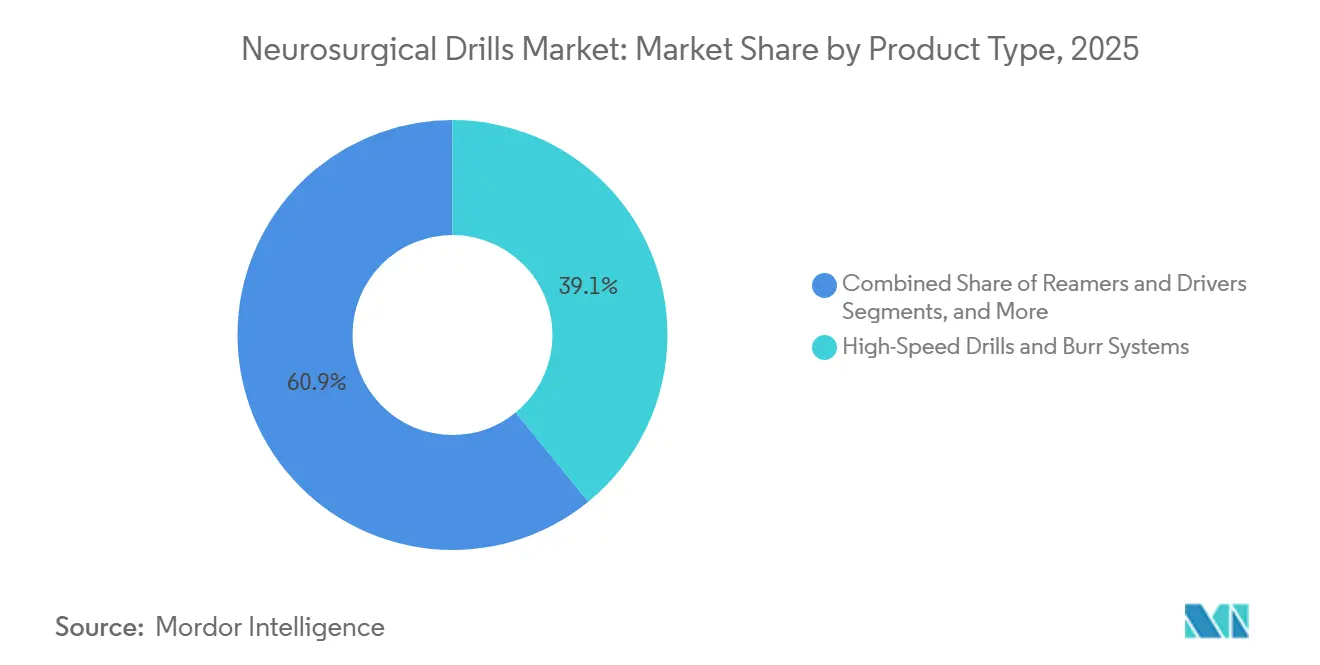
High-speed drills and burr systems are projected to hold a 39.12% share of the neurosurgical drills market in 2025. Their leading position reflects use in craniotomy, skull-base surgery, and spinal laminectomy. Drill bits, burrs, and cutting accessories generate recurring sales, while single-use versions gain attention as hospitals assess sterilization costs.
Reamers and drivers are projected to grow at a 5.78% CAGR through 2031, supported by demand for pedicle preparation and spinal fusion procedures. Anterior cervical discectomy and fusion and posterior lumbar interbody fusion require precise work on disc spaces and endplates. Microdebriders, shavers, neurosurgical saws, and twist drills support neuroendoscopic, skull-base, craniotomy, and emergency bedside procedures.

By Power Source: Corded Systems Retain Scale While Batteries Gain Ground
Electric corded systems are projected to hold a 43.56% segment share in 2025. Their large installed base reflects integration with hospital operating room infrastructure and support for neurosurgical and ENT suites. A single console can support multiple handpieces and departments, providing a cost advantage for hospitals.
Battery-powered systems are forecast to grow at a 6.25% CAGR through 2031, supported by higher lithium-ion energy density and use in intensive care units, emergency departments, and ambulatory surgical centers. Pneumatic, manual, and hybrid systems remain relevant where compressed-air reliability, established training, or power reliability are important. A 2026 pediatric sEEG case series found that a single-use battery-operated drill achieved burr-hole times below 15 seconds per trajectory without complications.
By Application: Cranial Surgery Holds the Largest Base, While Spine Grows Faster
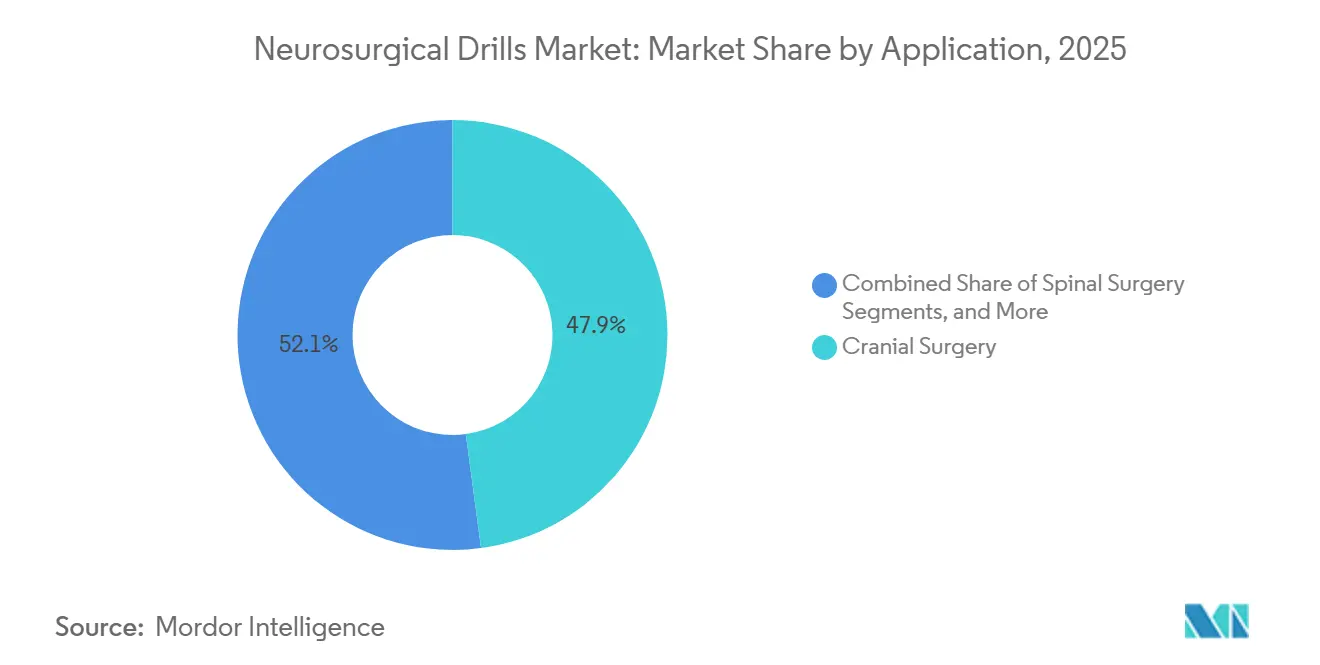
Cranial surgery is projected to account for 47.88% of the neurosurgical drills market in 2025. The application includes craniotomy, burr-hole, skull-base, tumor, vascular, traumatic brain injury, and deep brain stimulation procedures. Tertiary hospitals in North America and Europe support demand through an established base of reimbursed cranial procedures.
Spinal surgery is projected to grow at a 5.94% CAGR through 2031. Degenerative disc disease and spinal stenosis increase demand for laminectomy and discectomy procedures among aging populations. Compact cordless systems support the shift toward ambulatory surgical centers, while EU MDR post-market surveillance helps manufacturers build clinical evidence for product positioning.
By End User: Hospitals Provide Volume, While Ambulatory Centers Expand Quickly
Hospitals are projected to hold a 47.34% segment share in 2025. They manage high-complexity cases, including ruptured aneurysms, large tumor resections, spinal deformity surgeries, and procedures requiring intensive care support. Their imaging capabilities, capital infrastructure, and multi-year purchasing agreements support established suppliers.
Ambulatory surgical centers are forecast to grow at an 8.12% CAGR through 2031. Single-level laminectomy, microdiscectomy, and selected cranial access procedures can be performed in outpatient settings for appropriate patients. Specialty centers prioritize speed and ergonomics, while academic hospitals often adopt navigation-linked and robotic-compatible systems early. The proposed CMS rule supports facility-fee reimbursement for spinal procedures performed in ASCs.
Geography Analysis
North America is projected to hold a 42.80% regional share in 2025, supported by high procedure volumes, established reimbursement systems, and the rapid adoption of connected surgical platforms. The United States is the largest country-level market, with hospitals investing in navigation-integrated consoles and single-use cordless systems. Canada is adopting advanced tools as provinces modernize hospital infrastructure, while medical tourism and private hospital investments support growth in Mexico.
The United States influences product launches in the neurosurgical drills market through the FDA 510(k) review process, including the April 2026 clearance of the Velocity Alpha MR High Speed Surgical Drill System by Clearpoint Neuro. Europe is the second-largest region in 2025, led by Germany, the United Kingdom, France, and Italy. Germany's EU MDR framework requires notified body certification and post-market clinical follow-up for higher-risk devices, while NHS framework agreements in the United Kingdom support long-term supplier relationships.
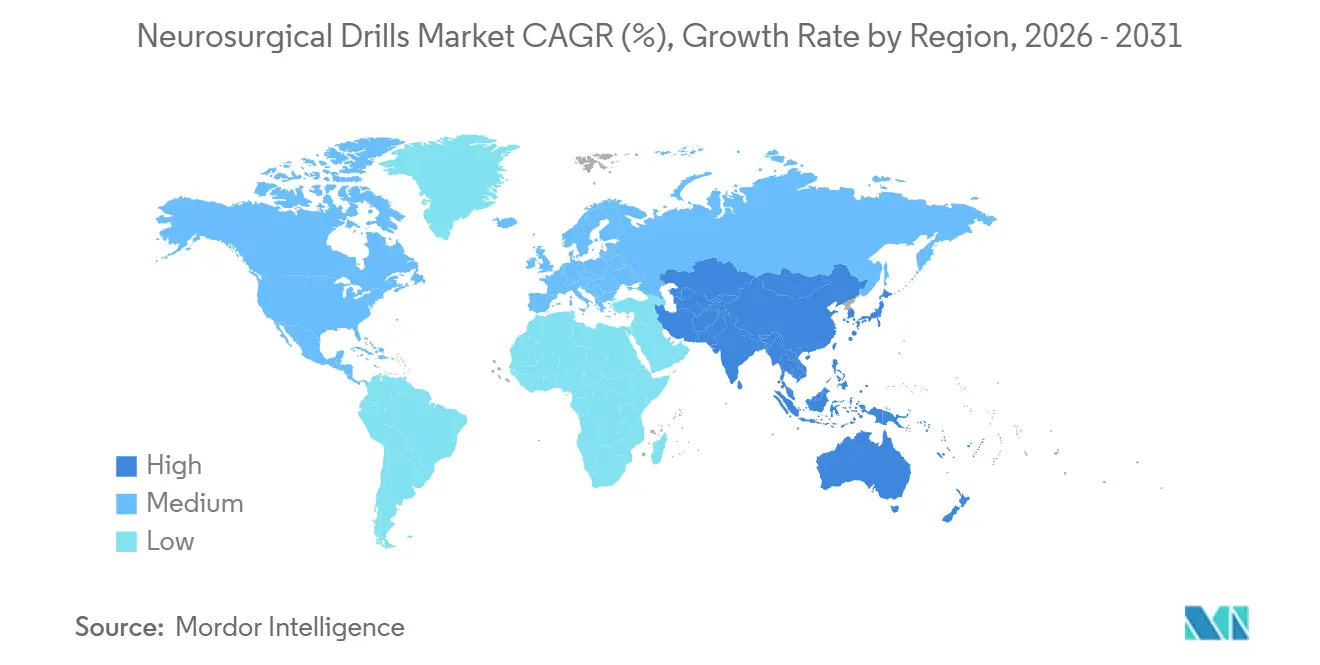
Asia-Pacific is projected to grow at a CAGR of 7.66% through 2031, representing the strongest regional growth outlook for the neurosurgical drills market. China's public hospital expansion and neurosurgeon density of 0.94 per 100,000 people indicate demand potential and capacity constraints. India requires differentiated product strategies for premium private hospitals in tier-1 cities and cost-sensitive government hospitals, while Japan and South Korea are replacing older consoles with navigation-connected systems. A 2025 study found that the neurological disease burden in Asia is rising, with aging increasing the need for surgical interventions through 2045. The Middle East, Africa, and South America remain smaller markets, although GCC hospital projects and Brazil's public health system offer long-term opportunities.
Competitive Landscape
The neurosurgical drills market is moderately consolidated in the premium segment. Medtronic plc, Stryker Corporation, and Johnson & Johnson, through DePuy Synthes, offer integrated platforms comprising motors, navigation-ready attachments, consumables, and service contracts. These portfolios support equipment standardization across cranial and spinal procedures and strengthen customer retention through compatible handpieces and consumables. Stryker expanded its Signature 2 portfolio in March 2026 with motors, attachments, and cutting accessories designed to improve precision, visualization, and control.
Medtronic’s Midas Rex MR8 system and StealthStation S8 support navigated cranial drilling workflows. In April 2026, Medtronic reported initial clinical cases using the Stealth AXiS Surgical System with AI-enabled navigation and robotic guidance. In June 2026, Stryker received U.S. patent US12648779B2 for a drill system with a telescoping member and solenoid-actuated brake designed to stop penetration after cortical breakthrough. ClearPoint Neuro’s Velocity Alpha MR drill system operates at up to 80,000 rpm in MR environments of 3.0 Tesla or less.
Specialist manufacturers compete on precision and application-specific capabilities. KLS Martin Group, NOUVAG AG, De Soutter Medical, and adeor medical AG serve skull-base surgery and neuroendoscopy applications, where handpiece geometry can be more important than console compatibility. Hubly Surgical’s single-use Auto-Stop Drill supports bedside cranial access and spinal decompression as an alternative to reusable corded systems. MR-compatible and robot-mountable end effectors remain a key product development area, while ISO 13485 certification and EU MDR compliance increase entry barriers for smaller manufacturers.
Neurosurgical Drills Industry Leaders
-
Medtronic plc
-
B. Braun SE
-
Stryker Corporation
-
Johnson & Johnson (DePuy Synthes)
-
Integra LifeSciences Holdings Corporation
- *Disclaimer: Major Players sorted in no particular order
Recent Industry Developments
- July 2026: Chengdu EndoTronic Technology launched a 75,000 rpm high-speed UBE drill handle compatible with the Stryker Drive platform for unilateral biportal endoscopic spine surgery, supporting spinal decompression and intervertebral shaping through a single endoscopic port.
- June 2026: Stryker Corporation received U.S. Patent US12648779B2 for a surgical drill system featuring a telescoping member and solenoid-actuated brake mechanism that prevented further penetration after cortical bone perforation, supporting cranial access and spinal decompression procedures.
- May 2026: ClearPoint Neuro’s Velocity Alpha MR High Speed Surgical Drill System, manufactured by adeor medical AG in Germany, received CE marking after obtaining FDA 510(k) clearance and demonstrated operation at up to 80,000 rpm in magnetic environments of 3.0 Tesla or less.
- April 2026: Medtronic announced the first successful clinical cases using its Stealth AXiS Surgical System, which integrated AI-enabled navigation and robotic guidance to support adaptive trajectory correction in cranial and spinal drilling procedures.
Global Neurosurgical Drills Market Report Scope
As per the scope of the report, A neurosurgical drill (also known as a cranial drill, neuro drill, or cranial perforator) is a highly specialized medical power tool designed to precisely and safely cut through bone, specifically the skull (cranium) or vertebrae, to allow neurosurgeons access to the brain and spinal cord.
The neurosurgical drills market is segmented by product type, power source, application, end user, and geography. By product type, the market includes high-speed drills and burr systems, reamers and drivers, microdebriders and shavers, neurosurgical saws, twist drills and manual-compatible drill systems, and drill bits, burrs, and cutting accessories. By power source, the market is segmented into electric corded systems, battery-powered systems, pneumatic systems, and manual and hybrid systems. By application, the market is categorized into cranial surgery, spinal surgery, functional neurosurgery, neuroendoscopy, and peripheral nerve surgery. By end user, the market is segmented into hospitals, ambulatory surgical centers, neurosurgical specialty centers, academic and research hospitals, and other end users. By geography, the market is analyzed across North America, Europe, Asia-Pacific, the Middle East and Africa, and South America. The report also covers the estimated market sizes and trends for 17 countries across major regions globally. The report offers market sizes and forecasts in terms of value (USD) for the above segments.
| High-Speed Drills and Burr Systems |
| Reamers and Drivers |
| Microdebriders and Shavers |
| Neurosurgical Saws |
| Twist Drills and Manual-Compatible Drill Systems |
| Drill Bits, Burrs and Cutting Accessories |
| Electric Corded Systems |
| Battery-Powered Systems |
| Pneumatic Systems |
| Manual and Hybrid Systems |
| Cranial Surgery |
| Spinal Surgery |
| Functional Neurosurgery |
| Neuroendoscopy |
| Peripheral Nerve Surgery |
| Hospitals |
| Ambulatory Surgical Centers |
| Neurosurgical Specialty Centers |
| Academic and Research Hospitals |
| Other End Users |
| North America | United States |
| Canada | |
| Mexico | |
| Europe | Germany |
| United Kingdom | |
| France | |
| Italy | |
| Spain | |
| Rest of Europe | |
| Asia-Pacific | China |
| India | |
| Japan | |
| Australia | |
| South Korea | |
| Rest of Asia-Pacific | |
| Middle East and Africa | GCC |
| South Africa | |
| Rest of Middle East and Africa | |
| South America | Brazil |
| Argentina | |
| Rest of South America |
| By Product Type | High-Speed Drills and Burr Systems | |
| Reamers and Drivers | ||
| Microdebriders and Shavers | ||
| Neurosurgical Saws | ||
| Twist Drills and Manual-Compatible Drill Systems | ||
| Drill Bits, Burrs and Cutting Accessories | ||
| By Power Source | Electric Corded Systems | |
| Battery-Powered Systems | ||
| Pneumatic Systems | ||
| Manual and Hybrid Systems | ||
| By Application | Cranial Surgery | |
| Spinal Surgery | ||
| Functional Neurosurgery | ||
| Neuroendoscopy | ||
| Peripheral Nerve Surgery | ||
| By End User | Hospitals | |
| Ambulatory Surgical Centers | ||
| Neurosurgical Specialty Centers | ||
| Academic and Research Hospitals | ||
| Other End Users | ||
| By Geography | North America | United States |
| Canada | ||
| Mexico | ||
| Europe | Germany | |
| United Kingdom | ||
| France | ||
| Italy | ||
| Spain | ||
| Rest of Europe | ||
| Asia-Pacific | China | |
| India | ||
| Japan | ||
| Australia | ||
| South Korea | ||
| Rest of Asia-Pacific | ||
| Middle East and Africa | GCC | |
| South Africa | ||
| Rest of Middle East and Africa | ||
| South America | Brazil | |
| Argentina | ||
| Rest of South America | ||
Key Questions Answered in the Report
What is the projected value of the Neurosurgical drills market by 2031?
The Neurosurgical drills market is projected to reach USD 727.21 million by 2031, from USD 682.53 million in 2026, at a 3.92% CAGR.
Which product type leads demand for neurosurgical drills?
High-Speed Drills and Burr Systems led the product type segment with a 39.12% share in 2025.
Which power source is growing fastest for neurosurgical drill systems?
Battery-Powered Systems are forecast to grow at a 6.25% CAGR through 2031, the highest rate among power-source segments.
Why are ambulatory surgical centers becoming important for drill suppliers?
Ambulatory Surgical Centers are forecast to grow at an 8.12% CAGR through 2031, supporting demand for portable systems with short setup cycles.
Which region has the strongest growth outlook for neurosurgical drill demand?
Asia-Pacific is forecast to grow at a 7.66% CAGR through 2031, supported by hospital expansion and equipment replacement.
What safety features matter when selecting a neurosurgical drill?
Auto-stop functions, torque control, lower heat generation, and durable risk-management processes can help reduce drilling-related safety concerns.