
Naval Vessel MRO Market Size and Share
Market Overview
| Study Period | 2020 - 2031 |
|---|---|
| Market Size (2026) | USD 63.27 Billion |
| Market Size (2031) | USD 73.66 Billion |
| Growth Rate (2026 - 2031) | 3.09 % |
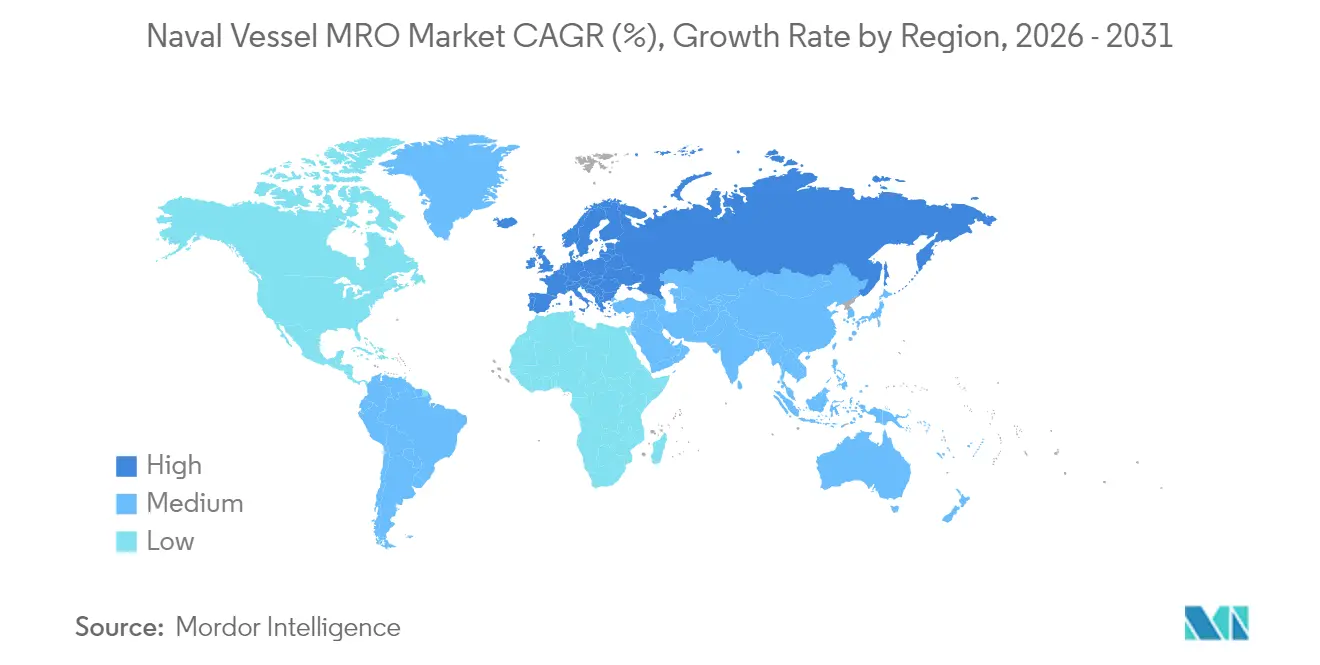
| Fastest Growing Market | Europe |
| Largest Market | Asia Pacific |
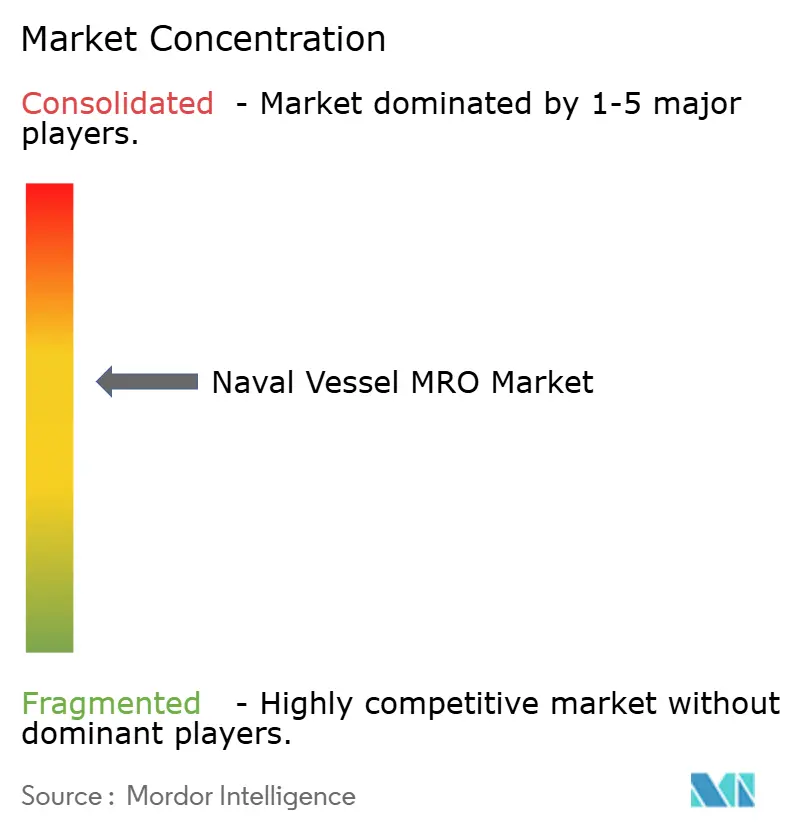
| Market Concentration | Medium |
Major Players *Disclaimer: Major Players sorted in no particular order Image © Mordor Intelligence. Reuse requires attribution under CC BY 4.0. | |
Naval Vessel MRO Market Analysis by Mordor Intelligence
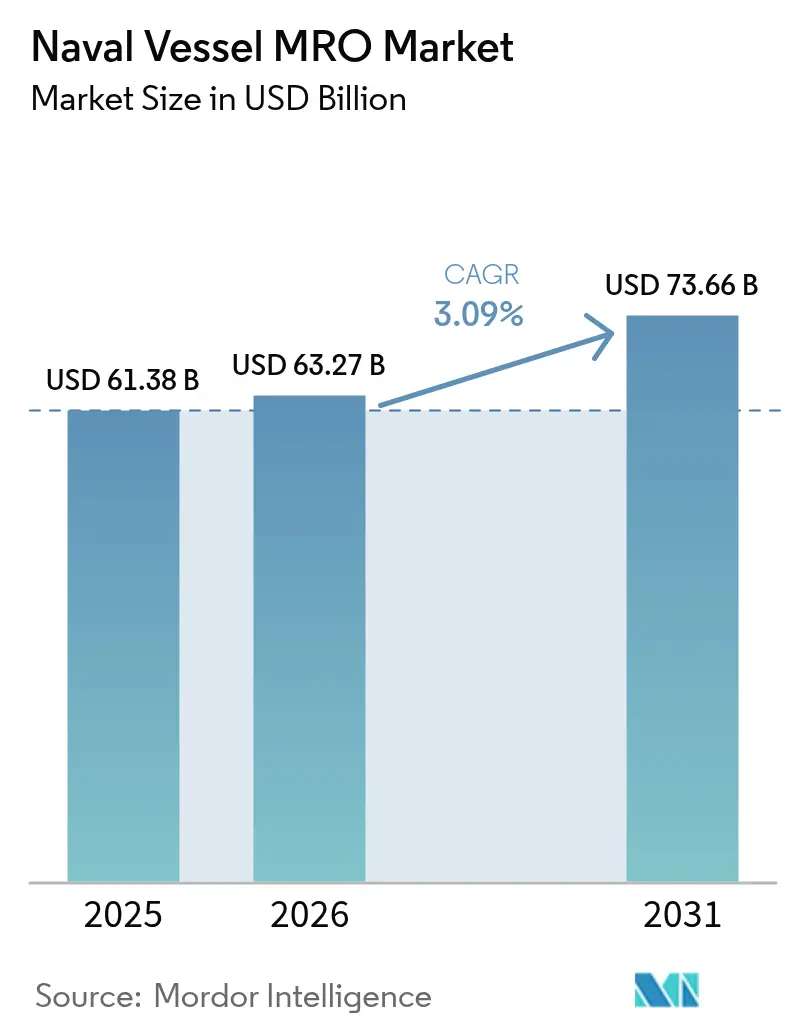
The naval vessel MRO market size stands at USD 61.38 billion in 2025. The naval vessel MRO market size in 2026 is estimated at USD 63.27 billion, growing from 2025 value of USD 61.38 billion with 2031 projections showing USD 73.66 billion, growing at 3.09% CAGR over 2026-2031. Sustained modernization programs, higher operational tempos in contested waters, and shifting toward performance-based logistics (PBL) contracts continue to anchor demand. Nuclear-powered vessel upkeep and dry-dock overhauls remain the most lucrative niches as they require specialized infrastructure and deep technical expertise, locking in premium pricing. Asia-Pacific accounts for the largest regional spend, propelled by China’s rapid fleet expansion and allied counter-responses, while Europe is accelerating fastest on the back of renewed NATO commitments. Supply-chain fragility and skilled-labor shortages pose measurable headwinds, yet digital twin analytics and additive manufacturing mitigate downtime and unlock incremental savings.
Key Report Takeaways
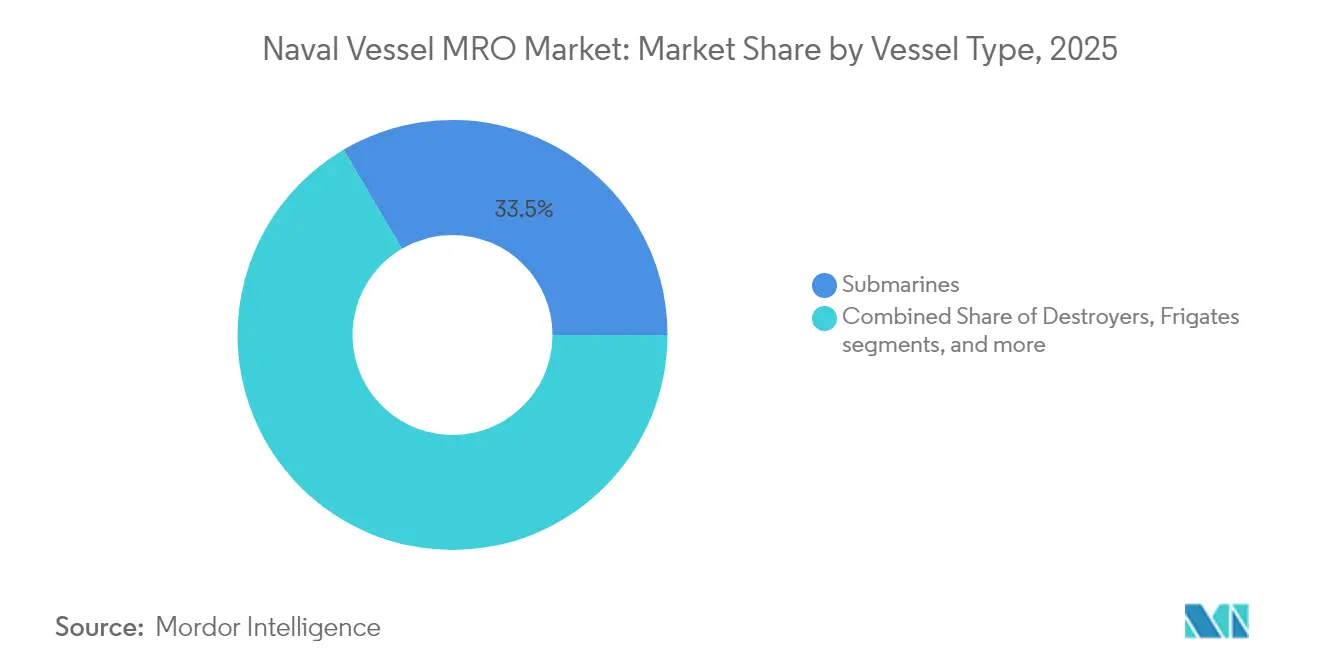
- By vessel type, submarines led the naval vessel MRO market share with 33.46% in 2025; frigates are forecasted to expand at a 5.05% CAGR through 2031.
- By propulsion type, nuclear-powered vessels captured 53.21% of the naval vessel MRO market size in 2025 and are projected to grow at a 4.12% CAGR through 2031.
- By MRO type, dry-dock services accounted for 38.57% of the naval vessel MRO market size in 2025; modification and upgrade services are advancing at a 3.60% CAGR to 2031.
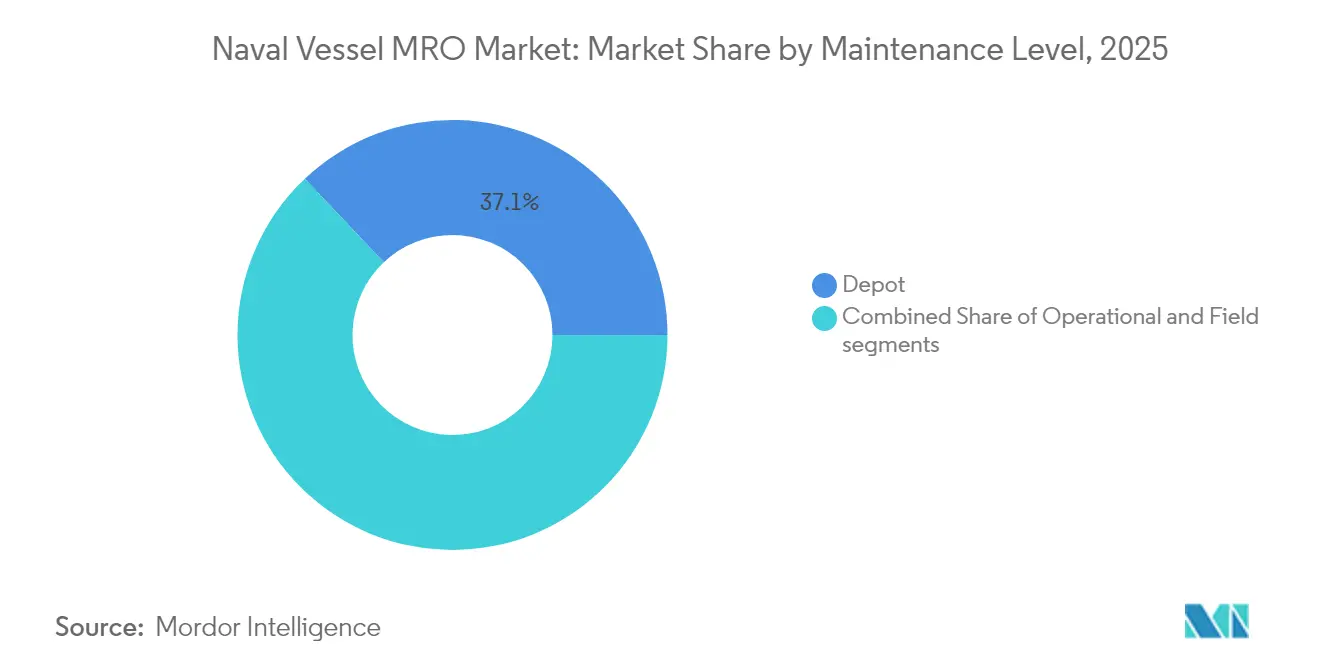
- By maintenance level, depot-level work controlled 37.05% of the naval vessel MRO market size in 2025, rising at a 4.66% CAGR through 2031.
- By geography, Asia-Pacific held a 37.14% share of the naval vessel MRO market in 2025, while Europe registered the highest regional CAGR at 3.88% to 2031.
Note: Market size and forecast figures in this report are generated using Mordor Intelligence’s proprietary estimation framework, updated with the latest available data and insights as of 2026.
Market Trends and Insights
Drivers Impact Analysis of Naval Vessel MRO Market*
| Driver | % Impact on CAGR Forecast | Geographic Relevance | Impact Timeline |
|---|---|---|---|
| Fleet-modernization programs | +0.80% | Global; highest in Asia-Pacific and Europe | Medium term (2-4 years) |
| Life-extension of legacy fleets | +0.60% | North America and Europe; spill-over to Asia-Pacific | Long term (≥ 4 years) |
| Rising maritime-security tensions | +0.50% | Global; focus on Indo-Pacific and Middle East | Short term (≤ 2 years) |
| Adoption of PBL contracts | +0.40% | North America and Europe; expanding to Asia-Pacific | Medium term (2-4 years) |
| Digital-twin based predictive MRO | +0.30% | North America and Europe; emerging in Asia-Pacific | Medium term (2-4 years) |
| Additive-manufactured spares | +0.20% | North America and Europe; pilot projects in Asia-Pacific | Long term (≥ 4 years) |
| Source: Mordor Intelligence | |||
Fleet-Modernization Programs
Nationwide upgrade plans are reshaping the naval vessel MRO market demand as governments aim to stretch capability rather than merely expand fleet count. The Philippines’ USD 35 billion modernization drive and Turkey’s three-year fleet enhancement initiative earmark sizable shares for maintenance infrastructure and platform upgrades rather than for acquisition only. Similar strategies in Denmark and Australia show that mid-tier navies can secure disproportionate capability gains by funding refits, overhauls, and modular upgrades. Submarine hull-life extensions add 10-15 years of service at near one-quarter of new-build cost, generating durable MRO revenue. Predictability improves because phased work packages allow contractors to plan labor and inventory well in advance, narrowing schedule slippage.
Life-Extension of Legacy Fleets
Keeping older ships battle-ready has moved from thrift to necessity as next-generation hulls arrive late. The US Navy cruiser overhaul program and the Royal Navy Type 23 frigate life-extension effort illustrate how navies capture 70-80% of modern capability for only 15-25% of replacement cost. Enhanced coatings, structural health monitoring, and mid-life combat-system swaps tackle fatigue and obsolescence while predictive analytics tighten inspection intervals. Growing reliance on legacy vessels stabilizes demand for depot-level refits that independent yards cannot easily replicate, bolstering premium pricing for incumbent contractors.
Rising Maritime-Security Tensions
Heightened friction in the Red, South China, and Eastern Mediterranean keeps task groups at sea longer. The USS Dwight D. Eisenhower flew over 13,000 sorties during a seven-month deployment that typically lasts six, sharply compressing overhaul windows and spiking spare-part consumption.[1] Allied responses—from Japan’s destroyer-escort transfers to the Philippines to Australia’s fleet-doubling plan—multiply regional demand for propulsion overhauls, combat-system checks, and electronic-warfare calibrations. The result is that workload lifts utilization across dry-dock slots and component-repair lines, sustaining the naval vessel MRO market even when new-build cycles flatten.
Adoption of PBL Contracts
Performance-based logistics models redistribute availability risk to contractors in return for steadier revenue and freedom to innovate. The US Navy’s USD 1.2 billion P-8A Poseidon support deal and StandardAero’s USD 315 million T56 engine agreement show how navies now pay for predetermined readiness levels rather than individual work orders. Contractors respond by embedding digital twins, additive manufacturing, and condition-based maintenance into service delivery, driving down lifecycle cost while meeting uptime metrics. PBL penetration exceeds 60% in new US programs and is spreading through European procurement frameworks.
Restraints Impact Analysis of Naval Vessel MRO Market*
| Restraint | % Impact on CAGR Forecast | Geographic Relevance | Impact Timeline |
|---|---|---|---|
| Dry-dock slot overruns and costs | −0.4% | Global; most acute in North America and Europe | Medium term (2-4 years) |
| Skilled-labor shortages | −0.3% | North America and Europe; emerging in Asia-Pacific | Long term (≥ 4 years) |
| Cyber-risk to connected shipyards | −0.2% | Global; higher in digitally advanced regions | Short term (≤ 2 years) |
| Green-compliance waste-disposal cost | −0.1% | Europe and North America; expanding globally | Medium term (2-4 years) |
| Source: Mordor Intelligence | |||
Dry-Dock Slot Overruns and Costs
Aging facilities and project creep push overhaul budgets well above plan. Pearl Harbor’s dry-dock modernization ballooned from USD 6.1 billion to USD 16 billion, while Portsmouth Naval Shipyard costs quadrupled, blocking capacity for other urgent work. The Shipyard Infrastructure Optimization Program injects USD 21 billion, yet it cannot eliminate near-term gaps that delay submarine refits by 12-18 months. Commercial yards often refuse naval contracts because overruns jeopardize profitability, further tightening the bottleneck.
Skilled-Labor Shortages
Demographics and high attrition shrink the talent pool for welding, pipe-fitting, and nuclear maintenance. Hampton Roads alone faces a 10,000-person shortfall that may quadruple by 2030, while European yards wrestle with limited cross-border mobility post-Brexit. Recruitment pipelines produce fewer than 15,000 qualified hands annually against a requirement for 174,000 over the decade. Labor scarcity inflates wage bills, stretches delivery dates, and curtails expansion plans, moderating naval vessel MRO market growth despite ample funding.
*Our forecasts treat driver/restraint impacts as directional, not additive. The impact forecasts reflect baseline growth, mix effects, and variable interactions.
Naval Vessel MRO Market Segment Analysis
By Vessel Type:
Submarines Drive Strategic DeterrenceSubmarines accounted for 33.46% of the 2025 naval vessel MRO market, reflecting their nuclear-propulsion complexity and deterrence value that anchor multi-year service contracts. High regulatory barriers restrict competition and support premium rates. Frigates represent the fastest-growing slice at 5.05% CAGR thanks to their role in distributed surface operations and relatively quicker build cycles that soon enter sustainment phases. Destroyers and corvettes sit mid-pack; the former benefit from Aegis-system maintenance, while the latter attract emerging littoral navies seeking budget-friendly patrol craft.
Subsurface platforms require extensive reactor refueling, acoustic signature checks, hull pressure tests, and lock-in depot-level workloads. Frigate programs leverage modular combat-system blocks, simplifying mid-life upgrades and enticing navies to invest in incremental capability paths instead of fresh hulls. Digital twin pilots under Spain’s ISOPRENE project have demonstrated 15-20% cuts in unscheduled downtime for both vessel classes, pointing toward broader adoption over the forecast period.

By MRO Type:
Dry-Dock Services Dominate Complex MaintenanceDry-dock work held 38.57% of the naval vessel MRO market in 2025 due to statutory hull inspections, shaft-line replacements, and propulsion-system overhauls that mandate docking. The segment enjoys steady visibility because mandatory periodicity supports multi-year master schedules. Modification and upgrade services are growing 3.60% annually as navies retrofit sensors, weapons, and electronic-warfare suites rather than wait for new builds.
Additive manufacturing is reshaping component repair economics. Metal 3D printers on the USS Bataan already produce certified spares at sea, cutting logistics lag and freeing dock space for heavier tasks. PBL frameworks incentivize suppliers to invest further in this capability, as faster part turnarounds boost contract performance metrics.
By Maintenance Level:
Depot-Level Services Command Premium PricingDepot-level work comprised 37.05% of the 2025 naval vessel MRO market and is rising at 4.66% CAGR, the fastest among maintenance levels, because advanced combat systems exceed organic ship-crew skill sets. Nuclear-qualified trades require years of clearance and schooling, tightening supply and elevating hourly rates. Digital-twin analytics refine yard schedules by predicting wear patterns, which lowers idle time and maximizes capital-intensive dock usage.
Intermediate maintenance fills the capability gap between crews and depots, especially for emergent repairs during extended deployments. Organizational maintenance remains essential yet budget-capped; navies prefer to reallocate complex work to contractors who guarantee uptime under PBL arrangements.
By Propulsion Type:
Nuclear-Powered Vessels Drive Premium DemandNuclear platforms captured 53.21% of the 2025 naval vessel MRO market and are projected to grow at a 4.12% CAGR, outpacing conventional propulsion due to their strategic priority and stringent safety standards. Only a handful of firms possess the requisite clearances, facilities, and tooling, which creates high entry barriers and durable margins. Diesel and gas-turbine vessels fill coastal patrol and rapid-response roles, benefiting from broader supplier bases but lacking the pricing power of nuclear-powered programs.
Supply-chain fragility remains acute for nuclear segments. General Dynamics Electric Boat pushed delivery schedules out by up to 16 months after critical component delays, illustrating dependency on specialized vendors. Nuclear maintenance budgets remain resilient despite these challenges because strategic imperatives rarely face cuts.
Geography Analysis
APAC Naval Vessel MRO Market
Asia-Pacific held 37.14% of the 2025 naval vessel MRO market spending, anchored by China’s fleet growth toward 435 ships by 2030 and allied counter-moves such as Australia’s plan to double its surface force. Shipbuilding powerhouses South Korea and Japan offer overflow dock capacity; Hanwha Ocean became the first Korean yard to win US Navy repair work, underscoring deeper allied collaboration.
Europe Naval Vessel MRO Market
Europe is the fastest-growing region at 3.88% CAGR as NATO members lift defense outlays to at least 2% of GDP. Denmark’s large-scale fleet expansion, France’s Tourville submarine commissioning, and Greece’s USD 27 billion rearmament funnel fresh hulls into sustainment pipelines. Turkey’s EUR 350 million Aksaz Naval Base upgrade further broadens regional maintenance options and reflects wider Mediterranean security concerns.
The Americas and MEA Naval Vessel MRO Market
North America sustains robust but stable demand as the US Navy balances modernization with aging-yard constraints. Emergency supplements of USD 5.7 billion for submarine labor and a USD 40.1 billion annual shipbuilding budget highlight fiscal commitment, yet projected force levels drop to 283 ships by 2027 before rebuilding toward 381 by 2054. South America and the Middle East/Africa remain smaller contributors, though programs like ZAR 1.4 billion (USD 78.90 million) submarine refit point to gradual upticks.
Regulatory Landscape
Naval vessel MRO is governed by naval-aviation style airworthiness and safety equivalents for ships, with particularly strict controls around nuclear work, cybersecurity for connected shipyards, and configuration control. In the United States, 10 USC 8680 restricts the overhaul, repair, and maintenance of US-homeported naval vessels in foreign shipyards, with limited exceptions (such as voyage repairs or specific deployed scenarios). This framework reinforces a domestically anchored depot ecosystem for many high-value availabilities. Execution is standardized through NAVSEA governance, including NAVSEA Standard Items and the Joint Fleet Maintenance Manual (JFMM) maintenance specifications managed via the Standard Specifications for Ship Repair and Alteration Committee (SSRAC). US Navy maintenance policy updates also shape compliance and planning, including OPNAVINST 4700.7N (issued December 5, 2024), alongside DoD maintenance policy that emphasizes Condition-Based Maintenance Plus (CBM+) integration into life-cycle plans.
In Europe, defense-industrial policy is moving toward more structured cross-border cooperation for procurement and sustainment. Regulation (EU) 2025/2643 (adopted December 16, 2025) establishes the European Defence Industry Programme (EDIP) framework, with mechanisms that can support joint procurement and maintenance while strengthening supply security and interoperability. In parallel, 2025 proposals to amend Directives 2009/43/EC and 2009/81/EC aim to simplify intra-EU transfers and procurement processes and enable longer framework agreement durations (up to ten years), aligning with the market shift toward longer-term availability-based contracting structures and multi-country sustainment arrangements.
Value Chain Analysis
The naval vessel MRO value chain runs from upstream materials and components (specialty metals, propulsion and powertrain parts, combat-system line replaceable units, and nuclear-certified items) through engineering and planning (class maintenance plans, technical data, and configuration management) into shipyard execution (dry-dock, depot modernization, and intermediate maintenance), followed by testing and certification, then fleet return-to-service and ongoing spares replenishment. Prime contractors and naval shipyards (public and private) orchestrate dockyard labor, certified subcontractors, and OEM repair lines for propulsion, electronics, and mission systems, while navies shape demand through maintenance schedules, surge requirements, and performance-based logistics constructs.
Capacity and supply-chain resilience are being reinforced through public-private partnerships and international teaming that expand qualified throughput without lowering naval quality gates. Examples include HD Hyundai Heavy Industries signing a US Navy Master Ship Repair Agreement (July 2024), which supports local shipyard work for US naval MRO, and a US Navy public-private partnership with Hadrian opening the Factory 4 facility in Cherokee, Alabama (March 2026) to produce submarine components for Virginia and Columbia-class programs. Submarine sustainment supply chains are also being localized through CPSP-related partnerships, including the TKMS and Seaspan Shipyards teaming agreement (January 2026) and a binding Algoma Steel and Hanwha Ocean memorandum of understanding that includes USD 250 million investment support tied to building out Canadian submarine sustainment infrastructure and supply-chain capability (January 2026). Forward maintenance readiness in Asia is further supported through alliances such as the Sumitomo Heavy Industries and IMIA strategic alliance (February 2026), aimed at supporting US Navy 7th Fleet maintenance readiness in Japan.
Competitive Landscape
The naval vessel MRO market is concentrated in a handful of defense primes that control nuclear-qualified facilities, security clearances, and specialized labor. Huntington Ingalls Industries (HII) tops the field with a USD 47.1 billion order backlog and the recent W International acquisition that expands Newport News Shipbuilding's capacity for AUKUS submarines.[3] General Dynamics Electric Boat remains pivotal but has eased production cadence due to component shortages, spotlighting supplier dependencies.
Strategic partnerships widen capacity and share risk. HII's 2025 memorandum with Hyundai Heavy Industries seeks to blend US nuclear expertise with South Korean throughput, potentially doubling Aegis destroyer output. Contractors differentiate through technology: the Spanish SOPRENE digital-twin project cut unscheduled downtime 15–20%, while US Navy additive-manufacturing pilots aim for USD 250 million annual savings.
Naval Vessel MRO Industry Leaders
-
General Dynamics Corporation
-
Lockheed Martin Corporation
-
BAE Systems plc
-
Huntington Ingalls Industries, Inc.
-
Naval Group
- *Disclaimer: Major Players sorted in no particular order
Naval Vessel MRO Market Companies Covered in this Report
- General Dynamics Corporation
- Huntington Ingalls Industries, Inc.
- Lockheed Martin Corporation
- NAVANTIA, S.A., SME
- thyssenkrupp AG
- BAE Systems plc
- Naval Group
- Rolls-Royce plc
- Rhoads Industries, Inc.
- Abu Dhabi Ship Building Company PJSC
- Larsen & Toubro Limited
- Damen Shipyards Group
- Singapore Technologies Engineering Ltd.
- FINCANTIERI S.p.A.
- HD Hyundai Heavy Industries Co., Ltd.
- Saab AB
- Austal Limited
- Mitsubishi Heavy Industries, Ltd.
- Kongsberg Gruppen ASA
Market Opportunities and Future Outlook
A clearer set of opportunities is emerging around distributed and allied maintenance capacity, which can ease dry-dock bottlenecks while still meeting NAVSEA-grade specifications and contracting requirements. The US Navy expanded repair work orders at South Korean shipyards in June 2026, and South Korean yards have been working through the gatekeeping steps that enable repeatable US Navy work, including Master Ship Repair Agreements and regular overhaul awards. Company-level wins such as HD Hyundai Heavy Industries securing a regular overhaul contract for USNS Cesar Chavez (January 2026) and Hanwha Ocean accumulating multiple US Navy MRO contracts since 2024 (as reported in March 2026) show how qualified non-US yards are being added to the surge-capacity toolset for selected vessel classes and operating patterns.
A second opportunity is labor substitution and industrialization of work packages within major availabilities, tied to measurable readiness throughput rather than incremental tasks. In June 2026, the US Navy initiated outsourcing of menial labor tasks (for example, painting, insulating, and transportation) during aircraft carrier Refueling and Complex Overhaul (RCOH), starting with USS Harry S. Truman, with an objective to reclaim up to 1 million sailor man-hours. This expands the addressable scope for contractors beyond traditional high-skill repairs into structured support work that can be standardized, competitively sourced, and integrated into performance-based logistics or availability contracts. On the platform side, the May 2026 US Department of the Navy shipbuilding plan emphasis on more distributed shipbuilding sites and modular, digital design priorities strengthens the business case for digital engineering, configuration control, and data-driven maintenance planning across the through-life support chain, supporting contractors that can connect shipyard execution to digital twins, condition-based maintenance, and faster spares turnaround.
Recent Industry Developments in Naval Vessel MRO Market
- June 2026: Huntington Ingalls Industries (HII) was awarded a USD 417.7 million IDIQ contract to provide maintenance and repair services for shipboard elevators across US Navy aircraft carriers and amphibious ships through June 2031. The award reinforces elevator sustainment as a multi-platform readiness enabler and consolidates a recurring workstream that connects shipboard systems support to availability performance outcomes.
- December 2025: Huntington Ingalls Industries (HII) received a USD 471.9 million sole-source Aircraft Carrier Engineering Services (ACES) contract covering FY2026-2030. The scope anchors long-cycle engineering and technical support tied to carrier sustainment, strengthening HII's role in planning, troubleshooting, and integrating modernization work across complex overhauls.
- November 2024: BAE Systems secured a USD 212 million US Navy contract to maintain, modernize, and repair USS Green Bay (LPD 20), with work scheduled for completion by October 2026. The award adds to the pipeline of amphibious-ship availabilities in San Diego and supports continuity for depot-level capacity and workforce utilization during a period of tight dry-dock scheduling.
Naval Vessel MRO Market Report Scope and Research Methodology
Market Definition and Coverage
This market covers the spending and contracted value tied to keeping naval vessels mission-ready, including routine upkeep, repairs, dry-dock work, and major overhauls that restore or extend platform life across fleets.
Scope exclusions: Pure new-build ship procurement, weapons procurement not part of a refit, and day-to-day base operations not linked to a defined maintenance event are excluded.
Segments Covered in This Report
- By Vessel Type
- Aircraft Carriers
- Destroyers
- Frigates
- Corvettes
- Submarines
- Other Vessel Types (Support and Auxiliary Vessels, Unmanned Surface, and Underwater Vessels)
- By MRO Type
- Engine MRO
- Dry-Dock MRO
- Component MRO
- Modification and Upgrade
- By Maintenance Level
- Organizational/Operational
- Intermediate/Field
- Depot
- By Propulsion Type
- Nuclear-Powered Vessels
- Conventional (Diesel/Gas Turbine)
- By Geography
- North America
- United States
- Canada
- Mexico
- Europe
- United Kingdom
- France
- Germany
- Italy
- Spain
- Russia
- Rest of Europe
- Asia-Pacific
- China
- India
- Japan
- South Korea
- Australia
- Rest of Asia-Pacific
- South America
- Brazil
- Argentina
- Rest of South America
- Middle East and Africa
- Middle East
- Saudi Arabia
- United Arab Emirates
- Turkey
- Rest of Middle East
- Africa
- Egypt
- South Africa
- Rest of Africa
- Middle East
- North America
Data Sources, Market Sizing, and Validation
Desk Research
Desk research was used to set the outer rails of the model and to keep assumptions realistic before interviews started. We reviewed public defense budget documents, naval readiness and sustainment releases, and procurement and sustainment plans from official sources such as defense ministries and navies, the US Congressional Budget Office, the US Government Accountability Office, and NATO-aligned publications.
To cross-check demand signals, we also used ship registry and fleet inventory references, public shipyard capacity announcements, tender portals, and customs and trade statistics for parts and marine equipment where relevant. Company annual reports and investor presentations were used to map service offerings and revenue exposure, and an approved paid database subscription was referenced for company financials, news tracking, and patent look-ups related to maintenance tooling. These examples are not exhaustive, and many other public sources were also used to collect data, validate it, and clarify open questions.
Primary Interviews and Surveys
Primary work focused on validating what is actually counted as MRO value, how dry-dock cycles are priced, and how overhaul timing shifts with fleet tempo. Interviews were conducted with shipyard-side and supply-chain-side experts, along with procurement and sustainment stakeholders, across APAC, EMEA, and the Americas. These inputs were then used to align secondary indicators with realistic service volumes and pricing paths.
Distribution of primary research fieldwork respondents
| Company type | Respondent position | Region |
|---|---|---|
| Top tier: 35% | CXOs: 12% | APAC: 39% |
| Mid tier: 43% | Functional/Unit leaders: 41% | EMEA: 34% |
| Smaller Players: 22% | Managers: 47% | Americas: 27% |
Market-Sizing & Forecasting
Sizing started with a top-down build where defense sustainment outlays and fleet activity signals are reconstructed into an addressable MRO pool by region, then filtered using the share of spend that typically sits in ship maintenance cycles versus other naval support lines. The totals were corroborated with selective bottom-up approximations, using sampled dockyard throughput, refit frequency, and indicative cost per docking or overhaul to sanity-check the model and adjust where gaps appeared.
Inputs that influenced the model included fleet size and age profile by major vessel categories, planned maintenance intervals and depot versus organizational split, dry-dock availability and utilization, modernization and life-extension program cadence, and inflation and labor intensity for skilled trades that shape service pricing. Forecasting leaned on scenario analysis supported by expert expectations around fleet readiness priorities, submarine sustainment intensity, and the timing of large refit packages, then stress-tested against budget growth paths. Where data was thin for smaller naval operators, ranges were estimated using peer fleet analogs and then normalized back to regional spend constraints so the final totals stayed consistent.
Data Validation & Update Cycle
Validation was handled through multiple checks so the final numbers do not rely on a single data point. Outputs were compared against independent signals such as publicly stated sustainment budgets, known docking cycles, and major refit program timelines, then any sharp jumps were investigated when they did not match those indicators.
Before sign-off, the model went through a second-analyst review for unit consistency, currency conversion timing, and year-to-year variance logic, and follow-up outreach was triggered when assumptions moved beyond expected ranges. Reports are refreshed annually, with interim updates made when material events occur, such as new multi-year sustainment awards, major yard capacity changes, or policy shifts that affect readiness funding. A final pass is performed right before delivery so clients receive the latest updated view.
Mordor Intelligence's Naval Vessels Maintenance Repair and Overhaul Market Size Measured Against Other Published Estimates
Published market values for naval vessel MRO can look different across sources because the services counted, the year used, and the currency handling are not always aligned. Differences also show up when one estimate follows budget intent, while another tries to approximate awarded work and realized yard throughput.
The main gap comes from whether modernization and modification packages are treated as part of MRO, and how depot-level overhauls are timed. Mordor Intelligence counts modification only when it is executed as a maintenance event tied to a vessel platform and its service cycle, rather than bundling broader upgrade programs as routine MRO value.
Benchmark comparison
| Source | Market Size | Gaps in Research Methodology |
|---|---|---|
| Mordor Intelligence | USD 63.27 B (2026) | |
| Global Consultancy A | USD 60.45 B (2025) | Uses a different base year and a longer forecast window, and its service buckets can blend regular maintenance with broader upgrade activity, which shifts value between years and inflates overlap with modernization spend. |
| Industry Publisher B | USD 58.67 B (2025) | Anchors the model on a base-year snapshot with limited clarity on how dry-dock events, component work, and system upgrades are separated, which can compress the near-term total when fleet tempo and depot cycles are not fully normalized. |
Across the three figures, the spread is explained mainly by year alignment and what gets counted as MRO versus adjacent modernization work. By tying the model to observable fleet cycles, depot events, and budget realism checks, the estimate stays traceable to simple inputs that can be revisited as new programs and docking schedules are announced.
Key Questions Answered in the Report
What is the expected value of global naval vessel MRO activity by 2031?
The naval vessel MRO market is projected to reach USD 73.66 billion by 2031 at a 3.09% CAGR.
Which region currently spends the most on naval maintenance and overhaul?
Asia-Pacific leads with 37.14% of 2025 spending, reflecting China’s fleet expansion and allied response programs.
Why are performance-based logistics contracts gaining favor?
PBL contracts shift availability risk to contractors while guaranteeing readiness, enabling navies to control costs and improve uptime, as seen in the USD 1.2 billion P-8A Poseidon deal.
How large is the nuclear-powered segment within naval vessel MRO?
Nuclear-powered vessels account for 53.21% of 2025 spending and are forecasted to grow 4.12% annually through 2031.
What is the main bottleneck limiting naval vessel MRO growth?
Shortage of dry-dock slots and escalating overhaul costs delay major programs by up to 18 months, constraining near-term capacity.
Which maintenance level shows the fastest growth?
Depot-level services are expanding at 4.66% CAGR because increasingly complex systems require specialized facilities and skills beyond ship-crew capability.