
Multilayer Transparent Conductors Market Size and Share
Market Overview
| Study Period | 2021 - 2031 |
|---|---|
| Market Size (2026) | USD 6.99 Billion |
| Market Size (2031) | USD 11.10 Billion |
| Growth Rate (2026 - 2031) | 9.68 % |
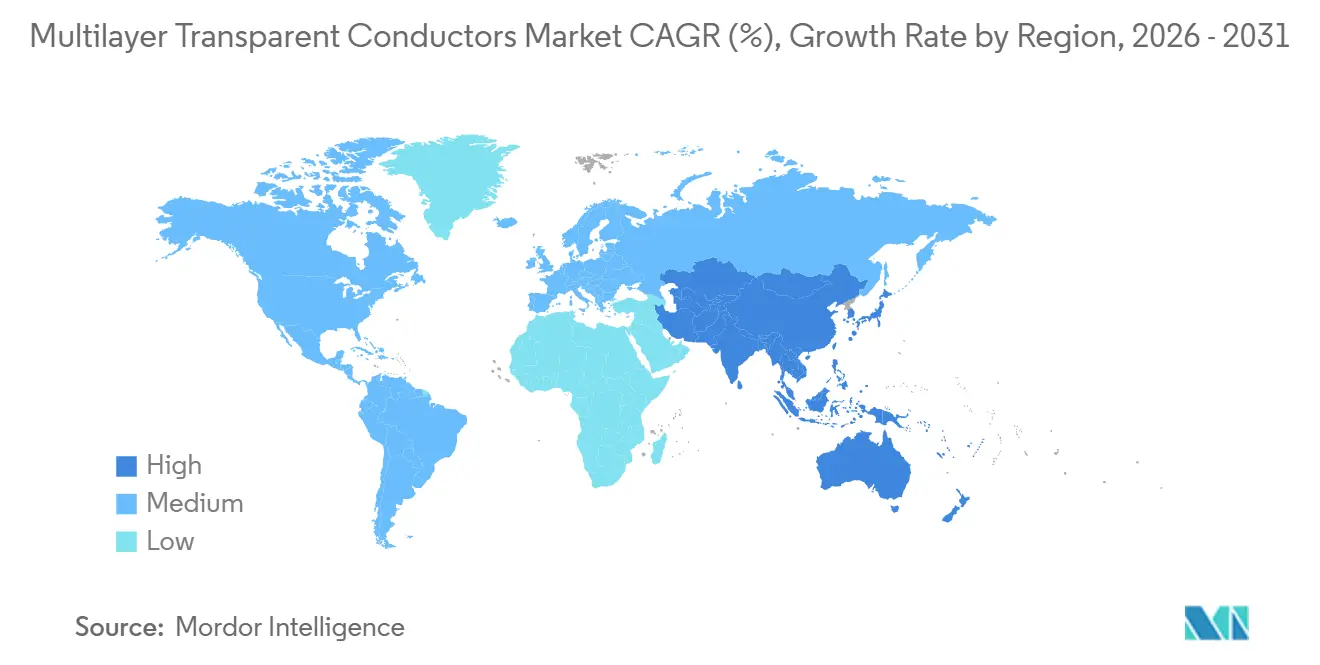
| Fastest Growing Market | Asia-Pacific |
| Largest Market | North America |
| Market Concentration | Medium |
Major Players *Disclaimer: Major Players sorted in no particular order Image © Mordor Intelligence. Reuse requires attribution under CC BY 4.0. | |
Multilayer Transparent Conductors Market Analysis by Mordor Intelligence
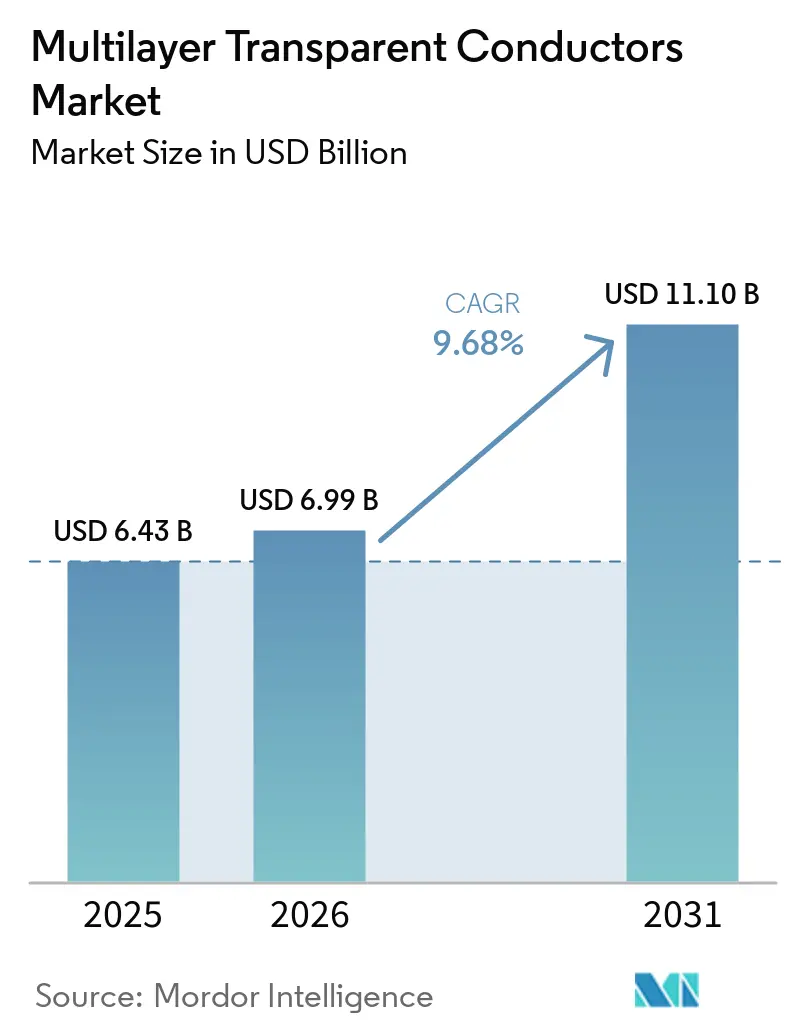
The multilayer transparent conductors market size is projected to expand from USD 6.43 billion in 2025 and USD 6.99 billion in 2026 to USD 11.10 billion by 2031, at a CAGR of 9.68% between 2026 and 2031. Growth is tied to the wider use of foldable displays, thin-film photovoltaic glazing, and electrically active automotive glass. Multilayer structures address performance limits that can restrict single-layer transparent conductive oxides in flexible or highly integrated devices. Suppliers are increasingly competing on stack design, deposition control, and customer qualification rather than on film supply alone. Indium supply exposure is encouraging work on silver nanowires, conductive polymers, carbon nanotubes, and other alternatives. This shift gives the multilayer transparent conductors market opportunities in applications where flexibility, optical performance, and lower processing cost must be achieved together.
Key Report Takeaways
- By material type, metal oxides held 42.74% of revenue in 2025, while conductive polymers are forecast to grow at a 10.05% CAGR through 2031.
- By technology, vacuum deposition held 48.05% of revenue in 2025, while sputtering is forecast to grow at a 10.23% CAGR through 2031.
- By application, displays held 36.11% of revenue in 2025, while photovoltaics are forecast to grow at a 10.66% CAGR through 2031.
- By end-use industry, consumer electronics held 58.36% of revenue in 2025, while automotive is forecast to grow at an 11.21% CAGR through 2031.
- By geography, North America held 35.63% of revenue in 2025, while the Asia Pacific is forecast to grow at a 10.74% CAGR through 2031.
Note: Market size and forecast figures in this report are generated using Mordor Intelligence’s proprietary estimation framework, updated with the latest available data and insights as of January 2026.
Global Multilayer Transparent Conductors Market Trends and Insights
Drivers Impact Analysis*
| Driver | (~) % Impact on CAGR Forecast | Geographic Relevance | Impact Timeline |
|---|---|---|---|
| Foldable and Rollable Display Qualification | +2.5% | Global, concentrated in Asia-Pacific, South Korea, and China | Short term (≤ 2 years) |
| Transparent Electrodes for Thin-Film PV and Building-Integrated PV | +2.1% | Global, North America, Europe, and Asia-Pacific | Medium term (2-4 years) |
| Electrification of Automotive Glass, HUDs, and Transparent Heaters | +1.8% | Global, Asia-Pacific, Europe, and North America | Medium term (2-4 years) |
| Low-Resistance Electrodes for High-Resolution Interfaces | +1.5% | Global, with North America and Asia-Pacific as core areas | Short term (≤ 2 years) |
| Roll-to-Roll Multilayer Deposition and Printed Electronics Scale-Up | +1.2% | Global, with early gains in North America, Europe, and East Asia | Long term (≥ 4 years) |
| Source: Mordor Intelligence | |||
Foldable and Rollable Display Qualification
Foldable displays require electrodes that retain stable conductivity through more than 200,000 bending cycles during standard smartphone qualification. Conventional indium tin oxide films can crack under repeated mechanical stress. Hybrid stacks that combine silver nanowires, PEDOT: PSS, and dielectric interlayers can retain conductivity while avoiding brittle failure. A 2026 review reported that silver-based multilayer electrodes achieved sheet resistance below 5 Ω/sq with visible transmittance above 90% [1]Frontiers in Materials Editorial Team, “Advancements in Metal-Dielectric Multilayer Structures: Tailoring for Enhanced Optoelectronic Performance,” Frontiers in Materials, frontiersin.org. . Suppliers must also maintain low haze after thermal and humidity cycling, which makes long-term optical stability an important qualification condition. Silver nanowire networks reached manufacturing readiness levels 8-9, supporting full-rate foldable smartphone supply chains.
Transparent Electrodes for Thin-Film Photovoltaics and Building-Integrated Photovoltaics
Perovskite-silicon tandem cells targeting efficiencies above 40% need high broadband transmission and low near-infrared free-carrier absorption. These requirements make multilayer transparent electrodes more suitable than indium-based oxide films alone in some cell designs. A 2026 review identified stacked oxide structures, including IZO/In₂O₃ multilayers, as a route to lower indium use while preserving performance. The review described a design that achieved more than 50% indium savings. Research also demonstrated a fully slot-die-coated 210 cm² semitransparent organic photovoltaic module with 9.26% power conversion efficiency and 43.2% average visible transmittance. IEC 61646 requirements and building codes shape the optical and electrical standards that glazing systems must meet before broader approval.
Electrification of Automotive Glass, Head-Up Displays, and Transparent Heaters
Automotive glass is being designed to heat, reflect head-up display images, and support camera apertures in the same assembly. The multilayer transparent conductors market responds to this need with stacks tailored to each optical function. Hyundai Motor Group deployed a 48V metal-coating transparent heater without visible tungsten wires. Testing showed a 2-3°C reduction in interior solar heat gain[2]Hyundai Motor Group, “MetalCoating Heated Glass: Exceptional Defrosting and Demisting Performance with Built-In Heating,” Hyundai Motor Group Stories, hyundaimotorgroup.com. . Eastman presented Horizon Vision at Auto China 2026, using variable-angle PVB in one windshield to meet both head-up display and ADAS camera optical needs. These specifications move supplier selection toward functional glazing performance instead of a narrow material comparison.
Demand for Low-Resistance Transparent Electrodes in High-Resolution Interfaces
4K, 8K, and micro-LED structures require lateral resistance below 5 Ω/sq to maintain even current distribution. Higher resistance can create visible luminance variation at high pixel densities. Research published in 2026 found that optimized ITO/Ag/ITO trilayers delivered 3.8 Ω/sq at 92.3% visible transmittance. The multilayer transparent conductors market benefits from results that address conductivity and transparency in large-area AMOLED and micro-LED production. Fine-pitch display manufacturing also increases the value of suppliers that can control deposition and patterning together. The multilayer transparent conductors market therefore benefits when interface designs are specified at stack level rather than simply by material category.
Restraints Impact Analysis*
| Restraint | (~) % Impact on CAGR Forecast | Geographic Relevance | Impact Timeline |
|---|---|---|---|
| Indium and Silver Price and Supply Volatility | -1.5% | Global, most acute in North America and Europe | Short term (≤ 2 years) |
| High Capital Intensity and Long Qualification Cycles for Multilayer Deposition | -0.9% | Global, North America, Europe, and Asia-Pacific | Medium term (2-4 years) |
| Stack-to-Stack Yield Loss from Optical, Electrical, and Mechanical Trade-Offs | -0.7% | Global, concentrated in high-resolution display applications in Asia-Pacific | Long term (≥ 4 years) |
| Source: Mordor Intelligence | |||
Indium and Silver Price and Supply Volatility
China accounted for 70% of global refined indium output in 2024, creating a concentrated source of supply for ITO users. Export licensing requirements for indium-related compounds introduced in February 2025 added disruption to sputtering-target supply chains. Silver creates a related cost exposure because it represented 15-20% of ITO film production costs. Its price rose more than 48% from 2019 to 2023, which increased cost-pass-through pressure for film producers. Indium production is tied to zinc smelting, so a fall in zinc output can tighten indium supply regardless of transparent conductor demand. The multilayer transparent conductors market therefore faces more difficult procurement planning for ITO-dependent manufacturers.
High Capital Intensity and Long Qualification Cycles for Multilayer Deposition
High-performance magnetron sputtering lines require investment starting above USD 15 million per line. Display and automotive customers typically take 18-36 months to qualify new multilayer films. This timing can delay revenue after capital has been committed. A 2026 review noted that large-area deposition must maintain nanometer-scale thickness consistency across meter-wide substrates. The same review found that ambient-air sol-gel options have lower interface reproducibility below 10 nm film thickness. The multilayer transparent conductors market remains more accessible to suppliers with established vacuum-processing assets.
*Our forecasts treat driver/restraint impacts as directional, not additive. The impact forecasts reflect baseline growth, mix effects, and variable interactions.
Segment Analysis
By Material Type: Metal Oxides Lead While Conductive Polymers Improve Processing Economics
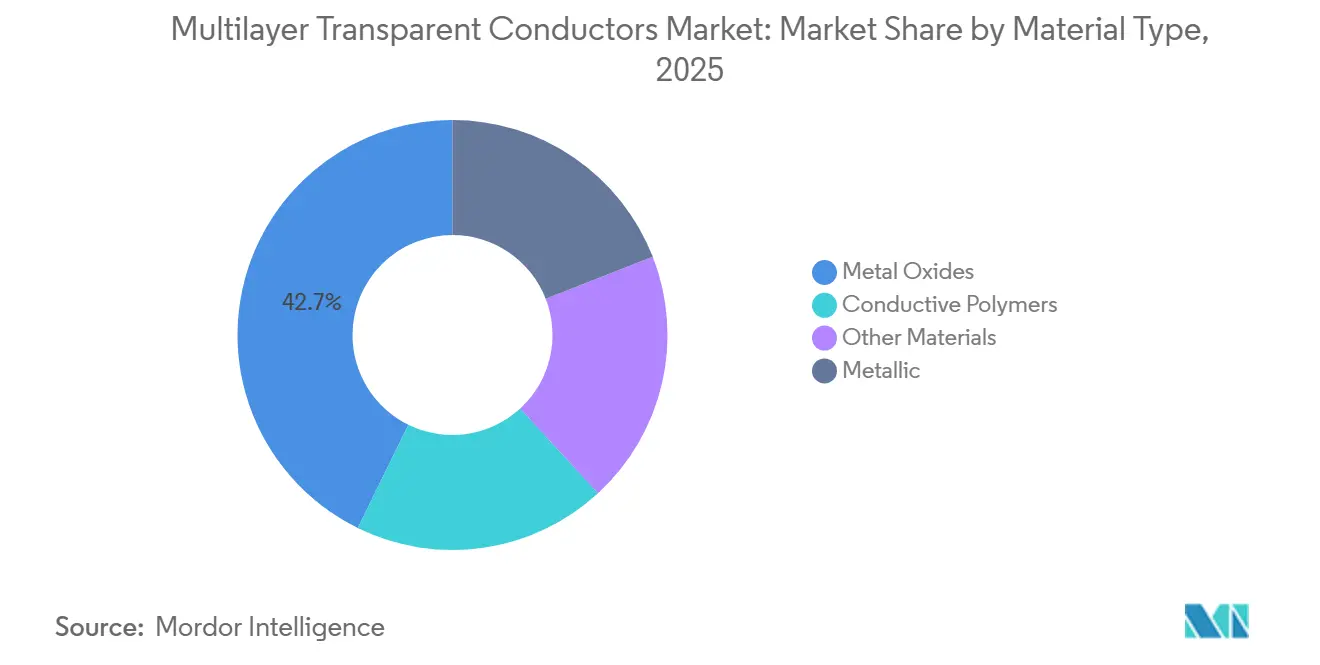
Metal oxides held 42.74% of the multilayer transparent conductors market share in 2025. ITO remained established across display panel lines in Asia-Pacific and North America. Metal oxide stacks can balance electrical conductivity with high optical transmission. Ta₂O₅/Ag/Ta₂O₅ structures achieved 91.64% transmittance at 2.53 Ω/sq in research published in 2026. This result shows why oxide-metal-oxide designs can be more effective than single-layer metal films. The multilayer transparent conductors market continues to use these designs because production infrastructure and display specifications are established.
Conductive polymers are forecast to grow at a 10.05% CAGR through 2031. PEDOT: PSS is gaining use in semitransparent organic photovoltaic modules because it can be processed in ambient conditions. The multilayer transparent conductors market can use this approach to reduce processing cost in suitable applications. Carbon nanotube films are moving beyond limited transparent heater use into automotive and sensor systems. Graphene films remain at lower commercial readiness. PEDOT:PSS degradation under prolonged illumination during 1,000-hour stability tests keeps formulation development important for wider display use. The multilayer transparent conductors industry is consequently balancing the proven scale of oxides with materials that can reduce process cost.



By Technology: Vacuum Deposition Leads While Sputtering Expands for Integrated Stacks
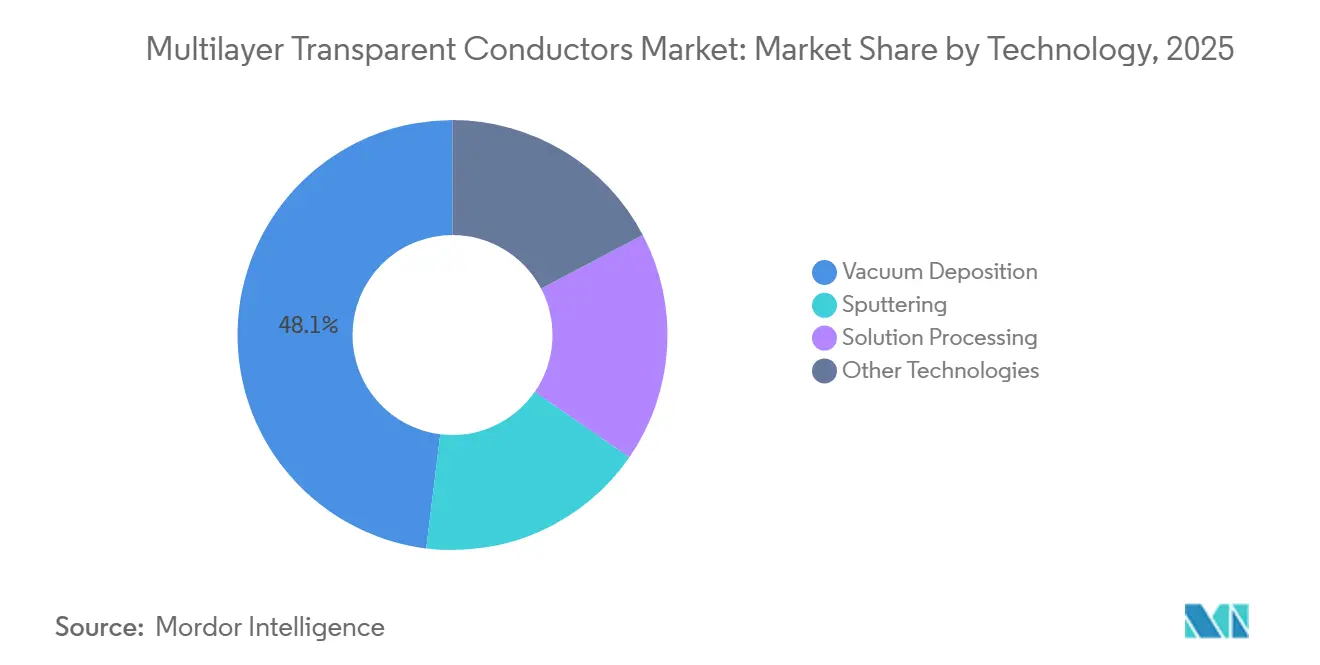
Vacuum deposition held 48.05% of revenue in 2025. The multilayer transparent conductors market continues to rely on it for tight control of dielectric-metal interfaces in display supply chains. Thermal evaporation is used for WO₃/Au and MoO₃/Ag stacks in semitransparent and heat-mirror applications. Solution-combustion synthesis demonstrated a cost reduction of up to 67% against vacuum sputtering for TCO fabrication over 300 cm² areas. Vacuum routes nevertheless retain an advantage where uniformity and interface quality are critical. Their installed base supports continued use in premium display and automotive films.
Sputtering is forecast to grow at a 10.23% CAGR through 2031. One magnetron platform can process ITO, AZO, TiO₂, and ultrathin silver sequentially without a vacuum break. The multilayer transparent conductors market benefits because this reduces contamination risk at sensitive interfaces. High-power impulse magnetron sputtering extends the process capability for thin, high-transmission films. Solution processing, including slot-die coating and gravure printing, is gaining importance for silver nanowire composites. Roll-to-roll AgNW films on 1,600 mm substrates reached costs near 50 RMB/m². Producers are using vacuum platforms for high-performance stacks while directing solution lines toward BIPV, smart windows, and flexible sensors.
By Application: Displays Provide the Largest Base While Photovoltaics Accelerates
Displays held 36.11% of the multilayer transparent conductors market size in 2025. OLED production requires low-resistance electrodes across larger substrate areas than LCD production. Foldable devices also favor composite multilayer films because monolithic ITO can fail under bending. Touch-screen integration adds further resistance requirements when sensing and display-driving functions share a substrate. Smart windows provide an adjacent demand for transparent conductor films. Electrochromic WO₃ devices with ITO interlayers demonstrated stability beyond 10,000 cycles in 2026 demonstrations. These uses keep displays important even as application demand broadens.
Photovoltaics is forecast to grow at a 10.66% CAGR through 2031. BIPV growth and progress in perovskite-silicon tandem cells are increasing requirements for broadband transparent electrodes. A 2026 review cited LONGi’s 34.85% cell efficiency milestone in 2025 as a factor bringing advanced electrode requirements closer to production procurement. Tandem cells need transmission from the visible range into the near-infrared range. This favors multilayer transparent electrodes that can be tuned across the optical spectrum. Building energy rules are also encouraging semitransparent photovoltaic window retrofits on commercial facades. The multilayer transparent conductors market has a wider path into construction-related demand as these projects advance.
By End-Use Industry: Consumer Electronics Leads While Automotive Gains Momentum
Consumer electronics held 58.36% of revenue in 2025. The multilayer transparent conductors market is supported by global shipments of display panels, touch screens, and flexible sensors. Foldable smartphone programs require suppliers to meet resistance-change criteria after 200,000 folding cycles. Suppliers without certified multilayer stacks can be excluded from major device programs. Building and construction also use electrochromic smart glazing as energy efficiency requirements increase. Industrial imaging, medical diagnostics, and military transparent antenna uses expand without the same cost constraints as consumer devices. These applications give the multilayer transparent conductors industry a broader set of demand sources.
Automotive is forecast to grow at an 11.21% CAGR through 2031. Heated glazing, augmented-reality head-up displays, and ADAS camera heater apertures are increasing demand. Vehicle makers evaluate defrost time, display luminance uniformity, and heater power efficiency. These requirements favor suppliers that can integrate materials and film performance at the system level. Customer qualification data has become an important competitive asset in this end-use area. CANATU’s joint development work with DENSO on larger-area CNT films illustrates the interest in full windshield heater applications. The multilayer transparent conductors market benefits where automotive programs move from localized heating toward larger glazed surfaces.
Geography Analysis
North America held 35.63% of the multilayer transparent conductors market share in 2025. The region has display-technology intellectual property, smart-glass programs linked to defense uses, and sputtering-equipped film producers. United States tariffs on Chinese indium compounds introduced in 2025 increased supply exposure for ITO-dependent producers. They also encouraged the procurement of silver nanowire and AZO alternatives. Canada and Mexico support automotive supply chains where head-up display windshields are creating demand for automotive-grade films. The United States has commercially advanced AgNW producers with roll-to-roll pilot lines and customer qualification relationships.
Asia Pacific is forecast to grow at a 10.74% CAGR through 2031. The multilayer transparent conductors market is supported by South Korea and China because of their display manufacturing positions. China produced more than 1,680 metric tons of ITO annually. It also hosted more than 2,300 display production lines that accounted for 81% of global OLED and LCD panel output in 2024. South Korean foldable smartphone makers influence transparent electrode specifications for global supply chains. Japan contributes through Nitto Denko and GUNZE LIMITED, which filed patents in 2025 and 2026 concerning flexible substrates, humidity durability, and near-infrared transmission. India and Vietnam are emerging demand centers through display incentives and relocated electronics assembly.
Europe is driven mainly by smart window and BIPV demand rather than high display manufacturing volume. Germany, France, and the United Kingdom have major construction-integrated photovoltaic programs. The EU Energy Performance of Buildings Directive is increasing procurement interest in electrochromic glazing with advanced electrodes. South America remains an early-stage region with limited local transparent conductor manufacturing capacity. Brazil and Argentina benefit from thin-film photovoltaic demand in high-irradiance settings. The Middle East and Africa are at an earlier stage, with Saudi Arabian construction projects supporting smart-window demand and South Africa supported by renewable energy investment programs.

Competitive Landscape
The multilayer transparent conductors market is moderately fragmented, and no supplier controls more than 15-20% of global revenue. End-use requirements differ across displays, photovoltaics, automotive glass, and building applications. This prevents a single film design from serving all demand at scale. Leading companies are developing material-agnostic deposition platforms that can process ITO, silver nanowire composites, and conductive polymer layers. Nitto Denko has protected film designs for humidity durability and near-infrared transmittance through patents filed in 2025 and 2026. Long customer testing cycles also create switching barriers for qualified suppliers.
Alternative deposition methods and conductive materials are the key areas for newer competitors. E Ink’s September 2026 investment in NewCopper supports evaluation of copper ink as a transparent electrode material compatible with roll-to-roll printing. The multilayer transparent conductors market could reduce reliance on indium and lower the infrastructure burden of sputtering through this approach. White space remains in very low-resistance films for micro-LED backplanes, earth-abundant BIPV materials, and roll-to-roll CNT production wider than 600 mm. Tandem PV acquired nexTC Corporation in August 2026 to integrate thin-film metal oxide coating processes into its tandem manufacturing demonstration line. Vertical control of deposition processes can become more important as tandem cell output moves toward commercial volume.
DuPont launched its Activegrid silver nanowire transparent conductive film line in South Korea during March 2025. The line supports transparent heating, in-mold electronics, ADAS heating, and EMI shielding across PET, PC, COP, and CPI substrates. CHASM Advanced Materials and Mativ Holdings also announced an exclusive January 2025 license for AgeNT Express AgNW/CNT hybrid film technology for heated glass applications. These moves show that suppliers are combining material development with scalable film processing and application access. The multilayer transparent conductors market therefore places value on qualified technologies that can move across display, automotive, and construction uses. Suppliers focused only on commodity ITO films face stronger pressure where flexible or multifunctional designs are required.
Multilayer Transparent Conductors Industry Leaders
Nitto Denko Corporation
Teijin Limited
3M
Abrisa Technologies
Cambrios Film Solutions Corporation
- *Disclaimer: Major Players sorted in no particular order


Recent Industry Developments
- September 2026: E Ink announced a strategic investment in NewCopper, a University of Maryland spinout developing roll-to-roll-compatible conductive copper ink, to evaluate copper as a transparent electrode material for future ePaper displays. The collaboration aims to build supply-chain resilience through localized conductive materials sourcing
- August 2026: Tandem PV acquired nexTC Corporation, an Oregon-based developer of thin-film metal oxide coating processes, integrating nexTC’s deposition capability into its perovskite-silicon tandem manufacturing demonstration line. Tandem PV raised USD 100 million from investors, including Eclipse and Constellation Energy.


Global Multilayer Transparent Conductors Market Report Scope
Multilayer transparent conductors are advanced thin-film structures designed to solve a major engineering dilemma: how to make a material that conducts electricity really well while remaining completely see-through and mechanically flexible.
The multilayer transparent conductors market is segmented by material type, technology, application, end-use industry, and geography. By material type, the market is segmented into metallic, metal oxides, conductive polymers, and other materials. By technology, the market is segmented into vacuum deposition, sputtering, solution processing, and other technologies. By application, the market is segmented into displays, photovoltaics, touch screens, smart windows, and other applications. By end-use industry, the market is segmented into consumer electronics, automotive, building and construction, and other end-use industries. By geography, the market is segmented into Asia Pacific, North America, Europe, South America, Middle East, and Africa. The report also covers the multilayer transparent conductors market size and forecasts for the aluminum fluoride market in 15 countries across major regions. For each segment, the market sizing and forecasts have been done on the basis of value (USD).
| Metallic |
| Metal Oxides |
| Conductive Polymers |
| Other Materials |
| Vacuum Deposition |
| Sputtering |
| Solution Processing |
| Other Technologies |
| Displays |
| Photovoltaics |
| Touch Screens |
| Smart Windows |
| Other Applications |
| Consumer Electronics |
| Automotive |
| Building and Construction |
| Other End-Use Industries |
| Asia-Pacific | China |
| India | |
| Japan | |
| South Korea | |
| Rest of Asia-Pacific | |
| North America | United States |
| Canada | |
| Mexico | |
| Europe | Germany |
| United Kingdom | |
| France | |
| Italy | |
| Rest of Europe | |
| South America | Brazil |
| Argentina | |
| Rest of South America | |
| Middle East and Africa | Saudi Arabia |
| South Africa | |
| Rest of Middle East and Africa |
| By Material Type | Metallic | |
| Metal Oxides | ||
| Conductive Polymers | ||
| Other Materials | ||
| By Technology | Vacuum Deposition | |
| Sputtering | ||
| Solution Processing | ||
| Other Technologies | ||
| By Application | Displays | |
| Photovoltaics | ||
| Touch Screens | ||
| Smart Windows | ||
| Other Applications | ||
| By End-Use Industry | Consumer Electronics | |
| Automotive | ||
| Building and Construction | ||
| Other End-Use Industries | ||
| By Geography | Asia-Pacific | China |
| India | ||
| Japan | ||
| South Korea | ||
| Rest of Asia-Pacific | ||
| North America | United States | |
| Canada | ||
| Mexico | ||
| Europe | Germany | |
| United Kingdom | ||
| France | ||
| Italy | ||
| Rest of Europe | ||
| South America | Brazil | |
| Argentina | ||
| Rest of South America | ||
| Middle East and Africa | Saudi Arabia | |
| South Africa | ||
| Rest of Middle East and Africa | ||


Key Questions Answered in the Report
How large is the multilayer transparent conductors market in 2026 and what is the projected market size in 2031?
The value is USD 6.99 billion in 2026 and is forecast to reach USD 11.10 billion by 2031 at a 9.68% CAGR. The forecast reflects demand from displays, photovoltaic glazing, automotive glass, and flexible electronic systems. It also reflects a move toward films that can be tuned for specific device functions.
Which material segment leads the Multilayer Transparent Conductors market demand?
Metal oxides led with 42.74% of revenue in 2025, supported by ITO use in established display panel production lines. Oxide-metal-oxide stacks also provide a practical route to high transmission and low sheet resistance in qualified applications. Conductive polymers are growing faster where ambient processing can lower film production costs.
Which end-use application is growing fastest?
Automotive is forecast to expand at an 11.21% CAGR through 2031, driven by heated glazing, augmented-reality head-up displays, and ADAS camera apertures. Vehicle makers increasingly assess films by defrosting, optical, and energy-use outcomes. This creates an advantage for suppliers with automotive qualification records and integration capability.
Which region is growing fastest for transparent conductor films?
Asia Pacific is forecast to grow at a 10.74% CAGR through 2031 because China and South Korea have major display manufacturing bases. Their production capacity and foldable-device supply chains influence requirements for transparent electrode stacks. Japan’s film-related patents add support for flexible substrates, humidity durability, and near-infrared transmission.
Page last updated on:





