
Mono Rapid Testing Market Size and Share
Market Overview
| Study Period | 2020 - 2031 |
|---|---|
| Market Size (2026) | USD 0.83 Billion |
| Market Size (2031) | USD 1.12 Billion |
| Growth Rate (2026 - 2031) | 6.12 % |
| Fastest Growing Market | Asia-Pacific |
| Largest Market | North America |
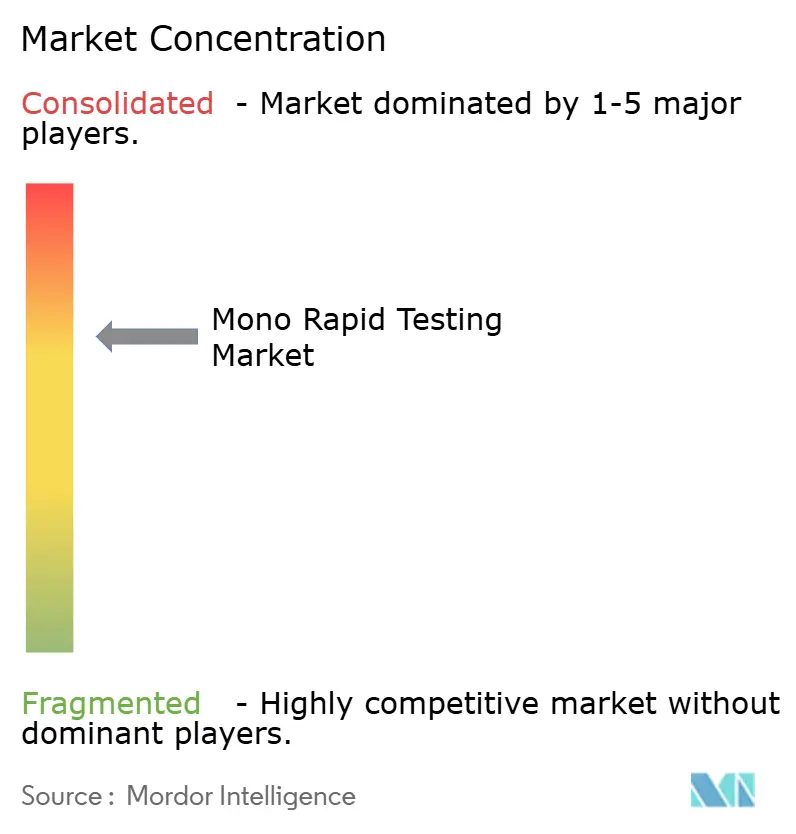
| Market Concentration | Medium |
Major Players *Disclaimer: Major Players sorted in no particular order Image © Mordor Intelligence. Reuse requires attribution under CC BY 4.0. | |
Mono Rapid Testing Market Analysis by Mordor Intelligence
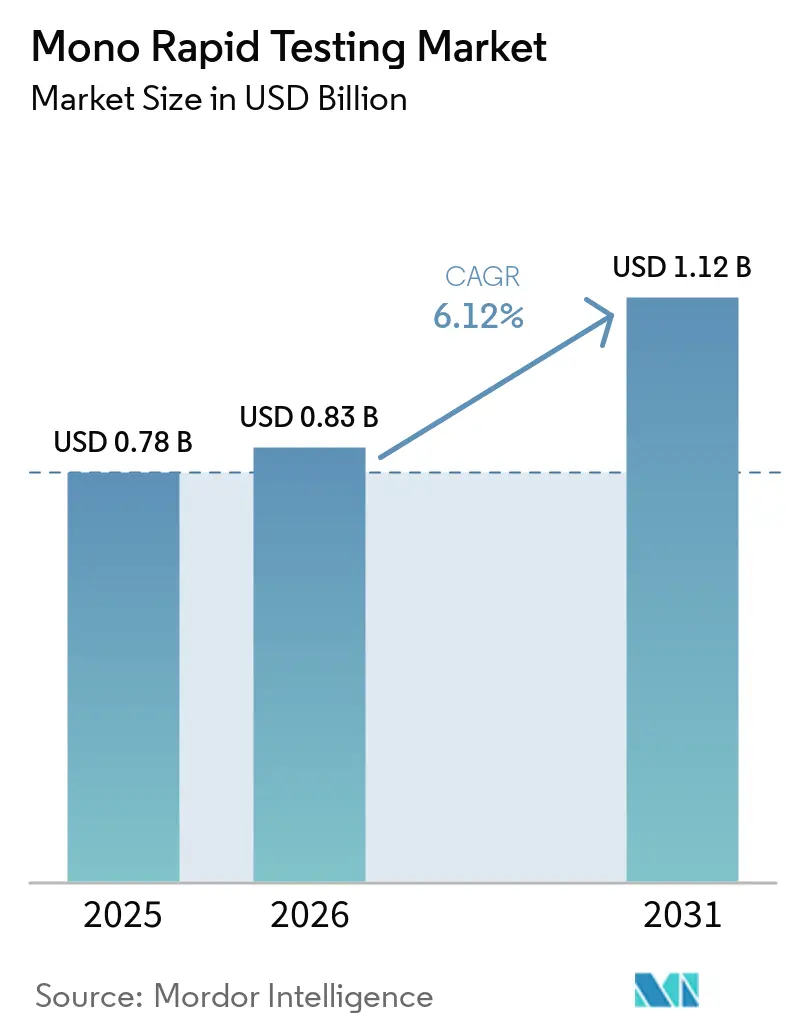
The Mono Rapid Testing Market size is projected to expand from USD 0.78 billion in 2025 and USD 0.83 billion in 2026 to USD 1.12 billion by 2031, registering a CAGR of 6.12% between 2026 and 2031.
The market covers heterophile antibody assays that support point-of-care diagnosis of infectious mononucleosis associated with Epstein-Barr virus infection. Same-visit diagnosis remains important in emergency departments, urgent care centers, physician offices, and student health clinics. A typical clinical presentation often does not require laboratory confirmation, which supports continued use of rapid testing where symptoms are clear. The mono rapid testing market continues to benefit from simple workflows, low equipment needs, and the need to avoid unsuitable antibiotic treatment. EBV-specific serology and molecular methods are gaining ground in complex cases, but their greater workflow demands leave room for rapid heterophile testing in decentralized care.
Key Report Takeaways
- By test format, monospot cassette tests held 37.65% of the mono rapid testing market share in 2025, while slide agglutination monospot tests are forecast to grow at a 8.5% CAGR through 2031.
- By sample type, whole blood held 56.53% of the mono rapid testing market share in 2025, while serum is forecast to grow at a 9.6% CAGR through 2031.
- By end user, hospitals and health systems held 62.54% of the mono rapid testing market share in 2025, while academic and student health institutions are forecast to grow at a 9.5% CAGR through 2031.
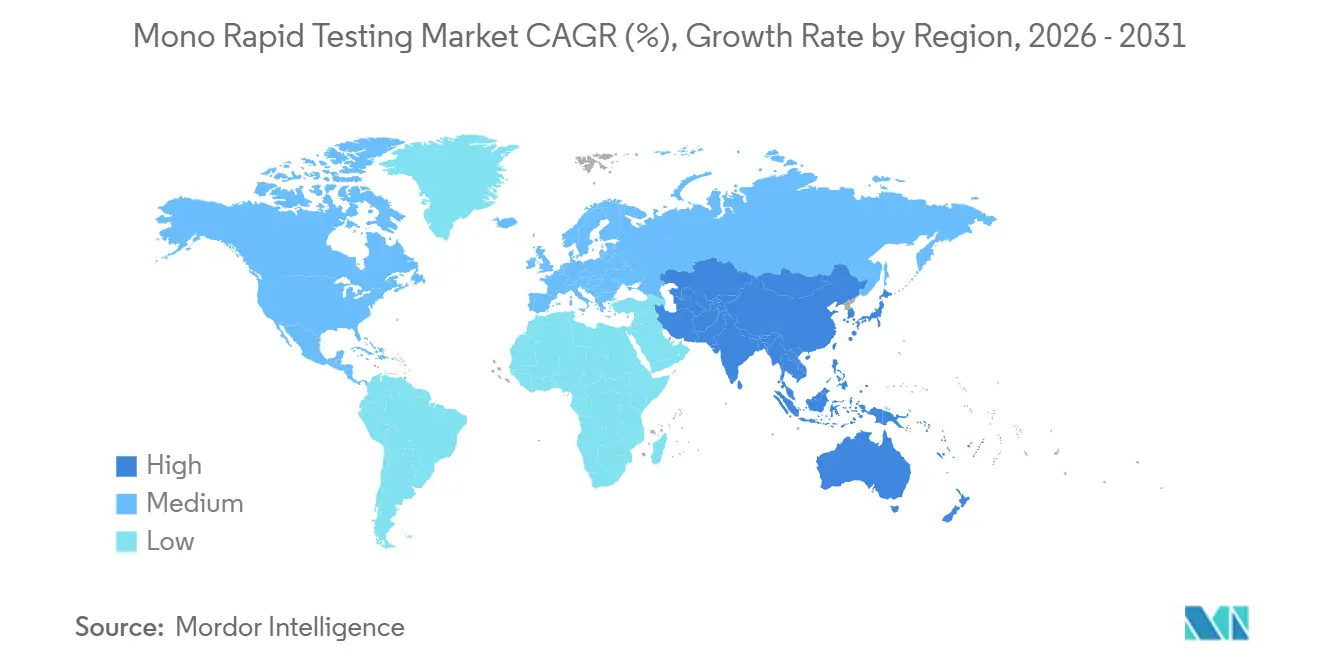
- By geography, North America held 42.65% of the mono rapid testing market share in 2025, while Asia-Pacific is forecast to grow at a 7.43% CAGR through 2031.
Note: Market size and forecast figures in this report are generated using Mordor Intelligence’s proprietary estimation framework, updated with the latest available data and insights as of January 2026.
Global Mono Rapid Testing Market Trends and Insights
Drivers Impact Analysis*
| Driver | (~) % Impact on CAGR Forecast | Geographic Relevance | Impact Timeline |
|---|---|---|---|
| Need for Rapid Diagnosis of Infectious Mononucleosis | +1.40% | Global | Short term (≤ 2 years) |
| High Demand for Testing Among Adolescents and Young Adults | +1.20% | Global, strongest in North America and Europe | Medium term (2-4 years) |
| Expansion of Point-of-Care Testing in Clinics and Emergency Departments | +0.90% | North America and Europe | Medium term (2-4 years) |
| Low Equipment Requirements for Monospot Testing | +0.60% | Global, particularly emerging markets | Short term (≤ 2 years) |
| Growing Use of Rapid Testing in Student Health and Sports Medicine | +0.70% | North America and Europe | Medium term (2-4 years) |
| Increasing Access to Decentralized Diagnostics in Emerging Markets | +0.70% | Asia-Pacific, Middle East and Africa, and South America | Long term (≥ 4 years) |
| Source: Mordor Intelligence | |||
Need for Rapid Diagnosis of Infectious Mononucleosis
Infectious mononucleosis can resemble streptococcal pharyngitis, influenza, and respiratory syncytial virus infection at presentation. This overlap makes a quick clinical distinction useful in frontline settings. Ampicillin or amoxicillin treatment can cause a rash in patients with infectious mononucleosis, which makes correct identification important. A positive monospot result can guide care during the same visit and reduce inappropriate antibiotic use. The American Medical Society of Sports Medicine recognizes heterophile antibody testing as one tool used alongside EBV-specific antibody testing and PCR in athletic care. High specificity in adults supports action after a positive result, although persistent clinical suspicion after a negative result can warrant follow-up testing.
High Demand for Testing Among Adolescents and Young Adults
Adolescents and young adults aged 15-24 remain the main population for symptomatic infectious mononucleosis. In many developing countries, EBV infection occurs during early childhood and is usually asymptomatic. In higher-income countries, delayed primary infection concentrates symptomatic disease in secondary schools, universities, and sports programs. At least 1 in 4 teenagers and young adults who contract EBV develop infectious mononucleosis. This pattern supports regular test procurement by campus health clinics and sports medicine services. The mono rapid testing market, therefore, retains a recurring base of demand that is less exposed to automation changes in adult laboratory medicine.
Expansion of Point-of-Care Testing in Clinics and Emergency Departments
Emergency departments are a major setting for monospot ordering because patients often need a result during the initial consultation. A 2024 review at University Hospitals Cleveland Medical Center found that emergency departments ordered 47.5% of monospot tests. Whole-blood monospot tests can operate in low-complexity settings because they do not require an instrument. Sekisui Diagnostics states that its OSOM Mono Test provides a result in 5 minutes from fingerstick whole blood without an instrument. WHO guidance on rapid diagnostic test accessibility supports designs that can be used across hospitals, clinics, and community settings[1]World Health Organization, “Rapid Diagnostic Test Accessibility Considerations for Professional Use and Self-Tests,” World Health Organization, who.int.. The mono rapid testing market can therefore extend beyond centralized laboratories as clinics add decentralized diagnostic capacity.
Growing Use of Rapid Testing in Student Health and Sports Medicine
Student health services value rapid testing because infectious mononucleosis can affect attendance and participation in sports. Splenomegaly occurs in around 50% of cases and creates a risk of splenic rupture during contact sports. Athletes are typically restricted from contact sports for at least 3-4 weeks after symptom onset. A 2024 sports medicine study linked AST and ALT values with spleen size in patients with infectious mononucleosis. Rapid, low-skill testing fits the first clinical visit at student health clinics. The mono rapid testing market also has a role in care pathways where clinicians must make timely return-to-play decisions.
Restraints Impact Analysis*
| Restraint | (~) % Impact on CAGR Forecast | Geographic Relevance | Impact Timeline |
|---|---|---|---|
| Reduced Sensitivity During Early-Stage Infection | -0.70% | Global | Short term (≤ 2 years) |
| Lower Test Performance in Young Children and Older Adults | -0.40% | Global | Medium term (2-4 years) |
| Cross-Reactivity and False-Positive Results | -0.30% | Global | Short term (≤ 2 years) |
| Substitution by Epstein-Barr Virus-Specific Serology and Molecular Testing | -0.50% | North America and Europe | Long term (≥ 4 years) |
| Source: Mordor Intelligence | |||
Reduced Sensitivity During Early-Stage Infection
The main clinical limitation of the monospot test is lower sensitivity early in the illness. Heterophile antibodies can rise during the second and third weeks of infection, leaving early presentations with a false-negative risk. A 2024 University Hospitals Cleveland Medical Center analysis reported 64% monospot sensitivity, compared with 96.4% for EBV antibody profiles in adolescents and adults. Clinicians may repeat a monospot test later or move to EBV serology after an early negative result. This can increase diagnostic time and cost in pediatric emergency and inpatient settings. Cross-reactivity and lower performance in younger children and older adults further narrow the situations where a standalone monospot result is sufficient.
Substitution by Epstein-Barr Virus-Specific Serology and Molecular Testing
CDC guidance does not recommend heterophile antibody testing as the primary method for diagnosing EBV infection because the test is not specific for EBV[2]Centers for Disease Control and Prevention, “Laboratory Testing for Epstein-Barr Virus (EBV),” Centers for Disease Control and Prevention, cdc.gov.. EBV antibody profiles can measure VCA IgM, VCA IgG, early antigen IgG, and EBNA IgG in centralized laboratory workflows. The FDA cleared Abbott Molecular’s Alinity m EBV assay in July 2025 for quantitative detection of EBV DNA in plasma from transplant patients[3]U.S. Food and Drug Administration, “510(k) K243489, Alinity m EBV,” U.S. Food and Drug Administration, fda.gov.. These methods increase substitution pressure in hospitals with automated laboratory capacity. They are less practical in small clinics and other decentralized sites that value low-cost, instrument-free testing. The mono rapid testing market is therefore more exposed at the high-acuity end of care than in community settings.
*Our forecasts treat driver/restraint impacts as directional, not additive. The impact forecasts reflect baseline growth, mix effects, and variable interactions.
Segment Analysis
By Test Format: Cassette Format Sustains Volume, Slide Agglutination Attracts Innovation
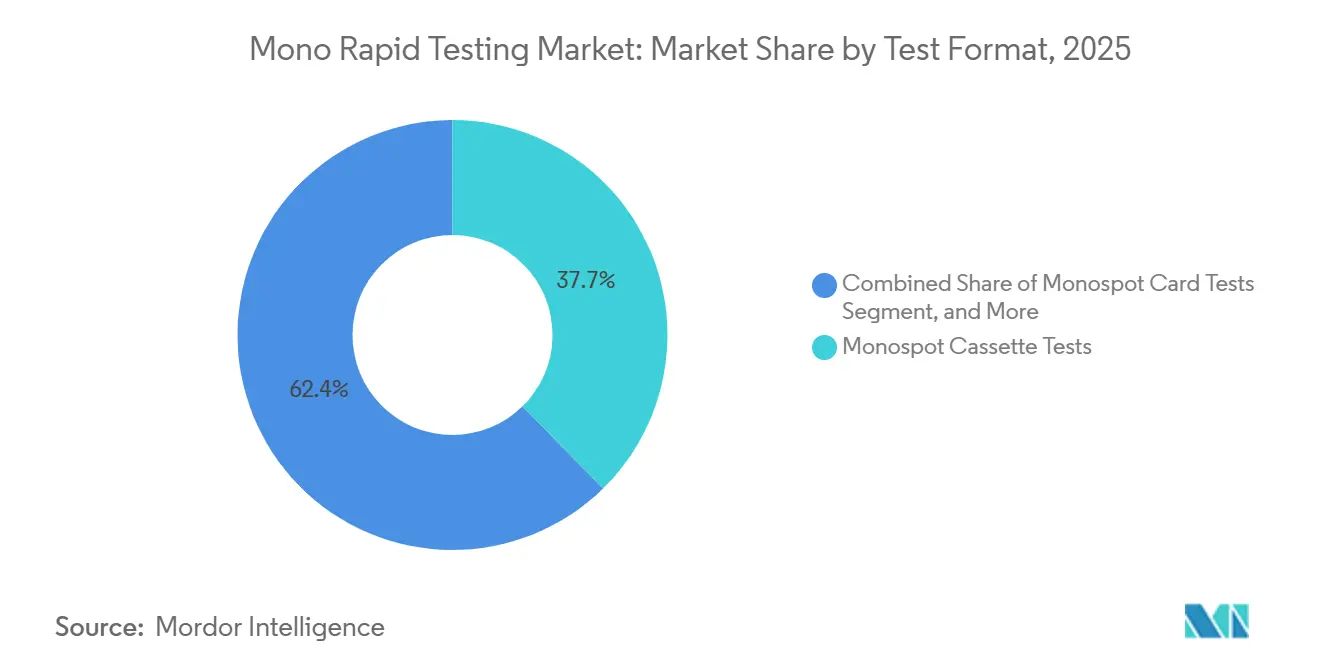
Monospot cassette tests held 37.65% of the mono rapid testing market share in 2025. The format fits point-of-care use because it supports fingerstick whole-blood testing and does not need an instrument. Abbott’s Clearview IM II reports 98% positive agreement and 99% negative agreement in product documentation. Sekisui Diagnostics offers the OSOM Mono Test for rapid whole-blood testing, while cassette designs support use in physician offices, urgent care centers, and lower-resource settings. The mono rapid testing industry continues to rely on cassette formats where rapid decisions matter.
Slide agglutination monospot tests are forecast to grow at an 8.5% CAGR through 2031. Their manual workflow can still support batch testing when student clinics manage seasonal testing demand. A 2025 study examined a clinical scoring tool to predict monospot positivity and reduce unnecessary orders. This approach may improve testing efficiency in settings that process many samples together, while card and tube-based agglutination tests continue to serve older hospital and reference laboratory procurement channels. The mono rapid testing market is shifting toward formats that combine reliable handling with simpler workflow control.



By Sample Type: Whole Blood Anchors Volume, Serum Offers Analytical Precision
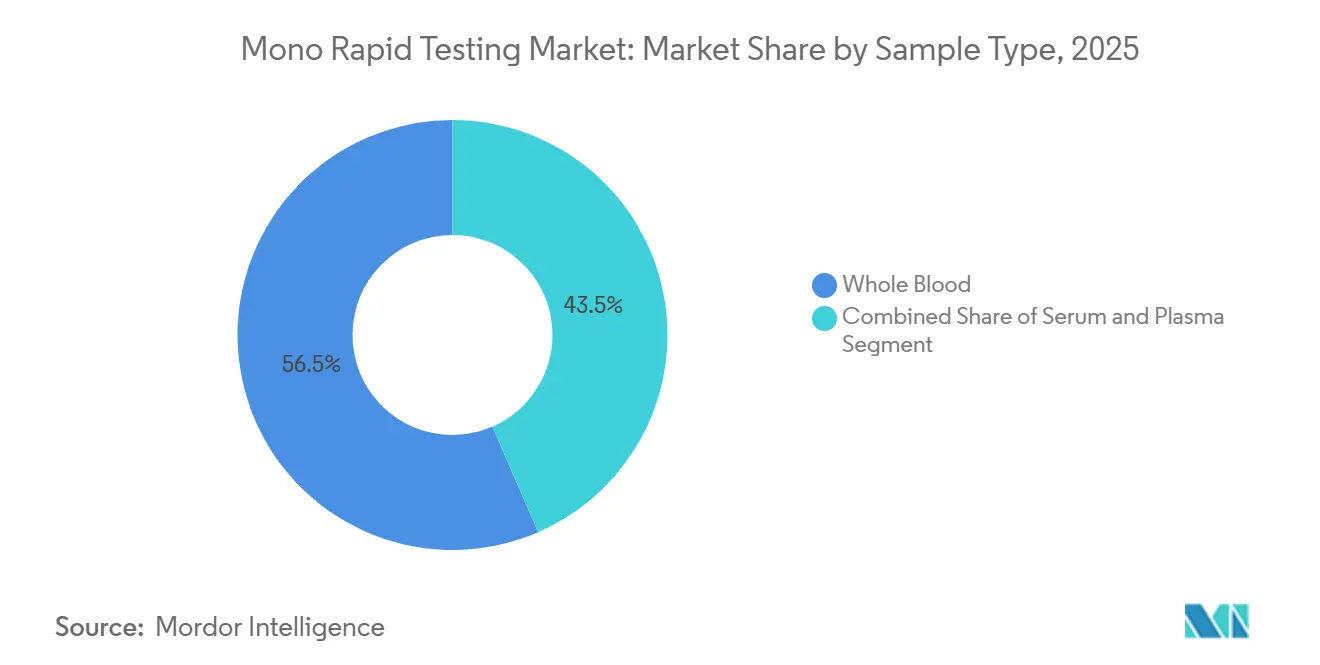
Whole blood held 56.53% of the mono rapid testing market share in 2025. Fingerstick collection avoids the need for venipuncture training and full phlebotomy support. This makes whole blood suitable for locations without laboratory professionals on site. BD and Babson Diagnostics launched a fingertip blood testing system in December 2024 that used as few as 6 drops of capillary blood, supporting wider capillary collection in ambulatory and urgent care workflows. The mono rapid testing industry benefits when collection methods lower pre-analytical barriers.
Serum is forecast to grow at a 9.6% CAGR through 2031. Centralized laboratories use serum in EBV serology because it supports antibody-based testing workflows. Serum can also connect an initial rapid screen with a reflex EBV antibody profile, creating demand where hospitals seek consistency between screening and confirmatory testing. Plasma remains a smaller and more specialized sample type for integrated serology and molecular workflows. The mono rapid testing market retains whole blood as the practical choice for decentralized testing, while serum supports laboratory-led diagnostic pathways.
By End User: Hospitals at the Core, Student Health Institutions Accelerate
Hospitals and health systems held 62.54% of the mono rapid testing market share in 2025. They manage moderate and severe cases that may involve splenomegaly, hepatitis, or airway compromise. University Hospitals Cleveland Medical Center reported that emergency departments accounted for 47.5% of monospot orders in 2024. The same analysis reported a 12.3% positive rate in emergency care and a 1.5% positive rate among inpatients, while independent diagnostic laboratories and physician offices remain established procurement channels. The mono rapid testing market depends on hospital ordering volumes while also serving outpatient care.
Academic and student health institutions are forecast to grow at a 9.5% CAGR through 2031. College students are a higher-risk group for symptomatic EBV infection. Fast diagnosis supports student wellness services and sports program management. Risk of splenic rupture can require a pause in contact sports, making timely diagnosis relevant to athletic clearance, while urgent care centers are another growing channel because the test provides a rapid result without instrumentation. The mono rapid testing market can expand through these settings as primary care access becomes more decentralized.
Geography Analysis
North America held 42.65% of the mono rapid testing market share in 2025. The region has a large base of CLIA-waived testing sites and high diagnostic use in physician offices and urgent care centers. Whole-blood cassette tests fit these settings because they do not require instrument investment. Canada and Mexico add demand through formulary-led purchasing and clinical care networks. The mono rapid testing market remains well established in North America because rapid tests are embedded in outpatient workflows.
Europe has lower testing volumes in some systems because primary care is more strongly managed through gatekeeping. However, the EU In Vitro Diagnostic Regulation supports investment in compliant test portfolios. Meridian Bioscience achieved IVDR certification for its Alethia molecular assay portfolio in February 2026. Germany, the United Kingdom, and France remain important sources of demand through large primary care networks. The mono rapid testing market in Europe is shaped by regulatory compliance and the replacement of older test formats.
Asia-Pacific is forecast to grow at a 7.4% CAGR through 2031. China and India have large potential patient populations, although clinical confirmation has historically been limited by primary care testing access. Roche’s Elecsys EBV VCA IgG received innovation approval from China’s National Medical Products Administration in December 2025, raising the profile of EBV diagnostics in China. Middle East and Africa and South America remain smaller markets, but growing point-of-care diagnostic capacity supports demand across private hospitals, community sites, and university health settings.

Competitive Landscape
The mono rapid testing market has a moderately concentrated structure. Abbott, Sekisui Diagnostics, QuidelOrtho, and Meridian Bioscience are established participants, while regional suppliers compete through pricing and distribution. Abbott’s Clearview IM II and Sekisui Diagnostics’ OSOM Mono Test are prominent rapid formats with established clinical documentation. Companies use hospital purchasing groups and national distribution channels to maintain access to clinical accounts. Multi-analyte point-of-care portfolios can also reduce demand for standalone purchasing decisions.
QuidelOrtho announced an agreement in June 2025 to acquire LEX Diagnostics for USD 100 million. The transaction targeted a molecular point-of-care platform with positive results in 6 minutes for selected respiratory tests. Abbott received FDA clearance for its Alinity m EBV assay in July 2025, extending its EBV offering for transplant monitoring. Meridian Bioscience launched liquid ambient-temperature-stable qPCR master mixes in September 2025, showing how suppliers are developing capabilities across rapid and molecular diagnostics. The mono rapid testing market continues to reward firms that can support decentralized workflows and regulatory requirements.
Vircell’s VIRAPID MONO combines Paul-Bunnell heterophile antibodies with VCA IgM, VCA IgG, and EBNA IgG markers in one immunochromatographic device. This approach addresses the need for more information than a single heterophile result can provide. ISO 13485 quality systems, IVDR compliance, and FDA clearance remain important entry requirements. The mono rapid testing market, therefore, has barriers that favor suppliers with regulatory, manufacturing, and distribution capabilities.
Mono Rapid Testing Industry Leaders
Abbott Laboratories
Becton, Dickinson and Company
bioMérieux SA
Cardinal Health
Danaher Corporation
- *Disclaimer: Major Players sorted in no particular order



Global Mono Rapid Testing Market Report Scope
| Monospot Cassette Tests |
| Monospot Card Tests |
| Slide Agglutination Monospot Tests |
| Tube-Based Agglutination Tests |
| Whole Blood |
| Serum |
| Plasma |
| Hospitals and Health Systems |
| Independent Diagnostic Laboratories |
| Physician Offices |
| Urgent Care Centers |
| Academic and Student Health Institutions |
| Other End Users |
| North America | United States |
| Canada | |
| Mexico | |
| Europe | Germany |
| United Kingdom | |
| France | |
| Italy | |
| Spain | |
| Rest of Europe | |
| Asia-Pacific | China |
| Japan | |
| India | |
| Australia | |
| South Korea | |
| Rest of Asia-Pacific | |
| Middle East and Africa | GCC |
| South Africa | |
| Rest of Middle East and Africa | |
| South America | Brazil |
| Argentina | |
| Rest of South America |
| By Test Format | Monospot Cassette Tests | |
| Monospot Card Tests | ||
| Slide Agglutination Monospot Tests | ||
| Tube-Based Agglutination Tests | ||
| By Sample Type | Whole Blood | |
| Serum | ||
| Plasma | ||
| By End User | Hospitals and Health Systems | |
| Independent Diagnostic Laboratories | ||
| Physician Offices | ||
| Urgent Care Centers | ||
| Academic and Student Health Institutions | ||
| Other End Users | ||
| Geography | North America | United States |
| Canada | ||
| Mexico | ||
| Europe | Germany | |
| United Kingdom | ||
| France | ||
| Italy | ||
| Spain | ||
| Rest of Europe | ||
| Asia-Pacific | China | |
| Japan | ||
| India | ||
| Australia | ||
| South Korea | ||
| Rest of Asia-Pacific | ||
| Middle East and Africa | GCC | |
| South Africa | ||
| Rest of Middle East and Africa | ||
| South America | Brazil | |
| Argentina | ||
| Rest of South America | ||


Key Questions Answered in the Report
What is driving demand for mono rapid testing?
Same-visit diagnosis, decentralized care, and demand among adolescents and young adults support test use. At least 1 in 4 teenagers and young adults who contract EBV develop infectious mononucleosis.
What is the forecast growth rate for mono rapid testing?
The mono rapid testing market is forecast to grow at a 6.1% CAGR from 2026 to 2031 and reach USD 1.12 billion by 2031.
Which test format leads demand?
Monospot Cassette Tests led with a 37.65% share in 2025, supported by fingerstick compatibility and instrument-free operation.
Which sample type is most widely used for mono rapid testing?
Whole blood led with a 56.53% share in 2025 because it supports fingerstick collection in decentralized settings.
Why are student health clinics important for testing?
Students and athletes need prompt assessment, particularly because splenomegaly can restrict contact sports for at least 3-4 weeks after symptom onset.
What limits use of the monospot test?
Sensitivity is lower early in illness, and EBV-specific serology or molecular testing may be used for confirmation in complex cases.
Which region has the strongest growth outlook?
Asia-Pacific is forecast to grow at a 7.4% CAGR through 2031, supported by expanding primary care diagnostic access and higher awareness of EBV testing needs.
Page last updated on:





