
Mold Release Agents Market Size and Share
Market Overview
| Study Period | 2022 - 2032 |
|---|---|
| Market Size (2027) | USD 2.71 Billion |
| Market Size (2032) | USD 3.65 Billion |
| Growth Rate (2027 - 2032) | 6.13 % |
| Fastest Growing Market | Asia-Pacific |
| Largest Market | Asia-Pacific |
| Market Concentration | Low |
Major Players *Disclaimer: Major Players sorted in no particular order Image © Mordor Intelligence. Reuse requires attribution under CC BY 4.0. | |
Mold Release Agents Market Analysis by Mordor Intelligence
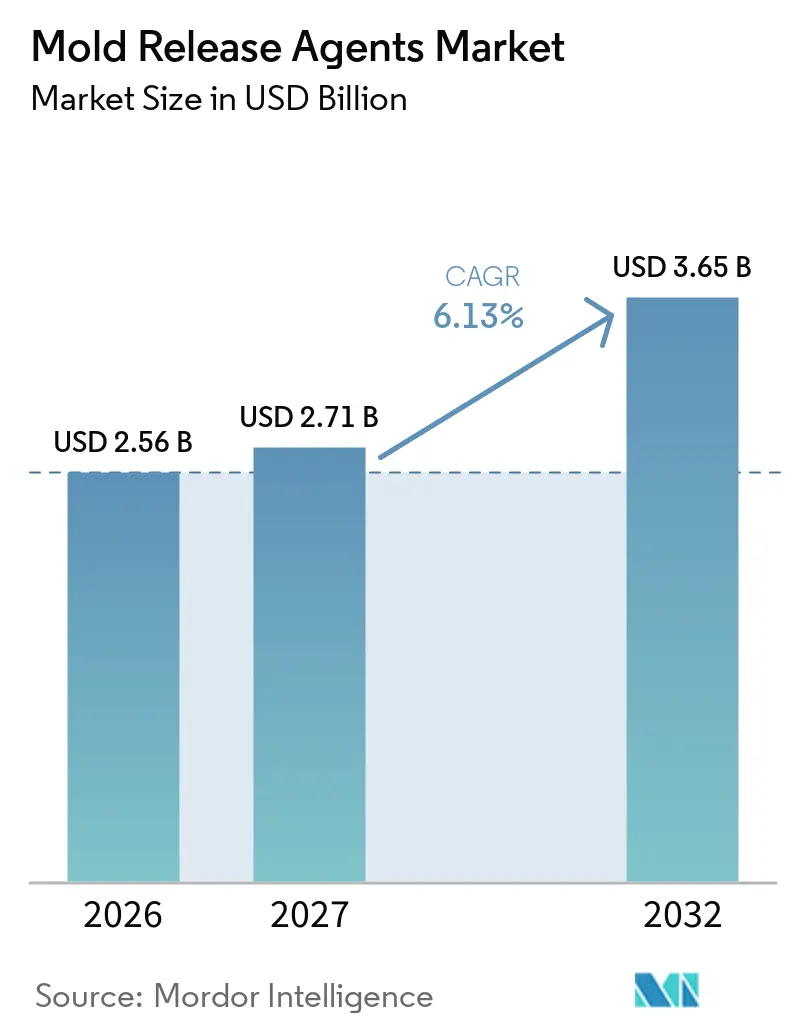
The Mold Release Agents Market size was valued at USD 2.56 billion in 2026 and is estimated to grow from USD 2.71 billion in 2027 to reach USD 3.65 billion by 2032, at a CAGR of 6.13% during the forecast period (2027-2032). The mold release agents market is supported by manufacturers that need consistent demolding, lower scrap, and longer mold life across casting, plastics, rubber, and composites. Automotive electrification is raising the use of aluminum cast parts, which places greater emphasis on stable release performance in high-pressure die casting. Water-based and fluorine-free product development is becoming more important as emissions rules and customer qualification requirements reshape formulation choices. Aerospace and wind-component producers create opportunities for suppliers that can meet demanding multi-cycle performance and certification needs. The mold release agents market also favors suppliers that can support customers during product trials, equipment adjustments, and approval processes.
Key Report Takeaways
- By type, water-based release agents held 56.15% of the mold release agents market share in 2026 and are forecast to advance at a 6.46% CAGR through 2032.
- By application, die casting held 32.67% of the mold release agents market share in 2026, while polyurethane molding is forecast to advance at a 7.19% CAGR through 2032.
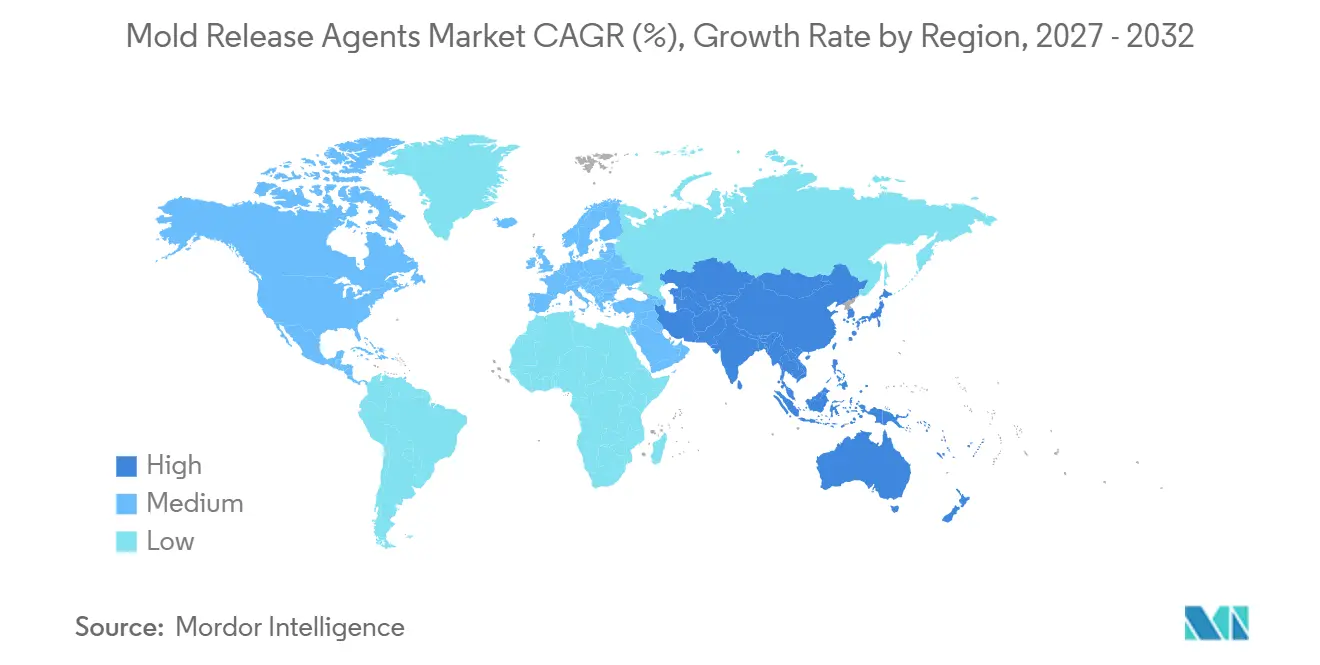
- By geography, Asia-Pacific held 44.73% of the mold release agents market share in 2026 and is forecast to advance at a 7.13% CAGR through 2032.
Note: Market numbers in this report are based on Mordor Intelligence's proprietary estimation framework, which combines nine months of actuals with Q4 projections for base year 2026.
Market Trends and Insights
Drivers Impact Analysis of Mold Release Agents Market*
| Driver | (~) % Impact on CAGR Forecast | Geographic Relevance | Impact Timeline |
|---|---|---|---|
| Automotive Lightweighting and EV Structural Casting | +1.8% | Global, concentrated in Asia-Pacific, North America, and Europe | Medium term (2–4 years) |
| Rising Molded-Component Production in Asia-Pacific | +1.5% | Asia-Pacific core, spillover to North America and Europe | Medium term (2–4 years) |
| Shift Toward Water-Based and PFAS-Free Formulations | +1.2% | Global, with regulatory-driven acceleration in North America and EU | Short term (≤ 2 years) |
| Expansion of Composite Manufacturing in Aerospace and Wind Energy | +0.9% | North America, Europe, and Asia-Pacific | Long term (≥ 4 years) |
| Demand for Longer Mold Life and Lower Scrap | +0.6% | Global | Long term (≥ 4 years) |
| Source: Mordor Intelligence | |||
Automotive Lightweighting and EV Structural Casting
Global electric vehicle sales reached 20 million units in 2025, representing more than one in four new cars sold worldwide. Electric vehicle platforms use 25%-27% more aluminum by weight than internal combustion vehicle platforms. Battery enclosures, motor housings, and underbody structures rely on die-cast parts, which support demand within the mold release agents market. High-pressure die casting accounted for 70%-80% of automobile castings in 2025, and larger casting machines increase the need for stable mold protection and heat transfer. Chem-Trend L.P. launched SL-10187 in March 2025 for high-pressure aluminum casting, with biostability, heat exchange, and weld protection as the stated performance targets. Failure in a structural casting cell can create scrap and warranty costs that exceed the cost of the release agent, which supports technically qualified supply arrangements.
Shift Toward Water-Based and PFAS-Free Formulations
The U.S. Environmental Protection Agency amended the National Volatile Organic Compound Emission Standards for aerosol coatings in 2025. The rule set the mold release coating category limit at 1.10 g O₃/g product and took effect on July 17, 2025[1]. This requirement supports low-volatile organic compound (VOC) product design and strengthens the commercial case for water-based systems in the mold release agents market. Product changes can require testing, documentation, and customer approval before a reformulated material can return to an approved supplier list. Larger suppliers can fund parallel development programs and technical support across several product lines. Smaller producers can face a more difficult transition when formulation work and customer trials occur at the same time.
Rising Molded-Component Production in Asia-Pacific
Asia-Pacific’s production base supports demand for mold release products used in die casting, injection molding, and rubber processing. India is developing as an additional demand center, with injection-molded plastics activity and automotive supplier investment supporting use across several molding processes. Vietnam, Thailand, and Indonesia are receiving electronics and light-vehicle assembly activity, which creates opportunities for the mold release agents market as new manufacturing lines are installed. Suppliers can build stronger customer relationships where they provide process advice alongside the material itself.
Expansion of Composite Manufacturing in Aerospace and Wind Energy
Composite molds used for wind turbine blades require release products that can sustain performance over repeated demolding cycles. Full-scale testing of 40-meter blade molds found that demolding forces rose with successive cycles. This increases the value of multi-cycle products in the mold release agents market, especially where mold cleaning affects production time. Aerospace customers also require extensive product qualification before release materials can be used in structural composite processes. Chem-Trend L.P. received an aerospace Integrated Product Support (IPS) certification for Zyvax 1070W EU in February 2026 for automated tape laying and fiber placement applications. The certification covered a water-based, fluorine-free, silicone-free product and increased the supplier’s approved solutions for that customer to 5.
Restraints Impact Analysis of Mold Release Agents Market*
| Restraint | (~) % Impact on CAGR Forecast | Geographic Relevance | Impact Timeline |
|---|---|---|---|
| VOC, PFAS, and Solvent Compliance Costs | -0.8% | North America and EU, with spillover to Asia-Pacific | Short term (≤ 2 years) |
| Raw-Material Price and Availability Volatility | -0.6% | Global | Short term (≤ 2 years) |
| Silicone Migration and Post-Molding Adhesion Failures | -0.3% | Global | Medium term (2–4 years) |
| Source: Mordor Intelligence | |||
VOC, PFAS, and Solvent Compliance Costs
Volatile Organic Compound (VOC) limits require producers to examine the carrier systems used in aerosol and other release products. The 2025 U.S. federal aerosol-coating amendments make regulatory documentation and formulation testing more important for suppliers serving this category. Customer requalification can add time and cost when a manufacturer replaces an established chemistry. These demands may favor companies that have laboratory capacity, application engineers, and broad customer support teams. The mold release agents market can therefore become more concentrated in regulated product categories without an abrupt change in the number of suppliers. Customers may also ask for updated application guidance and environmental documentation when spray practices or product composition change.
Raw-Material Price and Availability Volatility
The mold release agents market depends on silicone oils, waxes, and specialty surfactants that respond to different supply conditions. Silicone-based release materials are exposed to the availability and cost of cyclic siloxane inputs, while wax-based products are affected by petroleum-linked feedstocks. This exposure can reduce margins when supply contracts prevent immediate price adjustments. Producers with longer supply agreements can better manage sudden movements in input costs. Regional suppliers may have less flexibility to absorb cost changes while maintaining performance specifications. Supply continuity remains important because molding customers usually prioritize consistent output and low scrap over frequent material changes.
*Our forecasts treat driver/restraint impacts as directional, not additive. The impact forecasts reflect baseline growth, mix effects, and variable interactions.
Mold Release Agents Market Segment Analysis
By Type:
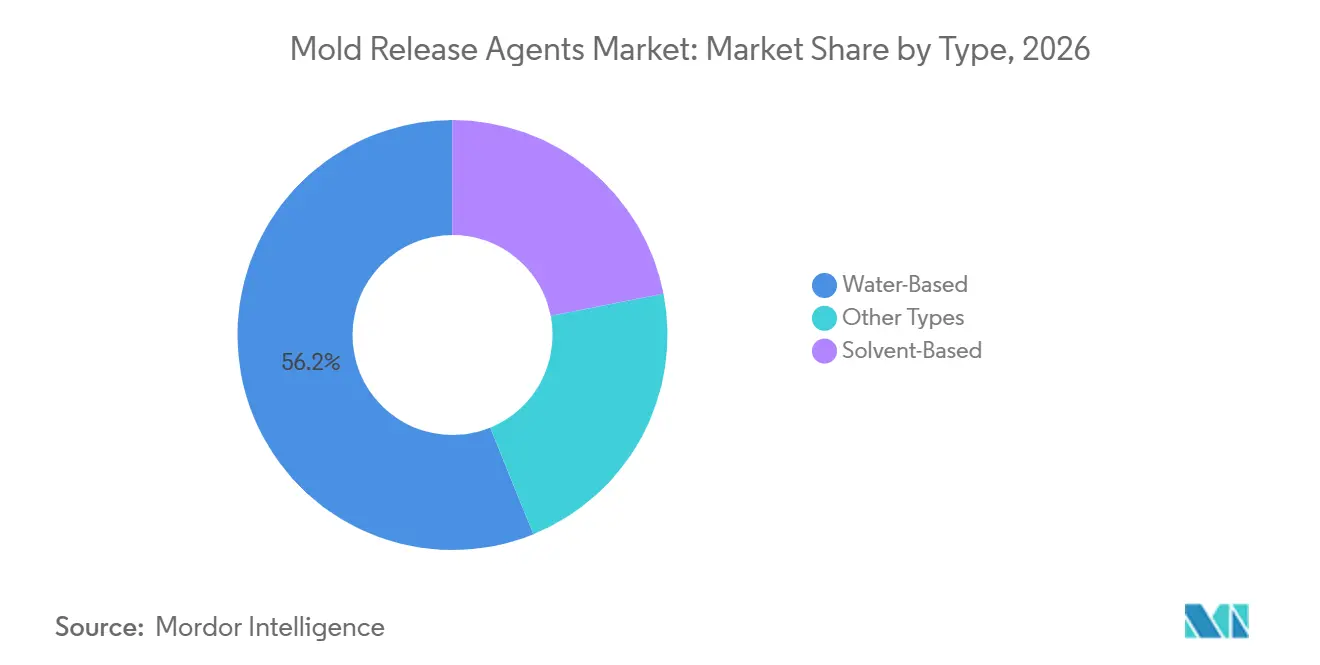
Water-Based Leads Both Scale and GrowthWater-based held 56.15% of the market share in 2026 and is projected to advance at a 6.46% CAGR through 2032. This segment accounted for the largest mold release agents market size among the listed product types in 2026. Water-based emulsions can use silicone polymers, wax dispersions, fatty-acid derivatives, and other active ingredients to support wetting and film formation. The materials are increasingly relevant where customers are seeking lower-VOC products without giving up repeated-release performance. Chem-Trend L.P. presented 2775W at the Composites and Advanced Materials Expo (CAMX) 2025 as a water-based, VOC-free, fluorine-free release agent designed to provide up to 4 times more releases per application than conventional paste wax. This type of product shows how performance improvement can support the transition away from solvent carriers in composite processes.
Solvent-based systems still have a role in high-speed rubber vulcanization, complex mold filling, and facilities where water quality or operating temperature affects emulsion stability. Their continued use reflects process-specific requirements rather than a uniform product shift. Other types include aerosol and dry-film products used in maintenance and precision applications. These categories serve narrower needs and have steadier demand. The mold release agents industry continues to require multiple chemistries because individual manufacturing lines have different cycle times, temperatures, and surface-finish requirements. Suppliers that offer water-based products and specialized alternatives can serve customers who need to qualify materials for several applications.



By Application:
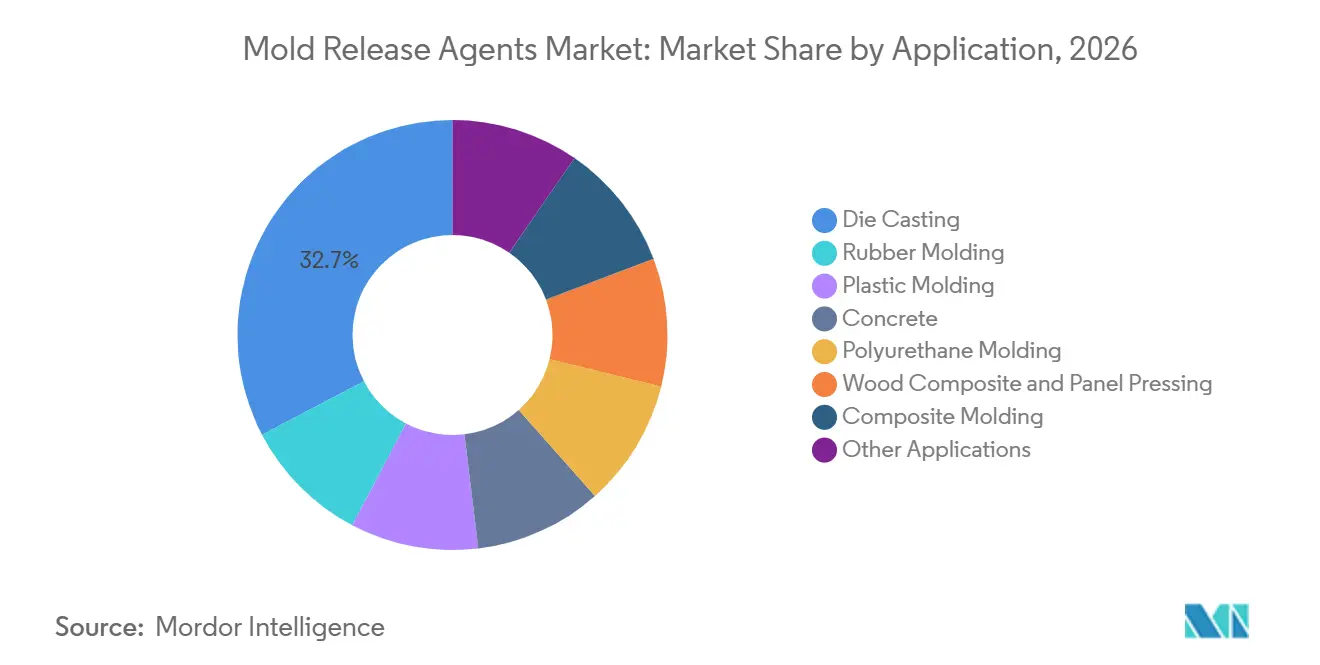
Die Casting Anchors Revenue, While Polyurethane Molding Scales FastestDie casting held 32.67% of the market share in 2026. The process uses high cycling rates, large mold surfaces, and controlled dilution, which creates consistent demand for release materials. Aluminum battery enclosures, motor housings, and underbody structures support the use of die-cast components in electric vehicle production. Global electric vehicle sales reached 20 million units in 2025, reinforcing the manufacturing base for these applications. The mold release agents market benefits where casting suppliers need dependable demolding, surface quality, and mold protection across long production runs.
Rubber molding supports demand in tire production, industrial sealing, and flexible automotive components. LANXESS serves the rubber value chain through its Rhein Chemie business, which offers processing additives and related materials to rubber manufacturers. Plastic molding supports consumer electronics, packaging, and medical-device output, particularly where injection-molding capacity is expanding. Polyurethane molding is projected to advance at a 7.19% CAGR through 2032, supported by uses in automotive seating, insulation, footwear, and medical cast parts. Composite molding, concrete form release, and wood-composite pressing each serve different manufacturing chains. Composite applications track aerospace and wind activity, while concrete and wood-composite applications are linked to construction and infrastructure demand.

Geography Analysis
APAC Mold Release Agents Market
Asia-Pacific held 44.73% of the market share in 2026 and is projected to advance at a 7.13% CAGR through 2032. China is the main regional production center because of its automotive casting operations and large electronics manufacturing base. India adds demand through its automotive supplier network and plastics processing capacity. Japan and South Korea support precision applications that require close control of molded surface quality. These manufacturing clusters give the mold release agents market a broad customer base across casting, rubber, plastics, and composites.
ASEAN, North America and Europe Mold Release Agents Market
Vietnam, Thailand, and Indonesia are attracting electronics and automotive assembly from higher-cost production locations. This activity creates new requirements for approved release materials as equipment and supply relationships are established. North America and Europe are important value markets because of their regulatory requirements, qualified supply chains, and concentration of high-specification applications. In North America, demand for structural aluminum casting is linked to investment in electric vehicle production. Europe has an established aerospace and wind-composite manufacturing base, which supports the use of products that meet demanding qualification requirements. LANXESS announced an expansion of rubber processing promoter production at its Bushy Park facility in South Carolina in September 2025, with production planned to begin in November 2025[2].
South America and MEA Mold Release Agents Market
South America and the Middle East and Africa contribute through applications with distinct local demand patterns. Brazil supports concrete form release and automotive casting through its construction and industrial activity. Argentina provides additional demand through agricultural equipment and automotive components. Gulf Cooperation Council countries are developing downstream plastics and rubber processing, creating opportunities tied to hydrocarbon-based raw materials. South Africa supports demand through automotive casting and catalytic-converter manufacturing. Infrastructure-related concrete release applications provide a stable base in these regions, even when more specialized uses grow at a different pace.
Competitive Landscape
Market Concentration
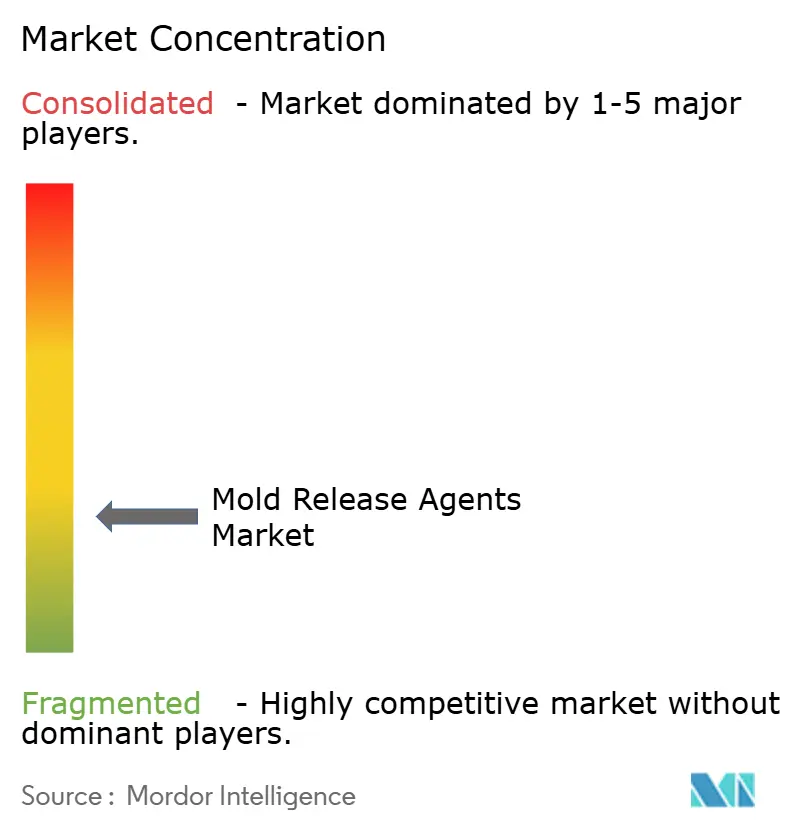
The mold release agents market is highly fragmented, with the top five players including Henkel AG & Co. KGaA, Shin-Etsu Chemical Co., Ltd., Wacker Chemie AG, Dow, and DAIKIN INDUSTRIES, Ltd. Global suppliers have stronger positions where aerospace, automotive original equipment manufacturers, and composite producers require certified materials and long approval cycles. Regional suppliers continue to serve price-sensitive rubber, plastic, and concrete applications. The mold release agents market rewards technical service because material performance is closely connected to mold condition, application method, and downstream finishing needs.
Freudenberg SE, through Chem-Trend L.P., has developed a portfolio of approved Zyvax composite release products. Chem-Trend L.P.’s February 2026 IPS approval for Zyvax 1070W EU added a water-based solution for automated aerospace composite production. Chem-Trend L.P. also received IPS approvals for Zyvax WaterShield EU and Zyvax Sealer 1028W EU in February 2026. These approvals can create switching barriers because a customer must conduct its own process qualification before adopting an alternative. DAIKIN INDUSTRIES, Ltd. received U.S. Patent 12391831 in July 2025 for a fluorine-containing polymer mold release composition. Shin-Etsu Chemical Co., Ltd. received U.S. Patent 12473473 in November 2025 for a silicone release composition that combines fluorine-containing and fluorine-lacking silicones.
LANXESS remains relevant to rubber molding through its Rhein Chemie business and integrated processing-additive offering. The company’s U.S. production expansion strengthens local availability for rubber customers in North America. Wacker Chemie AG presented POWERSIL Resin 710 at JEC World 2026 for high-temperature composite applications and positioned it as an alternative to PTFE and PEEK in certain uses. Dow, DAIKIN INDUSTRIES, Ltd., Shin-Etsu Chemical Co., Ltd., and Wacker Chemie AG compete through their material-science capabilities in silicone, fluoropolymer, and composite-related applications. Non-silicone and fluorine-free systems remain relevant where molded-part surfaces must support later bonding or painting. The mold release agents industry is likely to remain competitive because product qualification, application support, and formulation breadth matter alongside price.
Mold Release Agents Industry Leaders
-
Henkel AG & Co. KGaA
-
Shin-Etsu Chemical Co., Ltd.
-
Wacker Chemie AG
-
Dow
-
DAIKIN INDUSTRIES, Ltd.
- *Disclaimer: Major Players sorted in no particular order
Mold Release Agents Market Companies Covered in this Report
- AXEL Plastics Research Laboratories, Inc.
- Chem-Trend L.P.
- Cresset Chemical
- DAIKIN INDUSTRIES, Ltd.
- Dow
- Freudenberg SE
- Henkel AG & Co. KGaA
- LANXESS
- Marbocote
- McGee Industries, Inc.
- Michelman, Inc.
- Miller-Stephenson Chemical Company, Inc.
- REXCO
- Shin-Etsu Chemical Co., Ltd.
- Wacker Chemie AG
Recent Industry Developments in Mold Release Agents Market
- April 2026: Shanghai LoreChem Co., Ltd. showcased its LubeKote semi-permanent mold release agents and ThinkBond bonding solutions at international industry exhibitions. The showcase supports the mold release agents market by promoting release technologies for rubber molding, polyurethane processing, automotive components, and footwear manufacturing.
- April 2026: LANXESS presented its rubber-processing portfolio at India Rubber Expo 2026, including Rhenodiv BP-337 and BP-338 tire-curing release agents. These products support the mold release agents market by enabling clean demolding of cured tires while reducing material consumption compared with conventional reactive systems.
Global Mold Release Agents Market Report Scope
Mold release agents are substances applied to mold surfaces to prevent molded materials from sticking and to facilitate the removal of finished parts. They support smoother demolding, reduce surface defects, and help improve production efficiency across manufacturing and material-processing operations.
The Mold Release Agents Market is segmented by type, application, and geography. By type, the market is segmented into water-based, solvent-based, and other types. By application, the market is segmented into die casting, rubber molding, plastic molding, concrete, polyurethane molding, wood composite and panel pressing, composite molding, and other applications. The report also covers the market size and forecasts for mold release agents across 15 countries. For each segment, the market sizing and forecasts have been done on the basis of value (USD).
Segmentation Overview
| Water-Based |
| Solvent-Based |
| Other Types |
| Die Casting |
| Rubber Molding |
| Plastic Molding |
| Concrete |
| Polyurethane Molding |
| Wood Composite and Panel Pressing |
| Composite Molding |
| Other Applications |
| Asia-Pacific | China |
| India | |
| Japan | |
| South Korea | |
| ASEAN Countries | |
| Rest of Asia-Pacific | |
| North America | United States |
| Canada | |
| Mexico | |
| Europe | Germany |
| United Kingdom | |
| France | |
| Italy | |
| NORDIC Countries | |
| Rest of Europe | |
| South America | Brazil |
| Argentina | |
| Rest of South America | |
| Middle East and Africa | Saudi Arabia |
| South Africa | |
| Rest of Middle East and Africa |
| By Type | Water-Based | |
| Solvent-Based | ||
| Other Types | ||
| By Application | Die Casting | |
| Rubber Molding | ||
| Plastic Molding | ||
| Concrete | ||
| Polyurethane Molding | ||
| Wood Composite and Panel Pressing | ||
| Composite Molding | ||
| Other Applications | ||
| By Geography | Asia-Pacific | China |
| India | ||
| Japan | ||
| South Korea | ||
| ASEAN Countries | ||
| Rest of Asia-Pacific | ||
| North America | United States | |
| Canada | ||
| Mexico | ||
| Europe | Germany | |
| United Kingdom | ||
| France | ||
| Italy | ||
| NORDIC Countries | ||
| Rest of Europe | ||
| South America | Brazil | |
| Argentina | ||
| Rest of South America | ||
| Middle East and Africa | Saudi Arabia | |
| South Africa | ||
| Rest of Middle East and Africa | ||
Key Questions Answered in the Report
What is the size of the mold release agents market?
The mold release agents market size was valued at USD 2.56 billion in 2026 and is estimated to grow from USD 2.71 billion in 2027 to reach USD 3.65 billion by 2032, at a CAGR of 6.13% during the forecast period (2027-2032).
Which product type leads mold release agents market share?
Water-based release agents lead with 56.15% of the market share in 2026 and are projected to advance at a 6.46% CAGR through 2032.
What application held the largest share in 2026?
Die casting held 32.67% of the market share in 2026.
Which application is projected to advance through 2032?
Polyurethane molding is projected to advance at a 7.19% CAGR through 2032.