
Mobile Homes Market Size and Share
Market Overview
| Study Period | 2020 - 2031 |
|---|---|
| Market Size (2026) | USD 11.87 Billion |
| Market Size (2031) | USD 16.62 Billion |
| Growth Rate (2026 - 2031) | 6.96 % |
| Fastest Growing Market | Asia-Pacific |
| Largest Market | North America |
| Market Concentration | Medium |
Major Players *Disclaimer: Major Players sorted in no particular order Image © Mordor Intelligence. Reuse requires attribution under CC BY 4.0. | |
Mobile Homes Market Analysis by Mordor Intelligence
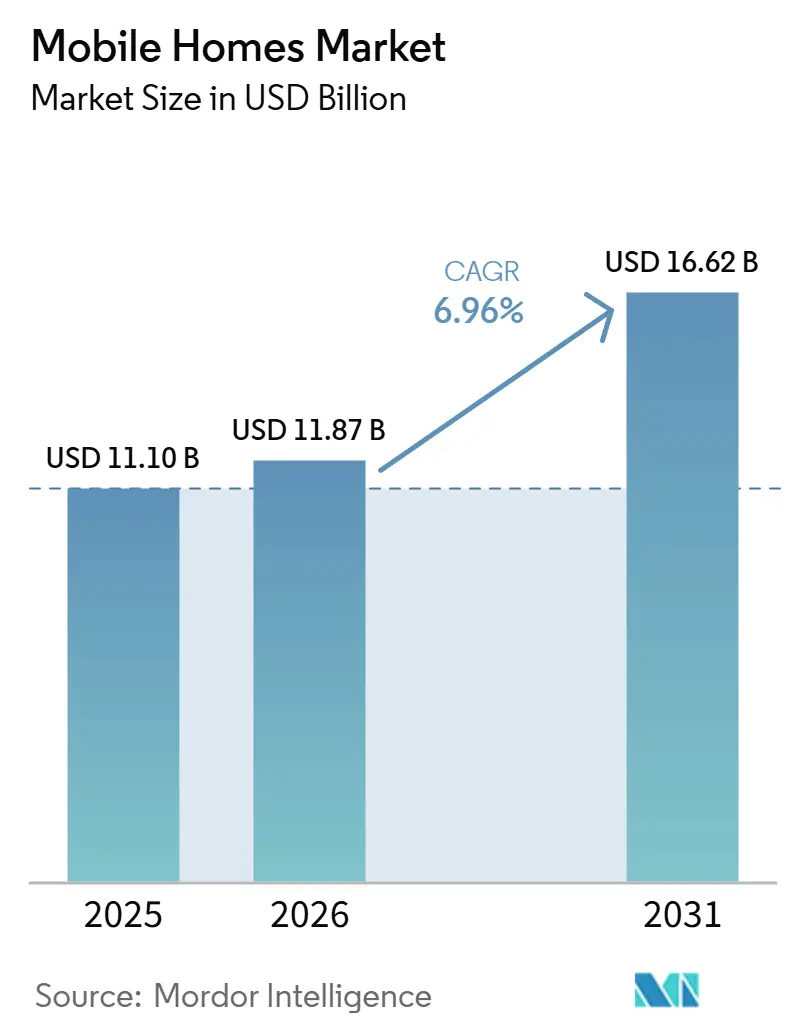
The Mobile Homes Market size is expected to grow from USD 11.10 billion in 2025 to USD 11.87 billion in 2026 and is forecast to reach USD 16.62 billion by 2031 at 6.96% CAGR over 2026-2031.
The Global Mobile Homes Market is driven by the persistent gap between housing costs and household purchasing power, particularly in the United States. According to the U.S. Census Bureau, the average cost of a new manufactured home was USD 126,800 as of May 2025, compared to the national average home sale price of USD 512,800, representing a gap of roughly USD 386,000. On a per-square-foot basis, manufactured homes cost approximately USD 85 per square foot in 2025, compared to nearly USD 168 per square foot for conventional site-built construction.
Factory-based production allows builders to maintain greater control over schedules, materials, and quality checks than many site-built projects. Federal and state policies are evolving to expand the range of locations and designs eligible for manufactured housing. At the same time, growing demand for energy-efficient models is making long-term operating costs a more important factor in buyer decisions.
However, local zoning restrictions, high-cost personal property loans, and rising material costs continue to constrain market growth, limiting how quickly the mobile home market can scale.
Key Report Takeaways
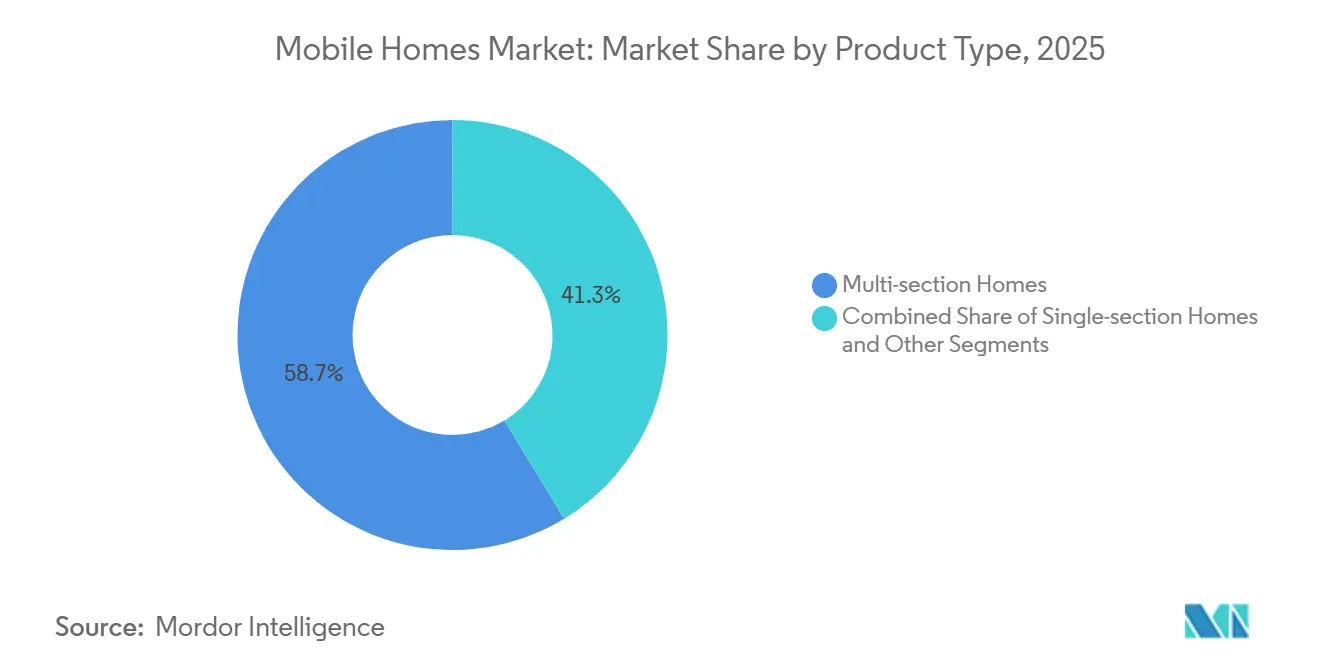
- By product type, multi-section homes held 58.7% of the Mobile Homes Market share in 2025, while the others segment is projected to record the fastest growth in the market, with a CAGR of 8.52% through 2031.
- By material, timber-based construction accounted for 56.4% of the Mobile Homes Market size in 2025, while composite and other materials are expected to register the fastest growth in the mobile home market share at a CAGR of 8.34% through 2031.
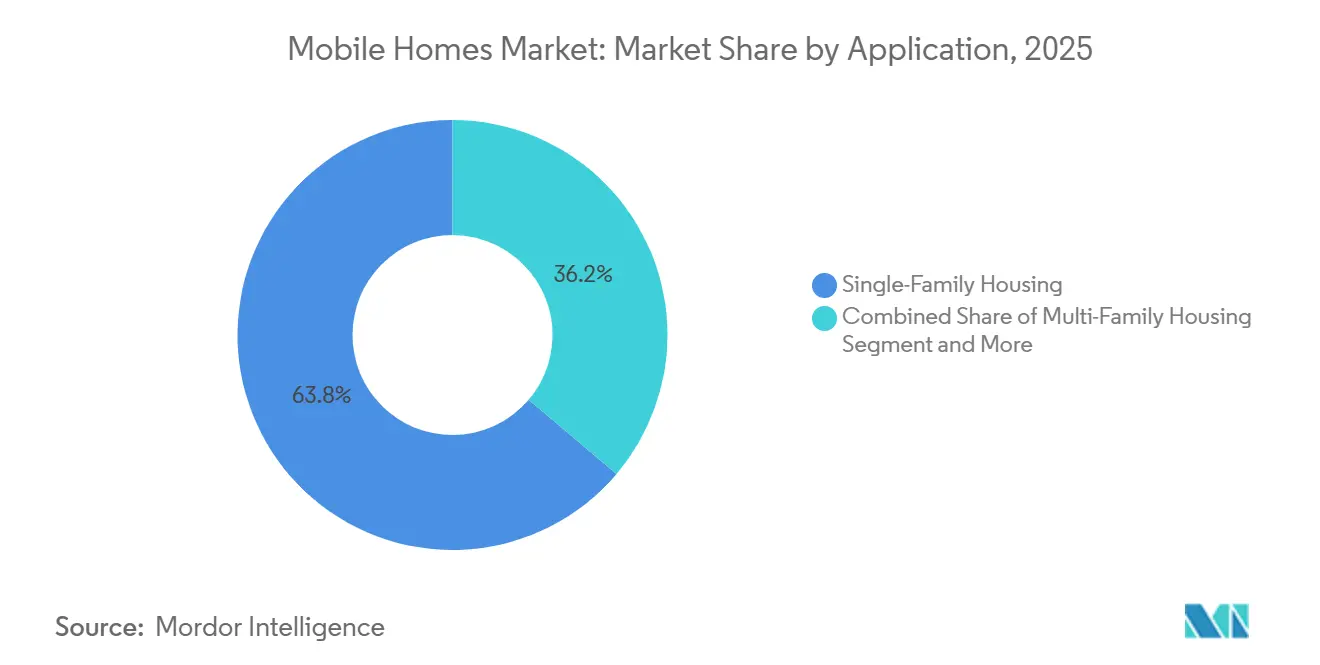
- By application, single-family housing accounted for 63.8% of the Mobile Homes Market share in 2025, while the others segment is forecast to register the fastest growth in the market at a CAGR of 8.73% through 2031.
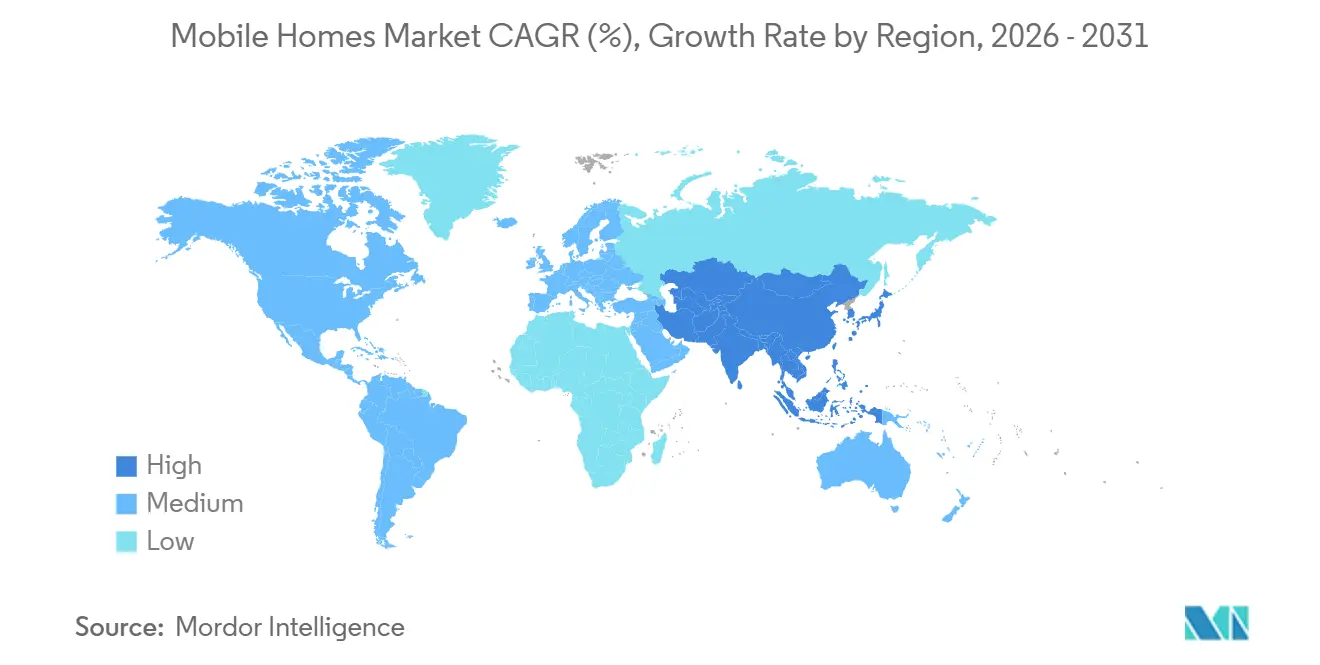
- By geography, North America captured 48.0% of the Mobile Homes Market share in 2025, while Asia-Pacific is projected to record the fastest growth in the Mobile Home Market, with a CAGR of 8.61% through 2031.
Note: Market size and forecast figures in this report are generated using Mordor Intelligence’s proprietary estimation framework, updated with the latest available data and insights as of January 2026.
Market Trends and Insights
Drivers Impact Analysis of Mobile Homes Market*
| Drivers | (~) % Impact on CAGR Forecast | Geographic Relevance | Impact Timeline |
|---|---|---|---|
| Housing Affordability Gap Increases Demand for Mobile Homes | +2.1% | Global, concentrated in North America | Short term (≤ 2 years) |
| Shorter Factory Build and Installation Cycles Accelerate Growth | +1.3% | North America, Asia-Pacific | Short term (≤ 2 years) |
| Supportive Financing Programs and Land-Use Policies Encourage Adoption | +1.2% | North America, Europe | Medium term (2-4 years) |
| Energy-Efficient Factory-Built Designs Drive Consumer Demand | +0.9% | North America, Europe | Medium term (2-4 years) |
| Institutional Investment Expands Communities and Builds-To-Rent Projects | +0.7% | North America | Medium term (2-4 years) |
| Multi-Story and Urban Infill Mobile Homes Expand Opportunities | +0.5% | North America, Asia-Pacific | Long term (≥ 4 years) |
| Source: Mordor Intelligence | |||
Housing Affordability Gap Increases Demand for Mobile Homes
The affordability gap remains the central driver of the Mobile Homes Market. The National Association of Home Builders reported in 2025 that nearly 60% of U.S. households could not afford a USD 300,000 home[1]National Association of Home Builders, “2025 Priced Out Analysis,” HousingWire, housingwire.com.. The National Association of Realtors recorded a median existing-home price of USD 440,600 in mid-2026. These conditions leave many households searching for lower-cost ownership options. Community occupancy reached 94% in 2025, indicating a limited supply of manufactured housing units on existing sites. Higher conventional home prices can therefore sustain interest even if factory-built home inputs become more expensive.
Shorter Factory Build and Installation Cycles Accelerate Market Growth
Controlled factory production helps manufacturers manage labor, materials, and inspections in the Mobile Home Market. This approach can shorten delivery compared with projects that depend on site conditions and local inspection schedules. The 21st Century ROAD to Housing Act, which became law on July 11, 2026, removed the permanent steel chassis requirement[2]Cavco Industries, “ROAD to Housing Act Is Now Law: What Homebuyers Need to Know,” Cavco Home Front Blog, blog.cavcohomes.com.. Cavco stated that the change creates opportunities for multistory construction, ground-level installation, and different placement formats. These options help projects fit more easily into urban and suburban settings. The change also gives manufacturers more scope to offer designs that do not resemble traditional mobile units.
Supportive Financing Programs and Land-Use Policies Encourage Adoption
Policy action can broaden the areas where the Mobile Homes Market can serve new buyers. Virginia enacted legislation in April 2026 that requires manufactured homes to be allowed in residential districts that permit site-built housing, subject to narrow historic-district exceptions[3]Virginia Public Radio, “New Virginia Law Will Expand Zoning for Manufactured Homes,” WHRO, whro.org.. The law also bars local governments from applying different standards to manufactured structures. In June 2026, the Federal Housing Finance Agency proposed an outcome-based Duty to Serve framework for chattel lending programs. The proposal would require Fannie Mae and Freddie Mac to develop responsible, scalable programs. Permitting reforms and studies of barriers to small-dollar mortgages can support access over time. Their effect will depend on how lenders and local authorities adopt federal requirements.
Energy-Efficient Factory-Built Designs Drive Consumer Demand
Energy performance has become more important because buyers consider both monthly operating costs and the sale price. The Department of Energy Zero Energy Ready Manufactured Home program focuses on sealed envelopes, efficient heat pumps, low-emission windows, smart thermostats, and ENERGY STAR appliances. Clayton Homes reported that its eBuilt program has delivered energy cost reductions of up to 50% compared with standard manufactured homes. The company also reported that more than 260,000 certified ENERGY STAR and Zero Energy Ready homes have been built since 2005. Champion launched its EcoWise series in March 2025 from its Sangerfield, New York, facility. Manufacturers with established high-performance product lines are better placed if energy requirements become more demanding.
Restraints Impact Analysis of Mobile Homes Market*
| Restraints | (~) % Impact on CAGR Forecast | Geographic Relevance | Impact Timeline |
|---|---|---|---|
| Restrictive Zoning and Land-Use Regulations Limit Expansion | -0.9% | North America, Europe | Short term (≤ 2 years) |
| High Chattel Financing Costs and Limited Mortgage Access Reduce Affordability | -0.7% | Global | Medium term (2-4 years) |
| Stigma, Appraisal Challenges, and Resale Value Uncertainty Affect Adoption | -0.5% | North America, Europe | Medium term (2-4 years) |
| Transportation Costs and Community Siting Constraints Increase Complexity | -0.3% | North America, Asia-Pacific | Long term (≥ 4 years) |
| Source: Mordor Intelligence | |||
Restrictive Zoning and Land-Use Regulations Limit Market Expansion
Local zoning remains an immediate constraint on the Mobile Homes Market. A 2025 study in Urban Studies found that variation and strictness in land-use regulations are significant barriers to the adoption of manufactured housing. Some jurisdictions allow site-built housing but exclude homes built to the federal HUD Code. Others require roof pitches, minimum floor areas, or exterior features that add cost without matching gains in housing quality. Maine, Maryland, New Hampshire, Rhode Island, Kentucky, and Virginia have adopted zoning protections in recent legislative cycles. Even so, changes in federal and state policy do not automatically change local approval practices. Placement volumes will remain limited where local planning rules do not align with broader housing policy.
High Chattel Financing Costs and Limited Mortgage Access Reduce Affordability
Financing costs can significantly reduce the upfront price advantage of manufactured housing. According to the Federal Housing Finance Agency (FHFA), approved chattel loan borrowers pay an average interest rate of 9.24%, compared to 6.63% for traditional manufactured home mortgages. Access remains an even greater barrier, as chattel borrowers face a denial rate of 65.6%, compared to just 8.8% for site-built home loans.
This financing channel is significant at scale. Approximately 70–80% of new manufactured homes are titled as personal property and financed through chattel loans, particularly in land-lease communities. The FHFA attributes the underdeveloped state of the chattel lending market to limited liquidity, the absence of securitization infrastructure, and a lack of robust performance data. It also notes that neither Fannie Mae nor Freddie Mac has purchased chattel loans for Duty to Serve purposes, despite chattel lending being designated as an “extra credit” activity.
*Our forecasts treat driver/restraint impacts as directional, not additive. The impact forecasts reflect baseline growth, mix effects, and variable interactions.
Mobile Homes Market Segment Analysis
By Product Type:
Multi-Section Homes Lead Demand While Other Formats Grow FasterMulti-section homes held 58.7% of the Mobile Homes Market in 2025. Their leading position reflects demand for larger layouts and designs that resemble conventional homes. They remain relevant in land-leased communities and owner-occupied placements. Single-section homes still meet the needs of lower-cost rural and workforce housing. Their smaller footprint allows them to fit on sites that cannot accommodate larger units. The Mobile Home Market value linked to multi-section homes also benefits from established dealer networks and buyer familiarity.
Others are forecast to grow at an 8.52% CAGR through 2031. The category includes volumetric modular homes, panelized homes, and container-based units. It serves commercial developers, disaster-relief agencies, urban infill operators, and hospitality businesses. The 2026 ROAD Act permits more design flexibility, including multi-story and ground-level configurations. China reported 45% growth in prefabricated building exports during the first quarter of 2026, reaching more than 150 countries. These formats can broaden applications beyond standard residential placements.



By Material:
Timber Retains Scale While Composite Materials Gain MomentumTimber-based construction accounted for 56.4% of the Mobile Homes Market size in 2025. Its position rests on established North American supply chains and familiar construction practices. Timber provides recognized thermal and acoustic performance. It also supports demand for renewable building inputs. Germany recorded a 24.1% share of newly approved residential buildings made of timber in 2025. Steel and concrete remain relevant in high-wind, seismic, permanent-foundation, and disaster-resilient applications.
Composite and other materials are projected to grow at an 8.34% CAGR through 2031. Manufacturers are testing recycled structural panels and engineered composites as alternatives to plywood and oriented strand board. These inputs can reduce exposure to lumber-price movements and imported wood costs. They can also provide stronger insulation performance than some conventional panels. The Mobile Homes Industry is using these materials to address energy performance and supply reliability. Timber should remain central, while composites take on a larger role in the material mix.
By Application:
Single-Family Housing Remains the Core Use CaseSingle-family housing held 63.8% of the Mobile Homes Market in 2025. This application is tied to owner-occupied starter homes and land-lease community residences. It gives households a lower-cost route to ownership where conventional housing prices are high. Site-built single-family homes appreciated 58.6% over the same period. Land tenure and location remain important to value outcomes.
Others are forecast to advance at an 8.73% CAGR through 2031. It includes disaster relief, temporary housing, student and senior housing, and workforce housing. These uses extend the Mobile Home Market beyond individual residential placement. Age-restricted communities are attracting investment because they address the demand from older households. French outdoor hospitality operators reported a 12% rise in mobile home sales in 2024-25. Multistory flexibility can also support the future workforce and build-to-rent projects.
Geography Analysis
North America Mobile Homes Market
North America accounted for 48.0% of the Mobile Homes Market in 2025. The region has a developed production base, dealer network, community operators, and financing channels. Manufactured housing community occupancy reached 94% in 2025, indicating a scarce supply. Equity LifeStyle Properties added more than 1,100 sites in Florida since 2020 and completed 500 expansion sites in Arizona. Firm Capital Property Trust completed a USD 160 million acquisition involving 1,649 Canadian sites in July 2026.
APAC Mobile Homes Market
Asia-Pacific is projected to expand at an 8.61% CAGR through 2031. Government prefabrication targets, urban growth, and demand for middle-class housing support the region. China reported 45% growth in prefabricated building exports during the first quarter of 2026. Singapore raised the adoption of Design for Manufacturing and Assembly from 61% of gross floor area in 2023 to 68% in 2024. India has public affordable-housing programs and increasing developer activity in Maharashtra and Gujarat.
EMEA and South America Mobile Homes Market
Europe, South America, the Middle East, and Africa represent the remaining Mobile Home Market demand. France reported a 12% rise in mobile home sales in 2024-25, driven by demand for outdoor hospitality. Germany was forecast to complete 185,000 residential units in 2026, supporting interest in faster-delivery formats. Gulf infrastructure projects support workforce housing needs. Rapidly urbanizing African cities can create demand for resilient construction. Policy, transport conditions, and land availability determine how much potential is realized in deployment.

Competitive Landscape
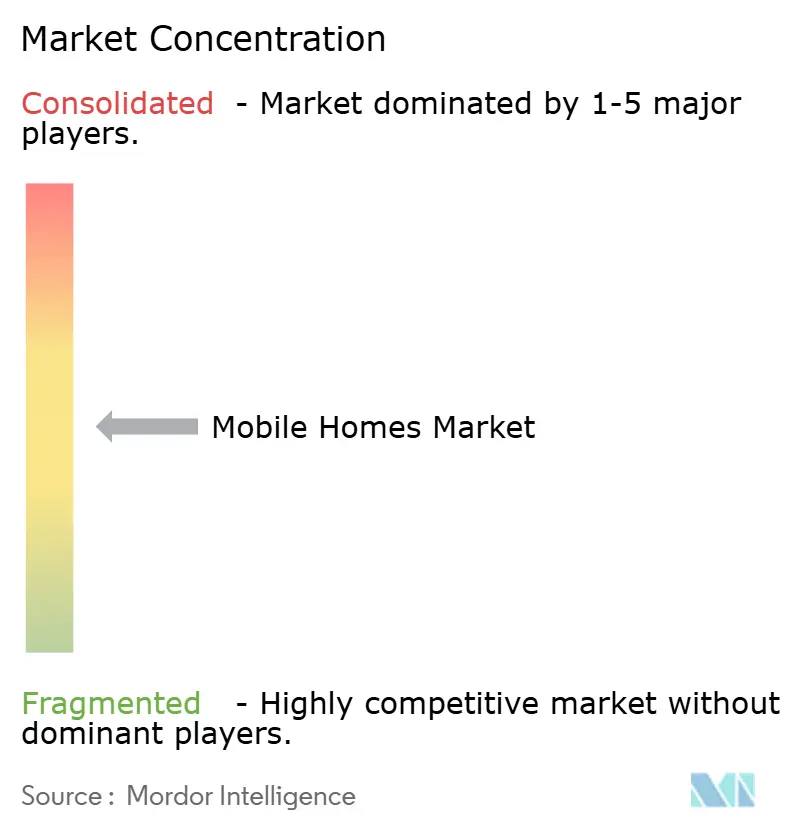
The Mobile Homes Market is moderately concentrated among Clayton Homes, Champion Homes, and Cavco Industries. Their scale spans manufacturing, retail distribution, and, in some cases, financing. Clayton Homes combines factory output, retail sales, and Vanderbilt Mortgage financing. Larger manufacturers can invest more steadily in product engineering and efficiency. Regional manufacturers compete through dealer relationships, custom floor plans, and local pricing. Freight costs can limit national producers' advantages in certain locations.
Champion Homes agreed in May 2026 to acquire 11 Homes Direct retail locations in 5 western states. The transaction expands its direct consumer reach. Cavco completed its USD 190 million acquisition of American Homestar in September 2025. It added 2 manufacturing facilities and 19 retail locations across Texas, Louisiana, and Oklahoma. Champion launched its EcoWise range in March 2025 to meet or exceed the Department of Energy Zero Energy Ready criteria. These moves show a focus on retail access, production coverage, and energy-efficient offerings.
Community operators and capital providers influence another part of the Mobile Homes Market. RHP Properties and an institutional partner secured USD 830 million for a 36-asset, 8,340-pad portfolio in April 2026. The financing covered properties with physical occupancy above 99%. Larger communities can support amenities, operations, and new-site development. Urban infill and multistory projects may favor firms with engineering capacity and municipal experience. The Mobile Home Market remains open to regional players, but scale provides advantages in land access, financing, design, and distribution.
Mobile Homes Industry Leaders
Clayton Homes, Inc.
Champion Homes, Inc.
Cavco Industries, Inc.
Legacy Housing Corporation
Live Oak Homes
- *Disclaimer: Major Players sorted in no particular order
Mobile Homes Market Companies Covered in this Report
- Clayton Homes, Inc.
- Champion Homes, Inc.
- Cavco Industries, Inc.
- Legacy Housing Corporation
- Live Oak Homes
- Jessup Housing
- Sunshine Homes, Inc.
- Adventure Homes
- American HomeStar Corporation
- Commodore Corporation
- Deer Valley Homebuilders, Inc.
- Nobility Homes, Inc.
- ScotBilt Homes, LLC
- Fleetwood Homes
- Chariot Eagle
- Cappaert Manufactured Housing
- Redman Homes
- Friendship Homes
- Golden West Homes
- Daiwa House Industry Co., Ltd.

Recent Industry Developments in Mobile Homes Market
- July 2026: Firm Capital Property Trust closed the acquisition of a 50% interest in a 10-property, 1,649-site manufactured home community portfolio in Alberta and Saskatchewan through its SunPark Communities division. The USD 160 million transaction expanded its manufactured housing community portfolio to 2,572 sites in Ontario, Alberta, and Saskatchewan.
- May 2026: Champion Homes signed a definitive agreement to acquire Homes Direct assets, the largest independent manufactured and modular home dealer in the western United States. The acquisition covers 11 retail locations across Arizona, California, Colorado, New Mexico, and Oregon, and was expected to close in Champion's second quarter of fiscal year 2027.
- April 2026: Newmark arranged USD 830 million in acquisition and refinancing financing from Wells Fargo on behalf of RHP Properties and an institutional capital partner. The financing supported a portfolio of 36 assets comprising 8,340 manufactured housing pads, with physical occupancy above 99%.
- March 2026: Virginia Governor Abigail Spanberger signed legislation effective July 1, 2026, permitting manufactured homes in residential districts that allow traditional site-built housing. The law includes narrow historic-district exceptions and bars local authorities from imposing different restrictions on manufactured structures.


Global Mobile Homes Market Report Scope
| Single-section Homes |
| Multi-section Homes |
| Others (Volumetric Modular Homes, Panelized Mobile Homes, and Container-based Mobile Homes) |
| Timber-Based Construction |
| Steel-Based Construction |
| Concrete-Based Construction |
| Composite and Other Materials |
| Single-Family Housing |
| Multi-Family Housing |
| Commercial, Hospitality, and Institutional Buildings |
| Others (Disaster Relief and Temporary Housing, Student and Senior Housing, Student and Senior Housing, Workforce Housing, and Container-based Mobile Homes) |
| North America | United States |
| Canada | |
| Mexico | |
| Europe | United Kingdom |
| Germany | |
| France | |
| Italy | |
| Spain | |
| Russia | |
| Rest of Europe | |
| Asia-Pacific | China |
| India | |
| Japan | |
| Australia | |
| South Korea | |
| South East Asia (Singapore, Malaysia, Thailand, Indonesia, Vietnam, and Philippines) | |
| Rest of Asia-Pacific | |
| South America | Brazil |
| Argentina | |
| Rest of South America | |
| Middle East and Africa | Saudi Arabia |
| United Arab Emirates | |
| Turkey | |
| South Africa | |
| Nigeria | |
| Rest of Middle East and Africa |
| By Product Type | Single-section Homes | |
| Multi-section Homes | ||
| Others (Volumetric Modular Homes, Panelized Mobile Homes, and Container-based Mobile Homes) | ||
| By Material | Timber-Based Construction | |
| Steel-Based Construction | ||
| Concrete-Based Construction | ||
| Composite and Other Materials | ||
| By Application | Single-Family Housing | |
| Multi-Family Housing | ||
| Commercial, Hospitality, and Institutional Buildings | ||
| Others (Disaster Relief and Temporary Housing, Student and Senior Housing, Student and Senior Housing, Workforce Housing, and Container-based Mobile Homes) | ||
| By Geography | North America | United States |
| Canada | ||
| Mexico | ||
| Europe | United Kingdom | |
| Germany | ||
| France | ||
| Italy | ||
| Spain | ||
| Russia | ||
| Rest of Europe | ||
| Asia-Pacific | China | |
| India | ||
| Japan | ||
| Australia | ||
| South Korea | ||
| South East Asia (Singapore, Malaysia, Thailand, Indonesia, Vietnam, and Philippines) | ||
| Rest of Asia-Pacific | ||
| South America | Brazil | |
| Argentina | ||
| Rest of South America | ||
| Middle East and Africa | Saudi Arabia | |
| United Arab Emirates | ||
| Turkey | ||
| South Africa | ||
| Nigeria | ||
| Rest of Middle East and Africa | ||


Key Questions Answered in the Report
What is driving demand for mobile homes?
Housing affordability pressures, factory-built delivery, policy support, and lower operating costs from energy-efficient designs support demand. High community occupancy also indicates that existing sites have limited spare capacity in key U.S. locations.
How large is the Mobile Homes Market?
The Mobile Homes Market is estimated at USD 11.87 billion in 2026 and is forecast to reach USD 16.62 billion by 2031 at a 6.96% CAGR. The forecast reflects the report's defined product, material, application, and geographic scope.
Which product type leads mobile home sales?
Multi-section homes led with 58.7% share in 2025 because they provide larger layouts and a more conventional residential appearance. Single-section homes remain relevant in rural and workforce housing settings where space and budgets are more limited.
Which region is growing fastest for mobile homes?
Asia-Pacific is projected to grow at an 8.61% CAGR through 2031, supported by urbanization and prefabrication programs. North America remained the largest region in 2025 because it has an established production, dealer, community, and finance ecosystem.
Why are chattel loans a challenge for buyers?
Average approved chattel-loan rates were 9.24%, compared with 6.63% for manufactured-home mortgages, which raises ownership costs. Since these loans finance many new homes in land-lease communities, access to loans can affect a large share of potential buyers.
Which companies are leading the mobile homes sector?
Clayton Homes, Champion Homes, and Cavco Industries are major manufacturers, while community operators and capital providers also influence supply. Leading companies are expanding through retail acquisitions, factory coverage, energy-efficient models, and community financing.
Page last updated on:





