
Mining Drill Bits Market Size and Share
Market Overview
| Study Period | 2022 - 2032 |
|---|---|
| Market Size (2027) | USD 2.10 Billion |
| Market Size (2032) | USD 2.75 Billion |
| Growth Rate (2027 - 2032) | 5.53 % |
| Fastest Growing Market | Asia-Pacific |
| Largest Market | Asia-Pacific |
| Market Concentration | Medium |
Major Players *Disclaimer: Major Players sorted in no particular order Image © Mordor Intelligence. Reuse requires attribution under CC BY 4.0. | |
Mining Drill Bits Market Analysis by Mordor Intelligence
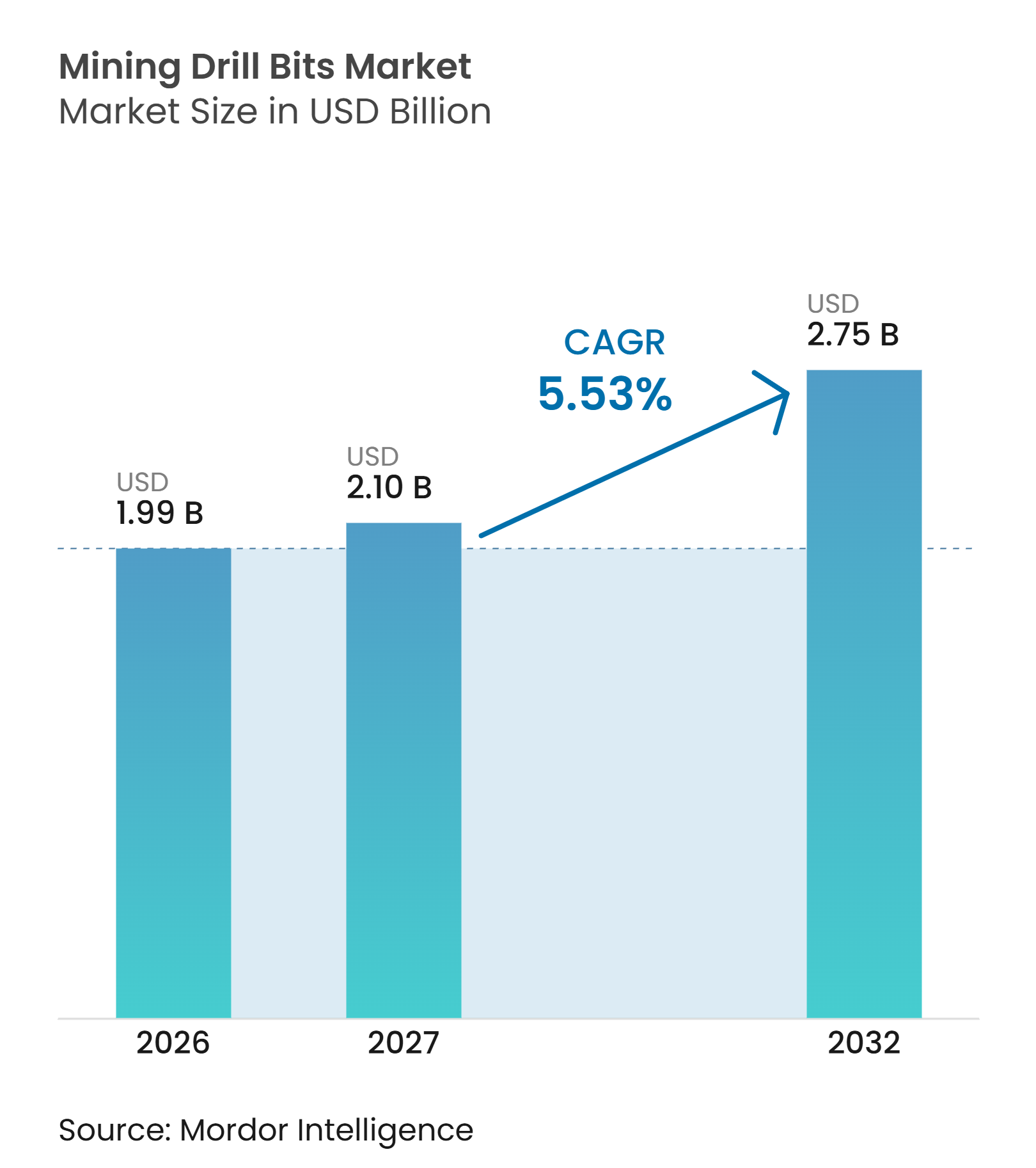
The Mining Drill Bits Market size is projected to be USD 1.99 billion in 2026, USD 2.10 billion in 2027, and reach USD 2.75 billion by 2032, at a CAGR of 5.53% from 2027 to 2032. Demand is shifting toward tools that can work in hard and abrasive deposits, as exploration programs target copper, lithium, cobalt, and rare earth elements across several major mining regions. Public support and permitting reforms in major mining jurisdictions are strengthening the pipeline for exploration and mine development, which supports longer drilling programs.[1] The mining drill bits market is also being shaped by deeper underground development, where Down-The-Hole (DTH) and other specialized tools are more relevant than standard surface drilling equipment. Automation is increasing the cost of unplanned bit failure and encouraging operators to select longer-life tools that can provide wear data. Raw-material volatility and longer environmental approvals remain important limits, although committed expansion projects provide continued demand visibility over the forecast period.
Key Report Takeaways
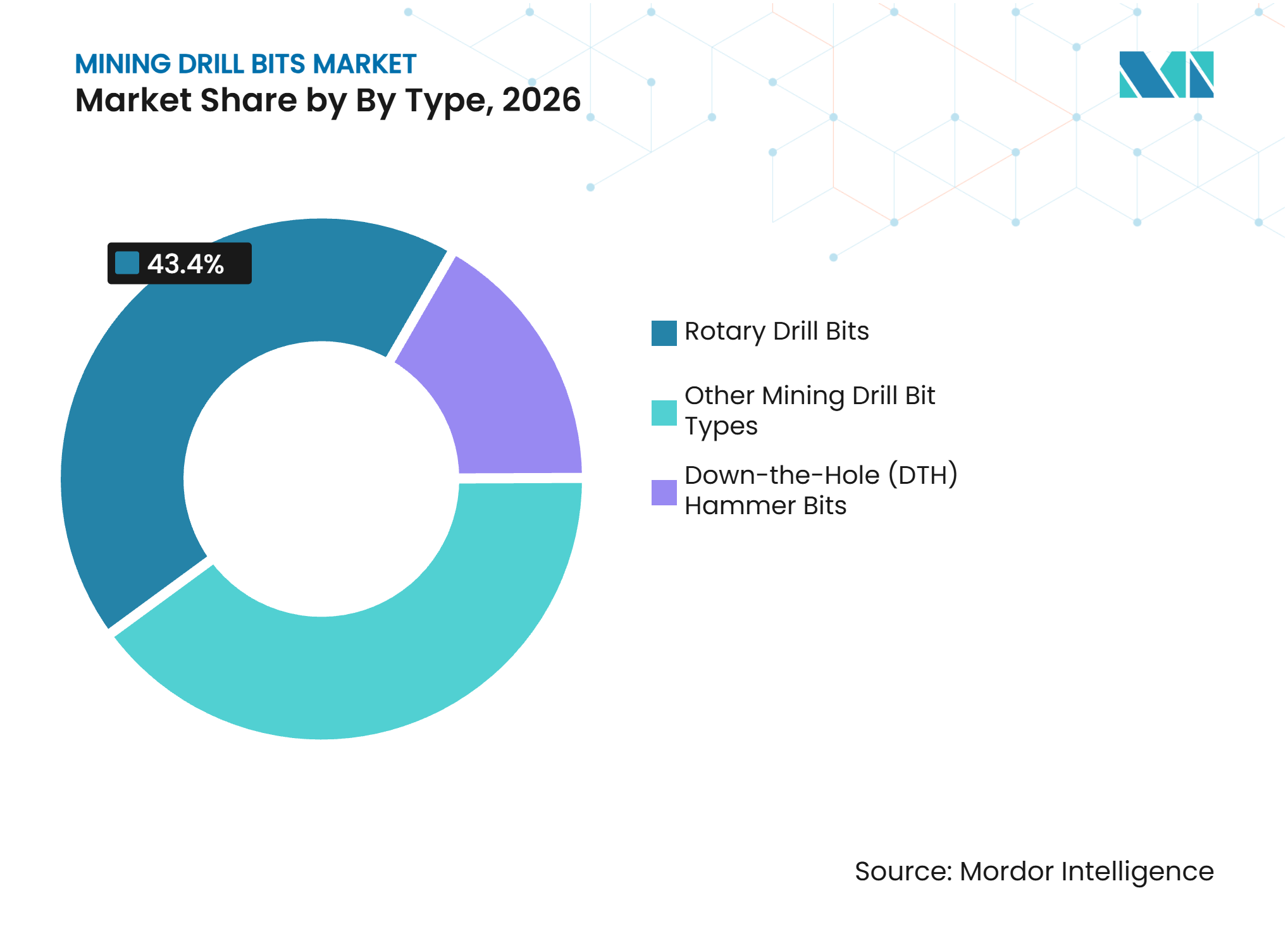
- By type, rotary drill bits held 43.4% of the mining drill bits market share in 2026, while Down-The-Hole (DTH) hammer bits are forecast to grow at a 5.8% CAGR through 2032.
- By material, tungsten carbide held 37.6% of the mining drill bits market share in 2026, while Polycrystalline Diamond Compact is forecast to grow at a 6.2% CAGR through 2032.
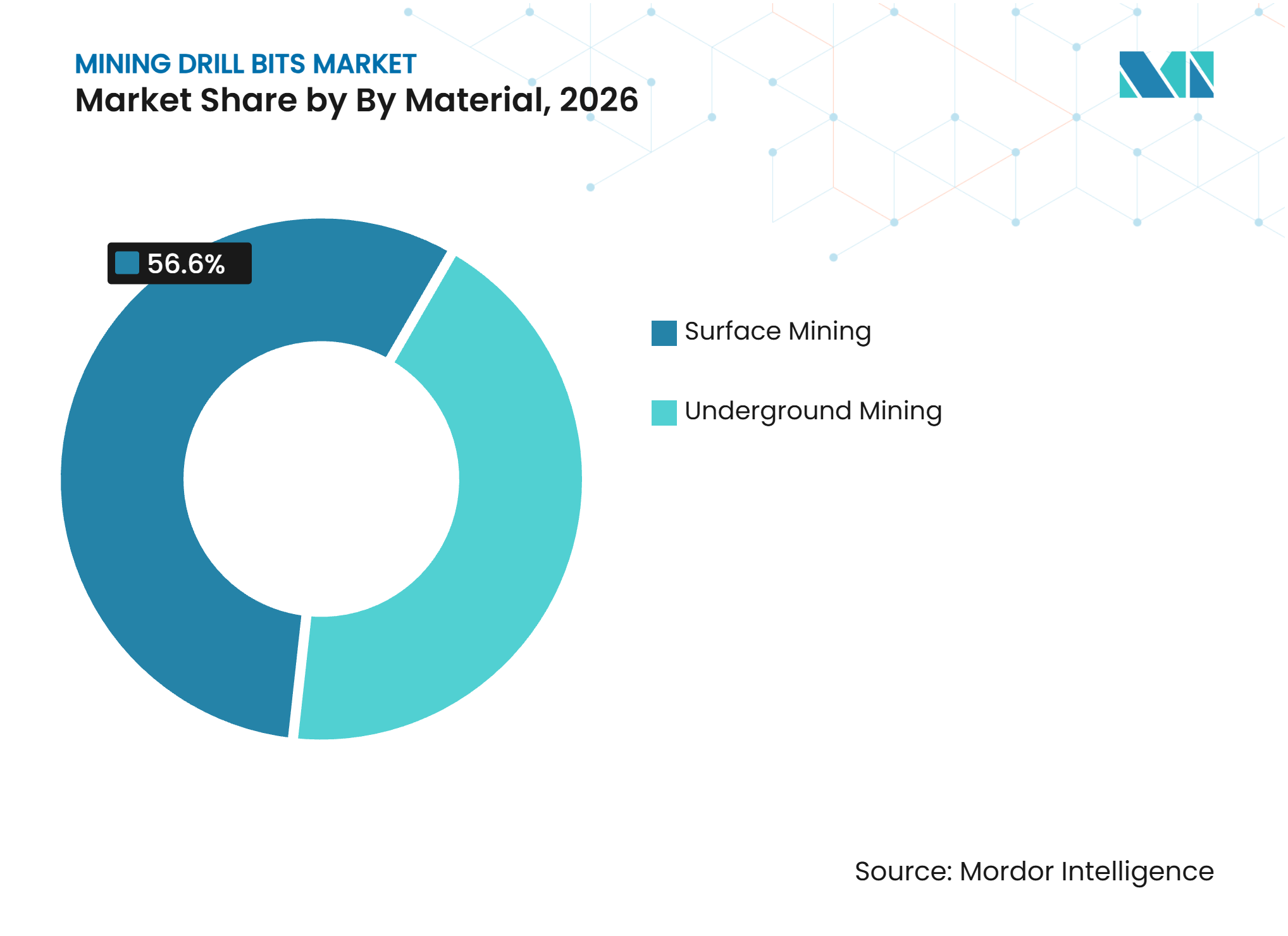
- By mining method, surface mining accounted for 56.6% of revenue in 2026, while underground mining is forecast to grow at a 5.9% CAGR through 2032.
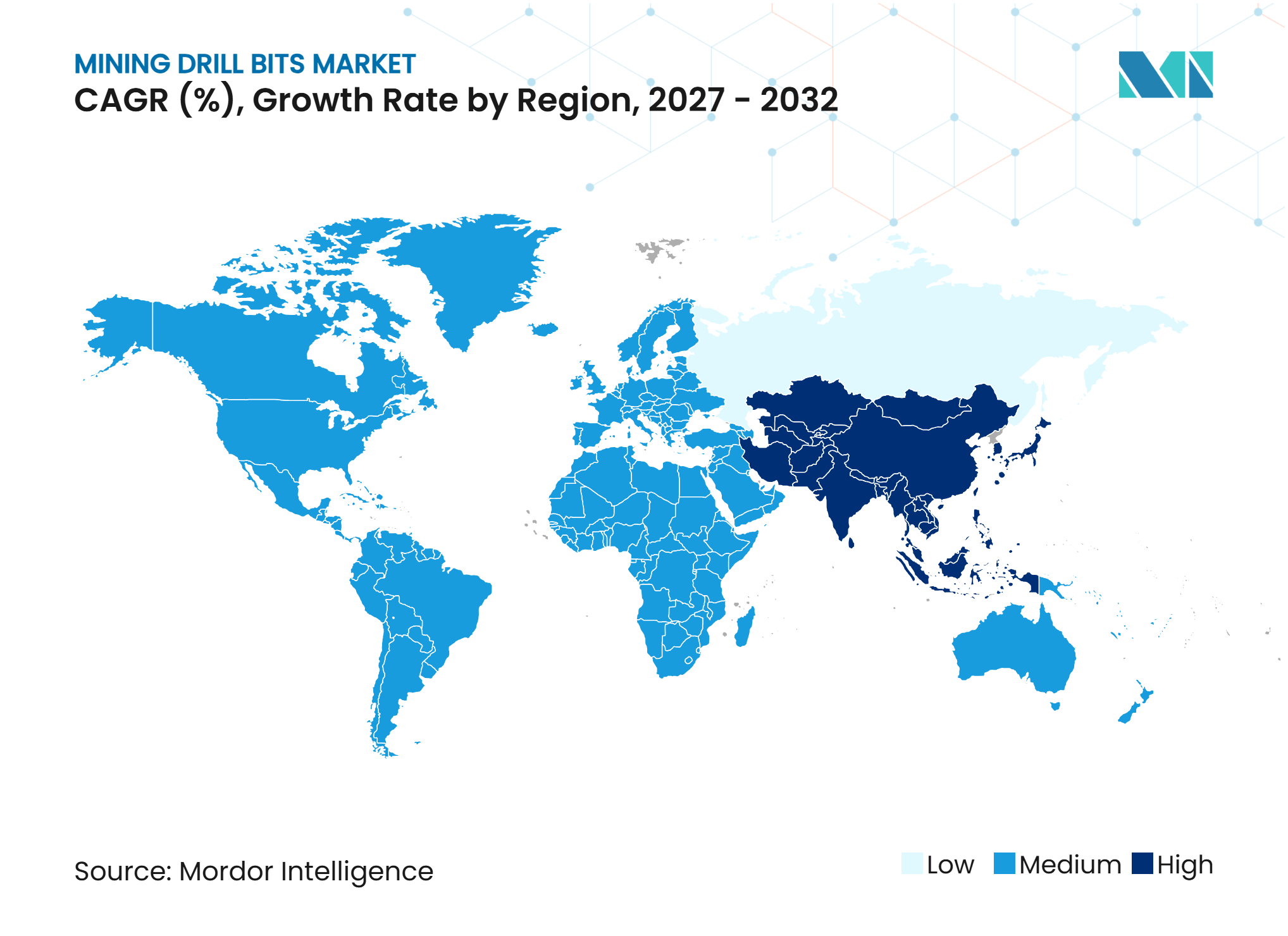
- By geography, Asia-Pacific accounted for 43.7% of revenue in 2026 and is forecast to grow at a 6.1% CAGR through 2032.
Note: Market numbers in this report are based on Mordor Intelligence's proprietary estimation framework, which combines nine months of actuals with Q4 projections for base year 2026.
Market Trends and Insights
Drivers Impact Analysis of Mining Drill Bits Market*
| Driver | (~) % Impact on CAGR Forecast | Geographic Relevance | Impact Timeline |
|---|---|---|---|
| Rising Demand for Critical Minerals and Hard-Rock Exploration | +1.3% | Global, concentrated in APAC, Americas, and Africa | Long term (≥ 4 years) |
| Expansion of Surface and Underground Mining Capacity | +1.0% | APAC, South America, Sub-Saharan Africa | Medium term (2-4 years) |
| Automation, Remote Operation, and Predictive Maintenance | +0.8% | North America, Australia, Northern Europe | Medium term (2-4 years) |
| Demand for Higher Penetration Rates and Lower Cost per Meter | +0.6% | Global, particularly large-fleet surface operations | Short term (≤ 2 years) |
| Infrastructure, Tunneling, and Quarrying Activity | +0.4% | APAC, Europe, Middle East | Medium term (2-4 years) |
| Government Support for Domestic Mineral Production | +0.5% | United States, European Union, India, Australia | Long term (≥ 4 years) |
| Source: Mordor Intelligence | |||
Rising Demand for Critical Minerals and Hard-Rock Exploration
Critical-mineral exploration is increasing drilling requirements across the mining drill bits market. Copper porphyries, lithium pegmatites, and rare earth deposits often require tooling that can withstand harder and more abrasive formations. The International Energy Agency reports that governments in the United States, European Union, Australia, Canada, and India are pursuing policies to strengthen mineral supply. The European Union has identified 47 strategic projects under the Critical Raw Materials Act, supporting faster development and financing access.[2] China’s April 2025 rare earth export restrictions disrupted European automotive supply chains, showing how mineral shortages can rapidly affect downstream manufacturers.[3] These conditions favor Down-The-Hole (DTH) and Polycrystalline Diamond Compact (PDC) tools in hard-rock programs, adding value to the mining drill bits market beyond growth in drilled meters and improving the product mix for specialized tool suppliers.
Expansion of Surface and Underground Mining Capacity
Committed mine investment is giving the mining drill bits market a visible pipeline of development drilling. BHP announced an investment above AUD 840 million, equivalent to USD 550 million, for Olympic Dam in October 2025 to support deeper ore access, electric rail expansion, and ore handling improvements.[4] Capstone Copper sanctioned the Mantoverde Optimized Project in Q3 2025 with USD 176 million of expansion capital and plans to increase throughput from 32,000 to 45,000 ore tonnes per day. Codelco completed the Acop CC 110 expansion at Chuquicamata in March 2025, opening 43 kilometers of primary tunnels for its underground transition. As mature surface deposits decline, more mining companies are moving into deeper ore zones. That movement supports specialized percussion tools and raises the value of each drilling campaign.
Automation, Remote Operation, and Predictive Maintenance
Automation makes drill-bit reliability more important because one failure can interrupt a connected drilling fleet. Sandvik introduced AutoMine Surface Fleet in May 2025, allowing one operator to manage more than 15 i-series surface rigs from a connected location. The system was field-validated at Boliden’s Kevitsa mine in Finland under demanding mineral and weather conditions and supports the mining drill bits market through greater emphasis on reliable, data-compatible consumables. A 2025 review of 166 studies found that machine-learning systems can identify drill-bit wear early and reduce operating expenses. Equipment manufacturers that supply both rigs and bits receive real-time wear information across their installed fleets. This advantage can influence bit procurement in the mining drill bits market, because mine operators may favor tools that work within existing rig and data systems and can use the same performance information across a connected fleet.
Demand for Higher Penetration Rates and Lower Cost per Meter
Large mines increasingly assess drilling tools through cost per meter rather than purchase price alone, a procurement shift that is influencing the mining drill bits market. Tools that drill more meters before replacement can reduce changeover time and maintenance interruptions. Epiroc launched its next-generation PCD drill bits in December 2025 and stated that the products offer longer service life and up to 90% lower carbon dioxide emissions than conventional carbide alternatives. Sandvik’s PowerCarbide grades are designed to extend insert life in abrasive conditions without reducing penetration performance. Longer tool life can reduce rig repositioning, maintenance, and manual handling demands. These economics support premium product adoption in the mining drill bits market even when material inputs become more expensive, because the operating cost of a drilling interruption can exceed the difference in the purchase price of a tool.
Restraints Impact Analysis of Mining Drill Bits Market*
| Restraint | (~) % Impact on CAGR Forecast | Geographic Relevance | Impact Timeline |
|---|---|---|---|
| Environmental Permitting and Mine-Closure Liabilities | -0.5% | Australia, European Union, North America | Long term (≥ 4 years) |
| Tungsten, Steel, and Diamond-Cutter Cost Volatility | -0.7% | Global, most acute in North America and European Union | Short term (≤ 2 years) |
| Cyclicality of Commodity Prices and Mining Capital Expenditure | -0.4% | Global, most exposed in South America and Africa | Medium term (2-4 years) |
| Bit Failure Risk in Heterogeneous and Ultra-Hard Formations | -0.3% | Hard-rock regions, APAC, Southern Africa, and Canada | Medium term (2-4 years) |
| Source: Mordor Intelligence | |||
Environmental Permitting and Mine-Closure Liabilities
Stricter closure and rehabilitation rules can delay the shift from discovery to development drilling. Western Australia updated its mine closure plan guidelines in November 2025 and required more detailed environmental provisions and public disclosure of closure liabilities. The International Council on Mining & Metals also calls for closure considerations to be incorporated early in mine planning. These requirements place a larger financial and administrative burden on project developers before drilling begins. The effect is particularly relevant for junior explorers, which contribute a meaningful share of early-stage drilling. More rigorous approval processes in Australia, Europe, and Canada can therefore delay demand in the mining drill bits market, even when operators have identified prospective mineral resources and intend to proceed with early development work.
Tungsten, Steel, and Diamond-Cutter Cost Volatility
Raw-material inflation is an immediate constraint for mining drill bit manufacturers. Tungsten carbide powder prices rose more than 231% year over year by late 2025 after China introduced export controls covering tungsten and other critical metals. China supplies 83% of global tungsten demand, which makes manufacturers exposed to concentrated supply conditions. Polycrystalline Diamond Compact (PDC) drill bits can carry an added cost of USD 3,000 to USD 25,000 per unit, increasing procurement pressure for mine operators. Manufacturers that rely on carbide may absorb part of these increases to protect order volumes. The US Department of Energy supported a pilot tungsten carbide recycling facility, but the current scale is too small to ease near-term supply pressure
*Our forecasts treat driver/restraint impacts as directional, not additive. The impact forecasts reflect baseline growth, mix effects, and variable interactions.
Mining Drill Bits Market Segment Analysis
By Type:
Rotary Bits Lead by Volume, Down-The-Hole (DTH) Reshapes Deep-Hole EconomicsRotary drill bits held 43.4% in 2026 because they are used widely in open-pit bench drilling, blast-hole work, and quarrying. Their position reflects the operational fit of rotary systems where large surface fleets require consistent flushing and energy efficiency. Down-The-Hole (DTH) hammer bits are forecast to grow at a 5.8% CAGR through 2032, supported by deeper and harder ore bodies where borehole accuracy becomes more important. Sandvik announced in January 2026 that Vale Base Metals ordered nine DR416i rotary blast-hole rigs and seven Leopard DI650i Down-The-Hole (DTH) rigs for Brazilian copper operations. The order includes a multi-year rock-tools supply arrangement and shows why mines keep both tool families in their drilling portfolios, rather than treating Down-The-Hole (DTH) equipment as a full substitute for high-volume rotary drilling on surface benches.
Other types include wing bits, anchor bits, and reverse-circulation tools used for sampling and geotechnical work. Larger blast holes can accelerate insert wear, which is increasing demand for better carbide grades and predictive maintenance. Epiroc states that its Epsilon² rotary tricone air-bearing bit uses Tornado vectored air-bearing and nozzle optimization features, can extend bearing life by up to 100%, and can reduce cone erosion by up to 60%. Mincon’s XP+ rotary tricone line is manufactured in Canada using proprietary heat-treatment processes and field data from global operations, representing a specialist response focused on drilling cost and field performance. Rotary and percussion tools also support shaft sinking, cavern work, and other tunneling activities, which broadens the application base for the mining drill bits market.



By Material:
Tungsten Carbide Anchors Market, POLYCRYSTALLINE DIAMOND COMPACT (PDC) Closes the Performance-Cost GapTungsten carbide held 37.6% in 2026 because it is compatible with major bit types and a wide range of rock formations. Its hardness of 8.5 to 9 on the Mohs scale supports its use from softer limestone through competent granite. Polycrystalline Diamond Compact (PDC) is forecast to grow at a 6.2% CAGR through 2032 as fewer bit changes can offset its higher initial cost in abrasive formations. China issued the MT/T 984-2025 standard for PPolycrystalline Diamond Compact (PDC) roof bits in coal mines in December 2025, with effect from June 2026. The standard provides a clearer basis for Polycrystalline Diamond Compact (PDC) use in Chinese underground coal operations.
Sandvik’s PowerCarbide range is available for rotary, down-the-hole (DTH), and top-hammer applications and uses self-hardening, gradient, and dual-property carbide variants. Thermally stable diamond serves the hardest and hottest applications, including deep geothermal wells and ultra-hard rock exploration, where Polycrystalline Diamond Compact (PDC) cutter thermal limits can restrict use. Steel remains a lower-cost option but loses competitiveness in hard rock when its abrasion resistance limits service life, and North American tariff pressures add to this challenge. Synthetic and industrial diamond, along with hybrid matrix-body materials, support directional drilling and geotechnical sampling. A 2025 study on deep-learning-based Polycrystalline Diamond Compact (PDC) wear monitoring shows that real-time condition information is becoming more important in material selection because it can limit unplanned failures
By Mining Method:
Surface Operations Hold Volume Edge, Underground Gains GroundSurface mining accounted for 56.6% of the mining drill bits market size in 2026, supported by open-pit coal, iron ore, copper, and gold operations. Standardized hole patterns, open rig access, and simpler flushing enable high use of large-diameter rotary tools. Underground mining is forecast to grow at a 5.9% CAGR through 2032 as miners pursue deeper and higher-grade ore bodies. Tharisa announced a phased transition from open-pit to underground Platinum Group Metals (PGM) and chrome operations in October 2025, supported by USD 547 million of transition capital through 2031. Mincon and Epiroc also signed a 3-year exclusive agreement in September 2025 to commercialize Hybrid Impact Technology for hard-rock surface mining.
Underground development requires Down-The-Hole (DTH) hammer bits, long-hole systems, and raise-bore cutters more often than surface work. This creates demand for tools with higher average selling prices than standard surface blast-hole products, since confined headings require more specialized percussion configurations and closer control over drilling quality. Resolution Copper completed rehabilitation and deepening of the No. 9 Shaft in Arizona, including an extension beyond 6,800 feet. Remote operation also has a stronger safety and productivity case in confined underground conditions, where workforce exposure and difficult access remain persistent operating concerns. These operating requirements reinforce demand for durable, sensor-compatible tools across the mining drill bits market, and they strengthen the mining drill bits market for premium underground systems, especially where operators seek to reduce manual handling and avoid unscheduled changes underground.

Geography Analysis
Asia-Pacific held 43.7% of the mining drill bits market size in 2026 and is forecast to grow at a 6.1% CAGR through 2032. China’s coal production and battery-metal exploration, Australia’s iron ore and lithium operations, and India’s mineral policy support regional drilling demand. India’s National Critical Mineral Mission has INR 16,300 crore, equivalent to USD 1.9 billion, in support and targets 1,200 domestic exploration projects by 2031. Indonesia’s nickel and coal operations, together with infrastructure-related mineral activity in Vietnam and Thailand, add further regional demand. China’s Linghang shield machine passed 10,000 meters beneath the Yangtze River in December 2025, showing the scale of rock-support and tunneling activity in the region, while Sandvik and Epiroc expanded distribution networks in Australia and Southeast Asia to serve replacement demand for high-wear tools.
North America and Europe form another important demand cluster for mining drill bits, with policy support and localized supply strategies influencing the mining drill bits market. A March 2025 US executive order directed federal agencies to accelerate permitting and support capital formation for domestic mineral projects. Resolution Copper’s No. 9 Shaft work supports a future long-life underground copper development cycle in Arizona. In Europe, the Woodsmith project tunnel passed 30 kilometers in December 2025 and created continuing drilling needs around the tunnel program. Sandvik’s May 2026 US joint venture with Alpha Metallurgical Resources adds local ground-support manufacturing capacity and addresses tariff exposure.
South America and the Africa and Middle East corridor provide further expansion opportunities for the mining drill bits market. Chile, Brazil, Peru, and Argentina continue to anchor demand through copper-focused development programs. The Mantoverde expansion and Sandvik’s Brazil rig order have multi-year rock-tools supply elements. Mincon reported 18% regional revenue growth in West Africa during Q4 2025, reflecting improved gold-mining activity. Saudi Arabia’s mining diversification and Morocco’s polymetallic exploration supplement established South African platinum group metals and gold activity.
Competitive Landscape
Market Concentration
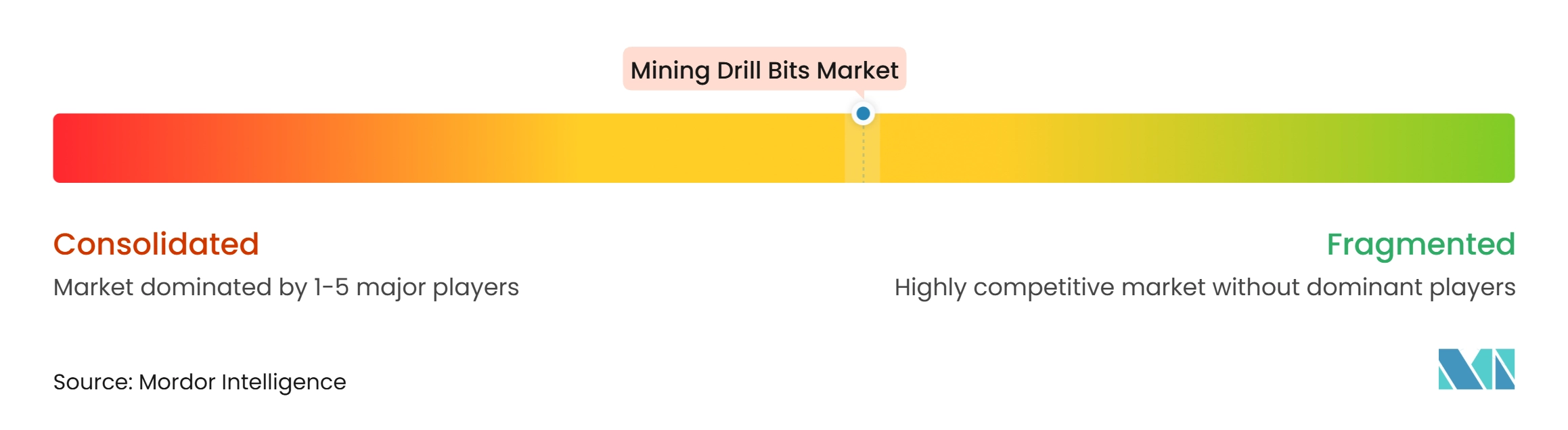
The mining drill bits market is moderately concentrated in the premium segment, where Sandvik, Epiroc, and Atlas Copco offer bits, rods, rigs, and automation systems. These integrated portfolios allow equipment suppliers to combine drilling hardware with digital monitoring. Wear information from connected fleets helps them improve tool design and customer support, and it can reduce the development cycle for new cutter configurations and bit designs. Mincon, Robit, Rockmore International, Halco Rock Tools, and Numa Tool compete through application knowledge, delivery capability, and regional coverage. Mincon reported EUR 148.7 million in revenue for 2025 and continued to focus on products with stronger intellectual property content.
Strategic partnerships have become more important in the mining drill bits market as mines adopt autonomous drilling. Mincon and Epiroc’s September 2025 agreement combined Mincon’s percussion engineering with Epiroc rig integration for the Hybrid Impact Technology system. Sandvik and Rio Tinto announced a partnership in June 2026 to develop interoperable autonomous open-pit drilling using Sandvik rigs and Rio Tinto’s Autonomous Drilling System. Sandvik also acquired an 80% stake in K&Y Diamond in April 2026 to strengthen its diamond-tool capability. These actions show that tool technology and data access are both becoming important competitive factors.
Chinese manufacturers, including Xiamen Prodrill Equipment, compete strongly on price in Down-The-Hole (DTH) and rotary categories across Southeast Asia and Africa. China’s own tungsten export controls have weakened part of that input-cost advantage for carbide-focused producers, creating additional pressure on suppliers that compete primarily through lower purchase prices. The mining drill bits market also has opportunities in geothermal drilling, offshore wind foundations, and solar-site preparation, where established mining suppliers have not engineered products at commercial scale. Competition will continue to depend on tool life, drilling performance, automation compatibility, and local service coverage.
Mining Drill Bits Industry Leaders
-
Sandvik AB
-
Epiroc AB
-
Boart Longyear Limited
-
Caterpillar Inc.
-
Mitsubishi Materials Corporation
- *Disclaimer: Major Players sorted in no particular order
Mining Drill Bits Market Companies Covered in this Report
- Atlas Copco AB
- Boart Longyear Group Ltd.
- Brunner & Lay, Inc.
- Bulroc (UK) Ltd.
- Caterpillar Inc.
- Center Rock Inc.
- Drill King International, L.P.
- Epiroc AB
- Halco Rock Tools Ltd.
- MICON Drilling GmbH
- Mincon Group plc
- Mitsubishi Materials Corporation
- Numa Tool Company
- Robit Plc
- Rockmore International, Inc.
- Sandvik AB
- Ulterra Drilling Technologies, L.P.
- Varel International Energy Services, Inc.
- Western Drilling Tools Inc.
- Xiamen Prodrill Equipment Co., Ltd.
Recent Industry Developments in Mining Drill Bits Market
- June 2026: Sandvik and Rio Tinto announce autonomous open-pit drilling partnership. The companies will co-develop interoperable autonomous drilling capabilities integrating Sandvik i-series surface rigs with Rio Tinto's Autonomous Drilling System (ADS™), targeting remote multi-rig operation from Rio Tinto's Perth Operations Centre with field trials planned to validate performance against production targets
- May 2026: Sandvik establishes US ground-support manufacturing joint venture with Alpha Metallurgical Resources. A new 100,000-square-foot West Virginia facility will produce rock bolts and resin capsules. Sandvik holds a 51% stake and the arrangement includes a long-term exclusive supply agreement, directly addressing US tariff exposure on imported tooling.
- April 2026: Sandvik acquires 80% of Canadian diamond tool maker K&Y Diamond. The Montreal-based monocrystalline diamond tools manufacturer generated SEK 120 million in 2025 revenue with a strong earnings before interest, taxes, and amortization (EBITA) margin. The acquisition extends Sandvik's diamond-cutter capability in line with demand for hard-rock precision tooling.
- January 2026: Sandvik supplies 16 autonomous-ready surface drill rigs to Vale Base Metals in Brazil. Nine DR416i rotary blasthole rigs and seven Leopard DI650i Down-The-Hole (DTH) rigs, equipped with AutoMine for fully autonomous operation, were ordered. Deliveries began in Q4 2025 and extend through 2027.
- December 2025: Epiroc launches next-generation PCD drill bits globally. The second-generation PCD bits replace the Powerbit X range and deliver a claimed increase in service life, fewer bit changes, lower total drilling cost, and carbon dioxide emission reductions of up to 90% against conventional carbide alternatives
Global Mining Drill Bits Market Report Scope
Mining drill bits are specialized cutting tools used in drilling equipment to penetrate rock formations, extract mineral deposits, and facilitate blasting, exploration, and production activities in mining operations. They are typically manufactured using durable materials such as tungsten carbide, polycrystalline diamond compact (PDC), synthetic and industrial diamond, steel, and thermally stable diamond to withstand high impact forces, abrasive conditions, and elevated temperatures. Mining drill bits are commonly used in surface and underground mining operations for the extraction of coal, iron ore, copper, gold, and other metallic and non-metallic minerals. They are designed to support different drilling techniques, geological conditions, and rock hardness levels, helping improve drilling efficiency, penetration rates, tool life, and overall mining productivity.
The Global Mining Drill Bits Market is segmented by type, material, and mining method. By type, the market is segmented into rotary drill bits, down-the-hole (DTH) hammer bits, and other mining drill bit types. By material, the market is segmented into tungsten carbide, polycrystalline diamond compact (PDC), synthetic and industrial diamond, steel, thermally stable diamond, and other materials. By mining method, the market is segmented into surface mining and underground mining. The report also covers the market size and forecasts for the global mining drill bits market across 26 countries in key regions, including North America, Europe, Asia-Pacific, South America, and the Middle East and Africa. For each segment, market sizing and forecasts are provided on the basis of value (USD).
Segmentation Overview
| Rotary Drill Bits |
| Down-the-Hole (DTH) Hammer Bits |
| Other Mining Drill Bit Types |
| Tungsten Carbide |
| Polycrystalline Diamond Compact (PDC) |
| Synthetic and Industrial Diamond |
| Steel |
| Thermally Stable Diamond |
| Other Materials |
| Surface Mining |
| Underground Mining |
| North America | United States |
| Canada | |
| Mexico | |
| Europe | Germany |
| France | |
| Italy | |
| Spain | |
| United Kingdom | |
| Poland | |
| Russia | |
| Rest of Europe | |
| Asia-Pacific | China |
| India | |
| Japan | |
| South Korea | |
| Australia | |
| Indonesia | |
| Vietnam | |
| Thailand | |
| Rest of Asia-Pacific | |
| South America | Brazil |
| Argentina | |
| Chile | |
| Rest of South America | |
| Middle East and Africa | Saudi Arabia |
| United Arab Emirates | |
| Egypt | |
| South Africa | |
| Morocco | |
| Rest of Middle East and Africa |
| By Type | Rotary Drill Bits | |
| Down-the-Hole (DTH) Hammer Bits | ||
| Other Mining Drill Bit Types | ||
| By Material | Tungsten Carbide | |
| Polycrystalline Diamond Compact (PDC) | ||
| Synthetic and Industrial Diamond | ||
| Steel | ||
| Thermally Stable Diamond | ||
| Other Materials | ||
| By Mining Method | Surface Mining | |
| Underground Mining | ||
| By Geography | North America | United States |
| Canada | ||
| Mexico | ||
| Europe | Germany | |
| France | ||
| Italy | ||
| Spain | ||
| United Kingdom | ||
| Poland | ||
| Russia | ||
| Rest of Europe | ||
| Asia-Pacific | China | |
| India | ||
| Japan | ||
| South Korea | ||
| Australia | ||
| Indonesia | ||
| Vietnam | ||
| Thailand | ||
| Rest of Asia-Pacific | ||
| South America | Brazil | |
| Argentina | ||
| Chile | ||
| Rest of South America | ||
| Middle East and Africa | Saudi Arabia | |
| United Arab Emirates | ||
| Egypt | ||
| South Africa | ||
| Morocco | ||
| Rest of Middle East and Africa | ||
Key Questions Answered in the Report
What is the projected value of mining drill bits by 2032?
The mining drill bits market is projected to reach USD 2.75 billion by 2032, rising from USD 1.99 billion in 2026 at a 5.53% CAGR.
Which drill bit type leads demand?
Rotary drill bits lead with a 43.4% share in 2026, supported by open-pit bench drilling, blast-hole work, and quarrying.
Which mining drill bit type is growing fastest?
DTH hammer bits are forecast to grow at a 5.8% CAGR through 2032 as mining moves toward deeper and harder ore bodies.
Which material is gaining the most traction in hard-rock drilling?
POLYCRYSTALLINE DIAMOND COMPACT (PDC) is forecast to grow at a 6.2% CAGR through 2032 because longer tool life can reduce bit changes in abrasive formations.
Why is underground mining important for drill-bit suppliers?
Underground mining is forecast to grow at a 5.9% CAGR through 2032 and requires DTH, long-hole, and raise-bore tools with higher technical requirements.
Which region offers the strongest growth outlook?
Asia-Pacific held 43.7% of revenue in 2026 and is forecast to grow at a 6.1% CAGR through 2032, supported by mining activity in China, Australia, India, and Southeast Asia.