
Military Embedded Systems Market Size and Share
Market Overview
| Study Period | 2020 - 2032 |
|---|---|
| Market Size (2027) | USD 2.32 Billion |
| Market Size (2032) | USD 3.62 Billion |
| Growth Rate (2027 - 2032) | 9.31 % |
| Fastest Growing Market | Asia-Pacific |
| Largest Market | North America |
| Market Concentration | Medium |
Major Players *Disclaimer: Major Players sorted in no particular order Image © Mordor Intelligence. Reuse requires attribution under CC BY 4.0. | |
Military Embedded Systems Market Analysis by Mordor Intelligence
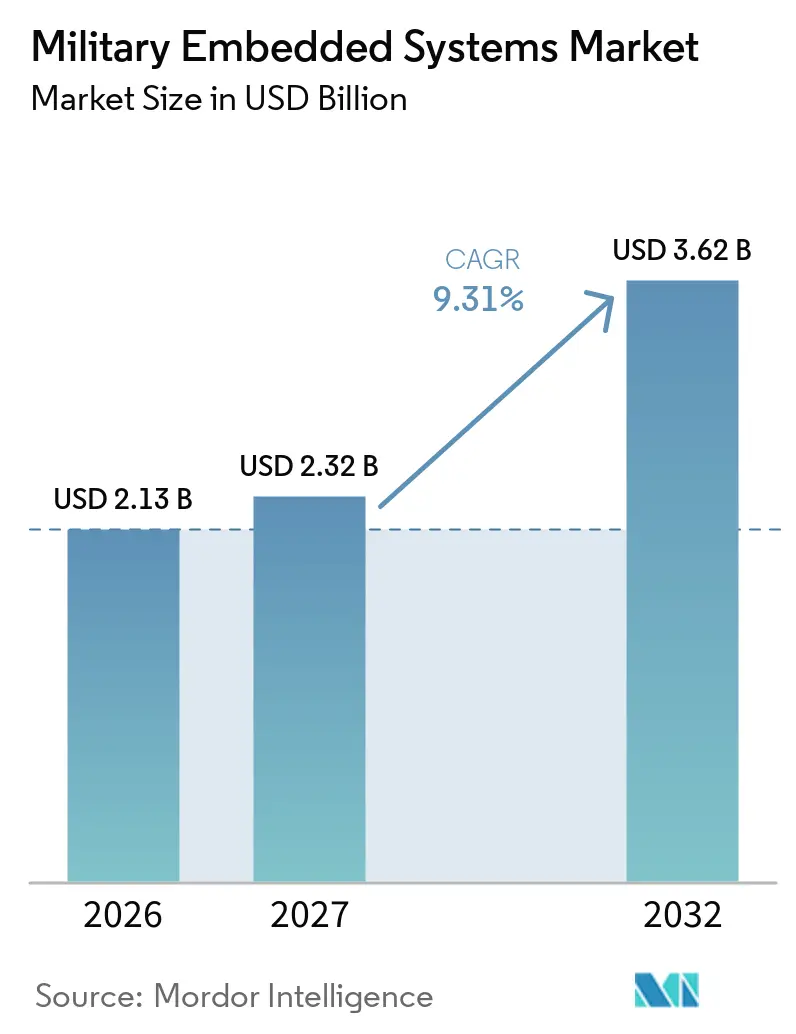
The military embedded systems market size was valued at USD 2.13 billion in 2026 and is forecast to grow from USD 2.32 billion in 2027 to reach USD 3.62 billion by 2032, at a 9.31% CAGR during the forecast period (2027-2032). Platform modernization is increasing demand for rugged computing across land, air, naval, space, and uncrewed operations. Programs increasingly need to be processed at the point of use because communications can be limited or disrupted in contested settings. Open architectures are changing purchase decisions because new physical modules must support common standards before software can move between platforms. Governments also place greater weight on domestic and trusted semiconductor supply, which can alter supplier choices by region. The military embedded systems market therefore favors vendors that combine reliable hardware, secure software integration, and conformance with open technical standards.
Key Report Takeaways
- By component, hardware held a 67.45% revenue share in 2026, while software is forecast to grow at an 11.34% CAGR through 2032.
- By platform, land systems held 43.56% revenue share in 2026, while unmanned systems are forecast to grow at a 12.23% CAGR through 2032.
- By installation type, new installations accounted for 56.32% of revenue in 2026, while upgrades are forecast to grow at an 11.01% CAGR through 2032.
- By application, intelligence, surveillance, and reconnaissance (ISR) held 28.55% revenue share in 2026, while electronic warfare is forecast to grow at an 11.21% CAGR through 2032.
- By geography, North America held a 36.82% revenue share in 2026, while Asia-Pacific is forecast to grow at an 11.95% CAGR through 2032.
Note: Market numbers in this report are based on Mordor Intelligence's proprietary estimation framework, which combines nine months of actuals with Q4 projections for base year 2026.
Global Military Embedded Systems Market Trends and Insights
Drivers Impact Analysis*
| Driver | (~) % Impact on CAGR Forecast | Geographic Relevance | Impact Timeline |
|---|---|---|---|
| Defense modernization and multi-domain operations | +2.50% | Global, led by North America and Europe | Short term (≤ 2 years) |
| AI inference at the tactical edge | +2.00% | North America, Asia-Pacific core, spill-over to Europe | Short term (≤ 2 years) |
| Growth of attritable autonomous systems and swarms | +1.50% | North America, Asia-Pacific core | Medium term (2-4 years) |
| Resilient processing for denied, disrupted, intermittent, and limited networks | +1.20% | Global, especially Indo-Pacific and Eastern Europe | Medium term (2-4 years) |
| Rising EW and sensor-fusion workloads | +1.00% | North America, Europe, Middle East | Short term (≤ 2 years) |
| Commercial silicon and open architecture adoption | +0.80% | Global | Long term (≥ 4 years) |
| Source: Mordor Intelligence | |||
Defense Modernization and Multi-Domain Operations
The military embedded systems market benefits as armed forces connect more assets across ground, air, sea, space, and dismounted operations. Multi-domain operating concepts require tactical nodes to share timely information and contribute to a common operational picture. This requirement raises the need for processing, secure communications, and data handling within vehicles and deployed systems. Rheinmetall AG received an initial EUR 1.88 billion (USD 2.11 billion) call-off under the TaWAN LBO framework in February 2025 to equip a Bundeswehr division with interference-resistant tactical network capability. Modernization programs favor systems that can handle more data while remaining reliable in harsh operating conditions. Such programs favor modular systems that can be updated without replacing the full platform.
AI Inference at the Tactical Edge
The military embedded systems market benefits from local AI inference in environments with limited connectivity. Tactical users require systems that process imagery, signals, and other sensor data streams with low latency while operating within size, weight, power, and cooling constraints. Leonardo DRS introduced SAGEcore in October 2025 with rugged GPU processing, SOSA-compliant multi-sensor data fusion, encryption, and PACE communications for several defense platform types.[1]AI workloads require greater thermal control, memory bandwidth, and predictable scheduling than many traditional embedded designs provide. The military embedded systems market also requires architectures that can support new models without a complete system replacement. The US DoD expanded its APFIT program to USD 400 million in FY2025, improving the path for nontraditional AI suppliers.
Growth of Attritable Autonomous Systems and Swarms
The military embedded systems market is supported by low-cost autonomous platforms designed to operate in contested conditions with higher acceptable loss rates. These systems require onboard computing for decision loops, collaborative communications, navigation, and mission execution without assured external connectivity. The US DoD moved the Replicator initiative toward its first production-capable tranche of lethal uncrewed aerial systems in 2025. L3Harris Technologies, Inc. released AMORPHOUS in February 2025 to enable a single operator interface for controlling large numbers of heterogeneous autonomous assets. The pressure to contain unit cost can limit security hardening and create vulnerabilities across larger fleets. Procurement agencies may therefore place more emphasis on qualification and cyber requirements as these systems scale.
Rising EW and Sensor-Fusion Workloads
The military embedded systems market is expanding as EW becomes a persistent processing requirement on modern platforms. Systems must examine signals, identify threats, and adapt to changing conditions with limited time for central processing. These requirements increase the need for secure processors capable of executing complex signal analysis close to the operational user. Open architectures allow processing modules to be replaced without redesigning the radio-frequency front end, thereby reducing adaptation costs. The Open Group released SOSA Reference Architecture Edition 2.0, Snapshot 3, in June 2025, adding profiles for hardware acceleration, space, and directed-energy systems. The integration of radar, SIGINT, electro-optical, infrared, and acoustic data increases demand for high-speed data buses and advanced OpenVPX chassis.
Restraints Impact Analysis*
| Restraint | (~) % Impact on CAGR Forecast | Geographic Relevance | Impact Timeline |
|---|---|---|---|
| Long qualification and certification cycles | -1.50% | Global, most acute in North America and Europe | Long term (≥ 4 years) |
| Cyber exposure across distributed edge nodes | -1.20% | Global | Short term (≤ 2 years) |
| SWaP-C limits for AI-enabled platforms | -0.80% | Global, most acute for airborne and dismounted platforms | Medium term (2-4 years) |
| Legacy-system interoperability and configuration drift | -0.70% | North America, Europe | Long term (≥ 4 years) |
| Source: Mordor Intelligence | |||
Long Qualification and Certification Cycles
The military embedded systems market faces slower adoption because qualification can take longer than the commercial semiconductor cycle. Hardware assurance, environmental ruggedization, and cryptographic certification can collectively take 3 to 7 years from component choice to fielding. A processor chosen at the start of this process can be 2 or 3 generations behind current commercial technology by the time it is cleared. This gap increases lifecycle cost and limits the performance available for AI workloads. The DoD software modernization plan seeks to improve delivery practices, but hardware qualification has not kept pace. The market can therefore face delays in adopting more efficient processors.
Cyber Exposure Across Distributed Edge Nodes
The military embedded systems market must address a larger cyber attack surface as tactical networks add distributed computing nodes. Each connected vehicle, sensor, or operational device requires security controls throughout its design, deployment, and use. The DoD announced the Cybersecurity Risk Management Construct in September 2025, replacing static assessments with a five-phase process that covers design, build, test, onboard, and operations. These controls can increase compliance work before a system enters acquisition. They also establish more rigorous requirements for software maintenance throughout a platform's life cycle. Security requirements may favor established vendors that offer continuous monitoring and secure development practices. The same concern can slow wider deployment where operational users need rapid integration of new edge nodes.
*Our forecasts treat driver/restraint impacts as directional, not additive. The impact forecasts reflect baseline growth, mix effects, and variable interactions.
Segment Analysis
By Component: Software Momentum Redefines the Embedded Value Chain
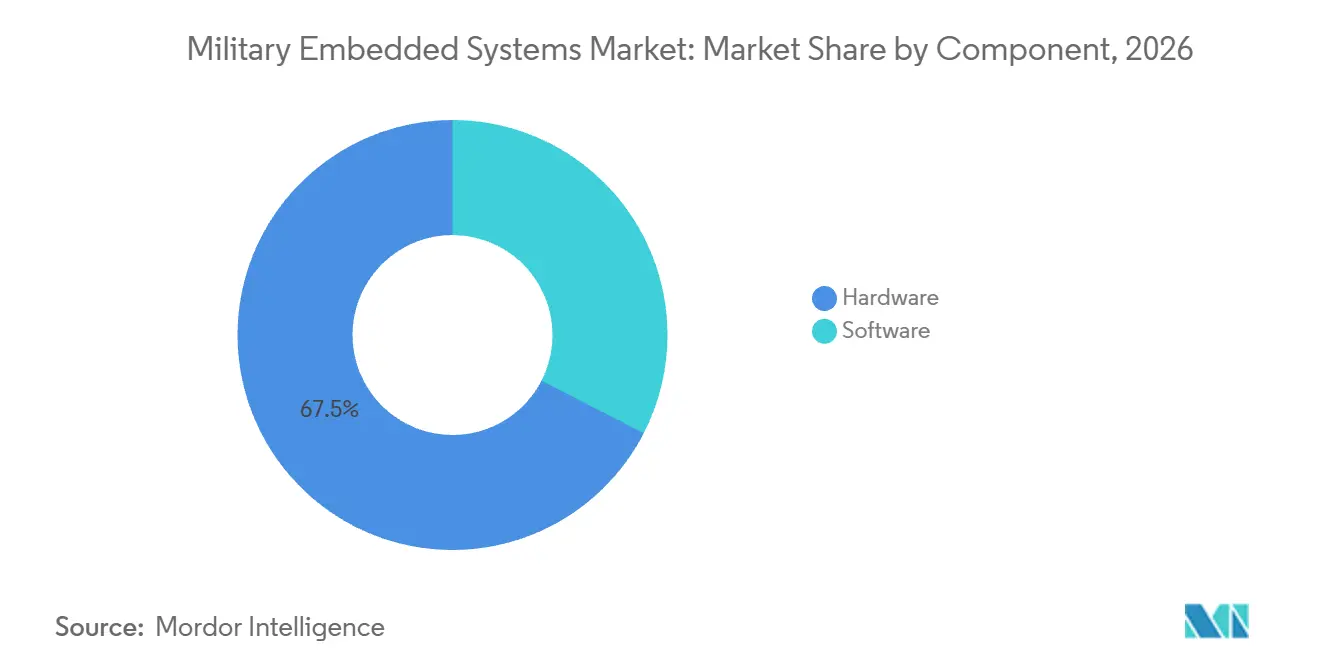
Hardware accounted for 67.45% of the military embedded systems market share in 2026, reflecting the cost of rugged processors, backplanes, power supplies, and input-output modules. Land, naval, and airborne systems each require components that can withstand vibration, temperature fluctuations, and electromagnetic interference. Airborne programs are particularly hardware-intensive because they require conduction-cooled designs, high reliability, and deterministic processing. The hardware layer remains essential as open standards require compatible physical modules before reusable software can be deployed. The military embedded systems industry also depends on hardware suppliers capable of meeting defense qualification requirements. The growing use of newer OpenVPX configurations supports replacement demand for older installed systems. The result is a durable hardware base even as more of the program's value shifts toward software-defined capabilities.
Software is projected to grow at an 11.34% CAGR through 2032, the highest rate among component categories. Growth is supported by AI and ML runtimes designed for rugged GPUs and middleware that operates across different hardware suppliers. FACE-compliant middleware and modular open systems approaches improve software portability across qualified platforms. The US Army's Reprogramming Analysis Team supports tools for updating EW mission software on fielded systems. Software can be revised more often than the underlying equipment, which makes maintenance relationships important over long program lives. CMMC requirements can raise entry barriers for smaller vendors that lack mature secure development processes. These factors strengthen software's role in the military embedded systems market.

By Platform: Unmanned Ascendancy Reorders System Integration Priorities
Land systems accounted for 43.56% of revenue in 2026 because armored vehicles, missile systems, and mobile command posts each use multiple embedded subsystems. Their installed base creates continuing demand for processors, communications modules, sensor interfaces, and mission computing. The US Army’s Terrestrial Layer System Brigade Combat Team received USD 269.50 million in research, development, test, and evaluation funding between FY2020 and FY2025. Airborne platforms carry higher value per unit because safety certification and sensor throughput needs are demanding. Naval and space platforms have smaller positions but require highly reliable electronics. SOSA standards now include dedicated hardware slot profiles for space applications. These characteristics preserve land systems as the largest platform category in the military embedded systems market.
Unmanned platforms are projected to expand at a 12.23% CAGR through 2032, the fastest rate among platforms. Growth comes from Group 1 through 3 uncrewed aerial vehicles, uncrewed surface and undersea vehicles, and attritable loitering munitions. Curtiss-Wright received a USD 31 million IDIQ contract from the US Navy in June 2025 for MOSA-based airborne mission processors for the MQ-4C Triton and PMA-290 aircraft.[2] The configuration includes single-board computers, high-performance embedded computing modules, GPU boards, and network switches in a SOSA-aligned architecture. Demand is growing because these systems need local processing for autonomy and sensor analysis. A common airworthiness pathway for autonomous decision algorithms remains limited. This can create timing uncertainty even where mission demand is strong.
By Installation Type: Upgradation Acceleration Challenges Legacy Assumptions
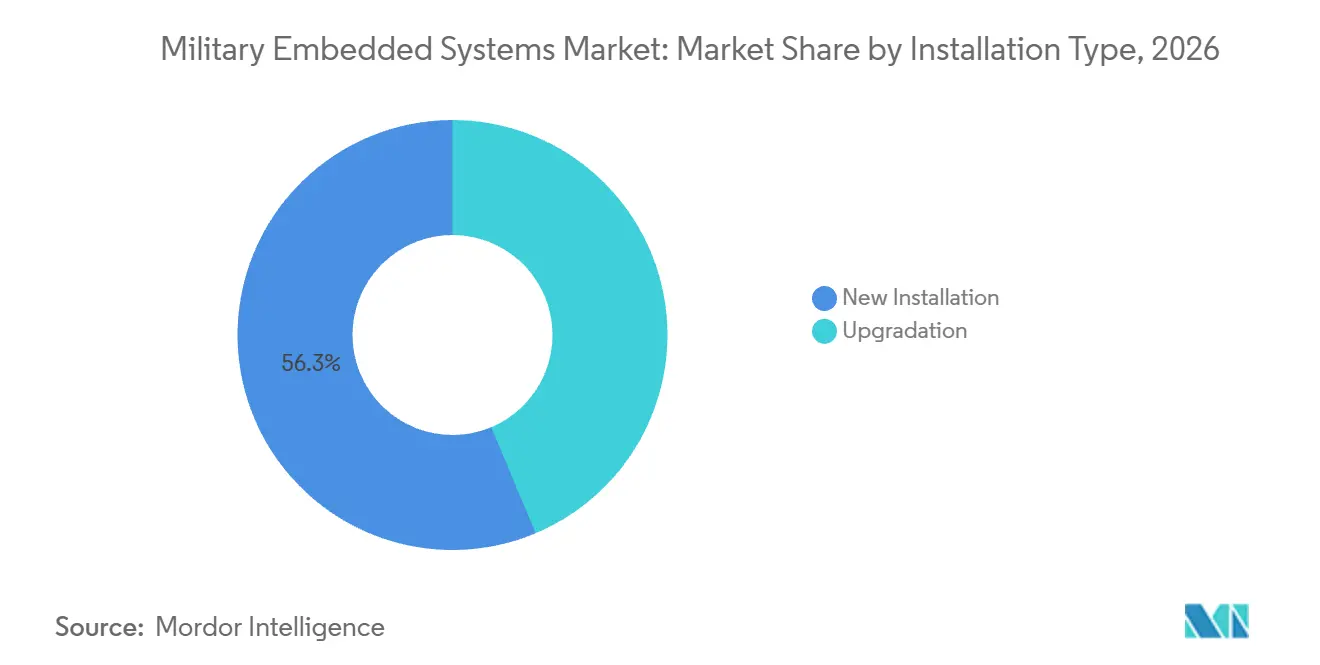
New installations accounted for 56.32% of revenue in 2026, supported by greenfield programs in NATO countries, Indo-Pacific allies, and the US. New platforms can incorporate current computing architectures at the outset instead of adapting to existing interfaces. Appropriations for FY2025 supported new starts under defined conditions and gave program offices more latitude to adopt new computing designs. Airborne and naval installations have the highest embedded computing value per system because they need redundancy and complex sensor integration. Their designs also require validated interfaces for safety-critical operations. The military embedded systems market continues to see substantial demand from platform procurement programs. These installations establish the hardware base for later software upgrades and technology insertions.
Upgradation is forecast to grow at an 11.01% CAGR through 2032, as commercial silicon evolves faster than defense platform replacement cycles. Manned aircraft and surface ships can remain in service for 30 to 40 years, creating continuing need for processing-board replacements. Legacy naval and airborne systems require targeted computing insertions that preserve established hardware and software compatibility. This approach maintains system continuity while providing current-generation processing capability. MOSA requirements can require replacement boards to follow open standards. That need can also prompt backplane updates as part of a broader upgrade effort. This pattern keeps qualified boards in demand as mission software and sensor loads evolve. The military embedded systems market therefore gains recurring demand without requiring a full platform redesign.
By Application: EW Demand Widens Across Every Domain
ISR captured 28.55% of military embedded systems revenue in 2026 because surveillance missions require persistent collection and rapid processing across multiple domains. AI inference is increasingly integrated into ISR payloads to support pattern recognition and target identification closer to the sensor. Aitech introduced the A230 Vortex AI GPGPU in August 2025 for near-real-time analysis and automated target recognition at the vehicle level. This approach can reduce the delay associated with sending data to remote cloud systems. C2, communication, and navigation are also important categories because platforms must connect legacy waveforms and newer internet protocol data networks. Wearables remain smaller but are growing with soldier modernization. The military embedded systems market continues to rely on ISR as a primary driver of processor demand.
EW is forecast to grow at an 11.21% CAGR through 2032, making it the fastest-growing application. Elbit Systems received a USD 1.64 billion contract in August 2025 for a European customer covering networked land EW, SIGINT and COMINT, uncrewed systems, and a military digitalization network.[3] It also received a USD 1.40 billion European modernization contract in May 2026 that includes networked EW and autonomous systems. EW and ISR increasingly use shared CMOSS and SOSA hardware. This increases the value of early conformance with standards for module suppliers. It also supports common processor designs that can be used across related mission systems.
Geography Analysis
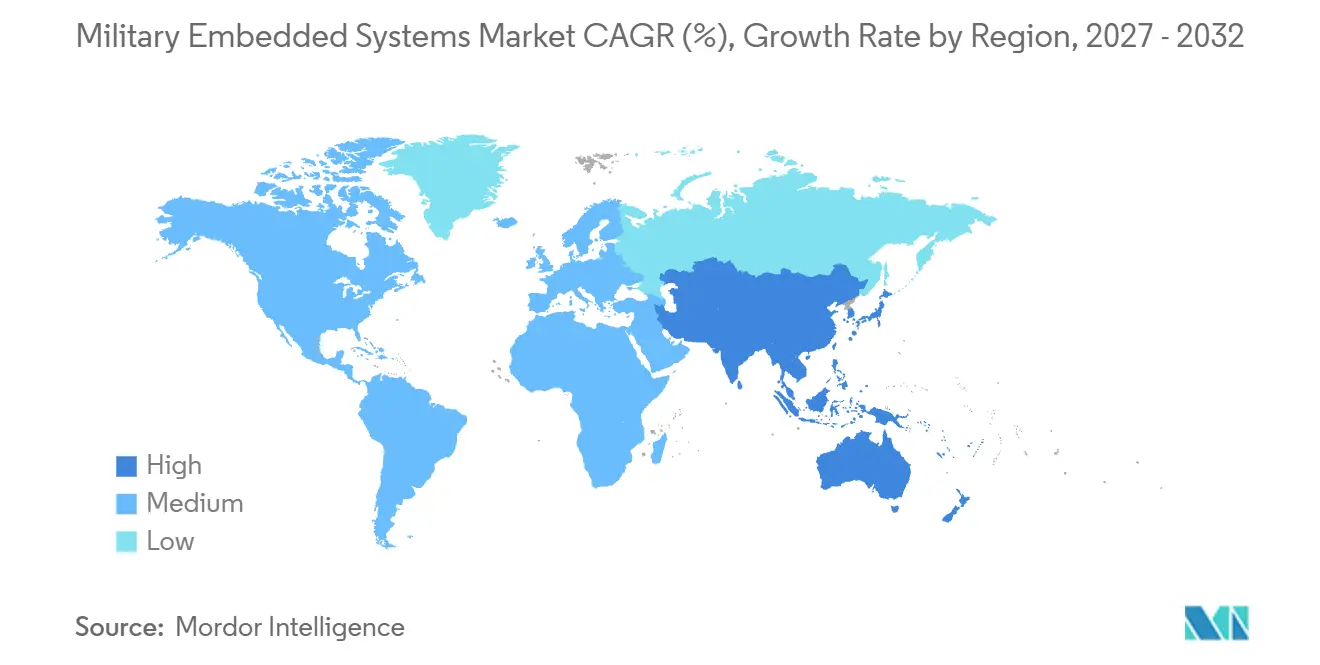
North America held 36.82% of the military embedded systems market share in 2026, supported by defense budgets, modernization programs, and open-architecture policy. US acquisition rules increasingly require modular open systems approaches across relevant programs. SOSA adoption by the Air Force, Army, and Navy creates a clearer pathway for iterative computing refresh. Northrop Grumman was selected for the Defense Microelectronics Activity’s 10-year ATSP5 contracting vehicle in February 2026. The vehicle has a USD 25.30 billion ceiling across 10 companies and is designed to accelerate the delivery of military-grade microelectronics. Continuing resolutions can restrict funding for new starts and shorten visibility on multi-year contracts. This can create revenue variability for prime contractors despite sustained modernization needs.
Asia-Pacific is forecast to grow at an 11.95% CAGR through 2032, the highest rate among geographic regions. The region combines domestic semiconductor programs, defense modernization, and efforts to reduce reliance on Western supply chains. China is developing domestic GPU and system-on-chip capabilities after export restrictions affected access to foreign technologies. India supports domestic suppliers under its Make in India initiative while qualifying imported computing equipment for Tejas aircraft programs. Japan, South Korea, and Australia are more closely aligned with US open-architecture standards. These differing procurement paths create varied opportunities across the market.
Europe is experiencing stronger demand as governments digitize land forces and increase defense procurement. NATO’s 2% of GDP defense spending target is linked to programs that require vehicle-mounted computing, communications, and sensor integration. Rheinmetall’s EUR 1.88 billion (USD 2.11 billion) TaWAN LBO call-off in 2025 demonstrates investment in secure tactical network infrastructure. RHEINMETALL Middle East demand centers on Israel, the United Arab Emirates, and Saudi Arabia, driven by domestic programs and imports. South America remains smaller, with Brazil leading a limited set of modernization activities and bilateral partnerships. The military embedded systems market in Europe is likely to remain linked to broader force modernization rather than stand-alone processor purchases. This supports continuing opportunities for embedded suppliers that meet interoperability and security needs.
Competitive Landscape
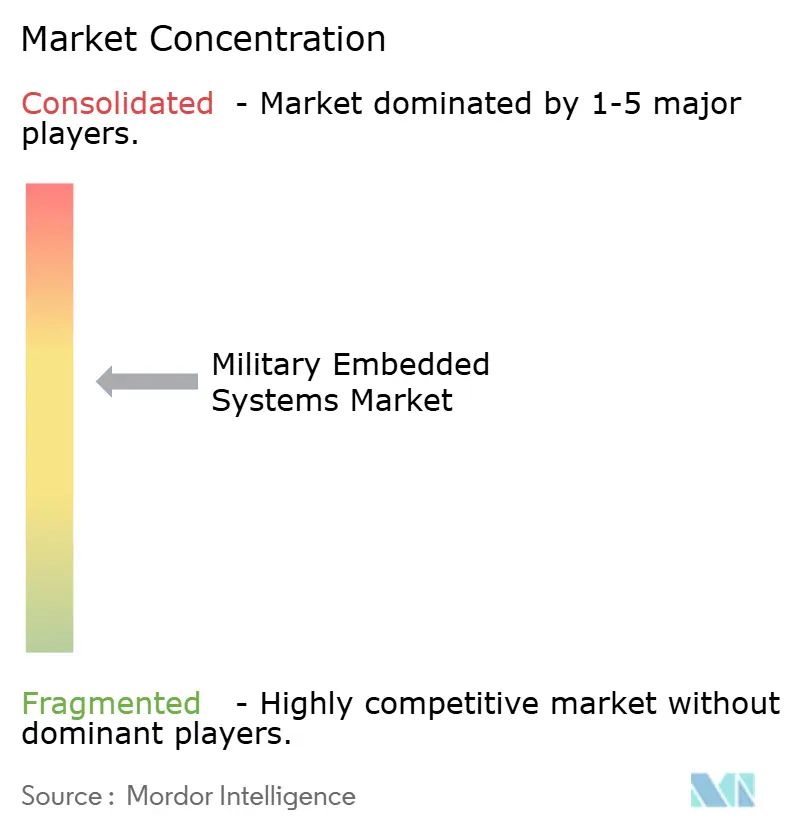
The military embedded systems market is moderately concentrated because a group of vertically integrated defense primes captures much of the program-level revenue. L3Harris Technologies, Inc., BAE Systems plc, Curtiss-Wright Corporation, Mercury Systems, Inc., and General Dynamics Corporation compete alongside specialist suppliers such as Leonardo S.p.A., Elbit Systems Ltd., Advantech Co., Ltd., and Kontron AG. Prime contractors integrate platforms, mission systems, and customer access. Specialist firms compete for processor cards, chassis, storage, and other subsystem positions within these programs. The transition to MOSA and SOSA is a central differentiator because solicitations increasingly specify conformance to standards. The Open Group's SOSA Consortium includes 170 member organizations and provides a common technical framework for open systems. Suppliers that qualify early can improve their access to new programs.
Northrop Grumman's ATSP5 selection illustrates the importance of contracting speed as well as technology capability. The company states that the vehicle is intended to shorten the proposal-to-award process for military microelectronics to 80-90 days. Mercury Systems, Inc. demonstrates how specialized positions can generate recurring revenue across several related programs. The market rewards these positions when suppliers retain form-factor and performance compatibility. Thermal management, radiation-tolerant AI accelerators, and directed-energy processing remain areas where suppliers can differentiate.
Nontraditional AI firms are entering the military embedded systems market through rapid prototyping programs and other transaction agreements. Their role is growing because procurement agencies need AI computing solutions that can move faster than traditional acquisition cycles. Compliance with CMMC and the DoD's cyber risk framework can still favor established providers with mature secure development practices. Competition will remain tied to reliable thermal design, cyber compliance, program relationships, and alignment with standards. The supplier structure therefore combines large integrators with specialized component companies.
Military Embedded Systems Industry Leaders
-
BAE Systems plc
-
Curtiss-Wright Corporation
-
L3Harris Technologies, Inc.
-
General Dynamics Corporation
-
Mercury Systems, Inc.
- *Disclaimer: Major Players sorted in no particular order
Recent Industry Developments
- August 2026: Curtiss-Wright Corporation secured USD 40 million in contracts from Leidos, Inc., to supply electromechanical actuation and mission computing systems for the US Army Indirect Fire Protection Capability Program.
- May 2026: Mercury Systems, Inc., a global leader in aerospace and defense electronics, announced a multi-year contract with Blue Raven, a leading defense industry distributor, to deliver 1,000 RTBX06 BuiltSECURE™ servers.
- February 2026: Curtiss-Wright Corporation was selected by The Boeing Company to provide mission computer technology for the US Air Force's C-17 Globemaster III Flight Deck Obsolescence and Technology Refresh program.
Global Military Embedded Systems Market Report Scope
The military embedded systems market comprises specialized computing hardware and software solutions that support mission-critical processing, control, communication, and decision-making across military platforms and defense applications. The scope includes embedded systems deployed on new military platforms and for upgrading and modernizing existing defense systems. These systems support real-time data processing, sensor fusion, edge AI, and operations in demanding military environments.
The military embedded systems market is segmented by component, platform, installation type, application, and geography. By component, the market is segmented into hardware and software. By platform, the market is segmented into land, airborne, naval, unmanned, and space. By installation type, the market is segmented into new installation and upgradation. By application, the market is segmented into intelligence, surveillance and reconnaissance (ISR), command and control (C2), communication and navigation, electronic warfare (EW), weapon and fire control, wearables, and others. The report also covers market sizes and forecasts for the military embedded systems market across major countries in major countries across different regions. For each segment, the market size is provided in terms of value (USD).
| Hardware |
| Software |
| Land |
| Airborne |
| Naval |
| Unmanned |
| Space |
| New Installation |
| Upgradation |
| Intelligence, Surveillance, and Reconnaissance (ISR) |
| Command and Control (C2) |
| Communication and Navigation |
| Electronic Warfare (EW) |
| Weapon and Fire Control |
| Wearables |
| Others |
| North America | United States | |
| Canada | ||
| Mexico | ||
| Europe | United Kingdom | |
| France | ||
| Germany | ||
| Italy | ||
| Russia | ||
| Rest of Europe | ||
| Asia-Pacific | China | |
| India | ||
| Japan | ||
| South Korea | ||
| Australia | ||
| Rest of Asia-Pacific | ||
| South America | Brazil | |
| Argentina | ||
| Rest of South America | ||
| Middle East and Africa | Middle East | United Arab Emirates |
| Saudi Arabia | ||
| Israel | ||
| Rest of Middle East | ||
| Africa | South Africa | |
| Rest of Africa | ||
| By Component | Hardware | ||
| Software | |||
| By Platform | Land | ||
| Airborne | |||
| Naval | |||
| Unmanned | |||
| Space | |||
| By Installation Type | New Installation | ||
| Upgradation | |||
| By Application | Intelligence, Surveillance, and Reconnaissance (ISR) | ||
| Command and Control (C2) | |||
| Communication and Navigation | |||
| Electronic Warfare (EW) | |||
| Weapon and Fire Control | |||
| Wearables | |||
| Others | |||
| By Geography | North America | United States | |
| Canada | |||
| Mexico | |||
| Europe | United Kingdom | ||
| France | |||
| Germany | |||
| Italy | |||
| Russia | |||
| Rest of Europe | |||
| Asia-Pacific | China | ||
| India | |||
| Japan | |||
| South Korea | |||
| Australia | |||
| Rest of Asia-Pacific | |||
| South America | Brazil | ||
| Argentina | |||
| Rest of South America | |||
| Middle East and Africa | Middle East | United Arab Emirates | |
| Saudi Arabia | |||
| Israel | |||
| Rest of Middle East | |||
| Africa | South Africa | ||
| Rest of Africa | |||
Key Questions Answered in the Report
What is the projected value of military embedded systems market by 2032?
The military embedded systems market is forecast to reach USD 3.62 billion by 2032, growing at a 9.31% CAGR from 2027 to 2032.
Which component grows fastest through 2032?
Software is the fastest-growing component, with an 11.34% CAGR through 2032, driven by AI runtimes, portable middleware, and secure software updates.
Which platform has the strongest forecast growth?
Unmanned platforms are forecast to grow at a 12.23% CAGR through 2032 as demand rises for uncrewed aircraft, surface systems, and autonomous munitions.
What is the largest application for embedded defense computing?
ISR led applications with 28.55% revenue share in 2026 because surveillance and sensor processing require persistent local computing.
Which region grows fastest through 2032?
Asia-Pacific is forecast to grow at an 11.95% CAGR through 2032, supported by modernization and efforts to develop trusted domestic computing supply chains.
Why are open standards important for military embedded systems?
MOSA and SOSA help programs use compatible modules and update processing capability without redesigning the full platform.