
Military Aramid Fiber Market Size and Share
Market Overview
| Study Period | 2022 - 2032 |
|---|---|
| Market Size (2027) | USD 1.56 Billion |
| Market Size (2032) | USD 2.20 Billion |
| Growth Rate (2027 - 2032) | 7.13 % |
| Fastest Growing Market | Asia-Pacific |
| Largest Market | Asia-Pacific |
| Market Concentration | High |
Major Players *Disclaimer: Major Players sorted in no particular order Image © Mordor Intelligence. Reuse requires attribution under CC BY 4.0. | |
Military Aramid Fiber Market Analysis by Mordor Intelligence
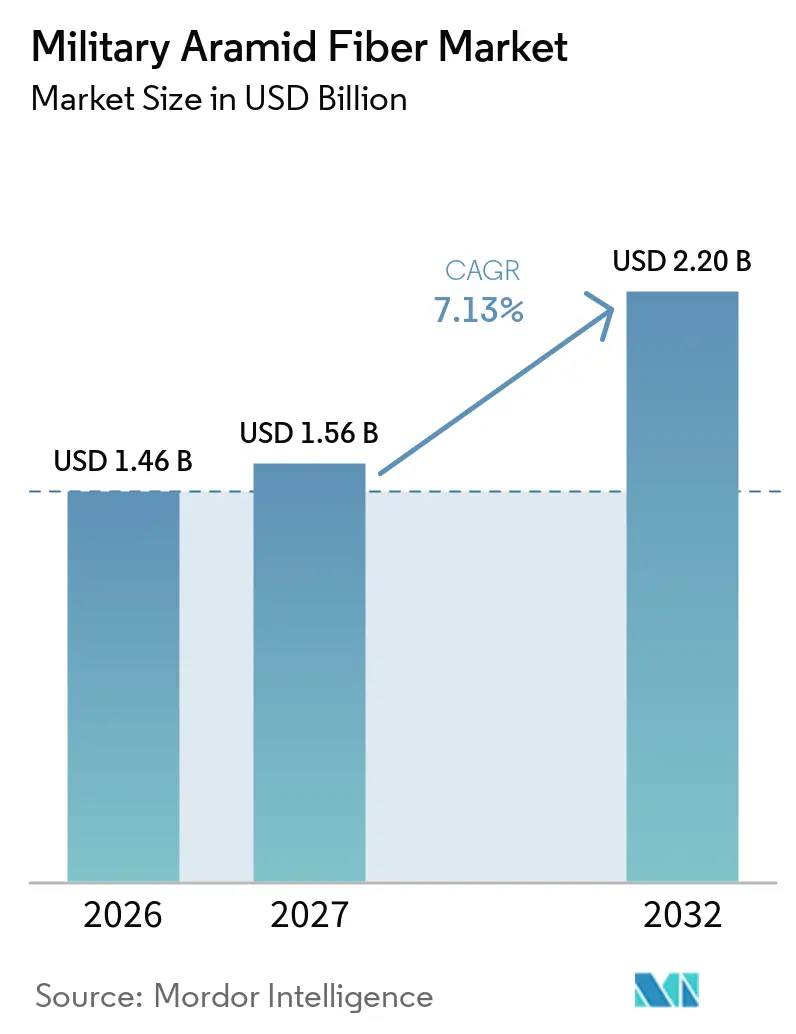
The Military Aramid Fiber Market size was valued at USD 1.46 billion in 2026 and is estimated to grow from USD 1.56 billion in 2027 to reach USD 2.20 billion by 2032, at a CAGR of 7.13% during the forecast period (2027-2032). Defense procurement increasingly treats high-performance fiber specifications as a supply-security requirement rather than a routine material purchase made late in the equipment cycle. The military aramid fiber market benefits from multi-year contracts for soldier systems and protected platforms, which set fiber specifications, testing requirements, and supply expectations well before deliveries begin. Governments in NATO countries, the Indo-Pacific, and other defense economies are extending personal-protection programs, supporting a more stable demand base than many industrial fiber uses and reducing dependence on isolated purchases. Producers are responding through qualification work, specialty grades, and lower-emissions feedstocks, while buyers weigh performance, supply security, lifecycle requirements, and the practical availability of qualified material. Competition from ultra-high-molecular-weight polyethylene, ceramics, and hybrid armor remains important where lower system weight is the priority, particularly in armor designs that combine several materials. For the military aramid fiber market, this makes material qualification and continuity of supply as relevant as fiber performance.
Key Report Takeaways
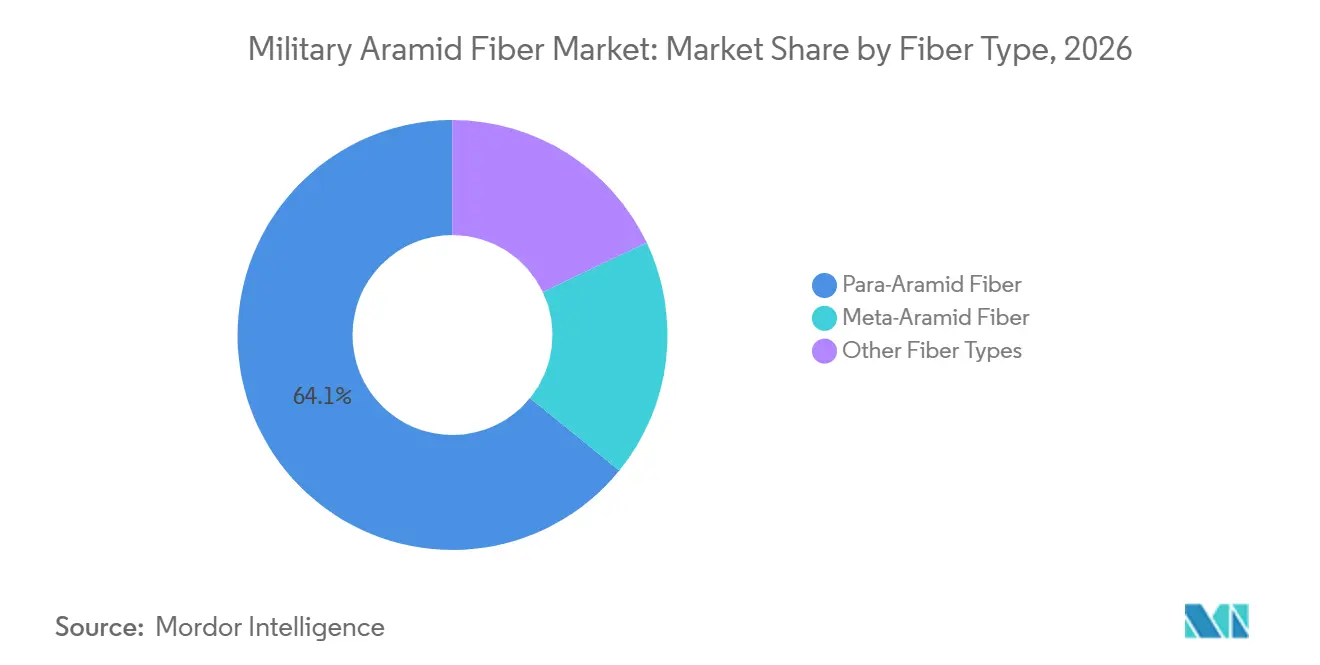
- By fiber type, para-aramid fiber held 64.14% of the military aramid fiber market share in 2026, while meta-aramid fiber is forecast to advance at a 7.74% CAGR through 2032.
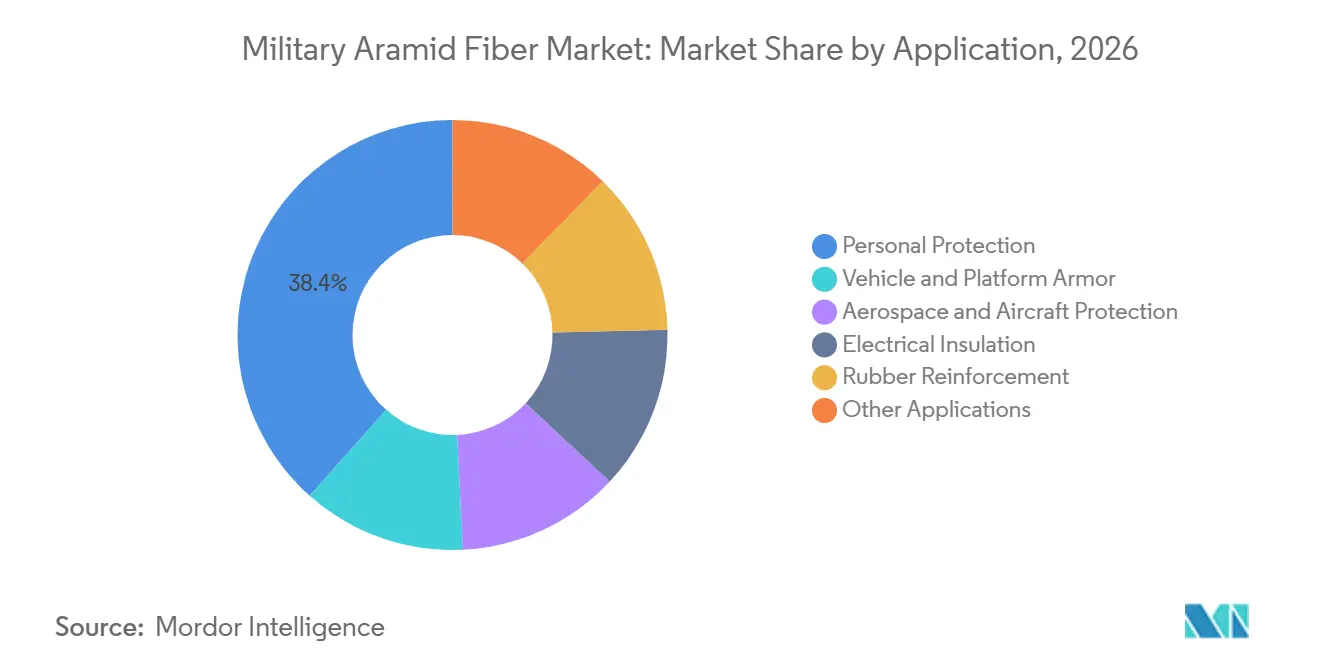
- By application, personal protection held 38.45% of the military aramid fiber market share in 2026, while vehicle and platform armor is forecast to advance at an 8.15% CAGR through 2032.
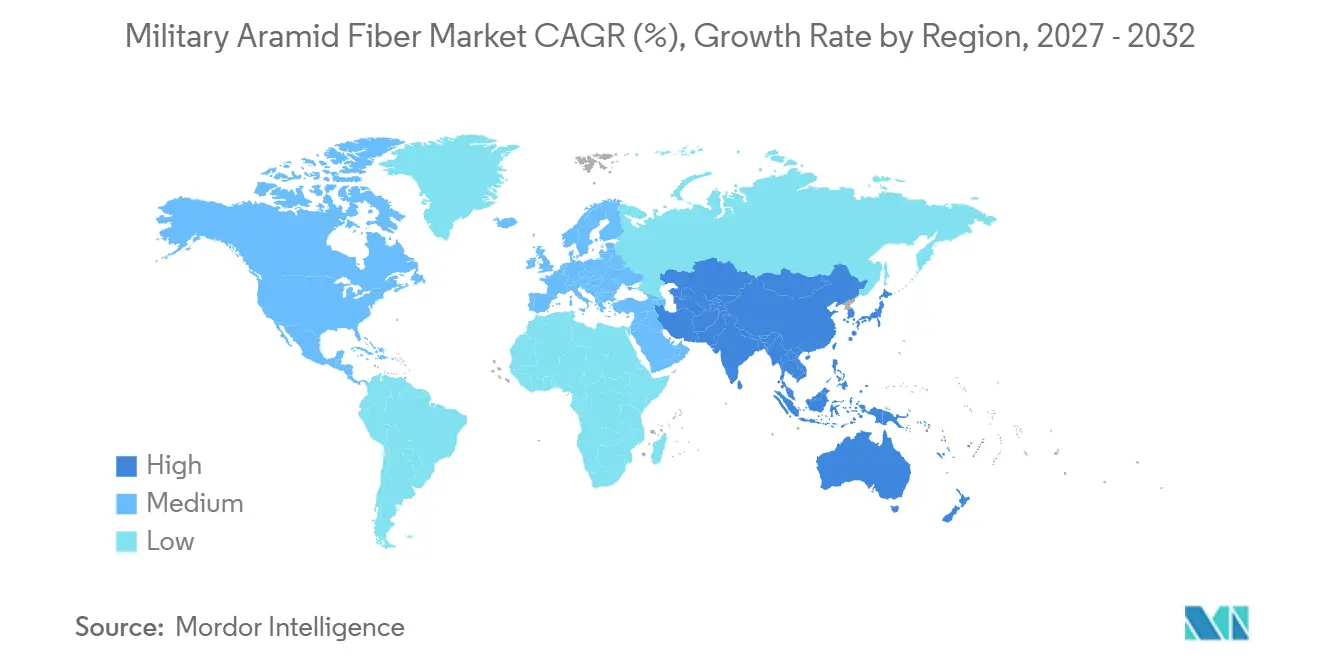
- By geography, Asia-Pacific held 37.18% of the military aramid fiber market share in 2026 and is forecast to advance at an 8.02% CAGR through 2032.
Note: Market numbers in this report are based on Mordor Intelligence's proprietary estimation framework, which combines nine months of actuals with Q4 projections for base year 2026.
Market Trends and Insights
Drivers Impact Analysis of Military Aramid Fiber Market*
| Driver | (~) % Impact on CAGR Forecast | Geographic Relevance | Impact Timeline |
|---|---|---|---|
| Rising Defense Procurement and Soldier-Protection Modernization | +2.4% | Global, led by North America, APAC core (India, Japan, South Korea) | Short term (≤ 2 years) |
| Lightweighting of Armor Systems for Mobility and Payload | +1.7% | North America & EU, spillover to APAC | Medium term (2–4 years) |
| Expansion of Military Aviation, UAVs and Unmanned Platforms | +1.2% | Global, with early adoption in North America and China | Medium term (2–4 years) |
| Evolving Ballistic, Fragmentation and Drone Threat Profiles | +0.9% | Global, with heightened urgency in Europe and APAC | Short term (≤ 2 years) |
| Domestic Qualification and Localization of Strategic Fiber Supply | +0.7% | APAC core (South Korea, India), spillover to MEA | Long term (≥ 4 years) |
| Source: Mordor Intelligence | |||
Rising Defense Procurement and Soldier-Protection Modernization
Defense budget expansion in NATO countries and the Indo-Pacific is supporting longer procurement programs for body armor, ballistic helmets, and combat load-bearing systems, with material selection considered alongside system testing and equipment availability. The military aramid fiber market is linked to these programs because protection requirements often specify material properties that para-aramid and hybrid aramid systems can meet in established equipment configurations. Procurement teams are using longer supply agreements to reduce the risk of disruptions in qualified fiber availability, especially when a program requires a specified material that cannot be readily substituted. This approach gives producers a clearer view of demand before finished equipment reaches users and allows armor suppliers to plan production against defined technical requirements. Japan’s defense build-up includes personal protection, unmanned systems, and missile programs that use high-performance fibers at different points in their supply chains and across different equipment lifecycles. The resulting contract structure supports a more durable demand base for the military aramid fiber market than one-time equipment purchases, even when individual order schedules vary.
Lightweighting of Armor Systems for Mobility and Payload
Protective equipment can add more than 40 kg to a fully equipped dismounted soldier’s load, which can reduce endurance, affect movement, and increase the risk of musculoskeletal injuries during extended operations. Para-aramid vehicle-panel systems can reduce weight by 30% - 60% compared with equivalent steel solutions in layered designs, giving vehicle designers more flexibility in how mass is allocated across the platform. A 2025 peer-reviewed evaluation found that a Twaron and ultra-high-molecular-weight polyethylene hybrid configuration met NATO Standardization Agreement (STANAG) 4569 Level I protection requirements while maintaining structural integrity across the tested areal-weight configurations. Teijin Limited launched Twaron Next in November 2025 with mechanical performance comparable to standard Twaron and 25% lower carbon dioxide emissions than the industry average. These characteristics give procurement teams a way to consider mobility, durability, and environmental requirements alongside ballistic performance when evaluating equipment alternatives. The military aramid fiber market can also benefit from lower armor mass, enabling lighter tactical vehicles, wearable sensor systems, and unmanned-ground-vehicle designs that would otherwise face payload limitations.
Expansion of Military Aviation, Unmanned Aerial Vehicles, and Unmanned Platforms
The growth of unmanned systems creates a demand channel based on larger platform fleets rather than the material intensity of individual crewed platforms, changing the pattern for composite-material demand. Aramid-reinforced composite panels can be used in tactical unmanned aerial system airframes where low weight, impact resistance, and reduced radar signature are important design considerations. A 2024 peer-reviewed study reported that polypropylene and polyethylene composites reinforced with silicon-dioxide-modified aramid fibers recorded a 20% rise in tensile strength and a 36%–52% improvement in modulus for small unmanned aerial vehicle body covers. Even modest aramid content per unit can add up when procurement programs expand into large fleets, especially where a program requires replacement airframes and spare parts. Military aviation also uses aramid materials in engine-nacelle thermal barriers, helicopter-cabin spall liners, and structural panels for maritime patrol aircraft that operate in demanding environments. The military aramid fiber market, therefore, serves applications where supplier qualification relationships may extend across long equipment lifecycles and where design changes require material validation.
Evolving Ballistic, Fragmentation, and Drone Threat Profiles
First-person-view drone attacks are changing protection requirements because their explosive payloads can create fragmentation patterns unlike those from conventional ballistic threats and can expose equipment from different directions. Aramid fabrics absorb energy through friction and maintain a stable load response, which supports their use in protective systems facing fragments, blast effects, and repeated operational exposure. A 2025 computational study found that hybrid configurations incorporating aramid laminates reduced transmitted pressure by 78% in modeled protective cage structures for first-person-view drone payloads. This work supports the continued development of layered protective systems rather than reliance on a single material where threats combine blast, fragments, and impact. The military aramid fiber market can gain from revised armor specifications as armed forces address drone-related fragments, overpressure, and conventional threats together in the same protection package. Recurring material testing and qualification can also favor established suppliers that already hold validated defense product positions and can support updates without restarting the full approval process.
Restraints Impact Analysis of Military Aramid Fiber Market*
| Restraint | (~) % Impact on CAGR Forecast | Geographic Relevance | Impact Timeline |
|---|---|---|---|
| Capital-Intensive Para-Aramid Production and Qualification Costs | -1.4% | Global, most acute in markets outside established supply hubs (MEA, South America) | Long term (≥ 4 years) |
| Competition from UHMWPE, Ceramics and Hybrid Armor Systems | -1.1% | North America & EU, spillover to APAC | Medium term (2–4 years) |
| Concentrated Supply of Defense-Qualified High-Performance Fiber | -0.8% | Global, most acute for non-allied procurement offices | Medium term (2–4 years) |
| Source: Mordor Intelligence | |||
Capital-Intensive Para-Aramid Production and Qualification Costs
Para-aramid manufacturing requires polymerization under dry conditions and close control of molecular-weight distribution, making the process technically demanding from initial production through quality assurance. These requirements make new plants capital-intensive relative to their output, limiting the qualified supply base available to defense buyers and raising the cost of entry for new producers. New entrants also face lengthy defense testing before a fiber can be listed for program use, even after the manufacturing process is established. Ballistic testing, durability assessments, and supply-chain documentation reviews can take 18-36 months before approval, extending the period before an investment can serve defense customers. This limits how quickly the military aramid fiber market can add capacity when defense demand rises and can place pressure on budgets under fixed-price equipment contracts.
Competition from Ultra-High-Molecular-Weight Polyethylene, Ceramics, and Hybrid Armor Systems
Ultra-high-molecular-weight polyethylene systems compete with para-aramid in soft armor, hard-armor backing, and vehicle spall liners, particularly where equipment designers prioritize lower mass. Their high specific strength is particularly relevant in helmets and vehicle protection, where weight-to-protection performance is central to the design choice and can affect platform mobility. A 2025 Scientific Reports study assessed boron carbide and ultra-high-molecular-weight polyethylene armor configurations at areal densities that make hard-armor substitution a material consideration. Para-aramid retains advantages in thermal stability, flame resistance, and established defense qualification history, which continue to matter in demanding operating conditions. These properties remain relevant where environmental conditions or contract specifications restrict the use of polyethylene alternatives and require a proven performance history. The military aramid fiber market nonetheless faces a narrower set of applications in which aramid is the uncontested material choice, particularly in hard-armor systems, which require producers to focus on use cases where their material properties are decisive.
*Our forecasts treat driver/restraint impacts as directional, not additive. The impact forecasts reflect baseline growth, mix effects, and variable interactions.
Military Aramid Fiber Market Segment Analysis
By Fiber Type:
Para-Aramid Leads, While Meta-Aramid Grows FasterPara-aramid fiber held 64.14% of the military aramid fiber market in 2026. Its position reflects validated ballistic-test history, government-qualified listings, and use across body-armor panels, helmet prepregs, vehicle spall liners, and composite structural panels. Para-aramid can deliver tensile strength 5-6 times that of steel wire and withstand temperatures above 500 °C. Teijin Limited introduced Twaron Next in November 2025, using circular and bio-based raw materials while maintaining its stated mechanical performance. The product’s 25% lower carbon dioxide emissions than the industry average suggest that environmental criteria may carry more weight in future procurement decisions.
Meta-aramid fiber is projected to advance at a 7.74% CAGR through 2032 in the military aramid fiber industry. It is used in flame-resistant combat uniforms, military flight suits, and textile layers designed for ballistic, thermal, and chemical protection. The military aramid fiber market size for this material group is supported by garment systems that require several protection properties in one construction. Kermel serves military meta-aramid demand in fire-protective uses, while other fiber types include blended yarns and aramid-ceramic composite materials. Quality-management systems and NATO STANAG requirements act as key filters for government procurement, while new suppliers can face qualification cycles lasting up to 24 months before program eligibility, strengthening the position of incumbents even as demand rises.

By Application:
Personal Protection Holds the Largest Position, While Vehicle and Platform Armor AdvancesPersonal protection held 38.45% of the military aramid fiber market in 2026. Soldier-system modernization programs in the United States, India, Japan, South Korea, and NATO European members support demand for body armor and helmets. The military aramid fiber market size linked to personal protection depends on recurring equipment replacement cycles and revised readiness requirements. Aerospace and aircraft protection provides additional demand through helicopter-cabin spall liners, military transport-aircraft structures, and tactical unmanned aerial system panels. Electrical insulation and rubber reinforcement are smaller military uses, including vehicle high-voltage protection and heat-resistant tracked-vehicle components, while other applications include blast-mitigation panels, nano-reinforced aramid composites, and aramid-based naval mooring components at earlier stages of commercialization.
Vehicle and platform armor is projected to advance at an 8.15% CAGR through 2032. This demand reflects a move from steel monocoque vehicle designs toward composite armor systems that can reduce mass while meeting current threat requirements. A 2025 study found that para-aramid and ultra-high-molecular-weight polyethylene hybrid panels maintained required performance against 7.62 mm NATO full metal jacket projectiles at certified areal densities. Aramid-reinforced panels can be used in light tactical vehicles, armored personnel carriers, and naval patrol craft, while lower armor mass can extend operating range or preserve payload capacity in unmanned ground vehicles. This application supports growth in the military aramid fiber industry as platform designers place more value on mobility and system integration.
Geography Analysis
APAC Military Aramid Fiber Market
Asia-Pacific held 37.18% of the military aramid fiber market in 2026 and is projected to advance at an 8.02% CAGR through 2032, giving the region both the largest reported position and the fastest projected regional expansion. China and India account for a substantial part of the region’s manufacturing-capacity expansion, while Yantai Tayho Advanced Materials Co., Ltd. and Sinochem International Corporation are scaling meta-aramid and para-aramid output for military and telecommunications uses. Japan’s defense reinforcement program supports demand for personal protection, unmanned systems, and missile programs that use high-performance fibers at different points in their supply chains and at different stages of the equipment lifecycle. Long-term qualified-supplier relationships also shape regional purchasing because buyers need continuity in a material that is evaluated within an entire protection system. South Korea’s localization efforts can create a procurement advantage for domestic producers such as Kolon Industries, Inc. and Taekwang Industrial Co., Ltd., particularly where domestic supply is part of a broader strategic-material policy.
North America Military Aramid Fiber Market
North America remains an important procurement center because the United States Department of Defense buys body armor, ballistic helmets, and platform-protection systems at scale through established equipment programs. United States Army programs require protection systems compliant with National Institute of Justice standards, sustaining demand for para-aramid in personal protection and setting high thresholds for replacement materials. Long-duration supply agreements between fiber producers and prime armor contractors provide demand visibility, but they also expose suppliers to input-cost volatility when material costs move during contract periods. Canada and Mexico contribute demand through constabulary and border-security modernization activity, although their procurement scale is smaller than that of the United States. The military aramid fiber market in North America also faces direct competition from ultra-high-molecular-weight polyethylene systems, making thermal performance, qualification history, delivery assurance, and integration knowledge important differentiators for aramid producers.
EMEA and South America Military Aramid Fiber Market
Europe is supported by higher defense investment and interest in circular material systems for protective textiles, including a greater focus on how materials are managed after use. Teijin Limited’s European production assets and Kermel’s fire-protective materials serve regional personal-protection requirements and reinforce the importance of established local supply relationships. The military aramid fiber market benefits where procurement specifications recognize long service life, heat resistance, verified material handling, and a manufacturer’s ability to support traceability. South America and the Middle East and Africa remain smaller demand areas, with modernization programs in Brazil, Saudi Arabia, and South Africa supporting the adoption of NATO-compatible personal-protection standards. This leaves room for suppliers that can offer local support, reliable access to tested materials, and documentation suitable for government procurement.
Competitive Landscape
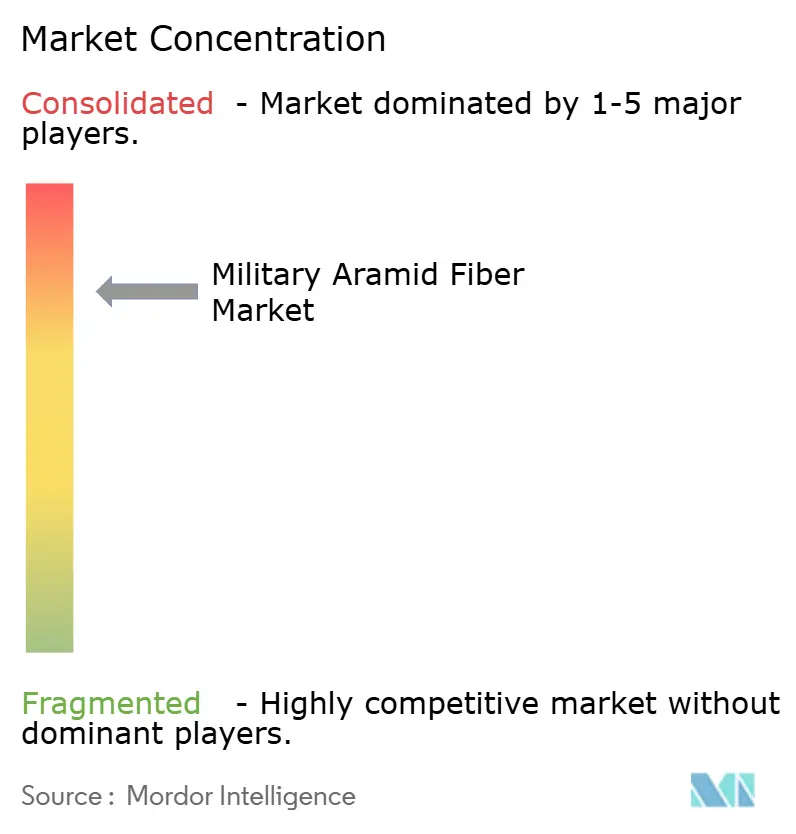
The military aramid fiber market is consolidated, with the top five players including DuPont, TEIJIN LIMITED, Kolon Industries, Inc., HS HYOSUNG ADVANCED MATERIALS, and Yantai Tayho Advanced Materials Co., Ltd. Government qualification procedures create a strong barrier because entrants must complete material testing, documentation, program-specific evaluation, and repeatable manufacturing verification before buyers can approve a new fiber. Suppliers therefore compete on proven product performance, manufacturing capacity, traceability, delivery reliability, thermal resistance, and the ability to meet system-weight requirements without disrupting established armor designs.
DuPont completed the divestiture of its Aramids business, including Kevlar and Nomex, to Arclin in April 2026 in a transaction valued at USD 1.8 billion, transferring a well-established portfolio to a new owner[1]. The business had net sales of USD 1.3 billion in 2024 and operated 5 global manufacturing sites at the time of the transaction, demonstrating the scale of the asset base involved. This ownership change preserves the relevance of established aramid brands while creating a new supplier relationship that defense buyers and armor manufacturers must manage through existing qualification arrangements. TEIJIN LIMITED launched Twaron Next at Milipol Paris in November 2025 as a para-aramid made with circular and bio-based feedstocks, linking a material-development decision with the environmental criteria appearing in more procurement discussions[2]. The product offers 25% lower carbon dioxide emissions than the industry average without the company reporting a reduction in mechanical performance, showing how product design can affect competitive positioning beyond direct strength measures.
Kolon Industries, Inc. expanded annual para-aramid capacity from 7,500 metric tons to 15,310 metric tons through a KRW 300 billion investment, illustrating the scale of capital required to build a credible position in qualified supply. Chinese producers, including Yantai Tayho Advanced Materials Co., Ltd. and Sinochem International Corporation, are pursuing cost-competitive commercial positions while developing domestic military qualification paths that can support access to their local defense programs. This approach can increase pricing pressure in non-military grades while access to allied defense programs remains constrained by qualification, documentation, and supply rules. Kermel and HS HYOSUNG ADVANCED MATERIALS have scope to extend their positions through specialty and protective-material applications, but development work must align with the lengthy validation process faced by all new defense materials. The military aramid fiber market remains shaped by testing cycles, customer validation, and the practical difficulty of replacing a specified fiber in an operating defense program, especially after equipment has been tested and accepted.
Military Aramid Fiber Industry Leaders
-
DuPont
-
TEIJIN LIMITED
-
Kolon Industries, Inc.
-
HS HYOSUNG ADVANCED MATERIALS
-
Yantai Tayho Advanced Materials Co., Ltd.
- *Disclaimer: Major Players sorted in no particular order
Military Aramid Fiber Market Companies Covered in this Report
- Aramid Hpm, LLC.
- DuPont
- Honeywell International Inc.
- HS HYOSUNG ADVANCED MATERIALS
- Huvis Corp.
- Kamenskvolokno JSC
- Kermel
- Kolon Industries, Inc.
- Sinochem International Corporation
- SINOPEC YIZHENG CHEMICAL FIBRE LIMITED
- SRF Limited
- Taekwang Industrial Co., Ltd.
- TEIJIN LIMITED
- TORAY INDUSTRIES, INC.
- Toyobo MC Corporation
- Yantai Tayho Advanced Materials Co., Ltd.
Recent Industry Developments in Military Aramid Fiber Market
- June 2026: Arclin collaborated with BSST to develop a next-generation explosive ordnance disposal (EOD) suit featuring Kevlar EXO aramid fiber technology. The lightweight suit is designed to improve fragment protection while reducing operator burden, supporting demand in the military aramid fiber market for lightweight, high-performance protective equipment.
- April 2026: DuPont completed the divestiture of its Kevlar® and Nomex® aramid businesses to Arclin in a transaction valued at approximately USD 1.8 billion. The acquisition places established aramid fiber technologies used in ballistic protection and military protective equipment under Arclin’s ownership, reshaping the competitive landscape of the military aramid fiber market.
Global Military Aramid Fiber Market Report Scope
Military aramid fibers are high-performance synthetic fibers designed to provide high tensile strength, low weight, heat resistance, and durability in demanding defense environments. They are used in protective and structural materials where impact resistance, thermal stability, and weight reduction are important.
The Military Aramid Fiber Market is segmented by fiber type, application, and geography. By fiber type, the market is segmented into para-aramid fiber, meta-aramid fiber, and other fiber types. By application, the market is segmented into personal protection, vehicle and platform armor, aerospace and aircraft protection, electrical insulation, rubber reinforcement, and other applications. The report also covers the market size and forecasts for military aramid fiber across 16 countries. For each segment, the market sizing and forecasts have been done on the basis of value (USD).
Segmentation Overview
| Para-Aramid Fiber |
| Meta-Aramid Fiber |
| Other Fiber Types |
| Personal Protection |
| Vehicle and Platform Armor |
| Aerospace and Aircraft Protection |
| Electrical Insulation |
| Rubber Reinforcement |
| Other Applications |
| Asia-Pacific | China |
| India | |
| Japan | |
| South Korea | |
| ASEAN Countries | |
| Rest of Asia-Pacific | |
| North America | United States |
| Canada | |
| Mexico | |
| Europe | Germany |
| United Kingdom | |
| France | |
| Italy | |
| NORDIC Countries | |
| Russia | |
| Rest of Europe | |
| South America | Brazil |
| Argentina | |
| Rest of South America | |
| Middle East and Africa | Saudi Arabia |
| South Africa | |
| Rest of Middle East and Africa |
| By Fiber Type | Para-Aramid Fiber | |
| Meta-Aramid Fiber | ||
| Other Fiber Types | ||
| By Application | Personal Protection | |
| Vehicle and Platform Armor | ||
| Aerospace and Aircraft Protection | ||
| Electrical Insulation | ||
| Rubber Reinforcement | ||
| Other Applications | ||
| By Geography | Asia-Pacific | China |
| India | ||
| Japan | ||
| South Korea | ||
| ASEAN Countries | ||
| Rest of Asia-Pacific | ||
| North America | United States | |
| Canada | ||
| Mexico | ||
| Europe | Germany | |
| United Kingdom | ||
| France | ||
| Italy | ||
| NORDIC Countries | ||
| Russia | ||
| Rest of Europe | ||
| South America | Brazil | |
| Argentina | ||
| Rest of South America | ||
| Middle East and Africa | Saudi Arabia | |
| South Africa | ||
| Rest of Middle East and Africa | ||
Key Questions Answered in the Report
What is the size of the military aramid fiber market?
The military aramid fiber market size was valued at USD 1.46 billion in 2026 and is estimated to grow from USD 1.56 billion in 2027 to reach USD 2.20 billion by 2032, at a CAGR of 7.13% during the forecast period (2027-2032).
What is driving demand for military aramid fiber?
Soldier-protection modernization, lighter armor systems, unmanned platforms, and changing fragmentation threats support demand.
Which fiber type held the largest share in 2026?
Para-aramid fiber led with 64.14% share in 2026, supported by its use in body armor, helmets, vehicle liners, and structural panels.
Which application is projected to advance fastest through 2032?
Vehicle and platform armor is projected to advance at an 8.15% CAGR through 2032 as platforms shift toward lighter composite armor designs.