
Midstream Oil and Gas Analytics Market Size and Share
Market Overview
| Study Period | 2022 - 2032 |
|---|---|
| Market Size (2027) | USD 0.91 Billion |
| Market Size (2032) | USD 2.23 Billion |
| Growth Rate (2027 - 2032) | 19.71 % |
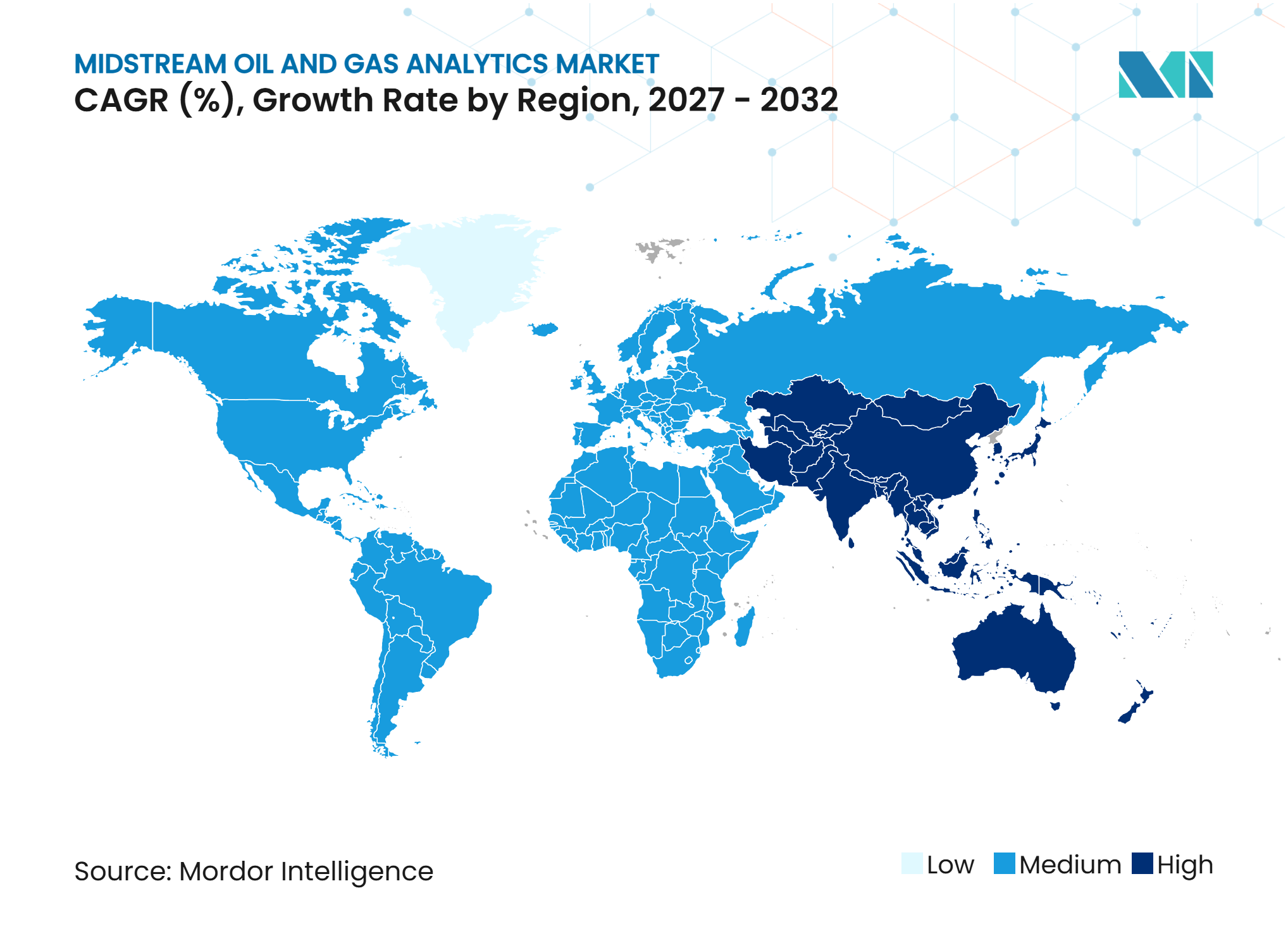
| Fastest Growing Market | Asia-Pacific |
| Largest Market | North America |
| Market Concentration | Medium |
Major Players *Disclaimer: Major Players sorted in no particular order Image © Mordor Intelligence. Reuse requires attribution under CC BY 4.0. | |
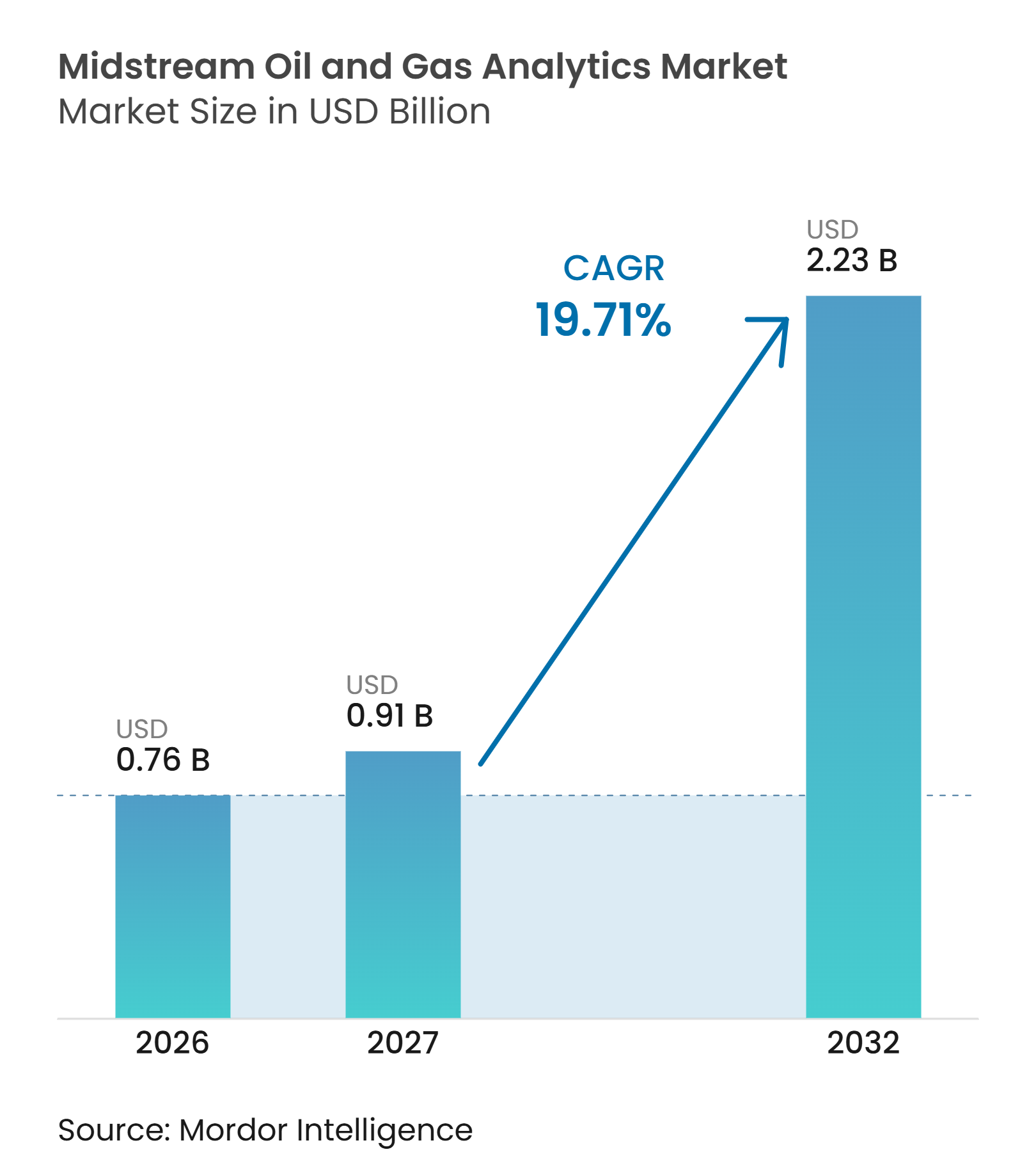
Midstream Oil and Gas Analytics Market Analysis by Mordor Intelligence
The Midstream Oil And Gas Analytics Market size was valued at USD 0.76 billion in 2026 and is estimated to grow from USD 0.91 billion in 2027 to reach USD 2.23 billion by 2032, at a CAGR of 19.71% during the forecast period (2027-2032). The midstream oil and gas analytics market is growing as operators use connected data to improve pipeline dispatch, terminal throughput, measurement, and asset reliability. Cloud platforms, industrial artificial intelligence, and higher-frequency vessels, satellite, and infrastructure data are making this work more practical across dispersed assets. The planned expansion of liquefied natural gas capacity is also increasing the need for reliable feed-gas transport, terminal scheduling, and custody-transfer information.[1] Vendors are responding by combining analytics software with industrial automation, remote monitoring, and cybersecurity controls. Regulatory requirements in Europe and pipeline safety rules in the United States also make emissions detection and data quality more important for operators.[2]
Key Report Takeaways
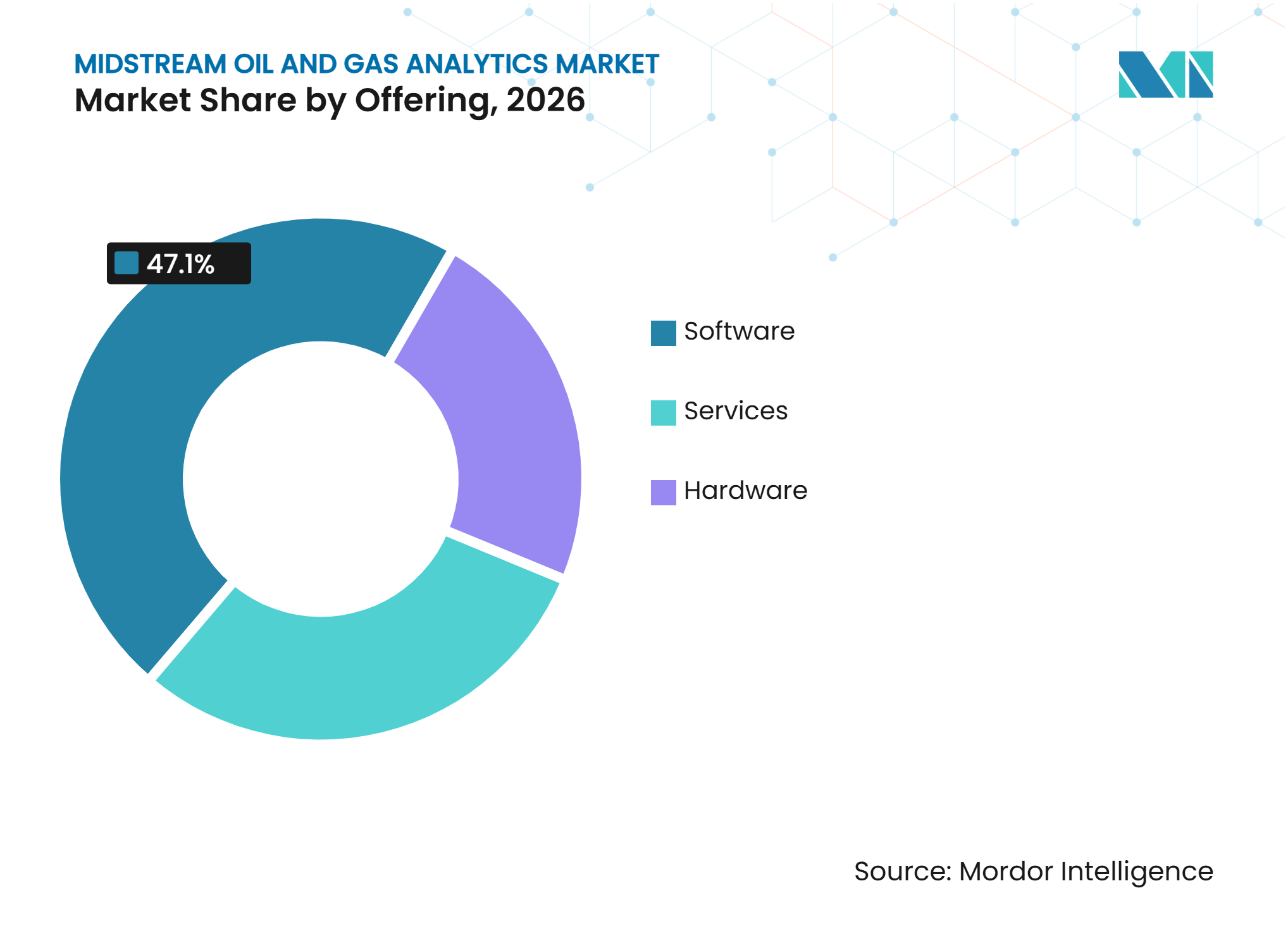
- By offering, software held 47.1% of the midstream oil and gas analytics market share in 2026, while services are projected to grow at a 20.6% CAGR through 2032.
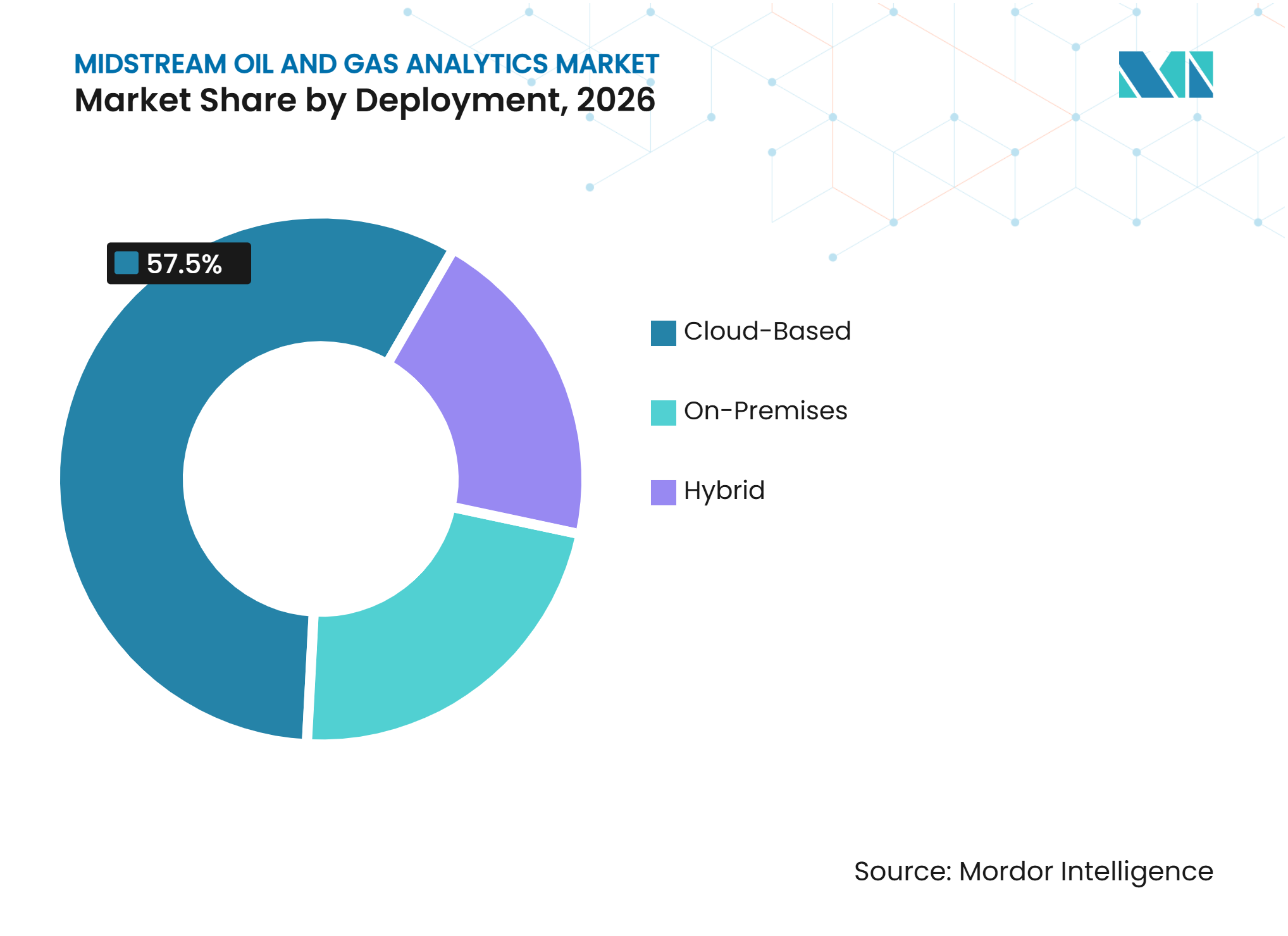
- By deployment, cloud-based solutions accounted for 57.5% of the midstream oil and gas analytics market share in 2026 and are forecast to expand at a 20.8% CAGR through 2032.
- By technology, big data analytics captured 23.8% of the midstream oil and gas analytics market share in 2026, while generative AI is forecast to grow at a 22.6% CAGR through 2032.
- By geography, North America held 36.2% of the midstream oil and gas analytics market share in 2026, while Asia-Pacific is forecast to grow at a 22.5% CAGR through 2032.
Note: Market numbers in this report are based on Mordor Intelligence's proprietary estimation framework, which combines nine months of actuals with Q4 projections for base year 2026.
Market Trends and Insights
Drivers Impact Analysis of Midstream Oil and Gas Analytics Market*
| Driver | (~) % Impact on CAGR Forecast | Geographic Relevance | Impact Timeline |
|---|---|---|---|
| Real-Time Monitoring and Remote Operations Adoption | +3.5% | Global, with concentration in North America and Middle East | Short term (≤ 2 years) |
| Aging Pipeline and Terminal Infrastructure Integrity Requirements | +3.0% | North America and Europe | Medium term (2-4 years) |
| Methane, Emissions and Safety Reporting Requirements | +2.5% | European Union, North America after 2034 | Medium term (2-4 years) |
| Cloud, Artificial Intelligence, and Industrial Internet of Things Adoption | +4.0% | Global | Medium term (2-4 years) |
| Midstream Revenue Leakage and Settlement-Automation Opportunity | +2.0% | North America, Middle East and Africa, and Asia-Pacific | Medium term (2-4 years) |
| Molecule-Level Flow Visibility from Satellite, Vessel, and Infrastructure Data | +2.5% | Global, led by LNG trade routes and cross-border pipelines | Long term (≥ 4 years) |
| Source: Mordor Intelligence | |||
Real-Time Monitoring and Remote Operations Adoption
Remote operations are gaining ground because sensors, edge computing, and cellular or satellite connectivity can now support continuous information capture at dispersed sites. Quorum Software acquired zdSCADA in March 2025, linking cloud-based Supervisory Control and Data Acquisition (SCADA) capabilities with its FLOWCAL measurement software and related services.[3] This combination supports a more direct connection between field data, production management, and commercial workflows. More frequent readings increase the need to identify exceptions and prioritize field response, rather than simply collect more data. The Pipeline and Hazardous Materials Safety Administration advanced methane emissions detection requirements in January 2025, which strengthen the case for better leak detection and monitoring across U.S. gas pipelines.[4] The midstream oil and gas analytics market therefore benefits when remote monitoring is treated as both an operating tool and a compliance requirement.
Aging Pipeline and Terminal Infrastructure Integrity Requirements
Integrity programs need more frequent and better-connected data as pipelines, compressor stations, and terminals age. Operators must bring inspection findings, corrosion records, pressure information, and geohazard observations into current risk assessments. Digital twins and condition monitoring tools make that work easier when data is available across systems. ISO 10903:2025 sets requirements for pipeline geohazard monitoring processes, systems, and technologies across the pipeline life cycle. This standard raises the importance of consistent data governance for organizations that use digital records to support integrity decisions. The midstream oil and gas analytics market also gains from the need to replace reactive maintenance practices with earlier identification of changing asset conditions.
Methane, Emissions and Safety Reporting Requirements
European methane rules have created near-term demand for leak detection, measurement, reporting, and verification tools. The European Commission describes Regulation (EU) 2024/1787 as a framework for reducing methane emissions in the energy sector. Operators need systems that combine field observations with source-level emissions inventories and reports for regulators. This demand is important for gas infrastructure that serves cross-border supply chains and LNG buyers. In the United States, the EPA proposed reconsideration of the Greenhouse Gas Reporting Program in September 2025, creating a different regulatory setting for domestic operators. The differing rules increase the value of analytics products that can meet several reporting needs without forcing operators to maintain separate systems.
Cloud, Artificial Intelligence, and Industrial Internet of Things Adoption
Cloud and connected-device deployment is changing how midstream teams use operational information. AspenTech released V15 in May 2025 with expanded generative AI capabilities and sustainability-oriented models for industrial users. Emerson and TotalEnergies also announced a July 2025 collaboration to deploy AspenTech Inmation across TotalEnergies industrial sites, centralizing millions of real-time data points for artificial intelligence use cases. These programs show how enterprise data fabrics can link field, control-room, engineering, and management information. Analytics can then support anomaly investigation, maintenance planning, and production decisions from the same operating data. Vessel tracking, satellite information, and infrastructure data add a commercial layer by improving visibility into movements and delivery timing. The midstream oil and gas analytics market is supported by this shift because operators want scalable access to data without building and maintaining separate systems at every site.
Restraints Impact Analysis of Midstream Oil and Gas Analytics Market*
| Restraint | (~) % Impact on CAGR Forecast | Geographic Relevance | Impact Timeline |
|---|---|---|---|
| Cybersecurity Exposure Across Operational Technology Networks | -1.5% | Global, with higher exposure in North America and Europe | Short term (≤ 2 years) |
| Legacy Data Silos and High Integration Costs | -2.0% | Global, most severe in mature basins with multi-decade infrastructure | Medium term (2-4 years) |
| Model Drift from Geopolitical Rerouting and Extreme Operating Conditions | -0.8% | Middle East and Africa, Europe, and global LNG trade routes | Long term (≥ 4 years) |
| Proprietary Data Rights and Limited Cross-Operator Data Sharing | -0.7% | North America and Europe | Long term (≥ 4 years) |
| Source: Mordor Intelligence | |||
Cybersecurity Exposure Across Operational Technology Networks
Connecting analytics applications to legacy Supervisory Control and Data Acquisition (SCADA) and control systems can expand the attack surface of pipeline, terminal, and storage assets. The issue is most acute where older systems have limited patching cycles or weak separation between operational technology and business systems. Honeywell has highlighted the need for cyber-resilient pipelines and storage terminals as information technology and operational technology become more closely connected. International Electrotechnical Commission (IEC) 62443 remains relevant because it provides a framework for industrial automation and control system security. Emerson introduced zero-trust cybersecurity as a core element of its Project Beyond enterprise operations platform in 2025. Security assessment, system hardening, and ongoing monitoring can raise the cost and lengthen the implementation of midstream oil and gas analytics market projects.
Legacy Data Silos and High Integration Costs
Many operators still hold SCADA histories, measurement data, enterprise records, and geospatial information in separate systems. These systems often use different structures and do not provide a complete asset or commercial view without additional integration work. A Canadian midstream customer using AspenTech Inmation aggregated 46 million rows of data daily, illustrating the operational scale of the data-management challenge. ISA-95 provides a framework for connecting enterprise and operational systems, and its updated Part 1 guidance addresses modern industrial integration needs. Even so, acquired assets and older equipment can require extended preparation before their data supports advanced analysis. Limited willingness to share proprietary pressure, corrosion, and flow data across operators also reduces the pool of information available to improve shared models.
*Our forecasts treat driver/restraint impacts as directional, not additive. The impact forecasts reflect baseline growth, mix effects, and variable interactions.
Midstream Oil and Gas Analytics Market Segment Analysis
By Offering:
Software Holds the Largest Position While Services Expand FasterSoftware held 47.1% of the midstream oil and gas analytics market size in 2026. This position reflects the role of analytics, optimization, simulation, and measurement platforms in dispatch, compression, throughput management, and reporting. Once installed and integrated, one software platform can serve many metering points, pipeline sections, and compressor stations. Hardware remains important because smart sensors, flow computers, and edge devices create the field data required by analytics software. ABB and RMG announced a 2025 collaboration on ultrasonic gas meters for U.S. energy applications, supporting custody transfer data collection. The relationship between metering equipment and analytics keeps hardware connected to platform adoption.
Services are forecast to expand at a 20.6% CAGR through 2032, which makes them the fastest-growing offering segment. Operators increasingly need support for data engineering, model tuning, managed monitoring, and remote operations. Baker Hughes reported that its iCenter network reached 2,000 connected critical assets in 2025, demonstrating the scale of remote diagnostic services offered across energy assets. These service models allow customers to access specialist support when internal analytics teams are still developing. The arrangement also gives vendors recurring revenue that is less dependent on a single software sale. The midstream oil and gas industry benefits when services help operators convert data investments into practical actions at asset level.



By Deployment:
Cloud-Based Systems Combine Scale with Faster GrowthCloud-based deployment accounted for 57.5% of the midstream oil and gas analytics market size in 2026. It also has the highest projected deployment CAGR at 20.8% through 2032. Cloud systems are attractive when an operator needs shared access to information across pipelines, terminals, processing facilities, and corporate teams. They reduce the need to build separate server capacity at each location. The TotalEnergies and Emerson program shows how an industrial data fabric can centralize high volumes of real-time information across sites. This model can support enterprise reporting and artificial intelligence development from a common information base.
On-premises systems remain relevant for sensitive control workloads, lower-latency applications, and organizations with strict data-residency expectations. Hybrid deployment is therefore becoming important for large operators with mixed technical and regulatory needs. In a hybrid design, edge systems manage time-sensitive field control while cloud platforms support broader analysis, training, visualization, and reporting. AVEVA's CONNECT platform supports hybrid connectivity between PI Data Infrastructure and cloud analytics. International Electrotechnical Commission (IEC) 62443 and North American Electric Reliability Corporation Critical Infrastructure Protection (NERC CIP) compliance considerations influence which information can move beyond local environments. The midstream oil and gas analytics market will continue to include all deployment types because technology choices depend on asset criticality and local control requirements.

By Technology:
Big Data Analytics Supports the Wider Analytics StackBig data analytics held 23.8% of the midstream oil and gas analytics market share in 2026. It provides the structured data foundation for reconciliation, historian normalization, throughput balancing, and regulatory reporting. Operators need these functions before they can depend on automated recommendations from more advanced tools. Large data environments also help firms link operating conditions to equipment history and commercial outcomes. A 2025 peer-reviewed study of digital transformation in oil and gas discussed the role of structured enterprise data in improving operational data processing. Strong data governance remains necessary because analytics quality depends on the completeness and consistency of the underlying information.
Generative AI is forecast to expand at a 22.6% CAGR through 2032. Technology is being applied to natural-language access to operational data, investigation of anomalies, and support for work-management decisions. Honeywell updated its Forge Production Intelligence platform in February 2025 with an Intelligent Assistant designed to provide performance information through natural-language prompts. Digital twins, edge analytics, industrial Internet of Things (IoT) analytics, machine learning, and visualization serve related but different roles across the architecture. Their combined use can move decisions closer to equipment while allowing enterprise teams to maintain a common view of operations. The midstream oil and gas industry will need interoperability across these tools to avoid creating new data silos.
Geography Analysis
North America
North America held 36.2% of the midstream oil and gas analytics market share in 2026. The region has dense pipeline networks, established measurement processes, and a large base of operators that are expanding digital operations. LNG export development is raising demand for feed-gas transport, terminal scheduling, and reliable measurement information. The International Energy Agency stated that LNG capacity additions expected from 2026 to 2028 are led by projects in the United States, Qatar, and Canada. Pipeline operators are also responding to federal methane detection requirements that raise the value of field monitoring and documented data quality. Quorum Software’s FLOWCAL platform, Baker Hughes iCenter, and Seeq software illustrate the established vendor presence supporting measurement, remote diagnostics, and advanced monitoring in the region. The result is sustained demand for systems that link operational data with settlement, compliance, and maintenance work.
Asia-Pacific
Asia-Pacific is forecast to grow at 22.5% CAGR from 2027 to 2032. National oil company modernization, new gas import infrastructure, and wider use of standardized data systems support this expansion. China's GB/T 44250.1-2024 standard addresses Internet of Things (IoT) systems for oil and gas long-distance transport pipelines, covering data collection, transmission, and pipeline management. This type of technical framework can reduce barriers to integrating information from sensors through to business applications. India is expanding its city gas distribution network, which raises demand for measurement, billing, and integrity tools across new service areas. At Woodside's Pluto LNG facility in Australia, an autonomous robot and a digital twin provide more frequent inspection information for operations teams. In Indonesia, Vietnam, and Thailand, many operators are still prioritizing SCADA upgrades and basic historian systems, leaving room for later adoption of more advanced analytics.
Europe, Middle East and Africa, and South America
Europe's demand is shaped by methane reporting obligations under Regulation (EU) 2024/1787, including leak detection and measurement-based reporting requirements. This makes reporting platforms, aerial sensor integration, and source-level emissions inventories important for regional operators. In August 2025, the Egyptian General Petroleum Corporation, DNV, Siemens, and Enxpert Energy signed an agreement to modernize Egypt's petroleum pipeline network through digital transformation, predictive analytics, theft detection, and real-time monitoring. SLB and ADNOC also launched their AI-powered Production System Optimization platform at the Abu Dhabi International Petroleum Exhibition and Conference (ADIPEC) 2025, using operational data to improve production performance across ADNOC assets. These programs show that emissions compliance and production optimization are creating different routes to adoption across the combined geography. Brazil and Argentina remain earlier-stage opportunities, where adoption is concentrated around LNG regasification, export infrastructure, and pipeline monitoring. This mix gives vendors scope to offer both basic data management and advanced AI-enabled services across the midstream oil and gas analytics market.
Competitive Landscape
Market Concentration
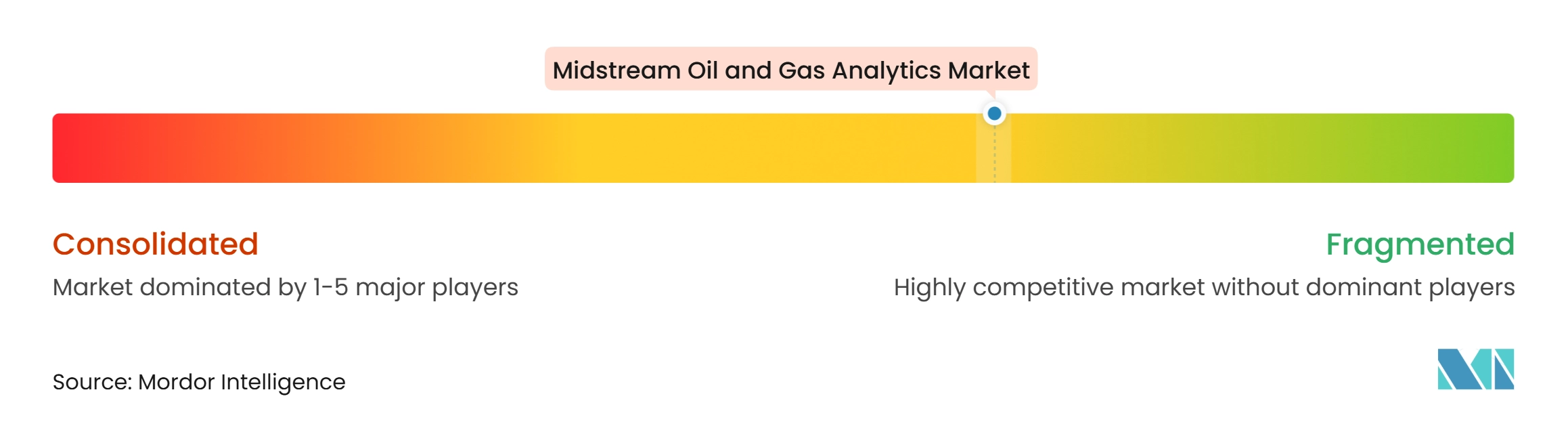
The midstream oil and gas analytics market is moderately concentrated because companies compete through different entry points, including industrial automation, measurement, asset performance, commercial intelligence, and specialist workflow software. Large suppliers such as Baker Hughes, Honeywell, Emerson, ABB, Siemens, and SLB can bundle analytics with equipment, automation, services, and control systems. Specialist providers such as Quorum Software, Seeq, Kpler, and Enverus focus more closely on measurement, processing data, flow intelligence, or energy information workflows. Quorum states that FLOWCAL is used by more than 80% of North American midstream companies, demonstrating strong concentration within measurement management rather than across the full sector. Customers commonly select platforms based on integration depth, data quality, cybersecurity approach, and the ability to improve a defined operating decision.
Companies are expanding their offerings through product development and partnerships. Baker Hughes released Cordant Release 25.2.1 in September 2025, adding hybrid AI-physics analytics, persona-based workspaces, multilingual support, and an AI Assistant for Work Management. Emerson and TotalEnergies announced their Inmation deployment program in July 2025, which is intended to centralize real-time industrial data across TotalEnergies sites. Kpler completed its acquisition of Spire Maritime in April 2025, combining commodity flow intelligence with maritime data capabilities. These moves indicate that vendors want to control more of the data path from asset signals and movement data through to customer decisions.
Competition also depends on how well suppliers address industrial cybersecurity and interoperability. International Electrotechnical Commission (IEC) 62443 requirements matter for buyers connecting analytics tools to operational systems, while International Society of Automation (ISA)-95 supports integration across enterprise and production layers. Vendors that combine secure integration with useful applications can build stronger renewal relationships. Broad cross-operator data sharing is still limited because pipeline, pressure, corrosion, and flow data have commercial and operational sensitivity. This leaves room for products that improve data governance and model performance without requiring unrestricted sharing.
Midstream Oil and Gas Analytics Industry Leaders
-
AVEVA Group Limited
-
Aspen Technology, Inc.
-
IBM Corporation
-
Emerson Electric Co.
-
Enverus, Inc.
- *Disclaimer: Major Players sorted in no particular order
Midstream Oil and Gas Analytics Market Companies Covered in this Report
- ABB Ltd.
- Aspen Technology, Inc.
- AVEVA Group Limited
- Baker Hughes Company
- Bentley Systems, Incorporated
- East Daley Analytics
- Emerson Electric Co.
- Enverus, Inc.
- Halliburton Company
- Honeywell International Inc.
- IBM Corporation
- Kpler SAS
- Oracle Corporation
- Quorum Software
- Rystad Energy
- SAP SE
- Schneider Electric SE
- Seeq Corporation
- Siemens AG
- SLB
Recent Industry Developments in Midstream Oil and Gas Analytics Market
- November 2026: B3 Insight launched its Model Context Protocol (MCP) Server, enabling oil and gas operators, water midstream companies, and financial institutions to access its produced-water, disposal, and subsurface intelligence datasets through compatible enterprise AI applications. The platform allows users to query licensed datasets using natural-language interactions and combine external industry information with proprietary operational data. Its database covers more than 170,000 injection wells, over 29 million monthly injection-volume and pressure records, and 3.7 million daily records across six US states. The launch supports data-driven decision-making for water midstream operations, infrastructure planning, and commercial risk assessment.
- September 2025: Kpler introduced an enhanced Destination Forecast for crude oil, refined products, and dry bulk. The service uses specialized machine-learning models at several geographic levels and provides a confidence-driven view for users working with vessel movements and cargo destinations.
- August 2025: Halliburton introduced the next generation of its Summit Knowledge digital ecosystem. The release included SK Well Pages, customizable dashboards for pump performance monitoring, and connection with Intelevate for remote monitoring.
- July 2025: TotalEnergies and Emerson's AspenTech business announced a strategic collaboration to deploy AspenTech Inmation across TotalEnergies industrial sites worldwide over a 2-year period, centralizing millions of real-time data points from facilities globally .
Global Midstream Oil and Gas Analytics Market Report Scope
Midstream oil and gas analytics refers to the use of data science, statistical modeling, and artificial intelligence to monitor, optimize, and manage the processing, transportation, and storage infrastructure that connects raw energy extraction (upstream) with consumer distribution or refining (downstream).
The midstream oil and gas analytics market is segmented into offering, deployment, technology, and geography. By offering, the market is divided among hardware, software, and services. By deployment, the market is segmented into on-premises, cloud-based, and hybrid. By technology, the market is segmented into artificial intelligence and machine learning, big data analytics, Internet of Things and industrial IoT analytics, digital twin analytics, edge analytics, cloud analytics, generative AI, and data visualization and business intelligence. The report also covers the market size and forecasts for the global midstream oil and gas market across 25 countries in key regions. For each segment, the market sizing and forecasts have been provided on the basis of value (USD).
Segmentation Overview
| Hardware |
| Software |
| Services |
| On-Premises |
| Cloud-Based |
| Hybrid |
| Artificial Intelligence and Machine Learning |
| Big Data Analytics |
| Internet of Things and Industrial IoT Analytics |
| Digital Twin Analytics |
| Edge Analytics |
| Cloud Analytics |
| Generative AI |
| Data Visualization and Business Intelligence |
| North America | United States |
| Canada | |
| Mexico | |
| Europe | Germany |
| France | |
| Italy | |
| Spain | |
| United Kingdom | |
| Norway | |
| Netherlands | |
| Russia | |
| Rest of Europe | |
| Asia-Pacific | China |
| India | |
| Australia | |
| Indonesia | |
| Vietnam | |
| Thailand | |
| Rest of Asia-Pacific | |
| South America | Brazil |
| Argentina | |
| Chile | |
| Rest of South America | |
| Middle East and Africa | Saudi Arabia |
| United Arab Emirates | |
| Egypt | |
| Nigeria | |
| Oman | |
| Rest of Middle East and Africa |
| By Offering | Hardware | |
| Software | ||
| Services | ||
| By Deployment | On-Premises | |
| Cloud-Based | ||
| Hybrid | ||
| By Technology | Artificial Intelligence and Machine Learning | |
| Big Data Analytics | ||
| Internet of Things and Industrial IoT Analytics | ||
| Digital Twin Analytics | ||
| Edge Analytics | ||
| Cloud Analytics | ||
| Generative AI | ||
| Data Visualization and Business Intelligence | ||
| By Geography | North America | United States |
| Canada | ||
| Mexico | ||
| Europe | Germany | |
| France | ||
| Italy | ||
| Spain | ||
| United Kingdom | ||
| Norway | ||
| Netherlands | ||
| Russia | ||
| Rest of Europe | ||
| Asia-Pacific | China | |
| India | ||
| Australia | ||
| Indonesia | ||
| Vietnam | ||
| Thailand | ||
| Rest of Asia-Pacific | ||
| South America | Brazil | |
| Argentina | ||
| Chile | ||
| Rest of South America | ||
| Middle East and Africa | Saudi Arabia | |
| United Arab Emirates | ||
| Egypt | ||
| Nigeria | ||
| Oman | ||
| Rest of Middle East and Africa | ||
Key Questions Answered in the Report
What is the forecast growth rate for midstream oil and gas analytics?
The midstream oil and gas analytics market is projected to grow at a 19.71% CAGR from 2027 to 2032, rising from USD 0.91 billion in 2027 to USD 2.23 billion in 2032.
Which deployment model leads adoption?
Within the midstream oil and gas analytics market, cloud-based solutions led with 57.5% share in 2026 and are forecast to grow at a 20.8% CAGR through 2032.
Why are pipeline operators adopting analytics tools?
Operators use them to support remote monitoring, leak detection, integrity management, measurement, settlement, and operational decision-making.
Which technology segment is growing fastest?
Generative AI is projected to grow at a 22.6% CAGR through 2032, supported by uses in anomaly investigation and natural-language access to operating data.
Which region has the largest demand?
North America held 36.2% share in 2026, supported by extensive pipeline infrastructure, LNG development, and U.S. methane detection requirements.
What is the main barrier to wider analytics adoption?
In the midstream oil and gas analytics market, cybersecurity exposure and difficult integration with separate legacy SCADA, measurement, enterprise, and geospatial systems remain key barriers.