
Middle East and Africa Technical Textile Manufacturing Market Size and Share
Market Overview
| Study Period | 2021 - 2032 |
|---|---|
| Forecast Data Period | 2027 - 2032 |
| Base Year Market Size (2026) | USD 12.07 Billion |
| Market Size (2027) | USD 13 Billion |
| Market Size (2032) | USD 20.5 Billion |
| Growth Rate (2027 - 2032) | 9.54 % |
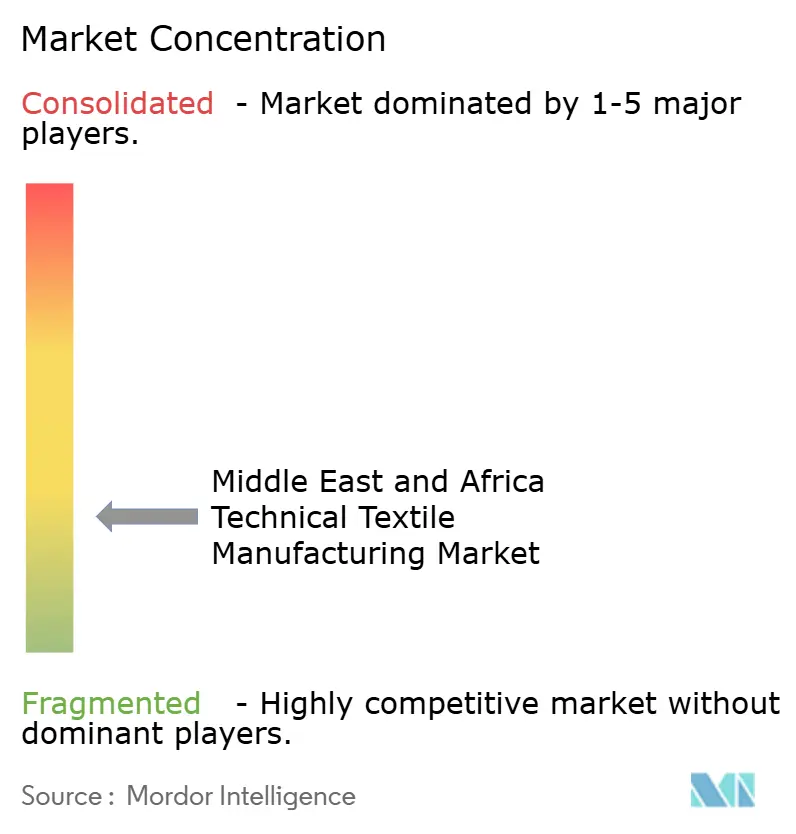
| Market Concentration | Low |
Major Players *Disclaimer: Major Players sorted in no particular order Image © Mordor Intelligence. Reuse requires attribution under CC BY 4.0. | |
Middle East and Africa Technical Textile Manufacturing Market Analysis by Mordor Intelligence
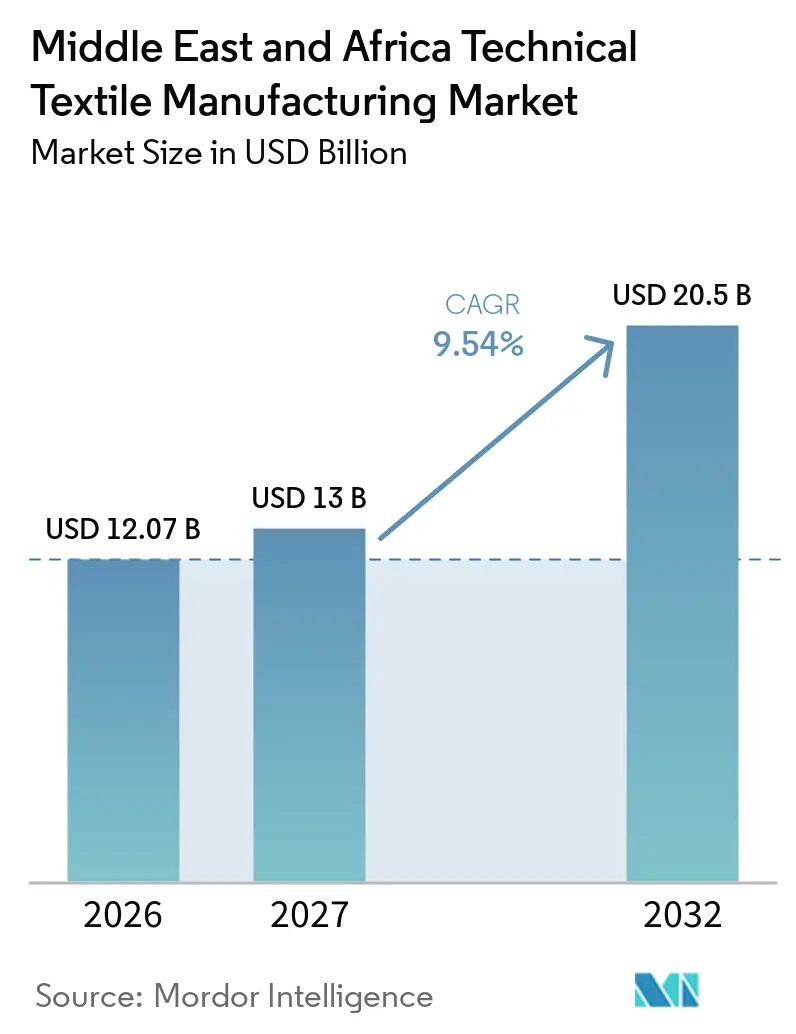
The Middle East And Africa Technical Textile Manufacturing Market size was valued at USD 12.07 billion in 2026 and is estimated to grow from USD 13 billion in 2027 to reach USD 20.5 billion by 2032, at a CAGR of 9.54% during the forecast period (2027-2032).
The Middle East and Africa technical textile manufacturing market is supported by infrastructure development, healthcare expansion, and initiatives to localize defense manufacturing across the region. Demand is driven by the use of technical textiles in construction, protective clothing, medical applications, transportation, and industrial processes, where durability, safety, and performance are key purchasing criteria. Local-content requirements and domestic manufacturing initiatives also influence procurement decisions by encouraging project owners and public-sector buyers to prioritize suppliers that meet local qualification criteria and applicable product standards. These conditions provide regional manufacturers with opportunities to strengthen their market position through local production capabilities, technical expertise, and reliable supply arrangements rather than competing solely on price. The market also presents import-substitution opportunities for selected specialized textile products. However, dependence on imported advanced fibers, functional coatings, and manufacturing machinery remains a key constraint. Saudi Arabia represents a major source of regional demand, supported by infrastructure investment and industrial diversification initiatives. However, delays in major projects, changes in public spending, and the pace of local manufacturing development may affect near-term order volumes across the region.
Key Report Takeaways
- By material type, synthetic fibers held 75% of the Middle East and Africa technical textile manufacturing market share in 2026, while regenerated and other fibers are forecast to grow at a 10.5% CAGR through 2032.
- By form and structure, nonwoven technical textiles held 40% of the Middle East and Africa technical textile manufacturing market size in 2026, and are forecast to grow at an 11% CAGR through 2032.
- By application, Mobiltech held 28% of revenue in 2026 and is forecast to grow at a 12% CAGR through 2032.
- By geography, Saudi Arabia held 42% of revenue in 2026 and is forecast to grow at an 11.5% CAGR through 2032.
Note: Market numbers in this report are based on Mordor Intelligence's proprietary estimation framework, which combines nine months of actuals with Q4 projections for base year 2026.
Market Trends and Insights
Drivers Impact Analysis of Middle East and Africa Technical Textile Manufacturing Market*
| Driver | (~) % Impact on CAGR Forecast | Geographic Relevance | Impact Timeline |
|---|---|---|---|
| Mega-Project Infrastructure and Geosynthetics Demand | +2.8% | Saudi Arabia, the United Arab Emirates, and Qatar are core markets, with spillover to Iraq, Kuwait, and Oman | Medium term (2-4 years) |
| Healthcare Modernization and Medical Nonwovens | +2% | GCC-wide, with early gains in Saudi Arabia, the United Arab Emirates, and Turkey | Short term (≤ 2 years) |
| Oil, Gas, Mining and Industrial Safety Requirements | +1.5% | Saudi Arabia, the United Arab Emirates, and Qatar, with secondary demand in Iraq and Oman | Medium term (2-4 years) |
| Defense Localization and Protective Textile Procurement | +1.2% | Saudi Arabia and the United Arab Emirates, with spillover to Qatar and Kuwait | Medium term (2-4 years) |
| Local-Content Policies and Import Substitution | +0.9% | GCC-wide, led by Saudi Arabia and the United Arab Emirates | Long term (≥ 4 years) |
| Climate-Resilient Water, Coastal and Waste Infrastructure | +0.6% | Saudi Arabia, the United Arab Emirates, Iraq, Kuwait, Oman, and Qatar | Long term (≥ 4 years) |
| Source: Mordor Intelligence | |||
Mega-Project Infrastructure and Geosynthetics Demand
Saudi Arabia’s major construction pipeline supports demand for geotextiles, geogrids, geomembranes, and geocomposites across large, complex development sites. These materials are used for erosion control, soil reinforcement, drainage, and containment during foundational works that must be performed under demanding site conditions. Aramco reported 67% local procurement across its supply base at its 2025 IKTVA conference, which reflects the greater importance of local sourcing in major procurement programs. The Middle East and Africa technical textile manufacturing market can benefit when domestic producers meet the required technical specifications, testing needs, and project qualification rules. Infrastructure programs therefore support both product volumes and local manufacturing capability, but suppliers must qualify early in the procurement process.
Healthcare Modernization and Medical Nonwovens
Healthcare investment supports demand for single-use medical textiles, including gowns, drapes, caps, wound-care materials, and protective barriers in clinical settings. New hospitals and surgical facilities require these materials repeatedly because they are not reused after procedures or patient care. Saudi German Nonwovens entered the medical segment in 2025 with its Ultramed brand, expanding its existing Saudi production base into clinical products. Saudi clinical requirements for single-use barrier materials establish a recurring need for products that meet defined performance standards and registration requirements. This gives the Middle East and Africa technical textile manufacturing market a stable demand base beyond construction activity and supports producers with dependable product quality.
Oil, Gas, Mining and Industrial Safety Requirements
Industrial activity in Saudi Arabia, the United Arab Emirates, and Qatar sustains demand for flame-resistant, chemical-resistant, and high-visibility textiles. Protective garments must meet safety rules and customer specifications in petrochemical, energy, and mining work environments, where material failure can create operating risks. Saudi standards require certification and Arabic-language labeling for industrial protective clothing sold in the Kingdom. Aramco’s engineering specifications also set higher requirements for contractors operating in its ecosystem. These requirements favor manufacturers that can consistently manage testing, certification, production quality, and the documentation needed by industrial customers.
Defense Localization and Protective Textile Procurement
Defense localization is expanding procurement opportunities for uniforms, ballistic fabrics, composite layers, and load-bearing materials. Saudi Arabia aims to localize 50% of defense spending by 2030, and licensed military-industrial facilities increased from 5 in 2019 to 296 by the third quarter of 2024. The 2025 privatization process for the Military Uniform and Accessories Factory is intended to expand military and commercial uniform capacity under GAMI licensing requirements[1]. This policy direction gives the Middle East and Africa technical textile manufacturing market a sovereign demand channel alongside commercial end uses. Producers that can qualify for military standards may also create export opportunities and serve adjacent protective-textile requirements.
Restraints Impact Analysis of Middle East and Africa Technical Textile Manufacturing Market*
| Restraint | (~) % Impact on CAGR Forecast | Geographic Relevance | Impact Timeline |
|---|---|---|---|
| Import Dependence for Advanced Fibers, Machinery and Finishes | -1.8% | Region-wide, most acute in Saudi Arabia and the United Arab Emirates | Medium term (2-4 years) |
| Certification and Specification Gaps Among Local Producers | -1.3% | GCC-wide, especially where Saudi and the United Arab Emirates conformity frameworks are enforced | Medium term (2-4 years) |
| High Energy, Water and Chemical Intensity of Finishing | -0.9% | Turkey, Iran, and emerging GCC producers | Long term (≥ 4 years) |
| Uneven Technical-Textile Skills and Application Engineering | -0.6% | Regional, with the largest gaps outside Saudi Arabia and the United Arab Emirates industrial clusters | Long term (≥ 4 years) |
| Source: Mordor Intelligence | |||
Import Dependence for Advanced Fibers, Machinery and Finishes
Regional manufacturers depend on imported aramid, carbon fiber, specialty coatings, and PFAS-free finishes for higher-performance products. Spunbond and meltblown lines, precision coating systems, and technical looms also come mainly from established overseas equipment suppliers. This increases lead times, raises the imported-input value of finished materials, and limits the amount of value retained within the region. Cost measures can reduce some landed-cost pressure, but they do not replace missing upstream supply or specialized equipment capability. The Middle East and Africa technical textile manufacturing market will capture more value as domestic capability moves beyond conversion into specialized inputs and finishing.
Certification and Specification Gaps Among Local Producers
Local producers face multiple conformity, testing, registration, and application-specific requirements before they can supply regulated customers. Saudi Arabia uses the SABER platform for certification, while the United Arab Emirates applies its own product control and conformity systems. The United Arab Emirates Ministry of Industry and Advanced Technology updated twelve national conformity marks and efficiency labels in April 2025, with a 12-month transition period. Smaller suppliers can lack the laboratory capacity, technical staff, and documented processes needed to meet several standards at the same time. As a result, local-content preferences may still favor certified international suppliers for higher-value contracts that require proven compliance.
*Our forecasts treat driver/restraint impacts as directional, not additive. The impact forecasts reflect baseline growth, mix effects, and variable interactions.
Middle East and Africa Technical Textile Manufacturing Market Segment Analysis
By Material Type:
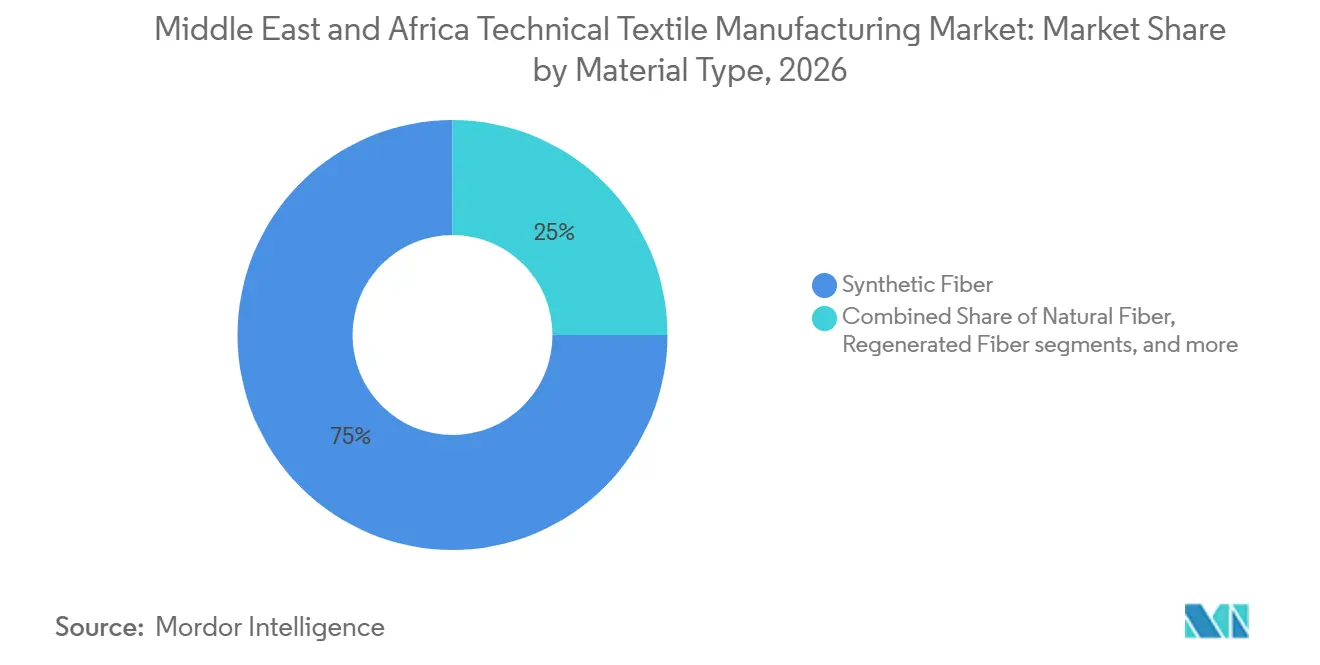
Synthetic Fibers Hold the Largest PositionSynthetic fibers account for 75% of the Middle East and Africa technical textile manufacturing market size in 2026. Their leading position reflects access to polypropylene and polyester feedstocks from petrochemical complexes in Saudi Arabia, the United Arab Emirates, and Qatar. Polyester and polypropylene are used across geosynthetics, nonwovens, and industrial filtration. Their use across these applications links feedstock availability to several large demand pools rather than one specialized product line. Polyamide supports protective workwear and automotive textiles, while polyethylene, UHMWPE, and Aramid serve higher-performance protective applications. The material group remains important because the region has a direct feedstock advantage and broad demand across infrastructure and industrial uses.
Regenerated and other fibers are forecast to grow at a 10.5% CAGR from 2027 to 2032. Buyers increasingly seek verified sustainable fiber content and PFAS-free performance in specified applications. This creates a requirement for traceability and consistent performance, not simply a substitution of one fiber for another. Conductive and sensor-integrated fibers are also relevant to defense and medical uses. Natural fibers serve narrower roles in Agrotech, Packtech, and Hometech where biodegradability is required. Inorganic fibers such as glass, carbon, and basalt are used in structural composites and fire protection, but they remain largely imported because regional draw-tower capability is limited. This mix shows why the Middle East and Africa technical textile manufacturing industry must combine feedstock strength with access to specialized materials.

By Form and Structure:
Nonwovens Combine Scale With GrowthNonwoven technical textiles hold 40% of the Middle East and Africa technical textile manufacturing market size in 2026. They also represent the fastest-growing structural category, with an 11% CAGR forecast for 2027 to 2032. Needle-punch products support geosynthetics, while spunbond products are used in hygiene and medical applications. The same manufacturing family therefore addresses both project-based infrastructure demand and recurring clinical demand. This combination places nonwovens at the center of healthcare, water, and infrastructure demand. The segment’s scale gives producers an incentive to develop local capacity across a broader product range.
The Saudi Water Authority began pilot operations at Toray Membrane Middle East’s Dammam plant in July 2025. The facility can produce up to 300,000 reverse-osmosis membranes annually under a technology-transfer agreement. This development supports local water-treatment supply chains and highlights the connection between nonwoven substrates and desalination infrastructure. It also demonstrates that locally established facilities can participate in technically demanding water applications when technology transfer is available. Woven technical textiles remain important for architectural membranes, industrial filtration, and protective uses that require tensile strength and dimensional stability. Knitted, braided, yarn, cord, and roving products serve smaller automotive, sportswear, rope, hose, and composite-reinforcement applications. The Middle East and Africa technical textile manufacturing market therefore needs both volume production and specialized conversion capability.
By Application:
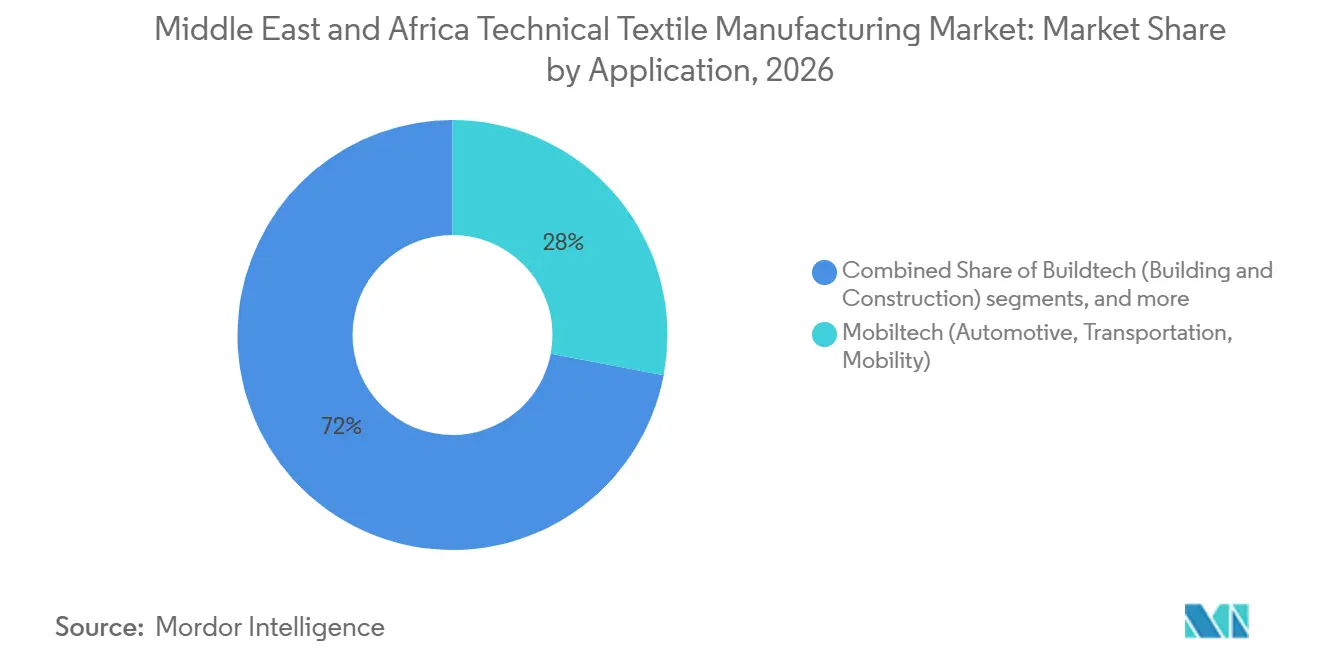
Mobiltech Is the Largest ApplicationMobiltech holds 28% of the Middle East and Africa technical textile manufacturing market share in 2026. It is also forecast to expand at a 12% CAGR from 2027 to 2032. Demand is increasingly linked to electric-vehicle components such as battery thermal-management materials, lightweight headliners, and acoustic dampening products. These products differ from conventional automotive textiles because their specifications are set through advanced OEM development programs. Regional converters must therefore meet performance requirements that are more exacting than those for standard automotive trim. Fleet electrification plans in Saudi Arabia and the United Arab Emirates provide a forward demand signal for these grades.
Buildtech and Geotech applications are closely connected to major development programs and transport infrastructure. They use products ranging from needle-punch filter fabrics to geogrids and geosynthetic clay liners. Their demand can increase quickly when projects move from planning to construction because these products are needed in foundational site works. Medtech includes surgical and hygiene disposables, wound-care products, and institutional protective textiles. Protech benefits from safety rules and defense localization, which support demand for flame-resistant workwear, ballistic layers, and industrial safety garments. Indutech and Packtech serve regional production and logistics, while Agrotech, Oekotech, Hometech, Clothtech, and Sporttech remain smaller, developing uses. The Middle East and Africa technical textile manufacturing market gains breadth when these application areas develop alongside its largest end use.
Geography Analysis
Saudi Arabia holds 42% of the 2026 Middle East and Africa technical textile manufacturing market share, and is forecast to grow at an 11.5% CAGR through 2032. The country benefits from co-located petrochemical feedstocks, local-content enforcement, and a large transport and construction pipeline. Saudi Government reported that Saudi transport projects are valued at USD 240 billion, supporting demand for geosynthetics and related materials[2]. Defense manufacturing also adds a public-sector demand channel for protective textiles. Its combination of industrial inputs, procurement policies, and project volume makes Saudi Arabia the region’s leading location for production investment.
The United Arab Emirates is the second-largest regional market and has active industrial zones including ICAD, KEZAD, Jafza, and SAIF Zone. ADNOC said suppliers committed USD 817 million to manufacturing facilities across the United Arab Emirates in May 2025. ADNOC’s in-country value program has directed USD 65.9 billion into the United Arab Emirates economy since 2018, creating incentives for domestic industrial supply chains. Turkey has a more established technical textile base across woven and nonwoven grades and participates as both an importer and exporter in the regional trade network.
Iraq is an emerging demand location for water-related materials. A USD 4 billion PowerChina contract awarded in July 2025 for the Basra seawater desalination plant creates demand for liners, drainage products, and filter fabrics at scale. The Saudi Water Authority projects that Saudi Arabia will contribute 36% of the regional desalination capacity additions through 2030. This supports long-term demand for filtration media and technical liner products across the wider region. Qatar, Kuwait, and Oman have concentrated demand from construction, healthcare, and industrial projects, but they remain more dependent on imports. The Middle East and Africa technical textile manufacturing market will develop unevenly, with Saudi Arabia and the United Arab Emirates leading production investment and other markets creating application-led demand.
Competitive Landscape
The Middle East and Africa technical textile manufacturing market is moderately fragmented. Regional specialists in geosynthetics and nonwovens compete for locally certified contracts and use their regional presence to respond to procurement requirements. International suppliers provide advanced fibers, membranes, coatings, and composite structures that local producers do not yet supply at the required specification level. Competition is particularly tied to certification, performance, and access to procurement relationships in geotechnical, medical, and defense applications, where purchasing decisions are not based on price alone and the cost of noncompliance can be high for project owners, public procurement bodies, and critical infrastructure operators. This places value on supplier registration, conformity systems, production consistency, and the ability to demonstrate performance before a project award.[3]
Technology transfer and vertical integration are important competitive approaches in the Middle East and Africa technical textile manufacturing market. Toray Membrane Middle East’s Dammam facility is an example of a sovereign-supported technology-transfer model in the region. The facility shows how localization can extend into capital-intensive products when government bodies and technology providers are aligned around a local manufacturing objective. Such arrangements can improve local qualification for contracts that import-only supply models may not secure, particularly when public procurement seeks domestic value creation. They also offer a route for regional producers to build process knowledge and improve their ability to serve specified applications over time.
The most visible gaps are high-specification geosynthetics and PFAS-free functional finishes for protective workwear. Companies able to produce geogrids, geosynthetic clay liners, chemical-resistant geomembranes, and compliant protective materials locally have a clearer route to premium projects. Global specialists retain an advantage where customers require product performance that has not yet been localized or independently demonstrated by a regional supplier. The Middle East and Africa technical textile manufacturing market is likely to remain open to international suppliers. At the same time, regional producers build technical capability and obtain the approvals needed for demanding contracts.
Middle East and Africa Technical Textile Manufacturing Industry Leaders
-
Mattex Group
-
ALYAF INDUSTRIAL COMPANY LTD.
-
Obeikan Technical Fabrics
-
Fibertex Nonwovens (Pty) Ltd
-
Freudenberg Performance Materials
- *Disclaimer: Major Players sorted in no particular order
Middle East and Africa Technical Textile Manufacturing Market Companies Covered in this Report
- Mattex Group
- ALYAF INDUSTRIAL COMPANY LTD.
- Obeikan Technical Fabrics
- FPC Industry
- TexoFib
- Exeed Geotextile
- Infrastructure Reinforcement Industrial Company
- Fibertex Nonwovens (Pty) Ltd
- Kaytech Engineered Fabrics
- Spunchem International
- PFNonwovens
- Freudenberg Performance Materials
- Ahlstrom
- Berry Global Group, Inc.
- DuPont de Nemours, Inc.
- Toray Industries, Inc.
- Mitsui Chemicals, Inc.
- Sioen Industries NV
- HUESKER Group
- Officine Maccaferri S.p.A.
- Solmax
Recent Industry Developments in Middle East and Africa Technical Textile Manufacturing Market
- October 2026: Saudi Arabia’s Alujain partnered with Belgium-based Beaulieu International Group to develop nonwoven textile production capabilities in the Kingdom. This partnership is expected to strengthen the regional supply of nonwoven roll goods for hygiene, medical, and other technical textile applications, supporting domestic manufacturing and import-substitution opportunities in Saudi Arabia.
- September 2025: Saudi Arabia's Military Industries Corporation, the Ministry of Industry and Mineral Resources, and the National Center for Privatization & PPP launched the EOI and RFQ phase for the privatization of the Military Uniform and Accessories Factory in Riyadh and Al-Kharj. Full ownership transfer under GAMI licensing requirements is designed to expand military and commercial uniform production capacity and unlock B2B export channels.
- July 2025: The Saudi Water Authority commissioned pilot operations at Toray Membrane Middle East's RO membrane plant in Dammam, the Middle East's largest such facility with an annual capacity of up to 300,000 membranes. The plant, stemming from a 2021 SWA technology-transfer agreement, is projected to contribute USD 304 million to Saudi GDP over the agreement term and create 147 direct jobs for Saudi nationals.
Middle East and Africa Technical Textile Manufacturing Market Report Scope
The Middle East and Africa Technical Textile Manufacturing Market Report is segmented by Material Type (Natural Fiber, Synthetic Fiber, and More), by Form and Structure (Woven Technical Textiles, Knitted Technical Textiles, and More), by Application (Mobiltech, Indutech, and More), and by Geography (Saudi Arabia, United Arab Emirates, and More). The Report Offers Market Size and Forecasts in Value (USD) for all the Above Segments.
Segmentation Overview
| Natural Fiber | Cotton |
| Jute | |
| Others - Flax, Wool, Hemp, Coir, etc. | |
| Synthetic Fiber | Polyester |
| Polyamide / Nylon | |
| Polypropylene | |
| Polyethylene / UHMWPE | |
| Aramid and Other Specialty Synthetic Fibers | |
| Regenerated Fiber - Viscose, Lyocell, and Modal | |
| Inorganic Fibers (Glass, Carbon, Basalt, etc.) | |
| Others (Metallic, Conductive, and Other Specialty Fibers) |
| Technical Yarns, Cords, and Rovings |
| Woven Technical Textiles |
| Nonwoven Technical Textiles |
| Knitted Technical Textiles |
| Braided Technical Textiles |
| Other Engineered Textile Structures |
| Mobiltech – Automotive, Transportation, and Mobility |
| Indutech – Industrial and Manufacturing Applications |
| Buildtech – Building and Construction |
| Medtech – Medical and Hygiene |
| Protech – Personal and Property Protection |
| Agrotech – Agriculture, Horticulture, Forestry, and Fishing |
| Geotech – Geotextiles and Civil Engineering |
| Packtech – Packaging and Containment |
| Oekotech – Environmental Protection |
| Hometech – Furniture, Floor Coverings, and Domestic Technical Applications |
| Clothtech – Functional Components for Clothing and Footwear |
| Sporttech – Sports and Leisure Applications |
| Saudi Arabia |
| United Arab Emirates |
| Turkey |
| South Africa |
| Nigeria |
| Qatar |
| Kuwait |
| Oman |
| Iraq |
| Rest of the Middle East and Africa (Bahrain, Jordan, Lebanon, Yemen, Syria, Palestine, etc.) |
| By Material Type | Natural Fiber | Cotton |
| Jute | ||
| Others - Flax, Wool, Hemp, Coir, etc. | ||
| Synthetic Fiber | Polyester | |
| Polyamide / Nylon | ||
| Polypropylene | ||
| Polyethylene / UHMWPE | ||
| Aramid and Other Specialty Synthetic Fibers | ||
| Regenerated Fiber - Viscose, Lyocell, and Modal | ||
| Inorganic Fibers (Glass, Carbon, Basalt, etc.) | ||
| Others (Metallic, Conductive, and Other Specialty Fibers) | ||
| By Form and Structure | Technical Yarns, Cords, and Rovings | |
| Woven Technical Textiles | ||
| Nonwoven Technical Textiles | ||
| Knitted Technical Textiles | ||
| Braided Technical Textiles | ||
| Other Engineered Textile Structures | ||
| By Application | Mobiltech – Automotive, Transportation, and Mobility | |
| Indutech – Industrial and Manufacturing Applications | ||
| Buildtech – Building and Construction | ||
| Medtech – Medical and Hygiene | ||
| Protech – Personal and Property Protection | ||
| Agrotech – Agriculture, Horticulture, Forestry, and Fishing | ||
| Geotech – Geotextiles and Civil Engineering | ||
| Packtech – Packaging and Containment | ||
| Oekotech – Environmental Protection | ||
| Hometech – Furniture, Floor Coverings, and Domestic Technical Applications | ||
| Clothtech – Functional Components for Clothing and Footwear | ||
| Sporttech – Sports and Leisure Applications | ||
| By Geography | Saudi Arabia | |
| United Arab Emirates | ||
| Turkey | ||
| South Africa | ||
| Nigeria | ||
| Qatar | ||
| Kuwait | ||
| Oman | ||
| Iraq | ||
| Rest of the Middle East and Africa (Bahrain, Jordan, Lebanon, Yemen, Syria, Palestine, etc.) | ||
Key Questions Answered in the Report
What is the projected growth rate for technical textile manufacturing in the Middle East and Africa?
The market is forecast to grow at a 9.54% CAGR from 2027 to 2032 and reach USD 20.5 billion by 2032, supported by infrastructure, healthcare, and defense procurement.
Which material type has the largest position in the Middle East and Africa technical textile manufacturing market?
Synthetic fibers lead with 75% of 2026 revenue. Their position is supported by regional polypropylene and polyester feedstocks that serve geosynthetics, nonwovens, and industrial filtration.
Which technical textile structure is growing fastest in the region?
Nonwoven technical textiles are forecast to grow at an 11% CAGR through 2032. They serve healthcare products, hygiene uses, geosynthetics, and water-treatment supply chains
What is the leading application for technical textiles in the Middle East and Africa?
Mobiltech leads with 28% of 2026 revenue and is forecast to grow at a 12% CAGR through 2032, as demand shifts toward electric-vehicle thermal and acoustic components.
Which country leads regional technical textile manufacturing demand?
Saudi Arabia leads with 42% of 2026 revenue and is forecast to grow at an 11.5% CAGR through 2032, supported by feedstocks, local-content requirements, and project
What limits local production of technical textiles?
Reliance on imported advanced fibers, machinery, and finishes, along with certification and skills gaps, limits regional capability in specialized products and slows local qualification for advanced, high-value projects across several applications.