
Middle East and Africa Pre-Engineered Buildings Construction Market Size and Share
Market Overview
| Study Period | 2020 - 2031 |
|---|---|
| Forecast Data Period | 2026 - 2031 |
| Base Year Market Size (2025) | USD 4.40 Billion |
| Market Size (2026) | USD 4.85 Billion |
| Market Size (2031) | USD 7.93 Billion |
| Growth Rate (2026 - 2031) | 10.34 % |
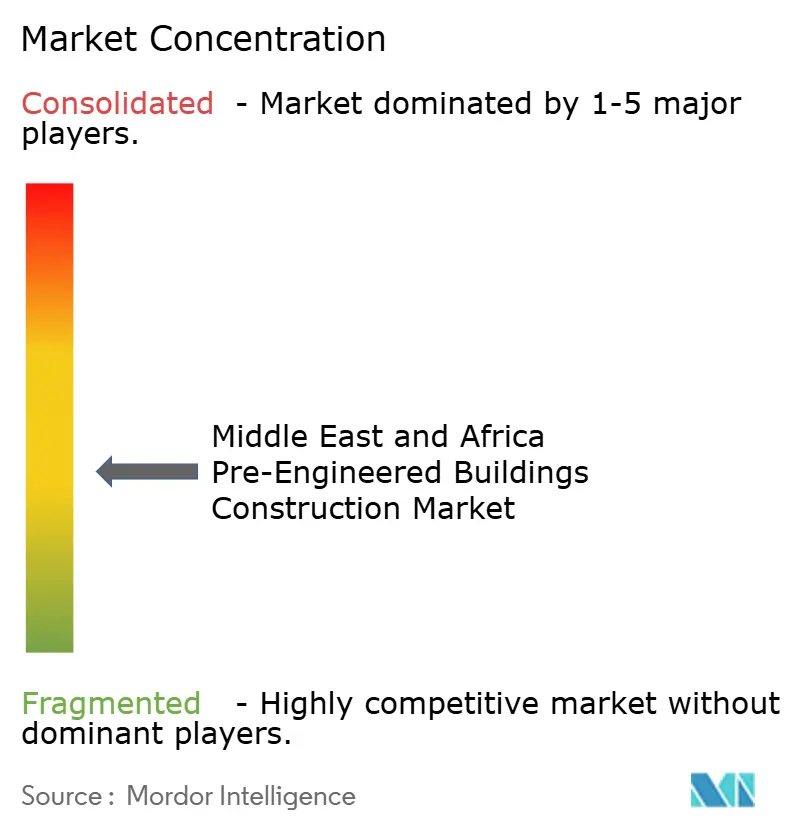
| Market Concentration | Medium |
Major Players *Disclaimer: Major Players sorted in no particular order Image © Mordor Intelligence. Reuse requires attribution under CC BY 4.0. | |
Middle East and Africa Pre-Engineered Buildings Construction Market Analysis by Mordor Intelligence
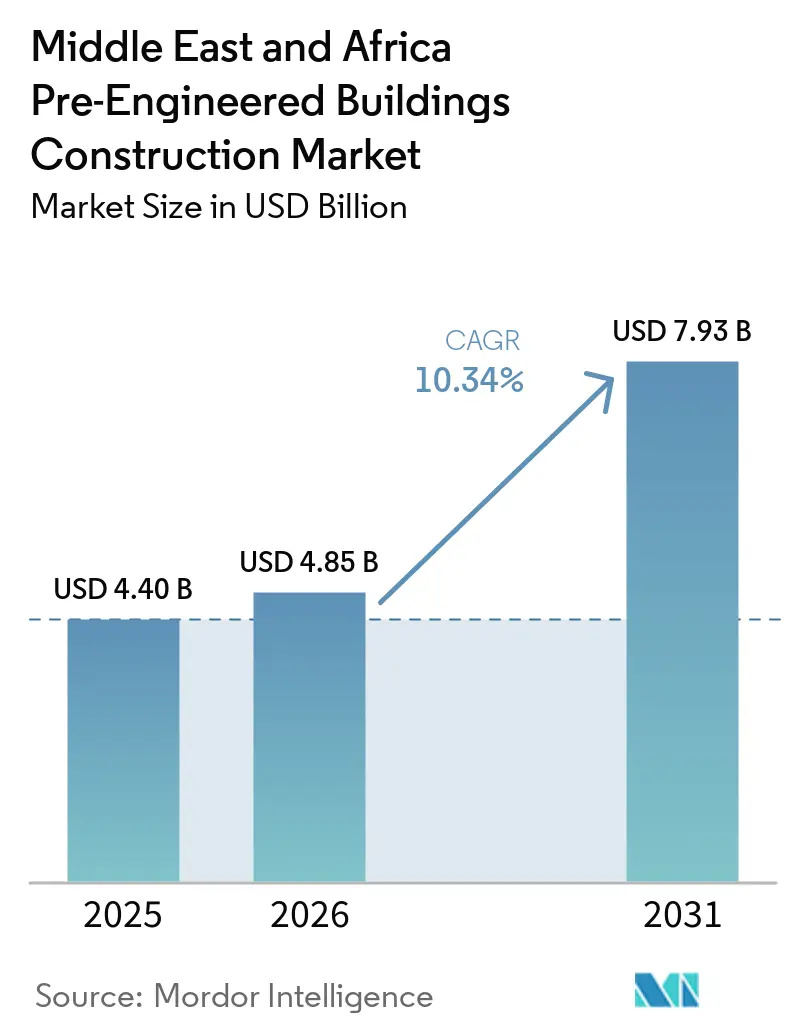
The Middle East And Africa Pre-Engineered Buildings Construction Market size was valued at USD 4.40 billion in 2025 and is estimated to grow from USD 4.85 billion in 2026 to reach USD 7.93 billion by 2031, at a CAGR of 10.34% during the forecast period (2026-2031). The Middle East and Africa pre-engineered buildings construction market is supported by industrial diversification, logistics investment, and demand for construction methods that shorten site work. Saudi Arabia and the United Arab Emirates (UAE) continue to expand industrial zones, free zones, and manufacturing capacity, which supports demand for factories, warehouses, and related facilities. Factory fabrication can support more predictable delivery schedules where projects require repeated building designs. The strongest opportunities sit in modular, multi-story, and institutional uses, while the large industrial base remains central to demand. Supply chains remain exposed to steel costs, freight conditions, and specialist installation capacity.
Key Report Takeaways
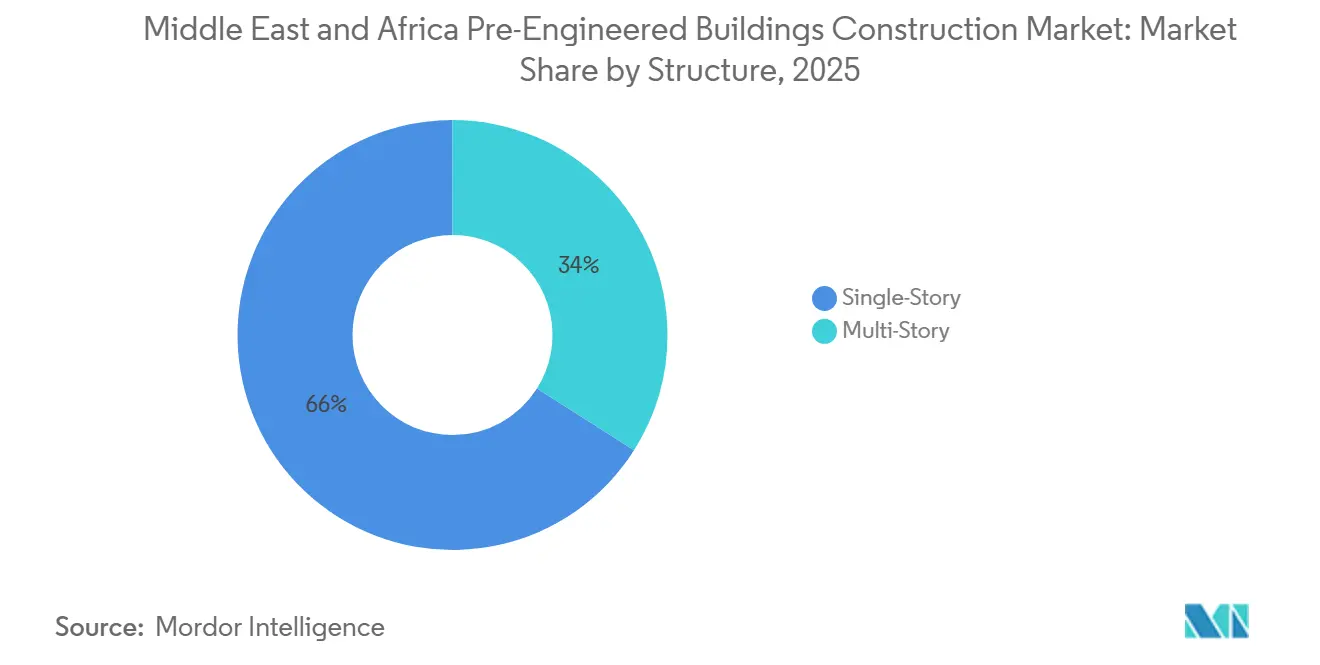
- By structure, single-story buildings accounted for a 66% Middle East and Africa pre-engineered buildings construction market share in 2025, while multi-story buildings are forecast to grow at an 11.8% CAGR through 2031.
- By product type, panelized and componentized systems accounted for a 38% Middle East and Africa pre-engineered buildings construction market share in 2025, while modular buildings are forecast to grow at a 12.2% CAGR through 2031.
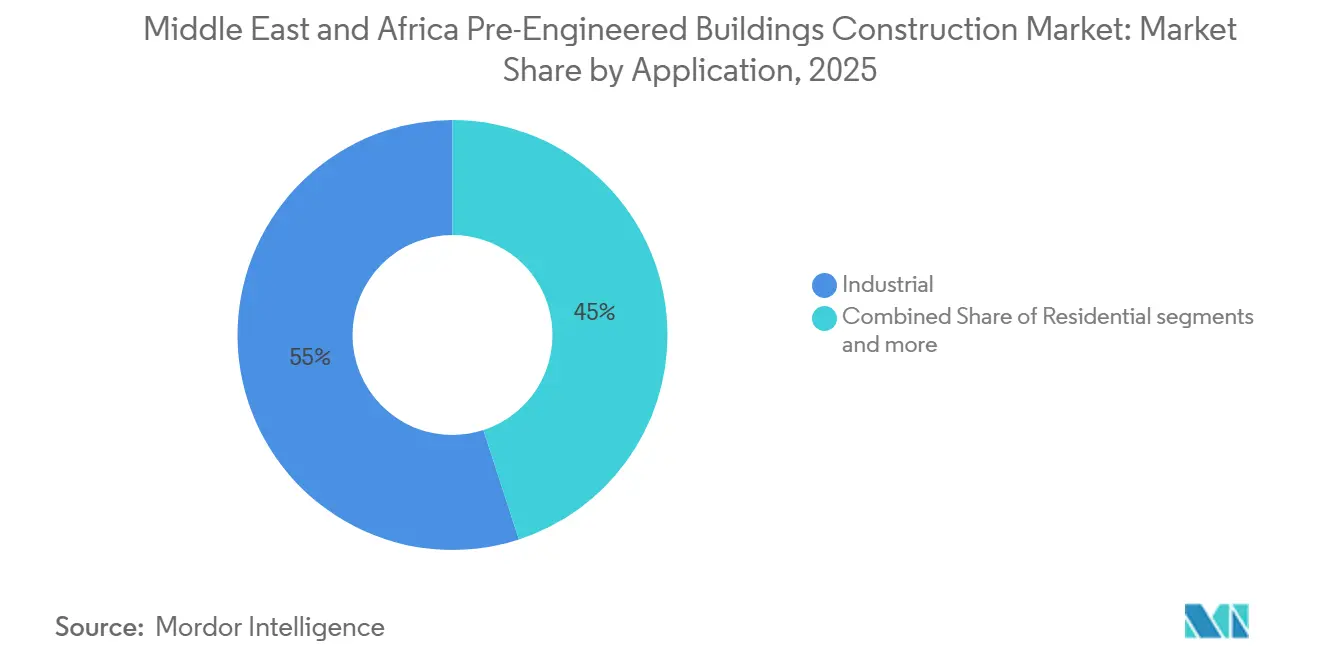
- By application, industrial facilities accounted for 55% of the Middle East and Africa pre-engineered buildings construction market size in 2025, while institutional buildings are forecast to grow at an 11.6% CAGR through 2031.
- By geography, Saudi Arabia accounted for a 28% Middle East and Africa pre-engineered buildings construction market share in 2025, while the United Arab Emirates is forecast to grow at an 11.5% CAGR through 2031.
Note: Market size and forecast figures in this report are generated using Mordor Intelligence’s proprietary estimation framework, updated with the latest available data and insights as of January 2026.
Middle East and Africa Pre-Engineered Buildings Construction Market Trends and Insights
Drivers Impact Analysis*
| Drivers | (~) % Impact on CAGR Forecast | Geographic Relevance | Impact Timeline |
|---|---|---|---|
| Gulf Economic-Diversification Programs and Non-Oil Manufacturing Zones | 3.20% | Saudi Arabia, United Arab Emirates, Oman, Kuwait, Qatar | Medium term (2–4 years) |
| Port, Airport, Free-Zone, and Mega-Logistics Corridor Investment | 2.40% | United Arab Emirates, Saudi Arabia, Egypt, Nigeria, Angola | Medium term (2–4 years) |
| Stadium, Tourism, Expo, and New-City Mega-Project Development | 1.80% | Saudi Arabia, United Arab Emirates | Short term (≤2 years) |
| Remote-Desert, Mining and Temporary Workforce Accommodation Requirements | 1.20% | Mali, Mauritania, South Africa, Zambia, Saudi Arabia | Long term (≥4 years) |
| Post-Conflict Reconstruction and Humanitarian Shelter Infrastructure | 0.80% | Sudan, South Sudan, Libya, northeast Nigeria | Long term (≥4 years) |
| Source: Mordor Intelligence | |||
Gulf Economic-Diversification Programs and Non-Oil Manufacturing Zones
The Middle East and Africa pre-engineered buildings construction market benefits from national programs that seek to grow non-oil manufacturing and expand industrial land. Saudi Arabia’s National Industrial Strategy seeks to position the country as an industrial and export hub, which supports demand for facilities that can be deployed across industrial cities. Oman’s Madayn announced 4 integrated industrial cities totaling 25.5 million sqm under its 2026-2030 plan, creating a future pipeline for industrial building procurement. Saudi MODON launched an 8-floor factory with 78 industrial units in Dammam in September 2025, showing that industrial projects can use vertical formats when land use becomes more constrained. These programs favor building suppliers that can repeat proven designs and meet local technical requirements. They also increase the value of reliable fabrication schedules, because industrial tenants need facilities that align with production start dates. A supplier that can deliver similar buildings across several sites can simplify purchasing and project management. This pattern supports longer relationships between industrial developers and qualified building providers. The Middle East and Africa pre-engineered buildings construction market, therefore, benefits from a shift toward repeat procurement rather than isolated projects.
Port, Airport, Free-Zone, and Mega-Logistics Corridor Investment
Logistics investment creates demand for warehouses, cargo areas, workshops, and supporting industrial facilities. DP World opened Phase 1 of the Sokhna Logistics Park in Egypt in October 2025 after investing USD 85 million, and Phase 2 is scheduled to increase the park to nearly 300,000 sqm in Q3 2026[1]. AD Ports Group began modernizing the Noatum Ports Luanda Terminal in September 2025 with USD 250 million of initial investment and a target to raise capacity to 350,000 TEUs by Q1 2027[2]. AD Ports Group also agreed with Egypt’s Suez Canal Economic Zone to develop an industrial and logistics park at East Port Said in May 2025. These investments support the Middle East and Africa pre-engineered buildings construction market because logistics operators need enclosed space before cargo volumes can be handled efficiently. They also favor standardized buildings that can be expanded as occupancy grows. This is useful for logistics operators because capacity requirements can change as customers, routes, and cargo volumes develop. A phased building plan may allow operators to begin with essential space and add capacity later. The approach makes delivery timing and flexibility important competitive factors.
Stadium, Tourism, Expo, and New-City Mega-Project Development
Saudi Arabia’s Expo 2030 and FIFA World Cup 2034 preparations extend the region’s construction pipeline beyond conventional industrial projects. The Expo 2030 master plan was nearing completion in early 2026. The Middle East and Africa pre-engineered buildings construction market can serve supporting uses such as accommodation, service buildings, hospitality facilities, and operations space. A 2025 contract for 12,000 permanent modular worker accommodation units at NEOM showed the scale of demand for factory-built buildings on large projects. The projects require units that meet sustainability and operational standards, rather than only low initial cost. This makes modular construction more relevant to long-duration development programs. It also shows that temporary and permanent uses can overlap when projects need accommodation or services early in construction. Developers can use factory completion to reduce the volume of work required at a remote site. The result is a broader role for modular units within project planning. It can also improve coordination where projects need many similar rooms or service areas delivered in a limited period. This does not remove the need for site preparation, utilities, and careful installation. It changes the sequence of work by moving a larger share of activity into a controlled manufacturing setting.
Remote-Desert, Mining and Temporary Workforce Accommodation Requirements
Mining, remote projects, and reconstruction needs create demand beyond Gulf urban development cycles. A workforce city at the Tasiast Gold Mine in Mauritania housed 8,400 workers through a steel and modular building system designed for remote delivery. Karmod installed a 2,000-person camp for a gold mining site in Liberia, comprising 32 single-story blocks across 15,500 sqm. Sudan’s reconstruction needs were estimated at USD 300 billion for Khartoum and USD 700 billion for the wider country in May 2025, while the World Bank reported more than 12.9 million forcibly displaced people. Libya discussed restarting prefabricated building activity with international companies in August 2026, indicating official interest in factory-based construction for reconstruction. The Middle East and Africa pre-engineered buildings construction market needs durable systems that can be transported, erected, and maintained in difficult locations. However, actual reconstruction demand will depend on security, funding, and implementation capacity.
Restraints Impact Analysis*
| Restraints | (~) % Impact on CAGR Forecast | Geographic Relevance | Impact Timeline |
|---|---|---|---|
| Imported Steel, Insulation and Seaborne-Freight Cost Exposure | -1.60% | Global; highest sensitivity in sub-Saharan Africa and North Africa | Short term (≤2 years) |
| Extreme Heat, UV, Sand Abrasion, and Saline-Corrosion Exposure | -0.80% | Gulf Cooperation Council (GCC) coastal cities; spill-over to Middle East and Africa | Medium term (2–4 years) |
| Limited Local Erection Contractors and Dependence on Imported Expertise | -0.60% | Sub-Saharan Africa; Saudi Arabia under Saudization constraints | Long term (≥4 years) |
| Red Sea, Gulf Shipping, and Geopolitical Route-Disruption Risk | -0.50% | Saudi Arabia, Egypt, United Arab Emirates, Red Sea corridor | Short term (≤2 years) |
| Source: Mordor Intelligence | |||
Imported Steel, Insulation and Seaborne-Freight Cost Exposure
The Middle East and Africa pre-engineered buildings construction market remains sensitive to steel, insulation, transport, import, and shipping costs. Steel represents a substantial part of the material cost for a pre-engineered building, which makes project pricing vulnerable when procurement conditions change. African projects face added pressure from import duties, taxes, inland transport, and congested ports, especially where materials travel long distances after entering a port. Daily Bab Al Mandeb ship crossings fell to 15 on September 12, 2026, following the seizure of Perim Island, according to The National. Suppliers that source regionally, plan freight early, and standardize components can reduce part of this exposure. Cost and delivery uncertainty can still delay approvals when developers compare pre-engineered buildings with local conventional alternatives. Project teams must weigh delivery reliability against the price advantage sought at the start of procurement. This is particularly important for projects with fixed opening dates or a narrow construction window. Better forecasting and earlier purchasing can limit, but not eliminate, this pressure.
Extreme Heat, UV, Sand Abrasion, and Saline-Corrosion Exposure
Gulf conditions require materials that can tolerate extreme heat, ultraviolet exposure, sand abrasion, and coastal corrosion. These conditions can increase the need for higher-grade coatings, insulated cladding, and detailed maintenance planning. Saudi Building Code requirements also affect design choices for wind, seismic performance, and other safety considerations. The Middle East and Africa pre-engineered buildings construction market must therefore compete with certified performance as well as price. In many African markets, a limited pool of certified erection contractors adds another constraint because imported engineering expertise raises time and cost. These conditions reward suppliers with local technical teams, tested specifications, and reliable after-sales support. They also require clear material selection before a project enters procurement. Where building owners understand operating conditions at an early stage, they can avoid later changes that delay fabrication. Service capability matters because site conditions can affect both installation quality and the life of the finished building.
*Our forecasts treat driver/restraint impacts as directional, not additive. The impact forecasts reflect baseline growth, mix effects, and variable interactions.
Segment Analysis
By Structure: Single-Story Buildings Lead While Multi-Story Formats Expand
Single-story buildings held 66% of the Middle East and Africa pre-engineered buildings construction market share in 2025. Warehouses, manufacturing facilities, energy maintenance sites, and mining camps often require broad column-free areas and simple internal circulation. These requirements support the continued use of single-level designs across industrial locations. Saudi industrial cities, the Suez Canal Economic Zone, and South African logistics corridors provide settings where this format can be repeated. The large installed base also gives fabricators established design and procurement experience. In the Middle East and Africa pre-engineered buildings construction market, the segment remains the practical choice for many high-bay and large-footprint facilities.
Multi-story structures are forecast to record an 11.8% CAGR through 2031. The category is gaining relevance in cities where industrial land is limited or expensive. MODON’s 2025 Dammam project included 8 floors and 78 industrial units, providing a regional reference for vertical production space. Multi-story projects require more advanced engineering, fabrication control, and compliance work than typical single-story buildings. Manufacturers that can meet these requirements are better placed to serve the faster-growing part of the structure category. The Middle East and Africa pre-engineered buildings industry is therefore broadening beyond conventional low-rise sheds. The shift does not replace single-story buildings in the short term, because many industrial uses still need wide floorplates. Instead, it gives developers another option where land efficiency becomes a priority. Design capability and compliance experience will determine which suppliers can participate consistently.

By Product Type: Panelized Systems Lead While Modular Buildings Expand
Panelized and componentized systems held 38% of the Middle East and Africa pre-engineered buildings construction market share in 2025. Their position reflects their ability to accommodate customized designs for large industrial and commercial projects. Panels and components can be configured for different spans, cladding needs, and building layouts. Gulf manufacturers have established supply chains and project experience for these requirements. This supports their use where customers need speed but do not require a fully volumetric module. The Middle East and Africa pre-engineered buildings construction market continues to rely on these systems for a broad range of industrial projects.
Modular buildings are forecast to grow at a 12.2% CAGR through 2031. Large worker accommodation programs have supported the category because projects can complete much of the work in a factory before site installation. The 2025 NEOM accommodation contract required 12,000 permanent units and included sustainability specifications, showing that modular delivery can be used at a significant scale. CIMC shipped modular hotel units for Earth Hotel Riyadh in August 2026, bringing modular construction into Saudi hospitality use. This change extends the category beyond temporary housing. Hotels, staff residences, and community facilities can use modular solutions when schedule certainty is important. The category can also give developers a more controlled way to coordinate finishes and building services before units arrive on site. These characteristics make modular buildings relevant to a wider set of customer requirements. The Middle East and Africa pre-engineered buildings construction market can benefit where developers value faster delivery, integrated finishes, and more controlled construction quality.
By Application: Industrial Facilities Remain Central to Demand
Industrial facilities held 55% of the Middle East and Africa pre-engineered buildings construction market share in 2025. Demand came from factories, warehouses, energy infrastructure, and facilities serving mining operations. Zamil Steel supplied 15,000 MT of structural steel for the 200,000 sqm Masar Mall project in Makkah in 2025, showing that large-format steel construction also serves commercial uses. Industrial work remains the largest application because diversification programs need production and logistics space before output can expand. Free zones and transport-linked development also support this demand. The Middle East and Africa pre-engineered buildings construction market will continue to depend on the pace of industrial project delivery. Facility demand will be strongest where construction schedules match manufacturing investment and logistics expansion. Industrial customers also need designs that accommodate machinery, storage, loading activity, and future changes in operations. This keeps practical engineering and adaptable layouts at the center of application demand.
Institutional buildings are forecast to grow at an 11.6% CAGR through 2031. New urban areas in the Gulf require schools, clinics, and public facilities, while reconstruction areas may require durable community buildings. These projects can use the same fabrication capacity and installation networks that serve commercial work. The category also benefits where rapid delivery is important, and project sites are difficult to access. Institutional buyers will place greater emphasis on safety, service life, and compliance than buyers of short-term structures. This gives the Middle East and Africa pre-engineered buildings industry an opportunity to apply industrialized construction capabilities to public-service requirements.
Geography Analysis
Saudi Arabia held 28% of the Middle East and Africa pre-engineered buildings construction market share in 2025. Its demand base includes industrial strategy programs, new industrial cities, NEOM, and the construction cycle for Expo 2030 and FIFA World Cup 2034. Kirby Building Systems broke ground on a 256,000 sqm manufacturing facility in Sudair Industrial City in February 2025, with a planned annual capacity of 100,000 MT of pre-engineered buildings and 100,000 MT of structural steel. The investment aligns local manufacturing capacity with the country’s demand pipeline. Saudi Aramco recognized Zamil Steel in February 2026 for delivering more than 50,000 MT of pre-engineered steel structures for the King Salman International Complex for Maritime Industries and Services. Saudi Arabia’s scale and local production base make it central to the Middle East and Africa pre-engineered buildings construction market.
The United Arab Emirates is forecast to grow at an 11.5% CAGR through 2031. Its free zones, ports, and industrial clusters support a steady need for logistics sheds, factory space, and support buildings. KEZAD signed a lease with ROX for an advanced manufacturing center at Khalifa Logistics Park 1 in May 2026, which supports continuing demand for production and logistics facilities. Turkey contributes both demand and supply within the regional scope, while Qatar and Kuwait add more stable Gulf demand. The United Arab Emirates (UAE) gives the Middle East and Africa pre-engineered buildings construction market a trade-oriented growth center with established logistics infrastructure. Its role as a distribution location means warehouse and production demand can be linked to domestic use and regional trade. Developers can benefit from established ports, road links, and free-zone services. These conditions help create a steady setting for industrial tenants and logistics providers.
Egypt provides a clear example of industrial zone development in Africa. The Suez Canal Economic Zone signed a contract for a USD 20.3 million prefabricated industrial complex at Qantara West in December 2025, covering 200,000 sqm across 2 phases. Nigeria has limited local metal building fabrication capacity, which restricts supply but creates a possible opening for domestic production investment. Karmod Nigeria delivered a 100-unit prefabricated housing estate in Kaduna in less than 6 months in November 2025[3]. Angola’s port modernization and mining activity in Zambia, Liberia, Mali, and Mozambique support demand for warehouses and accommodation. The World Bank’s estimate of 12.9 million forcibly displaced people in Sudan also indicates the scale of potential reconstruction needs if conditions permit. These varied markets broaden the Middle East and Africa pre-engineered buildings construction market beyond the Gulf industrial cycles. However, conditions differ considerably between countries, including access to ports, finance, skilled labor, and project approvals. Suppliers need local delivery plans rather than a single approach across the region. This variation can create challenges, but it also spreads opportunity across logistics, mining, manufacturing, housing, and reconstruction work.
Competitive Landscape
The Middle East and Africa pre-engineered buildings construction market is moderately fragmented. Gulf-based manufacturers have an advantage because they combine engineering, fabrication, supply, and erection capabilities. Zamil Steel has a deep project record in Saudi Arabia and North Africa, while Kirby Building Systems is expanding manufacturing capacity in Saudi Arabia. Zamil Steel’s Egypt subsidiary commenced work in July 2026 on a SAR 362.6 million (USD 97 million) contract for the Baladna dairy and agriculture project in Algeria. This type of regional project presence helps established suppliers compete for large contracts. The Middle East and Africa pre-engineered buildings construction market also includes exporters from India, China, and Vietnam that compete on price and production capacity.
Competition is increasingly shaped by local content, technical compliance, and digital engineering capability. Zamil Steel received a Tekla building information modeling award for work associated with the King Salman Maritime Complex, reflecting the role of digital coordination on complex projects. Suppliers also need to meet local requirements for fire-rated cladding, structural performance, and project documentation. Emirates Building Systems won the steel structure contract for Eaton’s manufacturing center in Jebel Ali Free Zone, showing that United Arab Emirates fabricators can compete for international client projects. Kingspan supplies insulated panel systems to regional integrators, making it a component provider rather than a direct turnkey rival in every project. The Middle East and Africa pre-engineered buildings construction market rewards companies that can document technical performance and manage complex procurement.
Africa remains a strategic opportunity because many markets have limited certified fabrication and erection capacity. This gap makes imported buildings and foreign technical teams important, but it can increase cost and delivery risk. Zamil Steel, Kirby Building Systems, and United Arab Emirates-based fabricators are positioned to serve cross-border demand because they have regional references and established manufacturing systems. Local partnerships can help these companies respond to installation constraints and public procurement needs. Price competition will remain significant where projects have simple specifications, while complex industrial, institutional, and multi-story projects favor experienced suppliers. The Middle East and Africa pre-engineered buildings construction market is therefore competitive but not dominated by a small group with a disclosed combined share. Customers can choose among established regional producers, specialist fabricators, and overseas exporters. The basis of competition varies by project, with price more important in standard buildings and technical delivery more important in complex assignments. This leaves room for suppliers that can build local relationships while maintaining dependable engineering and manufacturing standards. Strong execution on each project will remain important to repeat business across the region.
Middle East and Africa Pre-Engineered Buildings Construction Industry Leaders
-
Zamil Steel Holding Company
-
Kirby Building Systems
-
Tiger Steel Engineering LLC
-
BlueScope Steel Limited
-
Kingspan Group plc
- *Disclaimer: Major Players sorted in no particular order
Recent Industry Developments
- August 2026: Libya’s Minister of Housing and Construction, accompanied by representatives of China’s Nantong Construction Company, inspected the Prefabricated Building and Structural Components Factory in Sidi El-Sayeh to assess its condition and explore restarting operations.
- May 2026: Zamil Structural Steel Co. (Egypt), a subsidiary of Advanced Building Industries Company (SENAAT), signed a SAR 362.6 million (approximately USD 97 million) contract with Qatar-based Elegancia Steel Company for the design, engineering, and supply of steel structures and cladding works with insulating panels for the Baladna Algeria project in Adrar.
- February 2026: Zamil Steel was recognized by Saudi Aramco during the Mechanical Completion Ceremony for the King Salman International Complex for Maritime Industries and Services after supplying more than 50,000 MT of steel over six years. The company initially supplied approximately 22,000 MT of pre-engineered steel structures, followed by an additional 25,500 MT.
Middle East and Africa Pre-Engineered Buildings Construction Market Report Scope
| Single-Story |
| Multi-Story |
| Modular Buildings |
| Panelized and Componentized Systems |
| Other Prefabricated Building Types |
| Residential |
| Commercial |
| Industrial |
| Institutional |
| Others |
| Middle East | Saudi Arabia |
| United Arab Emirates | |
| Turkey | |
| Qatar | |
| Kuwait | |
| Rest of Middle East | |
| Africa | South Africa |
| Egypt | |
| Nigeria | |
| Rest of Africa |
| By Structure | Single-Story | |
| Multi-Story | ||
| By Product Type | Modular Buildings | |
| Panelized and Componentized Systems | ||
| Other Prefabricated Building Types | ||
| By Application | Residential | |
| Commercial | ||
| Industrial | ||
| Institutional | ||
| Others | ||
| By Geography | Middle East | Saudi Arabia |
| United Arab Emirates | ||
| Turkey | ||
| Qatar | ||
| Kuwait | ||
| Rest of Middle East | ||
| Africa | South Africa | |
| Egypt | ||
| Nigeria | ||
| Rest of Africa | ||
Key Questions Answered in the Report
What is the projected value of the Middle East and Africa pre-engineered buildings construction market by 2031?
The market is forecast to reach USD 7.93 billion by 2031, growing at a 10.34% CAGR from 2026.
Which structure type had the largest share in 2025?
Single-story buildings led with 66% share in 2025, supported by demand for warehouses, factories, mining facilities, and energy sites.
Which product category is growing fastest through 2031?
Modular buildings are forecast to grow at a 12.2% CAGR as worker accommodation, hospitality, and large project requirements expand.
What application leads to demand for pre-engineered buildings in the region?
Industrial facilities held 55% share in 2025 because manufacturing, warehousing, logistics, and energy projects require large enclosed spaces.
Which country has the largest regional share?
Saudi Arabia held 28% share in 2025, supported by industrial programs, manufacturing investment, and major development projects.
Why is the United Arab Emirates the fastest-growing geography?
The United Arab Emirates is projected to grow at an 11.5% CAGR through 2031 because free zones, trade activity, and industrial clusters support demand for factories and logistics buildings.