
Middle East and Africa Political Risk Insurance Market Size and Share
Market Overview
| Study Period | 2021 - 2032 |
|---|---|
| Forecast Data Period | 2027 - 2032 |
| Base Year Market Size (2026) | USD 9.90 Billion |
| Market Size (2027) | USD 10.60 Billion |
| Market Size (2032) | USD 15.10 Billion |
| Growth Rate (2027 - 2032) | 7.30 % |
| Market Concentration | Low |
Major Players *Disclaimer: Major Players sorted in no particular order Image © Mordor Intelligence. Reuse requires attribution under CC BY 4.0. | |
Middle East and Africa Political Risk Insurance Market Analysis by Mordor Intelligence
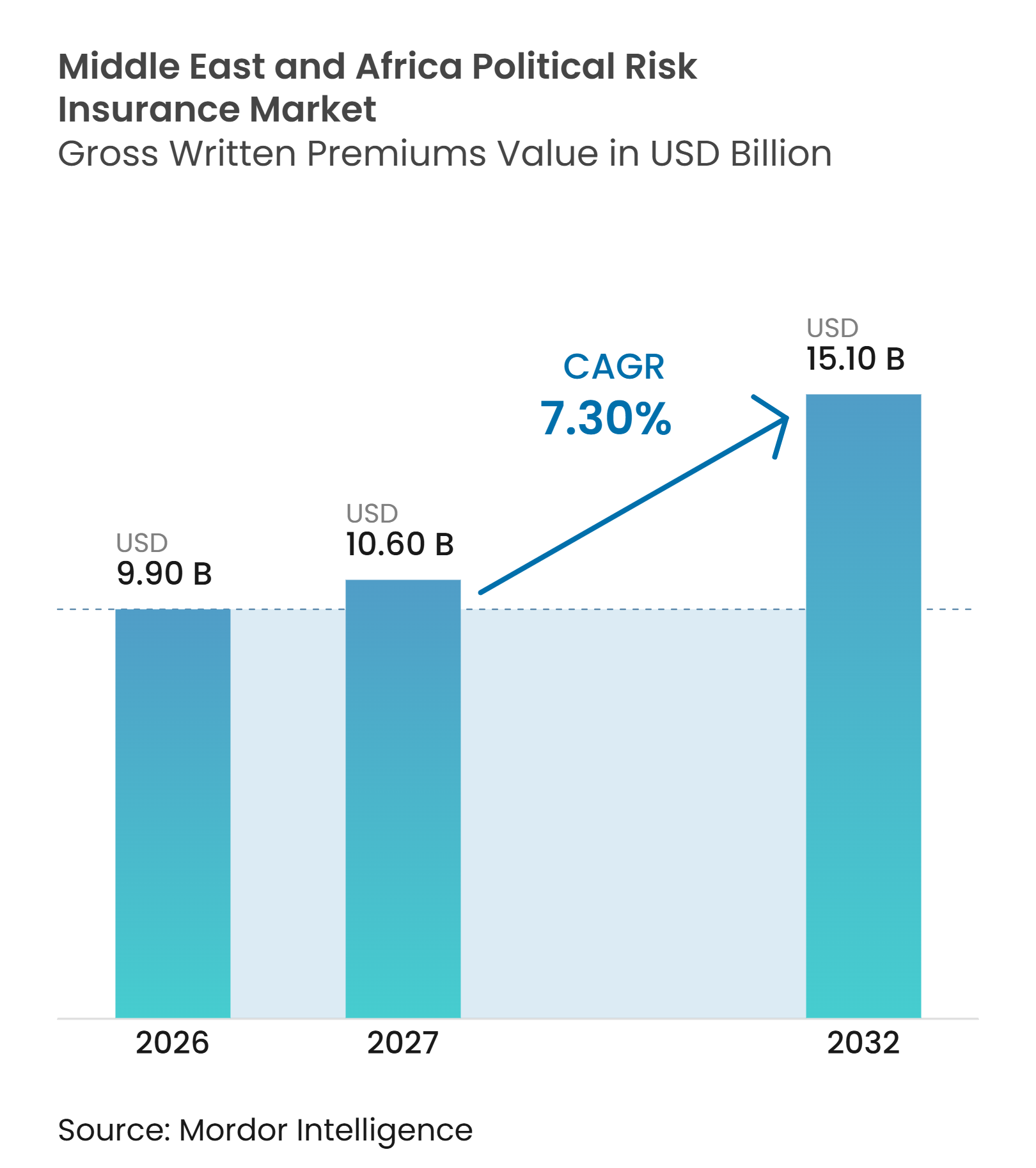
The Middle East And Africa Political Risk Insurance Market size in terms of gross written premiums value is expected to increase from USD 9.90 billion in 2026 to USD 10.60 billion in 2027 and reach USD 15.10 billion by 2032, growing at a CAGR of 7.30% over 2027-2032.
Demand is supported by investment in infrastructure, energy, and natural resources, where projects need cover for long-term country risk. Political violence, resource nationalism, currency restrictions, and state-related nonpayment are widening the risks that investors and lenders must assess. Insurers are responding with stricter underwriting in conflict-affected areas, while capacity is more available for lower-risk Gulf Cooperation Council exposures. The Middle East and Africa political risk insurance market also benefits when lenders require risk transfer before a project can draw down financing. These conditions create opportunities for insurers, export credit agencies, and multilateral institutions that can provide long tenors and work across several jurisdictions.
Key Report Takeaways
- By coverage type, political violence captured 34.3% of the Middle East and Africa political risk insurance market share in 2026, while no forecast CAGR for an individual coverage type is reported.
- By end user, project developers and sponsors held a 29.9% share in the Middle East and Africa political risk insurance market in 2026, while financial institutions are projected to grow at an 8.9% CAGR through 2032.
- By distribution channel, brokers and intermediaries accounted for a 52.8% share in the Middle East and Africa political risk insurance market in 2026, while digital and online platforms are projected to grow at an 8.9% CAGR through 2032.
- By provider type, export credit agencies held a 64.8% share in the Middle East and Africa political risk insurance market in 2026, while multilateral institutions are projected to grow at an 8.1% CAGR through 2032.
- By sector, energy and power accounted for a 34.7% share in the Middle East and Africa political risk insurance market in 2026 and is projected to grow at an 8.5% CAGR through 2032.
- By geography, the rest of the Middle East and Africa held 44.8% of the Middle East and Africa political risk insurance market share in 2026, while Saudi Arabia is projected to grow at a 9.5% CAGR through 2032.
Note: Market numbers in this report are based on Mordor Intelligence's proprietary estimation framework, which combines nine months of actuals with Q4 projections for base year 2026.
Market Trends and Insights
Drivers Impact Analysis of Middle East and Africa Political Risk Insurance Market*
| Driver | (~) % Impact on CAGR Forecast | Geographic Relevance | Impact Timeline |
|---|---|---|---|
| Infrastructure, Energy, and Natural Resource Investment | +2.0% | Saudi Arabia, United Arab Emirates, Nigeria, South Africa, and the rest of Sub-Saharan Africa | Long term (≥ 4 years) |
| Geopolitical Conflict, Political Violence, and War-Related Exposure | +1.7% | Gulf states, Egypt, Nigeria, Sudan, and the Sahel corridor | Short term (≤ 2 years) |
| Demand for Expropriation and Nationalization Protection | +1.2% | Nigeria, Democratic Republic of the Congo, Tanzania, Mali, Burkina Faso, and Guinea | Medium term (2-4 years) |
| Currency Inconvertibility, Transfer Restrictions, and Capital Controls | +0.8% | Core Sub-Saharan Africa and Middle East and North Africa oil-importing economies | Medium term (2-4 years) |
| Sovereign and State-Owned Enterprise Nonpayment and Contract Repudiation | +0.6% | Egypt, Nigeria, Angola, and the rest of Sub-Saharan Africa | Medium term (2-4 years) |
| Foreign Direct Investment and Cross-Border Project Financing | +0.5% | Middle East and Africa, with early gains in the Gulf, South Africa, and Kenya | Long term (≥ 4 years) |
| Source: Mordor Intelligence | |||
Infrastructure, Energy, and Natural Resource Investment in Higher-Risk Jurisdictions
Capital investment in energy, infrastructure, and extractive assets is a central driver for the Middle East and Africa political risk insurance market because these projects cannot easily change location once construction begins. MIGA issued USD 9.5 billion in new guarantees during fiscal year 2025, compared with USD 8.2 billion in fiscal year 2024, and Africa received 35% of its project allocations[1]. In July 2025, MIGA agreed to provide a USD 495 million, 15-year guarantee framework for CrossBoundary Energy projects in up to 20 African countries, covering currency inconvertibility and transfer restrictions. The African Development Bank approved a USD 125 million equity investment in ATIDI in June 2026 to expand political risk and credit insurance capacity for foreign investment and intra-African trade. These programs show why political risk coverage is increasingly built into project financing rather than purchased after an investment decision. Long-lived assets and lender conditions make demand more resilient when capital is directed to higher-risk jurisdictions.
Geopolitical Conflict, Political Violence, and War-Related Investment Exposure
Geopolitical conflict raises demand for political violence cover across the Middle East and Africa political risk insurance market, especially when several risks affect the same reinsurers. Arch Insurance reported that persistent instability and greater awareness of cover value are increasing underwriting activity across the region. Gulf-country political risk insurance rates increased by 20% to 30% in the 2026 spring update, showing that insurers were reassessing correlated exposures during the regional conflict[2]. The increased price of cover can encourage buyers to review limits, exclusions, and business continuity plans before a loss occurs. The same risk event can constrain capacity beyond its immediate location when reinsurers also carry exposure in Ukraine and other conflict areas. Political violence cover therefore remains important to asset owners and lenders, even as higher rates make program design more selective.
Rising Demand for Expropriation and Nationalization Protection
Resource nationalism is driving demand for expropriation and nationalization protection in the Middle East and Africa political risk insurance market. WTW identified mining code revisions in Tanzania, Guinea, Niger, and Burkina Faso that affected active projects through measures such as license revocations, stake reductions, and arbitration[3]. Such developments increase the importance of cover for regulatory actions that affect the economics of a concession. Traditional policies are also being tested by gradual measures that do not involve a formal seizure of an asset. Clifford Chance noted that the scope of covered perils and the question of whether incremental government action caused a loss can become central issues in political risk claims. Clear policy language and a careful description of the insured investment are therefore important for protection to respond as intended.
Foreign Direct Investment and Cross-Border Project Financing in Emerging Markets
Foreign direct investment and project financing are expanding the need for political risk transfer across the Middle East and Africa political risk insurance market. UNCTAD stated that the annual financing gap for the Sustainable Development Goals in developing countries rose from USD 2.5 trillion in 2014 to USD 4 trillion in 2023. The same publication found that 80% of investors surveyed by the African Union Commission and the Organisation for Economic Co-operation and Development viewed political risk as an obstacle to investment in Africa. In October 2025, Etihad Credit Insurance stated that it operated in 30 African countries and supported investment in renewable energy, infrastructure, healthcare, and digital transformation[4]. These capital flows need products that work for investors, lenders, exporters, and host governments. They also increase the need for cooperation between export credit agencies, multilateral providers, and private insurers.
Restraints Impact Analysis of Middle East and Africa Political Risk Insurance Market*
| Restraint | (~) % Impact on CAGR Forecast | Geographic Relevance | Impact Timeline |
|---|---|---|---|
| High Premiums, Deductibles, and Restricted Capacity | -0.8% | Sahel corridor, Red Sea-adjacent Gulf states, Nigeria, and South Sudan | Short term (≤ 2 years) |
| Complex Policy Wordings, Coverage Exclusions, and Claims Requirements | -0.6% | Middle East and Africa, particularly Sub-Saharan Africa | Long term (≥ 4 years) |
| Foreign-Exchange Controls and Restrictions on Premium or Claims Payments | -0.4% | Nigeria, Angola, Ethiopia, and the rest of Sub-Saharan Africa | Medium term (2-4 years) |
| Weak Contract Enforcement and Lengthy Sovereign Claims Recovery | -0.3% | Core Sub-Saharan Africa and Middle East and North Africa oil-importing economies | Long term (≥ 4 years) |
| Source: Mordor Intelligence | |||
High Premiums, Deductibles, and Restricted Capacity in Conflict-Affected Markets
High premiums, deductibles, and limited capacity constrain demand in the parts of the Middle East and Africa political risk insurance market that face the greatest risk. Buyers with smaller project values can find that the cost of comprehensive cover reduces the financial viability of a transaction. Gulf-country rate increases of 20% to 30% in 2026 illustrate the higher pricing that can follow concentrated geopolitical exposure. Capacity can also become selective when insurers need to limit their aggregate exposure to a country, a peril, or a single event. This can leave smaller project developers and exporters with limited options even when they have a clear need for protection. The result is a coverage gap in the same markets where investment risk is often most difficult to manage.
Complex Policy Wordings, Coverage Exclusions, and Claims-Settlement Requirements
Complex policy wording and claims requirements limit wider adoption in the Middle East and Africa political risk insurance market. Allianz Commercial identified language clarity as a practical issue in claims management, particularly when English-language policies are used in markets where English is not the operating language. Hybrid events can combine violence, regulatory action, state intervention, and currency controls in ways that are difficult to classify under older policy forms. The treatment of indirect government measures remains particularly important for mining and infrastructure investors. Policyholders need to understand triggers, exclusions, evidence requirements, and the sequence for notifying a potential claim. Better wording and stronger claims processes can reduce disputes and make cover more useful in complex jurisdictions.
*Our forecasts treat driver/restraint impacts as directional, not additive. The impact forecasts reflect baseline growth, mix effects, and variable interactions.
Middle East and Africa Political Risk Insurance Market Segment Analysis
By Coverage Type:
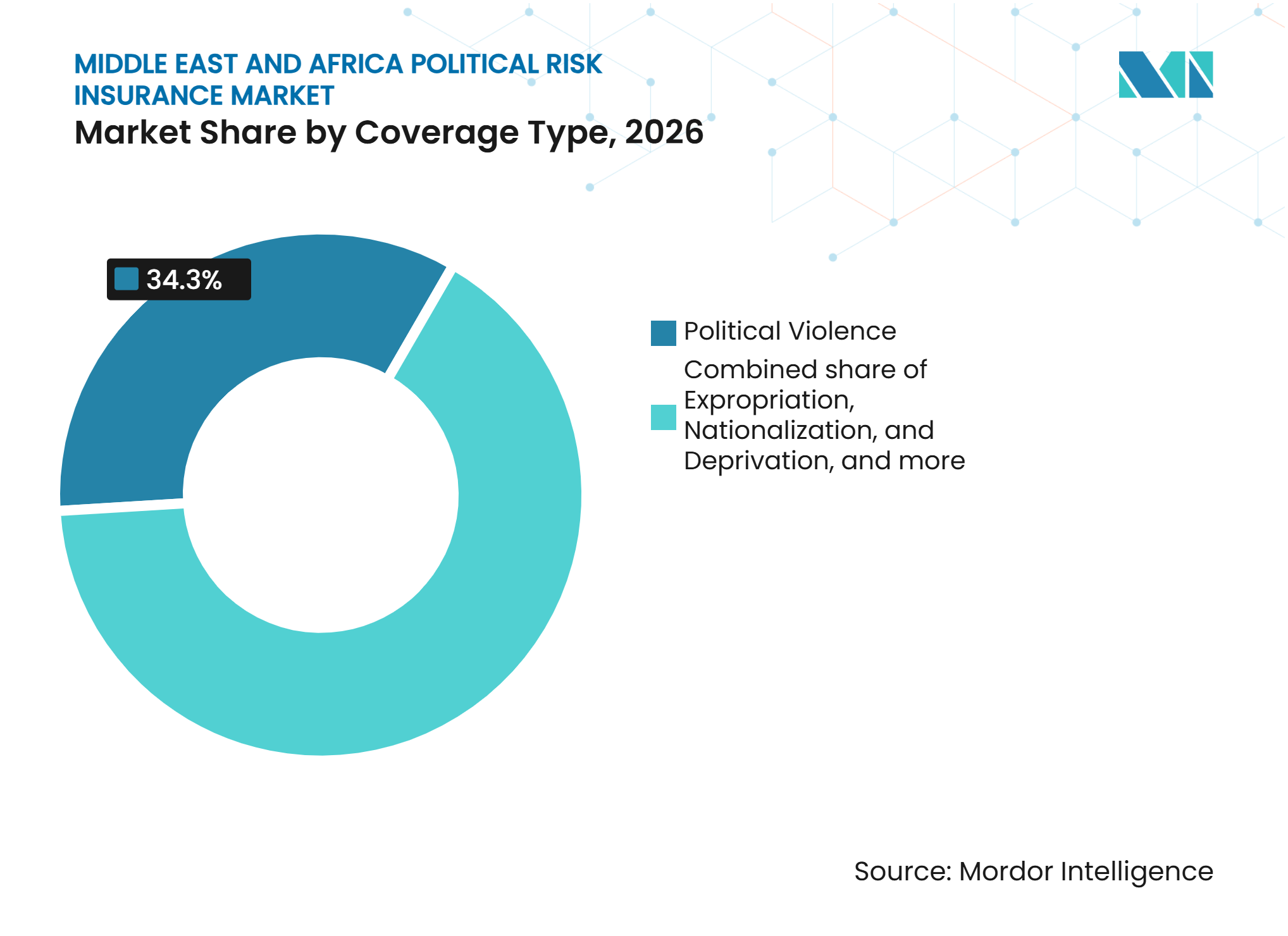
Political Violence Commands Market, Expropriation Pressures BuildPolitical violence captured 34.3% of the Middle East and Africa political risk insurance market share in 2026, making it the leading coverage type. Its position reflects frequent political violence events and the high insured values attached to conflict-exposed assets. Companies in the Gulf Cooperation Council may purchase broad cover that includes war and civil war, although cover should be aligned with the actual exposure of each asset. Lockton noted that maximum-limit political violence programs may not always reflect the risk profile of stable Gulf Cooperation Council locations such as the United Arab Emirates, Oman, and Kuwait. The Middle East and Africa political risk insurance market therefore requires careful risk selection rather than a single standard structure for all locations.
Expropriation, nationalization, and deprivation of assets cover is gaining importance as mining and natural resource projects face more regulatory intervention. Currency inconvertibility and transfer restriction coverage is also becoming more important for projects with earnings or debt service in foreign currency. MIGA’s USD 495 million framework for CrossBoundary Energy shows that these covers can be applied at a portfolio level, not only on a project-by-project basis. Breach of contract and non-honoring cover is relevant when infrastructure agreements depend on a state entity or sovereign counterparty. AXA XL states that it can offer political risk and credit insurance tenors of more than 20 years, which can support the long-term nature of these projects.


By End User:
Project Developers Lead, Financial Institutions Emerge as Growth EngineProject developers and sponsors accounted for 29.9% of the Middle East and Africa political risk insurance market in 2026. Their leading role is tied to the large number of energy, infrastructure, and extractive projects that need risk management from financing through operation. Lenders commonly require evidence of political risk cover before releasing funds for large projects. This makes insurance part of the financing structure rather than an optional operating expense. Project developers also need to consider whether the policy covers construction, operation, and potential changes in the political environment over the project life.
Financial institutions are the fastest-growing end-user group and are projected to grow at 8.9% CAGR through 2032. Banks use nonpayment insurance and contract frustration cover to manage country exposure in lending and trade finance portfolios. Their need for cover increases when lending expands across several markets with different legal systems and sovereign counterparties. Multinational corporations remain important buyers because governance requirements can make country risk management a board-level responsibility. Exporters and importers remain less well served, as smaller transactions can fall below the size threshold for complex policies.
By Distribution Channel:
Brokers Anchor Market, Digital Platforms Expand AccessBrokers and intermediaries held a 52.8% share in 2026, giving them the largest role in distributing cover in the Middle East and Africa political risk insurance market. Political risk transactions often need local market knowledge and coordination among insurers, export credit agencies, lenders, and investors. Brokers help structure placements when a program covers several countries or combines different risk types. They also support negotiations on limits, exclusions, policy wording, and claims procedures. This role remains valuable where clients require tailored cover for complex projects.
Digital and online platforms are projected to grow at an 8.9% CAGR through 2032. Their growth is linked to automated workflows and tools that help users assess country and transaction risk. Saudi EXIM reported work on a risk analysis platform that uses political and economic indicators to support country and market assessments. Digital tools can make standard products more accessible to smaller investors and exporters that cannot justify a fully brokered placement. Bancassurance and strategic partnerships can also embed cover into trade finance and project lending packages.
By Provider Type:
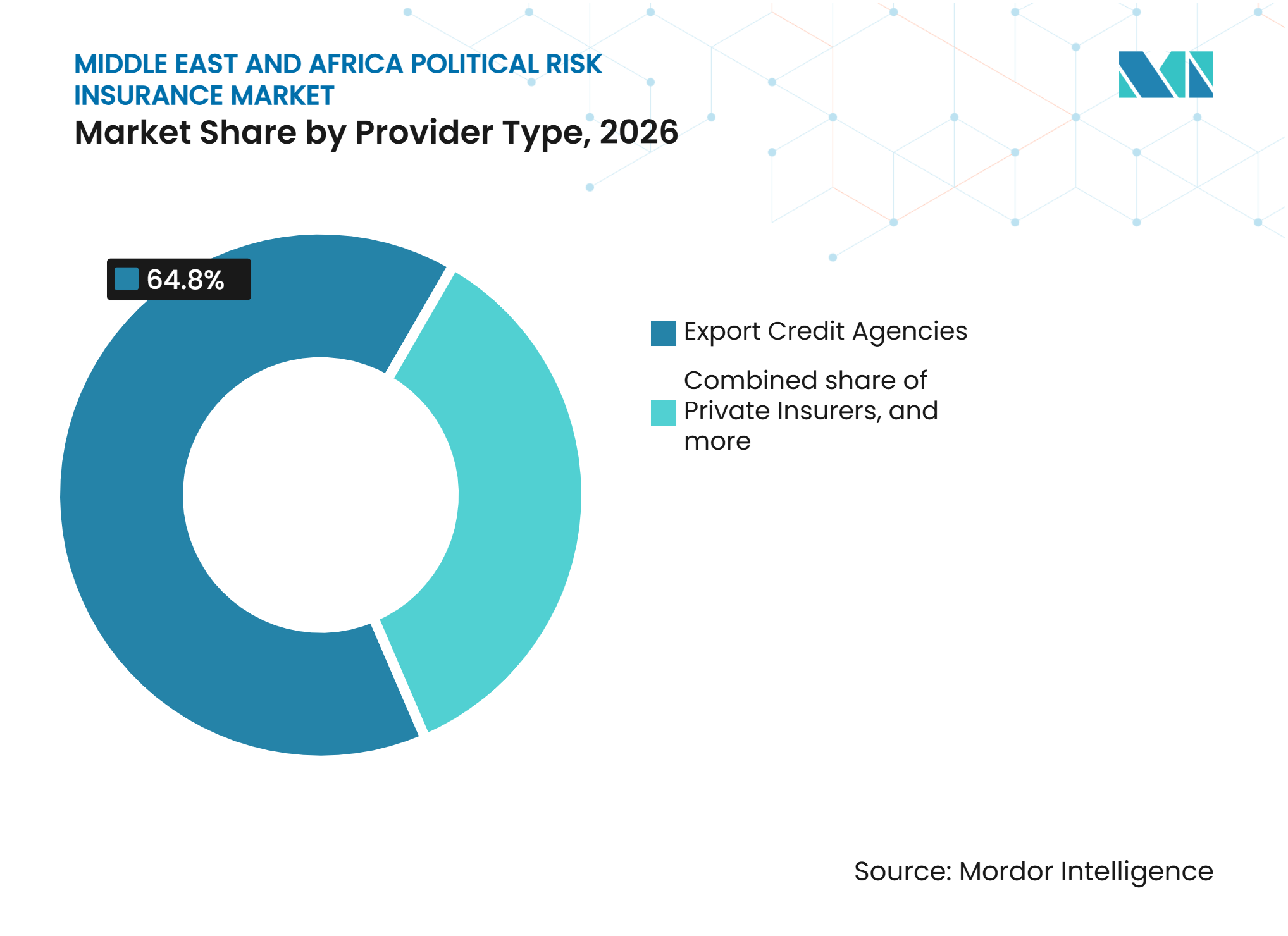
Export Credit Agencies Dominate, Multilateral Institutions Gain GroundExport credit agencies captured a 64.8% share in 2026, giving them the leading position in the Middle East and Africa political risk insurance market. UNCTAD found that export credit agencies represented 78% of total global political risk insurance issuance during the previous decade. They are important because the United Kingdom, United States, Saudi Arabia, United Arab Emirates, China, and Germany use national institutions to support overseas trade and investment. These providers operate under mandates that define who can receive cover, which markets are eligible, and what risks can be insured. Their government links can help them provide capacity where private providers may be more cautious.
Multilateral institutions are projected to grow at an 8.1% CAGR through 2032. MIGA issued USD 9.5 billion in new guarantees in fiscal year 2025, while the World Bank Group Guarantee Platform issued USD 12.3 billion across 77 projects in 40 countries. These institutions can provide longer tenors and may support smaller or higher-risk transactions that are difficult for private insurers to underwrite on their own. Their guarantees can encourage private lenders and insurers to participate in a project. Private insurers remain relevant where clients need speed, flexibility, and project-specific cover.

By Sector:
Energy and Power Drives Market, Sector Breadth ExpandsEnergy and power accounted for 34.7% of the Middle East and Africa political risk insurance market in 2026 and is projected to grow at an 8.5% CAGR through 2032. The sector needs long-term cover because power plants, renewable assets, pipelines, and related infrastructure are exposed to government action and changes in the operating environment. MIGA’s CrossBoundary Energy framework covers solar, wind, and battery storage projects across up to 20 African countries. This shows how distributed renewable energy projects are adding to demand alongside established oil and gas investments. Energy assets also often involve public contracts, foreign currency payments, and significant capital commitments.
Infrastructure and transportation form another important sector, supported by investment plans in Saudi Arabia, the United Arab Emirates, Egypt, and Nigeria. Mining, oil and gas, and other natural resource investments create demand, but resource nationalism can limit insurers’ willingness to underwrite some projects. Manufacturing, financial services, agribusiness, healthcare, and technology are smaller demand areas that can grow as regional trade links deepen. The African Continental Free Trade Area supports cross-border supply chains that may require broader country-risk protection. The Middle East and Africa political risk insurance industry is therefore not dependent on one sector, even though energy and power remain the largest.
Geography Analysis
Saudi Arabia is projected to grow at a 9.5% CAGR through 2032, making it the fastest-growing country in the Middle East and Africa political risk insurance market. The country recorded SAR 119 billion (USD 31.7 billion) in foreign direct investment inflows in 2024, and this was 24% higher than in 2023. Its 2025 target was SAR 139 billion (USD 37 billion), which points to sustained efforts to attract capital into renewable energy, construction, logistics, and major projects. These investments increase the need for cover that can address cross-border financing and longer project tenors. Regional political tensions also make risk assessment more important for investors and insurers.
The United Arab Emirates is a regional hub for outbound investment and political risk cover. Etihad Credit Insurance operates in 30 African countries and supports investment in renewable energy, infrastructure, healthcare, and digital transformation. MIGA and Etihad Credit Insurance formed a partnership to expand guarantees by combining multilateral capacity with United Arab Emirates origination capabilities. South Africa has a distinct risk profile because SASRIA provides domestic cover for strikes, riots, and civil commotion. International placements remain important for cross-border and larger political violence exposures.
The rest of the Middle East and Africa held 44.8% of the regional political risk insurance market in 2026. In fiscal year 2024, MIGA issued USD 1.2 billion in guarantees for 10 projects in Egypt, Jordan, Morocco, Oman, and Tunisia, including renewable energy, airport expansion, and education infrastructure. Nigeria offers opportunity because of its natural resource base and need for investment, while external balances, lending conditions, and exchange-rate management remain important considerations. The phased implementation of the African Continental Free Trade Area is also supporting cross-border trade and investment, including through the Trans-Africa Bond Alliance introduced by Afreximbank and ZEP-RE.
Competitive Landscape
Market Concentration
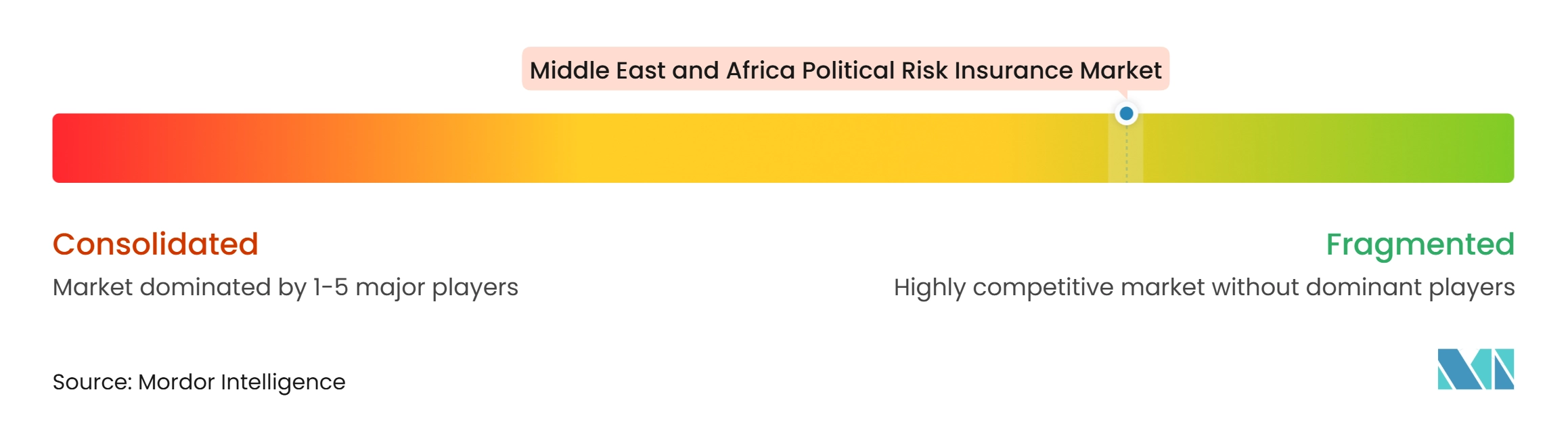
The Middle East and Africa political risk insurance market is fragmented, with capacity distributed across international private insurers, Lloyd’s syndicates, national export credit agencies, and multilateral development institutions. Private-sector participants include AXA XL, Chubb, Allianz Trade, Liberty Specialty Markets, Sompo International, Zurich Insurance Group, and Tokio Marine HCC. These providers offer different combinations of investment protection, contract frustration, currency inconvertibility, political violence, and non-payment coverage. AXA XL, for example, provides political risk and credit insurance with policy tenors of up to 20 years, covering risks such as expropriation, nationalisation, currency inconvertibility, political violence, and arbitration award default. Its policies are backed by AXA's AA- S&P rating or Lloyd's A+ rating.
Public-sector providers add another layer of competition through country-specific mandates and international risk-sharing arrangements. Relevant institutions supporting transactions in the region include Saudi EXIM, United Kingdom Export Finance, the United States International Development Finance Corporation (DFC), SACE, Export Development Canada, and Credendo. Saudi EXIM has expanded its international partnerships through reinsurance agreements with AIG, Allianz Trade, and Bpifrance under its Bridges Initiative, and subsequently signed agreements with SACE and the United States EXIM Bank. The DFC's reauthorization under the FY2026 National Defense Authorization Act increased its maximum contingent liability from USD 60 billion to USD 205 billion, expanding its capacity to support eligible international investments. However, this figure represents DFC's overall investment exposure limit, not political risk insurance capacity alone.
Political risk insurance is generally structured around the specific exposure, investment, sector, and jurisdiction, with available underwriting capacity varying across geographies and industries. This creates opportunities to develop tailored solutions for smaller investors, infrastructure developers, and project-finance participants that may have different coverage requirements from large multinational corporations. Clifford Chance also notes that political risk insurance is increasingly relevant across a range of investors and project structures, including infrastructure investments. In parallel, improved catastrophe modelling can help insurers assess political violence exposures: Verisk introduced a strikes, riots, and civil commotion catastrophe model in April 2025.
Middle East and Africa Political Risk Insurance Industry Leaders
-
Multilateral Investment Guarantee Agency (MIGA)
-
Lloyd’s
-
American International Group, Inc.
-
Allianz Trade
-
Arab Investment & Export Credit Guarantee Corporation (Dhaman)
- *Disclaimer: Major Players sorted in no particular order
Middle East and Africa Political Risk Insurance Market Companies Covered in this Report
- Multilateral Investment Guarantee Agency (MIGA)
- Lloyd
- American International Group, Inc. (AIG)
- Allianz Trade
- Arab Investment & Export Credit Guarantee Corporation (Dhaman)
- African Trade & Investment Development Insurance (ATIDI)
- AXA XL
- Chubb
- Coface
- Atradius
- Etihad Credit Insurance (ECI)
- Liberty Specialty Markets
- Sompo International
- Zurich Insurance Group
- United States International Development Finance Corporation (DFC)
- United Kingdom Export Finance (UKEF)
- Export Development Canada (EDC)
- Credendo
- SACE
- Saudi Export-Import Bank (Saudi EXIM)
Recent Industry Developments in Middle East and Africa Political Risk Insurance Market
- August 2026: Saudi EXIM signed a reinsurance agreement with ATIDI, African Trade and Investment Development Insurance, to transfer credit and political risks on Saudi export transactions across African markets, directly enabling Saudi exporters to expand into the continent with structured risk mitigation capacity.
- March 2026: DFC announced it would mobilize its political risk insurance and guaranty products to support commercial shipping charterers, shipowners, and maritime insurance providers operating in the Middle East during the Iran conflict escalation, acting under strategic guidance from the United States government to minimize market disruptions and support the free flow of goods and capital.
- February 2026: Saudi EXIM signed a Memorandum of Understanding on reinsurance arrangements with United Kingdom Export Finance, the United Kingdom’s national export credit agency, as part of Saudi EXIM’s Bridges Initiative to establish a global network of reinsurance partnerships covering raw materials and capital goods trade.
- February 2026: Saudi EXIM signed a trilateral Memorandum of Understanding with Poland’s BGK and KUKE, extending its reinsurance network into Central Europe and diversifying the sources of risk capacity accessible to Saudi exporters and investors.
Middle East and Africa Political Risk Insurance Market Report Scope
Segmentation Overview
| Expropriation, Nationalization, and Deprivation |
| Currency Inconvertibility and Non-Transfer Restrictions |
| Political Violence |
| Breach of Contract and Non-Honoring of Sovereign Obligations |
| Multinational Corporations |
| Financial Institutions |
| Exporters and Importers |
| Project Developers and Sponsors |
| Public Sector and Development Institutions |
| Direct Sales |
| Brokers and Intermediaries |
| Bancassurance and Strategic Partnerships |
| Digital and Online Platforms |
| Private Insurers |
| Export Credit Agencies |
| Multilateral Institutions |
| Energy and Power |
| Infrastructure and Transportation |
| Mining, Oil & Gas, and Natural Resources |
| Manufacturing and Industrials |
| Financial Services and Banking |
| Other (e.g., Agribusiness, Healthcare, Technology, etc.) |
| United Arab Emirates |
| Saudi Arabia |
| South Africa |
| Nigeria |
| Rest of Middle East and Africa |
| By Coverage Type | Expropriation, Nationalization, and Deprivation |
| Currency Inconvertibility and Non-Transfer Restrictions | |
| Political Violence | |
| Breach of Contract and Non-Honoring of Sovereign Obligations | |
| By End User | Multinational Corporations |
| Financial Institutions | |
| Exporters and Importers | |
| Project Developers and Sponsors | |
| Public Sector and Development Institutions | |
| By Distribution Channel | Direct Sales |
| Brokers and Intermediaries | |
| Bancassurance and Strategic Partnerships | |
| Digital and Online Platforms | |
| By Provider Type | Private Insurers |
| Export Credit Agencies | |
| Multilateral Institutions | |
| By Sector | Energy and Power |
| Infrastructure and Transportation | |
| Mining, Oil & Gas, and Natural Resources | |
| Manufacturing and Industrials | |
| Financial Services and Banking | |
| Other (e.g., Agribusiness, Healthcare, Technology, etc.) | |
| By Country | United Arab Emirates |
| Saudi Arabia | |
| South Africa | |
| Nigeria | |
| Rest of Middle East and Africa |
Key Questions Answered in the Report
What is political risk insurance used for in the Middle East and Africa?
It helps investors, lenders, and exporters manage political violence, expropriation, currency inconvertibility, transfer restrictions, and contract-related state actions.
How large is the Middle East and Africa political risk insurance market?
It is projected at USD 10.6 billion in 2027 and is forecast to reach USD 15.1 billion by 2032, with a 7.3% CAGR.
Which political risk insurance coverage type has the largest share in the Middle East and Africa?
Political violence is the largest coverage type, with a 34.3% share in 2026. The need for this cover rises when assets face conflict-related disruption.
Which end users are driving demand for political risk insurance in the Middle East and Africa?
Project developers and sponsors lead with 29.9% share in 2026, while financial institutions are the fastest-growing end-user group at an 8.9% CAGR through 2032.
Which providers are most important for political risk insurance in the Middle East and Africa?
Export credit agencies lead with 64.8% share in 2026, while multilateral institutions are projected to grow at an 8.1% CAGR through 2032.
Why is Saudi Arabia important for political risk insurance demand?
Saudi Arabia is projected to grow at 9.5% CAGR through 2032 as investment activity expands under Vision 2030 and projects require long-term risk mitigation.