
Market Overview
| Study Period | 2021 - 2031 |
|---|---|
| Forecast Data Period | 2026 - 2031 |
| Base Year Market Size (2025) | 37.95 Thousand metric tons |
| Market Volume (2026) | 59.28 Thousand metric tons |
| Market Volume (2031) | 149.11 Thousand metric tons |
| Growth Rate (2026 - 2031) | 20.26 % |
| Market Concentration | Medium |
Major Players *Disclaimer: Major Players sorted in no particular order Image © Mordor Intelligence. Reuse requires attribution under CC BY 4.0. | |
Middle-East And Africa Liquified Natural Gas (LNG) Bunkering Market Analysis by Mordor Intelligence
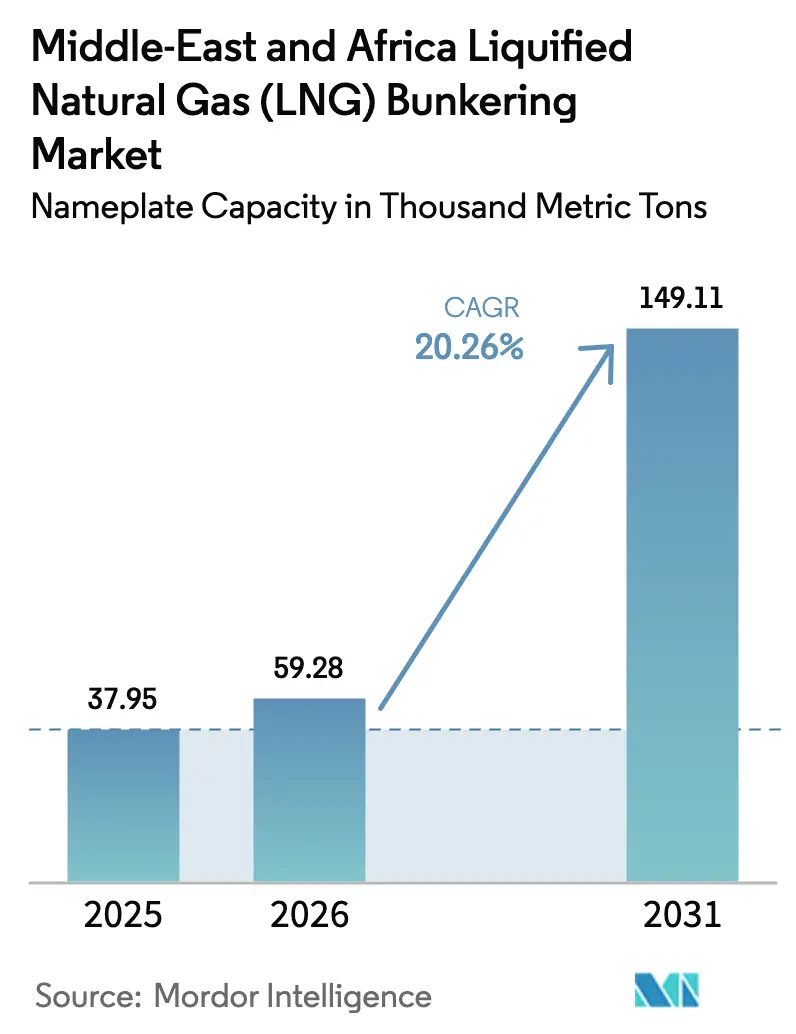
The Middle-East And Africa Liquified Natural Gas Bunkering Market size in terms of nameplate capacity is expected to grow from 37.95 Thousand metric tons in 2025 to 59.28 Thousand metric tons in 2026 and is forecast to reach 149.11 Thousand metric tons by 2031 at 20.26% CAGR over 2026-2031.
This growth rests on progressively tighter IMO emissions rules, surging Middle-East liquefaction capacity, and a security-driven resurgence of Cape-route traffic that together drive unprecedented demand at Gulf and African ports. The IMO 2020 sulphur cap and its 2023 greenhouse-gas strategy have made LNG the most practical compliance option for shipowners unwilling to retrofit scrubbers or pay a premium for bio-methanol. Qatar’s North Field expansion alone will lift national nameplate liquefaction output to 142 million tpa by 2030, ensuring abundant supply and muting price volatility for regional bunker hubs. Vessel operators also view LNG bunkering as a hedge against the EU Emissions Trading System, whose inclusion of maritime emissions in 2024 materially raised the cost of high-sulphur fuels on Europe-bound routes. Finally, the rise in Red Sea security threats has rerouted Asia-Europe traffic around the Cape of Good Hope, raising African port calls and expanding the LNG bunkering market footprint at Durban, Mombasa, and Richards Bay.
Key Report Takeaways
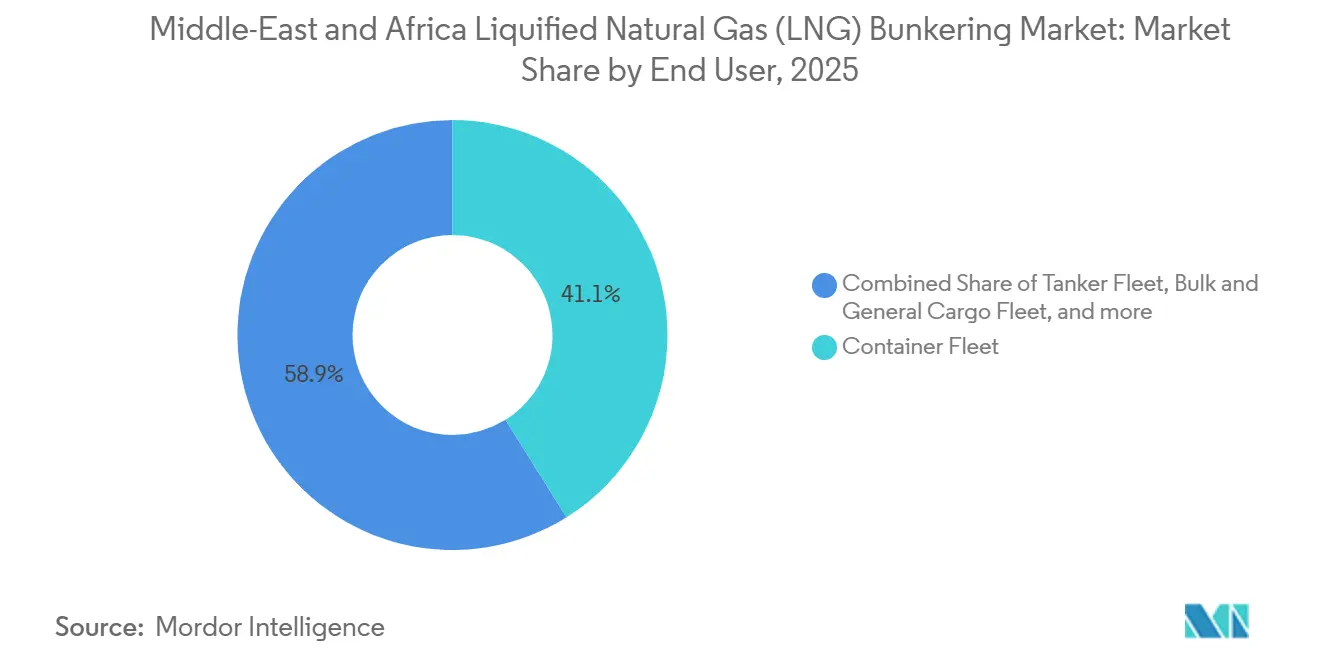
- By end user, the container fleet led with a 41.1% share in 2025, and it is forecast to expand at a 23.4% CAGR through 2031.
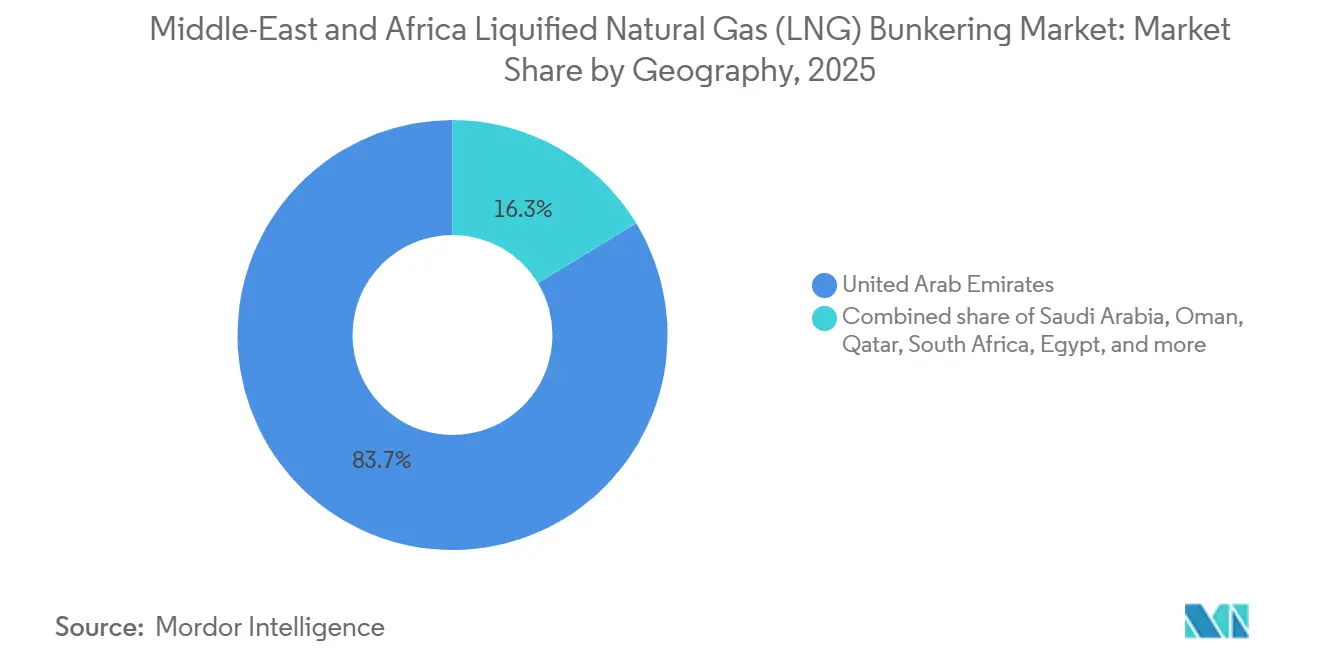
- By geography, the United Arab Emirates commanded 83.7% capacity in 2025, while South Africa is projected to register the fastest growth at a 24.7% CAGR through 2031.
Note: Market size and forecast figures in this report are generated using Mordor Intelligence’s proprietary estimation framework, updated with the latest available data and insights as of January 2026.
Market Trends and Insights
Drivers Impact Analysis of Middle-East And Africa Liquified Natural Gas (LNG) Bunkering Market*
| Driver | (~) % Impact on CAGR Forecast | Geographic Relevance | Impact Timeline |
|---|---|---|---|
| Stricter IMO sulphur and GHG mandates accelerate LNG adoption | 4.5% | Global, with early enforcement in EU and North America | Short term (≤ 2 years) |
| Mega Middle-East liquefaction additions lower bunker prices and boost supply | 3.8% | Middle East core, spillover to Africa and South Asia | Medium term (2-4 years) |
| Regional LNG bunkering hubs (Sohar, Fujairah, Durban) backed by incentives | 3.2% | UAE, Oman, South Africa | Medium term (2-4 years) |
| Security-driven Cape route shift raises demand at African ports | 2.1% | South Africa, Kenya, Egypt | Short term (≤ 2 years) |
| ESG-driven preference for low-carbon LNG (CCUS, e-drive trains) | 2.5% | Global, led by EU and Middle East | Long term (≥ 4 years) |
| Modular small-scale FSRU and LNGBV roll-outs enable secondary-port supply | 1.9% | Africa and secondary Middle East ports | Medium term (2-4 years) |
| Source: Mordor Intelligence | |||
Stricter IMO Sulphur and GHG Mandates Accelerate LNG Adoption
The IMO reduced the global sulphur limit in marine fuels from 3.5% to 0.5% in 2020, forcing operators to choose between costly scrubbers, low-sulphur fuel oil, or LNG. By 2025, more than 600 ships were running on LNG, and the IMO 2023 greenhouse-gas strategy, targeting net-zero shipping by 2050, cemented LNG as the most accessible compliance pathway until ammonia or hydrogen supply chains mature. The finalized life-cycle assessment credits LNG with a 20% lower well-to-wake carbon intensity versus heavy fuel oil, driving CMA CGM, MSC, and others to place large dual-fuel orders. The EU placed maritime emissions under its ETS in 2024, and prices climbed to EUR 85 per t, making high-sulphur fuels uneconomic on long Europe-bound voyages. Consequently, shipowners increasingly lock in LNG bunkering contracts to mitigate their carbon cost exposure.
Mega Middle-East Liquefaction Additions Lower Bunker Prices and Boost Supply
Qatar’s North Field East, South, and West phases will collectively add 88 billion m³ per year of liquefaction by 2027, lifting the nation to 142 million tpa and reinforcing its leadership in the LNG bunkering market. Saudi Arabia’s planned Ras Al-Khair terminal and the UAE’s Ruwais project together contribute a further 20 million tpa by 2029. Oversupply has already compressed spot LNG prices; the Platts JKM averaged USD 11.20 per MMBtu in H1 2025 against USD 17.50 in 2024, undercutting VLSFO on a per-voyage basis. Hub operators such as ADNOC and Shell now offer multi-year fixed-price bunker deals, reducing owners’ fuel-cost uncertainty and encouraging dual-fuel fleet expansion.
Regional LNG Bunkering Hubs Backed by Incentives
Fujairah delivered more than 700,000 m³ of LNG bunker fuel in 2025, ranking third worldwide after Singapore and Rotterdam.[1] The port authority earmarked USD 200 million for extra cryogenic storage and jetties, enabling simultaneous refueling of ultra-large container ships. Sohar Marsa LNG facility entered service in 2024 with a 1 million tpa nameplate and enjoys a 10-year tax holiday that cuts breakeven by 18%.[2] South Africa's Transnet launched front-end engineering in 2025 for Durban and Richards Bay, targeting a combined 300,000 t throughput by 2028. Incentive programs reduce capital burden and accelerate facility completion, broadening the LNG bunkering market coverage across secondary ports.
ESG-Driven Preference for Low-Carbon LNG
Institutional investors and cargo owners embed carbon metrics into charter contracts, rewarding operators who use certified low-carbon LNG. TotalEnergies began offering carbon-neutral LNG in 2024, adding a 15% price premium via offsets and CCS credits. Shell’s Quest project captures 1.4 million t of CO₂ per year and underpins low-carbon supply contracts for marine customers. QatarEnergy plans 11 million tpa of CO₂ capture by 2030, lowering its life-cycle emissions and attracting forward bunker commitments. Engine makers respond with methane-slip reductions, evidenced by Wärtsilä’s 31DF at sub-3 g/kWh in 2025 sea trials.[3] These advances strengthen LNG’s green credentials amid tightening IMO methane rules expected in 2027.
Restraints Impact Analysis of Middle-East And Africa Liquified Natural Gas (LNG) Bunkering Market*
| Restraint | (~) % Impact on CAGR Forecast | Geographic Relevance | Impact Timeline |
|---|---|---|---|
| High capex for cryogenic storage and bunkering assets | -2.3% | Africa and secondary Middle East ports | Short term (≤ 2 years) |
| LNG price volatility versus VLSFO undermines cost savings | -1.8% | Global, with acute impact in Asia-Pacific and Africa | Short term (≤ 2 years) |
| Incoming methane-slip rules may erode LNG's green advantage | -1.2% | EU and North America, spillover to global fleet | Medium term (2-4 years) |
| Skilled-labor shortage for LNG handling in several African ports | -0.9% | Sub-Saharan Africa | Medium term (2-4 years) |
| Source: Mordor Intelligence | |||
High Capex for Cryogenic Storage and Bunkering Assets
A shore-based LNG bunker terminal typically costs USD 100 million to USD 150 million, covering tanks, vaporization, and safety systems, which deters investment at ports with unclear demand.[4] A dedicated LNG bunkering vessel ranges from USD 50 million to USD 80 million, and financiers often insist on offtake commitments for 70% capacity before funding. Durban’s 2025 feasibility study projected an extra 18 months for land acquisition and permitting, delaying revenue and inflating interest costs. Lagos postponed its bunker project after failing to secure 10-year customer contracts. Smaller East-African ports also lack throughput to justify standalone terminals, reinforcing the chicken-and-egg dilemma that slows the LNG bunkering market rollout.
LNG Price Volatility Versus VLSFO Undermines Cost Savings
LNG spot prices track regional gas markets and heating demand, resulting in swings that exceed those of oil-linked VLSFO. JKM fell 36% from USD 17.50 per MMBtu in early 2024 to USD 11.20 in mid-2025, compressing cost advantages. Bulk and tanker owners operating on thin margins hesitate to lock into long LNG contracts while VLSFO remains available at relatively steady USD 580 per t. The absence of a deep LNG bunker derivatives market further limits hedging, and fuel-cost adjustment clauses in charters transfer risk to cargo owners, who may then prefer conventional fuel vessels.
*Our forecasts treat driver/restraint impacts as directional, not additive. The impact forecasts reflect baseline growth, mix effects, and variable interactions.
Middle-East And Africa Liquified Natural Gas (LNG) Bunkering Market Segment Analysis
By End User:
Container Fleet Dominates Amid Liner Commitment to Dual-Fuel NewbuildsContainer vessels held 41.1% of demand in 2025, while the tanker and bulk carrier categories lag. Within the container segment, CMA CGM’s 22-ship LNG program and MSC’s retrofit plan underscore long-term confidence in the fuel. This segment commands the highest LNG bunkering market share because liner operators can pass bunker costs through in freight rates and face strict ESG requirements from cargo owners. The container fleet is projected to grow at 23.4% annually to 2031, making it the largest contributor to the LNG bunkering market size through the forecast period.
Tankers and bulkers remain cautious. DHT Holdings and Euronav ordered LNG-ready VLCCs in 2024, yet widespread uptake is limited by freight-rate volatility and fragmented ownership. Ferries and OSVs trail even further; regional voyages rarely recoup the capital required for cryogenic tanks, though Norway’s Fjord Line demonstrates technical feasibility with its LNG-powered ferry delivered in 2024. Cruise operators such as Carnival already run 11 LNG-powered ships and could accelerate adoption once more ports add bunker capability. Overall, the LNG bunkering industry remains container-centric, but progressive infrastructure roll-outs and carbon-pricing signals may broaden participation across vessel classes later in the decade.

Geography Analysis
GCC Liquified Natural Gas (LNG) Bunkering Market
The UAE accounted for 83.7% of bunkering capacity in 2025 and is expected to expand at 22.1% annually through 2031, anchored by Fujairah’s strategic Strait-of-Hormuz location and ADNOC’s integrated supply chain. Fujairah handled over 700,000 m³ in 2025 and benefits from proximity to Qatar’s Ras Laffan, ensuring a steady supply regardless of spot price swings. Saudi Arabia plans to position Jeddah as a Red Sea hub with USD 120 million in cryogenic investments targeting 2027 service. Oman’s Sohar Marsa LNG commenced operations in 2024 at 1 million tpa and may be complemented by a Duqm facility, widening the LNG bunkering market footprint along the Indian Ocean corridor.
Africa Liquified Natural Gas (LNG) Bunkering Market
South Africa emerged as the African anchor as Cape-route traffic surged. Durban recorded a 40% rise in container calls in Q1 2025, and bunker sales jumped 28%, validating Transnet’s USD 150 million infrastructure plan. Richards Bay is evaluating an FSRU to serve both industry and marine clients by 2028. Egypt’s Suez Canal Authority accelerated LNG bunker plans at Ain Sokhna and Port Said to capture demand once Red Sea security improves. Nigeria shelved Lagos Port infrastructure due to customer shortfalls, yet the Train 7 liquefaction expansion could revive interest if domestic pricing becomes competitive. Kenya’s Mombasa is eyeing a 200,000 tpa FSRU for 2027, underlining how security-driven route changes have dispersed the LNG bunkering market across sub-Saharan Africa.
Regulatory Landscape
The regulatory environment for LNG bunkering in the Middle East and Africa is anchored in global maritime emissions compliance and port-level safety governance. IMO 2020 (0.5% sulphur cap) and the IMO 2023 GHG strategy are the main external drivers shaping shipowner fuel choices, while ports in the UAE and Oman operationalize LNG bunkering permissions through international safety frameworks (IMO-aligned procedures and SIGTTO/IAPH/OCIMF guidance). The Port of Fujairah, for example, specifies ship-to-ship (STS) transfer requirements for LNG/LPG carriers, including compliance with recognized industry guidelines and possession of valid statutory and security certificates, reinforcing a formalized permitting and operational-control approach at a key regional hub.
In Africa, offshore bunkering governance, customs compliance, and environmental management are tightening, which affects LNG bunker supply models such as STS and floating solutions. South Africa advanced multiple pillars in 2024-2026: SARS implemented customs-related rules under the Customs Act to address gaps in fuel imports and storage for offshore bunkering (November 2024), the Department of Forestry, Fisheries and the Environment published draft regulations for the environmental management of offshore bunkering for public comment (March 2025), and TNPA signed a 25-year terminal operator agreement with Ukwanda LNG for an onshore LNG regasification facility at the Port of Ngqura (May 2026). Policy alignment also links LNG infrastructure to broader energy security planning, with South Africa’s Integrated Resource Plan allocating 6,500 MW for gas-to-power and highlighting terminal development at Richards Bay, Coega, and Saldanha Bay, supporting a more predictable permitting runway for multi-use LNG import and bunkering assets.
Competitive Landscape
The value chain remains moderately concentrated. Upstream supply is in the hands of national oil companies, QatarEnergy, ADNOC, and Saudi Aramco, whose combined liquefaction expansions will exceed 180 million tpa by 2030. Midstream logistics is dominated by specialized players such as Nakilat, BW Group, and Mitsui O.S.K. Lines, each operating purpose-built LNG carriers and bunkering vessels. TotalEnergies acquired 25% of Sohar Marsa in 2025 and ordered two 18,000 m³ LNGBVs to secure downstream delivery margins. ADNOC mirrors this vertical integration at Fujairah, pairing Ruwais feedstock with its own LNGBV fleet.
Technology competition hinges on methane-slip reduction. Wärtsilä reported sub-3 g/kWh emissions in 2025 31DF trials, while MAN Energy Solutions delivered high-pressure gas injection systems that halve slip compared to previous designs. Barriers to entry remain steep: shore terminals cost up to USD 150 million, and an LNGBV costs as much as USD 80 million. Yet government co-financing, such as Oman’s tax holiday, mitigates capital hurdles for secondary players. White space persists in sub-Saharan Africa, where fixed infrastructure is limited, and floating solutions can leapfrog traditional terminal development, fostering new entrants in the LNG bunkering market.
Middle-East And Africa Liquified Natural Gas (LNG) Bunkering Industry Leaders
-
QatarEnergy
-
Royal Dutch Shell plc
-
TotalEnergies SE
-
ADNOC Logistics & Services plc
-
DNG Energy
- *Disclaimer: Major Players sorted in no particular order

Middle-East And Africa Liquified Natural Gas (LNG) Bunkering Market Companies Covered in this Report
- QatarEnergy
- Royal Dutch Shell plc
- TotalEnergies SE
- ADNOC Logistics & Services plc
- DNG Energy
- Oman LNG LLC
- BP plc
- Mitsui O.S.K. Lines (MOL)
- Nakilat (Qatar Gas Transport Co.)
- Kanfer Shipping
- JGC Holdings Corporation
- McDermott International Inc.
- Technip Energies N.V.
- BW Group
- SEA-LNG Ltd
- GasLog Ltd
- Wärtsilä Oyj
- MAN Energy Solutions
- Samsung Heavy Industries
- Hudong-Zhonghua Shipbuilding
Read Analysis of Middle-East And Africa Liquified Natural Gas (LNG) Bunkering Companies
Market Opportunities and Future Outlook
Opportunity is building as the region shifts from ad-hoc LNG bunkering toward long-dated, onshore and port-integrated infrastructure, supported by terminal operator agreements and large-capex hub projects. In South Africa, TNPA’s 25-year agreement with Ukwanda LNG for an onshore LNG regasification facility at the Port of Ngqura (May 2026) indicates a bankable structure that can underpin marine LNG availability alongside industrial demand. This type of long-tenor arrangement also addresses financing constraints for cryogenic assets, which typically require contracted utilization, and it opens up secondary-port supply chains that connect import/regas assets to bunkering via barges and controlled STS operations.
Demand for dedicated LNG bunkering hubs in the Gulf and along the Indian Ocean corridor is also moving through construction milestones. TotalEnergies and OQ Exploration and Production (OQEP)’s Marsa LNG project at Sohar Port, Oman (1 Mtpa) moved from groundbreaking in May 2025 to a major construction step, with the installation of the roof of its 165,000 cu m storage tank in March 2026, strengthening the physical basis for regular LNG bunker supply in Oman. In the UAE, AD Ports Group’s long-term agreements with Nimex Terminals for a planned LNG and LPG terminal hub at Khalifa Port (announced November 2025, with initial operations targeted for mid-2028) adds another scale pathway, creating commercial whitespace for marine fuel suppliers and logistics operators that can secure early offtake, develop barge-based distribution, and standardize procedures across ports using established safety and licensing requirements.
Recent Industry Developments in Middle-East And Africa Liquified Natural Gas (LNG) Bunkering Market
- May 2026: Transnet National Ports Authority (TNPA) signed a 25-year terminal operator agreement with Ukwanda LNG to develop an onshore LNG regasification facility at the Port of Ngqura in South Africa. The long-tenor concession supports capital deployment for cryogenic infrastructure that can also serve marine bunkering demand. It strengthens South Africa’s pathway to regular LNG availability at a major port node on the Cape route.
- May 2025: TotalEnergies and OQ Exploration and Production (OQEP) held the groundbreaking for the Marsa LNG project in Sohar, Oman, a 1 Mtpa plant positioned to supply LNG as a marine fuel. The project links upstream gas supply with a dedicated bunkering-focused development, supporting more reliable physical supply for vessels calling at Sohar and nearby routes. It also raises the competitive bar for integrated players offering end-to-end LNG marine fuel solutions in the Gulf.
- October 2024: TotalEnergies signed a charter contract for a new LNG bunker vessel with around 18,600 cubic meters capacity, under construction at Hudong-Zhonghua Shipbuilding and scheduled for delivery by end-2026. The vessel adds dedicated delivery capability required to scale ship-to-ship LNG bunkering, particularly where shore infrastructure is still ramping up. It supports the region’s shift toward more frequent and larger-volume LNG bunker operations aligned with new hub developments.
Middle-East And Africa Liquified Natural Gas (LNG) Bunkering Market Report Scope and Research Methodology
Market Definition and Coverage
For this study, the market is the supply of liquefied natural gas used as a marine fuel, where LNG is transferred to vessels at ports through truck-to-ship, ship-to-ship, or terminal-to-ship operations across the Middle East and Africa.
Scope exclusions: We exclude LNG used for power generation or industrial use onshore, and we also exclude LNG export volumes that are not delivered as bunkers to ships.
Segments Covered in This Report
- By End User
- Tanker Fleet
- Container Fleet
- Bulk and General Cargo Fleet
- Ferries and OSV
- Other End-Users
- By Geography
- Middle East
- United Arab Emirates
- Saudi Arabia
- Oman
- Qatar
- Bahrain
- Rest of Middle East
- Africa
- South Africa
- Egypt
- Nigeria
- Kenya
- Rest of Africa
- Middle East
Data Sources, Market Sizing, and Validation
Desk Research
Desk research starts by mapping LNG supply context and shipping activity so the demand pool is grounded in real port and fleet signals. We review public sources such as IMO releases on marine fuel rules, IEA LNG and gas market updates, UN Comtrade trade statistics, and port authority publications and throughput notes from major regional ports. Where available, we also use national energy or maritime agency updates and peer-reviewed technical papers that describe bunkering transfer methods and safety practices.
After that, the desk work feeds the first cut of model inputs, including the number of LNG-fueled vessels calling at ports, announced bunkering infrastructure, and typical operating patterns for truck-to-ship, ship-to-ship, and terminal-to-ship delivery. Company filings, investor presentations, and credible maritime press are used to confirm timelines and project status, and we selectively use paid subscriptions for company financials and intelligence, patent checks, and shipment-level import/export reads where it helps validate supply availability. The sources listed here are illustrative, and many other public documents and datasets were also referred to for data collection, validation, and clarification.
Primary Interviews and Surveys
Primary work is used to pressure test assumptions that are hard to see clearly in public data, such as realistic utilization of LNG bunkering assets, actual bunkering frequency by vessel type, and how quickly new ports can reach steady operations. We speak with suppliers, port and terminal stakeholders, shipping operators, and service providers across key Middle East and Africa trading lanes, so the demand build and pricing logic reflect what is happening on the ground.
Distribution of primary research fieldwork respondents
| Company type | Respondent position |
|---|---|
| Top tier: 37% | CXOs: 12% |
| Mid tier: 45% | Functional/Unit leaders: 34% |
| Smaller Players: 18% | Managers: 54% |
Market-Sizing & Forecasting
Sizing is built using a top-down and bottom-up approach where shipping activity and LNG adoption are translated into a bunkering demand pool, and then converted into annual LNG volumes by transfer method and operating patterns. We start from country and port level signals in the covered markets, and then apply practical conversion steps such as expected LNG-fueled vessel calls, average bunker quantity per call, and achievable utilization for each delivery mode.
To keep the model practical, a few variables are tracked closely, such as LNG-fueled fleet additions and retrofit activity, port readiness milestones for LNG bunkering, the split of truck-to-ship versus ship-to-ship versus terminal-to-ship delivery, average bunker volumes by vessel category, and relative LNG price signals that influence switching behavior versus conventional fuels. Results are corroborated with selective bottom-up approximations, including supplier and terminal capacity checks, sampled volumes implied by known operations, and channel feedback on ramp-up curves, with gaps handled through conservative utilization bands when confirmed port-level data is limited.
For forecasting, scenario analysis is used so the outlook can reflect different infrastructure commissioning speeds and vessel adoption paths across the region. The scenarios are tied back to interview consensus on timing, and the final forecast is selected once the assumptions stay consistent with observed port project progress and expected ship traffic.
Data Validation & Update Cycle
Validation is completed through triangulation across the demand build, supply readiness, and operational checks, and then reviewed for internal consistency before sign-off. We compare modeled LNG bunker volumes against independent signals such as port call trends, known bunkering project timelines, and fleet adoption announcements, and then investigate any jumps that do not align with practical ramp-up constraints.
Before publication, the model is reviewed in multiple steps by another analyst to confirm that units, conversions, and assumptions are applied consistently across countries and delivery modes. Reports refresh annually, with interim updates triggered when major terminals start operations, bunkering vessels are commissioned, or regulations materially change expected fuel choices. Right before delivery, a final pass is performed so clients receive the latest updated view.
Mordor Intelligence's Middle East and Africa Lng Bunkering Market Sizing Compared With Other Published Estimates
Published market sizes for LNG bunkering in the Middle East and Africa can look far apart because some sources report physical volume, while others report revenue, and the conversion steps are not always made visible. Differences also come from whether estimates count only delivered bunker volumes at ports, or whether they include adjacent LNG activities that do not translate into ship refueling demand.
A second driver is how fast new bunkering projects are assumed to ramp up after commissioning, which can move the near-term totals quickly when volumes are still small. If a single regional average price is applied and adoption is assumed evenly across ports, revenue totals can diverge from a volume-led build that follows vessel calls and transfer-mode availability.
Benchmark comparison
| Source | Market Size | Gaps in Research Methodology |
|---|---|---|
| Mordor Intelligence | USD 37.95 M (2025) | |
| Trade Journal A | USD 158.00 M (2024) | This estimate is presented as revenue and may apply a broad average bunker price across the region, without showing how port-level availability and early-stage utilization affect delivered volumes. |
| Regional Consultancy B | USD 220.00 M (2030) | This figure is for a later year and appears to rely on a different commissioning and ramp-up schedule for bunkering assets, which shifts the volume path and the implied revenue conversion. |
The table shows that unit choice, year selection, and ramp-up assumptions are the main reasons totals spread out across publications. When the build is anchored to delivered LNG volumes by transfer method (truck-to-ship, ship-to-ship, and terminal-to-ship) and checked against port readiness signals, the resulting 2025 total stays traceable, which is how it is handled in Mordor Intelligence.
Key Questions Answered in the Report
How large is the LNG bunkering market in the Middle-East and Africa today?
It reached 59.28 thousand metric tons in 2026 and is projected to climb to 149.11 thousand metric tons by 2031.
Which vessel category consumes the most LNG bunker fuel?
Container ships accounted for 41.1% of demand in 2025 and are projected to grow at 23.4% annually through 2031.
Why is Fujairah considered the leading regional bunkering hub?
Fujairah handles more than 700,000 m³ of LNG bunker fuel annually and benefits from integrated ADNOC supply and a strategic Strait-of-Hormuz location.
What is driving LNG infrastructure investment in South Africa?
Security-related shifts to Cape-route traffic increased port calls at Durban and Richards Bay, prompting Transnet to invest USD 150 million in bunkering facilities.
How do methane-slip regulations affect LNG’s attractiveness?
New IMO limits expected in 2027 make low-slip engines like Wärtsilä’s 31DF essential, preserving LNG’s 20% carbon-intensity advantage over heavy fuel oil.