
Middle East and Africa Energy Retrofit Tools Market Size and Share
Market Overview
| Study Period | 2022 - 2032 |
|---|---|
| Forecast Data Period | 2027 - 2032 |
| Base Year Market Size (2026) | USD 1.03 Billion |
| Market Size (2027) | USD 1.12 Billion |
| Market Size (2032) | USD 1.76 Billion |
| Growth Rate (2027 - 2032) | 9.39 % |
| Market Concentration | Medium |
Major Players *Disclaimer: Major Players sorted in no particular order Image © Mordor Intelligence. Reuse requires attribution under CC BY 4.0. | |
Middle East and Africa Energy Retrofit Tools Market Analysis by Mordor Intelligence
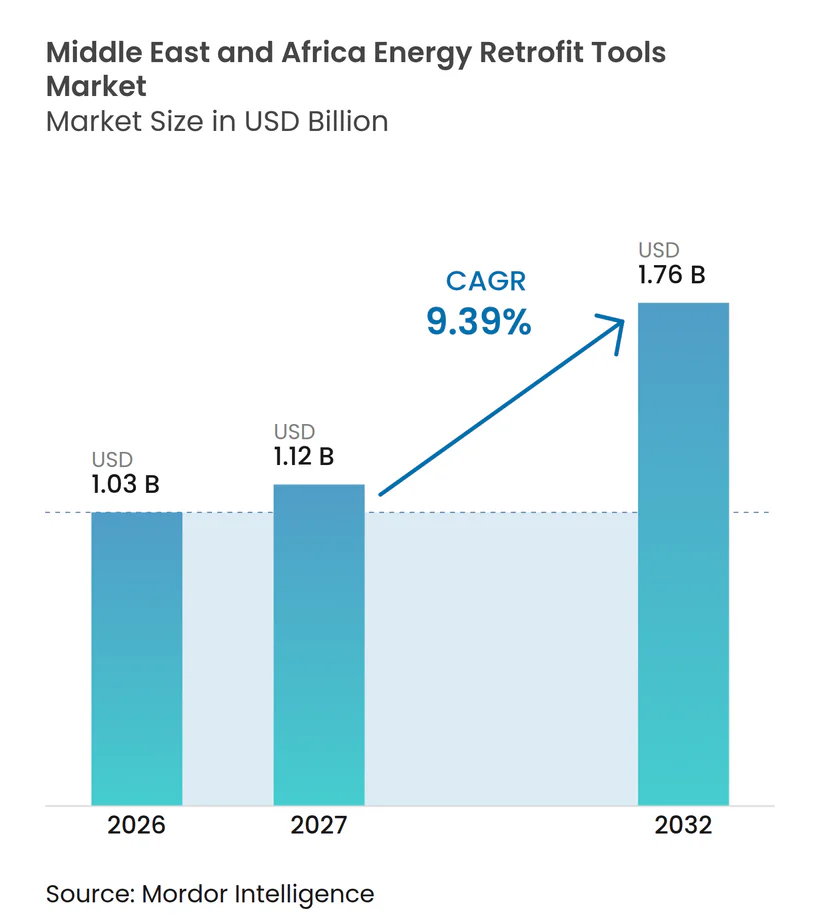
The Middle East And Africa Energy Retrofit Tools Market size is projected to be USD 1.03 billion in 2026, USD 1.12 billion in 2027, and reach USD 1.76 billion by 2032, at a CAGR of 9.39% from 2027 to 2032. The Middle East and Africa energy retrofit tools market is being shaped by rising power demand, particularly from cooling and desalination, which the International Energy Agency expects to increase electricity demand in the Middle East and North Africa by 50% by 2035.[1] High cooling loads make energy diagnostics and simulation tools more relevant to building owners seeking to manage peak demand and operating costs. Government retrofit programs and stronger building-performance rules are also shifting energy modeling, measurement, and verification from discretionary services into formal project requirements. The Middle East and Africa energy retrofit tools market has room to expand through performance contracts, smart metering, and projects that combine efficiency work with solar or district-cooling upgrades. The market remains constrained by capital costs, older control systems, and limited specialist capacity, particularly outside the Gulf Cooperation Council.
Key Report Takeaways
- By tool type, Heating, Ventilation, and Air Conditioning (HVAC) Diagnostic and Commissioning Tools held 21.4% of Middle East and Africa energy retrofit tools market share in 2026, while Smart Building Analytics and Energy Management Platforms are forecast to grow at a 12.1% CAGR through 2032.
- By application, HVAC Retrofit accounted for 22.3% of the Middle East and Africa energy retrofit tools market size in 2026, while Renewable Energy Integration is projected to expand at a 12.8% CAGR through 2032.
- By building type, Commercial Buildings held 39.6% revenue share in 2026, while Residential Buildings are forecasted to grow at a 10.5% CAGR through 2032.
- By geography, Saudi Arabia accounts for the largest revenue share at 30.2% and is expected to record the fastest growth at 10.2% during the forecast period.
Note: Market numbers in this report are based on Mordor Intelligence's proprietary estimation framework, which combines nine months of actuals with Q4 projections for base year 2026.
Market Trends and Insights
Drivers Impact Analysis of Middle East and Africa Energy Retrofit Tools Market*
| Driver | (~) % Impact on CAGR Forecast | Geographic Relevance | Impact Timeline |
|---|---|---|---|
| Government-led building decarbonization and retrofit programs | +2.5% | GCC core, with spillover to Egypt, South Africa, and Morocco | Medium term (2-4 years) |
| High cooling loads and rising peak-demand costs | +2.0% | Saudi Arabia, UAE, Qatar, Kuwait, with spillover to Egypt | Short term (≤ 2 years) |
| Smart meter, IoT, and cloud analytics deployment | +1.8% | UAE and Saudi Arabia, with early gains in Qatar and Egypt | Medium term (2-4 years) |
| Green-building codes and net-zero commitments | +1.5% | GCC and Morocco | Long term (≥ 4 years) |
| Performance-contracting models removing upfront capital barriers | +1.2% | UAE and Saudi Arabia, with emerging activity in South Africa | Medium term (2-4 years) |
| Digital optimization of district cooling, desalination, and data-center loads | +1.0% | UAE, Saudi Arabia, Qatar, with spillover to Egypt | Long term (≥ 4 years) |
| Source: Mordor Intelligence | |||
Government-Led Building Decarbonization and Retrofit Programs
State-backed programs are directing building owners toward formal retrofit planning and procurement. Egypt’s Global Environment Facility project, approved in November 2025, supports energy efficiency and distributed renewable energy investments in low-emission buildings.[2] These programs require credible energy baselines, measurement plans, and savings validation. This strengthens demand for building energy modeling and audit software. Public programs can make project documentation part of the funding and compliance process. The Middle East and Africa energy retrofit tools market benefits when these requirements apply across large building portfolios.
High Cooling Loads and Rising Peak-Demand Costs
Cooling is the central energy-use issue for many buildings in the region. Peer-reviewed research found that space cooling represented 85% to 90% of energy use in Saudi Arabian and UAE residential buildings examined under hot-arid conditions. Another study found that combined glazing, insulation, and HVAC upgrades could reduce cooling energy use by up to 68% in a Saudi Arabian villa when compared with the base case.[3] This gap gives owners a financial reason to assess equipment and building-envelope performance before approving major capital work. HVAC diagnostic tools can identify inefficient plant, while simulation platforms can test upgrade combinations and estimate savings. The Middle East and Africa energy retrofit tools market is supported by tools that link cooling improvements to operating savings.
Smart Meter, IoT, and Cloud Analytics Deployment
Digital energy tools are moving from individual pilots toward use across property portfolios. In December 2025, PureHealth launched a smart energy project across 10 major UAE healthcare facilities, using AI and IoT technologies to collect and analyze billions of sensor data points each year. The system is intended to optimize chillers and HVAC equipment as part of PureHealth’s Net Zero 2040 program. Such deployments show how continuous monitoring can supplement periodic energy audits. They also allow building owners to add analytics to older assets without replacing every control component at once. The Middle East and Africa energy retrofit tools market can gain because this approach broadens the pool of buildings using energy data for operational decisions.
Green-Building Codes and Net-Zero Commitments
Building rules are strengthening the need for documented energy performance. Dubai’s Al Sa’fat Green Building System made sustainability requirements part of the approval process for new buildings, and the 2023 update retained this regulatory direction. Saudi Arabia is progressing with SBC 601, SBC 602, SGBC 1001, and the Mostadam rating system. Peer-reviewed work indicates that localized building energy codes can deliver better outcomes than generic international standards across Saudi climate zones. Morocco’s Nationally Determined Contribution (NDC) 3.0 targets a 53% reduction in greenhouse gas emissions by 2035, supporting building efficiency measures. The Middle East and Africa energy retrofit tools market benefits as energy-modeling outputs become necessary for permits, ratings, and project finance.
Restraints Impact Analysis of Middle East and Africa Energy Retrofit Tools Market*
| Restraint | (~) % Impact on CAGR Forecast | Geographic Relevance | Impact Timeline |
|---|---|---|---|
| High upfront retrofit, sensorization, and integration costs | -1.5% | Pan-regional, strongest in non-GCC markets | Short term (≤ 2 years) |
| Legacy BMS and OT protocol interoperability constraints | -1.2% | GCC and Egypt, with emerging relevance in South Africa | Medium term (2-4 years) |
| Scarcity of in-country energy analytics and M&V talent | -0.8% | Non-GCC MEA, with spillover to smaller GCC cities | Long term (≥ 4 years) |
| Fragmented enforcement and limited financing outside GCC markets | -0.9% | East Africa, sub-Saharan Africa, and North Africa outside Morocco | Long term (≥ 4 years) |
| Source: Mordor Intelligence | |||
High Upfront Retrofit, Sensorization, and Integration Costs
Upfront project cost remains a major barrier to adoption. Energy-as-a-Service and performance-contracting structures can reduce the immediate capital burden by linking payment to delivered savings. The UNEP Copenhagen Centre report identifies access to finance as the most frequently cited barrier to Energy Service Company (ESCO) growth globally. East Africa and the Levant have thinner project-finance pipelines and fewer blended-finance options than core GCC markets. Owners may therefore defer audits, equipment upgrades, sensors, and integration work. The Middle East and Africa energy retrofit tools market has a smaller accessible customer base where these costs cannot be financed.
Legacy Building Management System (BMS) and Operational Technology (OT) protocol interoperability constraints
Many commercial properties were built before cloud-connected energy management became common. Their building management systems use BACnet, Modbus, KNX, and vendor-specific protocols, which can require additional integration work before data can be analyzed on a common platform. This complexity increases sensorization cost and can extend audit and deployment schedules. The issue is pronounced in older GCC office towers, where operational technology equipment and IT systems follow separate maintenance cycles. Wireless submetering overlays offer a practical alternative where full BMS integration is not economical. The Middle East and Africa energy retrofit tools market favors suppliers that can deliver reliable monitoring across mixed systems with less upfront modification.
*Our forecasts treat driver/restraint impacts as directional, not additive. The impact forecasts reflect baseline growth, mix effects, and variable interactions.
Middle East and Africa Energy Retrofit Tools Market Segment Analysis
By Tool Type:
Diagnostics Lead, Analytics AccelerateHVAC Diagnostic and Commissioning Tools held the largest 21.4% revenue share in 2026. Their position reflects the need to find inefficiencies in chillers, air-handling units, and variable refrigerant flow systems before owners approve larger upgrades. A 2024 performance assessment of an administrative building found guaranteed savings commitments of 28% to 31% from HVAC diagnostics and commissioning, with realized savings exceeding projections during the observed period.[4] These tools help owners establish a baseline, identify faults, and verify performance after improvements.
Smart Building Analytics and Energy Management Platforms are forecast to grow at a 12.1% CAGR through 2032, making them the fastest-growing tool category. Their use moves the buyer relationship from a one-time audit toward continuous data collection and optimization. Building Energy Modeling software is gaining importance where project teams must demonstrate performance through dynamic simulation rather than prescriptive calculations. Global Energy Service Company (ESCO) investment rose 10% to USD 42 billion in 2024, supporting the role of investment-grade modeling and audit outputs in performance contracts. Energy Audit and Assessment Tools remain the entry point for many projects, while renewable-energy and envelope-inspection tools support specialized retrofit decisions. Other tools address ventilation, water-system diagnostics, and submetering needs in sectors such as hospitality and healthcare.
By Application:
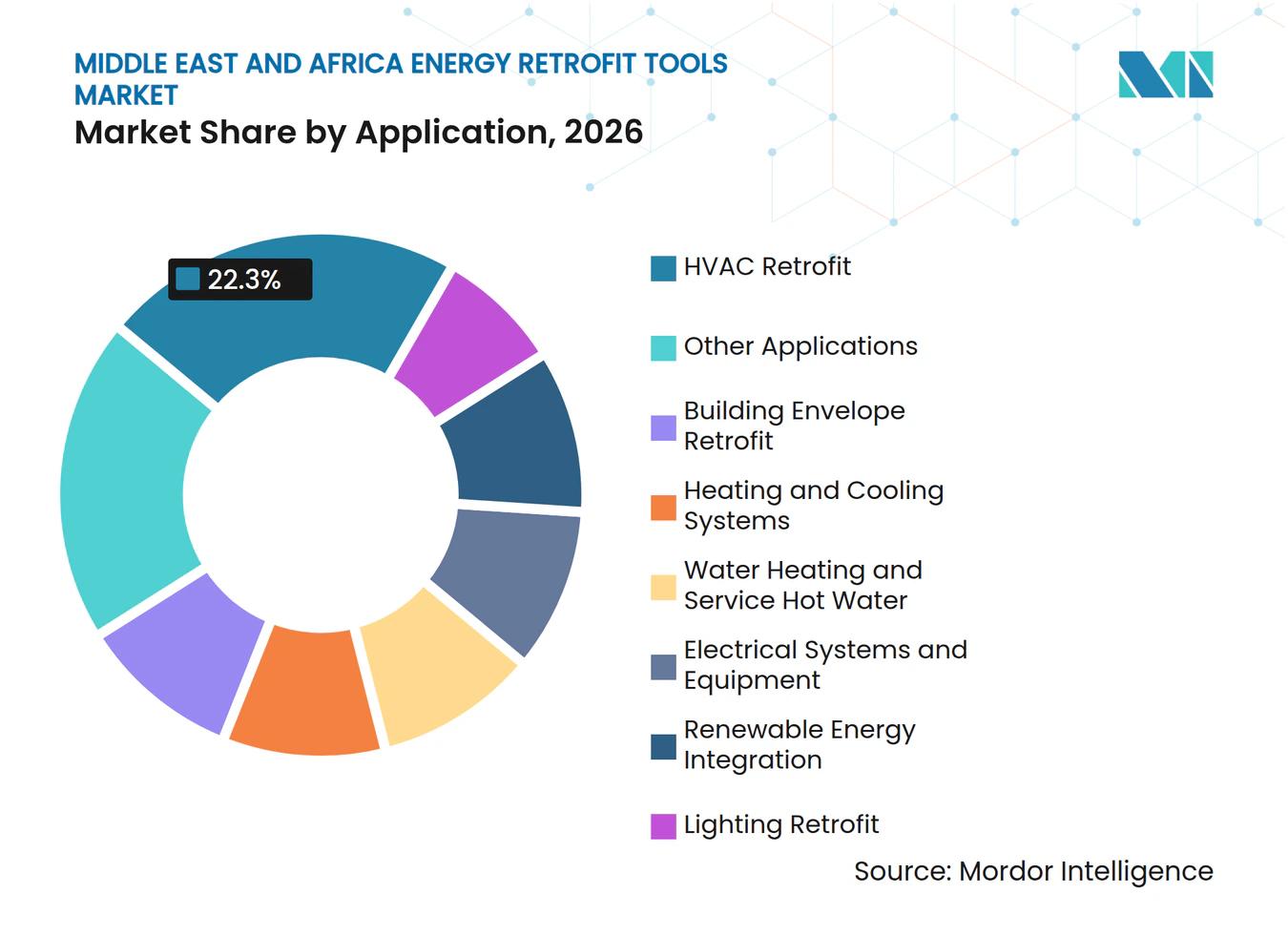
HVAC Retrofit Commands Spend, Renewable Integration Leads GrowthHVAC Retrofit accounted for 22.3% of the Middle East and Africa energy retrofit tools market size in 2026. This position follows the region’s high cooling demand and the presence of aging chillers, air-handling units, and Variable Refrigerant Flow (VRF) systems in commercial properties. ENGIE Solutions states that HVAC systems can account for up to 70% of building energy consumption in the UAE. Tool demand is strongest where owners need to determine which mechanical upgrades offer the most credible savings. Diagnostic, modeling, and monitoring platforms support the full HVAC retrofit process from asset assessment to post-project verification.
Renewable Energy Integration is forecast to grow at a 12.8% CAGR through 2032. Rooftop solar requirements, hybrid solar and district-cooling projects, and changing grid conditions are increasing the value of tools that test load profiles and renewable output together. Saudi Arabia’s target is for renewable sources to supply 50% of its power mix by 2030. Lighting Retrofit remains relevant where LED penetration is lower, while Building Envelope Retrofit is supported by evidence that combined envelope measures can reduce cooling energy use. Water heating, electrical systems, and other applications add savings that can strengthen the business case for a wider retrofit package.


By Building Type:
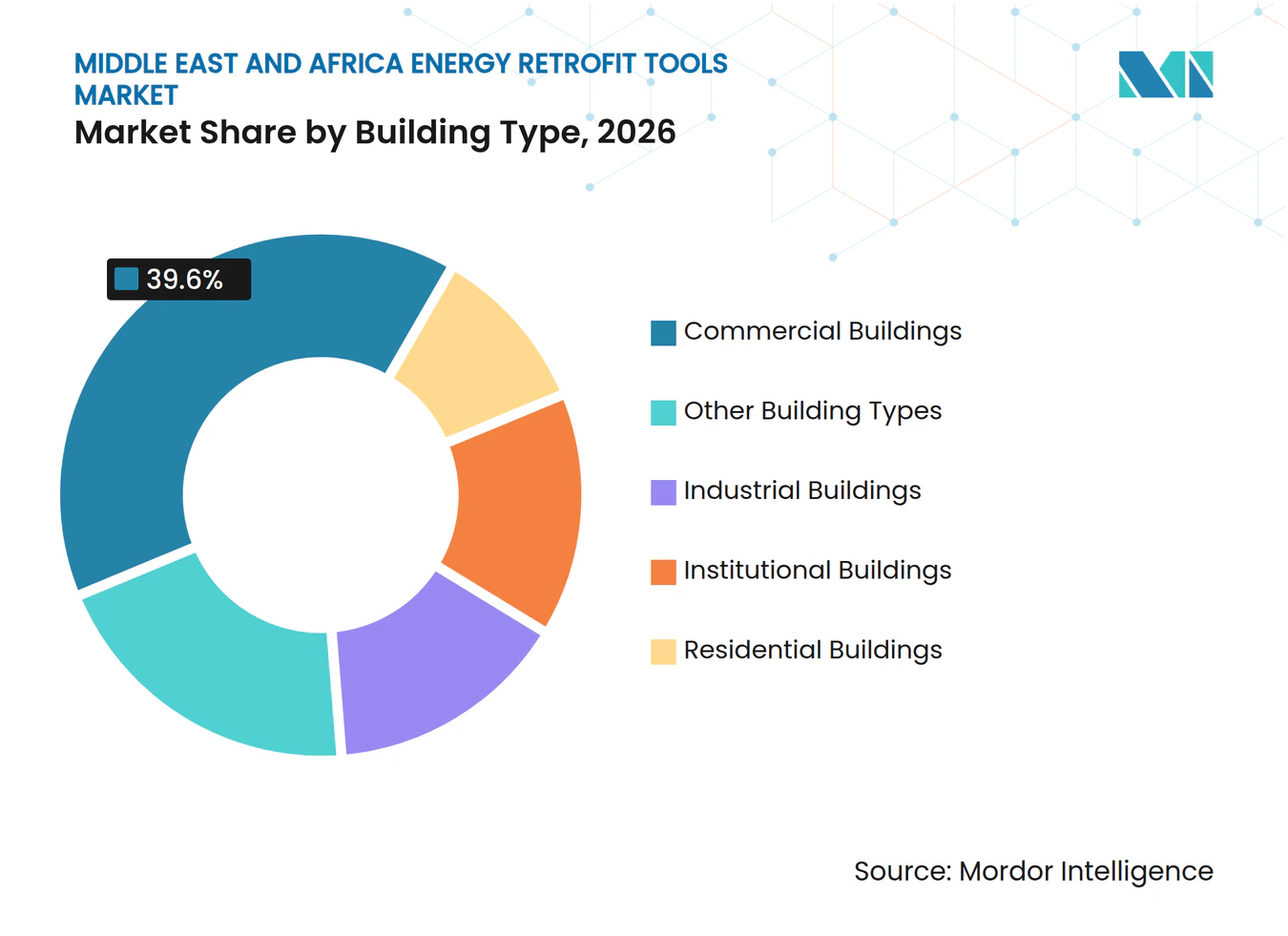
Commercial Stock Anchors Demand, Residential AcceleratesCommercial Buildings accounted for 39.6% of Middle East and Africa energy retrofit tools market share in 2026. Large commercial assets often have complex HVAC systems, multiple tenants, and formal facility-management processes, which make them suitable for energy modeling, analytics, and commissioning. Their scale can justify the cost of detailed audits and measurement plans. Commercial facilities therefore remain the principal near-term customer group for integrated offerings.
Residential Buildings are forecast to grow at 10.5% CAGR through 2032. Higher electricity costs and submetering are increasing attention to energy performance in homes and managed residential communities. Research on Saudi Arabian residential buildings found that combined envelope and HVAC retrofits could lower energy-use intensity by 31% to 43% against current stock using commercially available technologies. Residential portfolio projects can also use shared monitoring and standardized equipment specifications across many units. Industrial and institutional buildings retain demand through public programs, operating-cost priorities, and sustainability targets. Other building types include hotels and hospitality properties, where high occupancy and cooling needs create a distinct procurement cycle.

Geography Analysis
Saudi Arabia Energy Retrofit Tools Market
Saudi Arabia held 30.2% regional revenue share in 2026 and is forecast to grow at a 10.2% CAGR through 2032. The country has a large stock of institutional and commercial buildings developed under lower energy tariffs and less stringent code enforcement. This creates a retrofit backlog as building rules and energy-efficiency programs become more demanding. Research published in 2026 found that locally tailored Saudi energy codes can improve building outcomes across the Kingdom’s climate zones. The national renewable-power target also increases the need to model how retrofit measures interact with a changing electricity system.
United Arab Emirates Energy Retrofit Tools Market
The UAE remains a regional test bed for performance contracts and digital building management. In March 2025, Etihad ESCO announced the completion of Dubai’s first energy savings performance contract with proven results, a project that began in 2015 and concluded in 2024. In July 2026, Dubai Holding Community Management and Etihad ESCO signed an agreement to advance energy optimization, solar solutions, smart metering, and sustainability pilots across managed communities. The UAE therefore provides a pathway for the Middle East and Africa energy retrofit tools market to move from single-building contracts to community-level service arrangements.
Africa and Broader MEA Energy Retrofit Tools Market
Egypt and Morocco are important markets outside the GCC, while South Africa and the Rest of MEA add a broader project pipeline. Egypt’s November 2025 Global Environment Facility (GEF) project supports investment in energy efficiency and renewable energy for low-emission buildings. Johnson Controls Arabia secured a USD 90 million share of a Variable Refrigerant Flow (VRF) project in Egypt’s New Administrative Capital in March 2025, covering more than 11,000 units across 138 buildings. Morocco’s policy direction supports energy efficiency, while South Africa’s Energy Efficiency in Public Buildings and Infrastructure Program enables municipalities to prepare and implement energy performance contracts. These markets have different financing and enforcement conditions, which makes local delivery capability important.
Competitive Landscape
Market Concentration
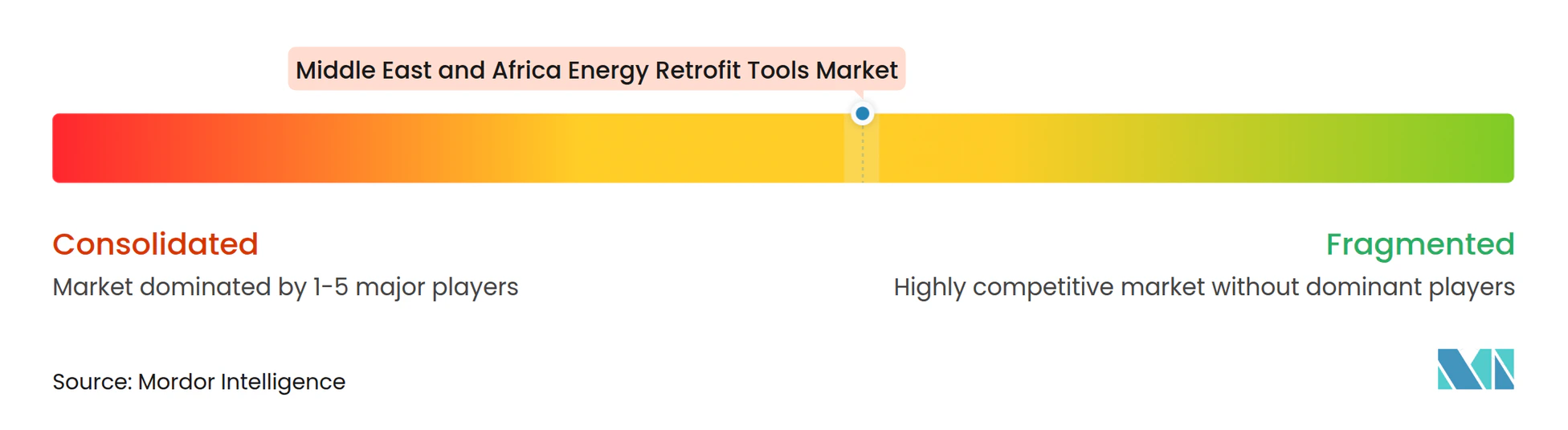
The Middle East and Africa energy retrofit tools market is moderately concentrated. Schneider Electric, Siemens, Honeywell, and Johnson Controls compete through portfolios that cover HVAC equipment, building controls, analytics, and service delivery. Regional Energy Service Companies (ESCOs), including Etihad ESCO, TAQA Energy Services, and Abu Dhabi Energy Services, compete through knowledge of local regulations and public-sector procurement. In September 2025, Johnson Controls and Tabreed signed a framework agreement covering advanced chiller technology, retro-commissioning, performance guarantees, and remote monitoring across Tabreed’s district-cooling portfolio. This approach links equipment, digital monitoring, and long-term service in one offering.
There is space for firms that solve specific compliance and integration problems. Software providers that connect Al Sa’fat, Global Sustainability Assessment System (GSAS), Autodesk, and Integrated Environmental Solutions Virtual Environment (IES-VE) workflows can assist project teams that need defined simulation outputs for ratings and approvals. Smaller buildings can favor wireless sensors and cloud dashboards that avoid full building-management-system replacement. In February 2026, Etihad ESCO began a selection process for an ESCO or consortium to retrofit the American University in Dubai, including energy conservation measures, a savings guarantee, maintenance, and measurement and verification. This project structure favors providers that combine technical delivery with contractual accountability.
Companies are also pursuing integrated offers across equipment, controls, and building-envelope measures. In June 2025, Dubai Airports and Etihad ESCO agreed on the final phase of an airport-wide lighting retrofit that will bring the total upgrade to more than 330,000 units across DXB and Dubai World Central. Buyers often procure several efficiency measures together rather than as isolated tool purchases. The Middle East and Africa energy retrofit tools market rewards suppliers that can package technologies, manage risk, and work across varied building systems. The available information does not disclose combined shares of leading companies.
Middle East and Africa Energy Retrofit Tools Industry Leaders
-
Schneider Electric SE
-
Honeywell International Inc.
-
Johnson Controls International plc
-
Siemens AG
-
ABB Ltd.
- *Disclaimer: Major Players sorted in no particular order
Middle East and Africa Energy Retrofit Tools Market Companies Covered in this Report
- Johnson Controls International plc
- Schneider Electric SE
- Siemens AG
- Honeywell International Inc.
- Trane Technologies plc
- Daikin Industries, Ltd.
- ENGIE SA
- ABB Ltd.
- Carrier Global Corporation
- Mitsubishi Electric Corporation
- Etihad Energy Services (Etihad ESCO)
- Abu Dhabi Energy Services (ADES)
- Al-Futtaim Engineering & Technologies
- Emrill Services LLC
- Saint-Gobain S.A.
- Kingspan Group plc
- ROCKWOOL A/S
- Kingspan Group plc
- Rockwool A/S
- Orion Energy Systems, Inc.
Recent Industry Developments in Middle East and Africa Energy Retrofit Tools Market
- July 2026: Dubai Holding Community Management and Al Etihad Energy Services signed a Memorandum of Understanding to advance energy efficiency across communities managed by Dubai Holding Community Management, covering energy optimization projects, solar solutions, smart metering deployment, and new sustainability pilot programs aligned with the Dubai Demand Side Management Strategy.
- December 2025: PureHealth launched a smart energy monitoring project with EPX, deploying AI and IoT technologies across 10 major UAE facilities to collect and analyze billions of data points annually from sensors optimizing chillers and HVAC systems toward PureHealth’s Net Zero by 2040 target.
- September 2025: Johnson Controls and Tabreed signed a framework agreement for advanced chiller technology and lifecycle services, covering large-capacity chillers with variable-speed drives, retro-commissioning, performance guarantees, and remote monitoring across Tabreed’s district-cooling portfolio.
- June 2025: Dubai Airports and Etihad ESCO signed an agreement for the final phase of an airport-wide lighting retrofit covering Concourse A at DXB and Dubai World Central, bringing the total lighting upgrade to more than 330,000 units across both airports, with installation scheduled to conclude by H2 2027.
Middle East and Africa Energy Retrofit Tools Market Report Scope
Energy retrofit tools refer to the physical equipment, digital software, and diagnostic technologies used by engineers, contractors, energy auditors, and facility managers to assess, plan, install, and optimize energy-saving upgrades in existing buildings. The energy retrofit tools market (also recognized in the industry as the energy retrofit systems market) refers to the global commercial market dedicated to upgrading existing buildings, industrial plants, and infrastructure with modern, energy-efficient technologies.
The energy retrofit tools market is segmented by tool type, which includes building energy modeling (BEM) software, audit tools, heating, ventilation, and air conditioning (HVAC) diagnostic equipment, envelope inspection systems, smart analytics platforms, renewable energy integration tools, and other specialized devices. In terms of application, the market is divided into HVAC upgrades, lighting systems, building envelope improvements, heating and cooling enhancements, water heating modifications, electrical system optimizations, renewable integration, and other miscellaneous applications. Based on building type, the sector is categorized into residential, commercial, industrial, institutional, and other building classifications. The report also covers the market size and forecasts for the Middle East And Africa energy retrofit tools market across 6 countries in the region. For each segment, the market sizing and forecasts have been provided on the basis of value (USD).
Segmentation Overview
| Building Energy Modeling (BEM) Software |
| Energy Audit and Assessment Tools |
| HVAC Diagnostic and Commissioning Tools |
| Building Envelope Inspection Tools |
| Smart Building Analytics and Energy Management Platforms |
| Renewable Energy Tools |
| Other Tools |
| HVAC Retrofit |
| Lighting Retrofit |
| Building Envelope Retrofit |
| Heating and Cooling Systems |
| Water Heating and Service Hot Water |
| Electrical Systems and Equipment |
| Renewable Energy Integration |
| Other Applications |
| Residential Buildings |
| Commercial Buildings |
| Industrial Buildings |
| Institutional Buildings |
| Other Building Types |
| Saudi Arabia |
| United Arab Emirates |
| Egypt |
| South Africa |
| Morocco |
| Rest of Middle East and Africa |
| By Tool Type | Building Energy Modeling (BEM) Software |
| Energy Audit and Assessment Tools | |
| HVAC Diagnostic and Commissioning Tools | |
| Building Envelope Inspection Tools | |
| Smart Building Analytics and Energy Management Platforms | |
| Renewable Energy Tools | |
| Other Tools | |
| By Application | HVAC Retrofit |
| Lighting Retrofit | |
| Building Envelope Retrofit | |
| Heating and Cooling Systems | |
| Water Heating and Service Hot Water | |
| Electrical Systems and Equipment | |
| Renewable Energy Integration | |
| Other Applications | |
| By Building Type | Residential Buildings |
| Commercial Buildings | |
| Industrial Buildings | |
| Institutional Buildings | |
| Other Building Types | |
| By Geography | Saudi Arabia |
| United Arab Emirates | |
| Egypt | |
| South Africa | |
| Morocco | |
| Rest of Middle East and Africa |
Key Questions Answered in the Report
What is the expected value of the Middle East and Africa energy retrofit tools market by 2032?
Middle East and Africa Energy Retrofit Tools Market is forecast to reach USD 1.76 billion by 2032, expanding at a 9.39% CAGR from 2027.
Which tool category has the largest share in 2026?
HVAC Diagnostic and Commissioning Tools led with 21.4% revenue share in 2026.
Which energy retrofit application is growing fastest?
Renewable Energy Integration is forecast to grow at a 12.8% CAGR through 2032.
Why are HVAC retrofit tools important in the region?
Cooling accounts for a large share of building energy demand, so diagnostics and energy modeling can help target high-value efficiency measures.
Which country leads regional demand?
Saudi Arabia held 30.2% revenue share in 2026 and is forecast to grow at a 10.2% CAGR through 2032.
What limits adoption in the Middle East and Africa energy retrofit tools market?
Upfront capital costs, legacy control-system integration, limited specialist talent, and uneven access to finance can delay projects.