
Market Overview
| Study Period | 2019 - 2031 |
|---|---|
| Forecast Data Period | 2026 - 2031 |
| Base Year Market Size (2025) | USD 67.79 Billion |
| Market Size (2026) | USD 73.42 Billion |
| Market Size (2031) | USD 109.38 Billion |
| Growth Rate (2026 - 2031) | 8.30 % |
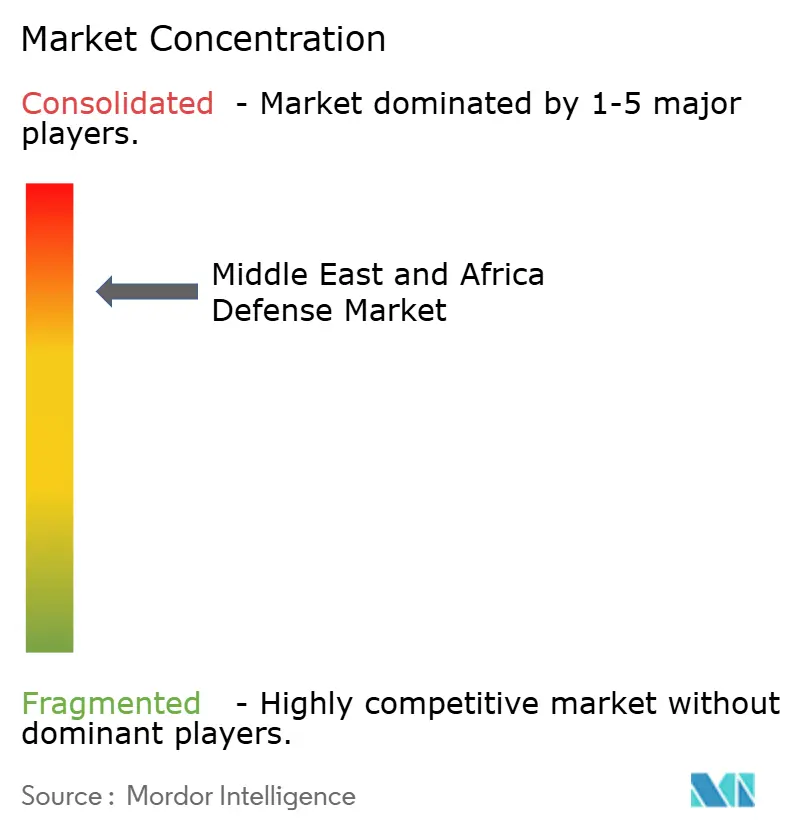
| Market Concentration | High |
Major Players *Disclaimer: Major Players sorted in no particular order Image © Mordor Intelligence. Reuse requires attribution under CC BY 4.0. | |
Middle East And Africa Defense Market Analysis by Mordor Intelligence
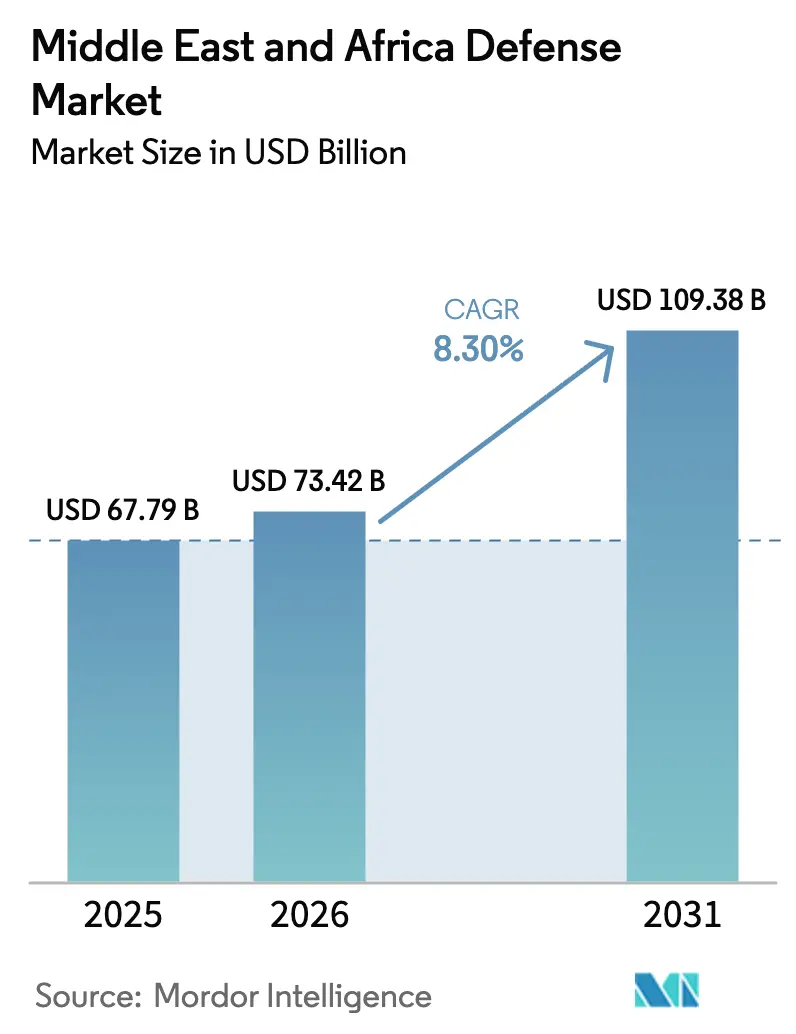
The Middle East and Africa defense market size is expected to grow from USD 67.79 billion in 2025 to USD 73.42 billion in 2026 and is forecasted to reach USD 109.38 billion by 2031 at an 8.30% CAGR over 2026-2031. Growth rests on sustained conflict in the Levant, the Gulf, and the Sahel, where defense ministries continue to prioritize force modernization over fiscal discipline. Saudi Arabia increased its outlays from USD 75.8 billion in 2024 to USD 81.4 billion in 2025, while Israel boosted its defense budget by 65% in 2024, underscoring demand that is largely shielded from commodity price swings. Sovereign wealth funds from the Gulf are now underwriting African joint ventures, broadening the Middle East and Africa defense market, and cementing cross-regional influence. Unmanned platforms, directed-energy weapons, and space-based intelligence, surveillance, and reconnaissance (ISR) programs are eclipsing traditional procurements, and European lenders have relaxed earlier environmental, social, and governance (ESG) limits, unblocking new credit lines for manufacturers.
Key Report Takeaways
- By armed forces, the army equipment captured 47.21% of the Middle East and Africa defense market share in 2025, whereas naval programs are advancing at a 9.23% CAGR through 2031.
- By type, vehicles accounted for 24.45% of the Middle East and Africa defense market size in 2025; however, unmanned systems are projected to post the highest CAGR of 11.54% from 2026 to 2031.
- By domain, land operations held a 46.54% share of the Middle East and Africa defense market in 2025; space-based ISR is forecast to expand at a 9.21% CAGR through 2031.
- By procurement nature, foreign purchases represented 66.34% of spending in 2025, while indigenous production is growing at a 9.75% CAGR.
- By geography, the Middle East commanded 81.45% of expenditure in 2025, whereas Africa is expected to register a 10.23% CAGR through 2031.
Note: Market size and forecast figures in this report are generated using Mordor Intelligence’s proprietary estimation framework, updated with the latest available data and insights as of January 2026.
Market Trends and Insights
Drivers Impact Analysis of Middle East And Africa Defense Market*
| Driver | (~) % Impact on CAGR Forecast | Geographic Relevance | Impact Timeline |
|---|---|---|---|
| Sustained geopolitical instability driving continuous defense preparedness | +2.1% | Middle East, Sahel | Long term (≥ 4 years) |
| Oil- and gas-backed defense spending across GCC modernization programs | +1.8% | Saudi Arabia, UAE, Qatar, Kuwait | Medium term (2-4 years) |
| National defense localization and industrialization mandates | +1.5% | Saudi Arabia, UAE, Egypt, Algeria, South Africa | Long term (≥ 4 years) |
| Accelerated adoption of unmanned, autonomous, and precision-strike systems | +2.3% | Regionwide | Short term (≤ 2 years) |
| Sovereign wealth fund–led defense investment and export financing into Africa | +0.9% | UAE, Saudi investments in Africa | Medium term (2-4 years) |
| Emergence of regional space-based ISR and surveillance capabilities | +1.2% | UAE, Saudi Arabia, Morocco, Israel | Medium term (2-4 years) |
| Source: Mordor Intelligence | |||
Sustained Geopolitical Instability Driving Continuous Defense Preparedness
Persistent conflict in Yemen, Syria, and Gaza keeps regional forces on high alert, ensuring steady demand for munitions, EW upgrades, and counter-rocket systems. Israel placed a USD 210 million order with Elbit Systems in November 2025 to upgrade Merkava tanks with artificial-intelligence sights, reflecting lessons learned in recent Gaza operations.[1] Houthi attacks on Red Sea shipping have accelerated Saudi and Egyptian naval purchases, while Sahel insurgencies spur African requirements for light armored vehicles and secure communications. Each new clash underscores the need for next-generation capabilities, insulating defense budgets from broader austerity measures and keeping the Middle East and Africa defense market on an upward trajectory.
Oil- and Gas-Backed Defense Spending Across GCC Modernization Programs
Hydrocarbon revenue continues to underwrite the majority of Gulf budgets. Riyadh’s USD 142 billion framework with the US for F-15 fighters, THAAD interceptors, and maritime patrol aircraft was structured to ride out short-term oil-price volatility. Qatar added more than USD 800 million in Boeing training and sustainment contracts for its F-15QA fleet. The UAE ordered four Airbus A330 Multi-Role Tanker Transport (MRTT) aircraft in July 2024, including technology-transfer clauses that channel knowledge to local firms.[2] Because these programs also create advanced-manufacturing jobs, they remain politically untouchable even during commodity downturns.
National Defense Localization and Industrialization Mandates
Vision 2030 obliges Saudi Arabia to localize over 50% of its defense spending by 2030, a target enforced through offset clauses across every major contract. Lockheed Martin awarded canister and pallet work for the THAAD system to Saudi firms in February 2024, marking the first indigenous production of the interceptor’s critical components. Egypt’s M1A1 Abrams co-production line and Algeria’s licensed assembly of Russian vehicles reveal that localization is now a region-wide policy instrument to secure jobs and strategic autonomy.
Accelerated Adoption of Unmanned, Autonomous, and Precision Strike Systems
Israel contracted Elbit Systems for USD 40 million in December 2024 to deliver swarm UAVs and micro-unmanned platforms capable of searching, identifying, and striking without human input. Turkey’s Bayraktar TB2 has spread across Libya, Ethiopia, and Morocco, showing that medium-altitude UAVs are no longer limited to NATO suppliers. Gulf states are blending Chinese Wing Loong UAVs with domestic designs to diversify sourcing. Meanwhile, USD 60 million in January 2025 for Elbit’s ReDrone counter-UAS suite points to a parallel boom in anti-UAS technologies.
Restraints Impact Analysis of Middle East And Africa Defense Market*
| Restraint | (~) % Impact on CAGR Forecast | Geographic Relevance | Impact Timeline |
|---|---|---|---|
| Exposure of defense budgets to hydrocarbon price volatility | -1.4% | Gulf, Algeria | Short term (≤ 2 years) |
| Export-control restrictions and sanctions on advanced defense subsystems | -1.1% | Middle East, parts of Africa | Medium term (2-4 years) |
| Rising ESG-related constraints on defense-sector financing | -0.6% | Regionwide | Medium term (2-4 years) |
| Shortages of skilled labor and secure electronics supply chains | -0.8% | Saudi Arabia, UAE, Egypt, South Africa | Long term (≥ 4 years) |
| Source: Mordor Intelligence | |||
Exposure of Defense Budgets to Hydrocarbon Price Volatility
When Brent crude dropped below USD 40 per barrel in 2020, Riyadh deferred multiple programs and renegotiated milestone payments with US contractors. Algeria likewise trimmed 2024 procurement after natural gas revenues dipped, delaying negotiations for Su-57 fighters. Although sovereign wealth funds buffer shocks, a two-year stretch under USD 60 would still force Gulf states to shift spending from modernization toward payroll and readiness.
Export-Control Restrictions and Sanctions on Advanced Defense Subsystems
The US International Traffic in Arms Regulations (ITAR) require case-by-case licenses for active electronically scanned array radars and long-range missiles, extending timelines by up to 18 months. Israel’s qualitative military edge doctrine downgrades sensitive exports to Gulf clients, while European embargoes restrict specific lethal systems for African buyers, nudging them toward Chinese or Russian suppliers. Financing hurdles add a second layer of delay as banks calibrate ESG policies on a deal-by-deal basis.[3]
*Our forecasts treat driver/restraint impacts as directional, not additive. The impact forecasts reflect baseline growth, mix effects, and variable interactions.
Middle East And Africa Defense Market Segment Analysis
By Armed Forces:
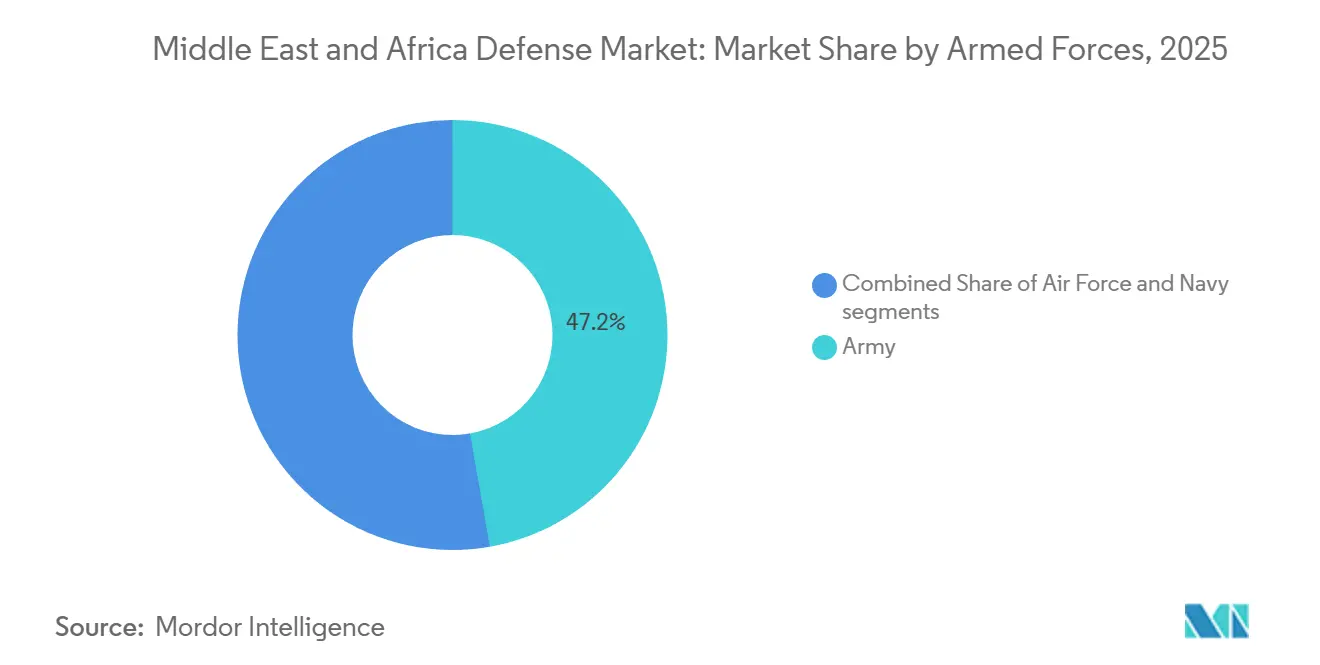
Naval Modernization Outpaces Land and AirNaval acquisition budgets are growing at a 9.23% CAGR, eclipsing the expansions of the air force and the army as states prioritize control of the Strait of Hormuz, the Suez Canal, and the Bab el-Mandeb. L3Harris Technologies, Inc., and SAMI signed an agreement in April 2025 with Zamil Shipyards to build modular unmanned surface vessels, a clear indicator that littoral security now drives platform roadmaps. In contrast, the army, despite accounting for 47.21% of 2025 expenditure, faces slower growth because most of its heavy-armor inventory has already been recapitalized. Ongoing upgrades to the M1A1 and Merkava emphasize digital fire-control and active-protection systems over raw tonnage. Naval spending also benefits from multinational task forces that share operational costs, enabling smaller Gulf states to field higher-end corvettes and mine-countermeasure (MCM) ships within collective frameworks. The Middle East and Africa defense market, therefore, concentrates new-build activity along coastlines while armies pivot to sustaining platforms already in service.
A second growth lever is the migration from crewed hulls to optionally manned or fully autonomous vessels. Saudi trials of unmanned surface craft signal appetite for persistent surveillance and cost-effective deterrence. Israel’s Iron Beam laser program, although primarily focused on air defense, will transition to shipboard testing, reinforcing naval modernization with directed energy capabilities. Because sea lanes carry most regional trade, even brief disruptions in the Red Sea or Gulf of Aden incur outsized economic penalties, prompting defense ministries to allocate budget headroom toward hulls, sensors, and missile systems that ensure open passage.

By Type:
Unmanned Systems Disrupt Traditional Platform HierarchiesVehicles still accounted for 24.45% of 2025 spending, while unmanned systems are rising at an 11.54% CAGR. The Middle East and Africa defense market for unmanned platforms is projected to surpass USD 25 billion by 2031, reflecting global shifts toward lower-risk, 24/7 ISR and precision-strike capabilities. Israeli, Turkish, and Chinese producers dominate medium-altitude long-endurance (MALE) exports, while Gulf states are seeding indigenous designs to hedge against export-license risks. Parallel investment in counter-UAS suites, such as Elbit’s ReDrone system, ensures that every new offensive capability spurs equal demand for defense.
C4ISR and EW budgets are also rising as militaries integrate sensors, edge computing, and artificial intelligence. Because network-centric doctrines require resilient data links, spending on hardened communications and passive detection gear increases in lockstep. Ammunition remains a volume business, driven by attrition warfare in Yemen and Gaza, yet stocks are shifting toward smart artillery and guided rockets. Emerging subcategories, including space and cyber tools, combine for a modest base today but carry steep growth curves, particularly as satellite data becomes central to targeting.
By Domain:
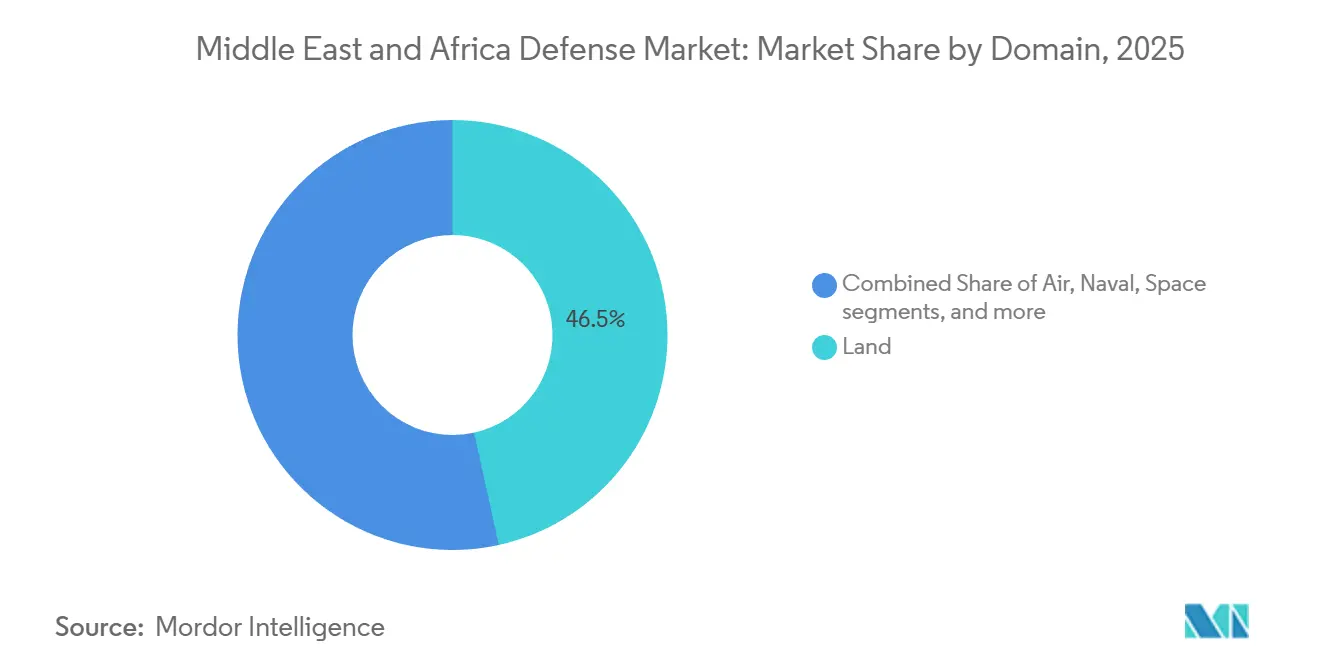
Space and Cyber Emerge as Strategic FrontiersLand operations accounted for 46.54% of total operations in 2025, anchored by troop deployments in Yemen, the Sinai, and the Sahel. Yet the space segment climbs at a 9.21% CAGR, fueled by Morocco’s satellite deal and Gulf launch schedules that extend sovereign coverage across chokepoints. The Middle East and Africa defense market share for cyber-electromagnetic projects, although currently below 5%, is doubling every five years as commanders view spectrum dominance as a prerequisite for both manned and unmanned operations. Air programs remain robust due to Saudi, Qatari, and Israeli fighter and tanker buys, but payload integration timelines temper dollar growth before 2031.
Electromagnetic spectrum budgeting overlaps with cyber line items, producing blended requirements for EW pods, threat-hunting software, and secure cloud infrastructure. Israel’s January 2025 contract for F-16I self-protection systems exemplifies how airborne platforms are increasingly incorporating cyber resilience features at the point of inception.[4] As regional powers network satellites, UAVs, and ground sensors into a unified picture, the payoff is faster kill chains and improved battle damage assessment, reinforcing the premium on space and cyber capabilities.
By Procurement Nature:
Indigenous Production Gains MomentumForeign procurement still covered 66.34% of 2025 demand; however, indigenous production is growing at a 9.75% CAGR as offset rules tighten. The Middle East and Africa defense market size, driven by local manufacturing, is expected to reach USD 45 billion by 2031, provided that Vision 2030 and similar programs achieve their milestones. Lockheed’s THAAD canister transfer and Boeing’s rotary-wing joint venture with SAMI exemplify how tier-one primes embed local partners to safeguard market access. Egypt’s Abrams tank line, Algeria’s armored vehicle licenses, and South Africa’s Denel restructuring all aim to increase self-reliance while maintaining export potential.
Local content requirements also promote workforce development, with Saudi Arabia aiming to create 100,000 skilled defense jobs by 2030. Edge-to-factory digital twins, additive manufacturing, and composite airframe shops accelerate the diffusion of technology across national economies. Even so, complex subsystems such as active electronically scanned array (ESA) radars often remain imported because they are subject to US or European export controls. Success, therefore, hinges on building sovereign microelectronics fabs and securing long-term intellectual property rights.
Geography Analysis
Middle East Defense Market
The Middle East accounted for 81.45% of total outlays in 2025, led by Saudi Arabia, the UAE, and Israel, each with multibillion-dollar modernization roadmaps. Riyadh’s USD 142 billion framework agreement for fighters, interceptors, and patrol aircraft represents a single-buyer commitment unmatched worldwide. The UAE added four Airbus A330 MRTTs and embedded industrial participation to uplift local supply chains. Israel, facing multi-front pressures, expanded its munitions and EW budgets in 2024 and continues to contract for autonomous systems at a rapid pace.
Africa Defense Market
Africa, although starting from a smaller base, is the fastest-growing territory, with a 10.23% CAGR through 2031. Algeria remains the largest African spender, though budget dips tied to gas revenue have delayed some fighter talks. Egypt leverages M1A1 co-production to anchor a domestic armored fleet, while Morocco’s spy satellite buy extends national ISR coverage over Western Sahara. Sahel states are channeling Gulf and European aid toward light armored vehicles, UAVs, and secure radios to counter insurgencies, and South Africa’s Denel aims to revive export lines for artillery and UAVs. Sovereign wealth fund financing from Saudi Arabia and the UAE serves as a catalyst, underwriting African contracts that might otherwise stall due to fiscal constraints.
EMEA Defense Market
Cross-regional ties are broadening. Israeli suppliers tap normalization accords to market precision munitions and counter-UAS kits across the Gulf and Morocco. Turkey’s Baykar Tech rides competitive pricing to secure orders in Libya and Ethiopia. Meanwhile, European lenders, having relaxed their ESG standards, are once again underwriting working capital for second-tier firms, ensuring supply chain liquidity for contracts in the Middle East and Africa.
Regulatory Landscape
Defense procurement and industrial participation across the region is shaped by a mix of national licensing, quality-conformance, and offset frameworks that increasingly tie awards to local content and technology transfer. In Saudi Arabia, the General Authority for Military Industries (GAMI) acts as the sector regulator and licensing body for military manufacturing, services, and supply activities. Its compliance approach is aligned to Vision 2030 objectives, including the stated goal to localize over 50% of defense spending by 2030. Procurement is also influenced by Saudi government tendering rules and contract conditions that embed localization and industrial participation requirements into major programs.
In the UAE, Tawazun Council plays a central role in defense-sector enablement through conformity systems, standards, and accreditation. Tawazun Quality and Conformity (TQC) supports testing and qualification of defense products against relevant standards, raising the bar for market entry and supplier approval in specific categories. In February 2025, Tawazun Council Executive Committee resolutions to regulate licensing procedures, accreditation standards, and evaluation processes further formalized how defense products are assessed, reinforcing compliance-driven sourcing for both imported systems and locally produced equipment.
Value Chain Analysis
The value chain starts with upstream inputs and subsystems, including metals and composites, energetics and propellants, electronics, sensors, and software, where access to secure semiconductors and export-controlled components remains a recurring bottleneck. Prime contractors and national champions (for example, EDGE Group, SAMI, and leading Israeli firms) anchor system design, integration, and final assembly, while tier suppliers provide structures, wiring, propulsion components, and mission electronics. Through-life support and upgrade work is increasingly separated from initial procurement, which expands the role of local MRO providers and depot-level maintenance networks as fleets and air-defense inventories grow.
Industrial participation and cross-border joint ventures are also deepening midstream manufacturing and sustainment capacity, particularly as indigenous production moves from licensed assembly into electronics, mission-system integration, and ammunition. Africa is building localized nodes as well, including Nigeria's domestic production ambitions through DICON partnerships announced in July 2025, with a USD 2 billion investment plan with SP Offshore Nigeria Limited to establish production lines spanning ammunition, weapons, drones, radars, and biometric systems, alongside an MoU with a Saudi-based partner for drones and satellite and communications equipment manufacturing. East Africa added an armored-vehicle manufacturing and support pathway as Streit Group finalized an agreement in September 2025 for manufacturing, repair, and sales at the Tanzania Automotive Technology Centre in Kibaha, while Egypt broadened technical cooperation in unmanned systems, precision munitions, and electronic warfare via AOI agreements signed at EDEX 2025.
Competitive Landscape
The Middle East and Africa defense market features a concentrated tier of Western primes, including Lockheed Martin Corporation, The Boeing Company, BAE Systems plc, Northrop Grumman Corporation, and RTX Corporation, which dominate high-ticket sales, especially in air and missile defense. Regional champions Saudi Arabian Military Industries (SAMI), Israel Aerospace Industries Ltd., Rafael Advanced Defense Systems Ltd., Elbit Systems Ltd., and EDGE Group have scaled rapidly, integrating electronics assembly, missile component machining, and unmanned system final assembly lines. Israeli firms can leverage fewer export restrictions to offer turnkey strike and counter-UAV packages, winning multi-year contracts, such as Elbit’s USD 2.3 billion international deal in November 2025. Turkey’s Baykar Tech competes aggressively in the medium-altitude UAVs niche, often pricing its products 30-40% below those of Western rivals.
Joint ventures are the preferred entry route for new technologies. L3Harris Technologies, Inc., SAMI, and Zamil Shipyards are field-testing unmanned surface vessels (USVs) that meld Western command-and-control (C2) software with local hull production. French, German, and Italian banks are openly marketing defense financing, reversing earlier ESG pullbacks and expanding lending pools for mid-cap suppliers. Chinese contractors are promoting integrated air-defense batteries accompanied by soft financing, while South Korean armor producers are seeking assembly partnerships in Saudi Arabia and the UAE, thereby intensifying competition in tracked and wheeled vehicles.
White-space opportunities lie in cyber defense, directed-energy weapons (DEWs), and small-satellite launch services. Because localization mandates favor technology transfer, primes that pair intellectual-property sharing with training programs gain an edge. Supply chain resilience is another battleground; firms able to guarantee secure semiconductor access and robust logistics attract preference in multi-year tenders.
Middle East And Africa Defense Industry Leaders
-
EDGE Group PJSC
-
Lockheed Martin Corporation
-
Israel Aerospace Industries Ltd.
-
Elbit Systems Ltd.
-
Saudi Arabian Military Industries
- *Disclaimer: Major Players sorted in no particular order
Middle East And Africa Defense Market Companies Covered in this Report
- Lockheed Martin Corporation
- The Boeing Company
- EDGE Group PJSC
- Saudi Arabian Military Industries
- Israel Aerospace Industries Ltd.
- BAE Systems plc
- Rafael Advanced Defense Systems Ltd.
- Elbit Systems Ltd.
- RTX Corporation
- Rheinmetall AG
- ASELSAN A.Ş.
- BAYKAR MAKİNA SANAYİ VE TİCARET A.Ş.
- Northrop Grumman Corporation
- Leonardo S.p.A.
- General Dynamics Corporation
- Airbus SE
- FNSS Savunma Sistemleri A.Ş.
- Oshkosh Defense LLC
- Rostec
- Thales Group
Market Opportunities and Future Outlook
Localization mandates and tighter supplier qualification regimes are creating near-term whitespace in domestic manufacturing enablement, supplier development, and test-and-qualification services, particularly in Saudi Arabia and the UAE. Saudi Arabia is using GAMI licensing and local content quotas to steer procurement toward in-Kingdom capability build-out, while platforms such as SAMI's RUKN program underline the need to onboard SMEs into defense supply chains across machining, electronics assembly, software, and quality systems. Ammunition and sustainment are also direct opportunity areas as operational tempos stay elevated and fleets require assured availability, supported by examples such as SAMI Ammunition operating an industrial complex reported to have over 60% localization.
Partnership-led technology transfer is expanding addressable opportunities in guided weapons and advanced electronics integration, as regional firms increasingly formalize co-development and co-production rather than import-only buying. In June 2026, EDGE signed an agreement with Safran Electronics and Defence to develop, produce, and commercialize advanced air-to-ground weapon systems, and EDGE also formed a joint venture with Leonardo to market defense systems and airborne radars. Separately, the US export-status upgrade for the UAE in July 2026, granting enhanced favorable treatment for transfers of advanced computing, AI, and defense technology, reduces friction for integrating certain high-end subsystems into local programs and supports demand for mission software, secure data handling, and system-level integration.
Recent Industry Developments in Middle East And Africa Defense Market
- June 2026: EDGE Group and Safran Electronics and Defence signed an agreement to develop, produce, and commercialize advanced air-to-ground weapon systems, building on a joint venture term sheet around extended-range precision-guided weapons. The tie-up strengthens local design-to-production pathways in the UAE for smart weapons and supports deeper technology transfer and industrial participation in high-growth munitions categories.
- December 2025: Elbit Systems secured a USD 2.3 billion contract with the UAE tied to advanced defensive technologies, reinforcing the shift toward survivability, aircraft protection, and electronic protection upgrades. The award expands the installed base for long-duration integration and sustainment work across the UAE fleet and raises competitive pressure on other electronic warfare and self-protection suppliers.
- July 2024: The UAE ordered four Airbus A330 MRTT aircraft with technology-transfer provisions, linking a major air-mobility procurement to domestic industrial participation. The program adds sustained demand for training, maintenance, and mission-system support while also widening the local supplier footprint tied to a strategic tanker platform.
Middle East And Africa Defense Market Report Scope and Research Methodology
Market Definition and Coverage
This market is defined as the value of defense-related procurement and modernization spending across Middle East and Africa countries, covering major equipment and systems bought for military use and readiness. The size is expressed in USD and reflects the demand created by defense budgets and acquisition programs.
Scope exclusions: We exclude civilian security purchases, pure internal-security policing items, and non-defense aerospace demand unless it is procured as a defense program.
Segments Covered in This Report
- By Armed Forces
- Air Force
- Army
- Navy
- By Type
- Personnel Training and Protection
- C4ISR and Electronic Warfare (EW)
- Vehicles
- Weapons and Ammunition
- Unmanned Systems
- Space and Cyber Systems
- By Domain
- Land
- Air
- Naval
- Space
- Cyber and Electromagnetic Spectrum
- By Procurement Nature
- Indigenous Production
- Foreign Procurement
- By Geography
- Middle East
- United Arab Emirates
- Saudi Arabia
- Qatar
- Israel
- Kuwait
- Rest of Middle East
- Africa
- South Africa
- Egypt
- Algeria
- Rest of Africa
- Middle East
Data Sources, Market Sizing, and Validation
Desk Research
Desk research starts with public budget and spending signals so the demand pool is anchored in what governments can actually fund. Sources reviewed include official defense budget documents and finance ministry releases, defense procurement and offset authority portals, and international spend trackers such as SIPRI and World Bank macro series for currency and inflation context.
We also use country tender portals and contract award notices where available, customs and trade statistics for major defense-linked categories (to gauge import reliance), and public annual reports or investor presentations for suppliers active in the region. A paid subscription for company financials and corporate intelligence is used selectively to standardize revenue splits and confirm exposure to Middle East and Africa programs. These examples are not exhaustive, and many other public sources were checked for data collection, validation, and clarification.
Primary Interviews and Surveys
Primary work focuses on validating what is actually being contracted and delivered, since defense plans can shift quickly. We speak with program and procurement experts, former service-side officers, local integrators, and component suppliers across key Middle East and Africa buying countries, and then we reconcile inputs back to the desk-built budget and trade picture.
Distribution of primary research fieldwork respondents
| Company type | Respondent position |
|---|---|
| Top tier: 29% | CXOs: 14% |
| Mid tier: 49% | Functional/Unit leaders: 41% |
| Smaller Players: 22% | Managers: 45% |
Market-Sizing & Forecasting
Sizing is built mainly using a top-down approach where national defense outlays, procurement shares, and modernization cycles are reconstructed into an addressable spend pool for the region, and then distributed across equipment and system buckets. The totals are then corroborated through selective bottom-up checks, such as sampled contract values, supplier revenue exposure to MEA programs, and volume plus average price approximations for a few high-ticket platforms.
Key inputs used in the model include defense budget allocations and multiyear plans, the procurement-to-OandM mix, large program timing (air defense, aircraft, naval, armored, C4ISR), import dependence signals from trade data, and USD exchange-rate and inflation assumptions that affect reported contract values. For forecasting, scenario analysis is applied around budget growth, conflict-driven urgency, and delivery slippages, and these scenarios are tempered using interview-based consensus on what is likely to be funded versus only announced. Where bottom-up coverage is incomplete, gaps are handled through normalized procurement ratios and cross-checks against historical spend patterns so the final total stays realistic.
Data Validation & Update Cycle
Validation is done by comparing the model outputs against independent signals such as published defense spending totals, visible tender pipelines, and known delivery schedules for major platforms. If an outlier appears, it is reviewed through currency timing checks, one-off program spikes, and re-checking the procurement mix assumptions, and then it is escalated for a second analyst review before sign-off.
The report is refreshed annually, and interim updates are made when material events occur, such as budget revisions, major conflict escalations, sanctions impacts, or large award announcements. Before final delivery, a fresh pass is completed so clients receive an updated view that reflects the latest public releases and interview feedback.
Mordor Intelligence's Middle East and Africa Defense Market Sizing Compared With Other Published Estimates
Published figures for Middle East and Africa defense do not always match because the underlying definitions are not the same, even when the titles look similar. Differences usually come from what is counted as defense, the geography boundary (MEA vs MENA), and whether the number represents procurement value, total military outlays, or a narrower systems-only view.
Some estimates blend total government defense spending and can also pull in adjacent homeland security and intelligence spending lines, which can inflate the headline. Other sources publish a much smaller value because they count only select platform categories or only a subset of countries. In our work, Mordor Intelligence counts regional defense procurement and modernization demand across Middle East and Africa in USD terms, and it avoids treating broad budget outlays or non-defense security spend as market revenue.
Benchmark comparison
| Source | Market Size | Gaps in Research Methodology |
|---|---|---|
| Mordor Intelligence | USD 67.79 B (2025) | |
| Trade Publication A | USD 220.60 B (2024) | This figure is reported as MENA defense spending, which tracks government outlays rather than an addressable procurement and systems market, and it also uses a different geography cut versus MEA. |
| Regional Consultancy B | USD 0.44 B (2024) | The estimate is presented in USD million and appears to reflect a narrower systems or solution scope, which can exclude major platform procurement and country coverage that materially moves the MEA total. |
The spread in the table is mainly explained by two choices, whether the number is total defense spending versus procurement market value, and whether the region is defined as MENA or MEA. By tying the estimate to procurement-focused inputs like budget allocation splits, program timing, and currency normalization, the result stays traceable and easier to repeat when assumptions get updated.
Key Questions Answered in the Report
What is the forecast value of the Middle East and Africa defense sector by 2031?
The Middle East and Africa defense market is expected to reach USD 109.38 billion by 2031.
Which segment is projected to grow fastest in regional defense budgets?
Unmanned systems are forecasted to record an 11.54% CAGR through 2031.
How large is naval spending compared with other armed-forces allocations?
Navy programs are on track for a 9.23% CAGR, outpacing land and air investments.
Why are Gulf states investing in African defense ventures?
Sovereign wealth funds use joint ventures to diversify revenue and extend strategic influence while meeting African demand for modern equipment.
What role does localization play in procurement policy?
Gulf and African governments now require extensive technology transfer and local assembly, driving indigenous production growth at a 9.75% CAGR.
How are export controls shaping purchase decisions?
License delays and subsystem downgrades encourage buyers to diversify suppliers and pursue domestic manufacturing to safeguard timelines and capabilities.