
Middle East and Africa Data Center Technical Workforce Market Size and Share
Market Overview
| Study Period | 2021 - 2032 |
|---|---|
| Forecast Data Period | 2027 - 2032 |
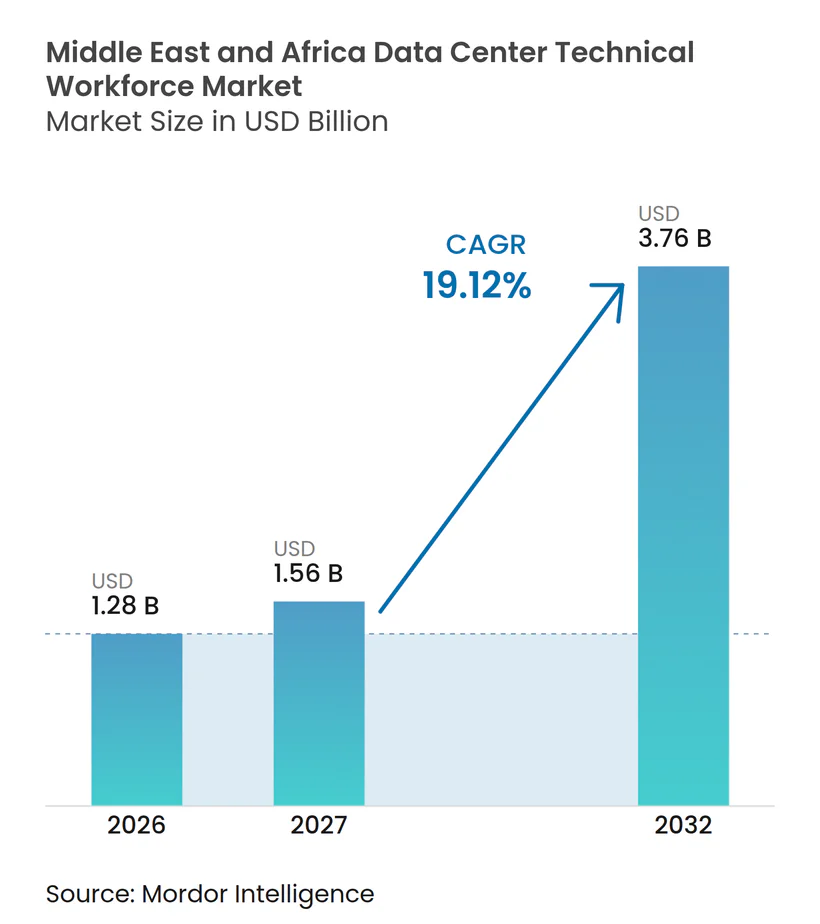
| Base Year Market Size (2026) | USD 1.28 Billion |
| Market Size (2027) | USD 1.56 Billion |
| Market Size (2032) | USD 3.76 Billion |
| Growth Rate (2027 - 2032) | 19.12 % |
| Market Concentration | Medium |
Major Players *Disclaimer: Major Players sorted in no particular order Image © Mordor Intelligence. Reuse requires attribution under CC BY 4.0. | |
Middle East and Africa Data Center Technical Workforce Market Analysis by Mordor Intelligence
The Middle East and Africa data center technical workforce market size is projected to expand from USD 1.28 billion in 2026 to USD 3.76 billion by 2032, registering a CAGR of 19.12% between 2027 and 2032. Government digital infrastructure programs and sovereign cloud requirements are increasing demand for specialists in electrical systems, commissioning, AI infrastructure, and cybersecurity, including personnel who can install, test, protect, and manage these systems. Announced capacity projects in Saudi Arabia, the UAE, and Sub-Saharan Africa require technical teams throughout design, construction, testing, handover, and operations. Shortages in specialized roles can delay projects, complicate handovers, and raise the value of experienced personnel with relevant site experience. The Middle East and Africa data center technical workforce market also reflects a wider shift in required skills, as AI-ready facilities combine traditional critical-power and cooling work with GPU, network, and software infrastructure responsibilities that must operate together. Operators are responding with training partnerships, external staffing, internal certification programs, and targeted efforts to develop local technical capacity.
Key Report Takeaways
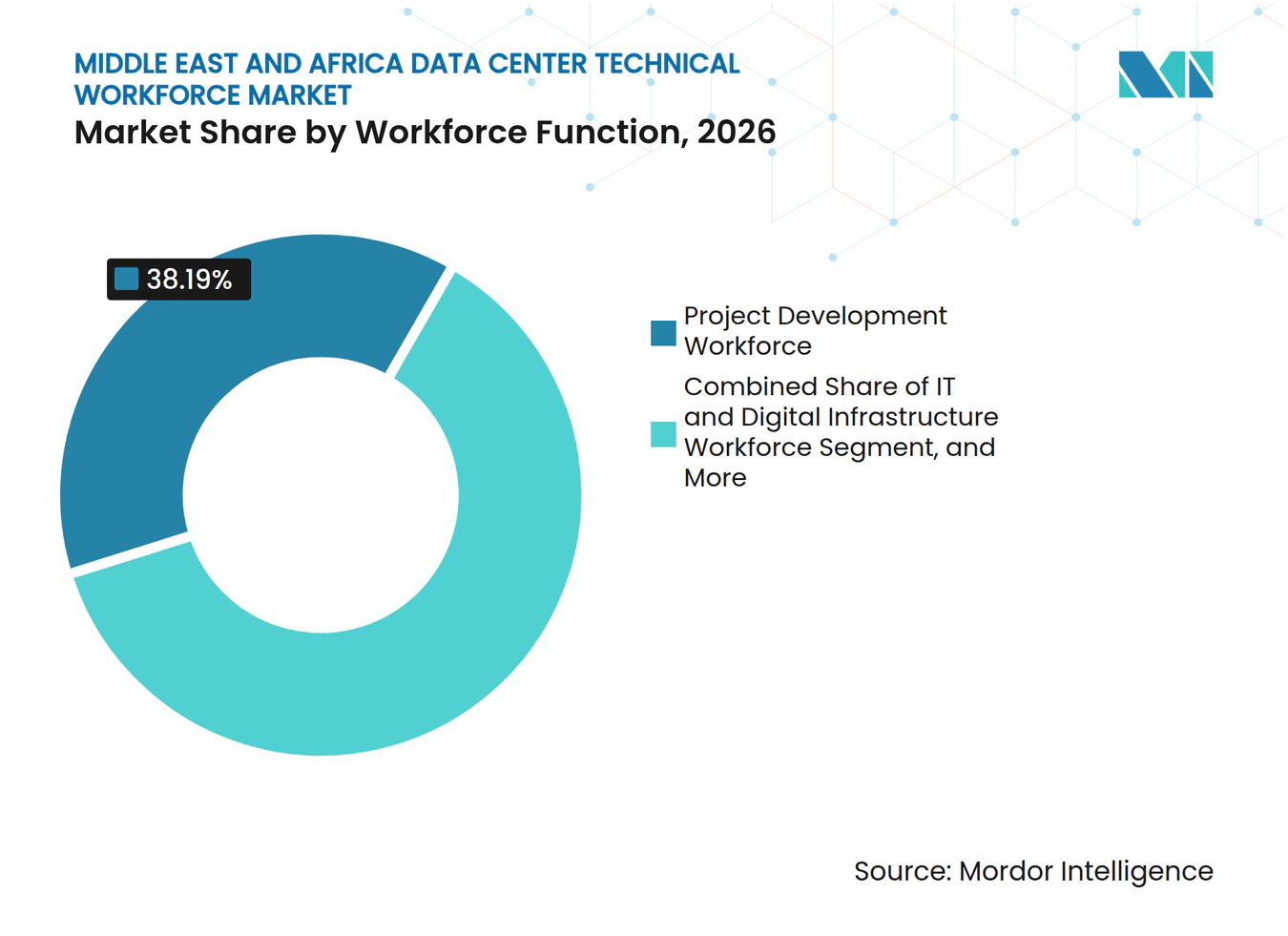
- By workforce function, project development held 38.19% of the Middle East and Africa data center technical workforce market share in 2026, while testing and commissioning is projected to expand at a 20.41% CAGR through 2032.
- By employment model, external workforce services held 54.67% of revenue in 2026 and are projected to expand at a 20.52% CAGR through 2032.
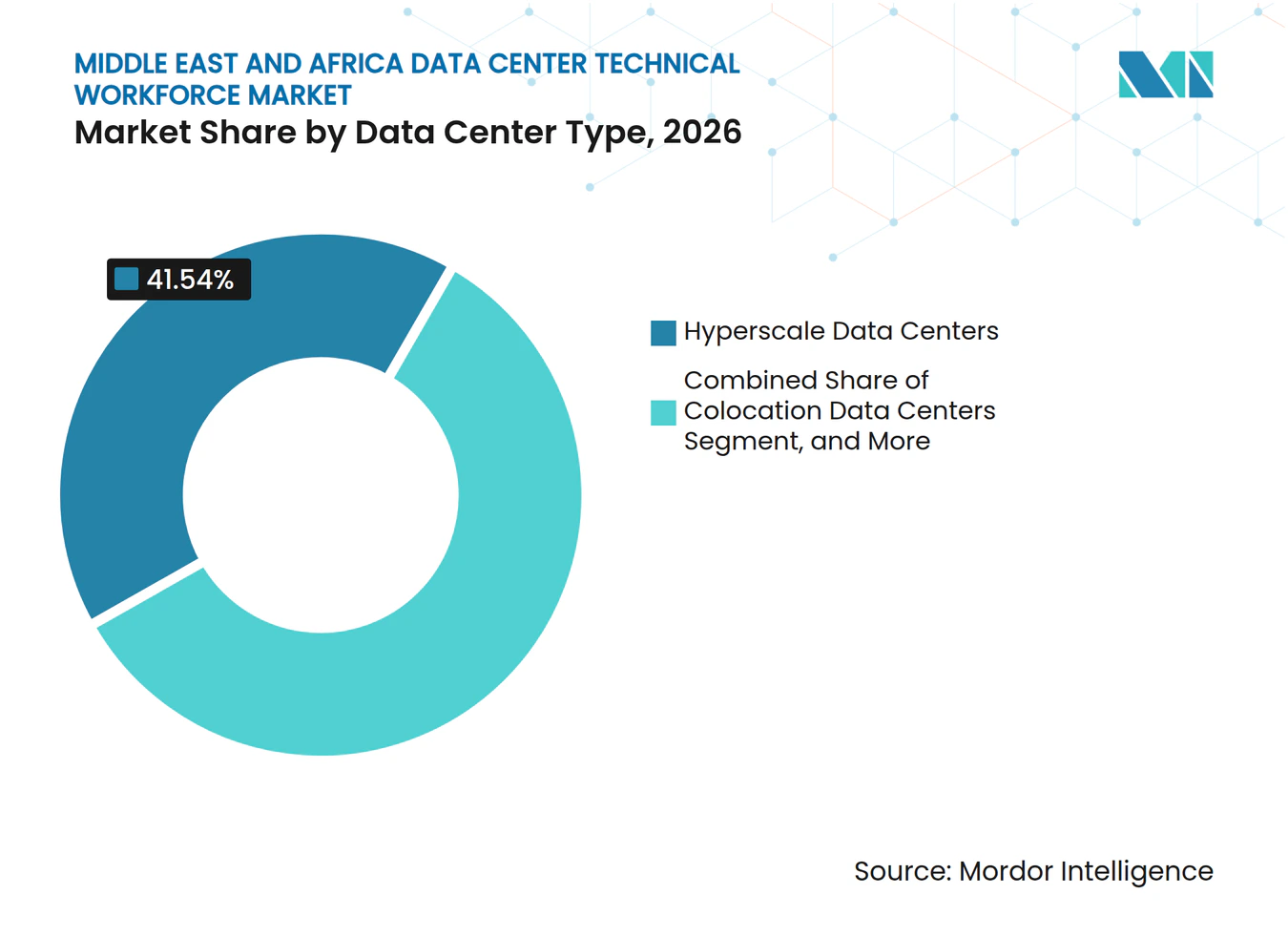
- By data center type, hyperscale facilities held 41.54% of revenue in 2026 and are projected to expand at a 20.81% CAGR through 2032.
- By geography, Saudi Arabia held 28.67% of regional revenue in 2026 and is projected to expand at a 20.89% CAGR through 2032.
Note: Market numbers in this report are based on Mordor Intelligence's proprietary estimation framework, which combines nine months of actuals with Q4 projections for base year 2026.
Market Trends and Insights
Drivers Impact Analysis of Middle East and Africa Data Center Technical Workforce Market*
| Driver | (~) % Impact on CAGR Forecast | Geographic Relevance | Impact Timeline |
|---|---|---|---|
| Government-Led Digital Transformation and Sovereign Cloud Programs | +4.2% | Saudi Arabia and UAE | Short term (≤ 2 years) |
| AI and Hyperscale Capacity Build-Out | +3.8% | Global, concentrated in Saudi Arabia and UAE | Short term (≤ 2 years) |
| Demand for Data Sovereignty and Localized Cloud Infrastructure | +3.4% | GCC-wide, with early adoption in Saudi Arabia, UAE, and Bahrain | Medium term (2–4 years) |
| Expansion of 5G, Edge Computing, and Interconnection | +2.8% | UAE and Saudi Arabia, spreading to South Africa and Egypt | Medium term (2–4 years) |
| Submarine Cable and Regional Connectivity Investment | +1.8% | Egypt, Nigeria, South Africa, and broader MEA | Long term (≥ 4 years) |
| Employer-Led Technical Training and Certification Ecosystems | +1.3% | Global, with pilot programs in UAE and Saudi Arabia | Long term (≥ 4 years) |
| Source: Mordor Intelligence | |||
Government-Led Digital Transformation and Sovereign Cloud Programs
Saudi Arabia and the UAE are moving from policy commitments to major infrastructure programs. Saudi Data and AI Authority targets 1.5 GW of sovereign capacity by 2030. In January 2026, SDAIA began work on the 480 MW Hexagon facility in Riyadh, which it describes as the world’s largest government Tier IV data center.[1] Saudi Arabia’s operational data center capacity increased from 68 MW in 2021 to 467 MW in the first quarter of 2026. Its broader ICT technical workforce reached 426,000 personnel in 2025, compared with 150,000 in 2018. The Middle East and Africa data center technical workforce market benefits because public-sector facilities require locally available teams for construction, operation, security, and compliance.
AI and Hyperscale Capacity Build-Out
AI infrastructure is changing both the scale of facilities and the skills required to support them. NEOM and DataVolt signed a USD 5 billion agreement in February 2025 for a 1.5 GW AI data center campus at Oxagon.[2] Alfanar Group committed USD 1.4 billion for 4 high-density Saudi facilities designed for AI and compute workloads. These projects require GPU cluster management, liquid-cooling engineering, and commissioning capabilities alongside conventional electrical and mechanical disciplines. NVIDIA has announced regional partnerships to train engineers in accelerated-computing workflows. The Middle East and Africa data center technical workforce market, therefore, needs a broader mix of technical capabilities as AI deployments move from planning into delivery.
Demand for Data Sovereignty and Localized Cloud Infrastructure
Data-residency requirements are linking cloud investment to locally operated infrastructure. e& enterprise plans to launch OneCloud, a UAE-sovereign cloud platform that will offer more than 200 OCI services.[3] Bahrain’s Information and eGovernment Authority and Beyon Solutions signed an agreement for the Kingdom’s first AI-ready Sovereign HyperCloud in November 2025. SAP also stated that Saudi Arabia became the first country to host its full SAP Business Network suite in a sovereign cloud setting. These deployments require staff who understand data residency, security controls, and the operational rules of regulated sectors. This strengthens demand across the Middle East and Africa data center technical workforce market for locally qualified infrastructure and cybersecurity personnel.
Expansion of 5G, Edge Computing, and Interconnection
5G expansion is creating demand for skills needed to operate distributed computing facilities. Ericsson expects GCC mobile data traffic to rise from 1.8 exabytes per month in 2025 to 3.3 exabytes per month in 2031. Smart-city programs in NEOM, Dubai, and Masdar City require low-latency computing close to users and devices, rather than relying only on centralized capacity. Edge sites need MEP specialists, building-management technicians, and network engineers who can work across dispersed locations and respond to local operating needs. Their hardware and support needs differ from those of large centralized facilities because sites may have limited on-site support. The Middle East and Africa data center technical workforce market gains from this shift because each additional edge location needs reliable technical coverage, local maintenance, and coordinated network support.
Restraints Impact Analysis of Middle East and Africa Data Center Technical Workforce Market*
| Restraint | (~) % Impact on CAGR Forecast | Geographic Relevance | Impact Timeline |
|---|---|---|---|
| Scarcity of Mission-Critical Technical Talent | -1.8% | MEA-wide, most acute in Nigeria, South Africa, and Egypt | Short term (≤ 2 years) |
| High Cost and Limited Access to Specialized Training | -1.2% | Sub-Saharan Africa, including Nigeria and South Africa, and secondary MEA markets | Medium term (2–4 years) |
| Grid Instability and Diesel-Dependent Operations | -0.9% | Sub-Saharan Africa, including Nigeria, South Africa, and Rest of Africa | Medium term (2–4 years) |
| Water and Thermal Management Constraints in Arid Markets | -0.7% | GCC and MENA, including Saudi Arabia, UAE, and Oman | Long term (≥ 4 years) |
| Source: Mordor Intelligence | |||
Scarcity of Mission-Critical Technical Talent
The most acute shortages are in roles that support critical facilities and complex commissioning work. The Africa Data Centers Association reported that more than 60% of African operators considered skills shortages their leading growth barrier in its 2025 Insider Survey. The same survey recorded worker retention as the leading concern for 39% of respondents and limited access to specialized training for 22.6%. Uptime Institute reported that nearly 2 out of 3 operators globally had difficulty hiring and retaining qualified staff in 2025. AI-ready facilities add requirements in software-defined networking, data pipelines, and automation. These gaps can slow deployment and increase the risk of configuration errors across the Middle East and Africa data center technical workforce market.
High Cost and Limited Access to Specialized Training
Formal technical training remains hard to access in several Sub-Saharan African markets. The Africa Data Centers Association found that only 12.9% of data center companies had formal academic partnerships. Vendor-led pathways from companies such as Vertiv, Schneider Electric, and NVIDIA can provide relevant skills but are often tied to enterprise budgets and commercial relationships. Smaller operators may therefore depend on imported expertise or face long vacancies for specialist positions. The resulting staffing cost can be significant where projects have not yet established recurring operating revenue. This constraint limits how quickly the Middle East and Africa data center technical workforce market can build a deeper local talent base.
*Our forecasts treat driver/restraint impacts as directional, not additive. The impact forecasts reflect baseline growth, mix effects, and variable interactions.
Middle East and Africa Data Center Technical Workforce Market Segment Analysis
By Workforce Function:
Project Development Leads While Commissioning Demand RisesProject development held 38.19% of revenue in 2026. This position reflects a regional pipeline centered on design, construction, installation, and site delivery in the Middle East and Africa data center technical workforce market. The GCC has 4 GW of data center capacity under development, which requires engineers and field teams throughout the project cycle. Project development staff coordinate electrical, mechanical, civil, and systems work before a facility can be handed to an operator. Testing and commissioning is projected to record the highest CAGR at 20.41% through 2032. These specialists validate redundant power, precision cooling, and dense network configurations before facilities enter service.
Commissioning requirements are becoming more demanding as AI-ready systems are deployed. Operators increasingly seek personnel who can test high-density equipment, record results, and verify resilience requirements before handover. A commissioning team must understand how power, cooling, controls, and network systems interact under operational conditions. Facility operations and maintenance staffing expand as completed sites move into regular operation. IT and digital infrastructure teams also need AI infrastructure and cybersecurity knowledge. The Middle East and Africa data center technical workforce industry increasingly depends on functions that combine physical-facility knowledge with software and network skills.



By Employment Model:
External Services Set the Operating PatternExternal workforce services accounted for 54.67% of the Middle East and Africa data center technical workforce market size in 2026. The segment is also projected to expand at a 20.52% CAGR through 2032. Large construction programs create temporary peaks in demand for commissioning, fit-out, and specialized engineering teams. These peaks can occur before a facility opens and then decline once operations stabilize. External providers give operators access to certified specialists on a project or managed-service basis. This reduces the need to carry permanent staff during periods of lower activity.
External teams can supply Uptime Institute Accredited Tier Designers, Certified Data Center Professionals, and MEP engineers with hyperscale delivery experience. They can be deployed where a project needs expertise for a defined task, site, or delivery stage. This model is relevant during the GCC build phase, concentrated between 2026 and 2028. In-house employees remain important for operational continuity and regulated workloads. Sovereign and financial-sector deployments may require locally employed personnel to manage sensitive systems. The Middle East and Africa data center technical workforce market will continue to use both models, although external services remain central to project delivery.
By Data Center Type:
Hyperscale Facilities Combine Scale and MomentumHyperscale facilities held 41.54% of revenue in 2026. They are projected to advance at a 20.81% CAGR through 2032. Large projects such as Stargate UAE, the NEOM Oxagon campus, and Khazna’s capacity plans create multi-year demand for design, construction, commissioning, and operations teams. Their scale requires separate specialists for critical power, cooling, controls, network infrastructure, and physical security. Tier III and Tier IV requirements further narrow the pool of eligible commissioning professionals. The Middle East and Africa data center technical workforce market size for hyperscale activity reflects this concentration of large and technically demanding programs.
Colocation facilities support workforce demand at regional interconnection hubs in Cairo, Lagos, Johannesburg, and Dubai. STC Group inaugurated Riyadh 5 in April 2026 with an initial 40 MW IT load that can expand to 80 MW. Carrier-neutral facilities need teams that can support multiple customers, networks, and equipment configurations. Enterprise, edge, and modular facilities extend demand into secondary GCC cities and African markets. These distributed sites need field technicians who can manage local equipment with limited centralized support. Each facility type therefore calls for a different staffing mix across the Middle East and Africa data center technical workforce market, even as hyperscale sites account for the largest share of activity.

Geography Analysis
Saudi Arabia Data Center Technical Workforce Market
Saudi Arabia held 28.67% of the Middle East and Africa data center technical workforce market share in 2026 and is projected to record a 20.89% CAGR through 2032. Operational capacity increased from 68 MW in 2021 to 467 MW in the first quarter of 2026. The Kingdom had 60 operating facilities, 610.1 MW under construction, and 3.4 GW of planned capacity by mid-2026. AWS has stated that its first Saudi cloud region is expected to launch in December 2026 with more than USD 5.3 billion in planned investment. Microsoft stated that its Saudi Arabia East data center region will be available in November 2026.
United Arab Emirates and South Africa Data Center Technical Workforce Market
The UAE is the second-largest regional workforce base. Abu Dhabi committed AED 13 billion (USD 3.54 billion) to its Government Digital Strategy 2025-2027. Stargate UAE had more than 5,000 workers on site during construction, and phase 1 of 200 MW is due to be completed in 2026. Microsoft plans to skill 1 million people in the UAE by the end of 2027, including 120,000 government employees and 175,000 students. South Africa remains Africa’s largest operational capacity base, accounting for more than 60% of the continent’s capacity.
MEA Data Center Technical Workforce Market
The Teraco Isando Campus in Johannesburg has 70 MW of IT capacity. Nigeria, Egypt, and other MEA countries form the next area of expansion for the Middle East and Africa data center technical workforce market. Nigeria had installed capacity of 136.7 MW in 2025, with capacity projected to approach 279.4 MW by 2030. Its workforce needs are complicated by grid availability of 41% and a reliance on power-resilience expertise. Egypt’s 15 operational submarine cables in mid-2025 support demand for network and interconnection personnel. The Africa Data Centres Association recorded 360 MW of active capacity, 238 MW under construction, and 656 MW planned in its 2026 report. This pipeline requires a substantial expansion in the supply of trained technical personnel.
Competitive Landscape
Market Concentration
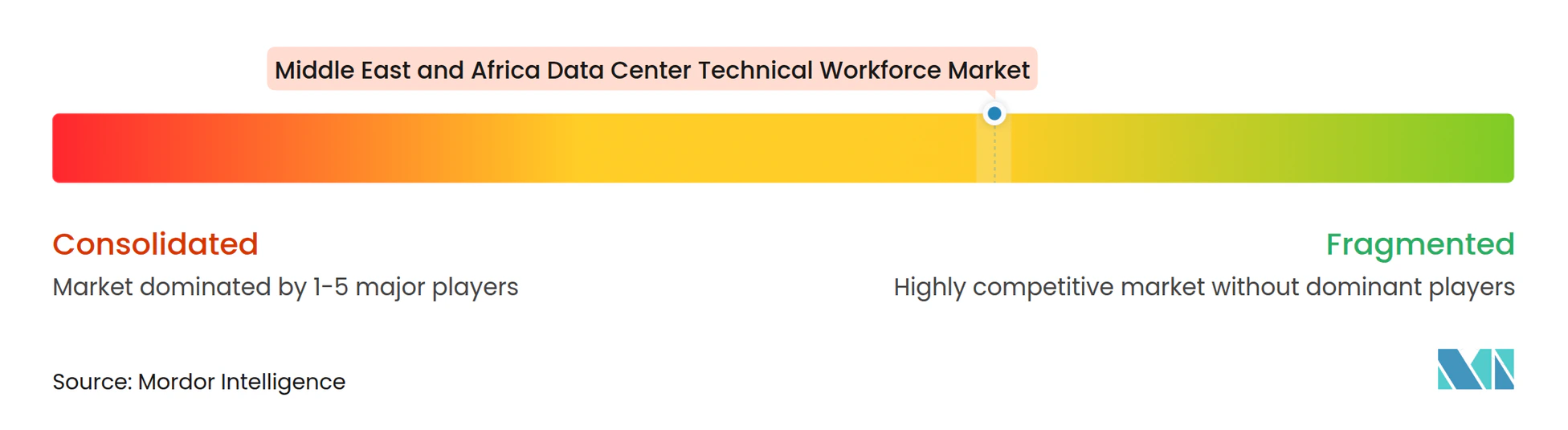
The Middle East and Africa data center technical workforce market is moderately fragmented, with operators, contractors, and technology providers serving different parts of the value chain. Competition includes regional operators such as Khazna Data Centers and G42 Cloud Computing. It also includes global colocation platforms such as Equinix and Digital Realty. African operators include Teraco Data Environments, Africa Data Centres, and Raxio Group. Engineering companies such as Jacobs Solutions and AECOM compete for related technical talent and delivery work.
Technology infrastructure providers also influence the supply of skills. Schneider Electric, Vertiv, Cisco, and NVIDIA offer equipment, technical knowledge, and training ecosystems. Khazna announced plans in October 2025 to add more than 1 GW of hyperscale capacity across several countries by 2030 and to provide structured training and certification programs. Vertiv Academy provides training for critical digital infrastructure roles across the region. NVIDIA’s regional partnerships focus on accelerated-computing and GPU infrastructure skills.
Operators are building internal certification programs and working with technology partners because external talent supply has not kept pace with capacity expansion. These measures make workforce development part of competition for project delivery and reliable operations. Specialist commissioning providers have an opening where operators lack internal expertise in AI-ready systems and advanced testing. The market remains diverse because no single provider combines regional data center ownership, engineering delivery, and technical training at scale.
Middle East and Africa Data Center Technical Workforce Industry Leaders
-
Khazna Data Centers
-
Digital Realty
-
Equinix
-
Africa Data Centres
-
Saudi Telecom Company
- *Disclaimer: Major Players sorted in no particular order
Middle East and Africa Data Center Technical Workforce Market Companies Covered in this Report
- Khazna Data Centers
- Digital Realty
- Equinix
- Africa Data Centres
- Saudi Telecom Company
- Gulf Data Hub
- Teraco Data Environments
- G42 Cloud Computing
- Vantage Data Centers
- Pure Data Centers
- Rack Centre
- Raxio Group
- Wingu Group
- N+ONE Datacenters
- Open Access Data Centres
- MainOne
- Telecom Egypt
- Oman Data Park
- Ooredoo
- Injazat
- Schneider Electric
- Vertiv
- Johnson Controls
- Jacobs Solutions Inc.
- AECOM
- NTT DATA Group Corporation
- Cisco Systems, Inc.
- NVIDIA Corporation
Recent Industry Developments in Middle East and Africa Data Center Technical Workforce Market
- October 2026: NaiTel (Aqaba Digital Hub) and MEDUSA Submarine Cable System signed an agreement to extend connectivity from Jordan to Europe and North Africa through MEDUSA's 8,700 km Mediterranean network via the Coral Bridge, improving digital infrastructure resilience for the broader Levant region.
- August 2026: Microsoft confirmed its Saudi Arabia East datacenter region will be available to customers in November 2026, enabling organizations to host eligible workloads and data locally in the Kingdom in support of Saudi Vision 2030. The region is designed to support mission-critical AI workloads for government and enterprise clients.
- April 2026: STC Group inaugurated Riyadh 5, MENA's largest carrier-neutral data center, at King Salman Energy Park (SPARK) in Riyadh. The facility offers an initial IT load of 40 MW, expandable to 80 MW, and meets Uptime Institute Tier III standards, intensifying competition in the GCC colocation market.
- January 2026: SDAIA broke ground on the Hexagon data center in Riyadh, the world's largest government-owned Tier IV facility at 480 MW, to consolidate Saudi public-sector workloads under a sovereign infrastructure model and reinforce the Kingdom's data center talent demand.
Middle East and Africa Data Center Technical Workforce Market Report Scope
The Middle East and Africa Data Center Technical Workforce Market refers to the demand for, supply of, and specialized recruitment, training, and managed staffing services related to skilled personnel needed to design, construct, commission, operate, maintain, secure, and upgrade data center facilities across the region.
The Middle East and Africa Data Center Technical Workforce Market Report is Segmented by Workforce Function (Project Development Workforce [Design and Engineering Workforce, Construction and Installation Workforce, Testing and Commissioning Workforce], Facility Operations and Maintenance Workforce [Data Center Operations Workforce, Facility Management Workforce, Maintenance and Reliability Workforce], IT and Digital Infrastructure Workforce [IT Hardware and Cloud Infrastructure Workforce, Network Infrastructure Workforce, Cybersecurity and Technical Security Workforce, AI Infrastructure Workforce]), Employment Model (In-house Workforce, External Workforce Services), Data Center Type (Hyperscale Data Centers, Colocation Data Centers, Enterprise, Edge and Modular Data Centers), and Geography (Saudi Arabia, United Arab Emirates, South Africa, Nigeria, Egypt, Rest of Middle East and Africa). The Market Forecasts are Provided in Terms of Value (USD).
Segmentation Overview
| Project Development Workforce | Design and Engineering Workforce |
| Construction and Installation Workforce | |
| Testing and Commissioning Workforce | |
| Facility Operations and Maintenance Workforce | Data Center Operations Workforce |
| Facility Management Workforce | |
| Maintenance and Reliability Workforce | |
| IT and Digital Infrastructure Workforce | IT Hardware and Cloud Infrastructure Workforce |
| Network Infrastructure Workforce | |
| Cybersecurity and Technical Security Workforce | |
| AI Infrastructure Workforce |
| In-house Workforce |
| External Workforce Services |
| Hyperscale Data Centers |
| Colocation Data Centers |
| Enterprise, Edge and Modular Data Centers |
| Saudi Arabia |
| United Arab Emirates |
| South Africa |
| Nigeria |
| Egypt |
| Rest of Middle East and Africa |
| By Workforce Function | Project Development Workforce | Design and Engineering Workforce |
| Construction and Installation Workforce | ||
| Testing and Commissioning Workforce | ||
| Facility Operations and Maintenance Workforce | Data Center Operations Workforce | |
| Facility Management Workforce | ||
| Maintenance and Reliability Workforce | ||
| IT and Digital Infrastructure Workforce | IT Hardware and Cloud Infrastructure Workforce | |
| Network Infrastructure Workforce | ||
| Cybersecurity and Technical Security Workforce | ||
| AI Infrastructure Workforce | ||
| By Employment Model | In-house Workforce | |
| External Workforce Services | ||
| By Data Center Type | Hyperscale Data Centers | |
| Colocation Data Centers | ||
| Enterprise, Edge and Modular Data Centers | ||
| By Geography | Saudi Arabia | |
| United Arab Emirates | ||
| South Africa | ||
| Nigeria | ||
| Egypt | ||
| Rest of Middle East and Africa | ||
Key Questions Answered in the Report
What is the size of the Middle East and Africa data center technical workforce market?
The Middle East and Africa data center technical workforce market is valued at USD 1.28 billion in 2026 and is projected to reach USD 3.76 billion by 2032. The market is expected to grow at a 19.12% CAGR during 2027-2032, driven by accelerating data center construction, sovereign cloud initiatives, digital transformation programs, and rising demand for skilled technical personnel throughout the facility lifecycle.
Which workforce function has the largest share?
Project Development Workforce holds the largest share at 38.19% in 2026. This segment encompasses design, engineering, construction, installation, and pre-operational preparation activities required for new data center developments. Strong capacity expansion across Gulf countries and other MEA markets continues to support demand for project development professionals.
Which function is expected to expand fastest?
Testing and Commissioning Workforce is projected to record the highest growth, at a 20.41% CAGR through 2032. These specialists are responsible for validating critical infrastructure such as power systems, cooling equipment, network architecture, and operational resilience before facilities become fully operational, particularly in increasingly complex AI-ready environments.
Why are external workforce services important in MEA data centers?
External Workforce Services account for 54.67% of the market in 2026 and are projected to grow at a 20.52% CAGR through 2032. This model enables operators and developers to access certified specialists during peak construction, deployment, fit-out, and commissioning phases without maintaining large permanent workforces after project completion.
Which country leads regional demand for technical workforce services?
Saudi Arabia leads the region with a 28.67% market share in 2026 and is expected to grow at a 20.89% CAGR through 2032. Strong investments in sovereign digital infrastructure, hyperscale facilities, cloud regions, and data center developments continue to drive demand for skilled technical personnel across the country.
What skills are most important for AI-ready data centers?
Critical skills include GPU infrastructure management, liquid cooling technologies, commissioning and testing, cybersecurity, network engineering, critical power systems, automation, and operational resilience management. Technical professionals must also understand the integration of physical infrastructure, digital controls, and software platforms required to support advanced AI and cloud workloads.