
Middle East and Africa Data Center Insurance Market Size and Share
Market Overview
| Study Period | 2021 - 2032 |
|---|---|
| Forecast Data Period | 2027 - 2032 |
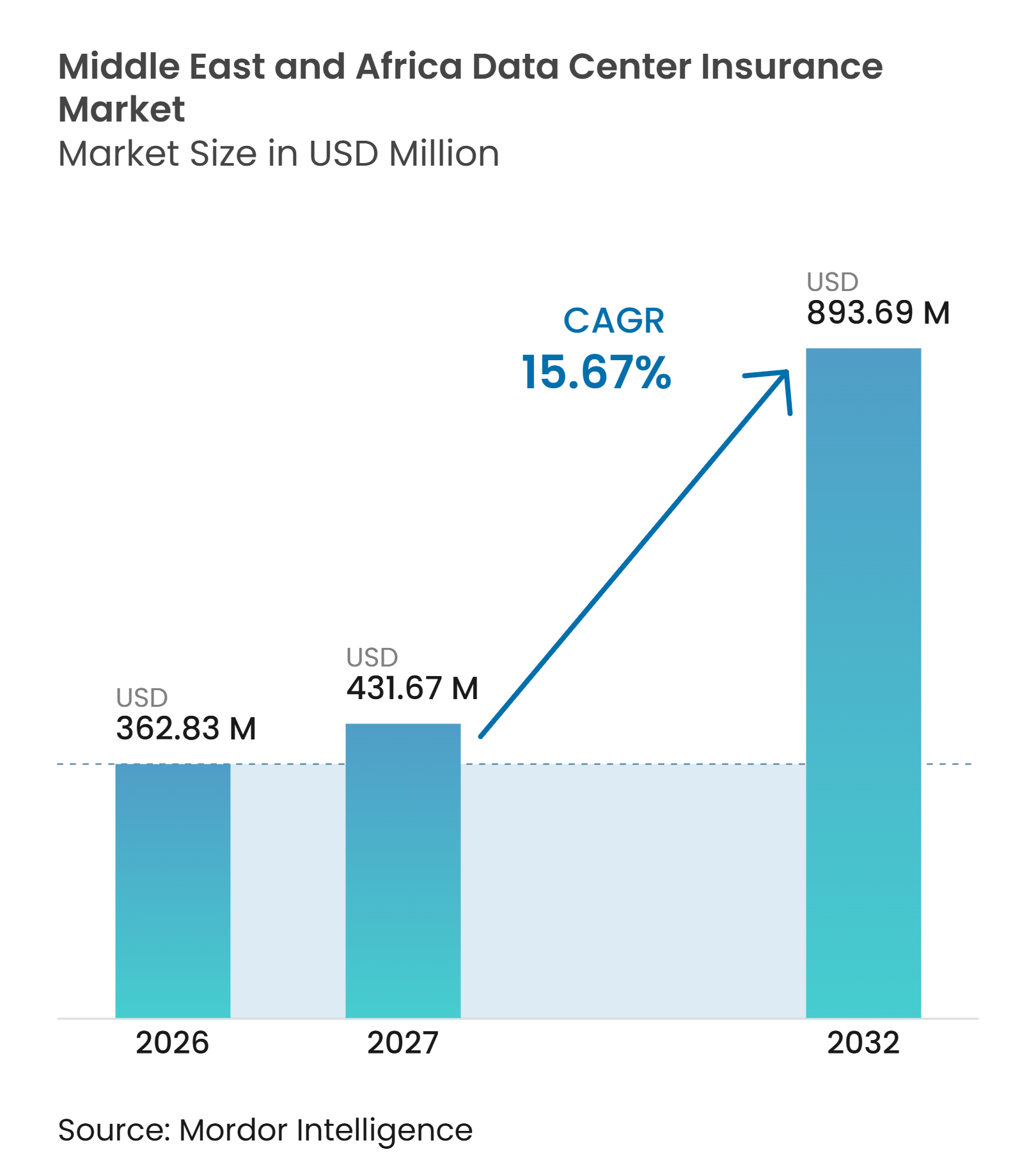
| Base Year Market Size (2026) | USD 362.83 Million |
| Market Size (2027) | USD 431.67 Million |
| Market Size (2032) | USD 893.69 Million |
| Growth Rate (2027 - 2032) | 15.67 % |
| Market Concentration | Medium |
Major Players *Disclaimer: Major Players sorted in no particular order Image © Mordor Intelligence. Reuse requires attribution under CC BY 4.0. | |
Middle East and Africa Data Center Insurance Market Analysis by Mordor Intelligence
The Middle East and Africa data center insurance market size was valued at USD 362.83 million in 2026 and estimated to grow from USD 427.24 million in 2027 to reach USD 893.69 million by 2032, at a CAGR of 15.67% during the forecast period (2027-2032). New hyperscale campuses are increasing the insured value concentrated at individual sites, especially where AI hardware, liquid cooling, and dedicated power assets operate together. Sovereign hosting rules in Saudi Arabia and the United Arab Emirates are moving infrastructure investment from a discretionary decision to a local compliance requirement for many global operators. This creates simultaneous demand for property, construction, cyber, and business interruption protection. The Middle East and Africa data center insurance market also faces more complex risk accumulation, as a single event can affect shared power, cooling, fiber, customer equipment, and service commitments. Insurers, brokers, and reinsurers are responding through specialist underwriting, risk engineering, and policy designs that address shorter service-level agreement penalty periods.
Key Report Takeaways
- By insurance type, Property Damage Insurance held 35.86% of the Middle East and Africa data center insurance market share in 2026, while Cyber Insurance is projected to expand at a 16.43% CAGR through 2032.
- By coverage structure, Combined Property and Business Interruption Policies accounted for 37.61% of the market in 2026, while Parametric Insurance is expected to grow at a 16.24% CAGR through 2032.
- By risk exposure, Electrical and Mechanical Equipment Failure accounted for 21.72% of the market in 2026, while Cyber-Related Operational Disruption is forecast to grow at a 16.62% CAGR through 2032.
- By policyholder, Data Center Owners and Operators held 37.43% of the market in 2026, while Cloud Service Providers are projected to grow at a 16.83% CAGR through 2032.
- By insurance distribution channel, Insurance Brokers and Consultants held 55.24% of the market in 2026, while Managing General Agents and Specialist Underwriting Agencies are expected to expand at a 16.41% CAGR through 2032.
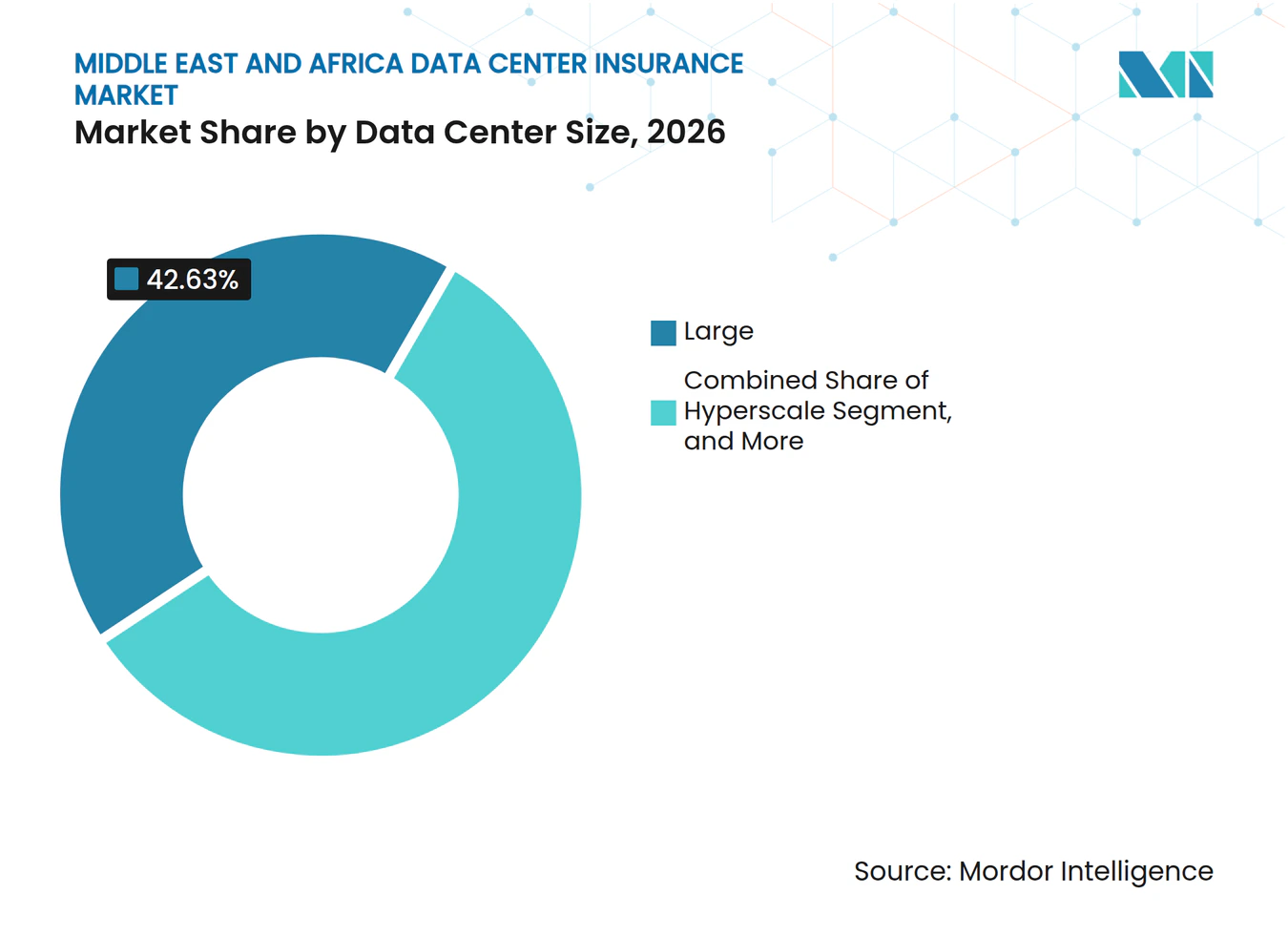
- By data center size, Large data centers accounted for 42.63% of the market in 2026, while Hyperscale facilities are projected to advance at a 16.87% CAGR through 2032.
- By data center type, Colocation held 44.26% of the market in 2026, while Cloud Service Providers are expected to grow at a 16.32% CAGR through 2032.
- By geography, the United Arab Emirates held 27.63% of the Middle East and Africa data center insurance market share in 2026, while Saudi Arabia is projected to grow at a 16.56% CAGR through 2032.
Note: Market numbers in this report are based on Mordor Intelligence's proprietary estimation framework, which combines nine months of actuals with Q4 projections for base year 2026.
Market Trends and Insights
Drivers Impact Analysis of Middle East and Africa Data Center Insurance Market*
| Driver | (~) % Impact on CAGR Forecast | Geographic Relevance | Impact Timeline |
|---|---|---|---|
| Cloud, AI, and Digital Sovereignty Investments | +4.5% | United Arab Emirates and Saudi Arabia, primary. Qatar and Turkey, secondary. | Medium term (2-4 years) |
| Expansion of GCC Data Center Capacity | +3.8% | GCC core, with spillover to North Africa and East Africa. | Long term (≥ 4 years) |
| Rising Insured Values and Lifecycle Complexity | +3.2% | United Arab Emirates and Saudi Arabia, highest concentration. Global supply chain impact. | Short term (≤ 2 years) |
| Growing Cyber and Service-Level Agreement Exposure | +2.6% | United Arab Emirates, primary threat intensity. Saudi Arabia, higher loss severity. | Short term (≤ 2 years) |
| Renewable Power and Captive Energy Integration | +1.4% | Saudi Arabia, including NEOM and Oxagon. United Arab Emirates, including Moro Hub. | Long term (≥ 4 years) |
| Underinsured African Edge Infrastructure | +1.1% | Kenya, Morocco, and South Africa, with spillover to Nigeria and West Africa. | Long term (≥ 4 years) |
| Source: Mordor Intelligence | |||
Cloud, AI, and Digital Sovereignty Investments Drive Structural Demand
Sovereign hosting requirements in Saudi Arabia and the United Arab Emirates are making in-country infrastructure a compliance requirement for many multinational operators. This makes insurance part of the project budget from the start, rather than a later financial decision. Saudi Arabia reported that its data center sector had expanded sixfold since the launch of Vision 2030, with investment above SAR 16 billion, or USD 4.26 billion, and more than 60 operational facilities. The AMD, Cisco, and Humain venture targeted 1 GW of AI infrastructure, with an initial 100 MW deployment planned for Riyadh and Dammam in the second quarter of 2026. High-density computing combines valuable hardware, specialized cooling, and local power systems in a single risk location. The Middle East and Africa data center insurance market therefore needs broader programs that link construction, property damage, equipment failure, cyber events, and interruption losses.
Expansion of GCC Data Center Capacity Creates a Stepwise Premium Base
The GCC construction pipeline is creating a steady flow of assets that need coverage before they begin commercial operation. Center3 announced a USD 10 billion plan to reach 1 GW of capacity in Saudi Arabia by 2030, following USD 3 billion in deployments. Construction and Erection All-Risk cover is often the first insurance product attached to these projects. Operational property and business interruption cover then becomes necessary as commissioning and customer occupancy progress. The sequence creates a longer relationship between insurers and project owners than a standard annual placement. The Middle East and Africa data center insurance market must also address potential coverage gaps as a facility transitions from construction to testing to full operation.
Rising Insured Values and Lifecycle Complexity Require New Underwriting Approaches
The insured values of new campuses are changing the scale of losses that carriers must prepare to absorb. Allianz Commercial found that fire accounted for more than 50% of loss severity across analyzed data center claims totaling EUR 700 million (USD 770 million). The same assessment identified lead times of up to 80 weeks for switchgear and 50 weeks for transformers. Delays of this length can extend interruption losses after a physical event, especially in import-dependent markets. FM Global updated its 2026 guidance for AI-oriented facilities, recommending 2-hour wall fire resistance for relevant battery-related risks. These conditions push the Middle East and Africa data center insurance market toward detailed engineering reviews and more conservative assessments of maximum loss.
Growing Cyber and Service-Level Agreement Exposure Outpaces Policy Development
Data centers increasingly depend on connected power controls, cooling systems, monitoring tools, and security platforms. Lower prices give operators room to improve coverage as their risk environment becomes more demanding. Standard business interruption waiting periods do not always fit service-level agreement penalties that can start within minutes of an outage. The Middle East and Africa data center insurance market is therefore seeing stronger interest in cyber, parametric, and tailored interruption protections. Clearer wording is also important where a cyber event may involve alleged state activity or a war exclusion.
Restraints Impact Analysis of Middle East and Africa Data Center Insurance Market*
| Restraint | (~) % Impact on CAGR Forecast | Geographic Relevance | Impact Timeline |
|---|---|---|---|
| Limited Loss History for AI-Ready Facilities | -0.5% | Global, most acute in Saudi Arabia and United Arab Emirates hyperscale segments. | Medium term (2-4 years) |
| Accumulation Risk Across Power, Cooling, and Fiber Dependencies | -0.4% | GCC core, with spillover to South Africa and Kenya. | Long term (≥ 4 years) |
| Replacement Lead Times for Transformers and Data Center Equipment | -0.3% | Global supply chain, most acute in import-dependent Middle East and Africa markets. | Short term (≤ 2 years) |
| Uneven Local Capacity and Regulatory Fragmentation | -0.2% | Africa, primary. Smaller GCC states, secondary. | Long term (≥ 4 years) |
| Source: Mordor Intelligence | |||
Limited Loss History for AI-Ready Facilities Constrains Actuarial Pricing
AI-ready facilities combine liquid cooling, high-density GPU systems, on-site generation, and battery energy storage in configurations that have limited regional loss history. Underwriters must therefore rely more heavily on engineering assessments than on mature actuarial data. Swiss Re stated that technical assessment and disciplined accumulation management are central to the sustainable underwriting of AI data center risks.[1] Comparisons with power generation, semiconductor manufacturing, or telecommunications do not fully capture the combined cyber, property, and revenue risks at a modern campus. Insurers use sublimits, exclusions, and mandatory inspections to address that uncertainty. This can constrain capacity or increase the effort needed to place complex risks in the Middle East and Africa data center insurance market.
Accumulation Risk Across Power, Cooling, and Fiber Dependencies Strains Portfolio Management
Many tenants can rely on the same power, cooling, and network infrastructure across a single campus. A single failure can create property, business interruption, liability, and cyber claims across several policyholders. Allianz Commercial documented individual hyperscale losses in the EUR 50 million to EUR 100 million (USD 55 million to USD 110 million) range from cooling and power incidents. Jazeera reported that more than 90% of data capacity between Europe and Asia passes through subsea cables in the Red Sea, including a corridor 26 km wide at its narrowest point. These dependencies make geographically separate facilities more correlated than they may appear in an underwriting portfolio. Carriers need clear visibility across building, equipment, utility, and reinsurance placements before extending large limits.
*Our forecasts treat driver/restraint impacts as directional, not additive. The impact forecasts reflect baseline growth, mix effects, and variable interactions.
Middle East and Africa Data Center Insurance Market Segment Analysis
By Insurance Type:
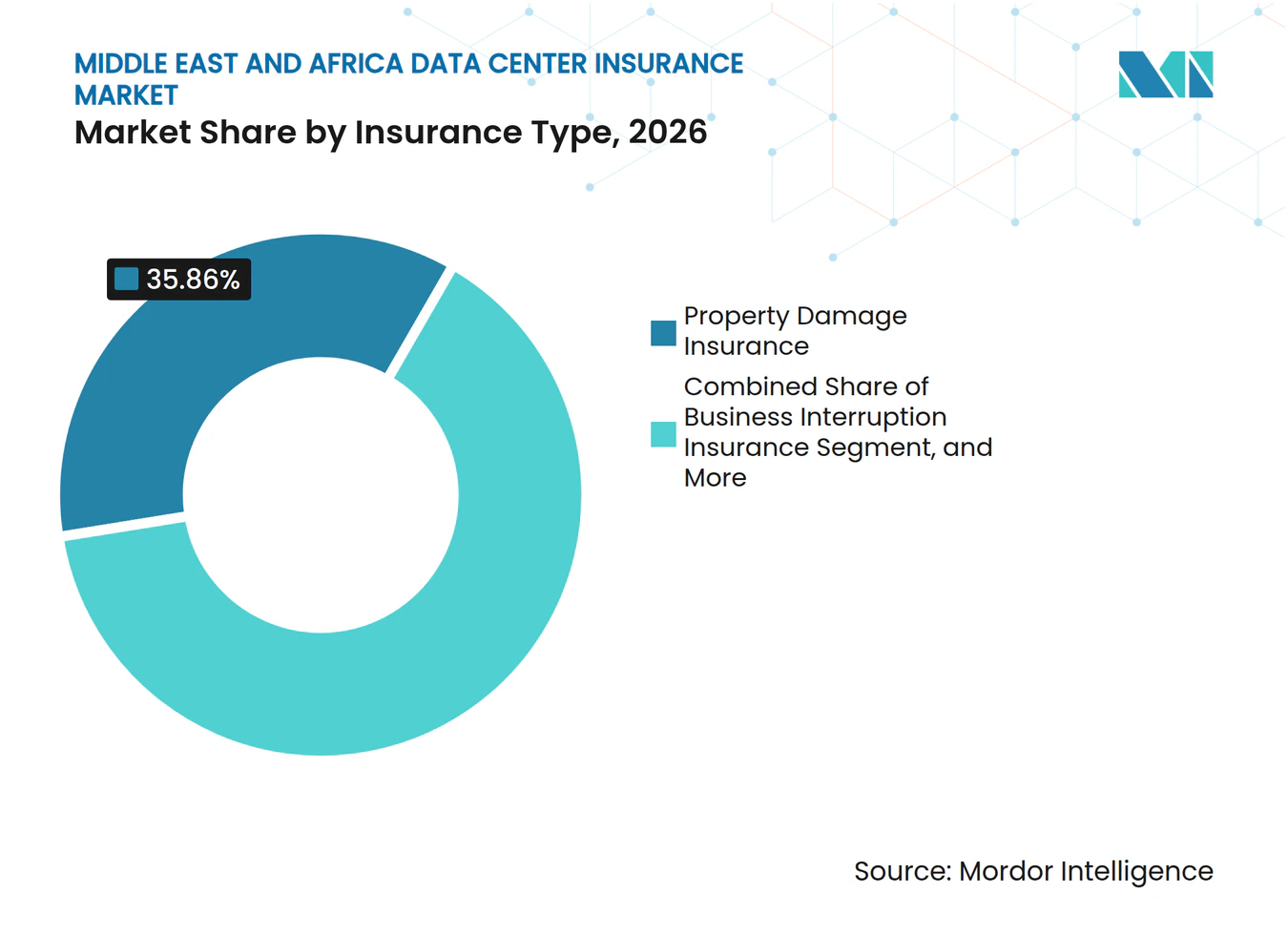
Property Coverage Anchors Demand While Cyber Insurance ExpandsProperty Damage Insurance held 35.86% of the market in 2026. This coverage remains central to the Middle East and Africa data center insurance market because new facilities need protection for buildings, servers, electrical systems, cooling equipment, and associated infrastructure. Fire is especially material because Allianz Commercial identified it as the primary cause of severity in more than 50% of analyzed data center claim values. Business Interruption Insurance and Equipment Breakdown Insurance form the core adjacent layers of a conventional program. A fire or electrical event can damage assets and stop customer services at the same time. Natural Catastrophe Insurance, General and Third-Party Liability Insurance, and Construction and Erection All-Risk Insurance address risks that arise during building and operation.
Cyber Insurance is projected to grow at a 16.43% CAGR through 2032. This expansion reflects the operating dependence of modern sites on connected power, cooling, access control, and monitoring systems. The Uptime Institute reported that power problems caused 45% of major outages in its 2025 survey, while cooling failures caused 14%. Saudi Arabia's National Cybersecurity Authority requirements and the United Arab Emirates critical infrastructure rules increase attention to documented cyber controls. The segment is also supported by demand for cover that responds to operational disruption rather than only data loss. The Middle East and Africa data center insurance industry is consequently moving toward policy wording that recognizes cyber-physical links.



By Coverage Structure:
Combined Policies Lead While Parametric Cover Meets Service RiskCombined Property and Business Interruption Policies held 37.61% of the market in 2026. This is the leading coverage structure in the Middle East and Africa data center insurance market. The structure connects physical damage with the income loss that follows a power, cooling, or fire event. It suits operators that have high availability commitments and a limited tolerance for disputes between separate insurers. Standalone Policies remain relevant for smaller operators whose risk profile does not require a complex program. Package Policies and Captive and Self-Insurance Arrangements offer larger organizations additional options when they have sufficient premium volume and risk management capability. The combined approach can also reduce claims coordination issues during a major outage.
Parametric Insurance is projected to grow at a 16.24% CAGR through 2032. It addresses a gap between conventional business interruption waiting periods and service-level agreement penalties, which may begin soon after downtime begins. Descartes Underwriting launched a product in January 2026, offering up to USD 140 million per policy for specified natural catastrophe triggers. Parametrix raised USD 27 million in December 2025 to scale service-level agreement breach insurance supported by more than 20 Lloyd's syndicates. Lockton and Parametrix also formed a June 2025 partnership for data center service-level agreement insurance. These products can support financing discussions when lenders want evidence that downtime-related obligations have been addressed.
By Risk Exposure:
Equipment Failure Leads While Cyber Disruption Gains ImportanceElectrical and Mechanical Equipment Failure accounted for 21.72% of the market in 2026. The exposure is a major consideration in the Middle East and Africa data center insurance market because power supply systems and cooling equipment are central to continuous site operations. The Uptime Institute's 2025 survey linked 45% of major outages to power supply issues and 14% to cooling failures. Fire and Explosion remain significant because high-density deployments may use lithium-ion battery systems. FM Global's updated guidance addresses this exposure through stronger fire protection practices. Flooding, windstorms, earthquakes, and other geophysical hazards add location-specific requirements across the region.
Cyber-Related Operational Disruption is expected to expand at a 16.62% CAGR through 2032. Connected operational technology increases the number of systems that can be affected by a cyber incident. Third-Party and Supply Chain Disruption is also becoming more relevant as operators serve interconnected cloud and colocation customers. The National Cybersecurity Authority's ECC-1:2018 framework in Saudi Arabia and NESA standards in the United Arab Emirates establish security expectations that affect underwriting. Compliance evidence can become part of the underwriting process before insurers agree to cover a site. This supports more formal risk transfer while raising the quality threshold for insureds.
By Policyholder:
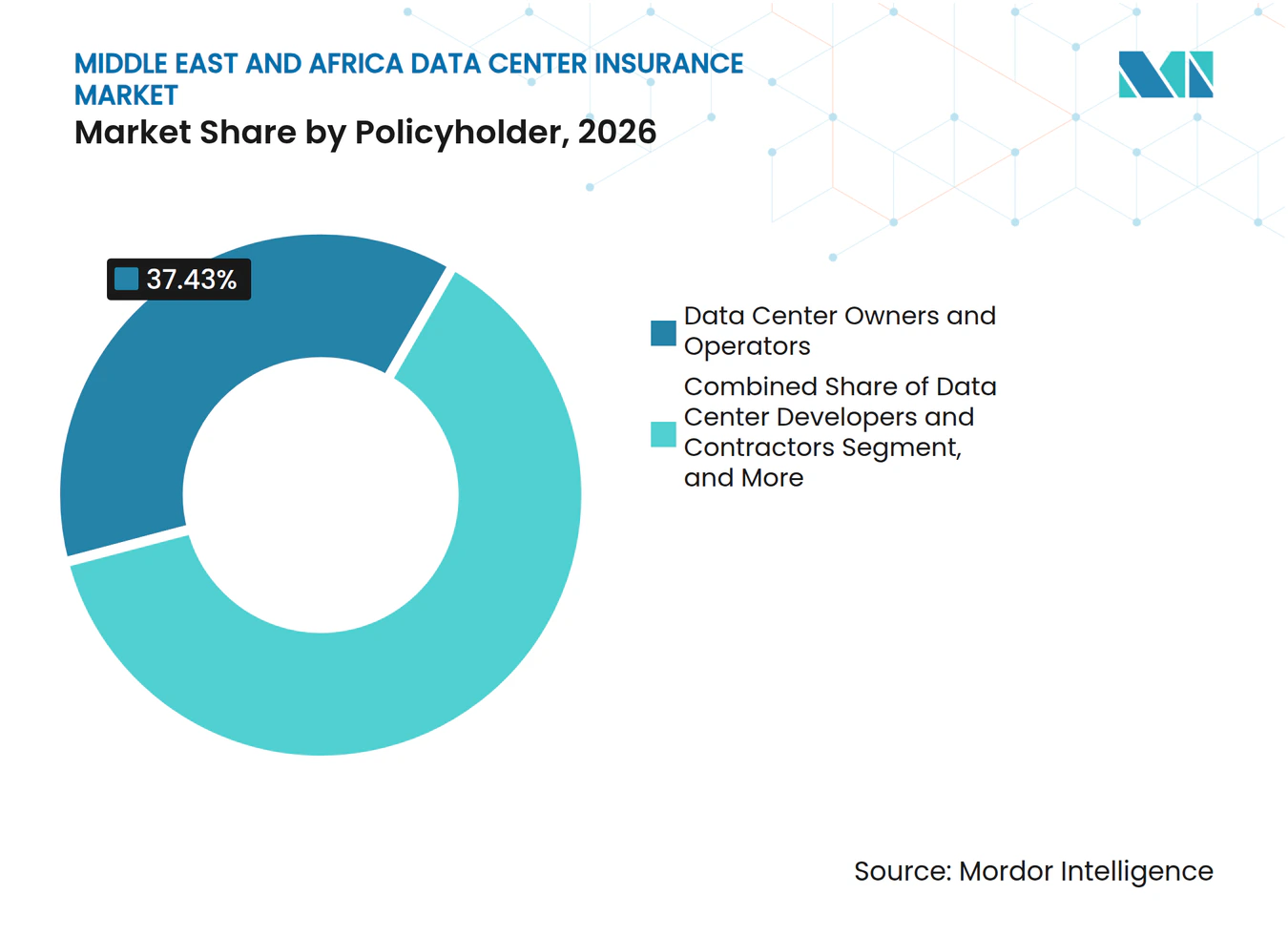
Owners Generate Current Demand While Cloud Providers AdvanceData Center Owners and Operators held 37.43% of the market in 2026. These organizations must ensure the physical campus is in place and often need to meet lender requirements before financing can be drawn. Colocation Providers form another important group because they manage tenant liability, shared infrastructure, and multiple customer service commitments. Data Center Developers and Contractors require coverage during construction, when loss causes differ from those of operational incidents. Equipment and Service Providers face technology errors and omissions and product liability risks as hardware values per rack rise. Together, these policyholders create demand across construction, property, liability, and business interruption lines in the Middle East and Africa data center insurance market.
Cloud Service Providers are projected to grow at a 16.83% CAGR through 2032. Sovereign cloud requirements are encouraging global platforms to establish domestic capacity rather than serve customers only from offshore regions. Microsoft, AWS, Google Cloud, and Oracle have committed to cloud regions in the GCC, supporting more formal insurance program requirements. These providers often use standardized global programs that need local adaptation. The Middle East and Africa data center insurance market benefits because a new cloud region can require a complete insurance placement from launch. Insurers with existing cloud relationships can respond more quickly to this demand.

By Insurance Distribution Channel:
Brokers Lead While Specialist Agencies Gain GroundInsurance Brokers and Consultants held 55.24% of the market in 2026. Complex programs can include property, construction, cyber, liability, and parametric cover for a single campus. Aon, Marsh, Lockton, Howden, and Willis Towers Watson maintain dedicated data center capabilities that support this work. Direct Insurance remains relevant for mid-tier operators with simpler needs. Reinsurance-supported programs are important for large facilities whose values exceed the net retention of a primary carrier. Brokers, therefore, have an important coordination role in the Middle East and Africa data center insurance market.
Managing General Agents and Specialist Underwriting Agencies are expected to grow at a 16.41% CAGR through 2032. These firms can develop policy language, inspection protocols, and claims processes for AI-ready sites. Their role is expanding as technical underwriting expertise develops unevenly across traditional carriers. Howden reported that its construction risk work includes AI-enabled schedule analysis to identify project delays.[2] Specialist agencies can use similar technical tools to assess changing values and handover risks. Their growth reflects demand for risk advice that goes beyond price comparison. The Middle East and Africa data center insurance market is likely to reward distributors that can connect local clients to international capacity.
By Data Center Size:
Large Facilities Hold Volume While Hyperscale Sites ExpandLarge data centers held 42.63% of the market in 2026. Established enterprise and colocation campuses in Dubai, Abu Dhabi, Riyadh, and Johannesburg give underwriters at least some loss history and engineering reference points. Medium-sized facilities serve regional enterprises and cloud operators in markets such as Turkey, Morocco, and Qatar. Small facilities support edge deployments in secondary African cities and smaller GCC locations. Their individual equipment and cooling losses may be modest, but they can add up to meaningful portfolio costs when aggregated. Each size class requires insurance limits and risk engineering that align with its operating model in the Middle East and Africa data center insurance market.
Hyperscale facilities are projected to record a 16.87% CAGR through 2032. Their growth is linked to national AI programs and large cloud deployments in Saudi Arabia and the United Arab Emirates. Blackstone and Humain announced an initial USD 3 billion partnership through AirTrunk in October 2025 to develop data centers in Saudi Arabia. These sites combine high-value compute equipment, liquid cooling, local generation, and intensive service obligations. Limited regional loss experience means underwriters must emphasize engineering-based maximum-loss analysis. This can raise the importance of facultative reinsurance and tailored risk controls across the Middle East and Africa data center insurance market.
By Data Center Type:
Colocation Holds the Base While Cloud Providers ScaleColocation held 44.26% of the market in 2026. The model is well established in the United Arab Emirates and Saudi Arabia, where operators serve several customers from shared facilities. Tenant-owned equipment, common utility failures, and service-level agreement liability require distinct policy provisions. Enterprise and Edge data centers serve government agencies, financial institutions, and regulated businesses that need local compute capacity. Their insurance needs include traditional property and liability coverage, with growing cyber requirements. Colocation, therefore, remains a substantial source of premium and specialist advisory work for the Middle East and Africa data center insurance market.
Cloud Service Providers are expected to grow at a 16.32% CAGR through 2032. The segment benefits from the same sovereign hosting requirements that support local hyperscale construction. G42 launched its Digital Embassies Framework in January 2026 to offer sovereign data storage and computing arrangements for partner nations. Cloud facilities can serve government and commercial users whose data has regulatory or diplomatic significance. A physical incident at one location may therefore create multiple customer and regulatory consequences. Insurers are developing more specific approaches rather than relying only on standard commercial property wording.
Geography Analysis
United Arab Emirates
The United Arab Emirates held 27.63% of the regional market in 2026. Its concentration of digital infrastructure supports demand for large property, cyber, and interruption programs. The Stargate UAE campus links G42 with OpenAI, Nvidia, Oracle, and SoftBank, adding a potential high-value insured concentration. The UAE National Cybersecurity Strategy, Smart Dubai rules, and NESA standards shape expectations for operator controls.
Saudi Arabia
Saudi Arabia is projected to record a 16.56% CAGR through 2032. Its construction pipeline requires international insurance capacity across property, equipment, cyber, and interruption risks. Center3's USD 10 billion plan and the AMD, Cisco, and Humain 1 GW initiative show the scale of planned infrastructure. The NCA ECC-1:2018 framework influences the cyber controls expected from critical infrastructure operators. Renewable power at the planned Oxagon campus introduces additional property underwriting considerations for the Middle East and Africa data center insurance market.
Qatar, Turkey, Morocco, Kenya, and South Africa
Qatar is gaining attention following MEEZA's long-term 8 MW lease with a global hyperscaler. Turkey has a developed colocation base and 76 operational data centers. Morocco and Senegal are attracting capital through AIIM's USD 90 million joint venture with N+ONE.[3] South Africa remains a regional reference market for risk engineering because it hosts AWS, Microsoft Azure, and Teraco facilities. These markets need underwriting that reflects local power, connectivity, flood, and regulatory conditions. Parametric products and focused engineering can help where conventional capacity is limited.
Competitive Landscape
Market Concentration
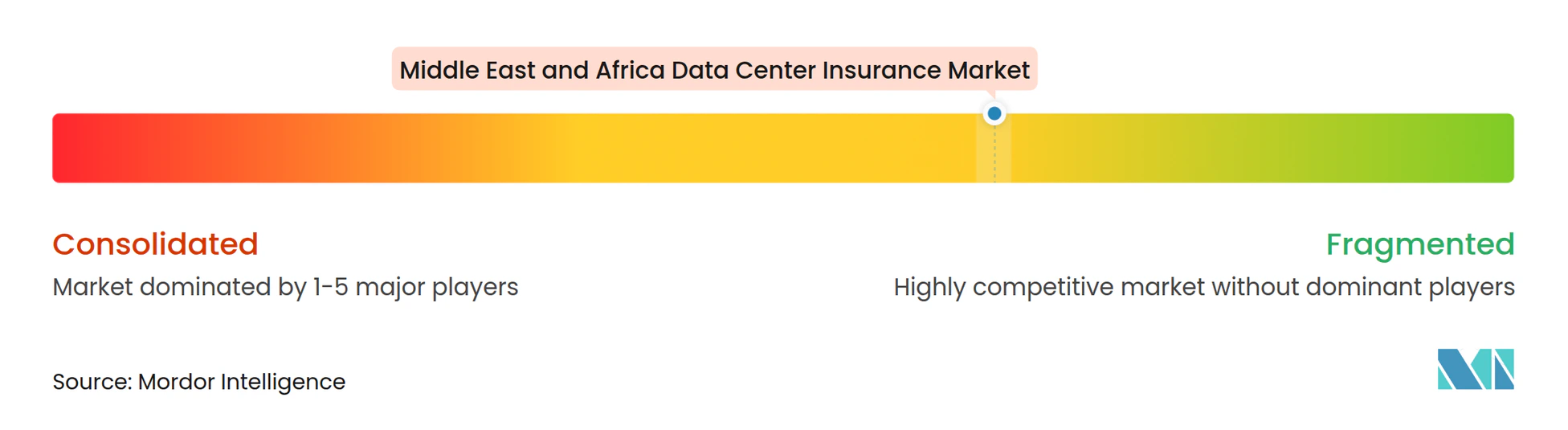
The Middle East and Africa data center insurance market is moderately concentrated among brokers and more fragmented among carriers. Aon, Marsh, Lockton, Howden, and Willis Towers Watson place many large accounts because they can design multi-layer programs and access international markets. Zurich, Allianz, AIG, Chubb, FM Insurance, Beazley, AXA, and QBE compete for primary layers. Munich Re, Swiss Re, and Lloyd's syndicates help provide reinsurance capacity for high-value sites.
Competition increasingly centers on risk services rather than on price alone. Marsh launched Data Center Insurance and Risk Management Services in July 2025 across the data center lifecycle. Lockton published a MENA Data Center Lifecycle Risk and Resilience Hub to support project and operational risk decisions. Howden partnered with Foresight to apply AI-enabled schedule analysis to construction programs. FM Insurance uses its claims experience to inform fire and liquid-cooling recommendations.
Mid-tier African colocation operators may have service obligations but insufficient premium volume to access complex international programs. Cyber-physical wording that addresses IT and operational technology events under a single policy is still developing in GCC markets. Captive arrangements are also emerging as large operators consider retaining selected risks. Africa Reinsurance Corporation and Africa Specialty Risks Limited provide locally focused knowledge through co-underwriting and fronting structures. Lloyd's Market Association guidance and FM Global loss-prevention standards continue to influence underwriting practices in the absence of a single MEA-specific technical standard.
Middle East and Africa Data Center Insurance Industry Leaders
-
Aon plc
-
Marsh & McLennan Companies, Inc.
-
Willis Towers Watson Public Limited Company
-
Lockton Companies, LLC
-
Howden Broking Group Limited
- *Disclaimer: Major Players sorted in no particular order
Middle East and Africa Data Center Insurance Market Companies Covered in this Report
- Aon plc
- Marsh & McLennan Companies, Inc.
- Willis Towers Watson Public Limited Company
- Lockton Companies, LLC
- Howden Broking Group Limited
- Zurich Insurance Group AG
- Allianz SE
- American International Group, Inc.
- Chubb Limited
- FM Insurance Company Limited
- Starr International Company, Inc.
- Liberty Mutual Holding Company Inc.
- AXA SA
- QBE Insurance Group Limited
- Beazley plc
- Munich Reinsurance Company
- Swiss Re Ltd
- Lloyd’s
- Africa Reinsurance Corporation
- Saudi Reinsurance Company
- Kuwait Reinsurance Company K.S.C.P.
- Oman Reinsurance Company SAOC
- Africa Specialty Risks Limited
- The Fidelis Partnership
Recent Industry Developments in Middle East and Africa Data Center Insurance Market
- August 2026: Allianz Commercial released its report on data center construction risks and claims trends, based on analysis of approximately EUR 700 million (USD 770 million) in insurance-industry claims, confirming fire as the primary driver of loss severity and equipment lead times of up to 80 weeks for switchgear and 50 weeks for transformers as material business interruption risk amplifiers for operators in import-dependent MEA markets.
- July 2026: Swiss Re Institute published sigma insights on insuring AI data center risks, projecting global data center insurance premiums to grow from USD 10.6 billion to USD 24.2 billion by 2030, with the core underwriting challenge centered on single-campus insured values that can exceed USD 20 billion and that no individual carrier can underwrite at full limit with traditional concentration management frameworks.
- March 2026: The SANS Institute released the GCC Cybersecurity Threat Landscape CXO Priorities Survey, covering 200 senior decision-makers across the region. The survey found ransomware (19%) and malware attacks (16%) recorded the highest year-over-year increases, with data directly informing underwriters' loss frequency assumptions for GCC cyber insurance programs attached to data centers.
- January 2026: Descartes Underwriting launched a parametric insurance product suite for data centers globally, offering flexible capacity of up to USD 140 million per policy against natural catastrophe triggers including earthquake, convective storms, and flood, designed to fill the gap between standard BI waiting periods and SLA penalty timelines for operators worldwide, including in MENA.
Middle East and Africa Data Center Insurance Market Report Scope
The Middle East and Africa data center insurance market provides risk transfer and coverage solutions tailored to protect digital infrastructure. It encompasses policies for property damage, business interruption, cyber liability, equipment breakdown, political violence, and construction risks associated with data center facilities across the region.
The Middle East and Africa Data Center Insurance Market Report is Segmented by Insurance Types (Property Damage Insurance, Business Interruption Insurance, Equipment Breakdown Insurance, Cyber Insurance, Natural Catastrophe Insurance, General and Third-Party Liability Insurance, Construction and Erection All-Risk Insurance, and Other Insurance Types), Coverage Structure (Standalone Policies, Combined Property and Business Interruption Policies, Package Policies, Parametric Insurance, and Captive and Self-Insurance Arrangements), Risk Exposure (Fire and Explosion, Electrical and Mechanical Equipment Failure, Power Supply Disruption, Flooding and Water Damage, Windstorms and Severe Weather, Earthquakes and Other Geophysical Hazards, Cyber-Related Operational Disruption, and Third-Party and Supply Chain Disruption), Policyholder (Data Center Owners and Operators, Colocation Providers, Cloud Service Providers, Data Center Developers and Contractors, and Data Center Equipment and Service Providers), Insurance Distribution Channel (Direct Insurance, Insurance Brokers and Consultants, Managing General Agents and Specialist Underwriting Agencies, and Reinsurance-Supported Insurance Programs), Data Center Size (Small, Medium, Large, and Hyperscale), Data Center Type (Colocation, Cloud Service Providers (CSPs), and Enterprise and Edge), and Geography (Saudi Arabia, United Arab Emirates, Qatar, Turkey, Rest of Middle East, South Africa, Kenya, Morocco, and Rest of Africa). The Market Forecasts are Provided in Terms of Value (USD).
Segmentation Overview
| Property Damage Insurance |
| Business Interruption Insurance |
| Equipment Breakdown Insurance |
| Cyber Insurance |
| Natural Catastrophe Insurance |
| General and Third-Party Liability Insurance |
| Construction and Erection All-Risk Insurance |
| Other Insurance Types |
| Standalone Policies |
| Combined Property and Business Interruption Policies |
| Package Policies |
| Parametric Insurance |
| Captive and Self-Insurance Arrangements |
| Fire and Explosion |
| Electrical and Mechanical Equipment Failure |
| Power Supply Disruption |
| Flooding and Water Damage |
| Windstorms and Severe Weather |
| Earthquakes and Other Geophysical Hazards |
| Cyber-Related Operational Disruption |
| Third-Party and Supply Chain Disruption |
| Data Center Owners and Operators |
| Colocation Providers |
| Cloud Service Providers |
| Data Center Developers and Contractors |
| Data Center Equipment and Service Providers |
| Direct Insurance |
| Insurance Brokers and Consultants |
| Managing General Agents and Specialist Underwriting Agencies |
| Reinsurance-Supported Insurance Programs |
| Small |
| Medium |
| Large |
| Hyperscale |
| Colocation |
| Cloud Service Providers (CSPs) |
| Enterprise and Edge |
| Middle East | Saudi Arabia |
| United Arab Emirates | |
| Qatar | |
| Turkey | |
| Rest of Middle East | |
| Africa | South Africa |
| Kenya | |
| Morocco | |
| Rest of Africa |
| By Insurance Type | Property Damage Insurance | |
| Business Interruption Insurance | ||
| Equipment Breakdown Insurance | ||
| Cyber Insurance | ||
| Natural Catastrophe Insurance | ||
| General and Third-Party Liability Insurance | ||
| Construction and Erection All-Risk Insurance | ||
| Other Insurance Types | ||
| By Coverage Structure | Standalone Policies | |
| Combined Property and Business Interruption Policies | ||
| Package Policies | ||
| Parametric Insurance | ||
| Captive and Self-Insurance Arrangements | ||
| By Risk Exposure | Fire and Explosion | |
| Electrical and Mechanical Equipment Failure | ||
| Power Supply Disruption | ||
| Flooding and Water Damage | ||
| Windstorms and Severe Weather | ||
| Earthquakes and Other Geophysical Hazards | ||
| Cyber-Related Operational Disruption | ||
| Third-Party and Supply Chain Disruption | ||
| By Policyholder | Data Center Owners and Operators | |
| Colocation Providers | ||
| Cloud Service Providers | ||
| Data Center Developers and Contractors | ||
| Data Center Equipment and Service Providers | ||
| By Insurance Distribution Channel | Direct Insurance | |
| Insurance Brokers and Consultants | ||
| Managing General Agents and Specialist Underwriting Agencies | ||
| Reinsurance-Supported Insurance Programs | ||
| By Data Center Size | Small | |
| Medium | ||
| Large | ||
| Hyperscale | ||
| By Data Center Type | Colocation | |
| Cloud Service Providers (CSPs) | ||
| Enterprise and Edge | ||
| By Geography | Middle East | Saudi Arabia |
| United Arab Emirates | ||
| Qatar | ||
| Turkey | ||
| Rest of Middle East | ||
| Africa | South Africa | |
| Kenya | ||
| Morocco | ||
| Rest of Africa | ||
Key Questions Answered in the Report
How large is data center insurance demand in the Middle East and Africa?
The regional market is estimated at USD 427.24 million in 2027 and is forecast to reach USD 893.69 million by 2032, at a 15.67% CAGR.
What is driving demand for data center insurance in the Middle East and Africa?
AI infrastructure investment, sovereign hosting requirements, expansion of GCC capacity, higher equipment values, and cyber exposure are increasing the need for specialized cover.
Which insurance type has the largest share in the Middle East and Africa data center insurance market?
Property Damage Insurance holds the largest share at 35.86% in 2026, reflecting the value of physical assets and the importance of fire and equipment protection.
Which segment is expected to grow fastest in data center insurance?
Hyperscale facilities are projected to grow at a 16.87% CAGR through 2032, closely followed by Cloud Service Providers at 16.83%.
Why is parametric insurance becoming relevant for data center operators?
Parametric cover can respond to defined outage triggers and may address service-level agreement penalties that begin sooner than standard business interruption cover responds.
Which country leads data center insurance demand in the region?
The United Arab Emirates leads with 27.63% share in 2026, while Saudi Arabia is projected to be the fastest-growing geography at a 16.56% CAGR through 2032.