
Middle East and Africa Data Center Cyber-Physical Security Market Size and Share
Market Overview
| Study Period | 2021 - 2032 |
|---|---|
| Forecast Data Period | 2027 - 2032 |
| Base Year Market Size (2026) | USD 292.03 Million |
| Market Size (2027) | USD 331.14 Million |
| Market Size (2032) | USD 621.37 Million |
| Growth Rate (2027 - 2032) | 13.41 % |
| Market Concentration | Medium |
Major Players *Disclaimer: Major Players sorted in no particular order Image © Mordor Intelligence. Reuse requires attribution under CC BY 4.0. | |
Middle East and Africa Data Center Cyber-Physical Security Market Analysis by Mordor Intelligence
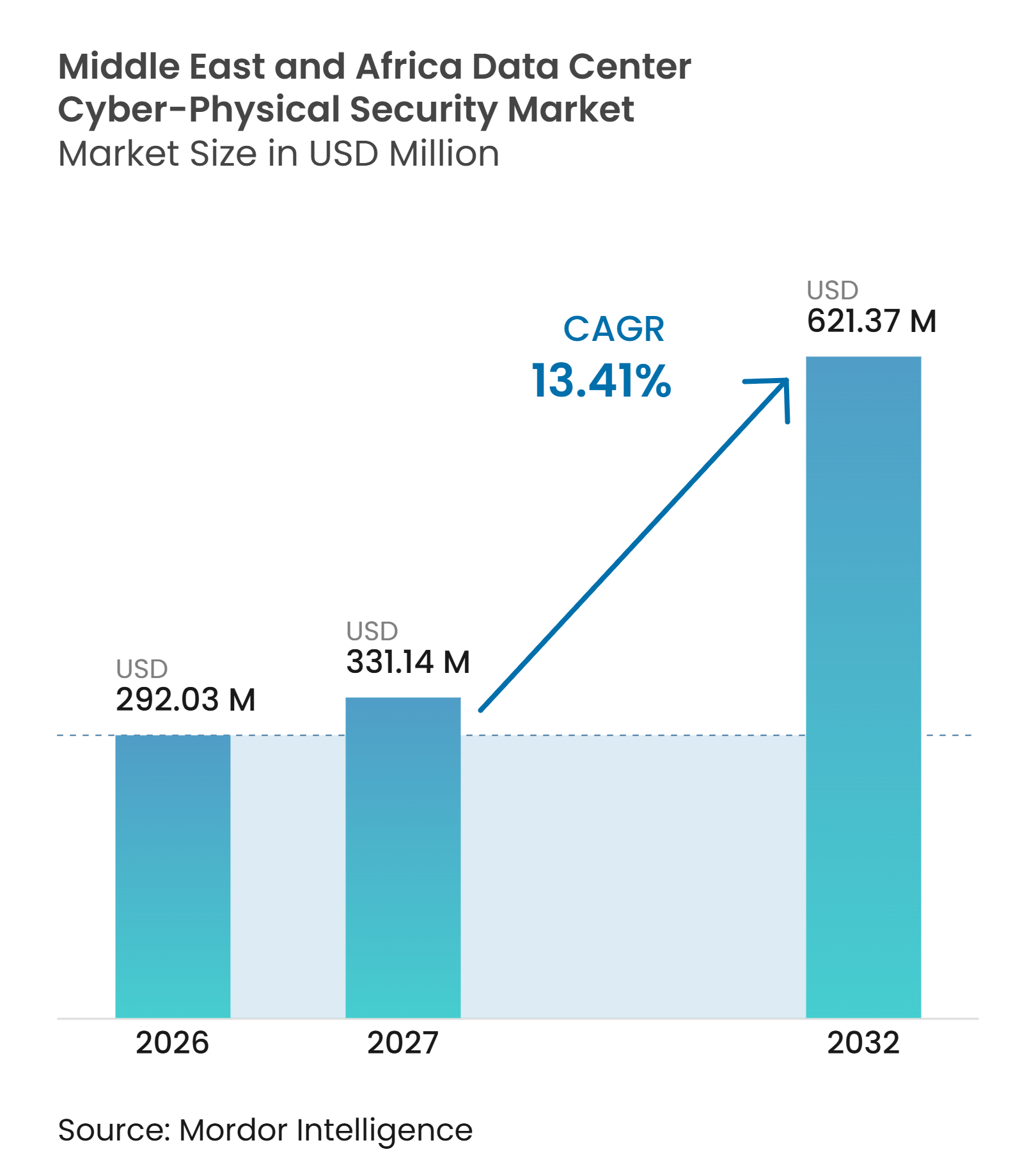
The Middle East and Africa data center cyber-physical security market size is expected to grow from USD 292.03 million in 2026 to USD 331.14 million in 2027, and is forecast to reach USD 621.37 million by 2032, at a 13.41% CAGR over 2027-2032. The Middle East and Africa data center cyber-physical security market is supported by new hyperscale, colocation, and AI-ready facilities that require auditable controls at the perimeter, access points, server halls, and infrastructure layers. Operators are combining video surveillance, access control, environmental monitoring, and operational technology security because building systems are increasingly connected to IP networks. Centralized platforms can help multi-site operators apply consistent policies and retain audit trails across facilities. The Middle East and Africa data center cyber-physical security market also faces delivery constraints because certified cyber-physical specialists and equipment designed for high-temperature conditions are not uniformly available across the region.
Key Report Takeaways
- By solution type, Network and Operational Technology Security Solutions held 28.12% of the Middle East and Africa data center cyber-physical security market share in 2026, while Unified Cyber-Physical Security Platforms are projected to expand at 14.26% CAGR through 2032.
- By security layer, Integrated Security Operations Platforms accounted for 32.38% of the market in 2026 and are projected to expand at a 17.92% CAGR through 2032.
- By deployment model, cloud-based solutions held 64.78% of the market in 2026, and are projected to expand at a 15.39% CAGR through 2032.
- By service type, System Integration and Implementation held 26.54% of the market in 2026, while Security Auditing and Compliance Services are projected to expand at a 16.59% CAGR through 2032.
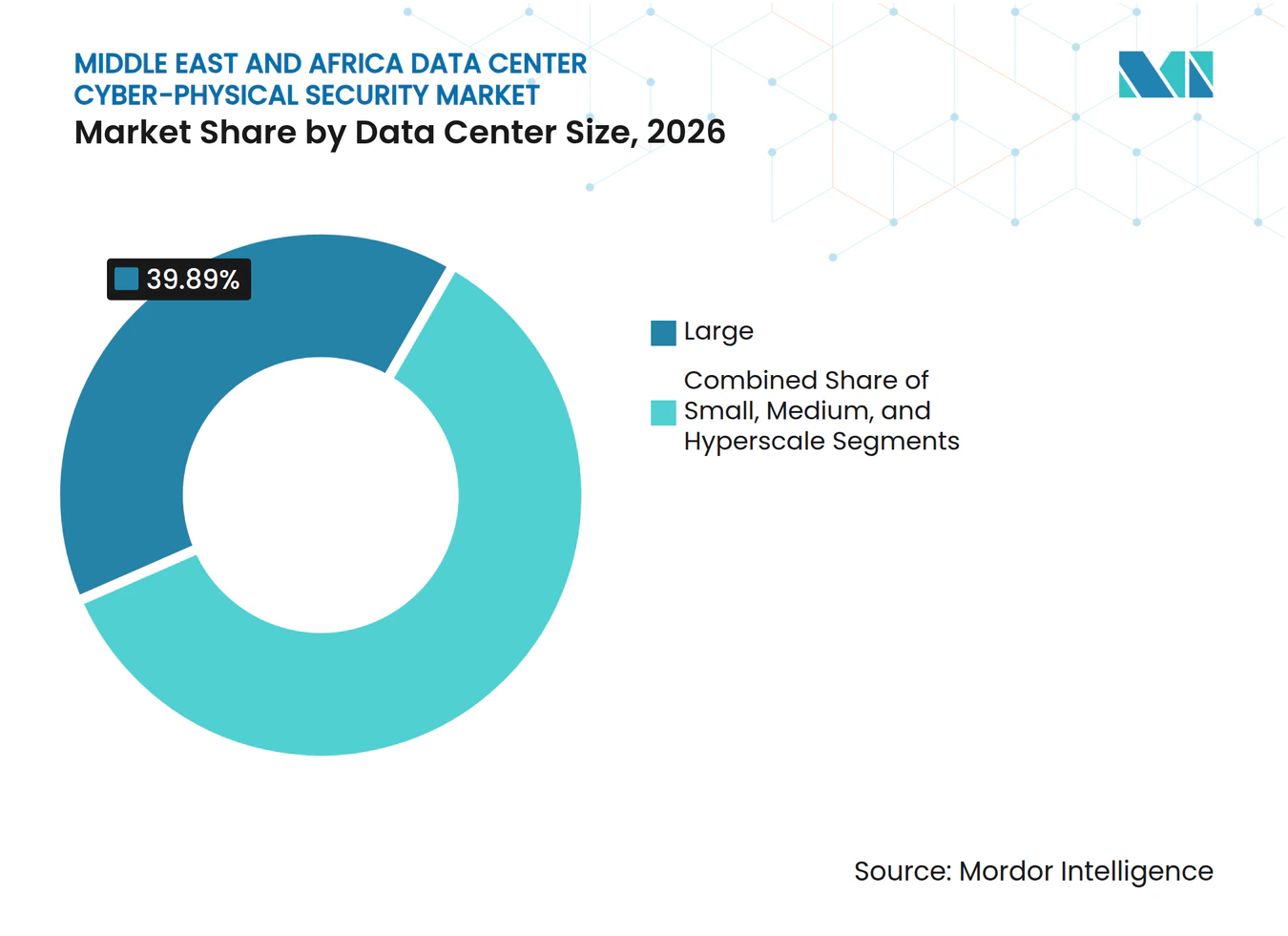
- By data center size, large facilities accounted for 39.89% of the Middle East and Africa data center cyber-physical security market share in 2026, while hyperscale facilities are projected to expand at a 17.27% CAGR through 2032.
- By data center type, colocation facilities held 38.74% of the market in 2026, while edge data centers are projected to expand at a 17.38% CAGR through 2032.
- By geography, the UAE held 37.53% of the Middle East and Africa data center cyber-physical security market in 2026, while Saudi Arabia is projected to expand at a 16.93% CAGR through 2032.
Note: Market numbers in this report are based on Mordor Intelligence's proprietary estimation framework, which combines nine months of actuals with Q4 projections for base year 2026.
Market Trends and Insights
Drivers Impact Analysis of Middle East and Africa Data Center Cyber-Physical Security Market*
| Driver | (~) % Impact on CAGR Forecast | Geographic Relevance | Impact Timeline |
|---|---|---|---|
| Expansion of Hyperscale and Colocation Data Centers | +3.2% | UAE and Saudi Arabia core, spillover to Turkey and South Africa | Short term (≤ 2 years) |
| Cloud Adoption, AI Workloads, and Digital Infrastructure Investment | +2.8% | UAE, Saudi Arabia, and South Africa | Short term (≤ 2 years) |
| National Data Sovereignty and Critical Infrastructure Protection Requirements | +2.3% | UAE, Saudi Arabia, Nigeria, and South Africa | Medium term (2-4 years) |
| Adoption of Integrated Security and Building Management Platforms | +1.8% | UAE and Saudi Arabia, expanding to South Africa and Nigeria | Medium term (2-4 years) |
| Rack-Level and Identity-Centric Protection for High-Density Computing | +1.4% | UAE and Saudi Arabia hyperscale campuses | Long term (≥ 4 years) |
| Cyber-Physical Convergence in Unmanned and Remotely Operated Facilities | +1.1% | UAE edge deployments, South Africa, and Nigeria remote facilities | Long term (≥ 4 years) |
| Source: Mordor Intelligence | |||
Expansion of Hyperscale and Colocation Data Centers
Hyperscale and colocation construction adds security requirements before a facility begins operations. Each data hall needs perimeter barriers, access controls, cameras, monitoring points, and records that support audits. The Middle East and Africa data center cyber-physical security market benefits because security requirements rise with physical floor space rather than staff headcount. Standardized designs can let a vendor extend a successful deployment across several facilities operated by the same customer. This favors providers that can coordinate equipment, software, integration, and ongoing services across countries. It also raises the value of local delivery partners where licensing and public procurement requirements differ.
Cloud Adoption, AI Workloads, and Digital Infrastructure Investment
AI-ready facilities concentrate high-value computing equipment in dense rack environments. These environments increase the need to manage entry to server halls and to identify abnormal thermal or environmental conditions. Microsoft has committed USD 15.2 billion to UAE investments through 2029, primarily for AI and cloud infrastructure, showing the scale of permanent infrastructure being developed in the country. Hyperscale designs commonly combine biometric access, anti-tailgating controls, continuous video coverage, and coordinated incident response. This pattern gives the Middle East and Africa data center cyber-physical security market a longer procurement cycle than a single construction phase. Vendors that meet standardized design requirements are better positioned to pursue repeat deployments.
National Data Sovereignty and Critical Infrastructure Protection Requirements
Data-hosting rules can create a compliance need for verifiable physical access records and monitored facilities. Government and regulated workloads often require operators to demonstrate that access is controlled and that events can be reviewed. These requirements can move physical security from a discretionary facility expense to a condition of service delivery. They also create defined purchasing periods when operators upgrade controls to meet a deadline. The Middle East and Africa data center cyber-physical security market can therefore favor suppliers that already meet security qualification requirements. Vendors with established relationships in the public sector and regulated industries may secure larger packages within a single budget cycle.
Increasing Adoption of Integrated Security and Building Management Platforms
Operators are moving from separate point solutions toward systems that combine security, building automation, and environmental controls. Integrated Security Operations Platforms held 32.38% of the Middle East and Africa data center cyber-physical security market in 2026 and are projected to expand at a 17.92% CAGR through 2032. Honeywell signed a February 2026 memorandum of understanding with Kortech to automate critical infrastructure projects, including data centers, in Egypt, Saudi Arabia, and the UAE.[1] Schneider Electric also formalized agreements in Saudi Arabia for smart energy management and building management system deployment for hyperscale data centers. Suppliers without native links between security events and facility telemetry may face weaker positions as customers consolidate vendors.
Restraints Impact Analysis of Middle East and Africa Data Center Cyber-Physical Security Market*
| Restraint | (~) % Impact on CAGR Forecast | Geographic Relevance | Impact Timeline |
|---|---|---|---|
| High Capital and Integration Costs for Multilayer Security Architecture | -2.1% | Nigeria, South Africa, Turkey, and Rest of Africa, moderately in Gulf | Short term (≤ 2 years) |
| Shortage of Cyber-Physical Security Specialists | -1.8% | Pan-regional, most acute in Sub-Saharan Africa | Medium term (2-4 years) |
| Legacy Infrastructure and Interoperability Constraints | -1.5% | South Africa, Nigeria, Turkey, and Rest of Middle East | Medium term (2-4 years) |
| Supply-Chain Delays and Environmental Hardening Requirements | -1.0% | Gulf markets and Sub-Saharan Africa | Short term (≤ 2 years) |
| Source: Mordor Intelligence | |||
High Capital and Integration Costs for Multilayer Security Architecture
A compliant multilayer design combines perimeter detection, biometric access, video analytics, monitoring, operational technology security, and a central management platform. The upfront cost can be difficult for smaller operators to finance in a single investment cycle. Convergint delivered a EUR 5 million (USD 5.3 million) security package for a hyperscale facility, including 5 data halls, more than 900 cameras, and more than 150 access control devices.[2] The project shows why phased deployments and financing options can matter in cost-sensitive locations. Those approaches may also require integrators to carry receivables for longer periods. This can narrow the pool of vendors prepared to serve smaller projects.
Shortage of Cyber-Physical Security Specialists
Modern data center protection requires skills across information technology, operational technology, and physical security. Teams must configure access policy, interpret video alerts, manage connected building systems, and coordinate incident response. Genetec identified skilled talent availability as a constraint on security platform adoption in its 2026 State of Physical Security report. Limited staffing can delay commissioning and make maintenance more difficult for complex facilities. It can also concentrate work among a small group of qualified integrators. This reduces price competition for specialized deployment and managed service contracts.
*Our forecasts treat driver/restraint impacts as directional, not additive. The impact forecasts reflect baseline growth, mix effects, and variable interactions.
Middle East and Africa Data Center Cyber-Physical Security Market Segment Analysis
By Solution Type:
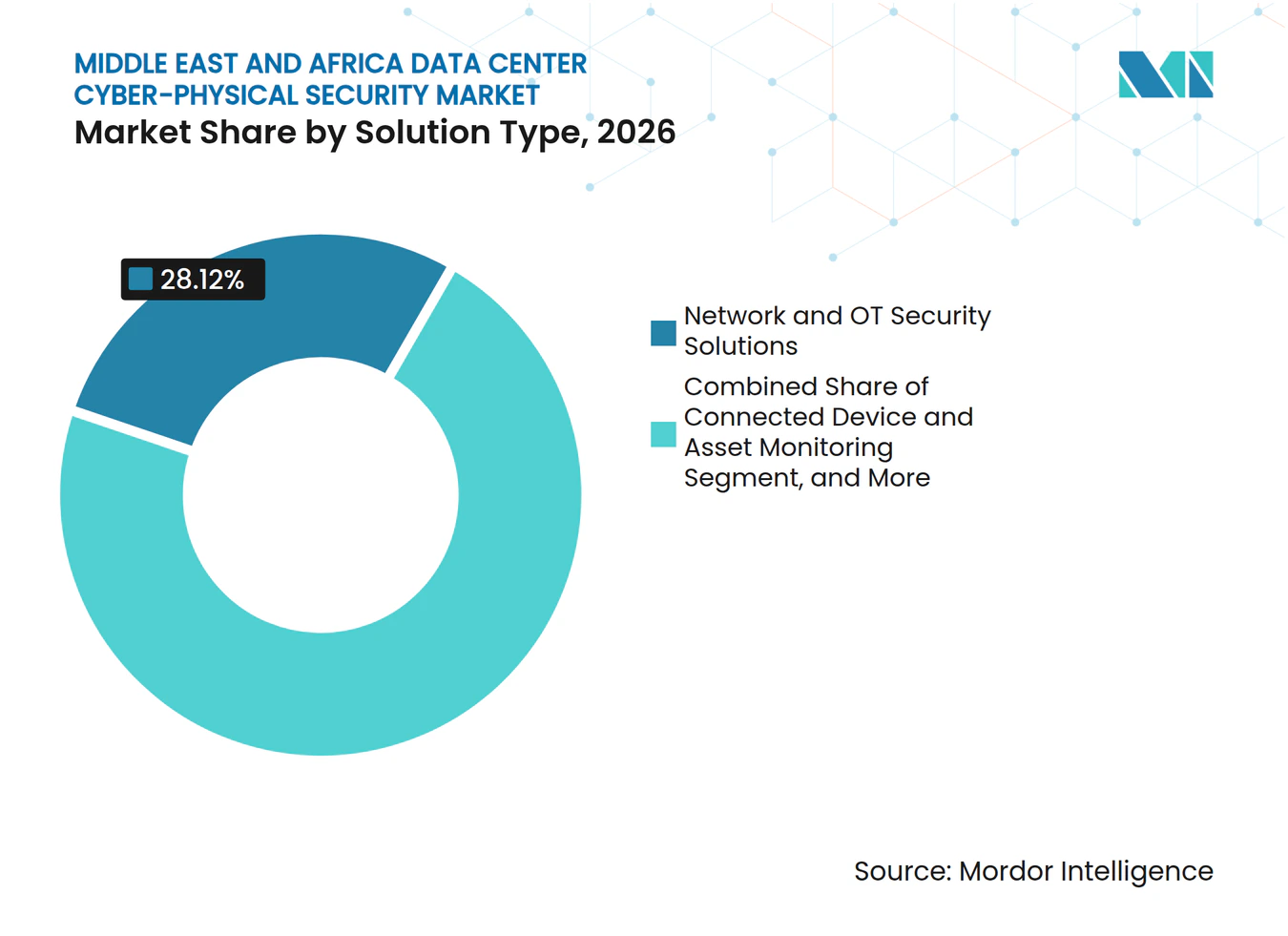
Network and Operational Technology Security Holds the Largest ShareNetwork and Operational Technology Security Solutions held 28.12% of the market in 2026. Building systems that control power, cooling, and physical access points are increasingly connected to corporate networks. That connection can create attack paths where systems were once isolated. Security for operational technology is therefore central to protecting generators, switchgear, precision cooling, and access barriers. The Middle East and Africa data center cyber-physical security market size for this category reflects the need to secure those connected facility systems.
Unified Cyber-Physical Security Platforms are projected to expand at a 14.26% CAGR through 2032. Operators are seeking common response processes for physical and digital events. Connected Device and Asset Monitoring Solutions provide visibility across large inventories of IP-connected sensors. Security Information and Event Correlation Solutions combine building, access, and network information for faster review. Identity and Access Management Solutions support zero-trust policies for staff, contractors, and visitors. Integration and Incident Response Services connect these technologies with operating procedures and managed services.



By Security Layer:
Integrated Platforms Lead Security ConsolidationIntegrated Security Operations Platforms accounted for 32.38% of the market in 2026. The category brings video surveillance, access control, perimeter protection, and operational alerts into one view. It can reduce the number of separate dashboards used by security and facility teams. Axis Communications describes an East African data center deployment that administered video management, access control, and perimeter protection through a single interface.[3] The arrangement can support security coverage without a corresponding increase in operating headcount.
This security layer is projected to expand at a 17.92% CAGR through 2032. Physical Access Control Systems and Video Surveillance Systems remain the base layer for data center security designs. Building Management and Facility Control Systems are becoming more relevant where teams need shared oversight of cooling, power, and fire systems. Environmental and Infrastructure Monitoring Systems address heat, humidity, and equipment performance conditions. Integrated platforms can make it easier to investigate a physical event alongside infrastructure alerts. The resulting switching costs can support recurring licenses, service agreements, and implementation work.
By Deployment Model:
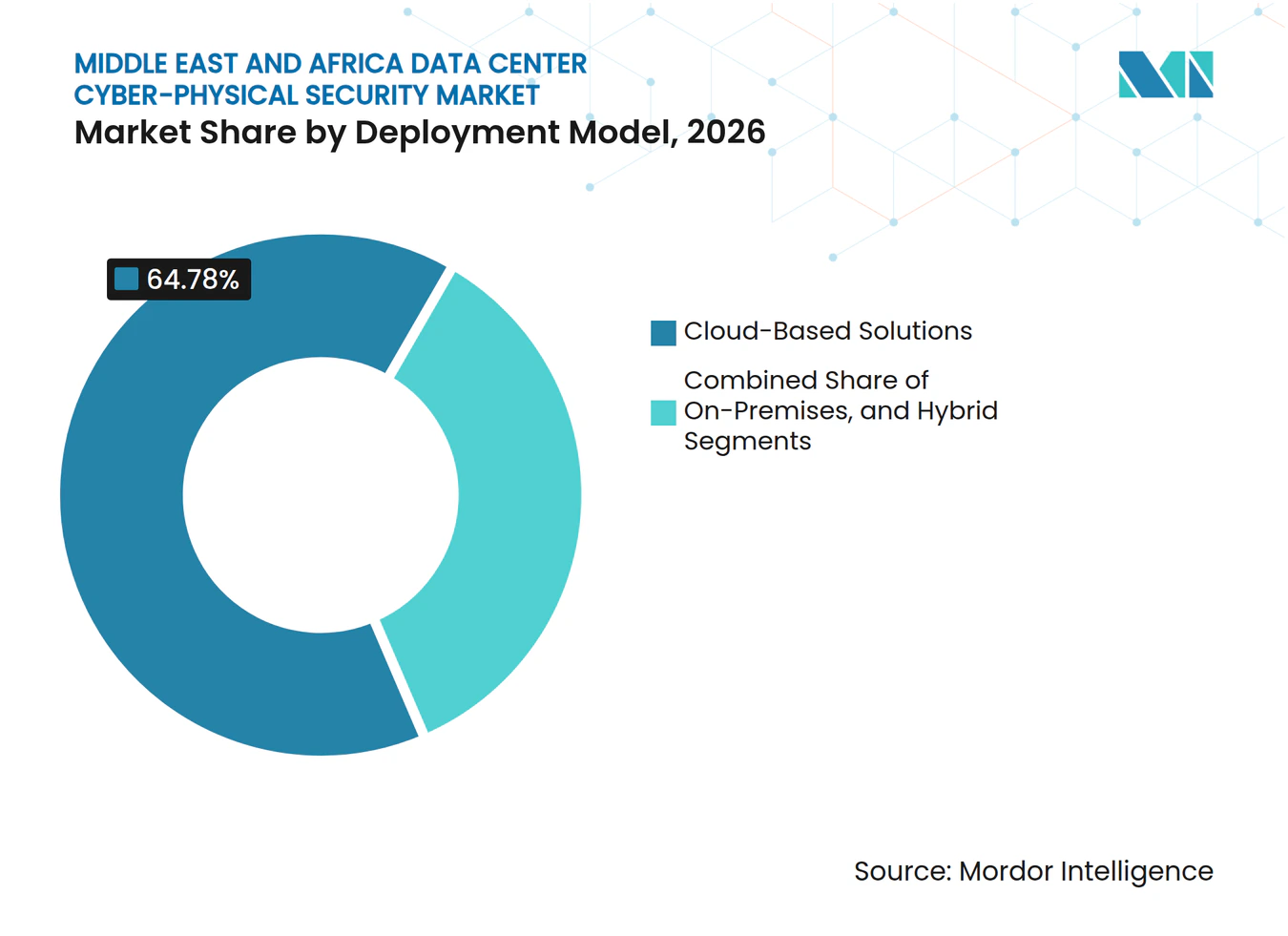
Cloud Management Shapes Security ArchitectureCloud-based solutions held 64.78% of the Middle East and Africa data center cyber-physical security market in 2026. Multi-site operators use cloud management to enforce consistent access policies across dispersed facilities. The model can centralize firmware management and produce audit trails without operating a separate server environment at every site. Brivo notes that cloud-based physical security still requires local controller operation during connectivity interruptions and local event retention for critical environments.[4] This makes resilient, hybrid-ready architecture important for high-availability facilities.
On-premise solutions remain relevant for government-classified facilities and sovereign cloud operations. Such facilities can restrict off-premise handling of access records and security data. Hybrid deployments combine centralized policy oversight with local processing and storage. This structure is useful for portfolios operating in both the Gulf and Sub-Saharan Africa, with different connectivity conditions. The Middle East and Africa data center cyber-physical security market can therefore support multiple deployment approaches. Suppliers need to support compliance requirements without reducing local operating resilience. This requirement places value on systems that maintain access control and event records during a disruption.

By Service Type:
Compliance Services Advance While Integration LeadsSystem Integration and Implementation held 26.54% of the market in 2026. New facilities require qualified providers to install, connect, test, and certify controls from multiple vendors. The service supports alignment with facility design rules and national compliance obligations. It also remains important when existing facilities upgrade security systems for AI-grade tenants. The market for integration shows the importance of commissioning work at this stage of regional construction.
Security Auditing and Compliance Services are projected to expand at a 16.59% CAGR through 2032. Data sovereignty and critical-infrastructure requirements increase the need for documented security reviews. Cyber-Physical Risk Assessment Services help operators assess controls across technology and facility environments. Managed Monitoring and Detection Services can support operators who cannot staff continuous security operations internally. Incident Response and Recovery Services extend the relationship from detection to remediation. Recurring services may become more important as commissioned facilities move into operating maturity.
By Data Center Size:
Hyperscale Facilities Set the Fastest PaceLarge data centers held 39.89% of the market in 2026. Established Tier III and Tier IV colocation facilities in the UAE and Saudi Arabia underpin this position. These facilities require upgrades when new tenants seek stronger protection than their legacy designs provide. Their scale increases the number of controlled doors, cameras, and monitored infrastructure points. Large facilities also give integrators a base of recurring upgrade and support work.
Hyperscale facilities are projected to expand at a 17.27% CAGR through 2032. Khazna Data Centers acquired a 225,000-square-meter land parcel in Dammam in December 2025 for up to 200 MW of AI-ready capacity. Hyperscale requirements can drive higher security spending per square meter than smaller facilities. Medium facilities are expanding as enterprises move from server rooms to purpose-built sites. Small facilities remain relevant in markets where telecommunications providers deploy local edge nodes. Vendors must balance simplified installation for smaller sites with the ability to scale as customer demand increases. Packages that combine core access, video, and environmental controls can address this transition without requiring a complete replacement.
By Data Center Type:
Edge Facilities Are the Fastest-Growing TypeColocation data centers held 38.74% of the market in 2026. These facilities host multiple tenants and therefore need clear physical separation, documented access, and shared security procedures. They also support many AI and cloud workloads that require high-specification controls. The Middle East and Africa data center cyber-physical security market size for colocation facilities reflects the central role of these facilities in regional hosting capacity. The buyer may be the facility owner rather than the tenant, which changes the supplier qualification process. Sales teams need to identify which party owns the facility risk and approves the security budget.
Edge data centers are projected to expand at a 17.38% CAGR through 2032. Their locations outside major hubs can place security systems in remote or lightly staffed environments. Remote operation makes automated video analytics, access management, and environmental monitoring more important. Edge sites often need responses that do not depend on an on-site guard. Cloud Service Providers can also standardize security designs across regional portfolios. Suppliers that understand budget control at both the landlord and tenant levels can position their offerings more effectively.
Geography Analysis
The UAE held 37.53% of the market in 2026. Its lead reflects established data center capacity and relationships with global hyperscalers in Dubai and Abu Dhabi. The country’s facility base is adding floor space that requires security equipment and managed controls. Operators in regulated sectors also need verifiable access management and surveillance records. The UAE is therefore a priority location for suppliers with unified physical security and building-management capabilities.
Saudi Arabia is projected to expand at a 16.93% CAGR through 2032. The country is developing more AI-ready and government-related digital infrastructure, which supports demand for stringent facility controls. Turkey has a large data center facility count within the wider regional landscape. Its operators are seeking international certifications as rack density rises and colocation requirements evolve. The rest of the Middle East includes markets at different stages of digital infrastructure development. International investment is bringing more formal security design standards to those locations.
South Africa remains an important procurement location because large data center campuses require continuous access control and monitoring. Teraco completed its CT2 expansion in Cape Town at 50 MW of critical IT load in November 2025. The project added 32 MW across 8 data halls and shows the scale of security systems needed at a large campus. Nigeria is drawing investment in AI-enabled facilities and has compliance-related demand from financial services data localization. The region also needs equipment that can operate reliably despite variable power conditions and complex logistics. These conditions create opportunities for the Middle East and Africa data center cyber-physical security market where providers can deliver reliable installation, service, and audit support.
Competitive Landscape
Market Concentration
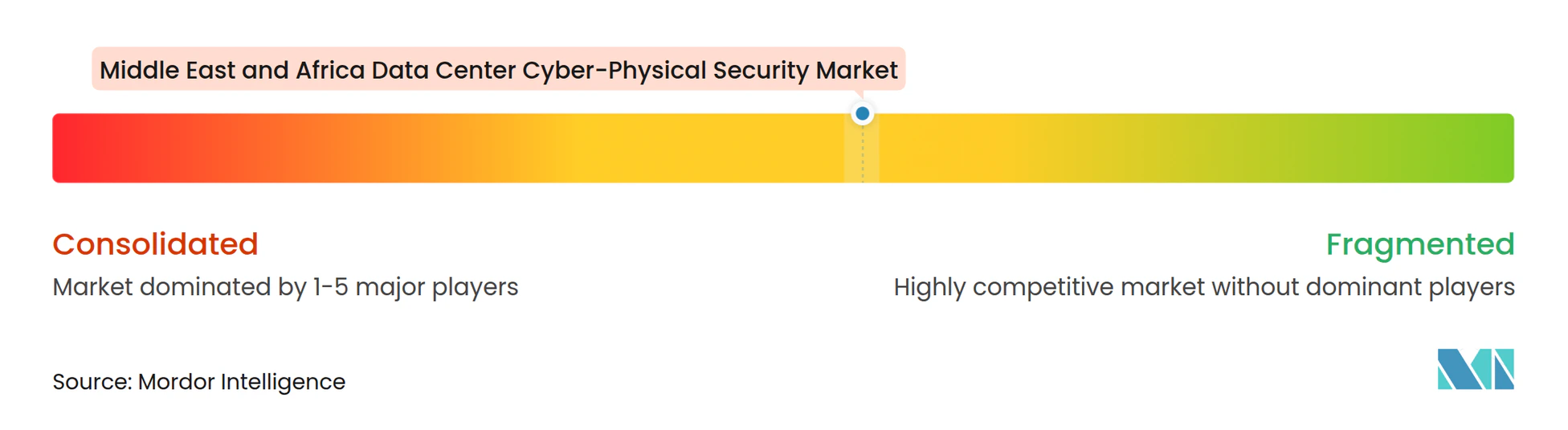
The Middle East and Africa data center cyber-physical security market has a concentrated top tier for large hyperscale and high-specification colocation contracts. Johnson Controls International, Honeywell International, Schneider Electric, and Siemens have broad portfolios that span physical security, automation, and facility controls. Regional systems integrators remain important because they understand local licensing, delivery practices, and procurement processes. Honeywell’s February 2026 agreement with Kortech combined its automation and digital security portfolio with regional engineering capability. This partnership approach can be more practical than building a delivery organization from the ground up in each country.
The Middle East and Africa data center cyber-physical security market is also changing as buyers combine operational technology security with access, video, and building systems. Schneider Electric and Cyberani by Aramco Digital announced a December 2025 agreement on joint operational technology and physical security initiatives in Saudi Arabia. ASSA ABLOY introduced its KentixONE platform to audiences in the Middle East and Africa for integrated monitoring and access control across more than 40 physical threat categories. Siemens positions cyber protection for converged IT and operational technology environments as a data center requirement. These moves show why integrated capabilities are becoming more important in vendor selection.
Smaller enterprises and edge accounts remain more fragmented than the high-end contract segment. BIOS Middle East Group, Pacific Control Systems, and 3S System Security Solutions have Gulf procurement expertise that can support partnerships with larger technology providers. Geographic opportunities are present in Sub-Saharan Africa outside South Africa and Nigeria, where formal security programs are still being developed. Architectural opportunities are also available for specialists in operational technology networks and building management systems. The competitive position of a supplier increasingly depends on integration depth, local delivery capacity, and post-commissioning support. Buyers also assess whether platforms can combine surveillance, access control, building data, and operational technology events without creating separate workflows. This requirement raises the importance of interoperable systems and trained local support teams. It can also favor long-term supplier relationships over isolated equipment purchases in large facilities. No combined share for the leading suppliers is provided, so a market concentration score cannot be assigned under the required methodology.
Middle East and Africa Data Center Cyber-Physical Security Industry Leaders
-
Johnson Controls International plc
-
Honeywell International Inc.
-
Schneider Electric SE
-
Siemens AG
-
Bosch Sicherheitssysteme GmbH
- *Disclaimer: Major Players sorted in no particular order
Middle East and Africa Data Center Cyber-Physical Security Market Companies Covered in this Report
- Johnson Controls International plc
- Honeywell International Inc.
- Schneider Electric SE
- Siemens AG
- Bosch Sicherheitssysteme GmbH
- Axis Communications AB
- ASSA ABLOY AB
- LenelS2
- Securitas Technology
- ABB Ltd
- Suprema Inc.
- Brivo Systems LLC
- Genetec Inc.
- Motorola Solutions, Inc.
- Convergint Technologies LLC
- 3S System Security Solutions Co.
- Ctelecoms
- BIOS Middle East Group
- Pacific Control Systems
- Africa Data Centres
- Teraco Data Environments (Pty) Ltd
Recent Industry Developments in Middle East and Africa Data Center Cyber-Physical Security Market
- September 2026: TEPCO Power Grid deployed Genetec Security Center to unify security operations across its critical infrastructure network, centralizing management of over 30,000 cameras and establishing a scalable platform supporting future digital transformation across the TEPCO grid. This deployment signals growing adoption of unified physical security platforms in energy-adjacent critical infrastructure with operational parallels to large data center campuses.
- September 2026: Johnson Controls launched AI-enabled security innovations at GSX 2026, including exacqVision 26.2 video management software with AI-driven insights across distributed camera fleets and Software House C•CURE IQ 3.20, which integrates video management, incident response, reporting, and spatial analytics into a single web-based access control platform. The company also introduced new Managed Services and Proactive Video Solutions designed for organizations expanding security operations in mission-critical environments.
- March 2026: Johnson Controls unveiled C-CURE IQ 3.2, IQ Panel 5 updates, and PowerSeries Neo 5 hybrid intrusion platform configurations at ISC West 2026. The release combines access control, video management, and incident workflows into a unified interface for mission-critical environments including data centers.
- February 2026: Honeywell signed a memorandum of understanding with Kortech (Hassan Allam Holding subsidiary) to automate and digitize critical infrastructure projects, including data centers, across Egypt, Saudi Arabia, and the UAE, combining Honeywell's global automation and digital security portfolio with Kortech's regional engineering delivery capability in what represents a significant expansion of Honeywell's MEA data center security presence.
Middle East and Africa Data Center Cyber-Physical Security Market Report Scope
The Middle East and Africa Data Center Cyber-Physical Security Market covers revenue from security solutions and services deployed in data centers across the UAE, Saudi Arabia, Turkey, South Africa, Nigeria, and other regional markets. Growth is driven by government-led digital infrastructure programs, data center construction in the Gulf region, critical infrastructure protection initiatives, and the rising adoption of remote monitoring and integrated security services.
The Middle East and Africa Data Center Cyber-Physical Security Market Report is Segmented by Solution Type (Unified Cyber-Physical Security Platforms, Connected Device and Asset Monitoring Solutions, Security Information and Event Correlation Solutions, Network and Operational Technology Security Solutions, Identity and Access Management Solutions, and Integration and Incident Response Services), Security Layer (Physical Access Control Systems, Video Surveillance Systems, Building Management and Facility Control Systems, Environmental and Infrastructure Monitoring Systems, and Integrated Security Operations Platforms), Deployment Model (On-Premise Solutions, Cloud-Based Solutions, and Hybrid Solutions), Service Type (Cyber-Physical Risk Assessment, System Integration and Implementation, Managed Monitoring and Detection, Incident Response and Recovery, and Security Auditing and Compliance Services), Data Center Size (Small, Medium, Large, and Hyperscale), Data Center Type (Colocation, Cloud Service Providers (CSPs), and Enterprise / Edge), and Geography (Middle East, and Africa). The Market Forecasts are Provided in Terms of Value (USD).
Segmentation Overview
| Unified Cyber-Physical Security Platforms |
| Connected Device and Asset Monitoring Solutions |
| Security Information and Event Correlation Solutions |
| Network and Operational Technology Security Solutions |
| Identity and Access Management Solutions |
| Integration and Incident Response Services |
| Physical Access Control Systems |
| Video Surveillance Systems |
| Building Management and Facility Control Systems |
| Environmental and Infrastructure Monitoring Systems |
| Integrated Security Operations Platforms |
| On-Premise Solutions |
| Cloud-Based Solutions |
| Hybrid Solutions |
| Cyber-Physical Risk Assessment |
| System Integration and Implementation |
| Managed Monitoring and Detection |
| Incident Response and Recovery |
| Security Auditing and Compliance Services |
| Small |
| Medium |
| Large |
| Hyperscale |
| Colocation |
| Cloud Service Providers (CSPs) |
| Enterprise / Edge |
| Middle East | United Arab Emirates |
| Saudi Arabia | |
| Turkey | |
| Rest of Middle East | |
| Africa | South Africa |
| Nigeria | |
| Rest of Africa |
| By Solution Type | Unified Cyber-Physical Security Platforms | |
| Connected Device and Asset Monitoring Solutions | ||
| Security Information and Event Correlation Solutions | ||
| Network and Operational Technology Security Solutions | ||
| Identity and Access Management Solutions | ||
| Integration and Incident Response Services | ||
| By Security Layer | Physical Access Control Systems | |
| Video Surveillance Systems | ||
| Building Management and Facility Control Systems | ||
| Environmental and Infrastructure Monitoring Systems | ||
| Integrated Security Operations Platforms | ||
| By Deployment Model | On-Premise Solutions | |
| Cloud-Based Solutions | ||
| Hybrid Solutions | ||
| By Service Type | Cyber-Physical Risk Assessment | |
| System Integration and Implementation | ||
| Managed Monitoring and Detection | ||
| Incident Response and Recovery | ||
| Security Auditing and Compliance Services | ||
| By Data Center Size | Small | |
| Medium | ||
| Large | ||
| Hyperscale | ||
| By Data Center Type | Colocation | |
| Cloud Service Providers (CSPs) | ||
| Enterprise / Edge | ||
| By Geography | Middle East | United Arab Emirates |
| Saudi Arabia | ||
| Turkey | ||
| Rest of Middle East | ||
| Africa | South Africa | |
| Nigeria | ||
| Rest of Africa | ||
Key Questions Answered in the Report
What is the Middle East and Africa data center cyber-physical security market size?
The Middle East and Africa data center cyber-physical security market size is expected to grow from USD 292.03 million in 2026 to USD 331.14 million in 2027, and is forecast to reach USD 621.37 million by 2032, at a 13.41% CAGR over 2027-2032.
Which solution category leads regional spending?
Network and Operational Technology Security Solutions lead with a 28.12% share in 2026.
Why are integrated security platforms important for data centers?
They combine access, video, perimeter, and facility information in a common operating interface and held a 32.38% share in 2026.
Which deployment model is most common for data center physical security?
Cloud-based solutions account for 64.78% of 2026 spending, supported by centralized policy management across multi-site portfolios.
Which facilities will expand security spending fastest?
Edge data centers are projected to expand at a 17.38% CAGR through 2032, followed by hyperscale facilities at a 17.27% CAGR.
Which country leads the regional sector?
The UAE leads with a 37.53% share in 2026, while Saudi Arabia has the highest forecast CAGR at 16.93% through 2032.