
Market Overview
| Study Period | 2020 - 2031 |
|---|---|
| Forecast Data Period | 2026 - 2031 |
| Base Year Market Size (2025) | 2.07 Million tonnes |
| Market Volume (2026) | 2.15 Million tonnes |
| Market Volume (2031) | 2.62 Million tonnes |
| Growth Rate (2026 - 2031) | 3.97 % |
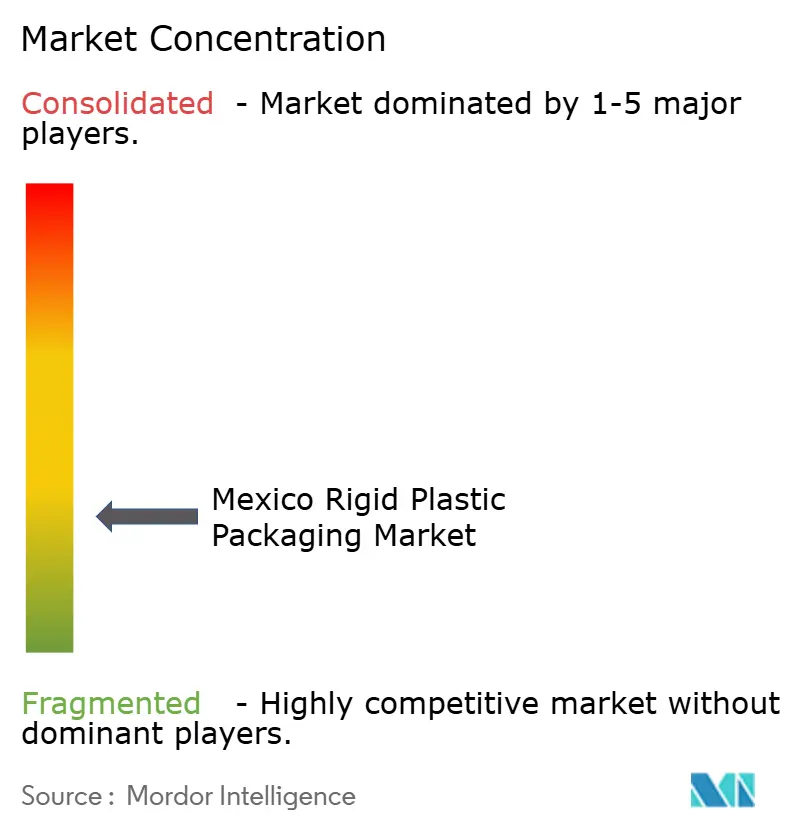
| Market Concentration | Low |
Major Players *Disclaimer: Major Players sorted in no particular order Image © Mordor Intelligence. Reuse requires attribution under CC BY 4.0. | |
Mexico Rigid Plastic Packaging Market Analysis by Mordor Intelligence
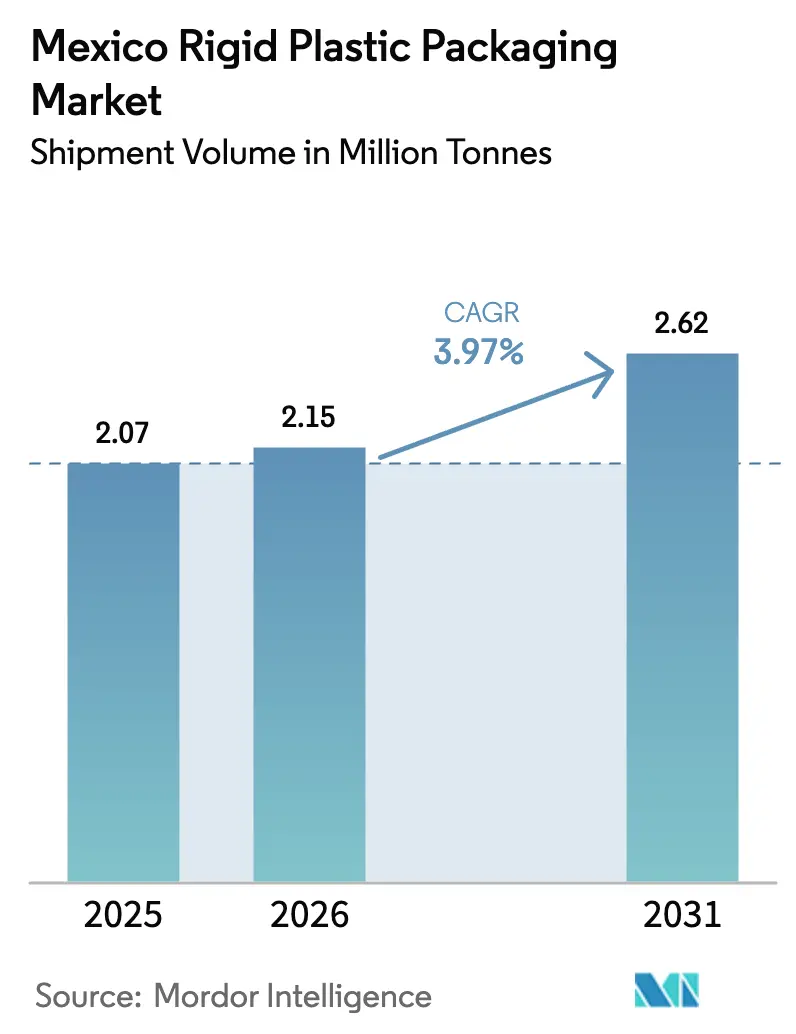
The Mexico rigid plastic packaging market size is expected to grow from 2.07 million tonnes in 2025 to 2.15 million tonnes in 2026 and is forecast to reach 2.62 million tonnes by 2031 at 3.97% CAGR over 2026-2031. Accelerated bottled-water consumption, strong nearshoring inflows, and resilient food exports underpin steady volume expansion, while substitution away from glass and metal containers further enlarges addressable demand. Lower resin costs relative to competing materials and the country’s developed recycling infrastructure support competitive production economics, whereas localized manufacturing clusters minimize logistics outlays. Regulatory momentum around circular-economy goals motivates brand owners to specify higher recycled-content packs, thereby stimulating investment in advanced sorting, washing, and extrusion assets. Nevertheless, state-level single-use levies and rPET feedstock tightness temper growth potential, keeping the price–volume equation finely balanced.
Key Report Takeaways
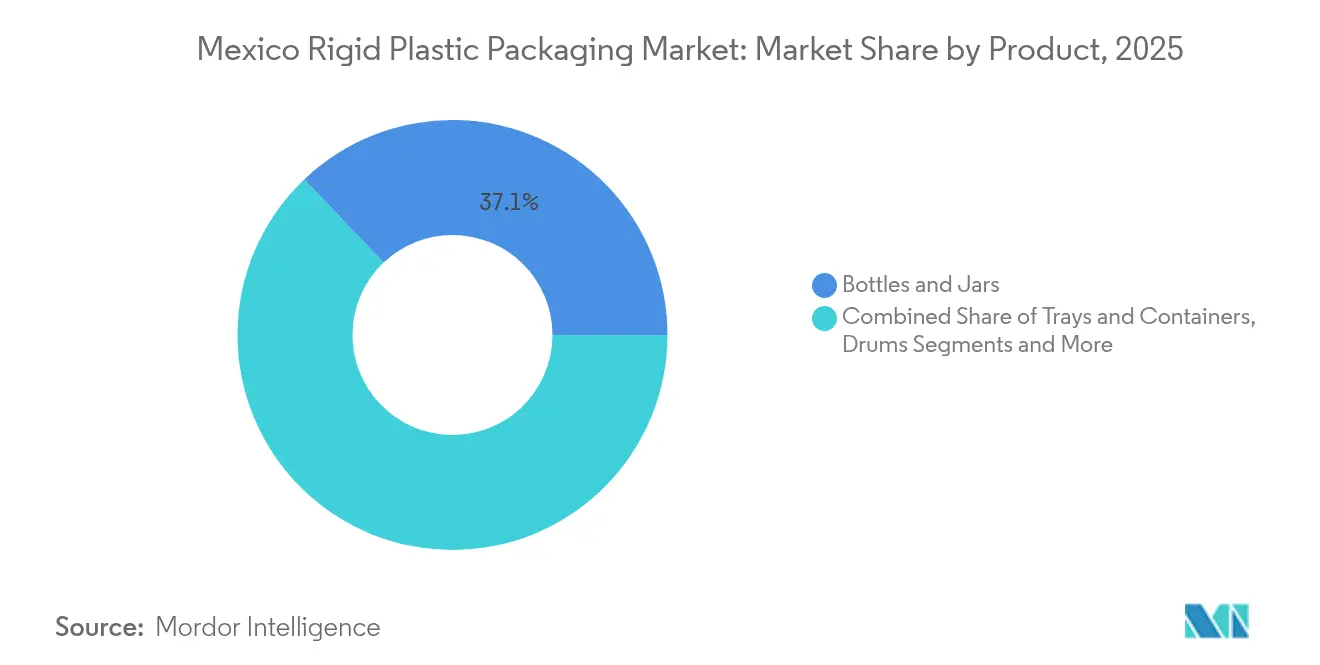
- By product, bottles and jars captured 37.12% of the Mexico rigid plastic packaging market share in 2025.
- By material, the Mexico rigid plastic packaging market size for polyethylene is projected to grow at a 4.74% CAGR between 2026 to 2031.
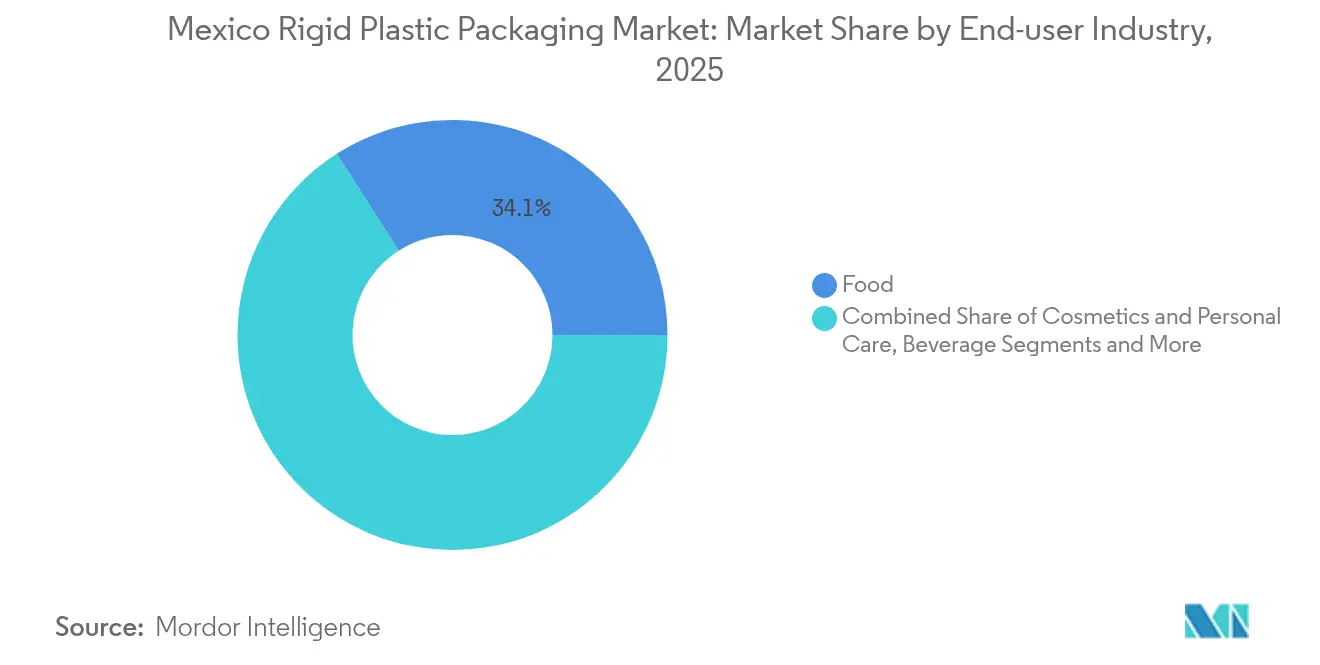
- By end-user industry, food captured 34.05% of the Mexico rigid plastic packaging market share in 2025.
Note: Market size and forecast figures in this report are generated using Mordor Intelligence’s proprietary estimation framework, updated with the latest available data and insights as of 2026.
Mexico Rigid Plastic Packaging Market Trends and Insights
Drivers Impact Analysis*
| Driver | (~) % Impact on CAGR Forecast | Geographic Relevance | Impact Timeline |
|---|---|---|---|
| Bottled-water and carbonated-soft-drink uptake | +1.2% | Nationwide urban centers | Short term (≤ 2 years) |
| Manufacturing nearshoring rebound | +0.9% | Northern border and Bajío | Medium term (2–4 years) |
| Food-export packaging requirements | +0.7% | Pacific agricultural states | Medium term (2–4 years) |
| Glass/metal-to-plastic substitution | +0.5% | Countrywide | Long term (≥ 4 years) |
| Pre-emptive tethered-cap adoption | +0.3% | National, anticipating regulatory alignment | Short term (≤ 2 years) |
| E-grocery boom requiring sturdy packs | +0.4% | Metropolitan areas, expanding to secondary cities | Short term (≤ 2 years) |
| Source: Mordor Intelligence | |||
Rise in Bottled-Water and CSD Consumption
Mexico retains the world’s highest per-capita bottled-water intake at 234 liters and maintains strong carbonated-soft-drink preferences, a pairing that produces reliable PET bottle volumes even during macro-economic softness. Federal health-risk standards enforced by COFEPRIS favor converters with certified hygienic operations, creating barriers to informal entrants. A 56% PET recycling rate achieved by PetStar demonstrates the closed-loop potential that increasingly influences brand procurement decisions. Bottled water’s role as a substitute for municipal supply makes demand comparatively inelastic, safeguarding baseline throughput for resin producers and molders.
Manufacturing Nearshoring Rebound
United States–Mexico-Canada Agreement (USMCA) certainty, coupled with supply-chain realignment out of Asia, delivered 10.63 million ft² of new industrial-space absorption around Monterrey in 2024, clustering electronics, appliance, and automotive plants that consume trays, component totes, and IBCs. Nuevo León alone hosts 79 industrial parks, enabling converters to run high-utilization lines while servicing diverse customers within a two-hour drive radius. Chinese tier-1 auto suppliers’ USD 7.06 billion cumulative investments since 2019 continue to spawn demand for protective battery housings and under-hood part packaging that must meet stringent OEM specifications.
Food-Export Packaging Demand
Mexico’s status as a major produce exporter to North America requires rigid containers that safeguard avocado and berry shipments through multi-modal transit and varied climates. ISO 22000 and FSSC 22000 certifications have become selection criteria among export-oriented packers, favoring suppliers with robust quality-assurance systems. The General Law of Adequate and Sustainable Food, effective April 2024, enforces prominent nutrition panels, driving adoption of high-clarity resins and superior printing surfaces.
Glass/Metal-to-Plastic Substitution
Lightweight plastic designs lower freight emissions and costs versus glass, a crucial factor given elevated diesel prices. Blow-mold advancements now realize thin-wall bottles retaining top-load strength, allowing beverage and sauce brands to migrate away from heavier formats. Plastic’s compatibility with recycled content supports corporate sustainability pledges, while integrated supply chains such as ALPLA’s 32 Mexican plants yield speed-to-market advantages.[1]ALPLA, “Company Fact Sheet,” alpla.com
Restraints Impact Analysis*
| Restraint | (~) % Impact on CAGR Forecast | Geographic Relevance | Impact Timeline |
|---|---|---|---|
| Environmental and disposal concerns | -0.8% | Urban municipalities | Medium term (2–4 years) |
| State-level single-use-plastic taxes | -0.6% | State-specific implementation, varying enforcement | Short term (≤ 2 years) |
| rPET feedstock supply volatility | -0.4% | National, affecting recycling-dependent operations | Short term (≤ 2 years) |
| Resin-plant water-scarcity curbs | -0.3% | Northern states, industrial corridors | Long term (≥ 4 years) |
| Source: Mordor Intelligence | |||
Environmental and Disposal Concerns
Municipal waste is projected to escalate from 44 million tonnes in 2025 to 65 million tonnes by 2030, amplifying public scrutiny of single-use plastics. State-level bans and fees add compliance costs and necessitate portfolio tweaks, with 69% of surveyed stakeholders doubting industry readiness for circular-economy execution. Extended-Producer-Responsibility frameworks under discussion could force converters to internalize collection and recycling expenses, nudging some buyers toward refill systems or alternate substrates.
rPET Feedstock Supply Volatility
Recycled PET availability tightens whenever informal collection networks are disrupted by commodity-price swings, prompting price spikes that erode converter margins. Although PLANETA’s 50,000 tonne annual facility and IMER’s capacity expansions boost domestic output, demand continues to outstrip supply during peak beverage seasonality. Converters, therefore, maintain parallel virgin-resin sourcing, exposing them to foreign-exchange fluctuations and import duties.
*Our forecasts treat driver/restraint impacts as directional, not additive. The impact forecasts reflect baseline growth, mix effects, and variable interactions.
Segment Analysis
By Product: Bottles and Jars Sustain Dual Leadership
Bottles and jars controlled 37.12% of the Mexico rigid plastic packaging market in 2025 and are forecast to grow at 5.05% through 2031, a rare concurrence of scale and momentum that underpins the overall Mexico rigid plastic packaging market size expansion. High beverage throughput, growing condiment exports, and personal-care premiumization all reinforce demand for PET and PE containers.
Trays and lidded containers capture e-grocery and ready-meal uptake, aided by rising electric-vehicle last-mile fleets that expand chilled-chain coverage. UN-rated drums and IBCs serve chemicals and agro-inputs moving across the US border, while molded pallets gain favor inside automated warehouses. Lightweighting programs implemented by multinational soft-drink bottlers cut resin per unit but increase total units shipped, sustaining feedstock volumes for blow molders.



By Material: PE Dominance, PET Outpaces
Polyethylene retained 33.45% of Mexico's rigid plastic packaging market share in 2025, buoyed by its versatility across closures, bottles, and industrial pails. However, PET leads growth at a 4.98% CAGR, underpinned by robust bottle-to-bottle recycling infrastructure and brand recycled-content targets, reinforcing the Mexico rigid plastic packaging market size trajectory.
Polypropylene benefits from automotive interior-component streams requiring scratch-resistant binning, whereas PVC confines itself to niche construction fittings that demand rigidity and chemical resistance. Polystyrene endures regulatory pressure but survives in protective appliance packaging where cushioning performance and mold-cost economics still prevail. Engineering resins such as ABS and PC capture value in medical-device trays and electronics caddies produced within clustered maquiladora facilities.
By End-user Industry: Food Maintains Scale, Industrial Accelerates
Food processors absorbed 34.05% of the Mexico rigid plastic packaging market size in 2025, relying on multilayer tubs, spice jars, and beverage bottles that meet COFEPRIS food-contact criteria. Label legislation from 2024 encourages high-resolution graphics and tamper-evident closures, driving incremental value addition.
Industrial demand rises at a 4.62% CAGR, reflecting battery, semiconductor, and appliance factories seeking returnable totes, component reels, and chemical containers. Pharmaceutical and medical-device assemblers select class-7-compliant blister trays and vials, while cosmetics brands deploy PET jars and PP closures with premium aesthetics to serve a growing middle-income consumer base.
Geography Analysis
Northern border states dominate the Mexico rigid plastic packaging market thanks to proximity to U.S. customers and USD-denominated cross-border flows. Nuevo León’s USD 66.458 billion export tally and dense park network concentrate converters near resin suppliers and high-volume end-users.
The Bajío corridor, responsible for 50% of national vehicle output, generates demand for grease-resistant component trays, heavy-duty drums, and dunnage. Guanajuato’s MXN 32.540 million soap-and-toiletry output feeds PET and PP bottle lines, while cafés and beverage fillers around Querétaro spur cap-and-closure orders.
Central Mexico, anchored by the Mexico City metropolitan area, serves 30 million consumers and a vast food-service sector that absorbs sauce bottles, dairy tubs, and takeaway clamshells. Pacific coastal states specialize in produce export packs, vented harvest crates, and high-clarity berry punnets aligned with port logistics to the U.S. West Coast and Asia. Water-scarce northern municipalities encourage the adoption of closed-loop process-water systems among resin producers, marginally elevating capital intensity for new pelletizing lines.
Regulatory Landscape
Mexico regulates rigid plastic packaging across waste management, product stewardship, and food-contact compliance. SEMARNAT oversees environmental policy and permitting, while PROFEPA enforces compliance through voluntary and mandatory audits under the General Law for the Prevention and Integral Management of Wastes (LGPGIR) and its implementing regulation, which shape handling, reporting, and traceability expectations for plastic packaging waste streams.
The policy framework tightened with the General Circular Economy Law entering into force on January 20, 2026. It formalizes Extended Producer Responsibility concepts and enables SEMARNAT to set sector or product-specific implementation agreements. The law also requires producers and importers to register circular management schemes and submit reports via a national platform, increasing documentation and compliance workloads for packaging users and converters. In parallel, food and beverage packs remain subject to COFEPRIS hygiene and food-contact controls, reinforcing certified operational practices for rigid packaging used in regulated end uses.
Competitive Landscape
The Mexico rigid plastic packaging market features moderate fragmentation: the top five suppliers account for roughly 45% of installed capacity, leaving scope for regional specialists. Multinationals such as ALPLA, Amcor, and Aptar leverage integrated design-to-recycling models, while domestic groups like Plastiex and Envases Universales excel in customized short-run work for local brands.
Recent capital allocations emphasize recycled-content capability: ALPLA’s PET wash line expansions and Coca-Cola FEMSA’s USD investment in PLANETA signal commitment to closed loops. Acquisition activity persists. ALPLA lifted its stake in the Taba joint venture in February 2025 to secure blow-molding volume in central Mexico.[3]ALPLA, “ALPLA Strengthens Mexican Presence,” alpla.com
Innovation differentiators include tethered caps that anticipate potential nationwide mandates, barrier coatings for hot-fill sauces, and RFID-embedded pallets enabling asset tracking in automated warehouses. Automation rollouts, particularly in high-cavitation closure cells, push productivity gains that smaller rivals struggle to replicate.
Mexico Rigid Plastic Packaging Industry Leaders
Amcor plc
ALPLA México SA de CV
Greif Inc.
Sonoco México
Mondi plc
- *Disclaimer: Major Players sorted in no particular order

Market Opportunities and Future Outlook
Compliance-driven circularity creates whitespace for converters that can provide traceable recycled-content packaging and documented circular management schemes. The General Circular Economy Law (in force January 20, 2026) shifts attention to reporting, scheme registration, and producer responsibility, which raises demand for suppliers that can deliver auditable recycled-resin sourcing, chain-of-custody documentation, and design-for-recycling guidance aligned with SEMARNAT requirements.
Execution is supported by on-the-ground collection and recycling initiatives that help brands raise PCR use, especially in PET, HDPE, and PP rigid formats. In March 2026, ALPLA Mexico and Vida Circular launched a permanent public collection point in Iztapalapa, Mexico City, targeting recovery of over 200,000 bottles (about 5 tonnes) annually, and ALPLA leadership in ANIPACs recycling division for the 2026 to 2028 term points to continued industry coordination on feedstock access and standards. These efforts also build on demand anchors already visible in Mexico, including bottled-water consumption intensity and export-oriented food packaging requirements that favor hygienic, high-clarity, and high-performance rigid packs.
Recent Industry Developments
- March 2026: ALPLA opened a permanent public recycling collection point in the Iztapalapa district of Mexico City to collect 200,000 plastic bottles annually with Vida Circular. The launch expands recycling infrastructure in Mexico and supports closed-loop capabilities. It strengthens ALPLA's regional presence and integrated design-to-recycling value chain.
- February 2026: ALPLA initiated construction of the PLANETA PET recycling plant in Cunduacan, Tabasco. The project adds PET recycling capacity in southeast Mexico. It advances circular-economy goals and secures recycled resin supply for local demand.
- July 2025: Sonoco Mexico committed USD 30 million to boost adhesives and sealants tube output by 100 million units annually across three Mexican plants. The move expands rigid packaging conversion capacity in Mexico. It signals solid demand growth and scale-up in the Mexican packaging segment.


Research Methodology Framework and Report Scope
Market Definition and Coverage
This market covers rigid plastic packaging used in Mexico to pack, protect, store, and transport finished goods. We count rigid plastic packs supplied to brand owners and industrial users, and measure the market in shipment volume (tonnes).
Scope exclusions: We exclude flexible plastic packaging formats. We also exclude secondary paper, metal, and glass packs, even if they are used alongside rigid plastics.
Segmentation Overview
- By Product
- Bottles and Jars
- Trays and Containers
- Caps and Closures
- Intermediate Bulk Containers (IBCs)
- Drums
- Pallets
- Other Products
- By Material
- Polyethylene (PE)
- Polyethylene Terephthalate (PET)
- Polypropylene (PP)
- Polystyrene (PS) and Expanded PS (EPS)
- Polyvinyl Chloride (PVC)
- Other Materials
- By End-user Industry
- Food
- Beverage
- Healthcare
- Cosmetics and Personal Care
- Industrial
- Building and Construction
- Automotive
- Other End-user Industries
Data Sources, Market Sizing, and Validation
Desk Research
Desk research sets the guardrails for what can realistically be consumed and produced inside Mexico before any market model is scaled. We referred to public data such as INEGI industrial statistics, Banco de Mexico macro series, and SAT customs and trade releases to understand production cycles, demand turning points, and import exposure.
To make the packaging link practical, we also used sources such as trade association publications for packaging and plastics, UN Comtrade trade codes for plastics articles, peer reviewed papers on rigid pack substitution and recycling in Mexico, and official environmental rules and circular economy initiatives that can shift material choices. Company annual reports, investor presentations, and credible press were checked for plant additions and demand mix shifts. We also used a paid subscription for company financials, patents, and shipment-level trade intelligence to fill gaps in the capacity footprint and product focus where public detail was thin. These examples are not exhaustive, and many other sources were also used to collect data, validate it, and clarify open questions.
Primary Interviews and Surveys
Primary work was used to test the desk assumptions that usually drive the biggest swings, especially the split between domestic production and imports and the typical conversion yields by resin and pack type. We spoke with stakeholders across converters, resin and additives participants, packaging buyers, and recycling value chain experts, then cross-checked views across Mexico to avoid a single corridor bias and to confirm the demand picture by end use.
Distribution of primary research fieldwork respondents
| Company type | Respondent position |
|---|---|
| Top tier: 39% | CXOs: 15% |
| Mid tier: 46% | Functional/Unit leaders: 27% |
| Smaller Players: 15% | Managers: 58% |
Market-Sizing & Forecasting
Sizing is primarily built from a top down reconstruction of Mexico rigid plastic packaging demand in tonnes. We translate manufacturing activity and packaged goods throughput into rigid pack consumption using practical intensity factors. The model is corroborated through selective bottom up checks such as sampled converter volumes, observed plant capacity ranges, and a simple ASP per kg logic approach to sense check implied growth.
Key inputs for this market include packaged food and beverage output indicators, PET and HDPE resin price direction, import and export movement for plastic articles, lightweighting and downgauging trends that change grams per pack, and recycled content availability that can shift material choices. For forecasting, we used scenario analysis tied to these drivers. The final path is aligned to what industry respondents see as realistic for substitution pace, near term demand cycles, and compliance related material changes. Where company level volume was not available, we used proxy capacity utilization ranges and normalized production yields so the roll ups did not overstate supply.
Data Validation & Update Cycle
We validated outputs through cross checks against independent signals such as trade flows, resin consumption direction, and capacity expansion news that should surface when the market accelerates. When large variances appeared, we re-tested assumptions with follow up calls and then reviewed the results in a second analyst pass before sign off.
The report is refreshed annually, and interim updates are made when material events occur, such as major plant moves, policy changes, or sharp resin swings. Before delivery, we run a final data pass so the published view reflects the latest information available at that time.
Mordor Intelligence's Mexico Rigid Plastic Packaging Market Sizing Compared With Other Published Estimates
Published estimates for this market can look far apart because some are built in value terms and others in volume terms, and that difference changes what is counted and how price effects are treated. Differences also come from what is considered rigid packaging, the use of import versus production weighting, and how fast recycled content adoption is assumed to progress.
Import and export movement for plastic articles, together with observed resin demand trends, acts as the check that keeps Mordor Intelligence's Mexico rigid plastic packaging estimate anchored to shipped tonnes rather than revenue swings driven by resin pricing.
Benchmark comparison
| Source | Market Size | Gaps in Research Methodology |
|---|---|---|
| Mordor Intelligence | USD 2.07 M (2025) | |
| Industry Association A | USD 1.92 M (2024) | Often reported as domestic production only, which can undercount imported rigid packs and can also miss cross border supply into Mexico based converters. |
| Trade Journal B | USD 2.30 M (2025) | Typically uses broader container and closure scope, and applies a fixed grams per pack factor that does not fully reflect ongoing lightweighting in Mexico. |
The spread in the table is mostly explained by unit choice and scope boundaries, then by how pricing and lightweighting are handled year to year. By keeping the model tied to tonnes and validating with trade and activity signals, the final number remains traceable to clear demand drivers and can be revisited when new data arrives.


Key Questions Answered in the Report
How large is the Mexico rigid plastic packaging market in 2026?
The market handles 2.15 million tonnes of rigid plastic packs in 2026, with output forecast to reach 2.62 million tonnes by 2031.
Which product type leads demand?
Bottles and jars dominate with 37.12% market share in 2025 and grow the quickest at a 5.05% CAGR.
What material is gaining the most traction?
PET exhibits the fastest 4.98% CAGR, buoyed by strong recycling infrastructure and brand sustainability targets.
How is nearshoring influencing packaging demand?
Industrial relocation to northern and Bajío corridors fuels orders for component trays, drums and IBCs, adding +0.86% to forecast CAGR.
What environmental regulations affect rigid plastic packaging in Mexico?
State-level single-use levies, the 2024 food-labeling law and SEMARNAT’s new digital permitting platform all shape compliance obligations and cost structures.
Page last updated on:


 Your data is secure and never sold or shared.


