
Mexico Fencing Market Size and Share
Market Overview
| Study Period | 2021 - 2032 |
|---|---|
| Forecast Data Period | 2027 - 2032 |
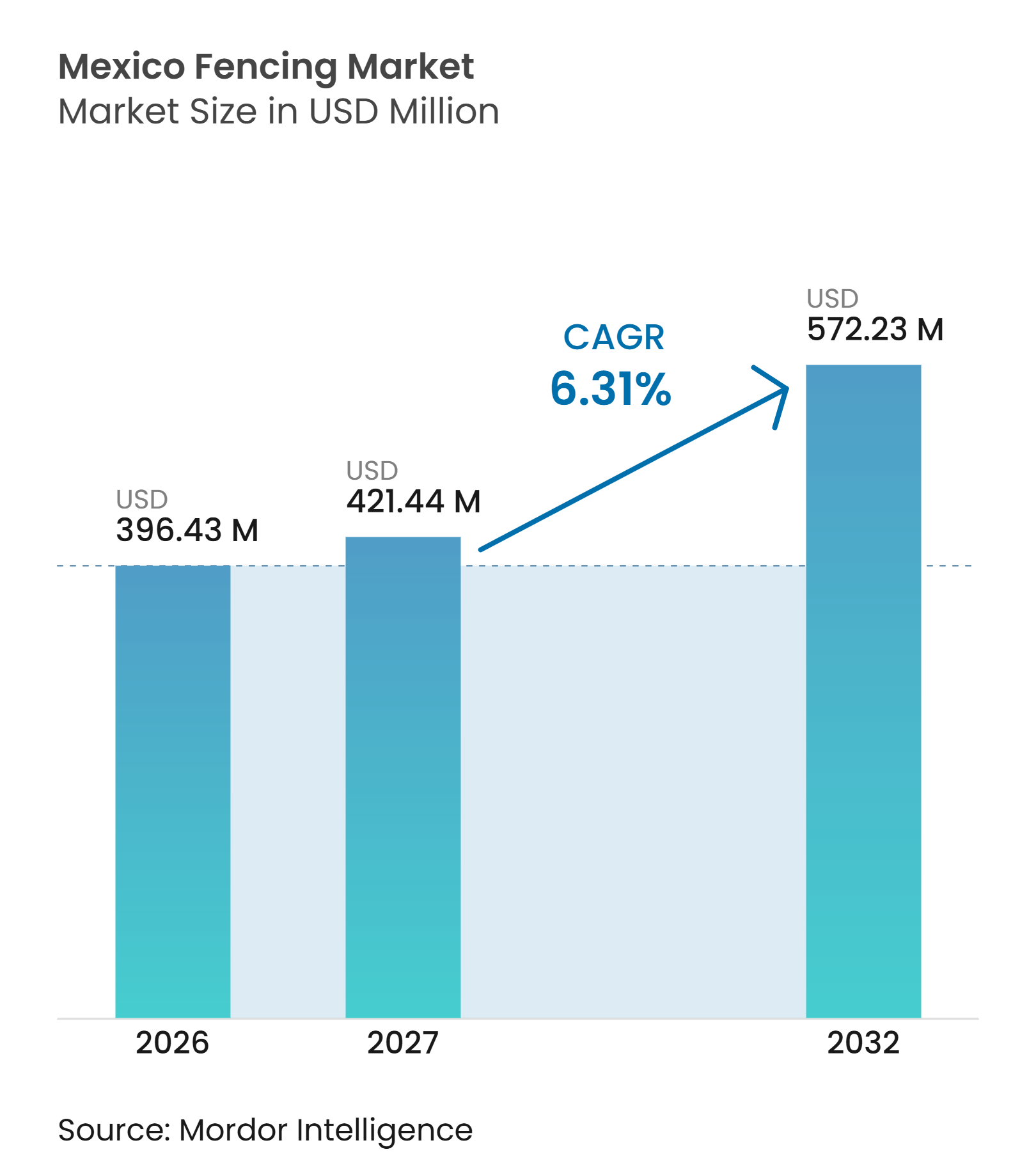
| Base Year Market Size (2026) | USD 396.43 Million |
| Market Size (2027) | USD 421.44 Million |
| Market Size (2032) | USD 572.23 Million |
| Growth Rate (2027 - 2032) | 6.31 % |
| Market Concentration | Medium |
Major Players *Disclaimer: Major Players sorted in no particular order Image © Mordor Intelligence. Reuse requires attribution under CC BY 4.0. | |
Mexico Fencing Market Analysis by Mordor Intelligence
The Mexico Fencing Market size was valued at USD 396.43 million in 2026 and is estimated to grow from USD 421.44 million in 2027 to reach USD 572.23 million by 2032, at a CAGR of 6.31% during the forecast period (2027-2032).
The market is gaining support from factory relocation, new industrial parks, trade-related logistics facilities, farm enclosure needs, and public infrastructure work. Industrial buyers increasingly treat fencing as a basic security and compliance requirement rather than a later site upgrade. Cost pressure remains a material concern because wire, steel, and polyvinyl chloride inputs became more expensive through 2026. Larger suppliers have a stronger position because they can manage procurement, manufacturing, and distribution in the same value chain. The Mexico fencing market also benefits from demand across industrial, logistics, farm, residential, and public works sites, which reduces reliance on a single buyer group.
Key Report Takeaways
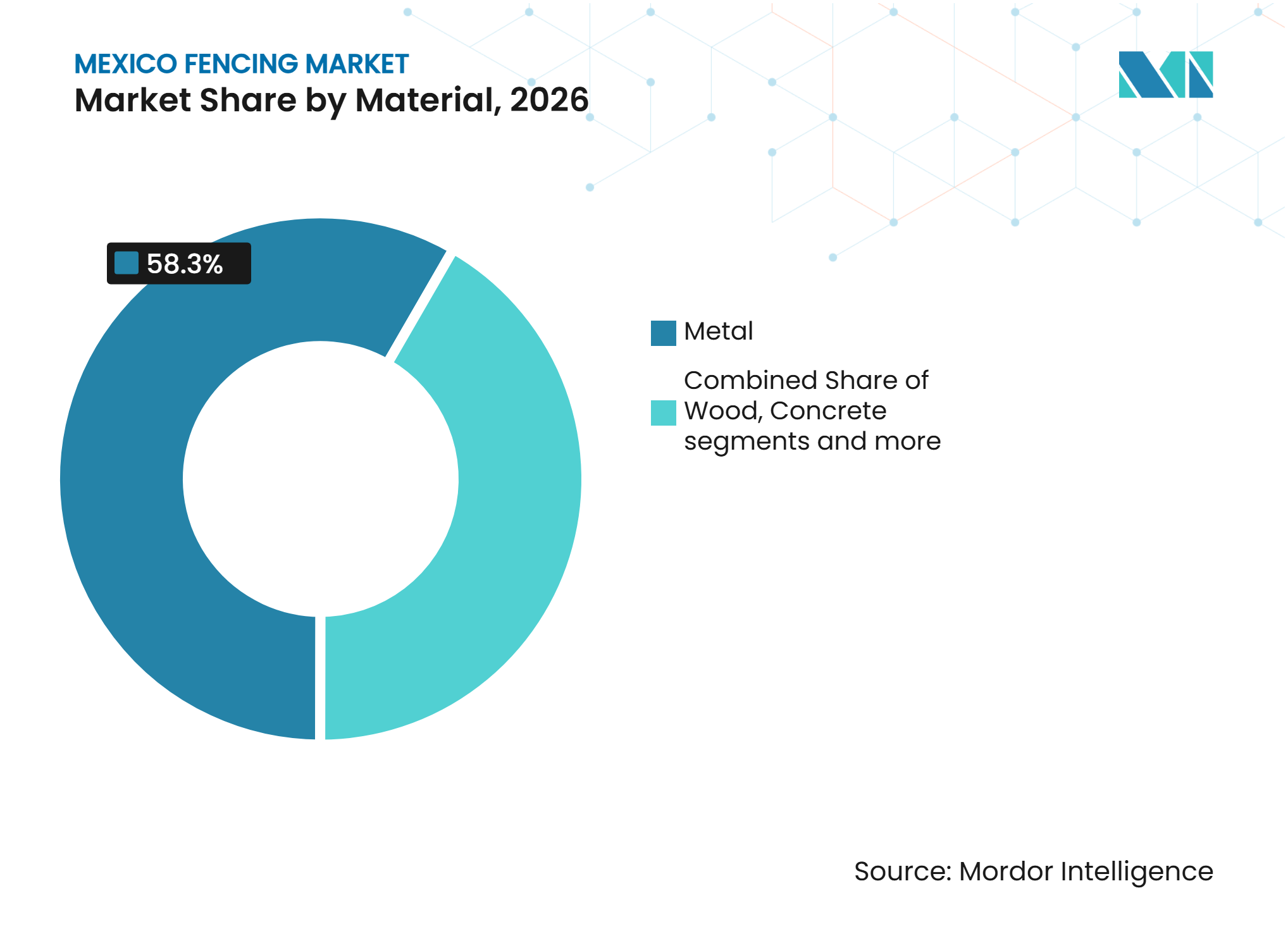
- By material, metal fencing held 58.3% of the Mexico fencing market share in 2026, while plastic & composite fencing is forecast to grow at a 6.88% CAGR through 2032.
- By end-user, residential applications held 40.4% of the Mexico fencing market size in 2026, while agriculture is forecast to grow at a 6.92% CAGR through 2032.
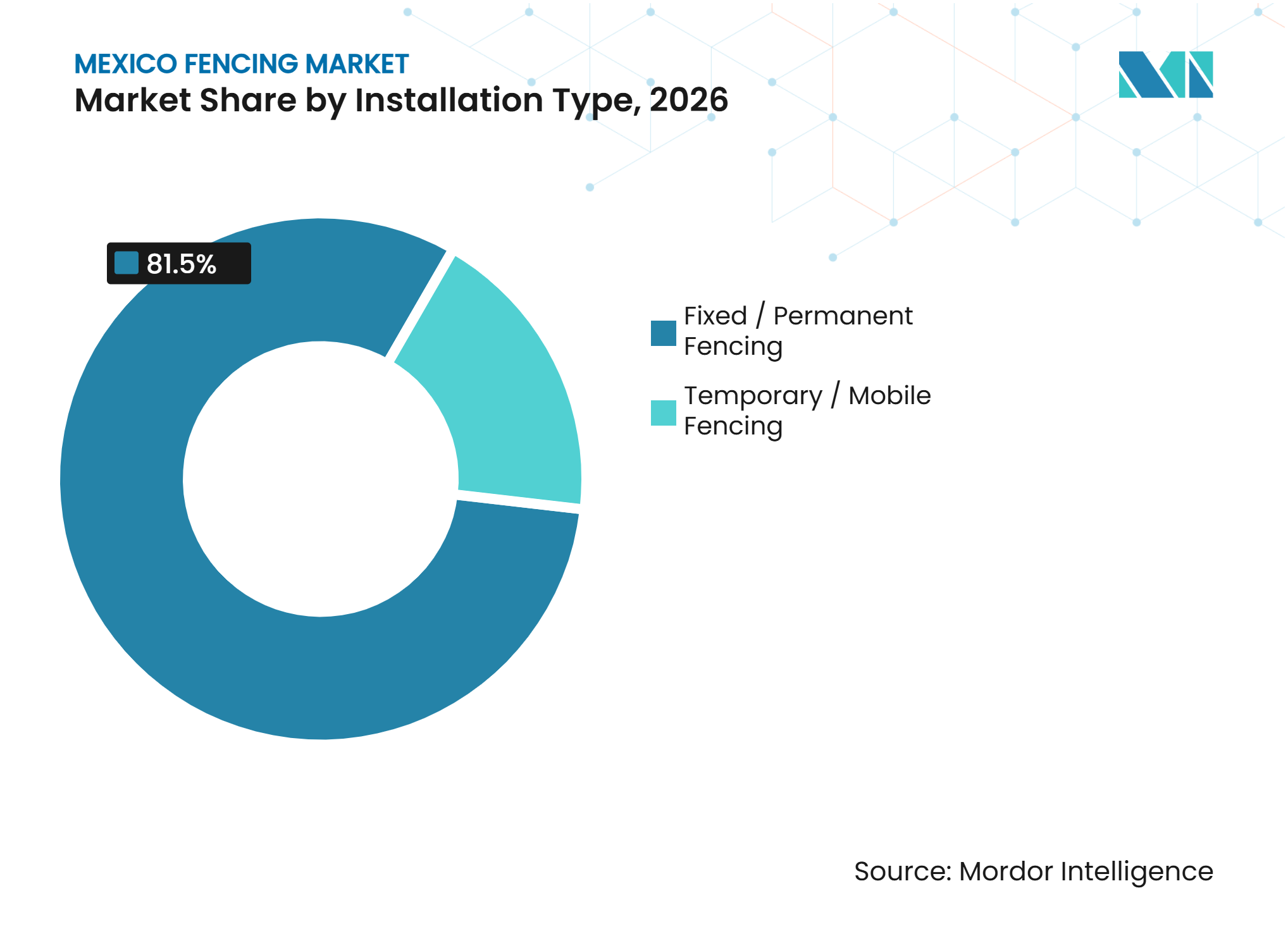
- By installation type, fixed or permanent systems accounted for 81.5% of the Mexico fencing market share in 2026, while temporary / mobile fencing is forecast to grow at a 6.55% CAGR through 2032.
- By installation channel, professional contractors held 68.4% of the Mexico fencing market size in 2026, while others – fabricators, DIY / modular kits are forecast to grow at a 6.62% CAGR through 2032.
- By state, the rest of Mexico captured 42.1% of the Mexico fencing market share in 2026, while Jalisco is forecast to expand at a 7.21% CAGR through 2032.
Note: Market numbers in this report are based on Mordor Intelligence's proprietary estimation framework, which combines nine months of actuals with Q4 projections for base year 2026.
Market Trends and Insights
Drivers Impact Analysis of Mexico Fencing Market*
| Drivers | (~) % Impact on CAGR Forecast | Geographic Relevance | Impact Timeline |
|---|---|---|---|
| Nearshoring-led industrial park expansion | +1.4% | Nuevo León, Jalisco, Bajío, Baja California, and Mexico City metropolitan area | Medium term (2-4 years) |
| United States-Mexico-Canada Agreement trade growth | +1.1% | Tamaulipas, Nuevo León, Baja California, and the Laredo corridor | Medium term (2-4 years) |
| Security concerns linked to theft and organized crime | +1.0% | Nationwide, especially State of Mexico, Puebla, Jalisco, and Guanajuato | Short term (≤ 2 years) |
| Agricultural and livestock activity | +0.8% | Veracruz, Jalisco, Chihuahua, Chiapas, and Sonora | Long term (≥ 4 years) |
| Government infrastructure work | +0.7% | Nationwide, especially Querétaro to Irapuato and Saltillo to Nuevo Laredo | Medium term (2-4 years) |
| Gated residential and master-planned housing development | +0.6% | Mexico City, Guadalajara, Monterrey, and Querétaro metropolitan areas | Medium term (2-4 years) |
| Source: Mordor Intelligence | |||
Nearshoring-Led Industrial Park Development Accelerates Perimeter Fencing Demand
Nearshoring is turning perimeter security from a routine site expense into a core project requirement across the Mexico fencing market. Mexico had 477 operating industrial parks and 103 under construction, indicating that the buildout pipeline now spans light industry, electronics, auto parts, and medical devices [1]. The Mexican Association of Private Industrial Parks (AMPIP) projected total industrial park investment to rise 36.6% in 2026 to USD 5.8 billion, and 66.1% of that capital was directed to new park developments where perimeter systems are part of the starting specification. Net absorption reached 3.3 million m² in 2025, while Jalisco and Nuevo León led project flow, which keeps demand strongest for welded mesh, anti-climb panels, and integrated perimeter systems rather than basic wire products. The Parque Industrial Seguro certification process reinforces this shift by reviewing access control, fencing, and infrastructure integrity together, which means security compliance now triggers procurement earlier in the development cycle.
USMCA-Supported Trade Growth Concentrates Demand at Logistics and Border Infrastructure
Trade growth under the United States-Mexico-Canada Agreement is adding a durable logistics-led demand layer to the Mexico fencing market. United States-Mexico bilateral freight trade reached USD 872.8 billion in 2025, up 3.9% from 2024, and commercial trucks accounted for 73.6% of that freight by value, keeping demand strong around customs yards, bonded warehouses, and cross-docking sites[2]. Port Laredo alone handled USD 353.9 billion in international trade in 2025, which shows how concentrated freight activity has become in key corridors that depend on permanent perimeter infrastructure. As the Laredo corridor approaches congestion limits, new capacity spending, including the USD 2.1 billion Baja California federal infrastructure plan and the Nuevo Laredo III International Bridge expansion, is shifting flows toward secondary logistics nodes that require new installations. Commercial truck crossings from Mexico totaled 7.589 million in 2025, up 6.1% from 2019, pointing to freight demand that is structural rather than cyclical and keeping fencing demand tied to long-term trade volume growth.
Organized Crime Risk and Rising Private Security Spend Shift Fencing Into a Mission-Critical Category
Security risk is pushing fencing higher on the spending priority list across the Mexico fencing market. Mexico’s physical security market is expanding, and the perimeter security equipment segment is growing, indicating that buyers no longer view perimeter hardening as optional[3]. Control Risks raised Mexico’s security risk rating from Medium to High in November 2024, citing organized crime penetration across 81% of municipalities and persistent extortion pressure on manufacturing, mining, and logistics operators. Cargo theft fell 21.5% in 2025, yet the State of Mexico still recorded more than 3,100 cases, and Jalisco saw higher transit theft in the second half of the year, which kept corporate security spending elevated. The economic cost of violence reached USD 224.4 billion in 2025, and the March 2026 reseller agreement between KeepZone AI and D-Fence shows that buyers are increasingly specifying physical fencing together with electronic perimeter detection rather than as standalone civil work.
Agricultural and Livestock Sector Activity Provides Structural and Geographically Dispersed Demand Base
Agriculture provides the Mexico fencing market with a broad and stable demand base that extends far beyond the main industrial corridors. Mexico’s cattle herd stood at 17.965 million head in 2025, with major concentrations in Jalisco, Chihuahua, and Veracruz, and those livestock regions continue to generate a steady need for ranch perimeter and rotational grazing enclosures. The United States Department of Agriculture Foreign Agricultural Service reported that intensive cattle systems account for 35% of Mexico’s farming structure. In comparison, extensive systems account for 56%, and the extensive base is the main driver of demand for barbed wire and graduated livestock mesh. Livestock represented 40.5% of Mexico’s total agricultural production value in 2025, which supports long-cycle replacement demand even when residential spending is softer. The herd rebuilding phase after the New World Screwworm outbreak redirected more than 1 million animals to domestic processing in 2025, and Alpura’s USD 517 million investment program announced in May 2025 adds another reason for increased demand for fresh fencing around ranch supply networks and animal handling sites. The NMX-H-004-SCFI-2008 galvanized wire standard also helps formal suppliers defend livestock-grade applications by limiting the extent to which low-end informal products can intrude into quality-sensitive farm use.
Restraints Impact Analysis of Mexico Fencing Market*
| Restraints | (~) % Impact on CAGR Forecast | Geographic Relevance | Impact Timeline |
|---|---|---|---|
| Fluctuating steel, wire, and polyvinyl chloride prices | -0.9% | Nationwide, with greater pressure in import-dependent and scrap-linked supply areas | Short term (≤ 2 years) |
| High rural labor and installation costs | -0.6% | Northern border states, central agricultural states, and southern regions | Long term (≥ 4 years) |
| Informal manufacturers and uneven product quality | -0.4% | Nationwide, especially peri-urban industrial and residential markets | Long term (≥ 4 years) |
| Lengthy permitting and land-use approvals | -0.3% | Federal infrastructure corridors and urban development zones | Medium term (2-4 years) |
| Source: Mordor Intelligence | |||
Input Cost Volatility Compresses Margins Across the Fabrication Chain
Raw material volatility is one of the clearest near-term limits on earnings across the Mexico fencing market. Wire rod prices in northern Mexico climbed to USD 692.7 per ton by late 2025 as scrap prices rose and regional steel production faced tighter operating conditions, while insulated wire and cable prices increased 17.42% in the 12 months through February 2026. Polyvinyl chloride costs rose even faster because the provisional duty on United States resin, higher global petrochemical feedstock costs, and a 4.7% fall in domestic production capacity pushed some polyvinyl chloride product prices up by as much as 65% between March and April 2026. That pressure inflates final prices for polyvinyl chloride and composite fencing, weakens demand from price-sensitive buyers, and also shifts some volume back toward metal products rather than creating a smooth substitution path. Producers that rely on export buffers also faced tighter conditions after DEACERO’s wire mesh exports to the United States drew anti-dumping duties of 32.05% in September 2025, which reduced cross-border flexibility at the same time that domestic input costs were rising.
Rural Installation Economics Constrain Adoption in Price-Sensitive Agricultural Markets
Installation economics remain a practical barrier in agricultural areas, even when the need for fencing is clear. Mexico’s labor market is heavily informal, yet remote terrain, long transport distances, and limited contractor access mean that installed costs do not fall as buyers often expect in rural areas. In 2025, professional installation of 1 kilometer of graduated livestock mesh cost USD 18,500 in southern states, compared with USD 9,800 in central regions, creating a significant regional cost disparity for ranchers. That difference discourages systematic perimeter upgrades on small and mid-sized farms, even when rotational grazing and better herd control can improve output and reduce animal loss. The Organization for Economic Co-operation and Development noted in 2025 that 90% of agricultural support transfers go to small-scale farmers. Still, those flows do not directly subsidize capital expenditure on fencing, leaving adoption heavily exposed to local cash flow and logistics conditions.
*Our forecasts treat driver/restraint impacts as directional, not additive. The impact forecasts reflect baseline growth, mix effects, and variable interactions.
Mexico Fencing Market Segment Analysis
By Material:
Metal Fencing Holds the Largest PositionMetal fencing held 58.3% of the Mexico fencing market share in 2026, making it the largest material group. Steel wire, galvanized mesh, welded mesh, chain link, and barbed wire are widely used because they serve residential, agricultural, industrial, and public applications. DEACERO benefits from a strong position in this material group through its steel production, wire processing, and national distribution network. Metal products also remain familiar to installers and buyers, which supports their use in standard projects that require dependable local availability. Aluminum is a smaller part of the segment, but it is used in selected commercial and residential applications where corrosion resistance and appearance are important.
Plastic & composite fencing is forecast to grow fastest at a 6.88% CAGR through 2032. This material is gaining attention in coastal zones and premium developments because buyers value corrosion resistance and lower maintenance needs. Higher steel wire costs can improve the long-term value case for composite panels, although polyvinyl chloride cost pressure limits the advantage in the near term. Industrial parks in Jalisco, Querétaro, and Monterrey can use composite and aluminum systems for landscaped perimeters and internal divisions where appearance and durability both matter. Metal fencing will remain the primary volume category, while composites serve a narrower but faster-growing part of the market.



By End-User:
Residential Applications Hold the Largest PositionResidential applications held 40.4% of the Mexico fencing market size in 2026, making them the largest end-user segment. Homeowners and gated communities use chain link, ornamental metal, wrought iron, and aluminum slat products for property boundaries and visible security. The professional contractor channel is important because households and developers often require foundations, gates, and finished installation rather than material-only purchases. Security concerns also support replacement demand as buyers strengthen perimeter protection at existing homes. This large installed base gives the segment steady volume across the country.
Agriculture is forecast to grow fastest at a 6.92% CAGR through 2032. Ranches, feedlots, dairy operations, and protected agriculture facilities need mesh, barbed wire, posts, and defined internal enclosure systems. The cattle population and continued investment in domestic animal processing support this demand in Jalisco, Veracruz, Chihuahua, Chiapas, and other livestock states. Residential buyers tend to prioritize appearance, security, gates, and local installation, while agricultural buyers focus more on coverage, durability, and repair needs. Government, mining, energy, and defense sites are smaller groups, but they require higher-value systems because access control and asset protection are critical.
By Installation Type:
Fixed / Permanent Fencing Holds the Largest PositionFixed / permanent fencing accounted for 81.5% of the Mexico fencing market share in 2026. Industrial parks, logistics facilities, public assets, and large farms favor permanent systems because they require long-term boundaries that can support gates, access control, and anti-climb features. The 103 industrial parks under construction strengthen this demand because each park needs site security before tenant operations begin. Permanent systems are also common in transport and utility locations where the service life of the fence must match the life of the asset. Bekaert’s focus on specialty wire applications reflects the importance of durable, higher-value infrastructure uses in Mexico.
Temporary / mobile fencing is forecast to grow at a 6.55% CAGR through 2032. Rail, highway, pipeline, and event projects require systems that can be installed quickly and moved as work progresses. The Querétaro to Irapuato and Saltillo to Nuevo Laredo rail projects are relevant because their combined budget exceeds USD 11.5 billion and their construction phases require controlled work zones. Reusable systems support rental and managed-service opportunities because contractors can shift them between site sections. Permanent fencing will remain the larger segment, but temporary systems are gaining value as infrastructure work becomes more geographically dispersed.

By Installation Channel:
Professional Contractors Hold the Largest PositionProfessional contractors held 68.4% of the Mexico fencing market size in 2026. Their position reflects the need for site measurement, structural support, foundations, gate installation, and project-specific safety requirements at industrial and public sites. Developers, highway operators, mines, and logistics companies also value warranties and post-installation service, which professional contractors can provide. National producers support this channel through distributor networks and training that help preserve installation quality. This channel will remain central for projects that have complex designs or formal compliance needs.
The other channels (fabricators and DIY / modular kits) are forecast to grow fastest at a 6.62% CAGR through 2032. Their growth reflects demand from small farms, peri-urban households, and project contractors that need repeatable systems with less design work. DEACERO’s Cercocentro model illustrates the move toward retail advice and installation support for customers who do not use a full professional contracting package. Fabricators can respond quickly to local repairs and custom dimensions, while kits suit buyers who need a practical system for smaller properties or temporary perimeters. Professional contractors remain the larger channel because complex projects require formal design, warranties, and compliance support.
Geography Analysis
Mexico City (CDMX) and Nuevo León
Mexico City (CDMX) and Nuevo León serve different but complementary demand areas in the Mexico fencing market. Mexico City supports steady sales from residential security upgrades, commercial properties, logistics sites, and public facilities. Nuevo León has a stronger base in automotive manufacturing, industrial parks, and cross-border supply chains. Industrial parks and logistics sites in Nuevo León need anti-climb mesh, welded panels, controlled gates, and access control systems. These two locations give suppliers access to both dense urban demand and higher-specification industrial projects.
Jalisco and Querétaro
Jalisco is forecast to record the highest state CAGR of 7.21% through 2032. Its manufacturing, logistics, cattle, and swine activity create demand for industrial security and agricultural enclosure systems. Querétaro adds a separate demand base through high-technology greenhouses, rail and highway links, and incoming industrial investment. This combination supports sales to industrial parks, farms, protected agriculture users, and distribution facilities. Suppliers need local inventory and installation coverage because project requirements differ across the 2 states.
Rest of Mexico
The rest of Mexico represented 42.1% of the Mexico fencing market share in 2026. This group includes livestock-intensive states, industrial corridors outside the named state markets, and public infrastructure projects across the country. Veracruz, Chihuahua, and Sonora support demand for ranch fencing, livestock mesh, and related enclosure products. Government road and rail work also extends project demand into areas with lower industrial investment. The broad geographic base reduces reliance on one state and supports a mix of standard agricultural products and specialized project systems.
Competitive Landscape
Market Concentration
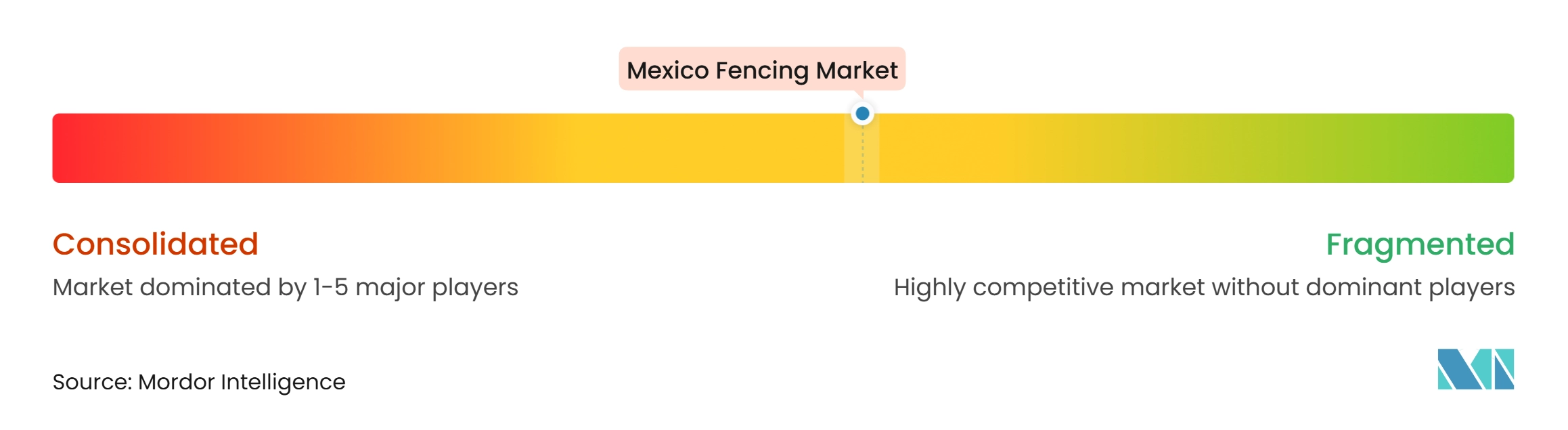
The Mexico fencing market is moderately concentrated because a limited group of vertically integrated domestic producers and global wire specialists leads the formal supply. DEACERO is a major competitor because it combines steel production, wire drawing, fencing products, and distribution. Its Ramos Arizpe expansion supports greater control of upstream material supply and reduces reliance on external inputs. Bekaert operates at the premium end of wire and specialty applications, where coating quality, technical performance, and customer requirements are more important than basic price.
Regional companies compete through proximity, quick delivery, customized cutting, and service for smaller orders. Grupo Cercamalla, Mallasiltec México, Cercafence, and Rejas y Mallas Monterrey are relevant in this part of the market because buyers often need local fabrication and faster response. Informal suppliers also compete in lower-value applications, although their products may not meet the requirements of certified industrial parks or livestock-grade projects. The Parque Industrial Seguro framework from the Mexican Association of Private Industrial Parks raises the standards for access control and perimeter infrastructure at commercial sites. This gives formal providers a stronger position where buyers require documented quality and dependable installation.
Strategic moves are focusing on supply control, certification, and security technology. DEACERO announced a USD 600 million Ramos Arizpe investment in 2024 and later received authorization to use the Hecho en México seal for its fencing, mesh, and wire products. Bekaert completed the sale of selected Latin American steel wire businesses in 2025, reflecting its focus on more selective specialty opportunities. Producers that can offer longer-life coatings, anti-climb systems, and products that integrate with electronic security equipment will have a clearer route to higher-value industrial projects. The competitive environment will remain price-sensitive in standard applications, but compliance and technical performance should gain importance in premium demand areas.
Mexico Fencing Industry Leaders
-
DEACERO
-
Grupo Industrial Tauro (Construfence)
-
SECURIMETAL
-
Acero Sueco Palme
-
Aceros Camesa
- *Disclaimer: Major Players sorted in no particular order
Mexico Fencing Market Companies Covered in this Report
- DEACERO
- Grupo Industrial Tauro (Construfence)
- SECURIMETAL
- Acero Sueco Palme
- Aceros Camesa
- Bekaert
- Merchants Metals
- Fortress Building Products
- Mallasiltec México
- Malla Acero
- Grupo Cercamalla
- Mallacero
- Grupo Malla Aceros
- CERCASEL
- Rejas y Mallas Monterrey
- Mega Malla
- Mexmalla y Servicios
- Alambrados y Construcciones del Bajío
- Cercafence
- Cercados Mata
Recent Industry Developments in Mexico Fencing Market
- November 2026: The Guanajuato Public Works Secretariat advanced the first phase of a perimeter fencing project, including complementary construction work. The project reflects continued public-sector investment in perimeter protection infrastructure and creates opportunities for fencing contractors and material suppliers.
- October 2026: Mexico's Secretariat of Infrastructure, Communications and Transport initiated procurement for the construction of a perimeter wall and slope protection at Bachillerato No. 300 in Cuautlancingo, Puebla. The project highlights the demand for boundary protection solutions across educational institutions.
- September 2026: The Benito Juárez Autonomous University of Oaxaca awarded a contract for the third phase of its perimeter wall construction project to Grupo Constructor Meiksi SA de CV. The project reflects continued investment in institutional infrastructure and perimeter security.
Mexico Fencing Market Report Scope
Segmentation Overview
| Metal | Steel |
| Aluminium | |
| Wood | |
| Plastic & Composite | |
| Concrete | |
| Other Materials |
| Residential |
| Agricultural |
| Military & Defense |
| Government |
| Mining |
| Petroleum & Chemicals |
| Energy & Power |
| Other End-Users |
| Fixed / Permanent Fencing |
| Temporary / Mobile Fencing |
| Professional Contractor |
| Others – Fabricators, DIY / Modular Kits |
| Mexico City (CDMX) |
| Nuevo León |
| Jalisco |
| Querétaro |
| Rest of Mexico |
| By Material | Metal | Steel |
| Aluminium | ||
| Wood | ||
| Plastic & Composite | ||
| Concrete | ||
| Other Materials | ||
| By End-User | Residential | |
| Agricultural | ||
| Military & Defense | ||
| Government | ||
| Mining | ||
| Petroleum & Chemicals | ||
| Energy & Power | ||
| Other End-Users | ||
| By Installation Type | Fixed / Permanent Fencing | |
| Temporary / Mobile Fencing | ||
| By Installation Channel | Professional Contractor | |
| Others – Fabricators, DIY / Modular Kits | ||
| By States | Mexico City (CDMX) | |
| Nuevo León | ||
| Jalisco | ||
| Querétaro | ||
| Rest of Mexico |
Key Questions Answered in the Report
What is the Mexico fencing market size in 2027?
The Mexico fencing market is valued at USD 421.44 million in 2027 and is forecast to reach USD 572.23 million by 2032.
What is the forecast growth rate for fencing in Mexico?
The market is forecast to grow at a CAGR of 6.31% from 2027 to 2032.
Which material leads fencing sales in Mexico?
Metal fencing leads with a 58.3% share in 2026 because steel wire, mesh, chain link, and barbed wire serve a broad set of applications.
Which end-user is growing fastest?
Agriculture is forecast to grow at a 6.92% CAGR through 2032, supported by cattle operations, feedlots, and protected agriculture facilities.
Why is Jalisco important for fencing suppliers?
Jalisco is the fastest-growing state at a 7.21% CAGR through 2032 because industrial parks, exports, livestock activity, and logistics demand are growing together.
What is the key challenge for fencing producers?
Rising costs for wire, steel, and polyvinyl chloride remain the main challenge because producers must either increase prices or accept lower margins.