
Mexico Commercial Greenhouse Market Size and Share
Market Overview
| Study Period | 2021 - 2031 |
|---|---|
| Forecast Data Period | 2026 - 2031 |
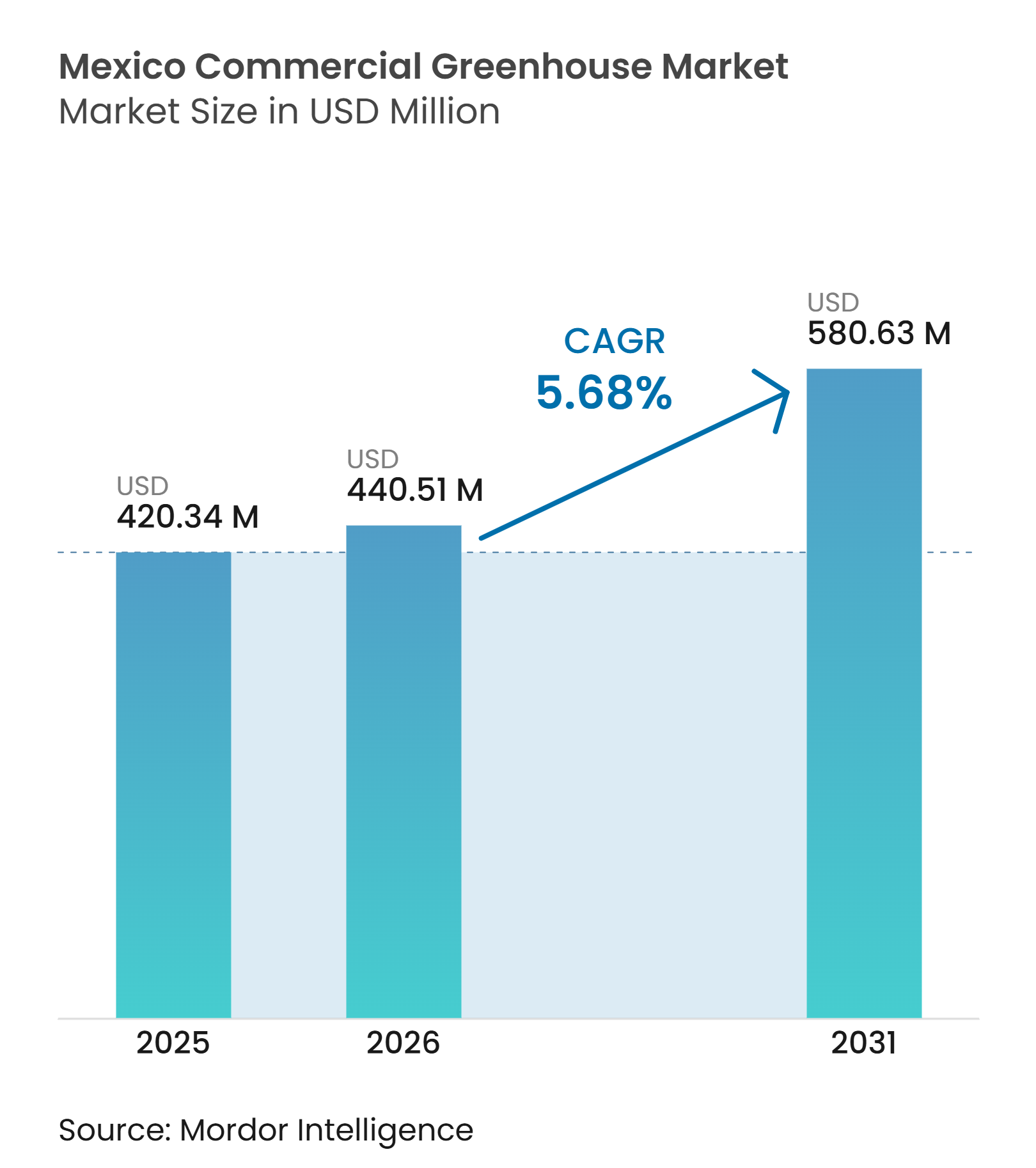
| Base Year Market Size (2025) | USD 420.34 Million |
| Market Size (2026) | USD 440.51 Million |
| Market Size (2031) | USD 580.63 Million |
| Growth Rate (2026 - 2031) | 5.68 % |
| Market Concentration | Low |
Major Players *Disclaimer: Major Players sorted in no particular order Image © Mordor Intelligence. Reuse requires attribution under CC BY 4.0. | |
Mexico Commercial Greenhouse Market Analysis by Mordor Intelligence
The Mexico commercial greenhouse market size was valued at USD 420.3 million in 2025 and is projected to grow from USD 440.5 million in 2026 to USD 580.6 million by 2031, at a 5.7% CAGR during 2026–2031. Export-oriented production remains the primary driver of demand, while water management, product traceability, and supply consistency shape investment decisions. Protected structures give growers greater control over production conditions and help them meet retailer requirements for consistent quality. The Mexico commercial greenhouse market also benefits from a gradual shift toward climate-managed systems that use water and energy more efficiently. Investment decisions increasingly balance export exposure with demand from domestic foodservice, plant retail, and nurseries. Competition centers on complete-structure design, local technical support, and the ability to integrate equipment into a workable project.
Key Report Takeaways
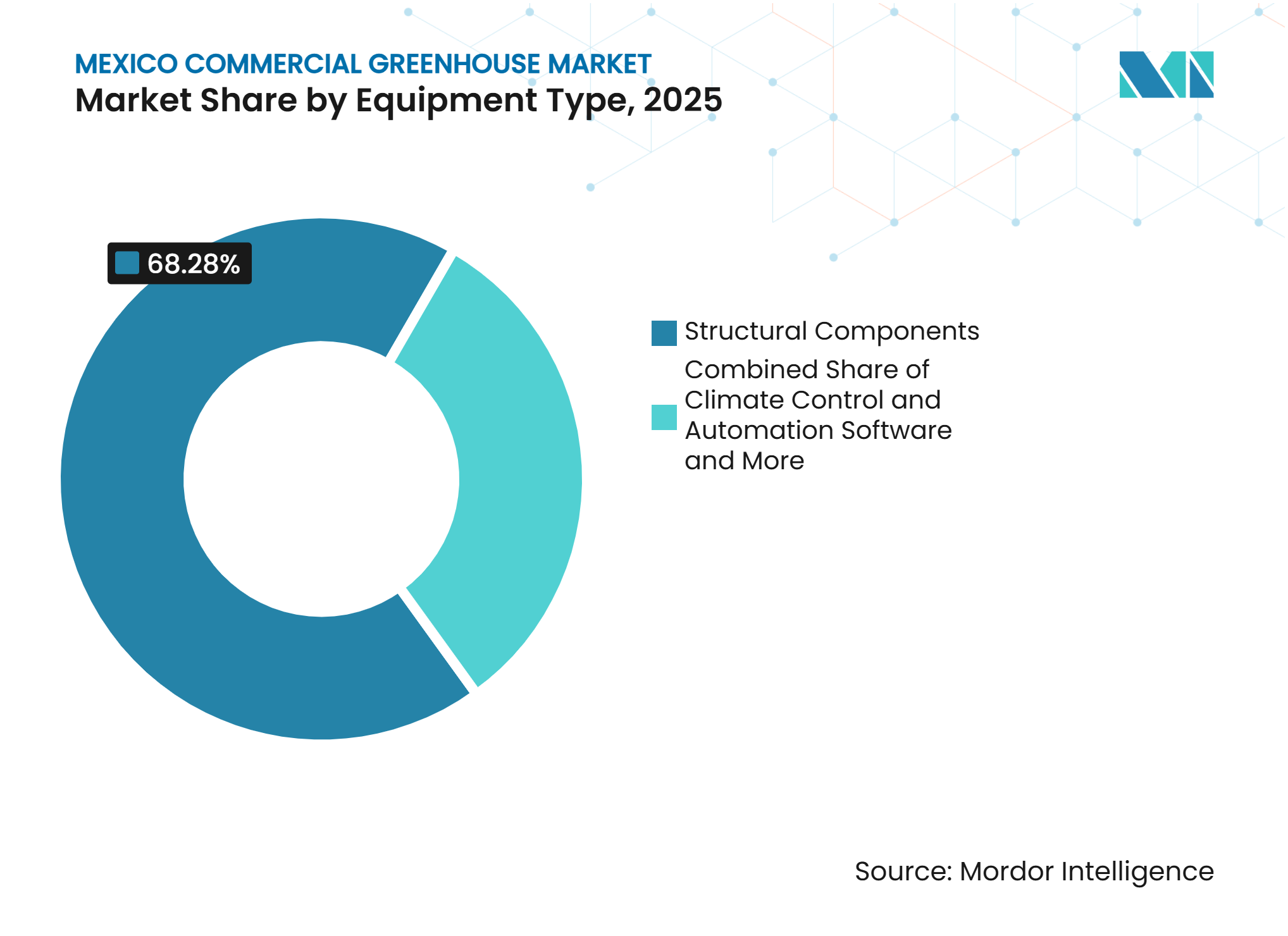
- By equipment type, Structural Components held 68.3% of the Mexico commercial greenhouse market share in 2025, while Climate Control and Automation Software is projected to grow at an 8.9% CAGR during 2026–2031.
- By crop type, Fruits and Vegetables held 91.1% of the Mexico commercial greenhouse market size in 2025, while Herbs and Microgreens are projected to grow at an 8.2% CAGR during 2026–2031.
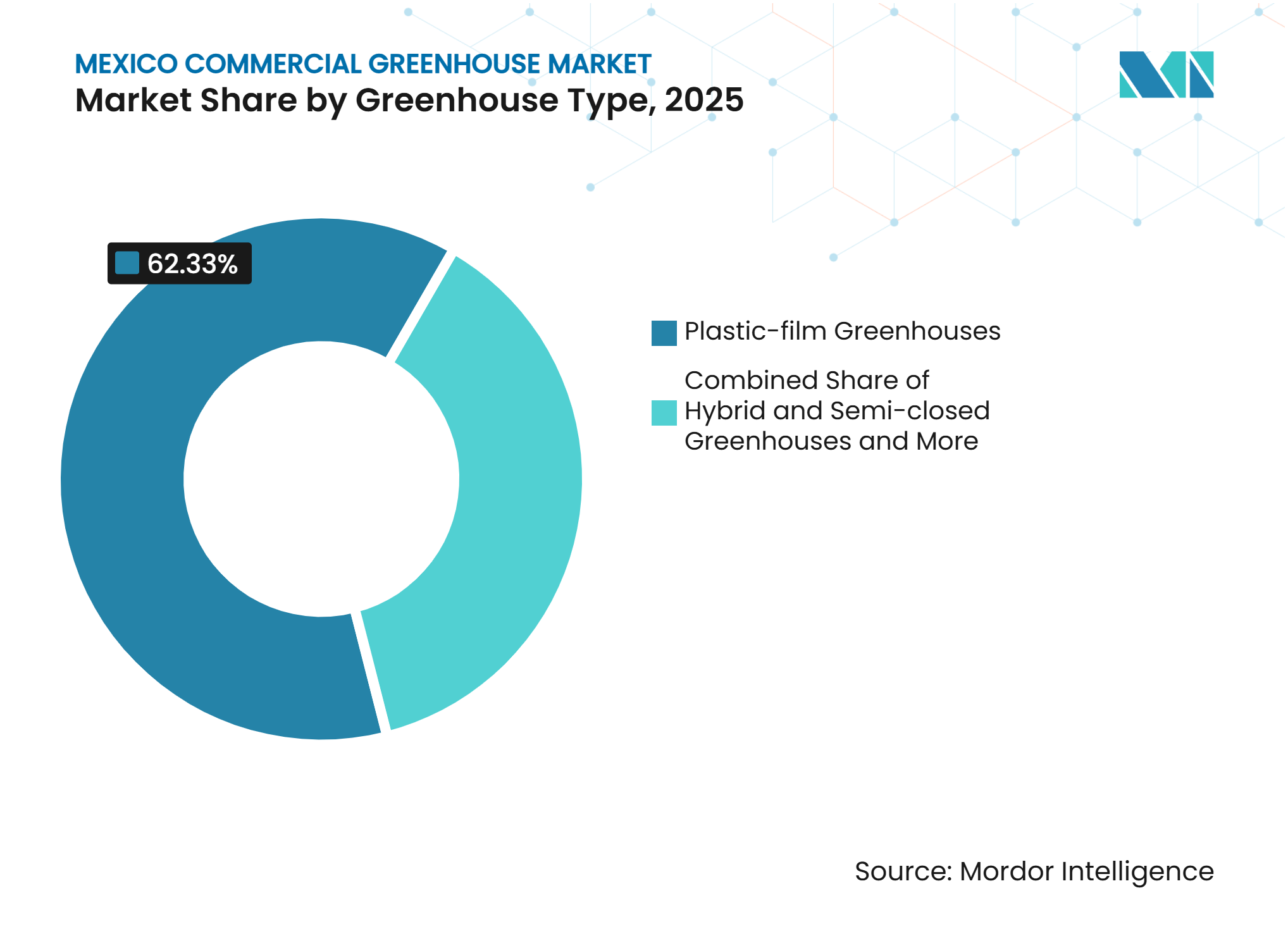
- By greenhouse type, Plastic-film Greenhouses held 62.3% of revenue in 2025, while Hybrid and Semi-closed Greenhouses are projected to grow at a 9.4% CAGR during 2026–2031.
- By cultivation technology, Non-hydroponic Soil and Substrate held 48.1% of revenue in 2025, while Hydroponic cultivation is projected to grow at a 7.8% CAGR during 2026–2031.
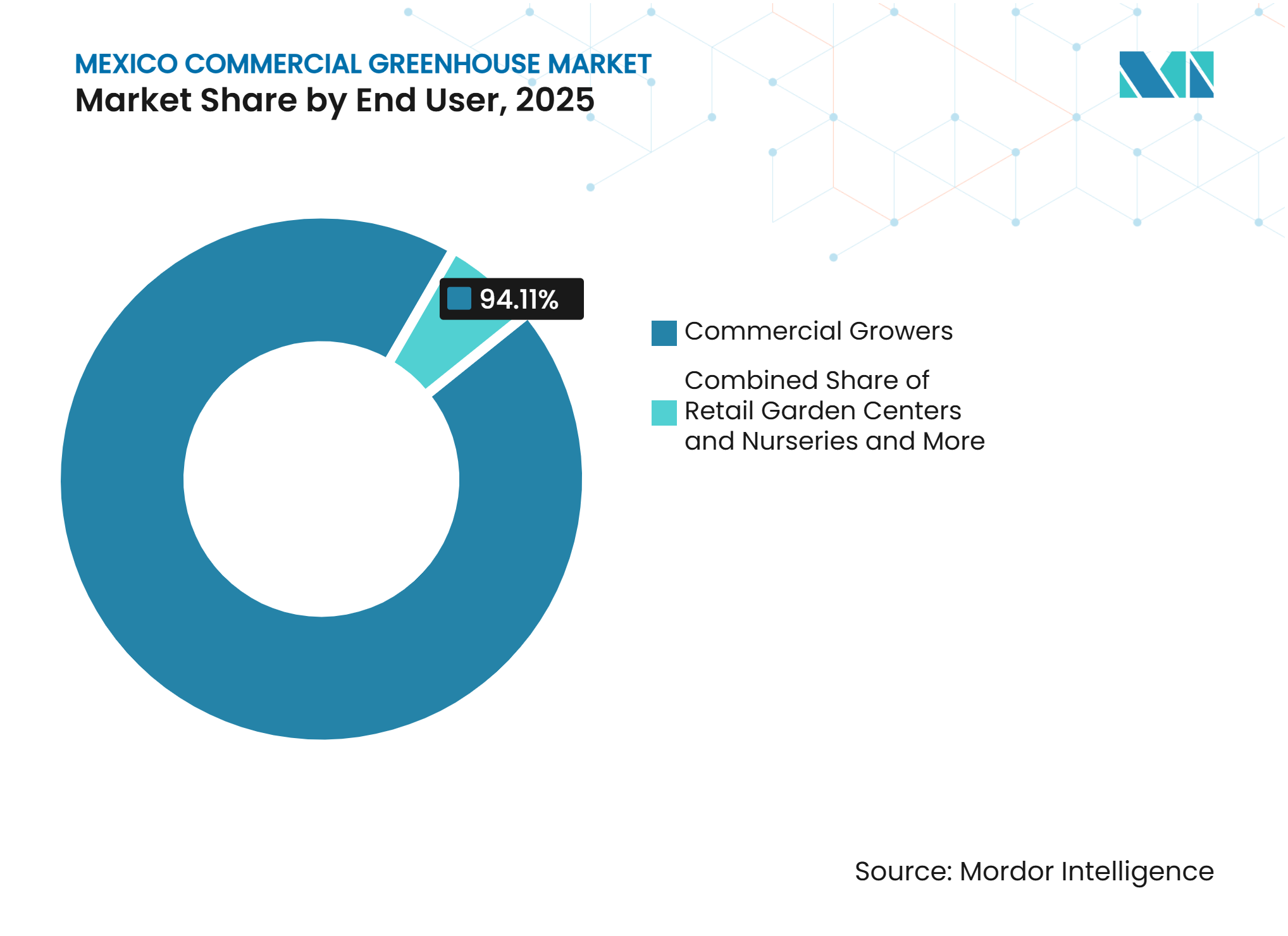
- By end user, Commercial Growers held 94.1% of revenue in 2025, while Retail Garden Centers and Nurseries are projected to grow at a 6.9% CAGR during 2026–2031.
Note: Market size and forecast figures in this report are generated using Mordor Intelligence’s proprietary estimation framework, updated with the latest available data and insights as of January 2026.
Market Trends and Insights
Drivers Impact Analysis of Mexico Commercial Greenhouse Market*
| Driver | (~) % Impact on CAGR Forecast | Geographic Relevance | Impact Timeline |
|---|---|---|---|
| Export Demand for Protected-Culture Produce | +1.5% | Sinaloa, Sonora, Baja California, and Querétaro supply export chains that require consistent deliveries and traceable production. | Long term (≥ 4 years) |
| Higher Yields and Premium Product Quality | +1.0% | Querétaro, Guanajuato, Jalisco, and Sinaloa have established greenhouse clusters and access to export logistics. | Medium term (2-4 years) |
| Government and Development-Finance Support | +0.7% | El Bajío receives the greatest benefit from established project pipelines, while northern states need water-efficiency upgrades. | Medium term (2-4 years) |
| Climate Volatility and Weather Protection | +0.9% | Sinaloa, Sonora, Jalisco, Guanajuato, and Bajío face heat, frost, and uneven rainfall conditions. | Long term (≥ 4 years) |
| Water-Efficiency Requirements Are Accelerating Structure Modernization | +0.7% | Guanajuato, Querétaro, Sinaloa, Sonora, Baja California, and Chihuahua face the strongest water-management pressure. | Medium term (2-4 years) |
| Expansion of High-Technology Greenhouse Clusters | +0.5% | Querétaro and Guanajuato form the main cluster, with activity extending to Nuevo León and Jalisco. | Short term (≤ 2 years) |
| Source: Mordor Intelligence | |||
Export Demand for Protected-Culture Produce
The United States Department of Commerce ended the suspension agreement on fresh tomatoes from Mexico in July 2025, reinforcing the need for export-oriented growers to manage both crop quality and trade exposure. Export contracts require structures that support reliable production through changing weather and delivery schedules. This trade environment supports investment in facilities that preserve crop quality and support year-round supply schedules. Retail customers also require reliable product handling and production records, which raises the value of purpose-built facilities over informal adaptations of field systems. The Mexico commercial greenhouse market therefore remains tied to the ability of growers to meet delivery, quality, and traceability requirements across North American supply chains.
Higher Yields and Premium Product Quality
Controlled growing conditions improve the consistency of temperature, humidity, irrigation, and nutrient delivery at commercial sites. These capabilities support crops that need dependable appearance, shelf life, and grading outcomes for retail and foodservice channels. Complete structures create a platform for screens, irrigation, ventilation, and environmental controls rather than treating each item as a separate purchase. This structure-led approach matters most for premium vegetables, berries, flowers, and specialty crops where quality variation affects buyer acceptance. Higher output per unit of land also strengthens the commercial case for replacing low-control production systems with more capable facilities.
Government and Development-Finance Support
Public and development finance programs improve access to capital for greenhouse projects that meet credit and governance requirements. Fideicomisos Instituidos en Relación con la Agricultura operates the Centro de Desarrollo Tecnológico Salvador Lira López, which transfers precision irrigation, climate control, and recirculation practices to producers[1]. Technical transfer reduces the operating risk that lenders face when assessing advanced cultivation projects. The support is most relevant in established clusters where developers, growers, and service providers already have project experience. The Mexico commercial greenhouse market gains from this support because financing and operating capability need to develop together for complete structures to perform as planned.
Climate Volatility and Weather Protection
Heat events, frost exposure, and irregular rainfall create direct production risks in Mexico's northern and central growing regions. Commercial buyers with fixed delivery schedules place a higher value on facilities that limit crop exposure to these conditions. Ventilation, shading, glazing, and structural design influence the practical level of protection available at each site. Protected cultivation also supports more stable production windows when open-field output becomes less predictable. The market benefits as growers place weather protection alongside yield and crop-quality requirements when selecting new structures.
Restraints Impact Analysis of Mexico Commercial Greenhouse Market*
| Restraint | (~) % Impact on CAGR Forecast | Geographic Relevance | Impact Timeline |
|---|---|---|---|
| High Upfront Capital Requirements | -1.50% | The barrier is strongest in Oaxaca, Chiapas, Veracruz, and other areas outside established export and finance networks. | Short term (≤ 2 years) |
| Limited Access to Technical Finance and Skilled Operating Capability | -1.10% | Chiapas, Veracruz, Michoacán, and rural areas outside Bajío, Sinaloa, and Querétaro have less access to specialist support. | Medium term (2-4 years) |
| Water-Concession and Compliance Uncertainty | -0.90% | Guanajuato, Querétaro, Sonora, Baja California, and Chihuahua face heightened uncertainty around water availability. | Medium term (2-4 years) |
| Export Price, Currency, Labor, Energy, and Disease Volatility | -1.40% | Sinaloa, Sonora, Querétaro, Guanajuato, and Jalisco carry high exposure through export-oriented production. | Long term (≥ 4 years) |
| Source: Mordor Intelligence | |||
Limited Access to Technical Finance and Skilled Operating Capability
A complete greenhouse requires skilled operation after construction, especially where systems use hydroponics, climate control, recirculation, and automation. Limited access to trained staff raises the risk that advanced facilities will not achieve their intended output or cost performance. Fideicomisos Instituidos en Relación con la Agricultura addresses part of this gap through producer-focused technology transfer at its Salvador Lira López center[2]. Coverage remains uneven because greenhouse expertise is concentrated in established production areas. This constraint limits investment in regions where capital and technical support do not develop at the same pace.
Export Price, Currency, Labor, Energy, and Disease Volatility
Export-oriented growers manage several risks simultaneously, including border measures, exchange-rate movements, labor availability, energy costs, and plant-health events. The United States Department of Commerce terminated the suspension agreement on fresh tomatoes from Mexico in July 2025, changing the trade conditions that growers must address. Such changes affect cash-flow expectations for projects focused on a narrow crop mix. Growers respond by considering structures supporting alternative crops or different production windows. This volatility reduces the appeal of large, standardized expansions in which revenue depends on a single export crop.
*Our forecasts treat driver/restraint impacts as directional, not additive. The impact forecasts reflect baseline growth, mix effects, and variable interactions.
Mexico Commercial Greenhouse Market Segment Analysis
By Equipment Type:
Structural Components Lead Project ValueStructural Components held 68.3% of revenue in 2025, making them the largest equipment category within the Mexico commercial greenhouse market. Frames, trusses, glazing, and covering systems define the useful life, crop environment, and future equipment options of a commercial facility. Their high value reflects the fact that every complete project begins with a durable enclosure and load-bearing design. Heating Systems, Cooling and Ventilation Systems, and Screening and Shading Systems are selected around this structural base. Richel Group documented a 110-hectare high-technology plastic greenhouse project in Mexico that used multi-span structures, shading, drainage, and water recirculation [3].
Climate Control and Automation Software is projected to grow at an 8.9% CAGR during 2026–2031. The equipment is increasingly specified with irrigation, ventilation, and shading systems because operators need coordinated environmental control. A 2024 review by Universidad de Guanajuato found that energy accounted for 20% to 40% of production expenses at Mexican greenhouse facilities and identified documented savings from digitized operations. LED Grow Lighting is relevant for sites with limited winter daylight or for crop programs that require precise light management. Irrigation and Fertigation Systems also gain importance because water delivery and nutrient control affect both operating efficiency and crop consistency.



By Crop Type:
Fruits and Vegetables Anchor Demand While Herbs Gain PaceFruits and Vegetables held 91.1% of revenue in 2025 and represented the largest crop category. Tomatoes, Cucumbers, Lettuce and Leafy Greens, Peppers, and Strawberries and Berries use controlled structures to improve quality and supply planning. This concentration reflects the importance of commercial horticulture and export-oriented purchasing requirements. The crop mix gives greenhouse builders a broad base of applications rather than reliance on a single variety. Flowers and Ornamentals serve different domestic channels, including Cut Flowers and Potted Plants and Bedding Plants, which require control of quality and timing.
Herbs and Microgreens are projected to grow at an 8.2% CAGR during 2026–2031. Short crop cycles suit direct supply relationships with foodservice and specialty retail buyers in major Mexican cities. Nutrient Film Technique and Deep Water Culture are relevant where operators seek regular harvests from compact growing areas. Cannabis and Specialty Crops remain limited by the development of the commercial regulatory environment for Medical Cannabis. Seedlings and Propagation Crops support the broader production system by supplying plant material to commercial greenhouse operators.
By Greenhouse Type:
Plastic Film Dominates While Hybrid Designs AdvancePlastic-film Greenhouses held 62.3% of revenue in 2025, making them the largest greenhouse type. These structures align with the climate conditions and cost requirements of many large vegetable-producing areas. They provide a practical platform for ventilation, screens, irrigation, and selected environmental controls. Plastic-film designs also allow staged modernization when growers need more capability than a basic tunnel without a full glass build. Their installed base keeps replacement covers, structural upgrades, and retrofits relevant to suppliers.
Hybrid and Semi-closed Greenhouses are projected to grow at a 9.4% CAGR during 2026–2031. The design combines passive and active climate management to improve control without incurring the full costs of a fully enclosed glass facility. Glass Greenhouses remain relevant for high-control production in established clusters with strong technical support. Rigid Polycarbonate Greenhouses offer a different balance of durability, insulation, and capital cost for locations that require more robust temperature management. The segment's advance reflects demand for designs that bridge basic plastic structures and higher-cost full-glass operations.

By Cultivation Technology:
Non-hydroponic Systems Retain the Largest PositionNon-hydroponic Soil and Substrate held 48.1% of revenue in 2025 and remained the largest cultivation technology category. Soil-based systems continue to benefit from established growing practices in major vegetable-producing regions. Coco Coir and Rockwool Substrate options offer tighter root-zone management without requiring every grower to adopt full recirculation. The category provides an accessible transition for operators moving from conventional cultivation toward greater environmental control. It also supports a variety of crop programs in which growers retain familiar production methods while upgrading the greenhouse itself.
Hydroponic cultivation is projected to grow at a 7.8% CAGR during 2026–2031. Nutrient Film Technique, Deep Water Culture, and Drip Hydroponics offer distinct approaches for leafy greens, herbs, and fruiting crops. Controlled water and nutrient delivery fits the needs of projects located in areas where efficient resource use has greater commercial importance. Hybrid and Vertical Integration remains an emerging configuration for sites serving local premium buyers. The technology's adoption depends on operator knowledge, maintenance capacity, and a structure designed to integrate water treatment, growing channels, and climate management.
By End User:
Commercial Growers Sustain Most PurchasesCommercial Growers held 94.1% of revenue in 2025 and represented the largest end-user group. Their purchasing decisions are linked to crop programs, export contracts, domestic supply commitments, water conditions, and access to financing. This concentration means that decisions by larger growers strongly influence orders for complete structures. The group requires designs that support reliable quality, manageable operating costs, and flexibility across crop choices. Commercial greenhouse manufacturers, therefore, compete on project engineering, installation quality, service reach, and the ability to integrate compatible systems.
Retail Garden Centers and Nurseries are projected to grow at a 6.9% CAGR during 2026–2031. The segment uses protected facilities for propagation, ornamental plants, and better control of display quality. Research and Educational Institutes support technical training and demonstration projects that help growers apply controlled-cultivation practices. These end users diversify demand beyond export-oriented vegetable projects and support a wider base of greenhouse applications.
Geography Analysis
Sinaloa remains a major center for protected vegetable production, while Sonora and Baja California support winter supply to western United States markets. The Mexico commercial greenhouse market size is shaped by these areas because their grower base links crop planning to cross-border logistics and retailer demand. Heat management, ventilation, and efficient irrigation are especially relevant in the north. Export-oriented facilities in these states select structures that preserve crop condition through demanding weather conditions and long supply chains. Their project requirements keep plastic-film systems, cooling solutions, and water-control designs commercially relevant.
Querétaro and Guanajuato form the principal high-technology cluster, supported by experienced growers, technical personnel, and project-service capabilities. These conditions favor facilities that combine structural quality with climate control and controlled irrigation. Jalisco adds a separate base in berries and ornamentals, where crop quality and certification requirements support enclosed production. Central production clusters influence the Mexico commercial greenhouse market share through their access to domestic population centers and export routes. The regional mix reduces reliance on a single crop or one production geography.
Arid and semi-arid regions require strong attention to water use, which makes recirculation and precise irrigation central to project design. Areas outside the main clusters face higher barriers because financing, technical support, and qualified operators are less available. Geographic expansion depends on project developers combining infrastructure, crop economics, and operating expertise at the same location.
Competitive Landscape
Market Concentration
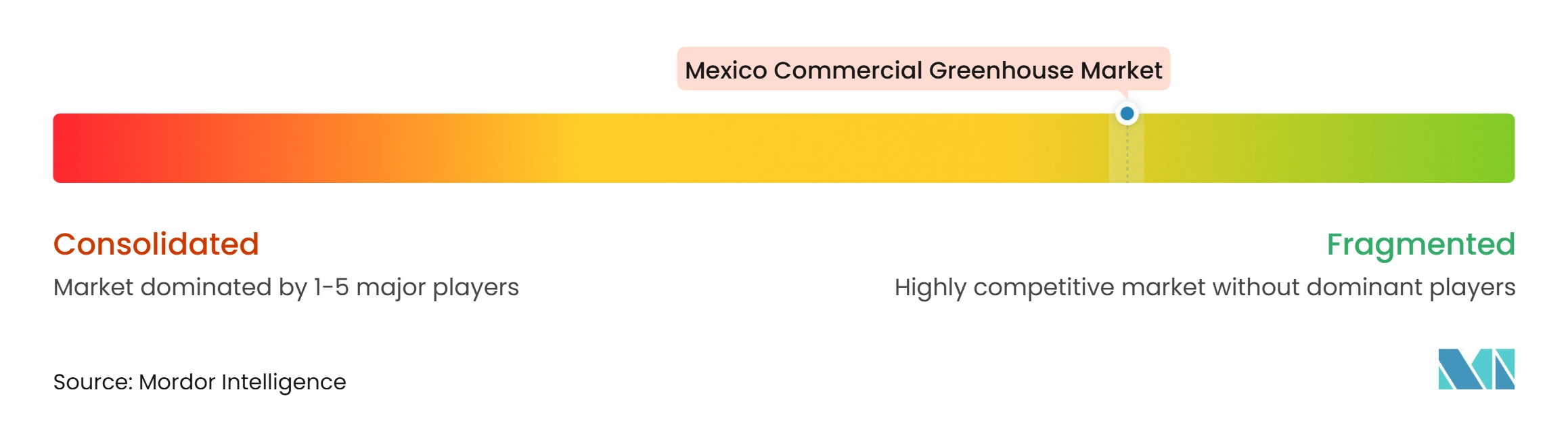
The Mexico commercial greenhouse market is fragmented, and no single manufacturer holds a dominant national position. The approved company universe includes Invernaderos y Tecnología, S.A.U., RIVSA Protected agriculture, Metaliser, GreenV Mexico, Novedades Agrícolas, S.A., J. Huete Greenhouses, ITOLSA agricultural, Surconsa de México S.A. de C.V., Richel Group, Fertri, Hortilife B.V., Invermex Invernaderos, StarFarm, KUBO Greenhouse Projects B.V. (KUBO Group B.V.), and Grupo Industrial TV, S.A.S. de C.V. Competition is based on complete-structure capability, project customization, local support, and the ability to integrate systems into a commercial facility. Component suppliers and software providers do not represent the market unless they sell qualifying complete commercial greenhouse structures. This structure places greater weight on technical capability and project references than on national brand scale.
Richel Group has maintained a documented Mexican project presence through complete greenhouse installations, including a 110-hectare high-technology plastic greenhouse project. In December 2024, Richel Group partnered with BIHOX on a Mexican greenhouse project that integrated water-oxygenation technology. GreenV Mexico has presented the SAIA concept as an artificial intelligence-integrated approach for high-technology greenhouse production. These examples show that differentiation extends beyond the frame and cover to the performance of the complete operating environment. Suppliers with local engineering and after-sales capacity hold an advantage where growers require service throughout design, construction, and crop operation.
Strategic positioning also reflects the need to serve different greenhouse types, crop systems, and project budgets. Plastic-film projects remain important for cost-sensitive vegetable production, while glass, polycarbonate, hybrid, and semi-closed designs address more controlled growing environments. Companies that integrate water management, screening, ventilation, and automation into a single build are better placed to address compliance and crop-quality requirements. Financing access remains a competitive factor because capital intensity limits the pool of buyers able to commission advanced sites. The fragmented structure leaves room for suppliers providing practical local support without relying on a single standardized greenhouse format.
Mexico Commercial Greenhouse Industry Leaders
-
Invernaderos y Tecnología, S.A.U.
-
Novedades Agrícolas, S.A.
-
GreenV Mexico
-
Metaliser
-
Richel Group
- *Disclaimer: Major Players sorted in no particular order
Mexico Commercial Greenhouse Market Companies Covered in this Report
- Invernaderos y Tecnología, S.A.U.
- RIVSA Protected agriculture
- Metaliser
- GreenV Mexico
- Novedades Agrícolas, S.A.
- J. Huete Greenhouses
- ITOLSA agricultural
- Surconsa de México S.A. de C.V.
- Richel Group
- Fertri
- Hortilife B.V.
- Invermex Invernaderos
- StarFarm
- KUBO Greenhouse Projects B.V. (KUBO Group B.V.)
- Grupo Industrial TV, S.A.S. de C.V.
Recent Industry Developments in Mexico Commercial Greenhouse Market
- December 2025: Richel Group held a regional seminar in Mexico for agents from South America, Central America, and Mexico, sharing project experience and regional market strategy for greenhouse expansion.
- November 2025: Richel Group exhibited at Expo Agroalimentaria 2025 in Irapuato, Guanajuato, presenting greenhouse climate-control, irrigation, and crop-protection solutions to Mexican producers.
- December 2024: Richel Group partnered with BIHOX on a Mexico greenhouse project integrating BIHOX's water-oxygenation technology to enhance photosynthesis and nutrient absorption, with Invercube Digital as a collaborating partner.
Mexico Commercial Greenhouse Market Report Scope
The study counts revenue generated by purpose-built glass or plastic structures where temperature, humidity, light, and fertigation are actively regulated to grow fruits, vegetables, flowers, ornamentals, herbs, and other specialty crops for sale to retailers, food-service buyers, or processors.
Scope exclusion: Backyard hobby houses and purely academic installations below 200 m² are not included.
The Mexico Commercial Greenhouse Market Report is Segmented by Equipment Type (Heating Systems, Cooling and Ventilation Systems, LED Grow Lighting, Irrigation and Fertigation Systems, Climate Control and Automation Software, Screening and Shading Systems, and Structural Components), by Crop Type (Fruits and Vegetables, Flowers and Ornamentals, Herbs and Microgreens, and Cannabis and Specialty Crops), by Greenhouse Type (Glass Greenhouse, Plastic-film Greenhouses, Rigid Polycarbonate Greenhouses, and Hybrid and Semi-closed Greenhouses), by Cultivation Technology (Hydroponic, Non-hydroponic Soil and Substrate, and Hybrid and Vertical Integration), and by End User (Commercial Growers, Research and Educational Institutes and Retail Garden Centers and Nurseries). The Market Forecasts are Provided in Terms of Value (USD).
Segmentation Overview
| Heating Systems | |
| Cooling and Ventilation Systems | |
| LED Grow Lighting | |
| Irrigation and Fertigation Systems | |
| Climate Control and Automation Software | |
| Screening and Shading Systems | |
| Structural Components | Glazing Systems |
| Frames and Trusses |
| Fruits and Vegetables | Tomatoes |
| Cucumbers | |
| Lettuce and Leafy Greens | |
| Peppers | |
| Strawberries and Berries | |
| Flowers and Ornamentals | Cut Flowers |
| Potted Plants and Bedding Plants | |
| Herbs and Microgreens | |
| Cannabis and Specialty Crops | Medical Cannabis |
| Seedlings and Propagation Crops |
| Glass Greenhouses |
| Plastic-film Greenhouses |
| Rigid Polycarbonate Greenhouses |
| Hybrid and Semi-closed Greenhouses |
| Hydroponic | Nutrient Film Technique |
| Deep Water Culture | |
| Drip Hydroponics | |
| Non-hydroponic Soil and Substrate | Soil-based |
| Coco Coir and Rockwool Substrate | |
| Hybrid and Vertical Integration |
| Commercial Growers |
| Research and Educational Institutes |
| Retail Garden Centers and Nurseries |
| By Equipment Type | Heating Systems | |
| Cooling and Ventilation Systems | ||
| LED Grow Lighting | ||
| Irrigation and Fertigation Systems | ||
| Climate Control and Automation Software | ||
| Screening and Shading Systems | ||
| Structural Components | Glazing Systems | |
| Frames and Trusses | ||
| By Crop Type | Fruits and Vegetables | Tomatoes |
| Cucumbers | ||
| Lettuce and Leafy Greens | ||
| Peppers | ||
| Strawberries and Berries | ||
| Flowers and Ornamentals | Cut Flowers | |
| Potted Plants and Bedding Plants | ||
| Herbs and Microgreens | ||
| Cannabis and Specialty Crops | Medical Cannabis | |
| Seedlings and Propagation Crops | ||
| By Greenhouse Type | Glass Greenhouses | |
| Plastic-film Greenhouses | ||
| Rigid Polycarbonate Greenhouses | ||
| Hybrid and Semi-closed Greenhouses | ||
| By Cultivation Technology | Hydroponic | Nutrient Film Technique |
| Deep Water Culture | ||
| Drip Hydroponics | ||
| Non-hydroponic Soil and Substrate | Soil-based | |
| Coco Coir and Rockwool Substrate | ||
| Hybrid and Vertical Integration | ||
| By End User | Commercial Growers | |
| Research and Educational Institutes | ||
| Retail Garden Centers and Nurseries | ||
Key Questions Answered in the Report
What is the value of France’s commercial greenhouse sector in 2026?
France’s commercial greenhouse sector is valued at USD 243.8 million in 2026.
Which equipment category leads commercial greenhouse sales in France?
Structural Components led commercial greenhouse sales in France with a 42.3% share in 2025.
Why are semi-closed greenhouse designs gaining attention in France?
Semi-closed greenhouse designs are gaining attention because they improve heat management and production continuity.
What is the main restraint on new commercial greenhouse projects?
High capital, labor, and operating costs remain the main restraint on new commercial greenhouse projects.