
Methyl Acetate Market Size and Share
Market Overview
| Study Period | 2022 - 2032 |
|---|---|
| Market Size (2027) | USD 335.62 Million |
| Market Size (2032) | USD 485.64 Million |
| Growth Rate (2027 - 2032) | 7.67 % |
| Fastest Growing Market | Asia-Pacific |
| Largest Market | Asia-Pacific |
| Market Concentration | Medium |
Major Players *Disclaimer: Major Players sorted in no particular order Image © Mordor Intelligence. Reuse requires attribution under CC BY 4.0. | |
Methyl Acetate Market Analysis by Mordor Intelligence
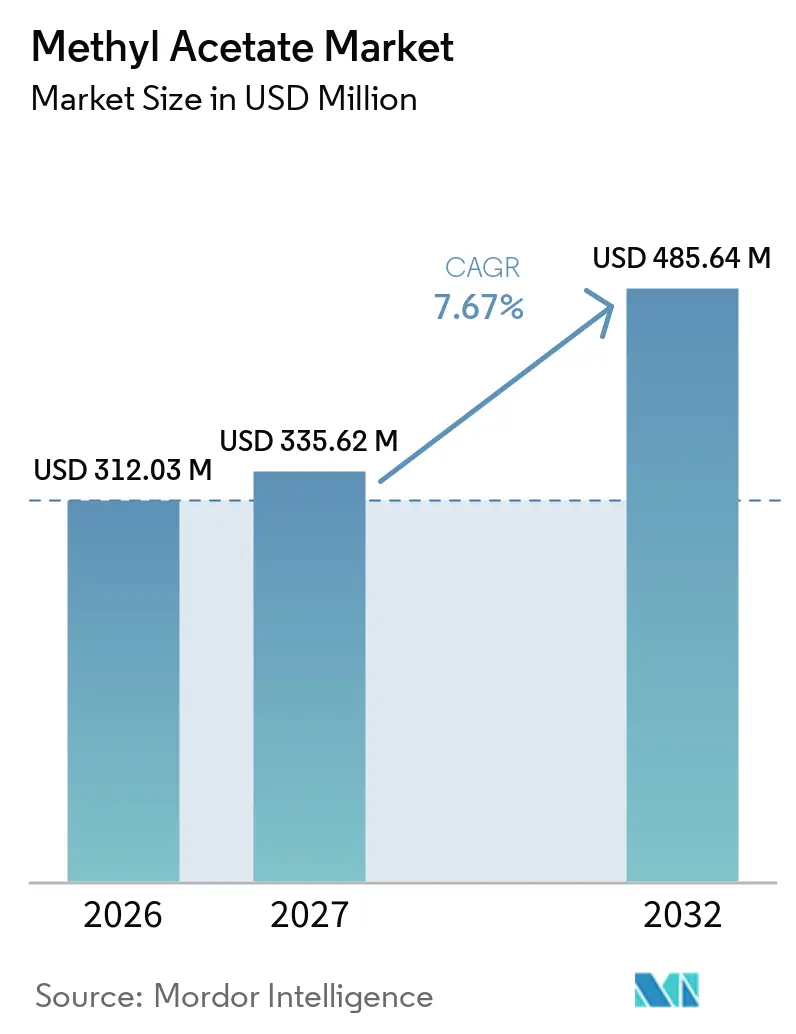
The Methyl Acetate Market size was valued at USD 312.03 million in 2026 and is estimated to grow from USD 335.62 million in 2027 to reach USD 485.64 million by 2032, at a CAGR of 7.67% during the forecast period (2027-2032). The methyl acetate market is moving beyond its traditional role as a commodity solvent because regulations and higher-value applications increasingly favor low-reactivity products. Its low photochemical reactivity supports the use in formulations that need to meet Volatile Organic Compound (VOC) requirements, while construction, automotive production, and packaging printing continue to support underlying demand across large-volume customer groups in several global regions. The methyl acetate market also benefits from rising requirements for faster-drying coatings and carefully specified solvents in pharmaceuticals and electronics, where performance and compliance can be assessed together. Integrated producers and companies with high-purity processing capabilities are better placed to address these requirements and to provide documented product consistency to qualified customers. Feedstock price movements, flammability controls, and competing solvent systems remain important limits on demand and producer margins, particularly for producers without integrated feedstock supply.
Key Report Takeaways
- By grade, industrial grade held 62.45% of the methyl acetate market share in 2026, while pharmaceutical grade is forecast to advance at an 8.13% CAGR through 2032.
- By purity, 90% to 99% purity held 44.06% of the methyl acetate market share in 2026, while greater than or equal to 99% purity is forecast to advance at an 8.36% CAGR through 2032.
- By end-use industry, paints and coatings held 48.38% of the methyl acetate market share in 2026, while personal care and cosmetics are forecast to advance at an 8.67% CAGR through 2032.
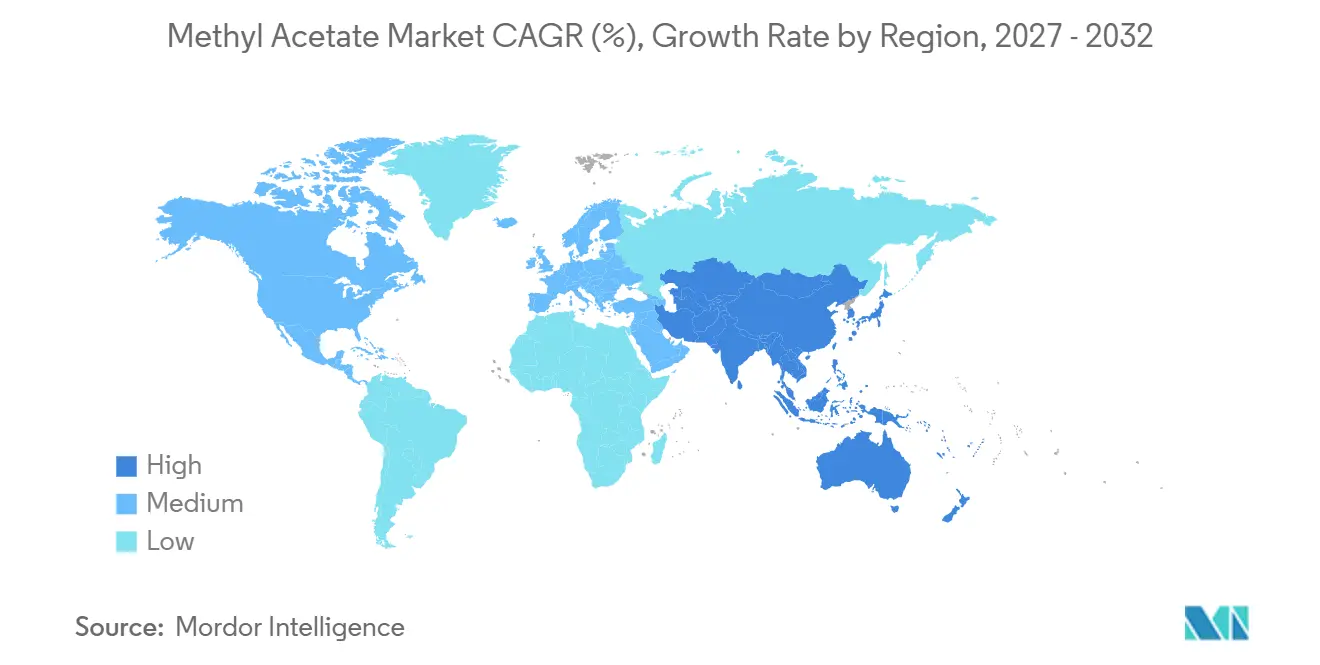
- By geography, Asia-Pacific held 45.73% of the methyl acetate market share in 2026 and is forecast to advance at an 8.59% CAGR through 2032.
Note: Market numbers in this report are based on Mordor Intelligence's proprietary estimation framework, which combines nine months of actuals with Q4 projections for base year 2026.
Market Trends and Insights
Drivers Impact Analysis of Methyl Acetate Market*
| Driver | (~) % Impact on CAGR Forecast | Geographic Relevance | Impact Timeline |
|---|---|---|---|
| Low-VOC and VOC-Exempt Solvent Substitution | +2.5% | Global, with earliest and strongest impact in North America and EU | Short term (≤ 2 years) |
| Fast-Drying Requirements in Coatings and Printing Inks | +2.0% | Global, core demand in Asia-Pacific and North America | Medium term (2-4 years) |
| High-Purity Demand from Pharmaceuticals and Electronics | +1.5% | Asia-Pacific core, spillover to North America and EU | Medium term (2-4 years) |
| Expanding Construction, Automotive, and Industrial Coatings Output | +1.2% | Asia-Pacific and South America | Medium term (2-4 years) |
| Regionalization of Chemical Production in Asia-Pacific | +0.8% | Asia-Pacific, with early gains in China, India, and ASEAN Countries | Long term (≥ 4 years) |
| Source: Mordor Intelligence | |||
Low-VOC and VOC-Exempt Solvent Substitution
Regulation of volatile organic compound (VOC) emissions is a central demand driver for the methyl acetate market. The U.S. Environmental Protection Agency retained methyl acetate’s photochemical reactivity factor at 0.07 g O₃/g VOC under the 2025 aerosol coatings rule, supporting its exempt status under the relevant federal framework[1]. The South Coast Air Quality Management District's phase-out of parachlorobenzotrifluoride (PCBTF) and tert-butyl acetate from January 2026 narrowed the compliant solvent choices for California applications. BASF developed starting formulations for PCBTF-free 2K polyurethane automotive refinish clearcoats that use methyl acetate as a compliant alternative. European Chemicals Agency requirements for flammability and occupational hazard documentation also favor suppliers with established technical documentation. As compliance deadlines approach, formulators have a reason to qualify compliant solvents before a mandate takes effect.
Fast-Drying Requirements in Coatings and Printing Inks
Methyl acetate has a boiling point of 57 °C, which supports rapid solvent release in coating and printing operations. This property is relevant for high-volume lines where drying speed affects throughput and line efficiency. In flexographic and rotogravure printing, slower solvents can reduce productivity, which supports methyl acetate use in fast-moving packaging applications. 2K polyurethane coatings need urethane-grade material with controlled water and alcohol content, shifting some demand toward higher-purity products. Eastman Chemical Company positions its high-purity methyl acetate for moisture-sensitive polyurethane systems where specification consistency is part of supplier qualification[2]. This requirement gives suppliers with reliable distillation and certification capabilities a clearer route into higher-value demand.
High-Purity Demand from Pharmaceuticals and Electronics
Pharmaceutical use is shifting from bulk extraction toward specified reaction media and drug-delivery applications in the methyl acetate market. Methyl acetate is an International Council for Harmonisation (ICH) Q3C Class 3 residual solvent, which reflects lower toxicological concern for uses such as active pharmaceutical ingredient synthesis and tablet coating. Semiconductor fabrication and printed circuit board cleaning also require solvents with controlled impurity profiles. VOC-exempt status can reduce compliance requirements for facilities located in air-quality nonattainment areas. Celanese Corporation identifies specialty solvents for pharmaceutical and advanced materials applications within its integrated acetyl chain. Supply chain traceability and batch-to-batch quality, therefore, become stronger competitive considerations for high-purity supply.
Expanding Construction, Automotive, and Industrial Coatings Output
Construction-linked coatings remain a large demand source for the methyl acetate market. Industrial grade material is used in architectural paints, protective coatings, and industrial maintenance products across developing economies. Automotive plants in China and South Korea use it in original equipment manufacturer paint lines and aftermarket refinish applications because rapid drying and resin compatibility support short production cycles. China’s integrated chemical system supports domestic availability of acetic acid, methanol, and downstream ester products. Producers located near feedstocks can offer supply reliability to industrial buyers that are sensitive to price and delivery.
Restraints Impact Analysis of Methyl Acetate Market*
| Restraint | (~) % Impact on CAGR Forecast | Geographic Relevance | Impact Timeline |
|---|---|---|---|
| Flammability, Storage, and Transport Requirements | -0.8% | Global, most acute in Middle East and Africa and South America | Medium term (2-4 years) |
| Methanol and Acetic Acid Price Volatility | -0.6% | Global, most margin-sensitive in North America and EU | Short term (≤ 2 years) |
| Competition from Acetone, Ethyl Acetate, and Water-Based Formulations | -0.5% | Global, most intense in price-sensitive Asia-Pacific markets | Long term (≥ 4 years) |
| Source: Mordor Intelligence | |||
Flammability, Storage, and Transport Requirements
Methyl acetate has a flash point of −10 °C and is classified as a United Nations (UN) Class 3 highly flammable liquid. This classification requires segregated storage, specialized tanker certification, and limits on co-loading. These requirements raise logistics and handling costs compared with water-based or lower-flammability alternatives, particularly where delivery distances are long or storage facilities are limited. The burden is greater for smaller users in parts of South America and Africa where hazardous goods infrastructure is less developed. European Chemicals Agency requirements also require occupational exposure controls and related documentation. In aerosol applications, the solvent’s flammability can limit use where it affects the classification of the finished formulation.
Methanol and Acetic Acid Price Volatility
Methyl acetate production depends on acetic acid and methanol, so changes in either feedstock directly affect producer costs. Supply disruptions in Europe and geopolitical pressure on Middle East methanol supplies increased cost pressure during 2025 and 2026. Celanese Corporation announced acetyl-chain price increases in February, March, and May 2026, showing how higher input costs were passed through the value chain. Producers without upstream integration face a greater risk of margin compression when feedstock costs rise, especially if customer contracts do not allow rapid price adjustments. Their capacity additions and quality-certification investments can become more difficult to fund. Buyers in printing inks and adhesives can also switch among qualified solvents when methyl acetate prices become less favorable.
*Our forecasts treat driver/restraint impacts as directional, not additive. The impact forecasts reflect baseline growth, mix effects, and variable interactions.
Methyl Acetate Market Segment Analysis
By Grade:
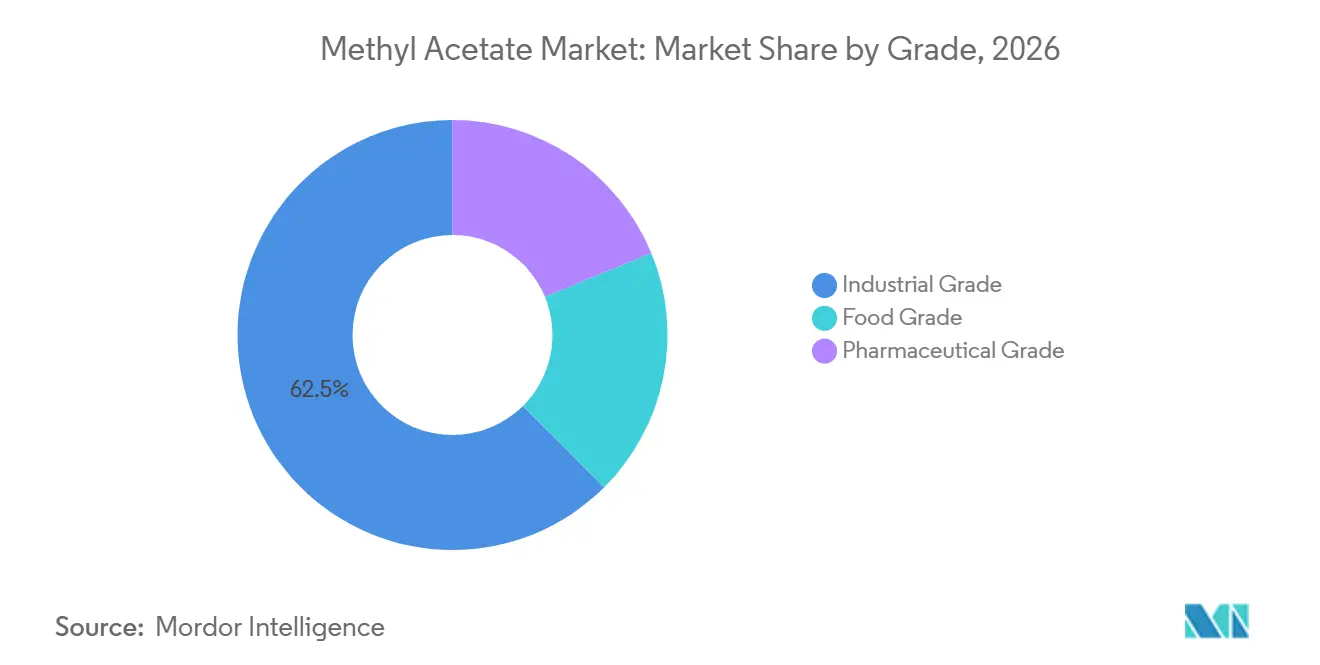
Industrial Grade Maintains Revenue Leadership as Pharmaceutical Grade ExpandsIndustrial grade held 62.45% of the methyl acetate market share in 2026. It serves the broad demand base in paints, adhesives, inks, and standard industrial cleaning applications. These uses provide steady demand because construction, vehicle maintenance, and industrial operations are geographically diverse. Industrial customers also tend to assess solvent choices closely against total formulation cost. Food grade serves flavor and fragrance applications where methyl acetate’s fruity odor supports the intended formulation. It occupies a smaller but stable position within the grade mix.
Pharmaceutical grade is projected to advance at an 8.13% CAGR through 2032 within the methyl acetate market. Demand is supported by tighter active pharmaceutical ingredient specifications and more tablet-coating applications. Pharmaceutical grade and the greater than or equal to 99% purity tier are closely connected because both depend on consistent specifications. Chang Chun Group has developed pharmaceutical-grade methyl acetate variants for tablet-coating applications. Suppliers focused only on standard industrial products may have less exposure to premium-grade demand.

By Purity:
90% to 99% Purity Leads, While Greater than or Equal to 99% Purity ExpandsThe 90% to 99% purity segment held 44.06% of the methyl acetate market share in 2026. Coatings, adhesives, and inks use this range where higher purity is not necessary for performance. Construction and automotive coatings in Asia-Pacific and North America support their large demand base. Less than 90% purity material serves lower-specification industrial cleaning and chemical process uses. In these applications, procurement decisions emphasize cost more than purity. Demand for this tier can decline gradually as product requirements become more stringent.
Greater than or equal to 99% purity is projected to advance at an 8.36% CAGR through 2032. Pharmaceuticals, electronics, and specialty coatings require better control of impurities and moisture. These applications support premium pricing where suppliers can document product consistency. Availability of certified supply and dependable specification control remains important for customers in these applications.
By End-Use Industry:
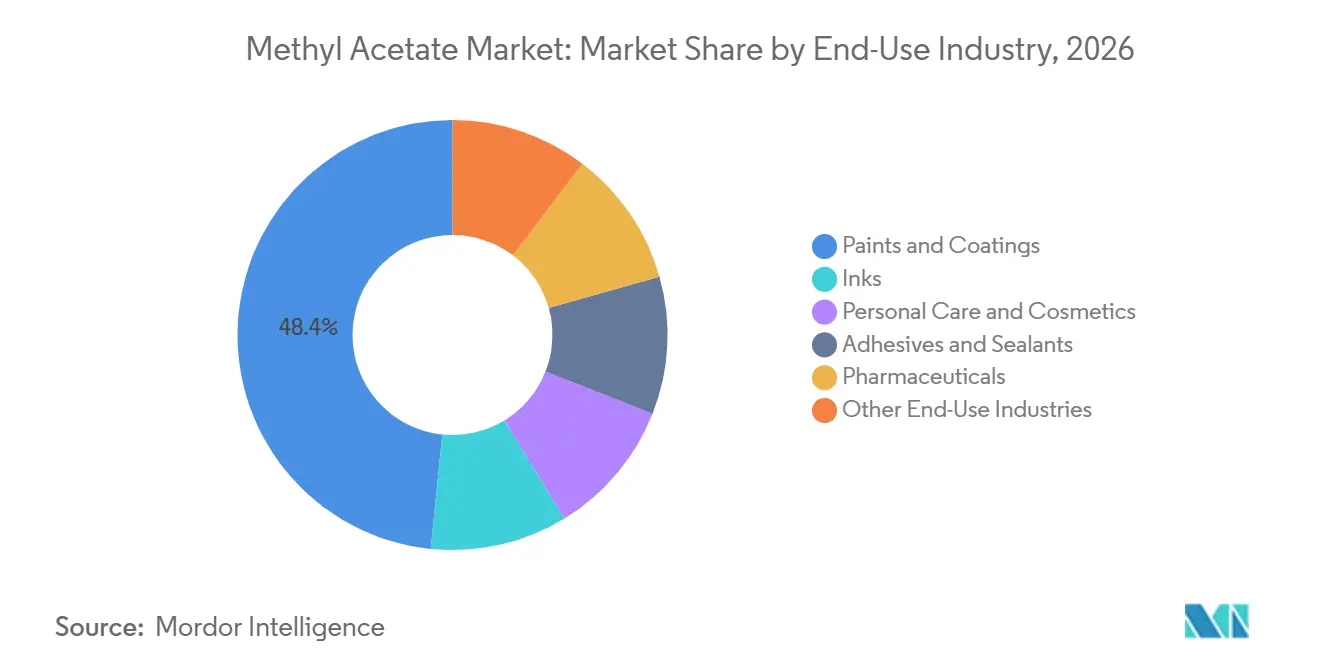
Paints and Coatings Lead Demand While Personal Care and Cosmetics Grow FasterPaints and coatings held 48.38% of the methyl acetate market share in 2026. This end-use includes architectural products, automotive original equipment manufacturer coatings, refinish systems, industrial primers, and marine protective coatings. Its importance comes from high material throughput across many coating types. Adhesives and sealants also use methyl acetate because it can dissolve resin systems used in construction and automotive assembly. Pharmaceuticals and inks represent more specialized demand pools with distinct specification requirements. Other uses include flavoring, agrochemicals, and specialty chemical synthesis.
Personal care and cosmetics are projected to advance at an 8.67% CAGR through 2032. Formulators use methyl acetate in nail care, fragrance blending, hair mists, and aerosol products where rapid evaporation and low residue are important. Eastman Chemical Company identifies methyl acetate as a solvent for uses that require controlled product performance. Personal care uses can require cosmetic-grade or food-grade material, which links their growth to demand for high-purity products. This creates another route for suppliers that can meet defined quality requirements. The shift in this end-use supports a higher-value mix within the methyl acetate market.
Geography Analysis
APAC Methyl Acetate Market
Asia-Pacific held 45.73% of the methyl acetate market share in 2026 and is projected to advance at an 8.59% CAGR through 2032. China is a major producer and consumer because it has integrated acetic acid, methanol, and downstream solvent production. This system supports cost advantages for domestic producers and export supply. India and ASEAN countries add demand through construction activity, automotive production, and manufacturing localization. Japan and South Korea contribute specialized pharmaceutical-grade and electronics-grade demand. Their stringent customer qualification requirements make them important value-oriented markets in the region.
North America Methyl Acetate Market
North America remains a major consumer and regulatory reference point for the methyl acetate market. Federal VOC regulations supports demand in coatings and cleaning applications where formulators need low-reactivity options. Celanese Corporation operates an integrated acetyl chain and reported USD 9.5 billion in 2025 net sales across its Acetyl Chain and Engineered Materials businesses. Mexico adds demand through nearshoring in vehicle manufacturing and electronics assembly. These facilities use coatings and adhesive-grade solvents in new industrial operations.
EMEA and South America Methyl Acetate Market
Europe operates under the European Chemicals Agency Registration, Evaluation, Authorisation and Restriction of Chemicals (REACH) framework, which requires hazard, exposure, and supply-chain documentation. BASF supports European supply through its integrated chemical sites and investment in Antwerp, Belgium. South America has demand linked to construction and automotive activity, although import dependence and economic cycles constrain predictability. The Middle East and Africa have lower current penetration because hazardous-goods logistics and VOC-compliance requirements are less developed. Both regions retain longer-term potential as industrial activity and urban development progress.
Competitive Landscape
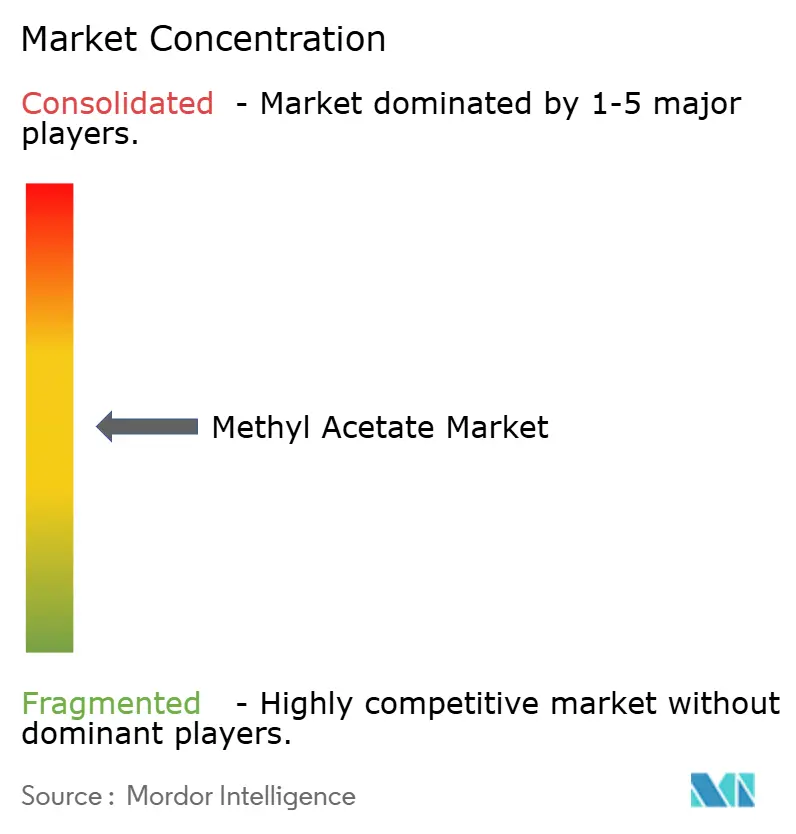
The methyl acetate market is moderately concentrated, with the top five players including Eastman Chemical Company, Celanese Corporation, Wacker Chemie AG, Anhui Wanwei Group Co., Ltd., and Chang Chun Group. Their established distribution networks and technical resources matter where pharmaceutical and electronics customers require dependable documentation, traceability, and repeatable batch performance. Chinese producers often compete through volume output, feedstock proximity, and access to domestic coatings and adhesives customers. This local position can reduce transport complexity for standard industrial users and can support responsiveness when demand changes. Competition is most direct in Industrial Grade products where cost differences are meaningful. Pharmaceutical-grade and electronics-grade materials are more protected by customer qualification and specification requirements.
Celanese Corporation announced in October 2025 that it intended to cease acetate tow manufacturing operations at its Lanaken, Belgium, facility in 2026 because the operation was not economically viable. This action reflects rationalization in high-cost European capacity and supports a focus on higher-margin products. BASF has developed PCBTF-free automotive refinish starting formulations using methyl acetate to help customers meet changing California requirements. The formulation work matters because customers can assess solvent performance within a system instead of changing an input material in isolation. Eastman Chemical Company supplies high-purity methyl acetate for moisture-sensitive polyurethane applications, supporting its position in specification-led segments. These moves show that application support and reliable product quality can be as important as production scale. They also increase the importance of relationships with formulators during product qualification.
Sustainability and process development are additional areas of competitive differentiation in the methyl acetate market. Celanese Corporation launched the ECO-CC product line at Clear Lake, Texas, in 2025, using low-carbon methanol from its Fairway carbon capture and utilization joint venture with mass-balance tracking and lifecycle assessment. This development may support lower-carbon acetyl-chain products, including ester grades, where customers need information on raw-material emissions. Bio-based methyl acetate and certified low-carbon material remain limited in commercial availability. Suppliers that can provide credible lifecycle or mass-balance documentation can address customers seeking emissions information for purchased materials. Such documentation can be relevant in European and North American customer procurement processes that now assess supply-chain information alongside price and technical fit. The competitive landscape remains broad because the leading supplier group does not hold a dominant share of supply.
Methyl Acetate Industry Leaders
-
Eastman Chemical Company
-
Celanese Corporation
-
Wacker Chemie AG
-
Anhui Wanwei Group Co., Ltd.
-
Chang Chun Group
- *Disclaimer: Major Players sorted in no particular order
Methyl Acetate Market Companies Covered in this Report
- Anhui Wanwei Group Co., Ltd.
- BASF
- Celanese Corporation
- Chang Chun Group
- Changzhou Xinkang Chemical Co., Ltd.
- China National Petroleum Corporation
- Eastman Chemical Company
- Hunan Xiangwei Co., Ltd.
- Jiangsu Ruifeng Polymer Materials Co., Ltd.
- Jiangsu Sopo Chemical Co., Ltd.
- Shanxi Sanwei Group Co Ltd.
- Sichuan Chuanwei Group Co., Ltd.
- Sinochem Plastics Co., Ltd.
- Wacker Chemie AG
- Yixing Jiangnan Chemical Co., Ltd.
- Zhangzhou Oushuo Chemical Co., Ltd.
Recent Industry Developments in Methyl Acetate Market
- May 2026: Celanese Corporation announced price increases across its acetyl chain portfolio, including acetic acid, vinyl acetate monomer, ethyl acetate, acetic anhydride, and selected solvents, effective immediately across the Americas and EMEA regions. The price adjustments are relevant to the methyl acetate market because changes in the pricing of related acetyl-chain chemicals can influence solvent-market pricing dynamics and procurement costs for downstream manufacturers.
- March 2026: Scientists at the CSIR–National Chemical Laboratory (CSIR-NCL) in Pune developed an indigenous technology to produce dimethyl ether (DME), a chemical intermediate used in manufacturing lower olefins, dimethyl sulfate, and methyl acetate. The development supports the methyl acetate market by advancing domestic production capabilities for an upstream chemical feedstock used in methyl acetate synthesis.
Global Methyl Acetate Market Report Scope
Methyl acetate is a volatile organic solvent and ester used in industrial formulations and chemical processing. Its fast evaporation rate and solvent properties make it suitable for applications requiring efficient dissolution, formulation compatibility, and controlled drying.
The Methyl Acetate Market is segmented by grade, purity, end-use industry, and geography. By grade, the market is segmented into industrial grade, pharmaceutical grade, and food grade. By purity, the market is segmented into greater than or equal to 99% purity, 90% to 99% purity, and less than 90% purity. By end-use industry, the market is segmented into paints and coatings, adhesives and sealants, pharmaceuticals, inks, personal care and cosmetics, and other end-use industries. The report also covers the market size and forecasts for methyl acetate across 15 countries. For each segment, the market sizing and forecasts have been done on the basis of value (USD).
Segmentation Overview
| Industrial Grade |
| Pharmaceutical Grade |
| Food Grade |
| Greater than or Equal to 99% Purity |
| 90% to 99% Purity |
| Less than 90% Purity |
| Paints and Coatings |
| Adhesives and Sealants |
| Pharmaceuticals |
| Inks |
| Personal Care and Cosmetics |
| Other End-Use Industries |
| Asia-Pacific | China |
| India | |
| Japan | |
| South Korea | |
| ASEAN Countries | |
| Rest of Asia-Pacific | |
| North America | United States |
| Canada | |
| Mexico | |
| Europe | Germany |
| United Kingdom | |
| France | |
| Italy | |
| NORDIC Countries | |
| Rest of Europe | |
| South America | Brazil |
| Argentina | |
| Rest of South America | |
| Middle East and Africa | Saudi Arabia |
| South Africa | |
| Rest of Middle East and Africa |
| By Grade | Industrial Grade | |
| Pharmaceutical Grade | ||
| Food Grade | ||
| By Purity | Greater than or Equal to 99% Purity | |
| 90% to 99% Purity | ||
| Less than 90% Purity | ||
| By End-Use Industry | Paints and Coatings | |
| Adhesives and Sealants | ||
| Pharmaceuticals | ||
| Inks | ||
| Personal Care and Cosmetics | ||
| Other End-Use Industries | ||
| By Geography | Asia-Pacific | China |
| India | ||
| Japan | ||
| South Korea | ||
| ASEAN Countries | ||
| Rest of Asia-Pacific | ||
| North America | United States | |
| Canada | ||
| Mexico | ||
| Europe | Germany | |
| United Kingdom | ||
| France | ||
| Italy | ||
| NORDIC Countries | ||
| Rest of Europe | ||
| South America | Brazil | |
| Argentina | ||
| Rest of South America | ||
| Middle East and Africa | Saudi Arabia | |
| South Africa | ||
| Rest of Middle East and Africa | ||
Key Questions Answered in the Report
What is the size of the methyl acetate market?
The methyl acetate market size was valued at USD 312.03 million in 2026 and is estimated to grow from USD 335.62 million in 2027 to reach USD 485.64 million by 2032, at a CAGR of 7.67% during the forecast period (2027-2032).
What is driving demand for methyl acetate?
VOC compliance, rapid drying in coatings and printing, and high-purity needs in pharmaceuticals and electronics support demand.
Which grade held the largest share in 2026?
Industrial grade held 62.45% in 2026 because paints, adhesives, inks, and industrial cleaning create a broad demand base.
Which purity is projected to advance fastest through 2032?
Greater than or equal to 99% purity is projected to advance at an 8.36% CAGR through 2032, supported by pharmaceutical, electronics, and specialty coatings uses.