
Metal Stamping Market Size and Share
Market Overview
| Study Period | 2022 - 2032 |
|---|---|
| Market Size (2027) | USD 278.91 Million |
| Market Size (2032) | USD 343.10 Million |
| Growth Rate (2027 - 2032) | 4.23 % |
| Fastest Growing Market | Asia-Pacific |
| Largest Market | Asia-Pacific |
| Market Concentration | Low |
Major Players *Disclaimer: Major Players sorted in no particular order Image © Mordor Intelligence. Reuse requires attribution under CC BY 4.0. | |
Metal Stamping Market Analysis by Mordor Intelligence
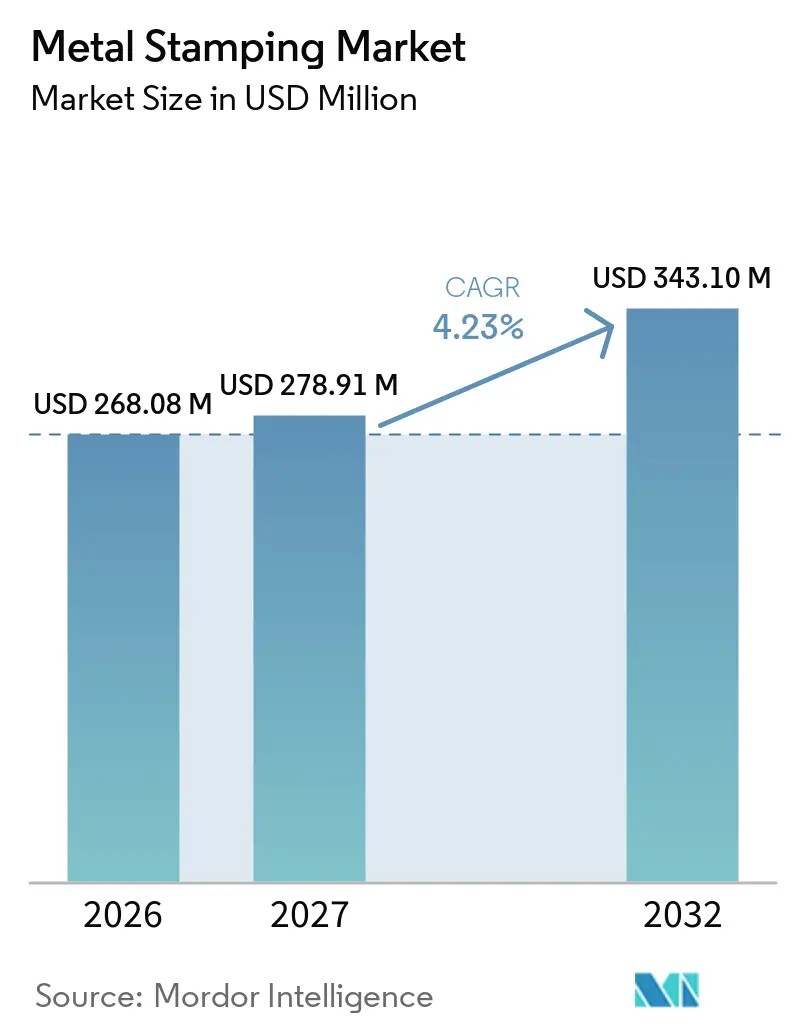
The Metal Stamping Market size was valued at USD 268.08 million in 2026 and is estimated to grow from USD 278.91 million in 2027 to reach USD 343.10 million by 2032, at a CAGR of 4.23% during the forecast period (2027-2032). Vehicle electrification is increasing demand for battery enclosures, structural frames, and precision electrical parts, while smaller connectors are raising the value of tight-tolerance forming. Automotive producers are also asking suppliers to make lighter, stronger body structures that meet predictable crash-performance requirements. Regional manufacturing incentives are making local production capacity a condition for winning some supply contracts rather than only a way to reduce logistics costs. The metal stamping market is becoming harder for smaller suppliers to enter because advanced dies, servo presses, hot-forming lines, and qualified engineering staff require sustained investment. Suppliers that combine programmable press technology with inspection systems can compete for more complex programs as vehicle designs consolidate multiple stamped parts into fewer integrated structures.
Key Report Takeaways
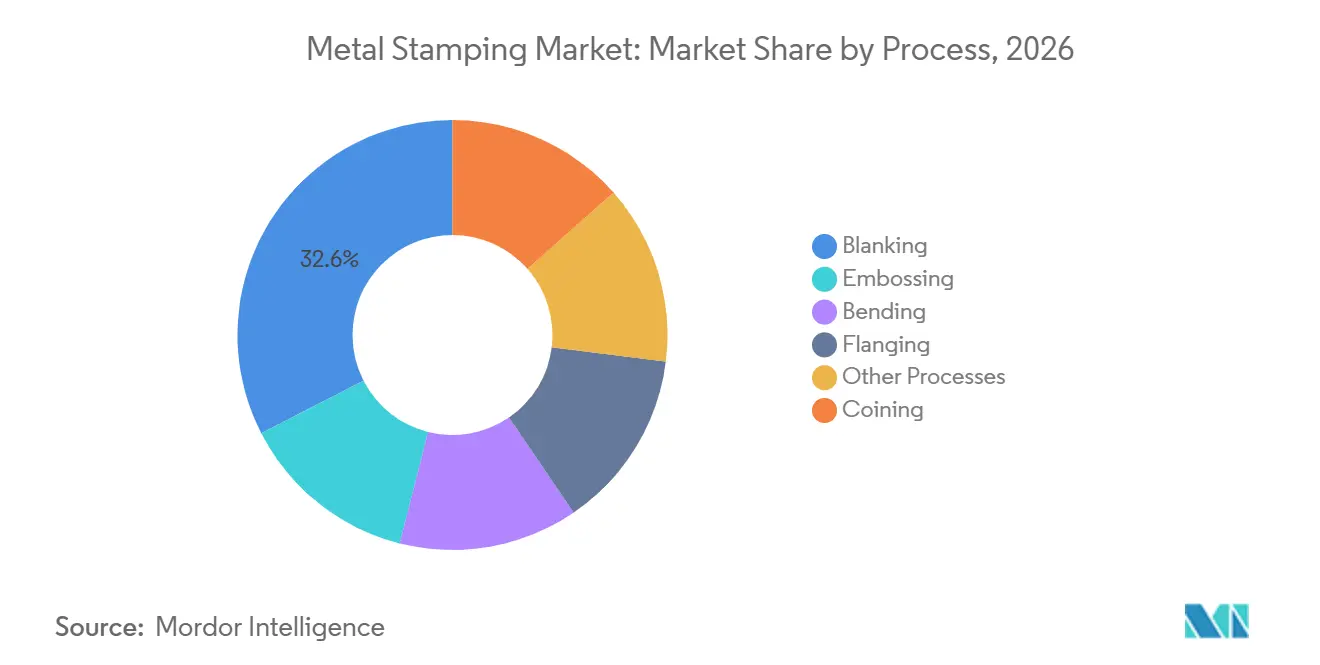
- By process, blanking held 32.56% of the metal stamping market share in 2026, while bending is forecast to advance at a 4.78% CAGR through 2032.
- By press type, the mechanical press held 51.34% of the metal stamping market share in 2026, while the servo press is forecast to advance at a 4.92% CAGR through 2032.
- By material, steel held 58.11% of the metal stamping market share in 2026, while aluminum is forecast to advance at a 5.14% CAGR through 2032.
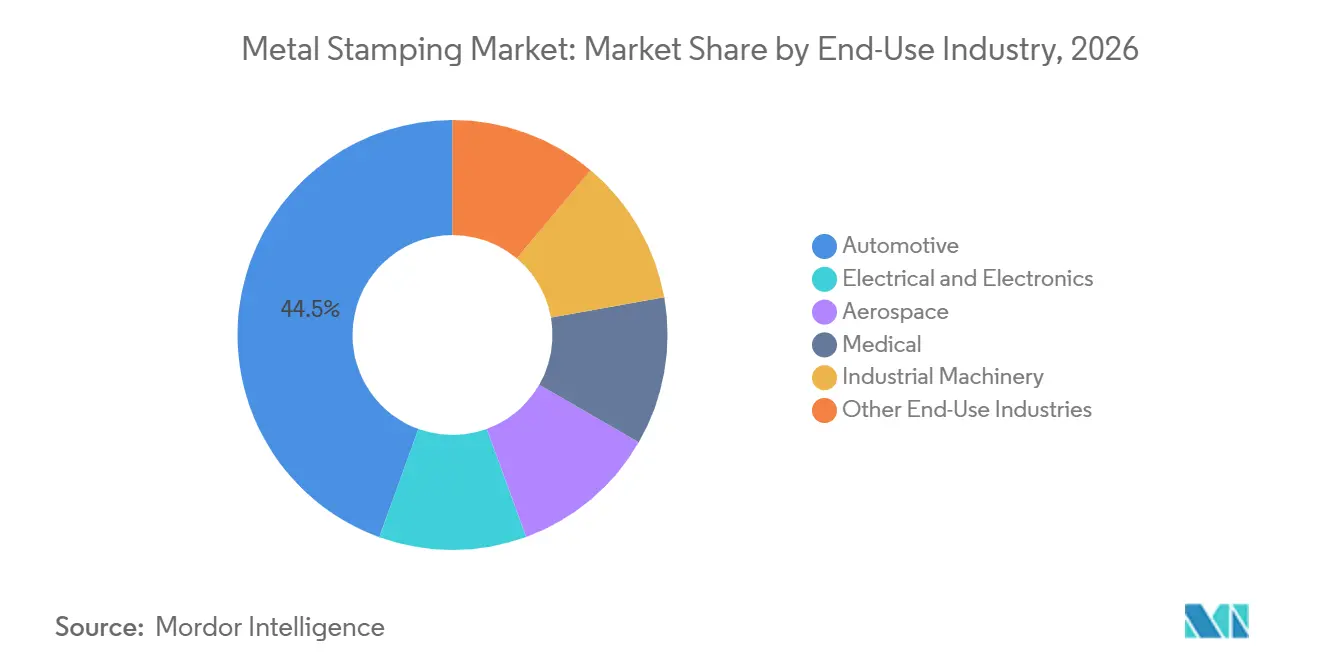
- By end-use industry, automotive held 44.47% of the metal stamping market share in 2026, while medical is forecast to advance at a 5.37% CAGR through 2032.
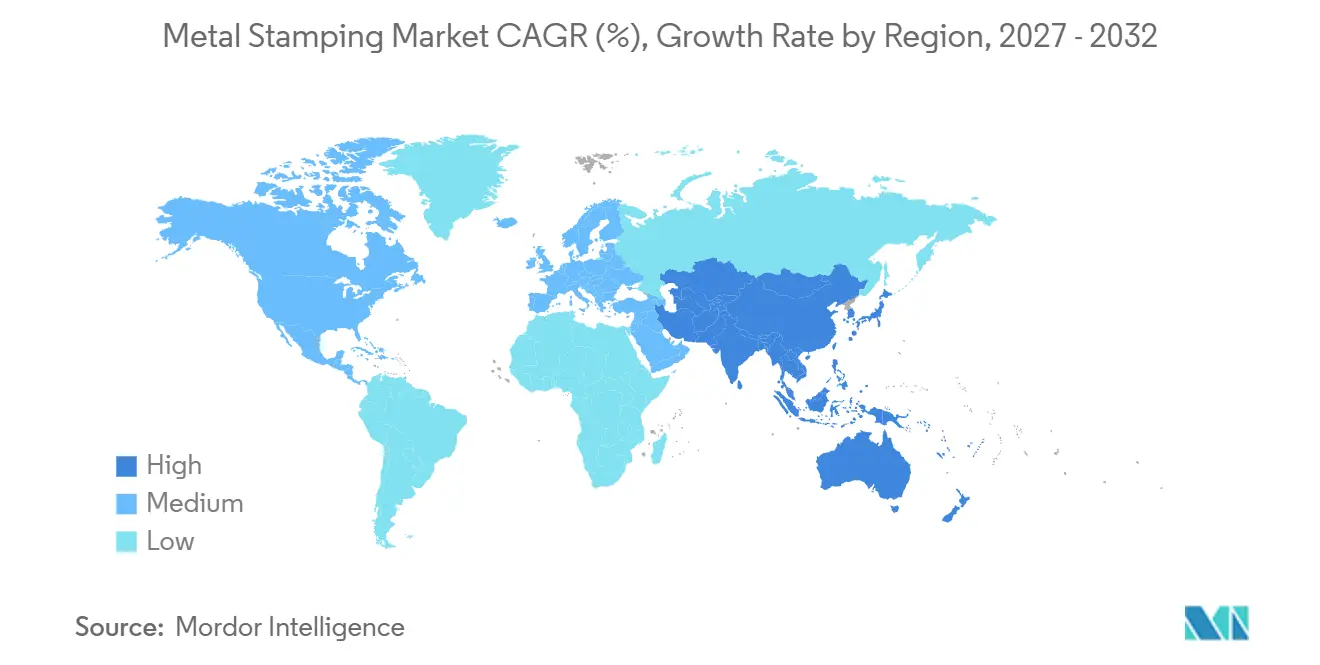
- By geography, Asia-Pacific held 40.36% of the metal stamping market share in 2026 and is forecast to advance at a 5.22% CAGR through 2032.
Note: Market numbers in this report are based on Mordor Intelligence's proprietary estimation framework, which combines nine months of actuals with Q4 projections for base year 2026.
Market Trends and Insights
Drivers Impact Analysis of Metal Stamping Market*
| Driver | (~) % Impact on CAGR Forecast | Geographic Relevance | Impact Timeline |
|---|---|---|---|
| EV Battery Enclosure and Lightweight Structural Demand | +1.4% | Global, concentrated in Asia-Pacific and North America | Short term (≤ 2 years) |
| Automotive Safety, Lightweighting and Body-in-White Complexity | +0.8% | Global, with intensity in China, Germany, and South Korea | Medium term (2-4 years) |
| Supply-Chain Localization and Regional Manufacturing Incentives | +0.7% | North America, India, Southeast Asia, MEA | Medium term (2-4 years) |
| Electronics Miniaturization and Precision Connector Demand | +0.6% | Asia-Pacific core, spillover to North America and Europe | Medium term (2-4 years) |
| Servo Press, In-Die Sensing and AI-Assisted Quality Adoption | +0.5% | Global, led by Europe and Japan | Long term (≥ 4 years) |
| Source: Mordor Intelligence | |||
EV Battery Enclosure and Lightweight Structural Demand
Electric vehicle battery enclosures have become a distinct source of demand for the metal stamping market. Battery programs require multi-stage draw, bend, and weld sequences, along with shielding and crash-resistant features that standard blanking lines cannot produce without major tool changes. Hindalco Industries commissioned an electric vehicle battery enclosure facility in Chakan, Pune, in 2025 with an investment of INR 5 billion (approximately USD 59 million). The facility delivered 10,000 aluminum battery enclosures to Mahindra & Mahindra and reported 40% lower weight than steel alternatives with an 8% to 10% improvement in driving range. These programs can create long production runs and closer supplier relationships, which increase the value of early investment in advanced forming capability.
Automotive Safety, Lightweighting and Body-in-White Complexity
Automotive body structures require parts that are stronger, lighter, and capable of controlled deformation during a collision. Hot-formed advanced high-strength steel is a key option for suppliers serving this requirement at vehicle-scale volumes. KIRCHHOFF Automotive received the Swedish Steel Prize in 2025 with Volkswagen AG for its ainitizing, Quenching and Partitioning (BQP) modified hot-forming process and SIBORA silicon-boron steel grade. The company stated that the solution improves energy absorption while reducing material mass. International Automotive Task Force (IATF) 16949:2016 requirements make advanced planning, production-part approval, and failure analysis important qualifications for automotive stampers. These requirements favor suppliers that can manage quality controls across multi-material assemblies.
Supply-Chain Localization and Regional Manufacturing Incentives
Supply-chain localization is changing, as the metal stamping market adds capacity. The United States reinstated a 25% additional duty on steel imports in February 2025 under Section 232, which raises costs for import-reliant buyers while supporting domestic sourcing conditions[1]. JBM Group and Sodecia Automotive International formed a joint venture in November 2025 for a hot-stamping facility in Chakan, Pune. The project carries an investment of INR 1.5 billion (approximately USD 18 million) and will make lightweight safety structures for internal combustion engine and electric vehicles. Benteler began construction of a 3,200-metric-ton cold-stamping plant in Kenitra, Morocco, in June 2025 to support a local-for-local model. Local production is increasingly part of the qualification process for automotive supply contracts.
Electronics Miniaturization and Precision Connector Demand
Connector work is moving toward smaller pitches and tighter process control in the metal stamping market. Automotive connectors for advanced driver-assistance systems and centralized electric vehicle architectures must maintain vibration resistance and signal integrity. Precision-stamped parts can be used in electrical contacts, shielding shells, and spring elements where dimensions and material properties are critical. The need for repeatable forming makes progressive dies, high-speed presses, and inspection systems more important in these programs. Suppliers without programmable presses and reliable in-die inspection have a narrower position in advanced connector work.
Restraints Impact Analysis of Metal Stamping Market*
| Restraint | (~) % Impact on CAGR Forecast | Geographic Relevance | Impact Timeline |
|---|---|---|---|
| Steel, Aluminum and Energy-Cost Volatility | -1.2% | Global, most acute in North America and Europe | Short term (≤ 2 years) |
| High Tooling, Die and Press Capital Requirements | -0.8% | Global, disproportionate in APAC core | Medium term (2-4 years) |
| Tool-and-Die Skills Shortage and Retirement of Experienced Workforce | -0.6% | North America, Europe, Japan | Long term (≥ 4 years) |
| Source: Mordor Intelligence | |||
Steel, Aluminum and Energy-Cost Volatility
Material cost changes affect the metal stamping market because suppliers often recover higher steel or aluminum costs after a delay. Martinrea International Inc. reported in its third-quarter 2025 results that it was negotiating tariff relief with customers for most of its exposure before year-end. U.S. steel tariffs initially took effect at 25% in February 2025 and were raised to 50% in June 2025. Fixed vehicle program prices can make it difficult to absorb sudden coil-cost increases. Hot stamping also requires furnace cycles above 900 °C, making energy costs material to plant economics. Suppliers with stable power arrangements can have a cost advantage over a full vehicle program cycle.
High Tooling, Die and Press Capital Requirements
Competitive capacity in the metal stamping market increasingly requires hot-forming equipment, servo presses, robotic workstations, and more complex dies. A progressive die set for a complex body structure can cost USD 1 million to USD 3 million and may need 12 to 18 months of tryout work before mass production. KIRCHHOFF Automotive invested EUR 10 million (approximately USD 10.8 million) in its Gliwice, Poland, site and EUR 12 million (approximately USD 13 million) in its Mielec facility in 2025. The investments covered additional robotic workstations, hot-forming, and cathodic dip painting capacity. This funding requirement favors global producers that can finance equipment upgrades and limits the programs available to smaller regional shops.
*Our forecasts treat driver/restraint impacts as directional, not additive. The impact forecasts reflect baseline growth, mix effects, and variable interactions.
Metal Stamping Market Segment Analysis
By Process:
Blanking Leads, Bending Gains Ground in Structural FormingBlanking held 32.56% of the metal stamping market share in 2026. It remains the basic process for creating flat blanks used in automotive, electronics, and industrial production. Its position reflects the high volume of sheet-metal preparation that is required before later forming stages. Embossing adds surface textures and reinforcement ribs that improve panel stiffness. Coining provides close dimensional control for connector terminals and precision mechanical parts. Flanging supports assembly work where closure panels require hemmed or rolled edges.
Bending is projected to advance at a 4.78% CAGR from 2027 to 2032. The process supports electric vehicle battery frames, structural crossmembers, and medical device housings that need multi-axis geometry and springback control. The metal stamping industry is adopting draw-in monitoring and adaptive cushion-force control to improve consistency in these applications. Research in the Journal of Manufacturing Processes reported that production lines can use force transducers, displacement probes, and machine-learning feedback for in-process control. These systems can identify forming drift before it produces defective parts.

By Press Type:
Mechanical Press Leads, Servo Press Supports Higher ControlThe mechanical press held 51.34% of the metal stamping market share in 2026. The installed base benefits from established tooling, operator familiarity, and lower purchase costs than servo-electric alternatives. Hydraulic press equipment remains useful when a process needs controlled force over a long stroke. It is suited to deep drawing and complex prototype work where force profiles vary by part. Mechanical presses continue to support a broad range of established production programs.
The servo press is projected to advance at a 4.92% CAGR from 2027 to 2032. The metal stamping market size for this equipment type is supported by zero-defect requirements, advanced high-strength steels, and programmable motion. Servo presses can use in-die sensors and tonnage-signature analysis to flag misfeeds and abnormal forming events. ANDRITZ Schuler GmbH’s Laser Blanking Line 1.18 DFT supports materials from 0.6 mm to 6 mm thick and can run up to 45 parts per minute. Integrated blanking and forming can reduce factory space, cycle time, and material waste.
By Material:
Steel Anchors Revenue, Aluminum Gains ImportanceSteel held 58.11% of the metal stamping market share in 2026. It benefits from established die-design knowledge, familiar thermal processing, and wide use in automotive body panels. Copper and other materials serve applications such as electrical contacts, busbars, shielding shells, and precision springs. These uses require conductivity or magnetic properties that steel cannot always provide. The broad steel supply base helps manufacturers support high-volume vehicle production.
Aluminum is projected to advance at a 5.14% CAGR from 2027 to 2032. The metal stamping market size for aluminum is supported by the need for lighter electric vehicle structures and battery-related components. The material can require more process simulation and die adjustments because it has greater springback than steel. Voestalpine AG supplies battery housing covers, complex automotive stampings, and press-hardened parts in steel and aluminum. Its Metal Forming Division had around 5,000 employees across 14 sites in the 2024/25 business year. The company uses proprietary tool steel and physical vapor deposition coatings to extend die life.
By End-Use Industry:
Automotive Anchors Demand While Medical Adds Premium GrowthAutomotive held 44.47% of the metal stamping market share in 2026. The sector uses stamped components in body-in-white structures, chassis systems, and closures. Industrial machinery and electrical and electronics applications use enclosures, brackets, contacts, and frames. Aerospace is a demanding outlet that may require Aerospace Standard (AS) 9100D and close-tolerance forming of lightweight alloys. Other end-use industries include energy equipment, heating, ventilation, and air conditioning systems, and consumer appliances.
Medical is projected to advance at a 5.37% CAGR from 2027 to 2032. It uses precision-stamped parts in minimally invasive instruments, implantable cardiac devices, and drug-delivery systems. These products can require surgical-grade stainless steel or titanium, burr-free edges, and fine surface finishes. Medical programs tend to have smaller volumes per stock-keeping unit but longer qualification cycles than automotive programs. CIE Automotive reported consolidated net income of EUR 335.78 million (approximately USD 363.6 million) for the full year 2025. The company stated that it outperformed its geographic markets by 1.7 percentage points through capacity allocation across its multi-technology platforms.
Geography Analysis
Asia-Pacific
Asia-Pacific held 40.36% of the metal stamping market share in 2026 and is projected to advance at a 5.22% CAGR through 2032. China produced more than 12 million new energy vehicles in 2025, supporting demand for enclosures, body structures, and electric vehicle components. Japan has a concentrated group of precision suppliers, including FUTABA INDUSTRIAL CO.,LTD., which is developing battery-side cooling components and applying digital-twin technology across 27 global sites. Unipres Corporation is developing door-ring integration technology that reduces the part count from 10 to 3 and cuts weight by 30%. India is attracting new stamping investment through vehicle production growth and domestic content requirements. The Production Linked Incentive Scheme for automotive components supports this investment environment. South Korea and the Association of Southeast Asian Nations (ASEAN) markets add demand through electronics connectors and automotive supply chains.
North America
North America is receiving new stamping investment as electric vehicle programs expand and original equipment manufacturers seek regional supply security. Toyota Boshoku Corporation opened a USD 225 million smart plant in Hopkinsville, Kentucky, in December 2025[2]. The facility makes seat-track, recliner, and motor-gear assemblies for Toyota Motor Corporation programs and created 157 jobs. Section 232 tariffs reinforce domestic steel sourcing but can increase costs for stampers that rely on imported coil. Magna International Inc. reported USD 42 billion in 2025 annual sales across its global operations. Its Body Exteriors and Structures segment is linked to the stamping supply base for North American and European vehicle producers. Mexico remains an important lower-cost production base, although suppliers are reviewing their footprints in response to trade and compliance conditions.
Europe, South America, and Middle East and Africa
Europe is a technically advanced part of the metal stamping market, with Germany supporting hot forming, press hardening, and automated quality systems. Voestalpine AG began a reorganization of its Automotive Components business in Germany during its 2024/25 fiscal year. The European Union Battery Regulation is increasing requirements for material traceability and battery-related components. Gestamp opened its eighth Brazilian plant in Piracicaba in early 2025 with an investment of BRL 100 million (approximately USD 18.2 million). The site prioritizes hot-stamping technology for lightweight automotive structural components. Morocco's Atlantic Free Zone is gaining attention through Benteler's Kenitra plant, which includes a 3,200-metric-ton cold-stamping press, welding systems, cathodic dip coating, and a 3D laser.
Competitive Landscape
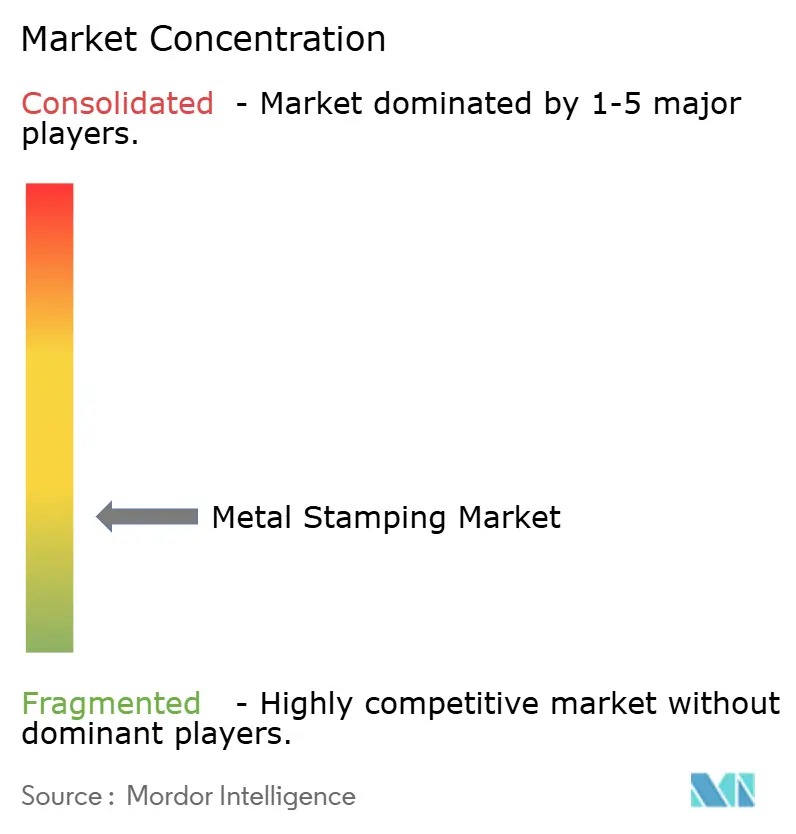
The metal stamping market is highly fragmented, with the top five players including Gestamp, Magna International Inc., Toyota Boshoku Corporation, ANDRITZ Schuler GmbH, and JBM Group. Japanese suppliers, including FUTABA INDUSTRIAL CO.,LTD., Unipres Corporation, and Yorozu Corporation, focus on precision forming and close links with Toyota Group engineering teams. Opportunities are concentrated in Indian electric vehicle hot stamping and precision connector work for advanced driver-assistance systems. The need for IATF 16949 certification, Production Part Approval Process documentation, and failure mode analysis creates a high entry threshold for automotive programs.
Technology investment is shaping company strategies in the metal stamping market. KIRCHHOFF Automotive uses Metris Visual Die Protection in the Smart Press Shop joint venture with Porsche AG to identify foreign objects and die cracks after each stroke. ANDRITZ Schuler GmbH launched the Laser Blanking Line 1.18 DFT in April 2025 to process steel, aluminum, and stainless steel, including material above 1,000 MPa. JBM Group and Sodecia Automotive International are building a hot-stamping facility in Pune for safety-critical structures. These moves show that suppliers are expanding their capabilities around complex structures, process monitoring, and local production.
Competitive pressure also comes from laser blanking and giga-casting. Laser blanking can reduce the need for progressive dies on complex blank shapes. Giga-casting can replace several stamped and welded subassemblies with a single aluminum casting. Unipres Corporation's door-ring program demonstrates the response from press specialists through part integration and hot-stamping development. Suppliers must also make larger investments in tools and production controls to reach original equipment manufacturer cycle-time expectations. The metal stamping industry, therefore, rewards broad technical capability, program-management discipline, and reliable quality compliance.
Metal Stamping Industry Leaders
-
Gestamp
-
Magna International Inc.
-
Toyota Boshoku Corporation
-
ANDRITZ Schuler GmbH
-
JBM Group
- *Disclaimer: Major Players sorted in no particular order
Metal Stamping Market Companies Covered in this Report
- AAPICO HITECH Public Company Limited
- ANDRITZ Schuler GmbH
- Benteler
- CIE Automotive
- FUTABA INDUSTRIAL CO.,LTD.
- Gestamp
- JBM Group
- KIRCHHOFF Automotive
- Magna International Inc.
- Martinrea International Inc.
- Shiloh Industries LLC
- Tower International
- Toyota Boshoku Corporation
- Unipres Corporation
- voestalpine AG
- Yorozu Corporation
Recent Industry Developments in Metal Stamping Market
- October 2026: Pre-Met invested in additional manufacturing equipment, including an AgieCharmilles wire erosion machine, a Cincinnati Milacron 75-metric-ton press, and automated feeding systems. The investment supports the metal stamping market by expanding production capacity, enabling the manufacture of larger and more complex components, and strengthening the company's ability to serve industrial customers.
- September 2026: American Metal Forming Technologies (AMFT) acquired Ramcel Precision Stamping and Manufacturing LLC, a supplier of custom metal stampings, tooling, automated assembly and robotic welding solutions. The acquisition supports the metal stamping market by expanding AMFT's precision stamping capabilities and strengthening its manufacturing services for transportation, construction, consumer goods, defense, and electronics industries.
Global Metal Stamping Market Report Scope
Metal stamping is a manufacturing process that uses dies and presses to shape flat metal sheets into components with specific dimensions and geometries. It supports the production of precision metal parts through operations that provide consistency, repeatability, and efficient material processing.
The Metal Stamping Market is segmented by process, press type, material, end-use industry, and geography. By process, the market is segmented into blanking, embossing, bending, coining, flanging, and other processes. By press type, the market is segmented into mechanical press, hydraulic press, and servo press. By material, the market is segmented into steel, aluminum, copper, and other materials. By end-use industry, the market is segmented into automotive, industrial machinery, electrical and electronics, aerospace, medical, and other end-use industries. The report also covers the market size and forecasts for metal stamping across 15 countries. For each segment, the market sizing and forecasts have been done on the basis of value (USD).
Segmentation Overview
| Blanking |
| Embossing |
| Bending |
| Coining |
| Flanging |
| Other Processes |
| Mechanical Press |
| Hydraulic Press |
| Servo Press |
| Steel |
| Aluminum |
| Copper |
| Other Materials |
| Automotive |
| Industrial Machinery |
| Electrical and Electronics |
| Aerospace |
| Medical |
| Other End-Use Industries |
| Asia-Pacific | China |
| India | |
| Japan | |
| South Korea | |
| ASEAN Countries | |
| Rest of Asia-Pacific | |
| North America | United States |
| Canada | |
| Mexico | |
| Europe | Germany |
| United Kingdom | |
| France | |
| Italy | |
| NORDIC Countries | |
| Rest of Europe | |
| South America | Brazil |
| Argentina | |
| Rest of South America | |
| Middle East and Africa | Saudi Arabia |
| South Africa | |
| Rest of Middle East and Africa |
| By Process | Blanking | |
| Embossing | ||
| Bending | ||
| Coining | ||
| Flanging | ||
| Other Processes | ||
| By Press Type | Mechanical Press | |
| Hydraulic Press | ||
| Servo Press | ||
| By Material | Steel | |
| Aluminum | ||
| Copper | ||
| Other Materials | ||
| By End-Use Industry | Automotive | |
| Industrial Machinery | ||
| Electrical and Electronics | ||
| Aerospace | ||
| Medical | ||
| Other End-Use Industries | ||
| By Geography | Asia-Pacific | China |
| India | ||
| Japan | ||
| South Korea | ||
| ASEAN Countries | ||
| Rest of Asia-Pacific | ||
| North America | United States | |
| Canada | ||
| Mexico | ||
| Europe | Germany | |
| United Kingdom | ||
| France | ||
| Italy | ||
| NORDIC Countries | ||
| Rest of Europe | ||
| South America | Brazil | |
| Argentina | ||
| Rest of South America | ||
| Middle East and Africa | Saudi Arabia | |
| South Africa | ||
| Rest of Middle East and Africa | ||
Key Questions Answered in the Report
What is the size of the metal stamping market?
The metal stamping market size was valued at USD 268.08 million in 2026 and is estimated to grow from USD 278.91 million in 2027 to reach USD 343.10 million by 2032, at a CAGR of 4.23% during the forecast period (2027-2032).
Which process held the largest share in 2026?
Blanking held 32.56% of the market share in 2026 because it is used to prepare flat sheet-metal blanks before subsequent forming operations.
Which press type is projected to advance fastest through 2032?
Servo press is projected to advance at a 4.92% CAGR through 2032 as manufacturers need programmable motion and in-die quality controls.
Which material is projected to advance fastest through 2032?
Aluminum is projected to advance at a 5.14% CAGR through 2032 because electric vehicles require lighter structural and battery-related parts.