
Metal Forming Equipment Market Size and Share
Market Overview
| Study Period | 2020 - 2031 |
|---|---|
| Market Size (2026) | USD 25.53 Billion |
| Market Size (2031) | USD 31.43 Billion |
| Growth Rate (2026 - 2031) | 4.25 % |
| Fastest Growing Market | Europe |
| Largest Market | Asia |
| Market Concentration | Medium |
Major Players *Disclaimer: Major Players sorted in no particular order Image © Mordor Intelligence. Reuse requires attribution under CC BY 4.0. | |
Metal Forming Equipment Market Analysis by Mordor Intelligence
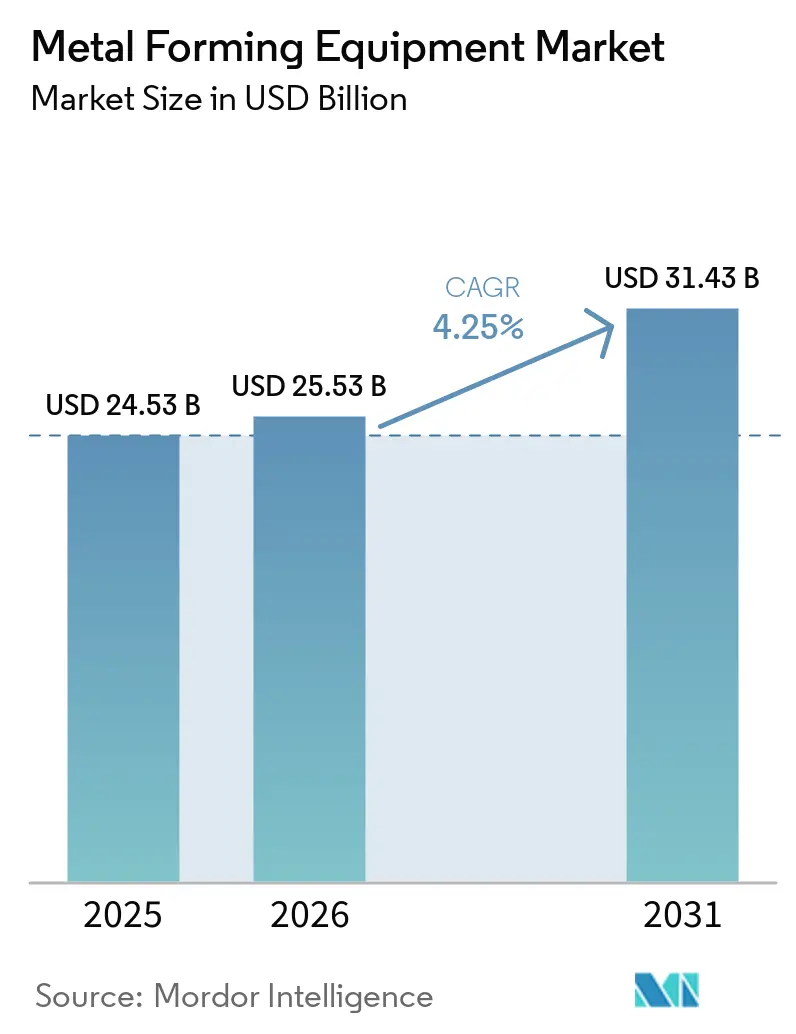
The metal forming equipment market size was valued at USD 24.53 billion in 2025, and is estimated to grow from USD 25.53 billion in 2026 to reach USD 31.43 billion by 2031, at a CAGR of 4.25% during the forecast period (2026-2031).
Automotive electrification is changing press-line specifications because battery enclosures, motor housings, and lightweight structural parts need more controlled forming. Demand also comes from investments in grid infrastructure, renewable-energy equipment, and regional manufacturing capacity. Servo technology, process monitoring, and lifecycle service are becoming more important in procurement decisions. European and Japanese suppliers compete on engineering depth and integrated systems, while Chinese manufacturers put pressure on standard-equipment prices. This setting supports opportunities for suppliers that combine equipment, controls, monitoring, and retrofit services.
Key Report Takeaways
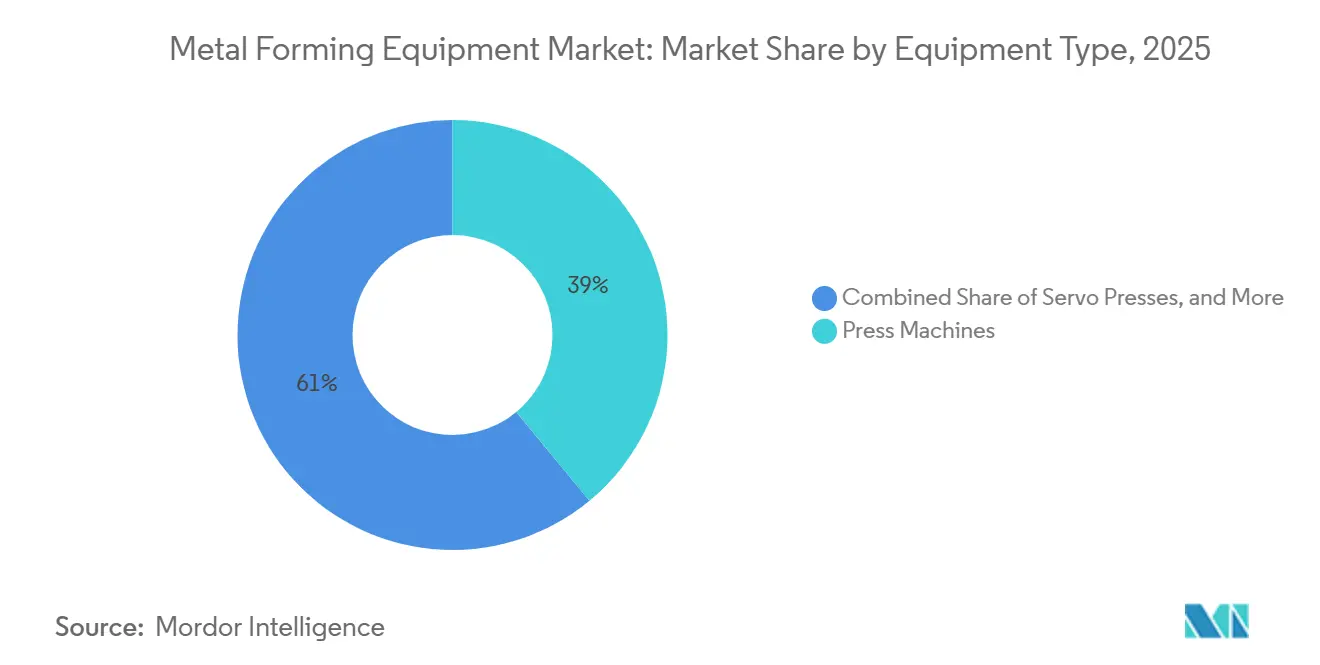
- By equipment type, press machines held 39% of the metal forming equipment market share in 2025, while servo presses are forecast to grow at a 6.8% CAGR through 2031.
- By forming process, stamping and punching held 28.5% of the metal forming equipment market size in 2025, while hydroforming is forecast to grow at a 7.1% CAGR through 2031.
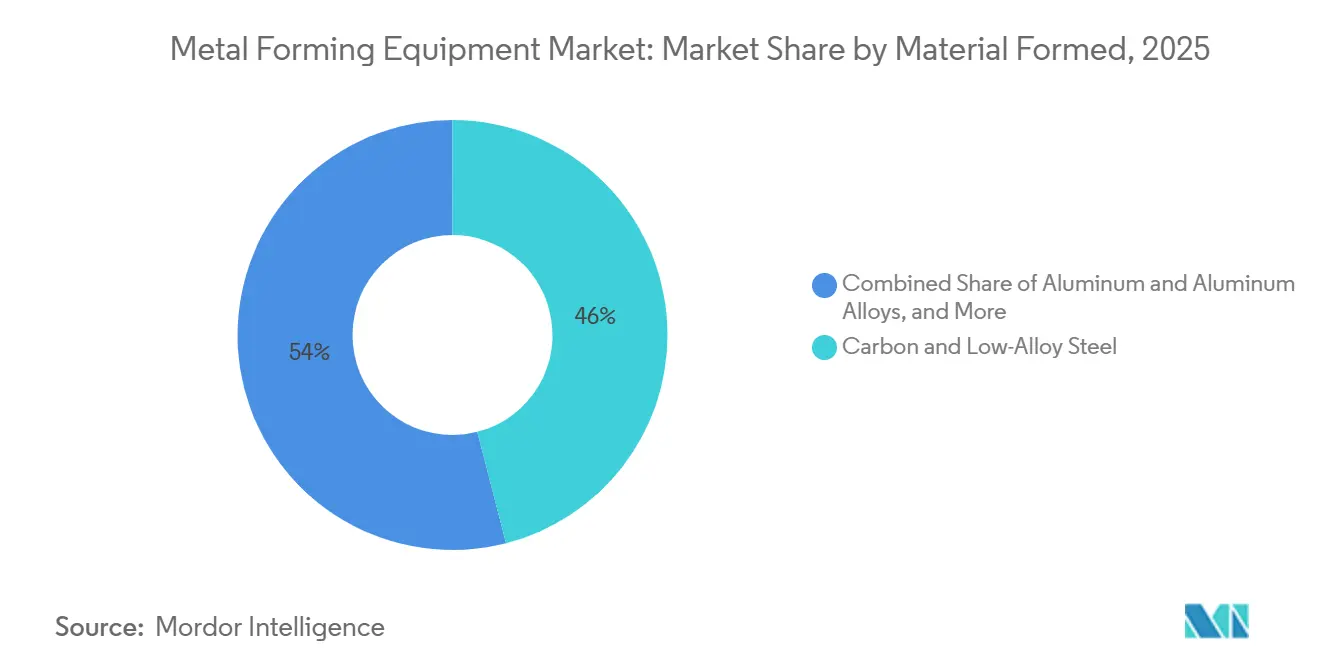
- By material formed, carbon and low-alloy steel held a 46% revenue share in 2025, while aluminum and aluminum alloys are forecast to grow at a 5.8% CAGR through 2031.
- By end-use industry, automotive and transportation held a 34% revenue share in 2025, while aerospace and defense are forecast to grow at a 6.4% CAGR through 2031.
- By geography, Asia-Pacific held a 53.1% revenue share in 2025, while Europe is forecast to grow at a 5.2% CAGR through 2031.
Note: Market size and forecast figures in this report are generated using Mordor Intelligence’s proprietary estimation framework, updated with the latest available data and insights as of January 2026.
Global Metal Forming Equipment Market Trends and Insights
Drivers Impact Analysis*
| Driver | (~) % Impact on CAGR Forecast | Geographic Relevance | Impact Timeline |
|---|---|---|---|
| Automotive Electrification and Lightweighting | +1.0% | Global, concentrated in China, the EU, and North America | Medium term (2-4 years) |
| Automation and Smart Manufacturing | +0.9% | Global, concentrated in Asia-Pacific and the EU | Medium term (2-4 years) |
| High-Strength and Lightweight Materials | +0.7% | Global, with relevance in South Korea, Japan, and ASEAN | Long term (≥ 4 years) |
| Regional Manufacturing Capacity Expansion | +0.6% | North America and the EU, including Germany, France, and Italy | Medium term (2-4 years) |
| Infrastructure and Industrial Capital Investment | +0.5% | Global, including the Middle East and Africa, Asia-Pacific, and North America | Long term (≥ 4 years) |
| Renewable Energy and Electrification Equipment Manufacturing | +0.4% | Global, including Asia-Pacific, North America, and the EU | Long term (≥ 4 years) |
| Source: Mordor Intelligence | |||
Automotive Electrification and Lightweighting
Battery electric vehicle platforms are changing the mix of equipment used in the metal forming equipment market. Battery enclosures, motor housing, and structural members need controlled forming of ultra-high-strength steels. Nippon Steel reported that some automotive grades reach tensile strengths of up to 2.0 GPa, which increases the need for programmable slide motion and controlled force delivery. Research on 1,500 MPa-class cold-forming steels also showed that DP1470 and MS1500 grades need tailored forming conditions and adaptive press control. Conventional fixed-speed mechanical presses cannot reliably provide the same operating range. New vehicle programs can therefore lead to replacement demand rather than only incremental equipment demand.
Automation and Smart Manufacturing
Integrated forming cells are shifting spending in the metal forming equipment market toward equipment with real-time quality monitoring. ANDRITZ Schuler introduced its HFA plus+ fineblanking series in January 2026 with servo-controlled hydraulic pump drives, Industry 4.0 interfaces, and stroke rates of up to 85 strokes per minute. The company stated that the new drives deliver double-digit energy-efficiency gains against fixed-speed hydraulic systems. These capabilities support more consistent process control and allow suppliers to document production conditions. Automated bending systems also help manufacturers operate manned and unmanned shifts. Suppliers that offer monitoring, controls, and maintenance alongside equipment can address both productivity and labor constraints.
Adoption of High-Strength and Lightweight Materials
The growing use of AHSS, aluminum alloys, and titanium is changing the equipment requirements within the metal forming equipment market. Nippon Steel described cold-rolled galvanized grades up to 1,180 MPa and hot-stamping sheets from 0.5 GPa to 2.0 GPa that are already used in automotive production. These materials make older equipment less suitable when plants must achieve tighter control of force, temperature, and material flow. Aluminum grades can require hot forming, quenching, and temperature control for complex shapes. A 2025 study demonstrated mechanical clinching between DP980 steel and AL5052 aluminum sheets, which depends on precise forming control. The shift toward mixed-material designs strengthens demand for advanced presses and hydroforming systems.
Reshoring and Expansion of Regional Manufacturing Capacity
Reshoring and domestic expansion are creating demand for new forming capacity in North America and Europe. The 2026 USA Reshoring Survey found that 36% of responding OEMs were actively executing reshoring in 2026, compared with 29% in 2025.[1]Reshoring Initiative and Regions Recruiting, “2026 USA Reshoring Survey Report,” Reshoring Initiative, reshorenow.org It also found that 63% of OEM respondents planned capital expenditures in 2026 or 2027 for reshoring or domestic expansion. NIST reported that supply-chain disruption and robustness concerns were cited by 49% of OEMs, while engineering proximity was cited by 45%.[2]National Institute of Standards and Technology, “Annual Report on the U.S. Manufacturing Economy: 2025,” NIST Advanced Manufacturing Series, nist.gov These priorities require local stamping, bending, drawing, and forging capability rather than only local final assembly. The metal forming equipment market benefits when greenfield projects add capacity beyond normal replacement cycles.
Restraints Impact Analysis*
| Restraint | (~) % Impact on CAGR Forecast | Geographic Relevance | Impact Timeline |
|---|---|---|---|
| High Capital Investment and Long Replacement Cycles | -1.2% | Global, especially SME-heavy markets in South Asia, the Middle East and Africa, and Latin America | Long term (≥ 4 years) |
| Raw Material and Critical Component Price Volatility | -0.9% | Global | Short term (≤ 2 years) |
| Skilled Operator, Tooling, and Controls Talent Shortages | -0.6% | North America, the EU, and global markets | Medium term (2-4 years) |
| Tooling and Die Costs | -0.4% | Global, concentrated in Asia-Pacific and North America | Medium term (2-4 years) |
| Source: Mordor Intelligence | |||
High Capital Investment and Long Replacement Cycles
High equipment costs and long useful lives can delay modernization in the metal forming equipment market. The Federal Reserve reported the United States manufacturing capacity utilization of 75.7% in June 2026, below the 1972-2025 average of 78.2%.[3]Board of Governors of the Federal Reserve System, “Industrial Production and Capacity Utilization, G.17,” Federal Reserve, federalreserve.gov Existing capacity can reduce the urgency to add equipment in the near term. NIST reported USD 3.3 trillion in depreciable manufacturing assets, including USD 2.6 trillion in machinery and equipment, while only 4.9% of depreciable assets were classified as new. This reflects an aging capital base and a preference for extending asset life. Small and mid-sized fabricators can find it difficult to fund the full lifecycle cost of servo and digitally integrated systems.
Raw Material and Critical Component Price Volatility
Volatility in structural steel, aluminum, and hydraulic components can create procurement uncertainty for equipment manufacturers. Equipment builders often source cast structures and hydraulic parts externally and may price orders under fixed contracts. Changes in input costs can therefore compress margins before equipment is delivered. Higher material costs also make long-term capital planning harder for customers considering large-tonnage equipment. This can encourage customers to delay orders until costs become more stable. The metal forming equipment market is consequently more favorable to suppliers that can offer modular upgrades and clear lifecycle cost plans.
*Our forecasts treat driver/restraint impacts as directional, not additive. The impact forecasts reflect baseline growth, mix effects, and variable interactions.
Segment Analysis
By Equipment Type: Servo Technology Reshapes Press Line Investment
Press machines held 39% of the metal forming equipment market size in 2025, supported by automotive body-in-white stamping, fabricated metal products, and industrial-parts production across high-volume manufacturing plants. Mechanical and hydraulic variants remained the volume base for plants handling repeat work with established tooling and predictable part designs. Servo presses are forecast to grow at a 6.8% CAGR from 2026 to 2031, the fastest rate among equipment types. Their programmable slide motion can deliver force at different points in the working zone and can be adapted to a specific material or part. This capability supports AHSS forming and force-signature traceability for battery modules and precision components.
ANDRITZ Schuler's HFA plus+ fineblanking system shows the investment direction in the metal forming equipment industry, with servo-controlled pump drives and process-monitoring interfaces. Press brakes and bending machines benefit from collaborative robot integration that supports flexible, automated bending without the same level of dedicated infrastructure. Forging equipment serves aerospace producers expanding domestic capacity for compressor and turbine disks made from nickel- and titanium-based materials. Roll-forming equipment supports structural profiles used in construction and renewable-energy projects. Wire, tube, and profile forming equipment and extrusion presses serve electrical infrastructure and automotive sub-frame applications.



By Forming Process: Hydroforming Gains Ground in Lightweight Applications
Stamping and punching held 28.5% of process revenue within the metal forming equipment market in 2025, led by automotive body panels and structural brackets produced through progressive dies. Progressive dies support efficient throughput where part volumes remain high and repeatability is important. Bending supports general fabrication, construction, and industrial machinery through CNC press brakes and automated cells. Deep drawing remains important for fuel and battery enclosures, appliance bodies, and precision medical housings. Forging supports aerospace, defense, and industrial drivetrain components where grain structure and cyclic performance are important.
Hydroforming is forecast to grow at a 7.1% CAGR from 2026 to 2031, the fastest rate among forming processes. It can create hollow structural members with fewer separate stampings, lower part counts, and less assembly work. This application is relevant to lightweight battery electric vehicle body structures that need complex geometry from a single tool. Rolling, extrusion, and related processes support aluminum profiles for skateboard platforms and renewable-energy racking systems. EU carbon dioxide fleet requirements and the United States CAFE standards sustain the case for equipment that processes lightweight components.
By Material Formed: AHSS and Aluminum Redefine Input Mix
Carbon and low-alloy steel accounted for 46% of the metal forming equipment market size in 2025, reflecting its use in automotive body-in-white, structural fabrication, machinery frames, and construction products. Cost efficiency, weldability, and wide availability support its broad application across established manufacturing lines. Stainless steel serves food-processing equipment, medical devices, and chemical-plant fabrication where corrosion resistance is required. Copper and copper alloys are used in busbars, connectors, and winding-wire formers for electrical infrastructure. Titanium, nickel, and other non-ferrous metals remain important for aerospace and defense components.
Aluminum and aluminum alloys are forecast to grow at a 5.8% CAGR from 2026 to 2031. The segment benefits from lightweighting needs in vehicle bodies and aerospace structures, where weight reduction is a design priority. Aluminum increases the need to manage springback, die wear, and thermal processing through more controlled equipment settings. A study of DP980 and AL5052 joining showed that mechanical clinching can widen design options for mixed-material vehicle structures. These requirements favor advanced servo, hydroforming, heating, and quenching systems over older assets.
By End-Use Industry: Aerospace Demand Accelerates Precision Forming Adoption
Automotive and transportation held 34% of end-use revenue in the metal forming equipment market in 2025, supported by global vehicle production and capital-intensive press-line investment. Industrial machinery, capital equipment, metal products, construction, and infrastructure create steady demand for press brakes, roll-forming systems, and hydraulic presses. Electrical and electronics applications require precision enclosures, busbars, and transformer-lamination equipment. Energy and power demand support the same applications as the grid infrastructure expands. Consumer appliances need equipment for housings and chassis, while medical manufacturing requires dimensional control and traceability.
Aerospace and defense are forecast to grow at a 6.4% CAGR from 2026 to 2031, the fastest rate among end-use categories. Aircraft production and defense programs require precision equipment for titanium and nickel-based rotating components. Domestic capacity programs increase the need for forging and forming equipment that can meet exact process requirements. These components require controlled production because they are used in demanding aerospace and defense applications. The metal forming equipment market, therefore, benefits from a need for precision, traceability, and reliable output in this end-use group.
Geography Analysis
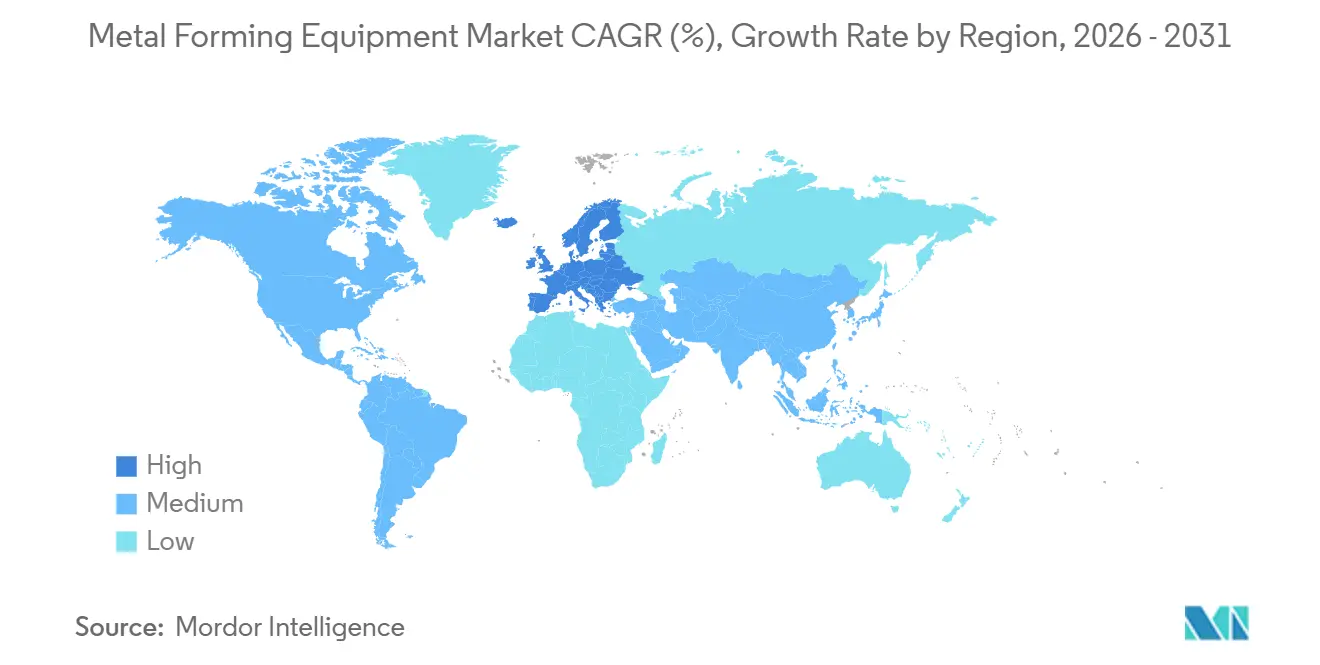
Asia-Pacific held 53.1% of the metal forming equipment market size in 2025, supported by China’s electric-vehicle production base and broad industrial manufacturing capacity. The region needs servo stamping lines, hydroforming cells, and high-tonnage forging presses for battery enclosures, motor housings, and lightweight structural members. India offers incremental opportunity through capacity investment across automotive, defense, and consumer durables. Japan and South Korea are mature replacement markets for servo-electric upgrades and precision forging systems. Vietnam, Thailand, and Indonesia are receiving near-shoring investment from automotive and electronics manufacturers.
North America was the second-largest regional market in 2025, supported by vehicle production and an expanding electric-vehicle assembly footprint. The 2026 USA Reshoring Survey found that 63% of responding OEMs planned domestic capital expenditures in 2026 or 2027. It also found that 36% were actively executing reshoring in 2026.[4]Reshoring Initiative and Regions Recruiting, “2026 USA Reshoring Survey Report,” Reshoring Initiative, reshorenow.org Canada benefits from integration with the United States automotive supply chain and its related demand for components. Mexico’s Nuevo León and Guanajuato clusters continue to attract tier-1 supplier investment.
Europe is forecast to grow at a 5.2% CAGR from 2026 to 2031, the fastest regional pace in the metal forming equipment market. Germany, Italy, and France have a high-value installed base of servo press lines, CNC press brakes, and integrated forming cells. Functional safety and energy-efficiency requirements support replacement, especially in automotive and precision-engineering plants. Brazil supports consistent press-machine demand through its automotive sector. ANDRITZ Schuler delivered a 6,500-ton forging press to Maxiforja in Brazil in July 2025 and a transfer press to AK Nova Automotive in Tangier, Morocco. Saudi Arabia and the United Arab Emirates offer longer-term opportunities as industrial diversification adds sheet-metal and structural-component capacity.

Competitive Landscape
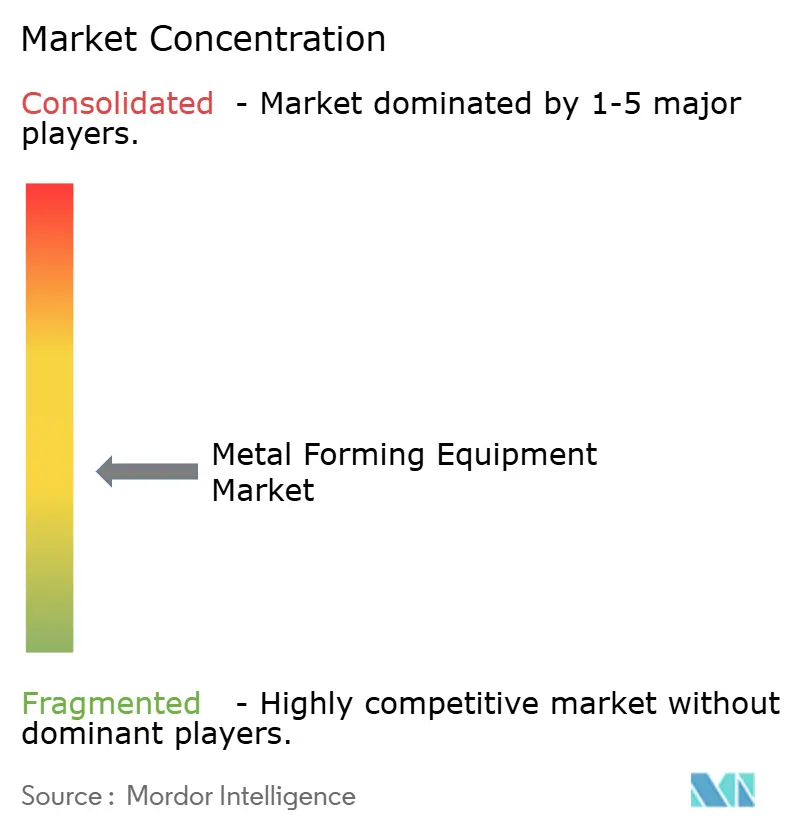
The metal forming equipment market is moderately fragmented. European and Japanese manufacturers are prominent in servo presses, transfer lines, and precision forging systems. The standard press segment is fragmented and faces price competition from Chinese manufacturers. ANDRITZ Schuler, TRUMPF, LVD, Bystronic, Salvagnini, Prima Power, and Ermaksan compete through system integration, monitoring, and lifecycle service. AIDA Engineering, Komatsu Industries, and AMADA have positions in high-precision servo and transfer press applications.
TRUMPF introduced the TruBend 1000 entry-level press brake for the United States and Canadian customers in March 2025, adding a lower-cost CNC bending option. It introduced the TruLaser Weld 3000 at FABTECH 2026, a compact robotic laser-welding cell designed to speed programming and widen accessible part geometry. ANDRITZ Schuler’s HFA plus+ combines servo-controlled pump drives, Feintool tooling integration, and Industry 4.0 interfaces. These moves differentiate established suppliers through automation, controls, and integrated applications. SMS group and Siempelkamp serve heavy-duty hydraulic press and metal-processing projects where customization and tonnage narrow the supplier field.
Retrofit and digital-enablement services are important for older hydraulic and mechanical press fleets in the metal forming equipment market. Plants in North America, India, and Eastern Europe can use CNC and servo retrofits instead of full machine replacement. This gives mid-sized fabricators a lower-cost route to automation. Chinese equipment subsidies have made service, digital integration, and customized engineering more important for European and Japanese suppliers. Modular hydroforming and incremental sheet-forming vendors address low-volume, complex-geometry work where conventional die costs are less economical.
Metal Forming Equipment Industry Leaders
ANDRITZ Schuler Group
AIDA Engineering, Ltd.
Komatsu Industries Corp.
AMADA Group / AMADA Press System Co., Ltd.
Nidec Press & Automation
- *Disclaimer: Major Players sorted in no particular order

Recent Industry Developments
- September 2026: TRUMPF introduced the TruLaser Weld 3000 at FABTECH 2026, an AI-enabled compact robotic laser welding cell with approximately 40% smaller optics than its predecessor, enabling the robot to reach deep-housing geometries; the machine was explicitly designed to address skilled worker shortages in precision sheet metal assembly.
- July 2026: LVD Company showcased its X-L punch-laser combination machine, integrating a 20-ton punch press with high-power laser, a 30 kW LaserCube capable of cutting steel up to 60 mm, and a fully automatic panel bender at EuroBLECH 2026, Hall 12, demonstrating the company’s push toward networked single-platform sheet metalworking.
- January 2026: ANDRITZ Schuler introduced the HFA plus+ fineblanking press series in partnership with Feintool AG; the new systems operate at 3,200-15,500 kN force and up to 85 strokes per minute with servo-controlled hydraulic pump drives delivering double-digit energy efficiency gains and full Industry 4.0 interfaces.
- July 2025: Maxiforja, a Brazilian forging company within CIE Automotive, commissioned a 6,500-ton GLK-type forging press from ANDRITZ Schuler, equipped with a Kinetic Energy Recovering System that reduces peak power demand by up to 40% versus conventional presses in the same tonnage class.


Global Metal Forming Equipment Market Report Scope
| Press Machines | Mechanical Presses |
| Hydraulic Presses | |
| Servo Presses | |
| Other General-Purpose Presses | |
| Press Brakes and Bending Machines | Hydraulic Press Brakes |
| Servo / Electric Press Brakes | |
| Mechanical Press Brakes | |
| Other Bending Machines | |
| Forging Equipment | Forging Presses |
| Forging Hammers | |
| Upsetting and Heading Machines | |
| Other Forging Equipment | |
| Roll Forming and Plate/Profile Rolling Equipment | Roll Forming Machines |
| Plate Rolling Machines | |
| Section and Profile Rolling Machines | |
| Other Secondary Rolling/Forming Equipment | |
| Wire, Tube and Profile Forming Equipment | Wire and Bar Drawing/Forming Equipment |
| Tube Forming and Bending Equipment | |
| Profile Forming Equipment | |
| Extrusion Presses | |
| Hydroforming Equipment | |
| Other Metal Forming Equipment |
| Stamping and Punching |
| Deep Drawing |
| Bending |
| Forging |
| Rolling and Roll Forming |
| Extrusion |
| Hydroforming |
| Other Forming Processes |
| Carbon and Low-Alloy Steel |
| Stainless Steel |
| Aluminum and Aluminum Alloys |
| Copper and Copper Alloys |
| Titanium, Nickel and Other Non-Ferrous Metals |
| Other Materials |
| Automotive and Transportation |
| Aerospace and Defense |
| Industrial Machinery and Capital Equipment |
| Metal Products and Fabrication |
| Electrical and Electronics |
| Construction and Infrastructure |
| Energy and Power |
| Consumer Appliances and Durable Goods |
| Medical and Precision Manufacturing |
| Other End-Use Industries |
| North America | United States |
| Canada | |
| Mexico | |
| South America | Brazil |
| Argentina | |
| Rest of South America | |
| Europe | Germany |
| Italy | |
| France | |
| United Kingdom | |
| Spain | |
| Russia | |
| Rest of Europe | |
| Asia-Pacific | China |
| Japan | |
| India | |
| South Korea | |
| ASEAN (Singapore, Malaysia, Indonesia, Thailand, Vietnam, Philippines, Myanmar, Cambodia, Laos, Brunei) | |
| Australia | |
| Rest of Asia-Pacific | |
| Middle East & Africa | Saudi Arabia |
| United Arab Emirates | |
| Turkey | |
| South Africa | |
| Rest of Middle East & Africa |
| By Equipment Type | Press Machines | Mechanical Presses |
| Hydraulic Presses | ||
| Servo Presses | ||
| Other General-Purpose Presses | ||
| Press Brakes and Bending Machines | Hydraulic Press Brakes | |
| Servo / Electric Press Brakes | ||
| Mechanical Press Brakes | ||
| Other Bending Machines | ||
| Forging Equipment | Forging Presses | |
| Forging Hammers | ||
| Upsetting and Heading Machines | ||
| Other Forging Equipment | ||
| Roll Forming and Plate/Profile Rolling Equipment | Roll Forming Machines | |
| Plate Rolling Machines | ||
| Section and Profile Rolling Machines | ||
| Other Secondary Rolling/Forming Equipment | ||
| Wire, Tube and Profile Forming Equipment | Wire and Bar Drawing/Forming Equipment | |
| Tube Forming and Bending Equipment | ||
| Profile Forming Equipment | ||
| Extrusion Presses | ||
| Hydroforming Equipment | ||
| Other Metal Forming Equipment | ||
| By Forming Process | Stamping and Punching | |
| Deep Drawing | ||
| Bending | ||
| Forging | ||
| Rolling and Roll Forming | ||
| Extrusion | ||
| Hydroforming | ||
| Other Forming Processes | ||
| By Material Formed | Carbon and Low-Alloy Steel | |
| Stainless Steel | ||
| Aluminum and Aluminum Alloys | ||
| Copper and Copper Alloys | ||
| Titanium, Nickel and Other Non-Ferrous Metals | ||
| Other Materials | ||
| By End-Use Industry | Automotive and Transportation | |
| Aerospace and Defense | ||
| Industrial Machinery and Capital Equipment | ||
| Metal Products and Fabrication | ||
| Electrical and Electronics | ||
| Construction and Infrastructure | ||
| Energy and Power | ||
| Consumer Appliances and Durable Goods | ||
| Medical and Precision Manufacturing | ||
| Other End-Use Industries | ||
| By Geography | North America | United States |
| Canada | ||
| Mexico | ||
| South America | Brazil | |
| Argentina | ||
| Rest of South America | ||
| Europe | Germany | |
| Italy | ||
| France | ||
| United Kingdom | ||
| Spain | ||
| Russia | ||
| Rest of Europe | ||
| Asia-Pacific | China | |
| Japan | ||
| India | ||
| South Korea | ||
| ASEAN (Singapore, Malaysia, Indonesia, Thailand, Vietnam, Philippines, Myanmar, Cambodia, Laos, Brunei) | ||
| Australia | ||
| Rest of Asia-Pacific | ||
| Middle East & Africa | Saudi Arabia | |
| United Arab Emirates | ||
| Turkey | ||
| South Africa | ||
| Rest of Middle East & Africa | ||


Key Questions Answered in the Report
What is the forecast growth rate for metal forming equipment through 2031?
The metal forming equipment market is forecast to grow at a 4.2% CAGR from 2026 to 2031, reaching USD 31.4 billion by 2031. Growth is supported by electric-vehicle production, advanced material use, regional capacity investment, and equipment upgrades.
Which equipment type is growing fastest through 2031?
Servo presses are forecast to grow at a 6.8% CAGR. Their programmable slide motion supports controlled forming of advanced materials and the traceability needs of electric-vehicle and precision-component production.
Which forming process has the highest forecast growth?
Hydroforming is forecast to grow at a 7.1% CAGR through 2031. It creates complex hollow structural parts with fewer separate stampings and can reduce assembly work for lightweight vehicle structures.
Which end-use application is expanding fastest?
Aerospace and defense are forecast to grow at a 6.4% CAGR through 2031. Aircraft and defense programs require precision forming and forging equipment for titanium and nickel-based components.
Which region leads global demand?
Asia-Pacific held 53.1% revenue share in 2025. China’s electric-vehicle manufacturing base and wider industrial capacity support demand for servo presses, hydroforming cells, and forging systems.
Why are manufacturers investing in servo presses?
Servo presses provide programmable slide motion and controlled force delivery for ultra-high-strength steels. They also support documented process conditions, which are important in battery-module and precision-component manufacturing.
Page last updated on:





