
Merchant Acquiring Market Size and Share
Market Overview
| Study Period | 2020 - 2031 |
|---|---|
| Market Size (2026) | USD 31.69 Billion |
| Market Size (2031) | USD 48.92 Billion |
| Growth Rate (2026 - 2031) | 9.07 % |
| Fastest Growing Market | Asia-Pacific |
| Largest Market | North America |
| Market Concentration | High |
Major Players *Disclaimer: Major Players sorted in no particular order Image © Mordor Intelligence. Reuse requires attribution under CC BY 4.0. | |
Merchant Acquiring Market Analysis by Mordor Intelligence
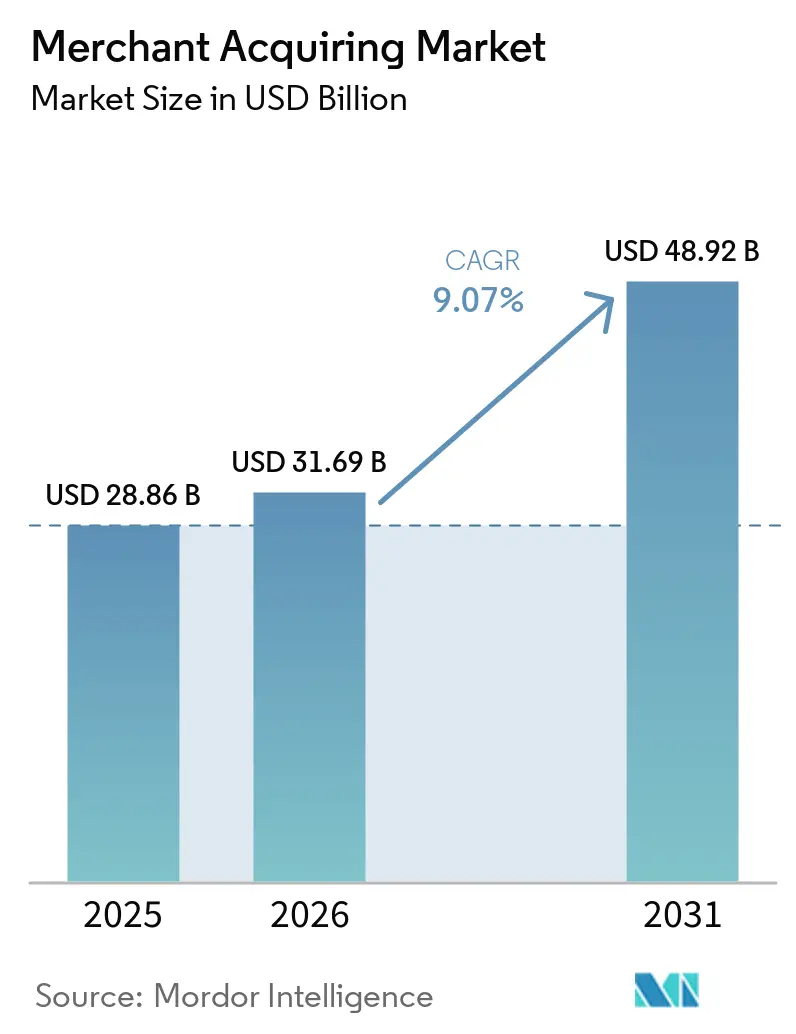
The merchant acquiring market size is projected to expand from USD 28.86 billion in 2025 and USD 31.69 billion in 2026 to USD 48.92 billion by 2031, registering a CAGR of 9.07% between 2026 to 2031. The merchant acquiring market is moving from stand-alone terminal contracts toward integrated commerce platforms that combine payment acceptance, analytics, lending, and risk services. This transition changes how acquirers protect merchant relationships, because operational software increasingly sits between the merchant and the payment processor. E-commerce acceptance, omnichannel settlement, and embedded payments are widening the role of the merchant acquiring market beyond transaction processing. Real-time account-to-account rails can lower payment costs, but they also require acquirers to build new capabilities or partners with specialized providers. Competition is becoming sharper as large processors pursue scale and software-native providers compete through developer tools, vertical software partnerships, and faster onboarding.
Key Report Takeaways
- By payment method, credit cards held 34.25% of the merchant acquiring market size in 2025, while BNPL is projected to expand at a 10.20% CAGR through 2031.
- By merchant size, large enterprises held 56.12% of the merchant acquiring market share in 2025, while SMEs are projected to expand at a 9.65% CAGR through 2031.
- By channel, POS solutions accounted for 44.71% of the merchant acquiring market size in 2025, while mPOS and SoftPOS are projected to expand at a 9.91% CAGR through 2031.
- By end-user industry, retail and e-commerce held 34.51% merchant acquiring market share in 2025, while transportation and logistics is projected to expand at a 10.40% CAGR through 2031.
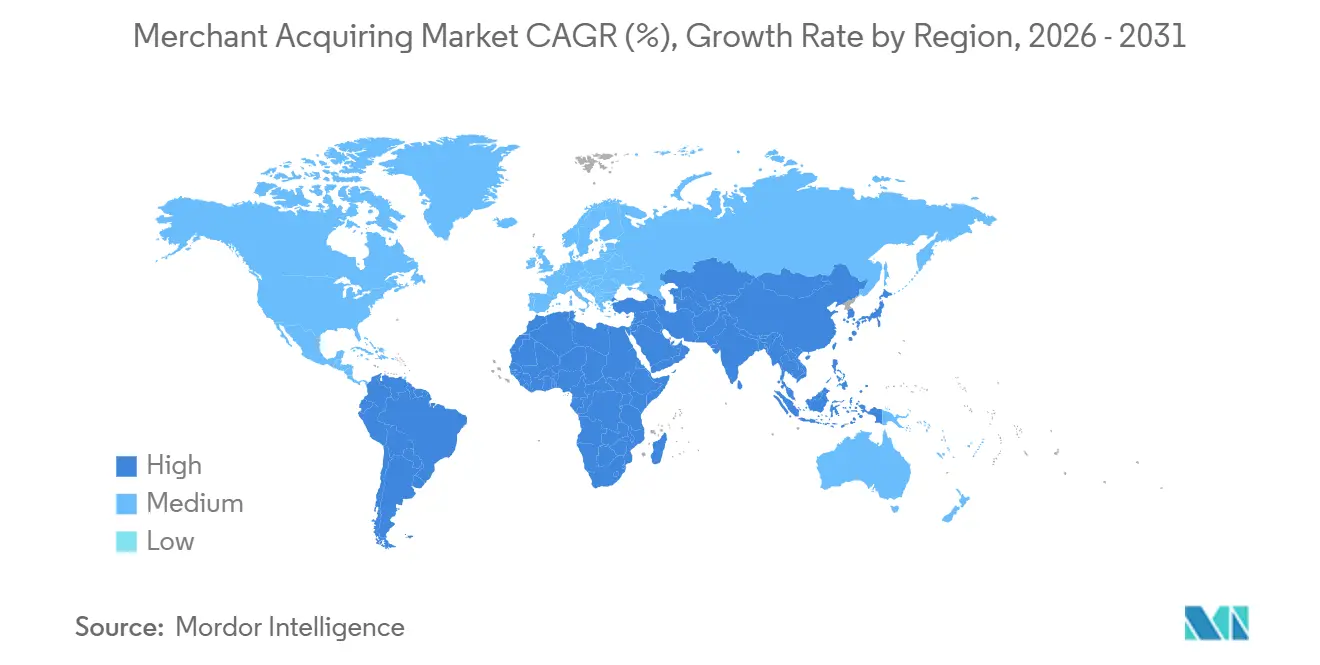
- By geography, North America held 34.43% merchant acquiring market share in 2025, while Asia-Pacific is projected to expand at a 10.54% CAGR through 2031.
Note: Market size and forecast figures in this report are generated using Mordor Intelligence’s proprietary estimation framework, updated with the latest available data and insights as of January 2026.
Market Trends and Insights
Drivers Impact Analysis of Merchant Acquiring Market*
| Driver | (~) % Impact on CAGR Forecast | Geographic Relevance | Impact Timeline |
|---|---|---|---|
| E-Commerce and Omnichannel Acceptance Expansion | +2.5% | Global, with concentrated impact in North America, Asia-Pacific, and Western Europe | Short term (≤ 2 years) |
| Embedded Payments Through Vertical Software and Marketplaces | +2.0% | North America, Western Europe, and emerging Asia-Pacific | Medium term (2-4 years) |
| Real-Time Account-to-Account Rails and Pay-by-Bank | +1.5% | India, Brazil, the European Union, the United Kingdom, GCC, and Southeast Asia | Medium term (2-4 years) |
| Tokenization and Network-Token Authorization Gains | +1.2% | Global, with early gains in North America, Western Europe, and Asia-Pacific | Short term (≤ 2 years) |
| Merchant Demand for Integrated Risk, Lending, and Analytics | +0.9% | North America and the European Union, with spillover to the Middle East and Africa and Asia-Pacific | Medium term (2-4 years) |
| Underwriting Data From Software-Led Merchant Distribution | +0.7% | North America, with emerging use in the European Union and Southeast Asia | Long term (≥ 4 years) |
| Source: Mordor Intelligence | |||
E-Commerce and Omnichannel Acceptance Expansion
The merchant acquiring market benefits as merchants combine store, online, and mobile payment acceptance within one operating model. A fragmented setup can create separate settlement processes, incomplete customer records, and more difficult payment reconciliation for merchants that sell through several channels. Visa reported that 43% of surveyed merchants accepted real-time payments in 2026, and 83% of those merchants saw a definite increase in use during the preceding year.[1] The same need for unified acceptance increases demand for processors that can manage several payment methods through one back-end system. This puts pressure on providers that still treat online and in-person payments as separate products. It also gives established acquirers an opportunity to retain merchants when they can offer consistent settlement, reporting, and support across channels.
Embedded Payments Through Vertical Software and Marketplaces
Vertical software platforms are becoming a major route to merchants for the merchant acquiring market. These platforms can place payment acceptance inside scheduling, invoicing, dispatch, or commerce tools that merchants already use each day. Fiserv stated in its 2026 ISV playbook that embedded working capital, disbursements, and fraud defense can help platforms deepen merchant adoption beyond stand-alone payment acceptance.[2] The model can reduce the need for a merchant to choose a processor separately from its operating software. It can also have more control over pricing and customer access toward the software platform. Acquirers that supply infrastructure without a clear software distribution strategy may face greater pressure on their share of merchant payment economics.
Real-Time Account-to-Account Rails and Pay-by-Bank
Real-time account-to-account payment rails create a direct cost and product challenge for the merchant acquiring market. Merchants can use pay-by-bank options to initiate payments from a customer account instead of relying solely on card rails. JPMorgan Chase offers Pay by Bank capabilities across the United States, the United Kingdom, and the European Union through an open banking API, including real-time pay-ins and closed-loop refunds. These options can matter for merchants with high payment volumes and a strong reason to manage acceptance costs. They can also create a new service opportunity for acquirers that add account-to-account initiation, reconciliation, and refund functions. Providers that do not support these rails may lose relevance where merchants want a broader mix of payment choices.
Tokenization and Network-Token Authorization Gains
Network tokenization supports card acceptance by replacing static account details with payment credentials that can be updated and managed more securely. Visa reported a 4.6% authorization-rate uplift for card-not-present transactions using network tokens rather than raw primary account numbers.[3] Mastercard also reported a 2.1% average authorization improvement, while Checkout.com data cited by Mastercard showed a 10.3 percentage-point authorization-rate improvement for merchants using network tokens. These gains can be particularly relevant for recurring payments and stored credentials, where expired cards and soft declines can disrupt collections. The merchant acquiring industry can use tokenization to position payment acceptance as a revenue-protection service rather than only a security feature. Better authorization results can strengthen the value of acquirer relationships with merchants that have large digital payment volumes.
Restraints Impact Analysis of Merchant Acquiring Market*
| Restraint | (~) % Impact on CAGR Forecast | Geographic Relevance | Impact Timeline |
|---|---|---|---|
| Interchange and Scheme-Fee Volatility | -1.8% | Global, with greatest exposure in North America and United Kingdom-European Economic Area cross-border corridors | Short term (≤ 2 years) |
| Card-Not-Present Fraud and Chargeback Liability | -1.3% | Global, with elevated exposure in Asia-Pacific e-commerce and North American card-not-present volumes | Short term (≤ 2 years) |
| Fragmented Cross-Border Licensing and Data Rules | -0.9% | The European Union, Asia-Pacific, and the Middle East and Africa, with spillover to South America | Medium term (2-4 years) |
| Acquiring Margin Compression From Enterprise Pricing | -0.7% | North America and the European Union, with spillover to core Asia-Pacific markets | Long term (≥ 4 years) |
| Source: Mordor Intelligence | |||
Interchange and Scheme-Fee Volatility
Interchange and scheme-fee volatility creates uncertainty for acquirers that price merchant services around stable blended rates. In June 2026, a U.S. federal judge approved a USD 38 billion Visa and Mastercard swipe-fee settlement that set a maximum standard consumer rate of 1.25% for 8 years and reduced average fees by 0.1 percentage point for 5 years. The UK Payments System Regulator also retained authority to impose caps on United Kingdom-European Economic Area cross-border interchange fees after a January 2026 High Court decision. These developments can change fee structures across merchant portfolios and reduce the predictability of pass-through revenue. They increase the need for clear merchant communications and flexible pricing controls. The merchant acquiring market also faces added complexity when state, national, and cross-border rules affect the same merchant relationship.
Card-Not-Present Fraud and Chargeback Liability
Card-not-present fraud and chargeback liability can reduce profitability and make onboarding more restrictive for higher-risk merchants. Visa consolidated fraud and dispute monitoring under its Acquirer Monitoring Program in April 2025, and its merchant excessive-ratio threshold became 1.5% on April 1, 2026.[4] The tighter threshold increases the importance of fraud prevention, dispute management, and merchant education. A merchant that remains above applicable thresholds can face more serious consequences for card acceptance. Acquirers therefore need fraud tools that support both transaction screening and operational action after a dispute occurs. This shifts fraud capability from a compliance requirement to a central part of merchant retention and portfolio management.
*Our forecasts treat driver/restraint impacts as directional, not additive. The impact forecasts reflect baseline growth, mix effects, and variable interactions.
Merchant Acquiring Market Segment Analysis
By Payment Method:
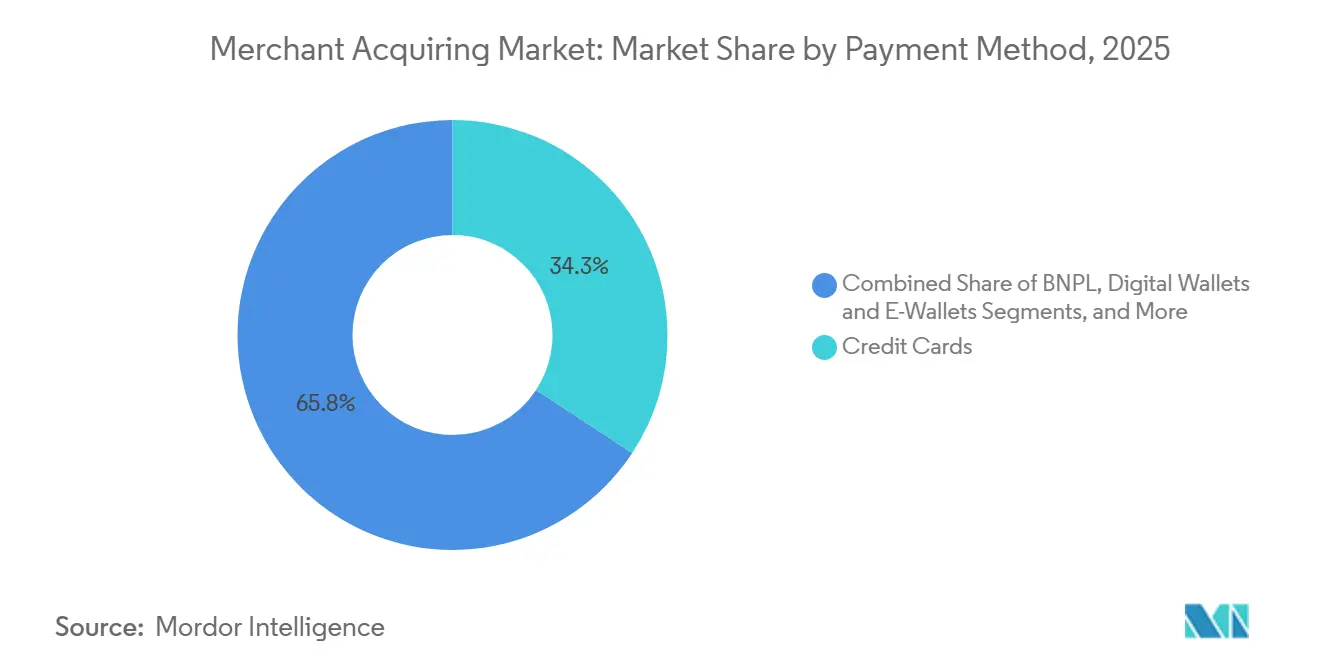
Credit Cards Retain Scale While BNPL Gains UseCredit cards held 34.25% of the merchant acquiring market share in 2025, making them the largest payment method segment. Their position reflects established acceptance networks, consumer loyalty programs, and broad merchant familiarity with card-based processing. Debit cards, digital wallets, e-wallets, bank transfers, and account-to-account payments remain important alternatives across regional payment systems. BNPL is projected to record a 10.20% CAGR through 2031, making it the fastest-growing payment method in the merchant acquiring market. The Federal Reserve reported that BNPL providers originated close to USD 160 billion in consumer credit products during 2025, with pay-in-4 plans representing close to half of issuance and more than 60% of total issuance carrying a 0% annual percentage rate.
BNPL adds a payment option for consumers who want scheduled installments rather than revolving credit, and it can support diverse checkout preferences. Klarna reported that it surpassed 1 million merchants globally in March 2026 after adding 285,000 merchants during 2025. The model is also being used beyond a one-time checkout payment, including recurring expenses and subscription renewals. That wider use can deepen its role in merchant cash-flow planning and customer retention. Acquirers need to support relevant payment methods without creating separate experiences for settlement, reporting, and refunds.

By Merchant Size:
Large Enterprises Lead While SMEs Expand FasterLarge enterprises commanded 56.12% of the merchant acquiring market share in 2025. Their substantial transaction volumes, international operations, and complex acceptance need support customized acquiring arrangements. These merchants often require detailed reporting, multi-currency settlement, and sophisticated controls for risk and routing. SMEs are projected to record a 9.65% CAGR through 2031, supported by embedded acquiring within software they use to run their businesses. The merchant acquiring market size for SMEs is supported by tools that bring payment acceptance into invoicing, scheduling, point-of-sale, and online commerce workflows.
Software platforms can reduce the administrative burden of selecting a separate acquirer and integrating payment functions after onboarding. Fiserv stated that embedded financial tools can support more durable merchant relationships than payments alone. Working capital, fraud controls, and disbursements can be useful additions for smaller merchants with uneven cash flow or limited staff. The model also changes the commercial relationship because a software provider may seek a greater share of payment economics as it scales. Acquirers must provide reliable infrastructure while preserving a meaningful role in the merchant relationship.
By Channel:
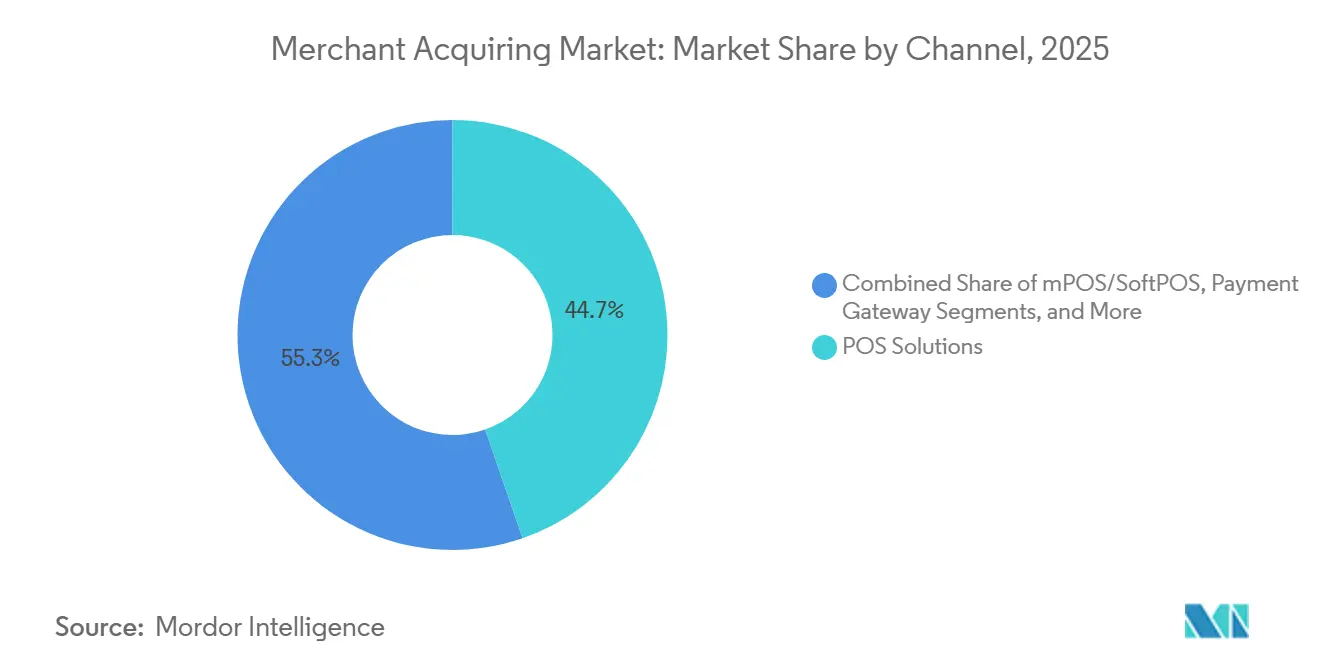
POS Solutions Lead While mPOS and SoftPOS AcceleratePOS solutions accounted for 44.71% of the merchant acquiring market size in 2025. They remain important for merchants that need durable in-person payment acceptance in retail, food service, and hospitality locations. Payment gateways serve a large share of digital commerce activity and support online checkout, recurring billing, and payment routing. mPOS and SoftPOS are projected to record a 9.91% CAGR through 2031, making them the fastest-growing channel. This shift reduces the need for separate payment hardware in some merchant settings and can support mobile sellers, delivery staff, temporary events, and smaller businesses.
SoftPOS can turn a compatible consumer device into an acceptance point when the required security and software conditions are met. Visa reported that Tap to Phone adoption was increasing by an average of 200% year over year globally. This channel can help processors place payment services closer to merchant workflows without a lengthy hardware deployment, and it can strengthen software-led distribution. Acquirers need to maintain dependable support, security, and transaction visibility as payment devices become more distributed. Dedicated terminals remain relevant for merchants with specialized checkout needs, but SoftPOS expands the settings where contactless payments can be accepted.
By End-User Industry:
Retail and E-Commerce Lead While Logistics AdvanceRetail and e-commerce held 34.51% of the merchant acquiring market share in 2025. This segment uses payment systems across store checkout, online sales, loyalty programs, returns, and delivery channels. Its size makes it a central setting for omnichannel acceptance and the adoption of digital wallets and BNPL options. Transportation and logistics are projected to record a 10.40% CAGR through 2031 as freight platforms embed payment, settlement, and working-capital functions into operational workflows. This can improve payment visibility for carriers and other companies that manage complex business-to-business transactions.
Visa and Airwallex announced a July 2026 collaboration to develop embedded finance solutions for freight and shipping platforms, addressing cross-border payments, working capital, and settlement processes. Healthcare is another specialized vertical with distinct payment needs because it connects patients, providers, claims, and revenue-cycle operations. Waystar reported that its platform processed more than 7.5 billion healthcare payment transactions annually and handled USD 2.4 trillion in gross claims. These examples show why vertical knowledge can matter as much as processing scale. Providers that understand workflow, documentation, and settlement requirements can build a more relevant offering for each end-user industry.
Geography Analysis
North America Merchant Acquiring Market
North America held 34.43% of the merchant acquiring market share in 2025. The region has a mature card ecosystem and significant payment volumes, but United States payment network volume expansion has moderated. This moderation increases competition for existing merchant relationships. Stripe entered the U.S. top five in 2026 with more than USD 900 billion in volume and 45% year-over-year expansion, according to the input. Checkout.com received approval for a Merchant Acquirer Limited Purpose Bank charter from the Georgia Department of Banking and Finance in January 2026, allowing it to pursue direct acquiring without a third-party sponsor bank.
APAC Merchant Acquiring Market
Asia-Pacific is projected to record a 10.54% CAGR through 2031, the fastest rate among the geographic segments. China, India, and Southeast Asia are driving payment volumes through widespread adoption of digital wallets and government-backed real-time payment rails, while Australia and Japan represent mature markets with strong contactless payment penetration. The merchant acquiring market across Asia-Pacific increasingly depends on the ability to support diverse wallet ecosystems, real-time payment infrastructure, and alternative payment methods alongside traditional card acceptance. This shift is creating opportunities for acquirers that can provide seamless omnichannel acceptance, localized payment capabilities, and scalable infrastructure across both developed and rapidly digitizing markets.
EMEA and South America Merchant Acquiring Market
Europe combines mature cashless markets with countries that continue to convert cash payments to cards and digital methods. The United Kingdom and Nordic countries have intense competition in core acquiring, while France and Spain offer room for payment-volume expansion through e-commerce and cash-to-card conversion. In South America, Brazil’s Pix system is changing acceptance economics, and PayPal added Pix support for SMEs in April 2026. The Middle East and Africa combine regulatory modernization with local requirements, while South Africa and Nigeria provide longer-term opportunities shaped by digital adoption and data rules.
Competitive Landscape
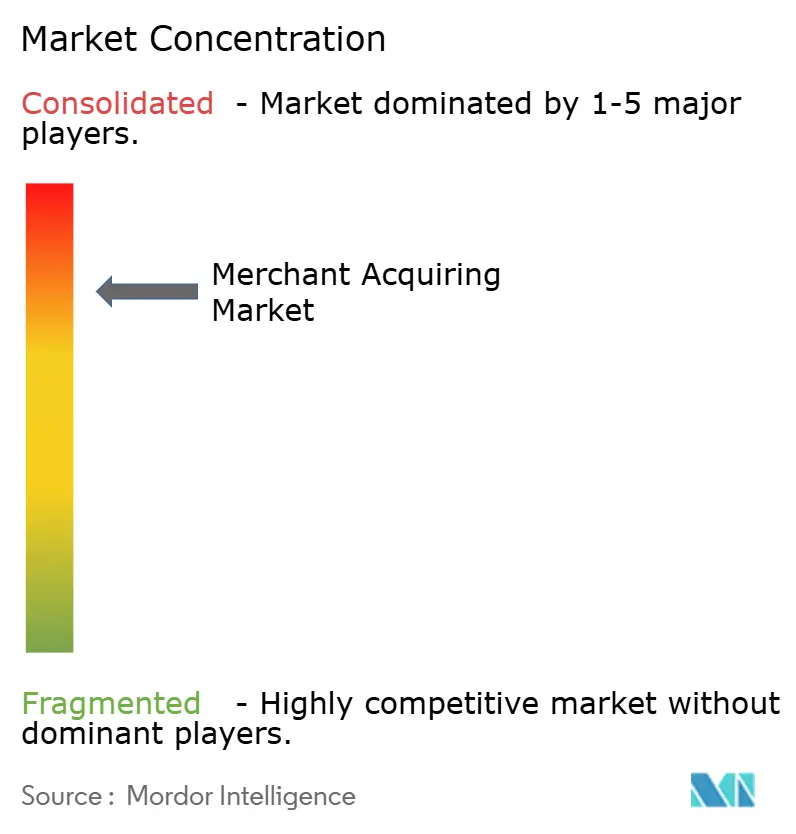
The merchant acquiring market is moderately concentrated among the largest providers and fragmented across smaller participants in the global merchant acquiring market. More than 300 acquirers operated in the United States, while the top 5 processed nearly two-thirds of U.S. card volume in 2025, according to the input. Global Payments completed its USD 24.25 billion acquisition of Worldpay in January 2026 and created a processor serving 6 million merchants across more than 175 countries. The combined business processed USD 3.7 trillion annually, according to the input. The transaction strengthened the importance of scale in technology, distribution, and international servicing while raising the barrier for smaller providers focused on basic processing.
Software-native providers compete through developer tools, integrated sales channels, and relationships with vertical software platforms. Stripe processed more than USD 900 billion in U.S. volume in 2026 and reported 45% year-over-year expansion, according to the input. Checkout.com is pursuing direct-acquiring capability in the United States through its approved Georgia charter. Adyen announced an agreement in April 2026 to acquire Talon.One for EUR 750 million (USD 870 million), adding loyalty and promotion decisioning capabilities. It then announced an agreement in June 2026 to acquire Orb for USD 335 million, extending enterprise billing and invoicing capabilities.
Fiserv faced weaker merchant-solutions performance in 2026 as its hardware-led Clover business encountered slower momentum. Reuters reported that Fiserv cut its full-year adjusted earnings-per-share forecast in August 2026 after merchant-solutions revenue declined 1% in the second quarter. Nuvei completed a live agentic-commerce proof of concept with Visa in July 2026, using tokenized Visa credentials on live payment rails. The mid-market remains an important opportunity in the merchant acquiring market because its needs can exceed basic small-business products but may not align with the scale and complexity of enterprise programs.
Merchant Acquiring Industry Leaders
-
Global Payments Inc.
-
Fiserv, Inc.
-
JPMorgan Chase & Co.
-
Stripe, Inc.
-
Adyen N.V.
- *Disclaimer: Major Players sorted in no particular order
Merchant Acquiring Market Companies Covered in this Report
- Fiserv, Inc.
- Global Payments Inc.
- JPMorgan Chase & Co.
- Stripe, Inc.
- Adyen N.V.
- PayPal Holdings, Inc.
- Block, Inc.
- Worldline S.A.
- Nexi S.p.A.
- Shift4 Payments, Inc.
- Paysafe Limited
- Checkout.com
- Rapyd Financial Network Ltd.
- PayU Payments Private Limited
- Bank of America Corporation
- Elavon, Inc.
- American Express Company
- Wells Fargo & Company
- Nuvei Technologies
- Moneris Solutions Corporation
Recent Industry Developments in Merchant Acquiring Market
- July 2026: Visa and Airwallex announced a collaboration to develop embedded finance solutions for freight and shipping platforms, targeting a sector that still relies on fragmented payment processes causing delayed settlement and cash-flow pressure on carriers. The initiative specifically targets cross-border B2B payments and working capital in logistics.
- June 2026: Nuvei announced a definitive agreement to acquire Payoneer for USD 2.75 billion, USD 7.40 per share in cash, with the combined entity targeting payment services in more than 150 markets. The deal is expected to close in mid-2027, pending shareholder and regulatory approval
- June 2026: Checkout.com was selected by Microsoft as its payments partner for EMEA operations, covering Microsoft 365, Azure, and Xbox. The partnership provides access to Checkout.com's acquiring services and AI-powered optimization engine for real-time transaction routing.
- November 2025: Network International announced an agreement to acquire RAKBANK's merchant acquiring business in the UAE, adding 5,000 merchants to its ecosystem and strengthening its position in the region's expanding payments landscape. The transaction was expected to close in early 2026, subject to regulatory approvals.
Global Merchant Acquiring Market Report Scope
The Merchant Acquiring Market Report is Segmented by Payment Method (Credit Cards, Debit Cards, Digital Wallets, Bank Transfers, BNPL, and More), Merchant Size (Large Enterprises, and SMEs), Channel (POS Solutions, Payment Gateway, mPOS/SoftPOS, and More), End-User Industry (Retail and E-Commerce, Travel and Hospitality, Food and Beverage, Healthcare, Transportation and Logistics, Media and Entertainment, and More), and Geography (North America, South America, Europe, Asia-Pacific, Middle East and Africa). The Market Forecasts are Provided in Terms of Value (USD).
| Credit Cards |
| Debit Cards |
| Digital Wallets and E-Wallets |
| Bank Transfers and Account-to-Account Payments |
| Buy Now, Pay Later (BNPL) |
| Other Payment Methods |
| Large Enterprises |
| Small and Medium Enterprises |
| POS Solutions |
| Payment Gateway |
| mPOS/SoftPOS |
| Other Channels |
| Retail and E-Commerce |
| Travel and Hospitality |
| Food and Beverage |
| Healthcare |
| Transportation and Logistics |
| Media and Entertainment |
| Other End-User Industries |
| North America | United States |
| Canada | |
| Mexico | |
| South America | Brazil |
| Argentina | |
| Rest of South America | |
| Europe | United Kingdom |
| Germany | |
| France | |
| Italy | |
| Spain | |
| Rest of Europe | |
| Asia-Pacific | China |
| India | |
| Japan | |
| South Korea | |
| Australia | |
| Rest of Asia-Pacific | |
| Middle East and Africa | United Arab Emirates |
| Saudi Arabia | |
| South Africa | |
| Rest of Middle East and Africa |
| By Payment Method | Credit Cards | |
| Debit Cards | ||
| Digital Wallets and E-Wallets | ||
| Bank Transfers and Account-to-Account Payments | ||
| Buy Now, Pay Later (BNPL) | ||
| Other Payment Methods | ||
| By Merchant Size | Large Enterprises | |
| Small and Medium Enterprises | ||
| By Channel | POS Solutions | |
| Payment Gateway | ||
| mPOS/SoftPOS | ||
| Other Channels | ||
| By End-User Industry | Retail and E-Commerce | |
| Travel and Hospitality | ||
| Food and Beverage | ||
| Healthcare | ||
| Transportation and Logistics | ||
| Media and Entertainment | ||
| Other End-User Industries | ||
| By Geography | North America | United States |
| Canada | ||
| Mexico | ||
| South America | Brazil | |
| Argentina | ||
| Rest of South America | ||
| Europe | United Kingdom | |
| Germany | ||
| France | ||
| Italy | ||
| Spain | ||
| Rest of Europe | ||
| Asia-Pacific | China | |
| India | ||
| Japan | ||
| South Korea | ||
| Australia | ||
| Rest of Asia-Pacific | ||
| Middle East and Africa | United Arab Emirates | |
| Saudi Arabia | ||
| South Africa | ||
| Rest of Middle East and Africa | ||
Key Questions Answered in the Report
What is the size of the merchant acquiring market?
The merchant acquiring market was valued at USD 28.86 billion in 2025 and is estimated at USD 31.69 billion in 2026. The merchant acquiring market is forecast to reach USD 48.92 billion by 2031. It is projected to reach USD 48.92 billion by 2031 at a 9.07% CAGR during the forecast period. The forecast reflects continued demand for integrated payment acceptance and merchant services.
What is driving merchant acquiring demand?
E-commerce expansion, omnichannel acceptance, embedded payments, account-to-account rails, and tokenization are broad drivers. These forces increase demand for payment acceptance that connects with merchant operations, settlement, customer records, fraud controls, and reporting. They also increase the value of providers that can serve merchants across online and in-person channels.
Which payment method leads payment acceptance?
Credit cards led with 34.25% share in 2025. BNPL is projected to be the fastest-growing payment method, with a 10.20% CAGR through 2031.
Why are SMEs important for payment processors?
SMEs are projected to expand at a 9.65% CAGR through 2031. Embedded payment services can make onboarding and access to financial tools easier for smaller businesses. Payment acceptance can be connected with invoicing, scheduling, online commerce, working capital, and fraud controls. This approach may lower operational effort for merchants that would otherwise manage several separate providers.
Which merchant acceptance channel is expanding fastest?
MPOS and SoftPOS are projected to expand at a 9.91% CAGR through 2031. These options can reduce the need for dedicated payment hardware in suitable merchant settings and can speed acceptance deployment for many smaller merchants. They can support mobile sellers, delivery teams, temporary locations, and businesses that need flexible acceptance points. Dedicated terminals still matter where merchants need specialized checkout hardware or high-volume in-store capabilities.
Which region has the fastest projected expansion?
Asia-Pacific is projected to record a 10.54% CAGR through 2031. Digital wallets, real-time payment rails, and strong digital transaction activity support this outlook for the merchant acquiring market. Providers must support local payment methods and regional merchant requirements to benefit from this demand and serve merchants operating across several sales channels.