
Medical Vacuum Systems Market Size and Share
Market Overview
| Study Period | 2020 - 2031 |
|---|---|
| Market Size (2026) | USD 1.85 Billion |
| Market Size (2031) | USD 2.51 Billion |
| Growth Rate (2026 - 2031) | 6.28 % |
| Fastest Growing Market | Asia Pacific |
| Largest Market | North America |
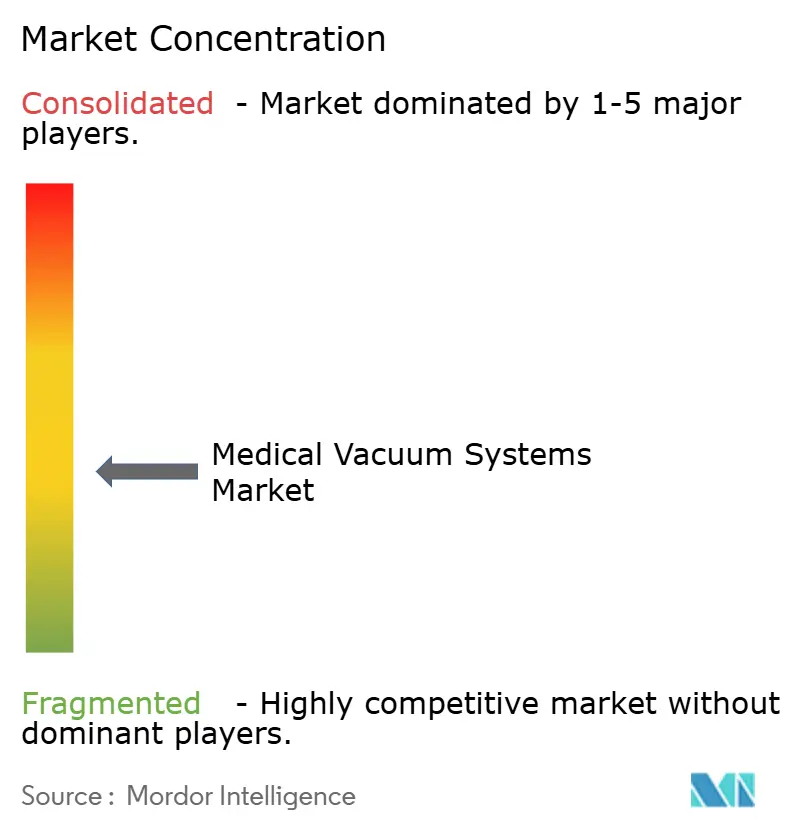
| Market Concentration | Medium |
Major Players *Disclaimer: Major Players sorted in no particular order Image © Mordor Intelligence. Reuse requires attribution under CC BY 4.0. | |
Medical Vacuum Systems Market Analysis by Mordor Intelligence
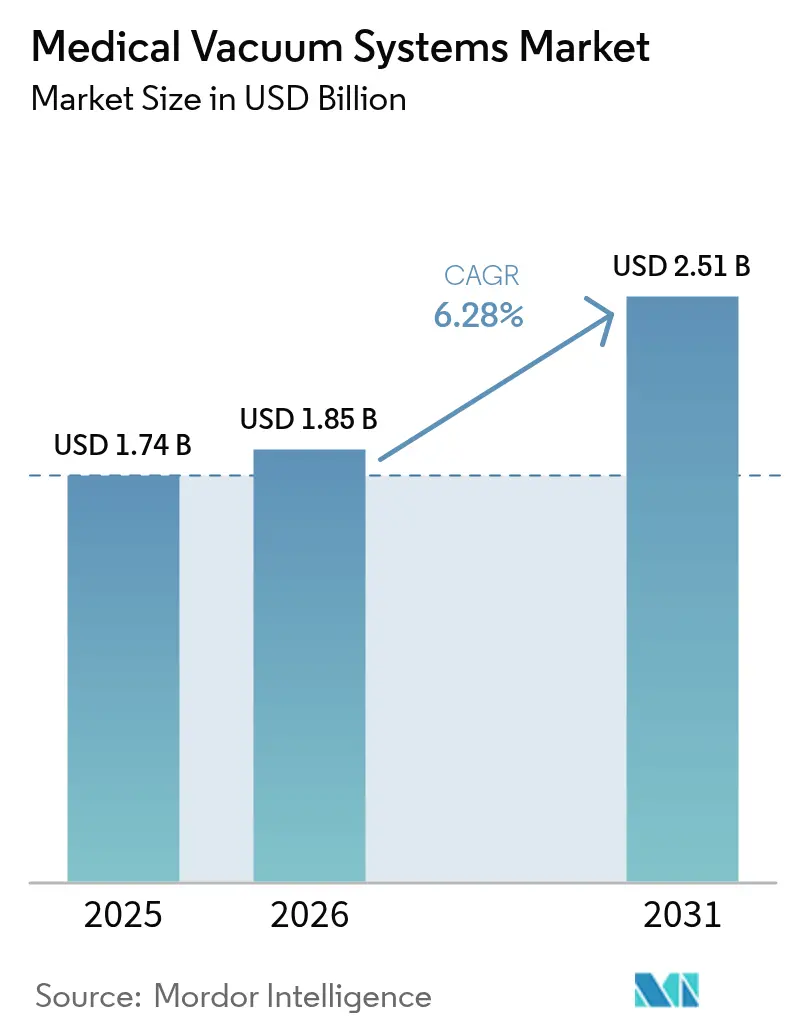
The Medical Vacuum Systems market size is expected to grow from USD 1.74 billion in 2025 to USD 1.85 billion in 2026 and is forecast to reach USD 2.51 billion by 2031 at 6.28% CAGR over 2026-2031.
Rising surgical volumes, the widening prevalence of chronic wounds, and hospitals’ shift to oil-free, energy-efficient pumps together form the backbone of this expansion. Healthcare providers are replacing water-ring and lubricated units with dry, NFPA-compliant platforms that deliver deeper vacuum levels, longer service life, and 30% lower energy use. Outpatient clinics and home-based wound-care programs also fuel demand for portable devices, while hospital decarbonization goals accelerate upgrades across centralized plants. Intensifying acquisition activity among leading manufacturers is consolidating know-how, broadening aftermarket networks, and keeping technological leadership firmly in view.
Key Report Takeaways
- By product type, standalone systems led with 41.05% of the medical vacuum systems market share in 2025; portable and compact systems are projected to expand at a 8.72% CAGR to 2031.
- By application, wound care and negative pressure wound therapy accounted for 31.66% of the medical vacuum systems market size in 2025, while dental applications are advancing at an 8.08% CAGR through 2031.
- By end user, hospitals held 53.74% of the medical vacuum systems market size in 2025, whereas home-care settings register the fastest growth at a 8.63% CAGR to 2031.
- By geography, North America captured 37.20% revenue in 2025; Asia-Pacific is forecast to post the fastest 7.59% CAGR to 2031.
Note: Market size and forecast figures in this report are generated using Mordor Intelligence’s proprietary estimation framework, updated with the latest available data and insights as of 2026.
Market Trends and Insights
Drivers Impact Analysis of Medical Vacuum Systems Market*
| Driver | (~) % Impact on CAGR Forecast | Geographic Relevance | Impact Timeline |
|---|---|---|---|
| Rising incidence of chronic & infectious diseases | +1.8% | Global, higher in North America & Europe | Long term (≥ 4 years) |
| Growing surgical volumes & adoption of suction equipment | +1.5% | Global, led by Asia-Pacific emerging markets | Medium term (2-4 years) |
| Shift toward oil-free, NFPA-compliant dry vacuum pumps | +1.2% | North America & EU regulatory markets | Medium term (2-4 years) |
| Modular construction spurring demand for integrated vacuum booms | +0.9% | Mainly APAC, spill-over to MEA | Short term (≤ 2 years) |
| Hospital decarbonization targets favoring energy-efficient systems | +0.8% | North America & EU, expanding to APAC | Long term (≥ 4 years) |
| Expansion of outpatient wound clinics in emerging markets | +0.6% | Asia-Pacific, MEA, Latin America | Medium term (2-4 years) |
| Source: Mordor Intelligence | |||
Rising Incidence of Chronic & Infectious Diseases
Chronic wounds affect up to 2% of the population in developed nations, and treatment for Medicare beneficiaries. These mounting costs are steering providers toward negative pressure wound therapy (NPWT) platforms that shorten healing times and reduce infection recurrence. COVID-19 heightened the need for reliable suction during respiratory management, while antibiotic resistance raised filtration standards across centralized plants. Larger facilities now deploy higher-capacity pumps with multi-stage filtration to protect immunocompromised patients. Value-based care incentives reward providers for lowering readmissions, keeping demand for portable and centralized NPWT solutions on a sustained upward path.
Growing Surgical Volumes & Adoption of Suction Equipment
An aging demographic and broader access to minimally invasive techniques are lifting global procedure counts, compelling operating rooms to integrate smarter fluid-control systems. Vacuum technology now reaches beyond basic suction into liposuction, endotracheal cleaning, and microsurgery fluid removal. Devices such as the Thopaz+ digital chest-drainage platform shorten intensive-care stays, which lowers costs and frees up capacity.[1] In emerging Asia-Pacific markets, new operating theaters favor modular vacuum booms that install quickly without disruptive construction, helping hospitals bring critical services online faster.
Shift Toward Oil-Free, NFPA-Compliant Dry Vacuum Pumps
Regulators are tightening contamination and reliability rules, pushing hospitals toward dry technology. Oil-free pumps cut energy use by 30% compared with liquid-ring systems, eliminate water consumption, and extend service life from around 7 years to as long as 20 years.[2] Variable-speed drives save a further 50% in electricity, directly supporting hospital carbon-reduction programs. Dental operators, facing amalgam-separator mandates, are early adopters of contact-free claw and molecular-drag designs that meet NFPA 99 standards.[3]
Modular Construction Spurring Demand for Integrated Vacuum Booms
Hospitals in fast-growing regions are embracing off-site fabrication to open sooner and keep budgets predictable. Vacuum booms delivered as pre-tested modules shorten commissioning, improve spatial efficiency, and simplify future expansion. Builders specify units with built-in flow monitoring and remote diagnostics that tie into digital-hospital dashboards. The approach matches the speed of public–private build-operate-transfer projects in Asia-Pacific and especially fits resource-constrained markets needing standardized, replicable solutions.
Restraints Impact Analysis of Medical Vacuum Systems Market*
| Restraint | (~) % Impact on CAGR Forecast | Geographic Relevance | Impact Timeline |
|---|---|---|---|
| High upfront & maintenance costs | -1.1% | Global, particularly emerging markets | Short term (≤ 2 years) |
| Stringent installation-code compliance | -0.8% | North America & EU regulatory markets | Medium term (2-4 years) |
| Helium-supply volatility inflating pump manufacturing costs | -0.6% | Global manufacturing hubs | Short term (≤ 2 years) |
| Cyber-security risks in IoT-enabled centralized plants | -0.4% | Developed markets with advanced IT infrastructure | Long term (≥ 4 years) |
| Source: Mordor Intelligence | |||
High Upfront & Maintenance Costs
Installing a medium-sized centralized plant often exceeds USD 100,000, and annual service contracts can reach 20% of that outlay. Budget-stretched hospitals in emerging economies must weigh these sums against beds, lab analyzers, and imaging equipment. Yet cost-of-care studies show portable NPWT can save USD 24,808 per complex-wound patient relative to surgery. Managed-equipment service agreements, such as the 98-facility Kenyan program, spread capital costs and guarantee uptime, gradually eroding this barrier.
Stringent Installation-Code Compliance
NFPA 99 stipulates strict testing, redundancy, and documentation, which lengthens timelines and pushes many facilities to hire certified contractors. Retrofits inside crowded plant rooms further complicate layout design. Multilayer regulation from device clearance to environmental permits varies by state, province, and municipality, increasing engineering hours. Manufacturers are now offering turnkey, pre-certified skids complete with templated inspection documents, shortening approval cycles and easing administrative load.
*Our forecasts treat driver/restraint impacts as directional, not additive. The impact forecasts reflect baseline growth, mix effects, and variable interactions.
Medical Vacuum Systems Market Segment Analysis
By Product Type:
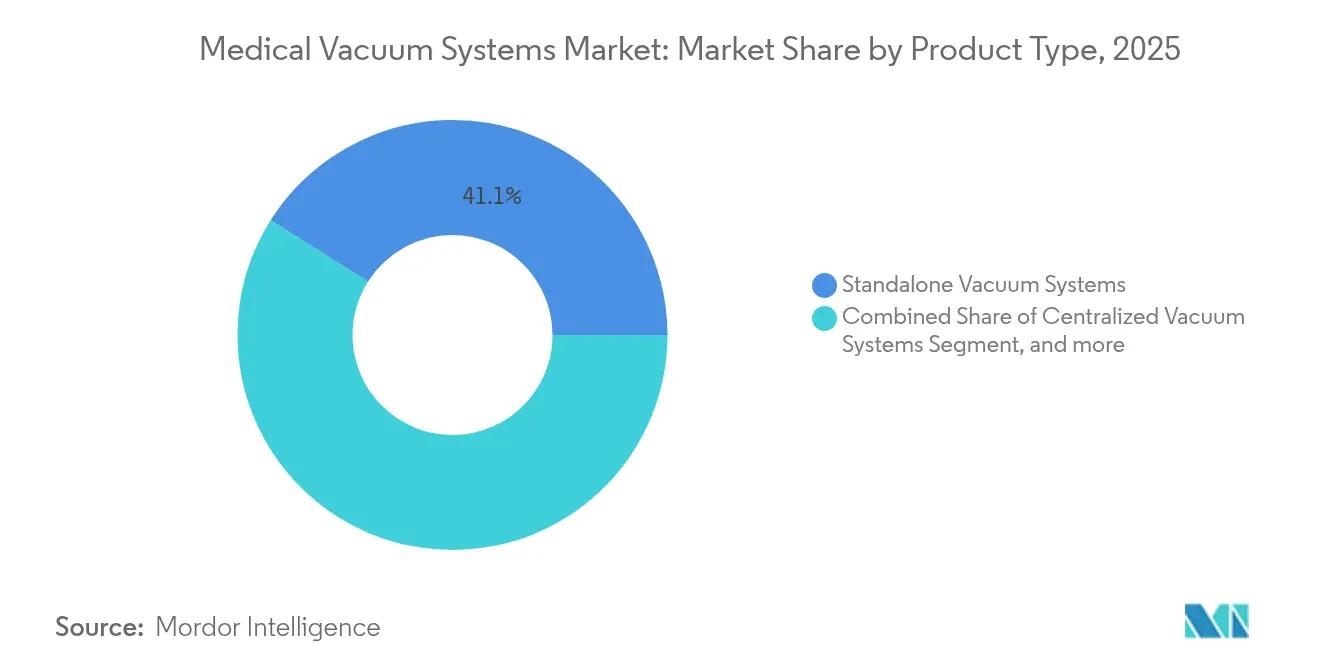
Standalone Systems Retain Capital PriorityStandalone pumps claimed 41.05% of the medical vacuum systems market in 2025, reflecting hospitals’ need for dedicated, high-capacity units in critical departments. These installations allow phased modernization because individual machines can be upgraded without disrupting wider service. Operating theaters and ICUs value quick service access and built-in redundancy that independent skids deliver. Energy-efficient dry-claw and scroll designs increasingly replace legacy lubricated models, dovetailing with capital programs aimed at cutting utility bills and maintenance labor.
Portable devices are growing fastest at a 8.72% CAGR. Home-health nurses routinely deploy two-pound, battery-powered NPWT dressings that stay in place for up to seven days, which keeps patients out of hospital and aligns with payer incentives. Advanced models now feature Bluetooth-enabled pressure logs that clinicians review remotely, supporting evidence-based therapy titration. The momentum behind decentralized care following the pandemic indicates sustained double-digit unit growth even after price erosion.
Accessories and consumables—filters, canisters, and tubing—form a resilient aftermarket stream that cushions revenue during capital-budget pauses. High-efficiency particulate filters must be replaced on a strict schedule, and antimicrobial canisters address rising infection-prevention standards. Manufacturers bundle these supplies into multiyear service packs that lock in customer loyalty and stabilize margins.

By Application:
Wound Care Dominance Meets Dental MomentumWound care and NPWT captured 31.66% of the medical vacuum systems market size in 2025, underpinned by escalating diabetes prevalence and longer life expectancy. Studies attribute lower limb-amputation risk reduction and faster granulation to continuous-pressure dressings, while payers see shorter hospitalization episodes. Premium systems that incorporate intermittent instillation fetch higher prices, broadening revenue despite moderate unit sales. Hospitals also use centralized plants to feed multiple bedside NPWT stations simultaneously, further embedding vacuum infrastructure into wound-management pathways.
Dental suction exhibits the highest 8.08% CAGR as infection-control guidelines tighten. Small-footprint, oil-free pumps equipped with antimicrobe-lined piping help practitioners comply with amalgam-separator directives and reduce aerosol risks. A surge in cosmetic dentistry and orthodontics expands chair-time per patient, heightening demand for continuously reliable suction. Manufacturers market modular, under-cabinet packages that integrate air, vacuum, and water lines for simplified installation in new clinics.
Surgical and OR fluid management continues to evolve with minimally invasive techniques that require precise smoke evacuation and low-noise operation. Respiratory and airway management receives attention as ICUs expand capacity post-pandemic, leading to upgrades in vacuum regulators and pipeline outlets designed for high-flow suction during intubation. Laboratory and diagnostic applications maintain steady demand for vacuum ovens, filtration apparatus, and blood-gas analyzers, sustaining a diversified end-use mix.
By End User:
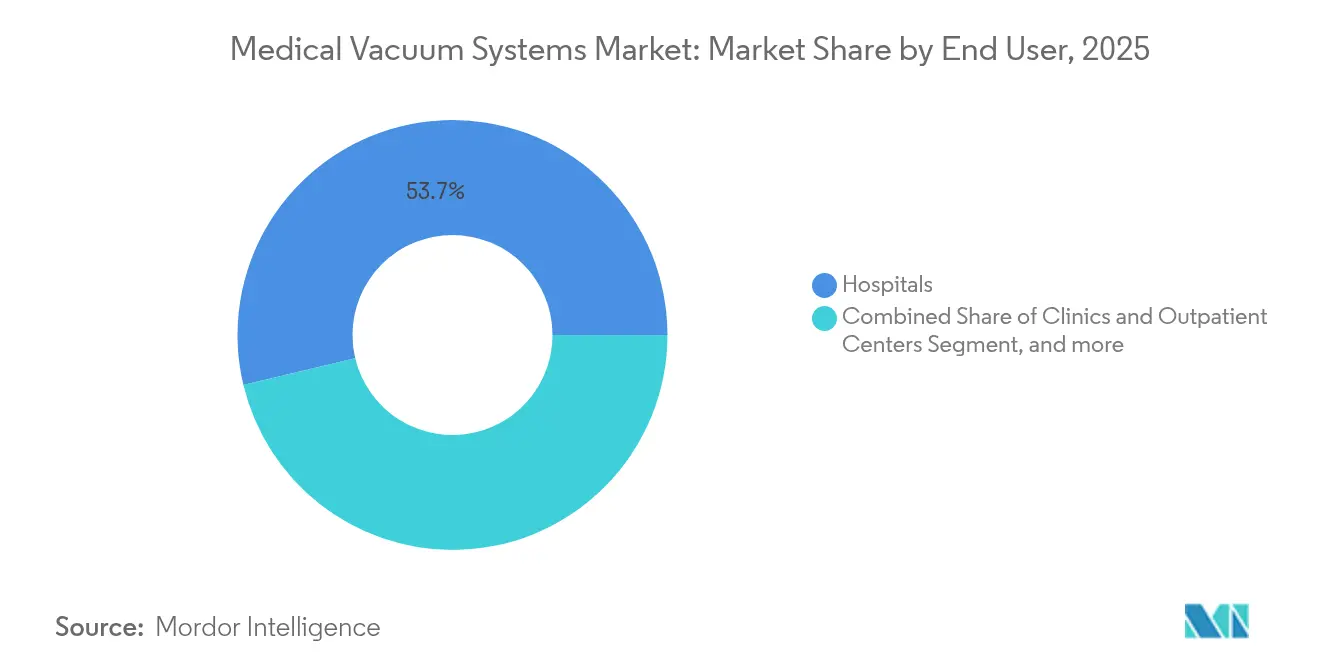
Hospitals Dominate While Home Care AcceleratesHospitals held 53.74% of the medical vacuum systems market size in 2025 owing to continual investment in operating theaters, intensive care expansion, and building-management integration. Multi-hospital networks standardize pump models and digital control panels to streamline spare-parts inventories and cross-facility maintenance. Predictive-maintenance algorithms tied into central supervisory control and data acquisition platforms forecast seal wear and trigger just-in-time service visits, minimizing downtime. Sustainability officers prioritize oil-free systems that pair with facility energy-management metrics, aligning capital buys with public net-zero pledges.
Home-care providers register a 8.63% CAGR through 2031, reflecting payers’ preference for lower-cost care sites and patients’ comfort with telehealth. Lightweight NPWT dressings average only USD 3,192 for a full healing episode compared with USD 28,000 for inpatient treatment. Device makers respond with intuitive interfaces, single-button pressure presets, and secure cellular connectivity that transfers compliance data to wound-care teams. Clinics and ambulatory surgical centers are also enlarging their vacuum footprints as same-day joint replacements and endoscopic procedures rise. Laboratories, diagnostic centers, and specialty outpatient hubs round out end-user demand with specialized vacuum requirements that call for oil-free, vibration-free systems to protect sensitive instruments.
Geography Analysis
North America Medical Vacuum Systems Market
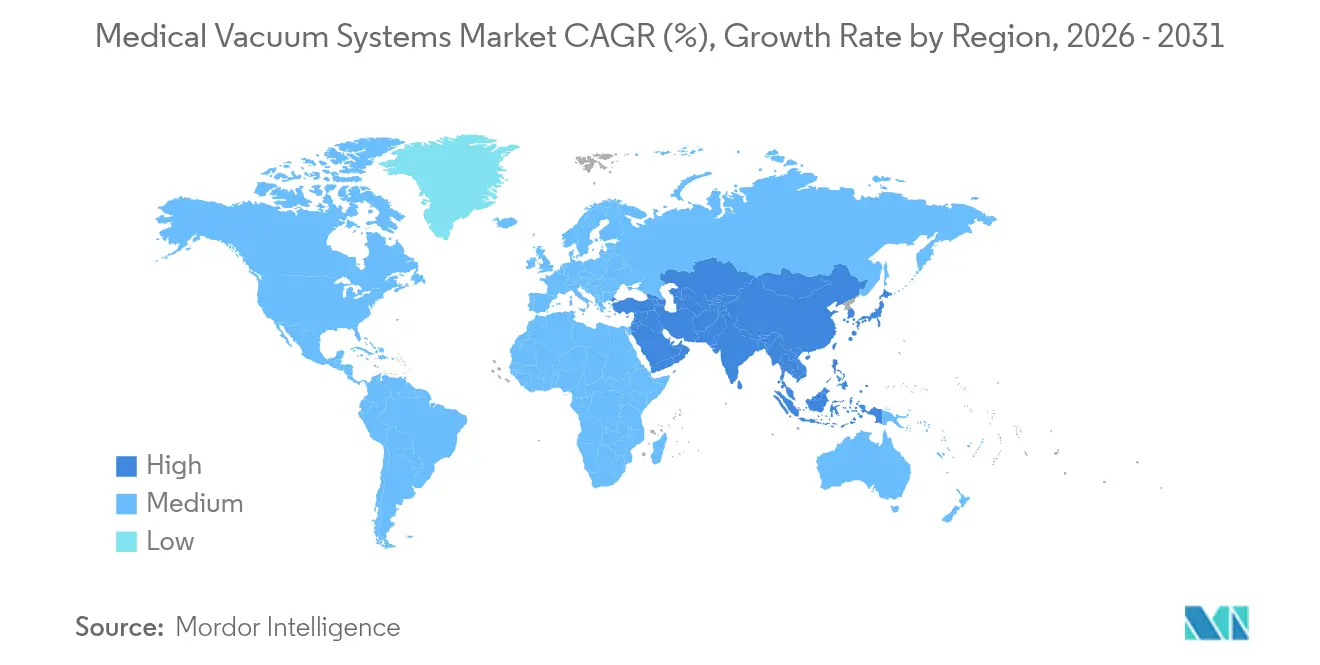
North America accounted for 37.20% of the medical vacuum systems market in 2025, leveraging widespread NFPA 99 compliance and deep capital reserves for plant modernization. Health-system consolidation steers toward standardized technical specifications, enabling multisite frame agreements that lower unit costs and secure parts availability. Providers report 30% energy savings after upgrading to variable-speed, oil-free pumps, freeing operational budgets for further decarbonization. Major academic medical centers work closely with manufacturers during R&D, accelerating the rollout of digital diagnostics and remote-monitoring modules. Reimbursement certainty for NPWT under Medicare and private payers ensures ready uptake of premium portable devices across inpatient and outpatient settings.
APAC Medical Vacuum Systems Market
Asia-Pacific is set to expand at an 7.59% CAGR, driven by large-scale hospital buildouts and growing domestic medical-device factories that shorten supply chains. Public healthcare investment programs in China, India, and Southeast Asia fund new tertiary centers equipped with NFPA-aligned medical-gas plants. Wound-healing clinics have multiplied rapidly, increasing specialized vacuum demand. Private hospitals targeting medical tourism install oil-free pumps and real-time vacuum alarms to meet international accreditation standards. While regulatory frameworks vary widely, regional harmonization efforts are underway, prompting vendors to develop adaptable compliance kits packaged for quick field-configuration.
EMEA and South America Medical Vacuum Systems Market
Europe, the Middle East & Africa, and South America present meaningful growth potential as infrastructure expansions intersect with managed-equipment service models that mitigate upfront cost. The International Finance Corporation’s USD 56 billion commitment to private-sector healthcare in fiscal 2024 underscores lasting investment momentum ifc.org. European hospitals pursue ambitious climate targets under Green Deal policies, adopting dry-pump technology and intelligent controls to trim carbon footprints. Middle-East mega-hospital projects specify modular, pre-tested vacuum skids compatible with heat-recovery loops to cope with desert energy loads. South American providers partner with manufacturers for staff-training programs that counter limited engineering workforces and keep plant uptime high.
Regulatory Landscape
Regulation covers both facility infrastructure codes for centralized vacuum plants and medical-device rules for suction and vacuum-related equipment. For healthcare facilities, ISO 7396-1:2016 sets requirements for design, installation, testing, and commissioning of medical gas pipeline systems (including vacuum), and it is in an update cycle via ISO/FDIS 7396-1. In the United States, NFPA 99 drives redundancy, verification testing, and documentation practices in hospital projects, shaping purchasing toward pre-certified, NFPA-aligned skids and controls to help shorten inspections and acceptance.
For devices used in suction and vacuum applications, market access typically depends on conformity to international safety and performance standards such as the ISO 10079 series and region-specific device pathways. In the United States, medical suction equipment is regulated as Class II and generally follows FDA device controls with 510(k) premarket notification. In Europe, Regulation (EU) 2017/745 (EU MDR) increases emphasis on clinical evaluation, technical documentation, and UDI implementation across applicable vacuum and suction device categories, reinforcing traceability and post-market obligations for manufacturers selling into EU hospital and home-care channels.
Competitive Landscape
The medical vacuum systems market remains moderately fragmented yet steadily converging as key suppliers strengthen vertical integration. Atlas Copco’s BeaconMedaes division, Busch Vacuum Solutions, and Gardner Denver (within Ingersoll Rand) command sizable installed bases. Each firm emphasizes proprietary oil-free pump designs, IoT-ready controllers, and multi-year service bundles that secure post-sale revenue. Product road maps lean heavily toward energy-efficiency improvements, remote diagnostics, and enhanced filtration performance that meets tightening infection-control norms.
Strategic acquisitions sharpen technological breadth. Ingersoll Rand’s purchase of Toshniwal Industries extended its footprint in precision pumps for Asia, while Busch Group’s acquisition of AVT GmbH deepened its service reach into heat-treatment vacuum furnaces. Supply-chain control from casting to rebuild kits shortens lead times and shields margins from raw-material inflation. Smaller regional players differentiate on rapid on-site service and custom engineering, though rising cybersecurity requirements may favor global actors equipped with robust IT-security resources.
Innovation revolves around predictive analytics platforms that integrate with hospital information technology. While such connectivity offers operational gains, health-system cybersecurity teams evaluate pump-controller firewalls and encrypted data paths before deployment, tempering immediate adoption. Manufacturers respond with isolated operational-technology networks, secure firmware-update protocols, and standards-based logging to alleviate concerns. Oil-free vacuum systems remain the definitive battleground as regulators and sustainability officers apply stronger purchasing weight to energy ratings and water conservation.
Medical Vacuum Systems Industry Leaders
-
Olympus Corporation
-
Atlas Copco AB (BeaconMedaes)
-
Busch Vacuum Solutions
-
Integra Biosciences AG
-
Ingersoll Rand (Gardner Denver)
- *Disclaimer: Major Players sorted in no particular order
Medical Vacuum Systems Market Companies Covered in this Report
- Atlas Copco AB (BeaconMedaes)
- Busch Vacuum Solutions
- Ingersoll Rand (Gardner Denver)
- Dragerwerk
- Air Techniques
- Allied Healthcare Products
- Medela
- ConvaTec Group plc
- Integra Biosciences AG
- Laerdal Medical
- EBARA Corporation
- Olympus
- Ohio Medical Corporation
- Amico Corporation
- Precision Medical
- ZOLL Medical Corp.
- 3M (Acelity)
- Smiths Group
- Cardinal Health
- Leybold GmbH
Market Opportunities and Future Outlook
Compliance-driven retrofit and new-build specifications create whitespace for suppliers that package vacuum plants as modular, expandable architectures, with turnkey documentation aligned to prevailing codes and standards. ISO 7396-1 requirements, including redundancy expectations (commonly implemented as N+1 in central plants), combine with NFPA 99 installation and testing rigor, favoring vendors that can standardize duplex-to-triplex expansions, provide validated reservoirs and bacterial filtration designs, and support qualified installation workflows. This ties to the report's focus on hospital modernization, where replacements of water-ring and lubricated units with dry, oil-free platforms target lower energy use and reduced contamination risk.
A second opportunity is emerging in digital centralized plants and distributed care, where remote monitoring and telemetry can reduce downtime while multi-site health systems standardize technical specifications. The report highlights growing interest in IoT-ready controllers and predictive maintenance, but cybersecurity concerns can slow deployments; vendors that provide secure firmware-update processes, segmented OT networks, and standards-based logging can better address these checks. On the clinical side, growth in home-care NPWT and outpatient wound clinics increases demand for portable systems and consumables, and suppliers that bundle accessories, filters, and service into managed-equipment agreements can help address the high upfront cost barrier for centralized installations.
Recent Industry Developments in Medical Vacuum Systems Market
- April 2026: Olympus received FDA clearance for the POWERSEAL Open Extended Jaw Device, expanding its regulated surgical portfolio in the United States. The clearance strengthens Olympus positioning in operating room procedure workflows where reliable suction and fluid management infrastructure is bundled into broader capital planning. It also underscores how regulatory milestones can accelerate adoption of adjacent OR equipment ecosystems.
- January 2025: Atlas Copco Group acquired Medi-teknique, a UK-based service provider focused on maintenance contracts for medical gas pipeline systems. The deal broadened Atlas Copco BeaconMedaes aftermarket coverage and increased capacity for compliance-focused inspection, repair, and lifecycle services. It reinforced the shift toward bundled service models that help hospitals manage uptime and documentation requirements.
- November 2024: Busch Group completed the acquisition of AVT GmbH, adding spare parts and service capabilities relevant to vacuum-furnace and related vacuum equipment service. While AVT is not a pure-play medical vacuum plant supplier, the transaction expanded Busch service depth and parts availability across vacuum applications used in medical technology value chains. The added service infrastructure supports faster turnaround times and strengthens lifecycle revenue capture.
Medical Vacuum Systems Market Report Scope and Research Methodology
Market Definition and Coverage
This market is defined as revenue generated from medical vacuum systems that create controlled suction in care and lab settings, mainly to remove fluids and gases during procedures and routine patient care. It includes centralized and standalone systems, along with related accessories and consumables, across major regions.
Scope exclusions: This sizing excludes non-medical industrial vacuum equipment and general-purpose pumps that are not marketed and used for clinical or laboratory suction workflows.
Segments Covered in This Report
- By Product Type
- Standalone Vacuum Systems
- Centralized Vacuum Systems
- Portable/Compact Vacuum Systems
- Accessories & Consumables
- By Application
- Wound Care / NPWT
- Anesthesiology
- Gynecology & Obstetrics
- Dental
- Respiratory & Airway Management
- Surgical Suction & OR Fluid Management
- Diagnostic & Research
- Pharma-Biotech Manufacturing
- By End User
- Hospitals
- Clinics & Outpatient Centers
- Laboratories & Diagnostic Centers
- Pharmaceutical & Biotech Companies
- Home Care Settings
- Ambulance & Emergency Services
- By Geography
- North America
- United States
- Canada
- Mexico
- Europe
- Germany
- United Kingdom
- France
- Italy
- Spain
- Rest of Europe
- Asia-Pacific
- China
- Japan
- India
- Australia
- South Korea
- Rest of Asia-Pacific
- Middle East & Africa
- GCC
- South Africa
- Rest of Middle East & Africa
- South America
- Brazil
- Argentina
- Rest of South America
- North America
Data Sources, Market Sizing, and Validation
Desk Research
Desk work starts by locking the product and use-case meaning of a medical vacuum system so pricing and volumes do not get mixed with adjacent pumping markets. We referenced public sources such as the World Health Organization for health system indicators, the US FDA for device classification and safety context, the US CDC for infection prevention related guidance, and OECD health statistics for procedure and capacity signals.
Next, we used secondary material such as company annual reports, investor presentations, and reputable healthcare press to understand installation patterns in hospitals, replacement cycles, and shifts toward dry technologies in certain settings. Where available, patent databases were reviewed to track the direction of technology focus, and an import or export shipment-level database was used selectively to sanity-check trade movement for relevant equipment categories. These sources are illustrative only, and many other public documents and datasets were also used for data collection, validation, and clarification.
Primary Interviews and Surveys
Primary work was used to pressure-test assumptions that desk sources rarely confirm, such as typical configuration per facility, pricing ranges by system type, and how often accessories and consumables are bundled versus sold separately. We spoke with a mix of manufacturers, distributors, hospital engineering and procurement teams, and clinical users, covering demand behavior across APAC, EMEA, and the Americas so regional differences in installation and maintenance practices could be reflected.
Distribution of primary research fieldwork respondents
| Company type | Respondent position | Region |
|---|---|---|
| Top tier: 30% | CXOs: 18% | APAC: 48% |
| Mid tier: 48% | Functional/Unit leaders: 26% | EMEA: 29% |
| Smaller Players: 22% | Managers: 56% | Americas: 23% |
Market-Sizing & Forecasting
Sizing was built using a top-down approach where hospital and outpatient infrastructure indicators are converted into an addressable installation and replacement pool, and then translated into value using realistic pricing and mix assumptions. To keep the totals grounded, we corroborated them with selective bottom-up approximations, such as sampled average selling price bands multiplied by estimated unit demand for centralized and standalone systems, followed by channel checks.
Inputs that matter in this market include operating room and ICU expansion activity, facility construction and renovation cycles, replacement timing of older oil-sealed systems, adoption of dry pump technologies, and usage intensity proxies tied to surgical and respiratory caseloads. Where accessory and consumable revenue is part of the scope, attach rates and bundling behavior were treated carefully so the same dollars were not counted twice. When local data gaps appeared, assumptions were borrowed from comparable countries and then adjusted based on interview feedback before being rolled back into regional totals.
For forecasting, scenario analysis was used so near-term capex cycles and medium-term healthcare capacity growth could be represented without forcing a single straight-line trend. The final outlook was aligned to the expected pace of new facility additions, retrofit momentum, and regional procurement patterns that respondents validated.
Data Validation & Update Cycle
Validation is done by comparing model outputs with independent signals, such as regional healthcare infrastructure growth, procedure intensity direction, and observed pricing and mix shifts discussed by the supply chain. Any large variance is flagged, assumptions are revisited, and the relevant participants are re-contacted when a change looks material rather than noise.
Before sign-off, the work goes through multi-step checks, including arithmetic validation, unit consistency checks, and peer review of the logic behind key drivers. The study is refreshed annually, and interim updates are triggered when major regulatory actions, supply disruptions, or sharp currency moves could change near-term pricing or demand. Right before delivery, we run a final pass to ensure the latest public indicators and event impacts are reflected.
Mordor Intelligence's Medical Vacuum System Market Sizing Compared With Other Published Estimates
Published market values for medical vacuum systems can look inconsistent because firms do not always count the same product set, the same care settings, or the same revenue layers. Differences also come from the year used as the starting point, the currency conversion timing, and whether the estimate leans conservative or assumes faster retrofit activity.
The main gap comes from whether accessories and consumables are included alongside system hardware, and Mordor Intelligence counts them only when they are directly tied to medical vacuum system installations and recurring use, which avoids inflating totals with unrelated suction or general pump spending. Spreads can also show up when one study uses a longer forecast window with a single CAGR, while another relies on shorter-cycle demand indicators like hospital construction and replacement cadence that can move year to year.
Benchmark comparison
| Source | Market Size | Gaps in Research Methodology |
|---|---|---|
| Mordor Intelligence | USD 1.74 B (2025) | |
| Industry Data Publisher A | USD 1.33 B (2024) | Uses an earlier base year and a narrower definition that appears to emphasize core vacuum system equipment, with less clarity on whether accessories and consumables are included, which can lower the stated total. |
| Industry Research Outlet B | USD 1.84 B (2024) | Uses a different starting year and a longer forecast horizon, and the scope presentation suggests broader category coverage by product and application, which can lift the base value if adjacent suction-related items are grouped in. |
The comparison shows that most of the spread is explainable once the year, included revenue layers, and product adjacency rules are made explicit. By keeping the market tied to defined clinical and laboratory suction workflows and by checking the totals against facility expansion and replacement signals, we can present a value that is easier to trace and repeat.
Key Questions Answered in the Report
What is the current size of the medical vacuum systems market?
The market is valued at USD 1.85 billion in 2026 and is projected to reach USD 2.51 billion by 2031.
Which region is growing the fastest for medical vacuum systems?
Asia-Pacific is forecast to post the highest CAGR at 7.59% through 2031 due to large hospital buildouts and expanding device manufacturing.
Why are oil-free vacuum pumps gaining popularity in hospitals?
Oil-free technology lowers energy use by 30%, eliminates water consumption, extends service life up to 20 years, and meets stringent NFPA 99 contamination standards.
What application dominates the medical vacuum systems market?
Wound care and negative pressure wound therapy lead with 31.66% market share in 2025 thanks to their proven healing benefits and supportive reimbursement.
How are hospitals addressing budget constraints for vacuum system upgrades?
Many engage in managed-equipment service contracts that bundle equipment, maintenance, and training, allowing upgrades without large up-front capital expenditure.