
Marketing Cloud Market Size and Share
Market Overview
| Study Period | 2020 - 2031 |
|---|---|
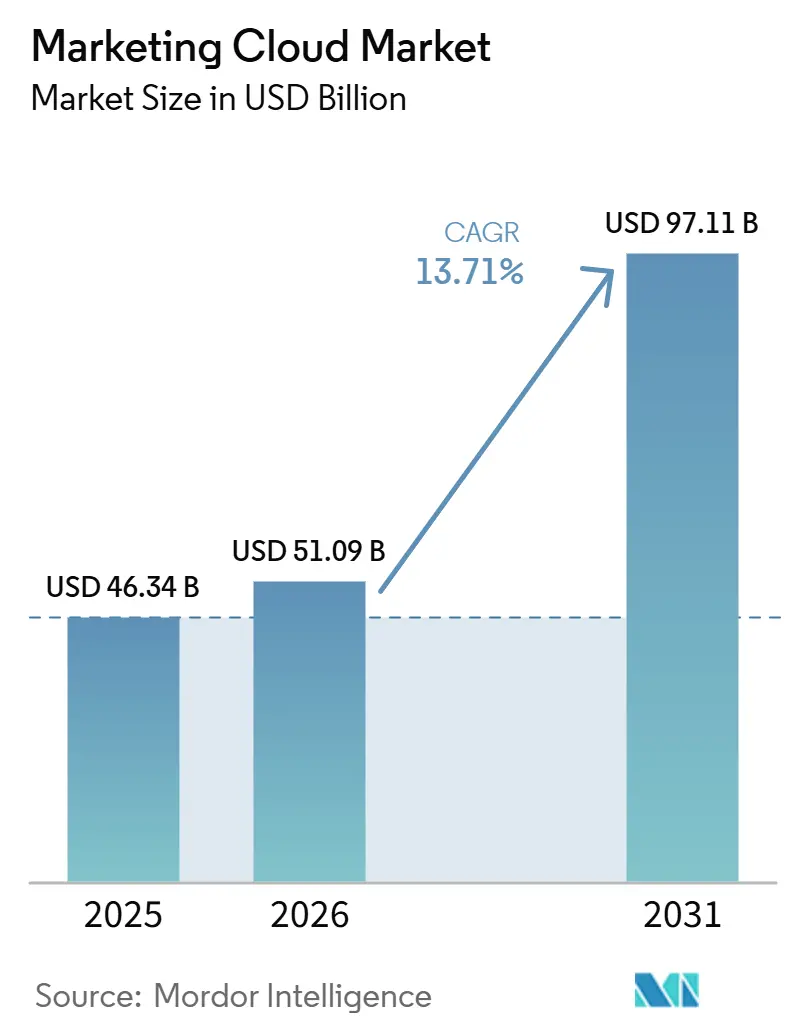
| Market Size (2026) | USD 51.09 Billion |
| Market Size (2031) | USD 97.11 Billion |
| Growth Rate (2026 - 2031) | 13.71% CAGR |
| Fastest Growing Market | Asia-Pacific |
| Largest Market | North America |
| Market Concentration | Medium |
Major Players *Disclaimer: Major Players sorted in no particular order Image © Mordor Intelligence. Reuse requires attribution under CC BY 4.0. | |
Marketing Cloud Market Analysis by Mordor Intelligence
The marketing cloud market size stood at USD 46.34 billion in 2025 and USD 51.09 billion in 2026 and is forecast to reach USD 97.11 billion by 2031, at a CAGR of 13.71% from 2026 to 2031. Growth reflects a deeper shift in how enterprises manage customer engagement, with these platforms moving closer to core revenue operations. AI-led orchestration is speeding up campaign design, audience selection, and content delivery, while privacy requirements are pushing companies to strengthen first-party data systems. Spending is also moving beyond campaign execution toward customer data management, lifecycle automation, and composable architectures that connect content, analytics, and activation tools more tightly. Competition is rising as large suite vendors defend enterprise accounts while focused challengers expand through narrower product positioning and faster onboarding. The main opportunity across the Marketing Cloud Market remains in cloud-native and AI-enabled deployments that reduce manual work, support privacy-safe personalization, and serve both large enterprises and SMEs with less operational friction.
Key Report Takeaways
- By component, platforms held 81.46% of revenue in the marketing cloud market in 2025, while services are projected to expand at a 15.68% CAGR through 2031.
- By deployment mode, public cloud deployment accounted for 68.92% of revenue in 2025 and is projected to grow at a 14.91% CAGR through 2031.
- By organization size, large enterprises represented 70.38% of spending in 2025, while SMEs are projected to advance at a 16.43% CAGR through 2031.
- By marketing function, campaign management captured 24.73% of revenue in 2025, while customer data management is projected to expand at a 17.58% CAGR through 2031.
- By end use, retail and e-commerce accounted for 23.84% of spending in 2025, while healthcare and life sciences are projected to grow at a 16.81% CAGR through 2031.
- By geography, North America held 40.27% of revenue in 2025, while Asia-Pacific is projected to record an 18.92% CAGR through 2031.
Note: Market size and forecast figures in this report are generated using Mordor Intelligence’s proprietary estimation framework, updated with the latest available data and insights as of January 2026.
Global Marketing Cloud Market Trends and Insights
Drivers Impact Analysis*
| DRIVER | (~) % IMPACT ON CAGR FORECAST | GEOGRAPHIC RELEVANCE | IMPACT TIMELINE |
|---|---|---|---|
| AI-Driven Campaign Orchestration and Content Generation | +3.4% | Global, with disproportionate adoption in North America and Australia | Short term (≤ 2 years) |
| Rising Need for Real-Time Personalization Across Customer Journeys | +3.1% | Global, most pronounced in North America, UK, and Japan | Short term (≤ 2 years) |
| First-Party Data Activation as Third-Party Cookies Fade | +2.5% | Global, with acute urgency in the EU, UK, and Southeast Asia | Short term (≤ 2 years) |
| Composable Marketing Stacks Replacing Monolithic Suites | +1.8% | North America, EU, and Australia, emerging in India and South Korea | Medium term (2-4 years) |
| Growth of Revenue-Tied Lifecycle Automation in B2B and B2C | +1.5% | North America and Western Europe, with rapid uptake in India and Brazil | Medium term (2-4 years) |
| Expansion of Privacy-Safe Identity Resolution and Consent Management | +1.1% | EU and India predominantly, with spillover to core APAC markets | Medium term (2-4 years) |
| Source: Mordor Intelligence | |||
Ai-Driven Campaign Orchestration and Content Generation
Generative AI has moved from pilot activity into daily use across enterprise marketing stacks. Salesforce launched Agentforce Marketing in June 2026, and the platform allows AI agents to identify prospects, create omnichannel content, and optimize campaigns against revenue goals. Salesforce said early adopter Rawlings reported 75% faster campaign creation after implementation, which shows that automation is now affecting execution speed in measurable ways.[1]Salesforce, Inc., “Salesforce Puts an AI Marketing Team in Every Marketer's Hands,” Salesforce Newsroom, salesforce.com This shift also changes how teams allocate work, because orchestration and repetitive production tasks can move away from manual workflows. Across the Marketing Cloud Market, vendors that deploy these capabilities earlier are likely to build stronger data and workflow advantages over slower rivals. The EU AI Act is also pushing platform providers to add transparency controls to automated customer-facing decisions in Europe.
Rising Need for Real-Time Personalization Across Customer Journeys
Real-time personalization now functions less as a differentiator and more as a basic customer expectation. Salesforce said AI-powered personalized recommendations and conversational agents drove 20% of all global retail orders during the 2025 holiday season, generating USD 262 billion in revenue. Salesforce also reported that 86% of marketers said AI has changed customer engagement, while 78% said the required volume of personalized content is beyond what human teams can produce alone. Klaviyo said its platform processed 3.4 billion daily customer interactions across more than 8 billion customer profiles in early 2026, which shows the infrastructure depth now needed for personalization at scale. The practical effect is that spending is moving toward unified customer profiles that bring together behavioral, transactional, and consent data into a single operating layer. The Marketing Cloud Market benefits from this shift because platforms that connect those data flows cleanly can support faster and more relevant customer decisions across channels.
First-Party Data Activation as Third-Party Cookies Fade
First-party data activation remains a core growth driver as marketers adjust to a weaker third-party identifier environment and stricter consent expectations. Adobe said in July 2024 that brands were making progress on cookie alternatives, yet still felt less prepared than ever for a world without third-party cookies. Salesforce said its Data Cloud managed more than 50 trillion records in FY2025, showing how large the infrastructure buildout has become around first-party data capture and activation. The competitive gap is shifting from simple data ownership toward the speed at which consented signals can be translated into a customer action. That change favors platforms with unified data layers over disconnected channel tools that still depend on fragmented records. The Marketing Cloud Market continues to gain from this transition because first-party activation supports both better personalization and stronger privacy alignment.
Composable Marketing Stacks Replacing Monolithic Suites
Enterprises are rethinking the role of all-in-one suites and are placing more value on modular, API-first architectures. Salesforce signed a definitive agreement in June 2026 to acquire Contentful, a composable content platform trusted by more than 4,800 enterprise brands. That move shows that content, data, and AI orchestration now need to connect dynamically rather than sit inside one closed environment. Salesforce also said Indeed reduced its martech stack by 40% after deploying Marketing Cloud Next, which suggests that a well-designed modular setup can also simplify operations. The result is a split across the Marketing Cloud Market, where large enterprises can support deeper composability while SMEs still prefer pre-integrated cloud tools with lower setup demands. Vendors that offer a simpler starting point and a clearer path to modular expansion are likely to be better aligned with both ends of the demand base.
Restraints Impact Analysis*
| RESTRAINT | (~) % IMPACT ON CAGR FORECAST | GEOGRAPHIC RELEVANCE | IMPACT TIMELINE |
|---|---|---|---|
| Integration Complexity Across CRM, CDP, Commerce, and Data Lakes | -2.3% | Global, most acute in large enterprise segments in North America and Europe | Medium term (2-4 years) |
| Enterprise Data Privacy, Residency, and Consent Compliance Burden | -1.8% | EU, India, and Southeast Asia, with spillover to North America | Medium term (2-4 years) |
| Vendor Lock-In Risks From Closed Marketing Suites | -1.3% | North America and Western Europe, where switching costs are highest | Long term (≥ 4 years) |
| Skills Gap in Marketing Analytics, Automation, and AI Operations | -0.9% | Global, with highest severity in South America and Southeast Asia | Medium term (2-4 years) |
| Source: Mordor Intelligence | |||
Integration Complexity Across Crm, Cdp, Commerce, and Data Lakes
Integration complexity remains the most material restraint on wider deployment across the Marketing Cloud Market. Enterprise stacks now commonly combine CRM systems, CDPs, commerce platforms, and data lakes from different vendors, and each added layer increases the effort needed for identity matching, workflow design, and data movement. The problem becomes more visible when companies adopt AI tools, because those systems need cleaner and faster data connections than many legacy stacks can provide. Teams then spend more time maintaining connectors and less time improving campaigns, analysis, and customer programs. Vendors are trying to reduce this burden through native integration and acquisition activity, including Salesforce’s June 2026 agreement for Contentful. Even so, the restraint remains significant because each new capability can create a new compatibility gap in heterogeneous environments.
Enterprise Data Privacy, Residency, and Consent Compliance Burden
Privacy, residency, and consent obligations continue to raise the cost and complexity of deployment decisions. The EU AI Act applies transparency obligations to automated decision-making in customer-facing systems, and those rules are relevant for AI-enabled marketing workflows.[2]European Parliament and Council, “AI Act, Regulatory Framework for Artificial Intelligence,” European Commission, digital-strategy.ec.europa.eu In practice, this means governance, consent tracking, and audit controls need to work consistently across every connected application. Large enterprises can usually spread those demands across legal, security, and engineering teams, while many mid-market buyers face a heavier operational burden. Procurement decisions increasingly favor vendors that can offer explainable automation and clearer data governance options in regulated environments. This slows some implementations in the Marketing Cloud Market even as it increases demand for compliant platform design.
*Our forecasts treat driver/restraint impacts as directional, not additive. The impact forecasts reflect baseline growth, mix effects, and variable interactions.
Segment Analysis
By Component: Platform Economics Favor Scale, but Services Set the Growth Pace
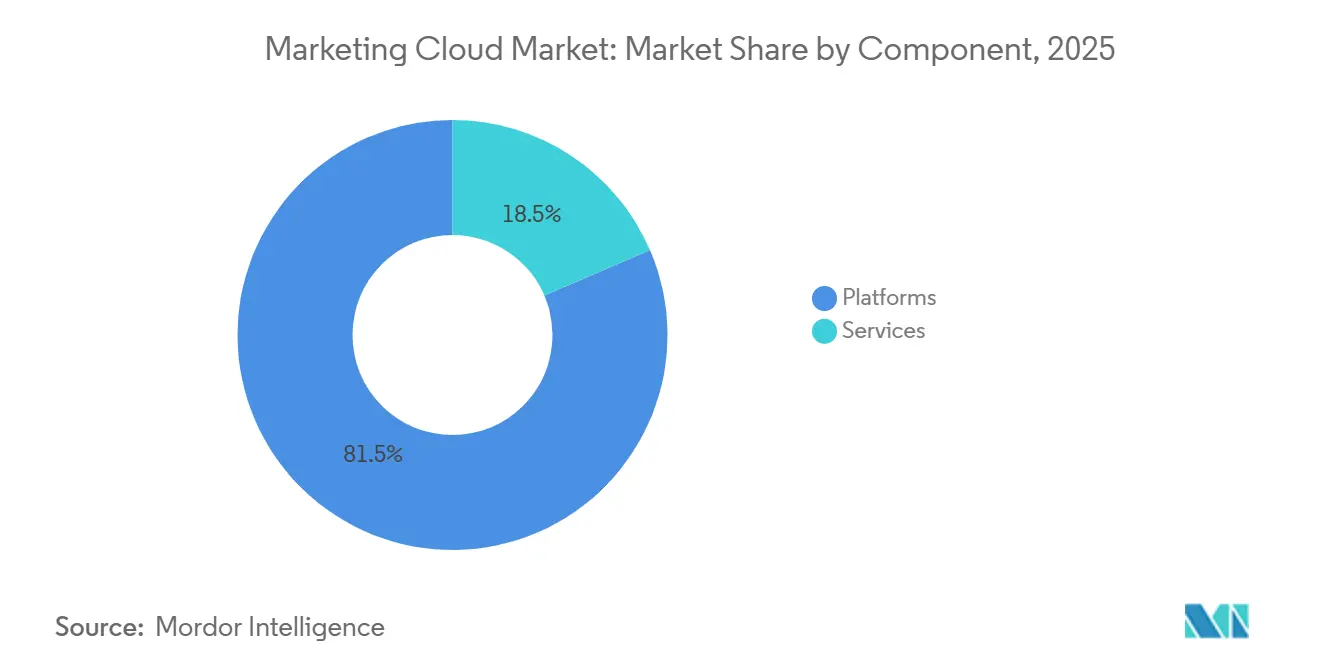
Platforms held 81.46% of the Marketing Cloud Market share in 2025, while services are projected to grow at a 15.68% CAGR through 2031. That gap shows how strongly the category still depends on core software platforms for value capture and account control. It also shows that the installed base is maturing, because buyers who already licensed platforms are now spending more on implementation, optimization, and managed support. Within the marketing cloud industry, service demand is rising as enterprises try to operationalize AI agents, lifecycle automation, and connected data pipelines without overextending internal teams.
Managed services are particularly relevant for mid-market buyers who want sophisticated capability without building a large internal operating layer. Professional services also remain important because enterprise deployments often require workflow redesign, data preparation, and governance setup before expected gains appear. Adobe reported FY2025 revenue of USD 23.77 billion, with Creative and Marketing Professional subscriptions growing 11% year over year, which reflects the scale at which large software ecosystems can support attached services demand. In the marketing cloud industry, this leaves platforms as the economic anchor while services carry a growing share of the execution burden as deployments become more complex.


By Deployment Mode: Cloud Becomes the Operating Standard, While Hybrid and Private Models Retain Niche Roles
Public cloud deployment accounted for 68.92% of revenue in 2025 and is projected to record a 14.91% CAGR through 2031. That dual lead shows that cloud is no longer just the preferred model for new deployments, but the operating standard for the Marketing Cloud Market. Buyers favor it because it supports faster updates, easier API access, and better elasticity for data-heavy personalization use cases. The same pattern also reduces the appeal of older on-premise architectures that struggle to keep pace with AI release cycles and real-time processing needs.
Private cloud retains a role in regulated environments where control over data handling and internal governance still shapes buying criteria. Hybrid models also remain relevant for enterprises that want to modernize campaign and analytics layers while keeping sensitive records in legacy environments during transition. Salesforce’s planned acquisition of Contentful reinforces the broader move toward cloud-first and composable operating models that connect content and orchestration more tightly.[3]Salesforce, Inc., “2025 SMB Trends, Why ASEAN Businesses Are Investing in AI and Automation,” Salesforce Asia-Pacific Blog, salesforce.com Across the Marketing Cloud Market, the main divide is no longer whether organizations will use cloud, but how fast they can move critical workflows there without disrupting security, compliance, or existing operations.
By Organization Size: Enterprise Revenue Dominates, While SME Adoption Accelerates Faster
Large enterprises represented 70.38% of global spending in 2025, while SMEs are projected to grow at a 16.43% CAGR through 2031. That balance shows that large buyers still anchor total revenue through broader contracts that span data integration, orchestration, and compliance layers. At the same time, SMEs are now reshaping growth momentum because AI-native platforms have reduced the setup and staffing burden that once limited adoption. The Marketing Cloud Market is therefore seeing a shift from enterprise-only sophistication toward more accessible and self-serve operating models.
Salesforce said 76% of ASEAN SMBs surveyed were increasing investment in digital tools in 2025, and 78% of those already using AI viewed it as a game-changing capability for campaign optimization and personalization. That finding supports the view that adoption is rising because smaller companies can now link commercial results to digital tooling more directly. Vendors that rely only on long enterprise sales cycles risk losing momentum in this part of the Marketing Cloud Market unless they add easier onboarding paths and lighter implementation models. The fastest growth is therefore coming from buyers who want enterprise-grade outcomes without enterprise-grade operating complexity.
By Marketing Function: Campaign Execution Leads Current Spend, While Data Management Gains Strategic Weight
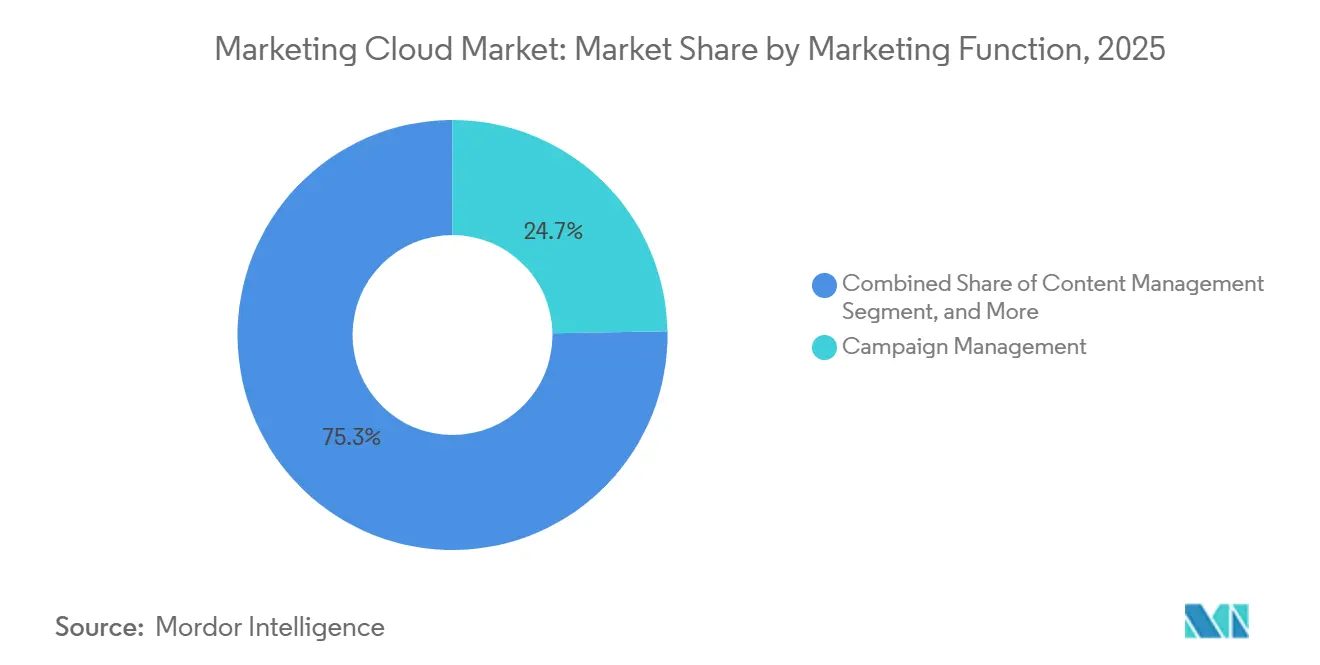
Campaign management captured 24.73% of the Marketing Cloud Market size in 2025, while customer data management is projected to expand at a 17.58% CAGR through 2031. That split shows the difference between where spending is anchored today and where strategic attention is moving next. Campaign execution remains central because enterprises still need unified tools for planning, activation, and measurement across channels. However, customer data management is gaining popularity faster because campaign quality increasingly depends on how complete, current, and permissioned the underlying profile is.
Klaviyo said its platform handled 3.4 billion daily customer interactions across more than 8 billion customer profiles globally, which illustrates the scale needed for real-time customer decisions. Advertising and branding, email marketing, content management, social media marketing, and analytics still serve important operational needs across the Marketing Cloud Market. Even so, analytics is increasingly being embedded inside orchestration workflows rather than purchased as a separate destination. The category is moving toward platforms that place a stronger data layer at the center and let campaign, content, and reporting functions operate around it.

By End Use: Retail Holds the Lead, While Healthcare and Life Sciences Advances Fastest
Retail and e-commerce accounted for 23.84% of end-use spending in 2025, while healthcare and life sciences are projected to expand at a 16.81% CAGR through 2031. Retail leads because conversion optimization, repeat purchase activity, and customer lifetime value are already tightly linked to digital engagement performance. Bluecore said AI powered a 46% increase in conversion rate during the 2025 Black Friday and Cyber Monday period across 144 retail brands, which helps explain continued platform spending in this vertical.[4]Bluecore, “Bluecore Data Reveals that AI Powered a 46% Increase in Conversion Rate During the 2025 Black Friday and Cyber Monday Shopping Period,” Bluecore Press Release, bluecore.com The Marketing Cloud Market continues to benefit from this vertical because retail buyers can often connect platform usage to near-term revenue outcomes more directly than other industries can.
Healthcare and life sciences are moving faster because firms are applying these tools to professional engagement, not just promotional outreach. Salesforce announced in December 2025 that Novartis selected Agentforce Life Sciences for Customer Engagement to unify interactions across marketing, sales, medical, patient services, and market access stakeholders. That use case raises the value of compliant, real-time personalization across multiple regulated touchpoints. BFSI and IT and telecom remain sizable buyers, while manufacturing, education, and travel and hospitality still show narrower deployments that are often centered on CRM linkage rather than full cross-channel orchestration.
Geography Analysis
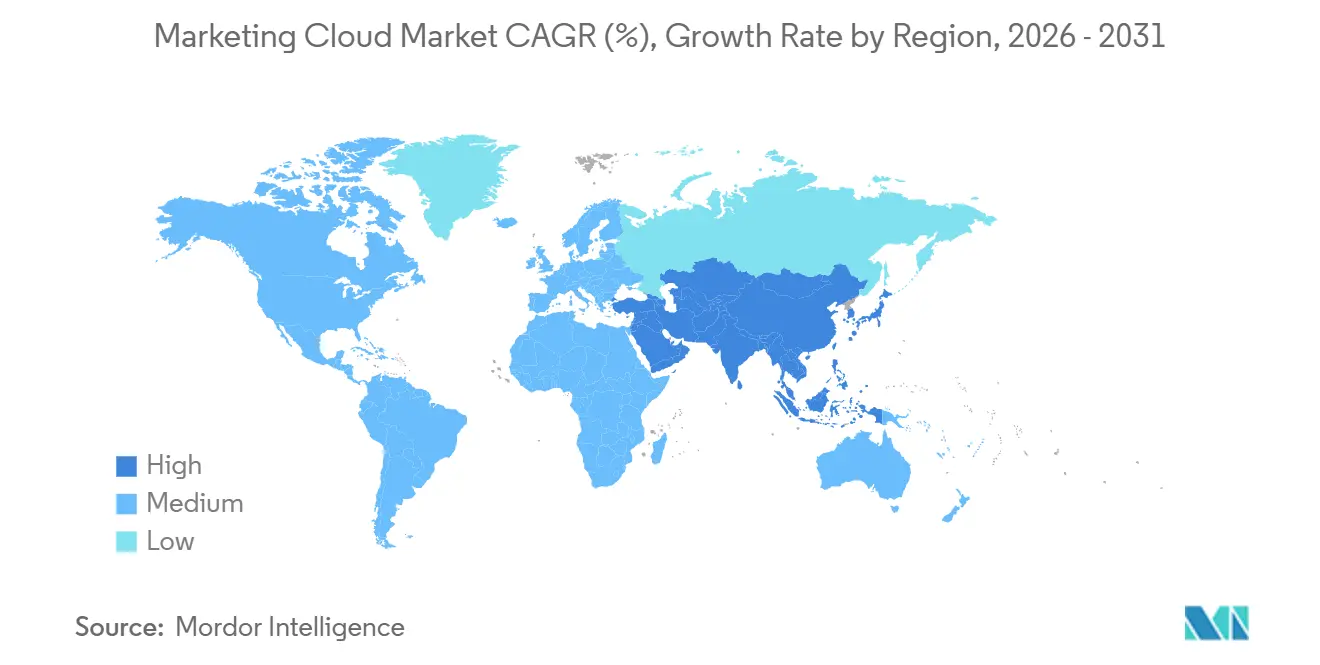
North America held 40.27% of revenue in 2025, which kept it in the leading position across the Marketing Cloud Market. Salesforce reported FY2025 Marketing and Commerce cloud revenue of USD 5.281 billion, which reflects the depth of enterprise platform spending tied to this region.[5]Salesforce, Inc., “Q4 FY25 Earnings Press Release,” Salesforce, salesforce.com The region benefits from a dense vendor base, mature digital infrastructure, and enterprise budgets that can support integration-heavy deployments. Europe remains a major demand center, with Germany, the United Kingdom, and France anchoring a large share of regional activity. The EU AI Act is pushing more governance and transparency into customer-facing automated systems, which supports platforms that can combine AI capability with clearer compliance controls.
Asia-Pacific is projected to record an 18.92% CAGR through 2031, making it the fastest-growing regional segment in the Marketing Cloud Market. The growth rate reflects lower current penetration in several large markets and a faster shift toward cloud adoption among SMEs. Klaviyo reported that revenue outside the Americas grew 39% in Q1 2026, with EMEA excluding the United Kingdom up 51% year over year, which points to broader international demand expansion around modern customer engagement platforms. China remains the largest regional market by volume, while India and Southeast Asia present stronger velocity in adoption, especially among smaller businesses. Australia also supports premium budgets in banking and insurance where real-time personalization and governance capabilities carry higher strategic value.
South America remains a smaller part of the Marketing Cloud Market, but it is still gaining importance as digital marketing capability broadens in the region. Brazil remains the main regional demand center because it combines the largest business base with the strongest technology spending profile. The Middle East and Africa shows a split pattern, with Gulf countries investing more actively in digital diversification while sub-Saharan markets remain earlier in adoption. Together, these regions provide expansion room for vendors seeking growth beyond the more established North American and European base.

Competitive Landscape
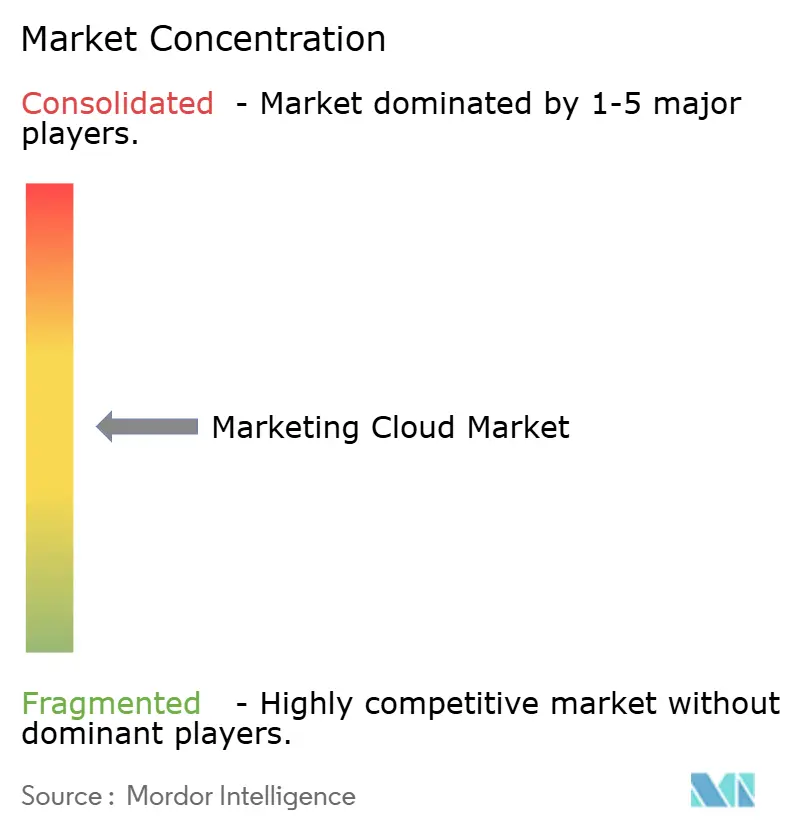
The global marketing cloud market is moderately consolidated at the platform tier, where Salesforce, Adobe, Oracle, and SAP hold strong positions in large enterprise accounts. Their advantage comes from broader product ecosystems, established service networks, and stronger switching barriers once data and workflows are embedded. Salesforce reported FY2025 Marketing and Commerce cloud revenue of USD 5.281 billion, and the company said Data Cloud managed more than 50 trillion records, which shows the scale of the data and commercial base supporting its position. Braze reported FY2026 revenue of USD 738.2 million with 24.4% year over year growth, and it also reported more than 50% year over year growth in large enterprise bookings, which shows that specialists can still break into accounts that were once harder to access. This leaves the broader Marketing Cloud Market led by a few large suite vendors at the top, while remaining far more fragmented across the wider field.
Competition in 2026 is centered on AI capability, data scale, orchestration depth, and the quality of prebuilt workflows. Salesforce launched Agentforce Marketing in June 2026, pushing AI agents deeper into pipeline creation, content generation, and lifecycle execution. Salesforce also signed a definitive agreement to acquire Contentful in June 2026, which adds a native composable content layer to its customer experience stack. Warmly announced in June 2026 that it was joining HubSpot, bringing person-level visitor identification and AI go-to-market agents into HubSpot’s broader CRM and data environment. Klaviyo and Google also announced a strategic partnership in February 2026 to support autonomous customer experiences across search, advertising, AI, and RCS for Business messaging.
The most active white space sits in mid-market enterprises that have outgrown entry-level tools but still want less complexity than large suite deployments bring. That is where pre-integrated, AI-native offerings with guided onboarding are competing hardest on time to value. Vertical specialists are also gaining attention in healthcare and financial services because those buyers place more weight on governance and workflow depth. Across the Marketing Cloud Market, vendor selection still depends on ecosystem fit, service support, and confidence that future expansion will not force heavy system rework.
Marketing Cloud Industry Leaders
Adobe Inc.
ActiveCampaign, LLC
Acoustic, L.P.
Braze, Inc.
Cheetah Digital, LLC
- *Disclaimer: Major Players sorted in no particular order

Recent Industry Developments
- June 2026: Salesforce launched Agentforce Marketing, an agentic marketing platform that enables AI agents to autonomously build pipeline, create content, execute campaigns, and optimize experiences against revenue goals. Integrated with Marketing Cloud Next, Data 360, and the Marketing Cloud Engagement MCP Server, the platform marks a fundamental shift from human-operated campaign management to agent-operated lifecycle orchestration.
- June 2026: Salesforce signed a definitive agreement to acquire Contentful, a composable headless CMS platform trusted by more than 4,800 enterprise brands. The acquisition adds a native, API-first content layer to Customer 360 and Headless 360, enabling Agentforce to dynamically assemble and deliver personalized experiences across every channel without manual publishing. The transaction is expected to close in Q3 of Salesforce's fiscal year 2027.
- February 2026: Klaviyo and Google announced a strategic partnership to enable autonomous, AI-driven customer experiences from product discovery through loyalty. The partnership integrates Google's search, advertising, AI, and RCS for Business messaging with Klaviyo's real-time customer data platform and decisioning engine, with Klaviyo among the first globally to offer access to Google Search as an entry point for RCS-powered AI customer agents.
- December 2025: Salesforce announced that Novartis selected Agentforce Life Sciences for Customer Engagement to connect patient and healthcare professional experiences, unifying engagement across marketing, sales, medical, patient services, and market access stakeholders on a single AI-powered platform.


Global Marketing Cloud Market Report Scope
The Marketing Cloud Market comprises platforms and solutions that integrate marketing technologies into a unified cloud-based environment. These solutions enable businesses to manage customer data, automate campaigns, conduct analytics, personalize customer interactions, and support omnichannel engagement through a single ecosystem. Marketing cloud platforms help enterprises improve marketing efficiency, deliver real-time personalized experiences, and measure ROI across digital channels. The market includes cloud-native solutions used across industries such as retail, banking, telecom, and healthcare to support scalable, data-driven, and customer-centric marketing operations.
The Marketing Cloud Market Report is Segmented by Component (Platforms, and Services [Managed Services, and Professional Services]), Deployment Mode (Public Cloud, Hybrid Cloud, and Private Cloud) Organization Size (Large Enterprises, and Small and Medium-Sized Enterprises), Marketing Function (Advertising and Branding, Customer Data Management, Campaign Management, Content Management, Email Marketing, Social Media Marketing, and Analytics and Reporting), End User Industry (BFSI, IT and Telecom, Healthcare and Life Sciences, Retail and E-Commerce, Media and Entertainment, Travel and Hospitality, Manufacturing, Education, and Other End User Industries), and Geography (North America, South America, Europe, Asia-Pacific, and Middle East and Africa). The Market Forecasts are Provided in Terms of Value (USD).
| Platforms | |
| Services | Managed Services |
| Professional Services |
| Public Cloud |
| Hybrid Cloud |
| Private Cloud |
| Large Enterprises |
| Small and Medium-Sized Enterprises |
| Advertising and Branding |
| Customer Data Management |
| Campaign Management |
| Content Management |
| Email Marketing |
| Social Media Marketing |
| Analytics and Reporting |
| BFSI |
| IT and Telecom |
| Healthcare and Life Sciences |
| Retail and E-Commerce |
| Media and Entertainment |
| Travel and Hospitality |
| Manufacturing |
| Education |
| Rest of End User Industries |
| North America | United States | |
| Canada | ||
| Mexico | ||
| South America | Brazil | |
| Argentina | ||
| Rest of South America | ||
| Europe | Germany | |
| United Kingdom | ||
| France | ||
| Italy | ||
| Spain | ||
| Russia | ||
| Rest of Europe | ||
| Asia-Pacific | China | |
| India | ||
| Japan | ||
| South Korea | ||
| Australia | ||
| Rest of Asia-Pacific | ||
| Middle East and Africa | Middle East | Turkey |
| Saudi Arabia | ||
| United Arab Emirates | ||
| Rest of Middle East | ||
| Africa | South Africa | |
| Rest of Africa | ||
| By Component | Platforms | ||
| Services | Managed Services | ||
| Professional Services | |||
| By Deployment Mode | Public Cloud | ||
| Hybrid Cloud | |||
| Private Cloud | |||
| By Organization Size | Large Enterprises | ||
| Small and Medium-Sized Enterprises | |||
| By Marketing Function | Advertising and Branding | ||
| Customer Data Management | |||
| Campaign Management | |||
| Content Management | |||
| Email Marketing | |||
| Social Media Marketing | |||
| Analytics and Reporting | |||
| By End User Industry | BFSI | ||
| IT and Telecom | |||
| Healthcare and Life Sciences | |||
| Retail and E-Commerce | |||
| Media and Entertainment | |||
| Travel and Hospitality | |||
| Manufacturing | |||
| Education | |||
| Rest of End User Industries | |||
| By Geography | North America | United States | |
| Canada | |||
| Mexico | |||
| South America | Brazil | ||
| Argentina | |||
| Rest of South America | |||
| Europe | Germany | ||
| United Kingdom | |||
| France | |||
| Italy | |||
| Spain | |||
| Russia | |||
| Rest of Europe | |||
| Asia-Pacific | China | ||
| India | |||
| Japan | |||
| South Korea | |||
| Australia | |||
| Rest of Asia-Pacific | |||
| Middle East and Africa | Middle East | Turkey | |
| Saudi Arabia | |||
| United Arab Emirates | |||
| Rest of Middle East | |||
| Africa | South Africa | ||
| Rest of Africa | |||


Key Questions Answered in the Report
What is the projected size of the marketing cloud market by 2031?
The marketing cloud market is forecast to reach USD 97.11 billion by 2031, up from USD 46.34 billion in 2025, with a 13.71% CAGR over 2026-2031.
What is driving growth in this space?
The main drivers are AI-led campaign orchestration, stronger demand for real-time personalization, greater reliance on first-party data, and the move toward composable architectures.
Which deployment model leads adoption?
Public cloud deployment led with 68.92% share in 2025 and is also the fastest-growing deployment model at a 14.91% CAGR through 2031.
Why is customer data management growing faster than campaign management?
Enterprises are placing more value on unified customer profiles and consented data activation, because stronger data quality improves every downstream marketing function.
Which end-use sector is expanding fastest?
Healthcare and life sciences is projected to grow at a 16.81% CAGR through 2031, while retail and e-commerce remained the largest end-use segment in 2025 with 23.84% share.
Why are SMEs adopting these platforms faster now?
SMEs are gaining access to AI-native and self-serve tools that reduce setup complexity, and this is helping the segment outpace larger organizations with a projected 16.43% CAGR.
Page last updated on:






