
Managed SaaS Backup Services Market Size and Share
Market Overview
| Study Period | 2021 - 2032 |
|---|---|
| Market Size (2027) | USD 3.88 Billion |
| Market Size (2032) | USD 8.40 Billion |
| Growth Rate (2027 - 2032) | 16.71 % |
| Fastest Growing Market | Asia-Pacific |
| Largest Market | North America |
| Market Concentration | Low |
Major Players *Disclaimer: Major Players sorted in no particular order Image © Mordor Intelligence. Reuse requires attribution under CC BY 4.0. | |
Managed SaaS Backup Services Market Analysis by Mordor Intelligence
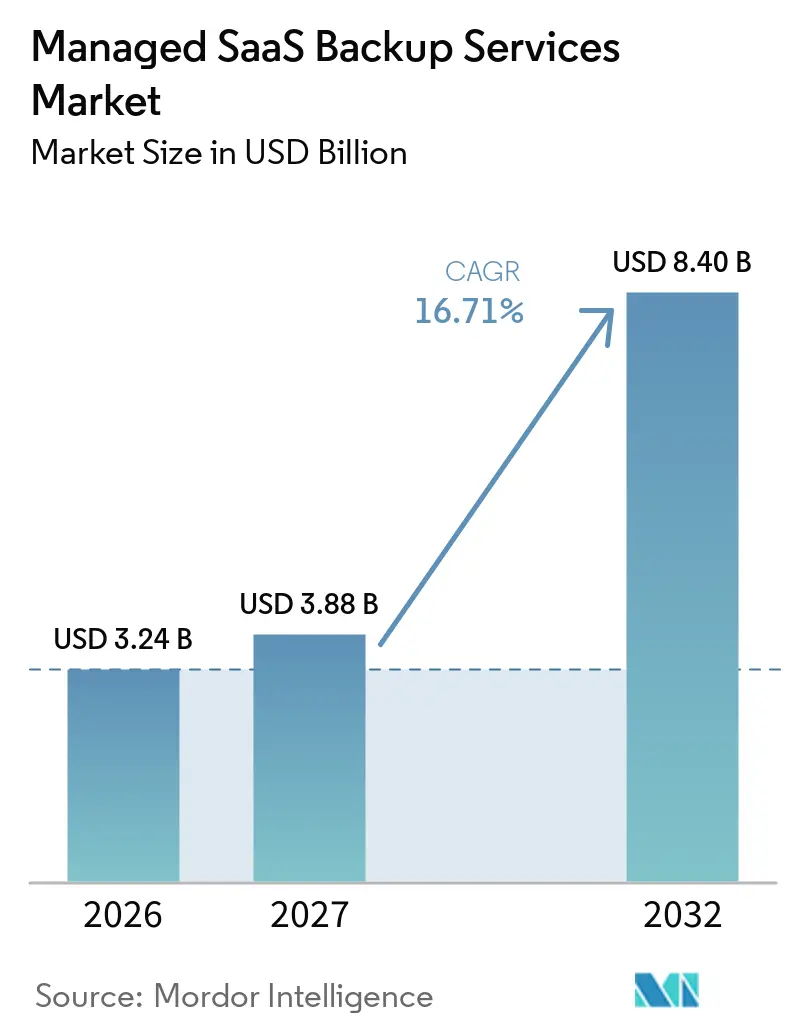
The managed SaaS backup services market size is projected to expand from USD 3.24 billion in 2026 and USD 3.88 billion in 2027 to USD 8.40 billion by 2032, registering a CAGR of 16.71% between 2027 and 2032. The managed SaaS backup services market is being shaped by the rising business dependence on SaaS platforms for payroll, customer contracts, clinical records, and financial information, where day-to-day business activity can depend on continued access to complete records and the permissions, configurations, and relationships surrounding them. Native recovery features can address accidental deletion, but they do not always provide the isolated and durable recovery copies needed after a serious intrusion, especially when the original tenant, a user account, or native recovery points have been affected. Ransomware-related data theft, stricter recovery obligations, and larger SaaS portfolios are moving backup decisions beyond routine IT spending and toward risk, legal, operational, and continuity priorities. Providers are responding with immutable storage, application-specific restoration, and cloud architectures designed to retain data separately from the source tenant while simplifying recovery for teams that do not manage each application directly. These conditions give the managed SaaS backup services market a wider role in enterprise resilience, compliance, and business continuity, with purchasing decisions increasingly influenced by the ability to prove that protected data can be restored in a usable and timely form.
Key Report Takeaways
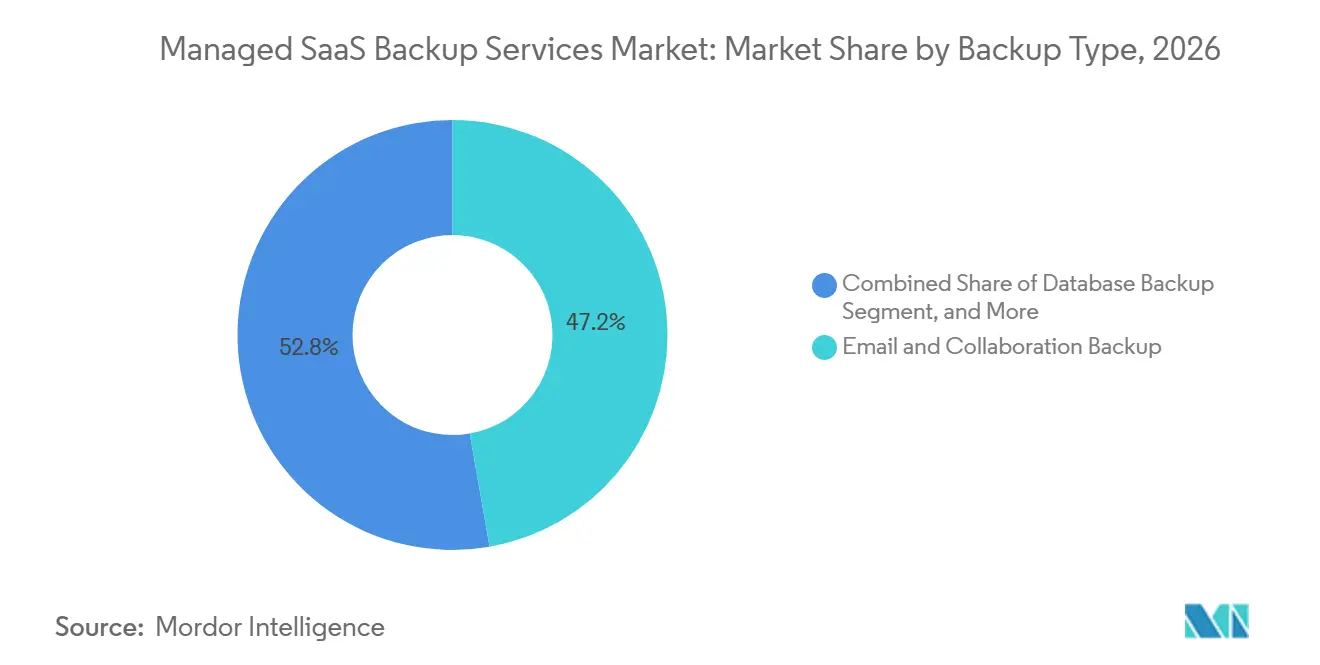
- By backup type, Email and Collaboration Backup held 47.24% of the managed SaaS backup services market share in 2026, while Database Backup is projected to expand at a 19.38% CAGR through 2032.
- By delivery model, Provider-Hosted Public Cloud accounted for 61.39% of revenue in 2026 and is expected to expand at a 17.68% CAGR through 2032.
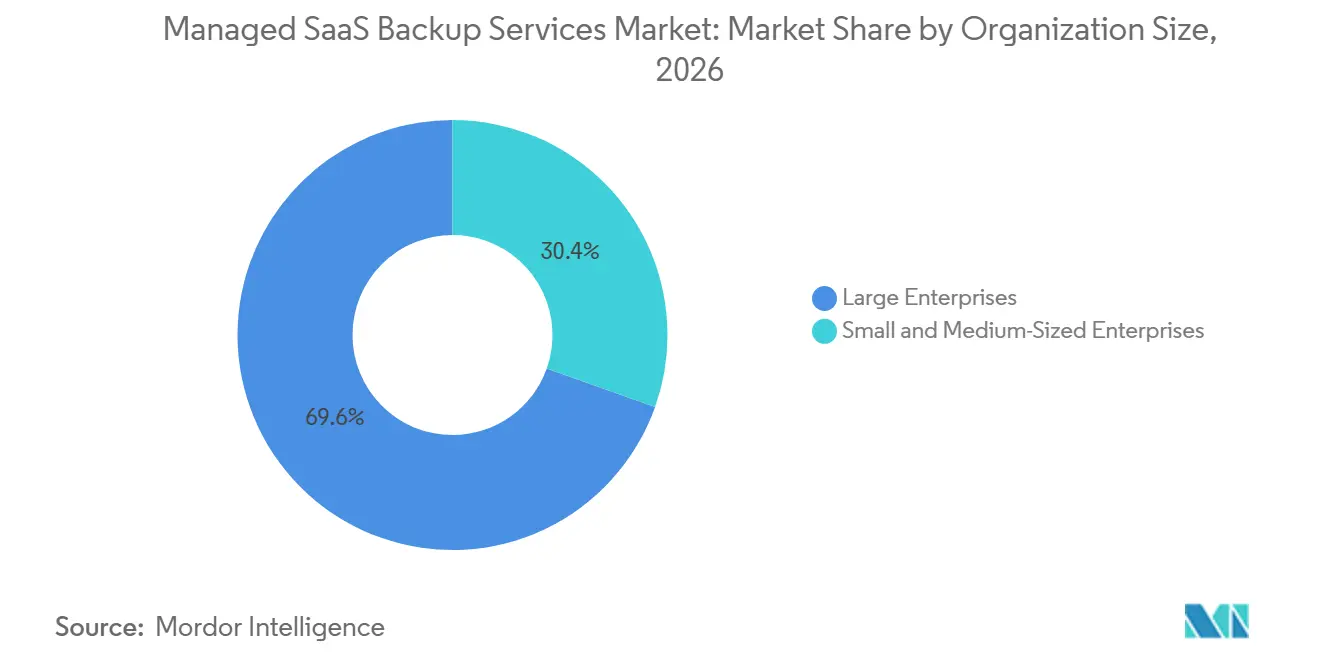
- By organization size, Large Enterprises held 69.57% of the managed SaaS backup services market revenue in 2026, while SMEs are projected to expand at an 18.11% CAGR through 2032.
- By end-user industry, BFSI accounted for 26.17% of revenue in 2026, while Healthcare and Life Sciences are projected to expand at an 18.21% CAGR through 2032.
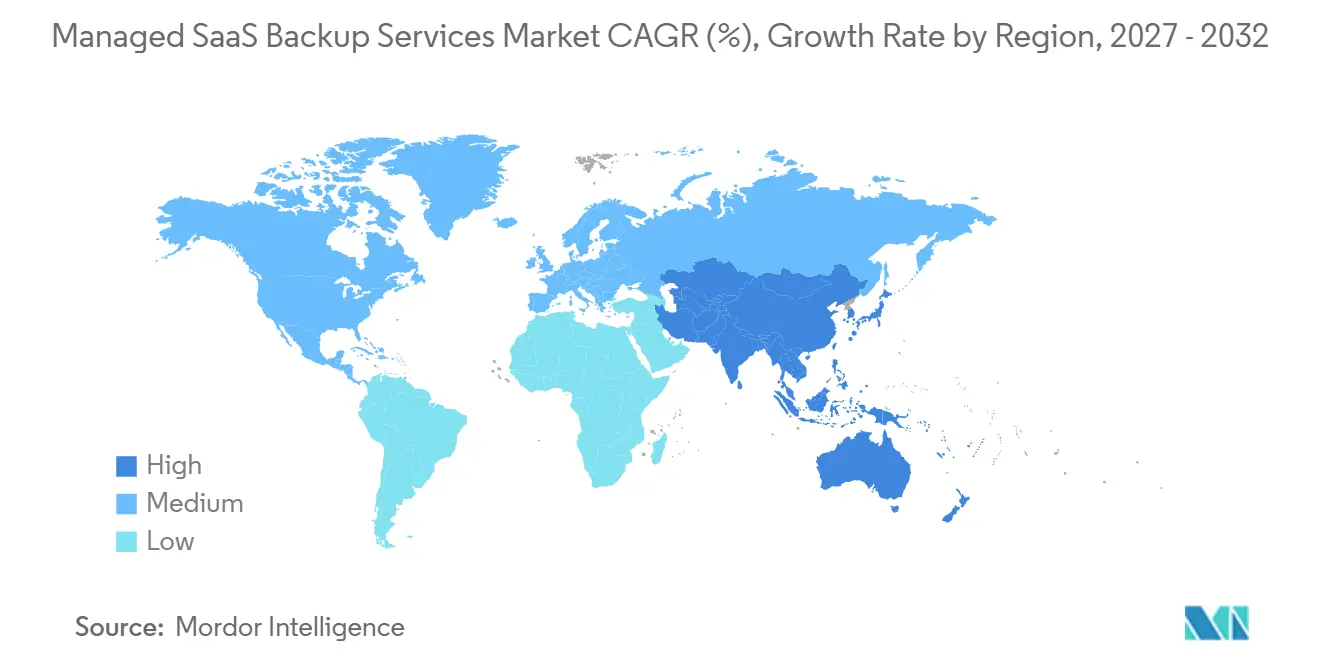
- By geography, North America held 42.67% of the managed SaaS backup services market revenue in 2026, while Asia-Pacific is projected to expand at a 19.43% CAGR through 2032.
Note: Market numbers in this report are based on Mordor Intelligence's proprietary estimation framework, which combines nine months of actuals with Q4 projections for base year 2026.
Market Trends and Insights
Drivers Impact Analysis of Managed SaaS Backup Services Market*
| Driver | (~) % Impact on CAGR Forecast | Geographic Relevance | Impact Timeline |
|---|---|---|---|
| Ransomware and Malicious SaaS Data Deletion | +4.2% | Global | Short term (≤ 2 years) |
| Accelerating Adoption of Business-Critical SaaS Applications | +3.5% | Global | Short term (≤ 2 years) |
| Regulatory Requirements for Retention, Recovery, and Data Sovereignty | +2.8% | Europe, North America, Asia-Pacific | Medium term (2-4 years) |
| Demand for Automated Recovery and Business Continuity | +2.1% | Global | Medium term (2-4 years) |
| Multicloud and Cross-Platform Backup Orchestration | +1.5% | North America, Europe, Asia-Pacific | Medium term (2-4 years) |
| Recovery Validation for AI-Generated and AI-Managed Workloads | +1.0% | North America, Asia-Pacific | Long term (≥ 4 years) |
| Source: Mordor Intelligence | |||
Ransomware and Malicious SaaS Data Deletion
Ransomware has shifted from file encryption toward campaigns that steal and misuse SaaS data. Zscaler reported 896.2 terabytes of data exfiltration across observed ransomware incidents from April 2025 through March 2026.[1] The report also recorded a more than 275% year-over-year increase in ransomware-related data theft and an average ransom payment of USD 431,995. Google Cloud reported that 77% of ransomware intrusions in 2025 involved data theft, compared with 57% in 2024. Attackers reviewed SharePoint repositories and Microsoft 365 mail environments to identify valuable information before encryption events. The managed SaaS backup services market benefits as buyers seek immutable copies that remain separate from a compromised SaaS tenant and can support recovery after an attacker has altered, deleted, or rendered native recovery options unreliable.
Accelerating Adoption of Business-Critical SaaS Applications
Organizations use an average of 139 SaaS applications, according to HYCU's 2025 resilience report. More than 50% of workloads run in public cloud environments, while only 56% of SaaS applications fall under centralized IT governance.[2] This gap leaves permission settings, data lineage, and links between applications outside consistent recovery oversight, even when the underlying application is integral to a finance, legal, customer-service, or clinical process. The managed SaaS backup services market, therefore, supports consolidated retention rules across fragmented application estates and helps organizations apply a consistent recovery policy where responsibilities are distributed between business and IT teams. Financial close, procurement, and legal work are increasingly carried out within SaaS applications, which raises the business impact of an unsuccessful restoration. Providers that protect Microsoft 365 alongside Salesforce, Okta, and other applications can reduce tool sprawl while widening the protected data set.
Regulatory Requirements for Retention, Recovery, and Data Sovereignty
Compliance requirements influence backup design before an organization selects a provider. GDPR Article 32 requires organizations to restore the availability and access to personal data in a timely manner after an incident. The regulation allows penalties of up to EUR 20 million (USD 22.6 million), or 4% of worldwide annual turnover. DORA has applied to European financial entities since January 2025 and requires documented testing of backup and recovery processes. HIPAA requires covered organizations to maintain documented backup, disaster recovery, and emergency operation plans for electronic protected health information. These obligations bring legal, compliance, and risk teams into procurement in the managed SaaS backup services market, even when their involvement lengthens the sales process and increases the importance of evidence that retention, access, data location, and restoration procedures are aligned.
Demand for Automated Recovery and Business Continuity
The 2025 IBM Cost of a Data Breach Report placed the average global cost of a breach at USD 4.4 million. Manual recovery can struggle to meet service-level recovery targets when an application state spans several SaaS services, and each service uses a different restoration process, object model, or administrative control. A 2025 peer-reviewed study found that automated cross-platform backup and disaster recovery reduced recovery time objectives by 37% and recovery point objectives by 41% against conventional single-cloud tools. The study attributed the improvement to policy-led orchestration and machine-learning-based anomaly detection. Vendors are adding validation functions that inspect snapshots for ransomware indicators and test restoration integrity before an incident is closed. This automation makes verifiable recovery a central requirement in the managed SaaS backup services market, particularly for buyers who need predictable restoration rather than a manual process that must be assembled during an incident.
Restraints Impact Analysis of Managed SaaS Backup Services Market*
| Restraint | (~) % Impact on CAGR Forecast | Geographic Relevance | Impact Timeline |
|---|---|---|---|
| Data Sovereignty and Cross-Border Transfer Restrictions | -1.2% | Europe, Asia-Pacific | Medium term (2-4 years) |
| SaaS API Rate Limits and Connector Dependency | -1.0% | Global | Short term (≤ 2 years) |
| Incomplete Recovery of Configuration, Metadata, and Relationships | -0.8% | Global | Medium term (2-4 years) |
| Vendor Lock-In and Proprietary Backup Formats | -0.7% | Global | Long term (≥ 4 years) |
| Source: Mordor Intelligence | |||
Data Sovereignty and Cross-Border Transfer Restrictions
Cross-border rules require managed backup providers to operate data storage and recovery processes across separate regulatory jurisdictions. GDPR applies safeguards to personal data transfers outside the European Economic Area, including backup copies. India's Digital Personal Data Protection Act and China's Personal Information Protection Law also increase the need for locally managed data storage. A global organization may therefore need separate backup vaults instead of one shared destination, along with processes that ensure recovery workflows respect the same location controls as the original data. This structure adds infrastructure, vendor management, and operating costs for the managed SaaS backup services market and can make service design more complicated for companies that operate in several regulated regions. Providers without region-specific infrastructure and customer-controlled encryption capabilities can face limits in regulated-sector procurement.
SaaS API Rate Limits and Connector Dependency
SaaS platforms use API rate limits to protect service availability, which can slow or interrupt backup jobs. A throttled session can leave data changes, configurations, and relationship metadata outside the protection window. Connector-dependent systems can also fail when a SaaS provider changes an API schema. Administrators may only discover the issue after a restoration request exposes the missing coverage, which can make a seemingly complete backup policy less dependable in practice. Backup architectures need dynamic pacing that considers the API cost of each object and adjusts request volume through response data. These technical limits restrict backup frequency and the recovery objectives that providers in the managed SaaS backup services market can guarantee for large SaaS estates, particularly where high volumes of changes must be processed within narrow backup windows.
*Our forecasts treat driver/restraint impacts as directional, not additive. The impact forecasts reflect baseline growth, mix effects, and variable interactions.
Managed SaaS Backup Services Market Segment Analysis
By Backup Type:
Email and Collaboration Backup Leads Revenue While Database Backup Expands FastestEmail and Collaboration Backup held 47.24% of revenue in 2026, making it the largest backup type in the managed SaaS backup services market. Microsoft 365 brings Exchange Online, SharePoint, Teams, and OneDrive into one operating environment, so a recovery problem can affect communications, documents, shared workspaces, and employee access at the same time. Organizations use this protection to preserve business records that may be required for e-discovery, litigation holds, internal investigations, and regulated communications retention. The need is not limited to retaining files because item-level search, permission context, and supporting metadata can determine whether a recovered record is useful. Long retention periods can also be necessary after an employee, folder, or account has changed, particularly when the organization must locate historical communications. The segment’s leading position reflects the importance of protecting both collaboration content and the context that allows teams to restore, find, and interpret that content after a disruption.
Database Backup is projected to expand at a 19.38% CAGR through 2032, supported by a protection gap in cloud-native relational database services. The supplied research states that AWS, Azure, and Google Cloud database offerings can provide only 7 days of native point-in-time retention, which may not cover multi-year retention duties or incidents found after several weeks. An external vault can extend retention and allow a provider to restore information at table or record level when a full database restoration is not appropriate. File, Folder, and Object Backup remains necessary as collaborative cloud workspaces add more unstructured information across departmental repositories and shared drives. Infrastructure and System Backup retains a role in hybrid environments where a full-server image can reduce the time needed to restore after an encryption event. Other Backup Types include SaaS metadata, configuration states, and agentic workflow backups, which become relevant when AI agents receive read and write access to systems of record. These requirements extend the managed SaaS backup services market beyond conventional file recovery and require providers to preserve data, settings, relationships, and usable recovery points together.

By Delivery Model:
Provider-Hosted Public Cloud Combines Scale With Faster ExpansionProvider-Hosted Public Cloud accounted for 61.39% of revenue in 2026 and is projected to expand at a 17.68% CAGR through 2032. Elastic capacity, consumption-based billing, and access to regional infrastructure allow organizations to add protection without making a separate capital investment in backup hardware. This model can make managed SaaS backup services easier to adopt for organizations without a dedicated infrastructure team or a large internal storage environment. SMEs can value a predictable operating model and a shorter implementation process when they need to protect SaaS data without adding extensive administration. Fully cloud-based providers such as Druva and Keepit also align their services with SaaS-first organizations that prefer to run protection, storage, policy management, and recovery through one managed environment. Within the managed SaaS backup services market, the result is a delivery model that connects backup operations to the cloud operating pattern that customers already use for core applications.
Provider-Hosted Private Cloud remains relevant for regulated organizations that require tenant-level storage isolation, customer-managed encryption keys, and a contractually specified physical location for data. Financial services and healthcare users may select this model when their recovery controls need to align closely with rules for sensitive records and restricted data access. Customer-Hosted and Hybrid deployments remain in use where on-premises infrastructure cannot be fully retired because of sovereignty requirements, existing technology investments, or concerns over data egress costs. A 2025 survey of German SMEs reported that 59% of respondents used hybrid backup architectures, compared with 19% in 2022, and identified regulatory compliance and data redundancy as key reasons. The pattern indicates that hybrid adoption can add another recovery layer rather than simply replace public cloud spending. These delivery options help the managed SaaS backup services market meet different requirements for control, location, administrative responsibility, and continuity planning.
By Organization Size:
Large Enterprises Lead Spending While SMEs Gain MomentumLarge Enterprises held 69.57% of revenue in 2026, reflecting the number of applications, users, records, and recovery scenarios they must manage across their SaaS estates. Many large organizations operate multi-tenant Microsoft 365, Salesforce, and ServiceNow deployments that require clear separation of data, permissions, and administrative responsibilities. Their backup requirements often include item-level restoration, cross-account replication, integrated compliance reporting, and recovery targets supported by service-level agreements. These functions can command higher per-seat pricing than basic subscriptions because restoration must work across a larger operational environment and under formal audit expectations. Multi-year managed service agreements also support enterprise spending by connecting protection to broader resilience and continuity budgets. The need to protect AI model artifacts, training datasets, and model configurations adds a further requirement for enterprises that have moved AI work from experimentation into production operations.
SMEs are projected to expand at an 18.11% CAGR through 2032, supported by cloud-first SaaS adoption, declining managed service prices, and cyber-insurance expectations for verifiable backup practices. Smaller organizations may not have dedicated recovery specialists, which makes a managed service provider a practical route to backup, security operations, endpoint protection, and ongoing monitoring. Some cyber-insurance policies require evidence of backup practices and restoration testing before coverage can be approved or renewed. Kaseya, Datto, and N-able Technologies incorporate managed backup within platforms that service providers use across their own customer portfolios. This approach allows providers to reach smaller customers through partners that already understand their local support needs and existing technology choices. Partner reach, service quality, and the ability to bundle protection with related security functions consequently shape competition for SME accounts. The managed SaaS backup services market can therefore expand in the SME segment through a channel model rather than relying solely on direct sales teams.
By End-User Industry:
BFSI Holds the Largest Share While Healthcare and Life Sciences Expands FastestBFSI accounted for 26.17% of revenue in 2026, supported by the sensitivity of financial information and the need for reliable audit trails across SaaS-based records. Banks, insurers, and other financial organizations manage transaction records, client documents, communications, and internal approvals that need preservation and recovery under detailed retention requirements. SOX, FINRA, MiFID II, and related rules increase the importance of documented protection, searchable historical data, and controlled restoration procedures. DORA also requires financial entities to maintain information on technology assets, including SaaS applications that should be covered by tested recovery documentation. A failed restoration can result in operational disruption, regulatory attention, and contractual consequences, rather than a limited technology inconvenience. Within the managed SaaS backup services market, these conditions keep managed SaaS backup services tied to enterprise risk-management decisions in financial institutions and sustain BFSI’s leading revenue position.
Healthcare and Life Sciences is projected to expand at an 18.21% CAGR through 2032. The HIPAA Security Rule requires covered entities to maintain retrievable and encrypted copies of electronic protected health information with documented backup, disaster recovery, and emergency operation planning. Cloud-hosted health records, telemedicine applications, and AI-assisted clinical workflows extend sensitive information into SaaS environments that were not always part of earlier infrastructure reviews. Providers must therefore support recovery processes that address access, integrity, availability, and the continuity requirements of clinical or patient-facing work. IT and Telecommunications, Government and Public Sector, Retail and E-Commerce, and Media and Entertainment provide additional demand as their information and workflows move to hosted applications. Government demand can increase where public-sector SaaS adoption is paired with national data sovereignty requirements and the need to demonstrate protected recovery. The wider customer base allows the managed SaaS backup services market to develop outside highly regulated sectors while retaining its relevance to them.
Geography Analysis
North America Managed SaaS Backup Services Market
North America held 42.67% of revenue in 2026, supported by a high concentration of SaaS applications and a developed ecosystem of managed service providers and value-added resellers. HIPAA, SOX, the California Consumer Privacy Act, and SEC recordkeeping requirements shape how organizations approach protection, retention, and recoverability across the region. The United States represents the majority of North American spending because federal agencies, large enterprises, and regulated financial institutions have mature backup and continuity programs. Cyber-insurance underwriting is also increasing attention to quarterly restoration testing, which can make managed backup a practical condition for coverage qualification rather than an optional technology purchase. Canada is expanding through public-sector digitization and provincial health-data privacy rules, while Mexico remains at an earlier stage with demand concentrated among multinational subsidiaries and export-oriented manufacturers.
APAC Managed SaaS Backup Services Market
Asia-Pacific is projected to expand at a 19.43% CAGR through 2032, making it the fastest-growing geographic segment in the managed SaaS backup services market. The region combines rapid SaaS adoption with data-localization requirements in major economies, which raises the need for regional storage, recovery, and service-delivery capabilities. India’s Digital Personal Data Protection Act makes timely data restoration important for organizations that manage sensitive information in BFSI, healthcare, and IT services. China’s Personal Information Protection Law supports demand for in-country backup vaults from providers serving local operations and multinational customers with China-based data. Australia uses distributed recovery architectures to support multicloud operations and address natural-disaster exposure, while South Korea is expanding managed backup use across semiconductor, electronics, and financial services enterprises.
EMEA and South America Managed SaaS Backup Services Market
Within the managed SaaS backup services market, Europe is shaped by procurement criteria linked to GDPR, NIS2, and DORA, which support demand for sovereignty-compliant backup design and well-documented recovery testing. Germany places strong emphasis on data sovereignty and cyber resilience in secure cloud backup selection, while the United Kingdom and France follow as significant European demand centers. South America is led by Brazil, where the LGPD framework supports managed backup adoption in financial services, logistics, and healthcare organizations that are moving operational data into SaaS systems. In the Middle East and Africa, Saudi Arabia and the UAE benefit from national digitization programs, while South Africa and Egypt are early adoption centers for hosted protection services. Across the managed SaaS backup services market, these markets are developing through public-sector migration, cloud-first deployment patterns, and emerging demand from BFSI and telecommunications users.
Competitive Landscape
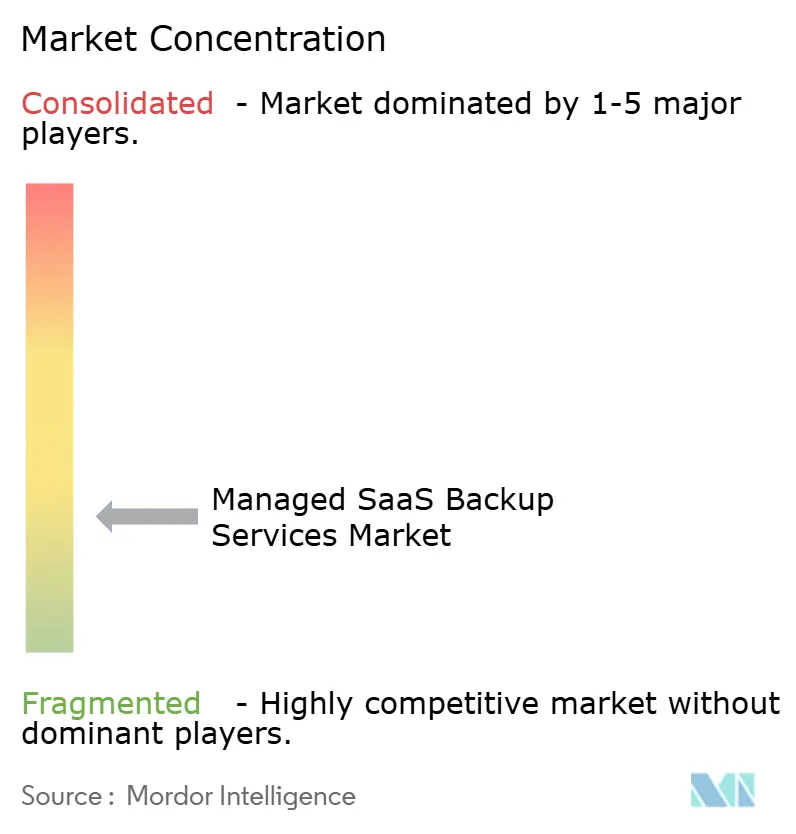
The managed SaaS backup services market is fragmented across enterprise platform vendors, SaaS-focused providers, and managed service provider specialists. Buyers can choose between broader data-protection platforms and services designed around application-specific backup, granular restoration, and storage that operates independently of the source tenant. Cohesity, Veeam, and Commvault pursue platform consolidation by expanding coverage across infrastructure, cloud workloads, applications, and emerging data types. Druva, Keepit, HYCU, and AvePoint emphasize SaaS-native protection depth and the needs of customers who want simple deployment across several business applications. Across the managed SaaS backup services market, this range of approaches allows vendors to compete on breadth, recovery detail, operational model, partner reach, and the location of protected data.
Veeam acquired Securiti in March 2026 to add data intelligence, sensitive-data discovery, data mapping, and compliance automation to its environments. Rubrik launched Okta Recovery in September 2025 to provide automated, immutable backup and granular recovery across Okta, Active Directory, and Entra ID.[3] Druva announced Dru MetaGraph in September 2025 as a tenant-specific metadata intelligence foundation that supports security, compliance, and operational analysis. HYCU expanded R-Cloud to cover more than 90 workloads, including AI and machine-learning environments, in September 2025. These moves show that identity protection, metadata use, AI-related workloads, and coverage across different operating environments are becoming important areas of competition.
ISO 27001 certification and SOC 2 Type II attestation are common requirements for regulated-sector procurement shortlists. Government and financial services buyers increasingly use these controls as entry requirements instead of treating them as sources of vendor differentiation. Recovery validation for AI-managed workloads remains open because current service packages do not fully address training-data lineage and model-artifact versioning. HYCU’s broader workload coverage begins to address the need, but customers still need evidence that a restored AI environment is complete, usable, and free of compromise. Market concentration score: 3 out of 10, because the available information shows more than 25 active vendors and does not identify a dominant group of leading suppliers.
Managed SaaS Backup Services Industry Leaders
-
Druva Inc.
-
Veeam Software Group GmbH
-
Rubrik, Inc.
-
AvePoint, Inc.
-
Commvault Systems, Inc.
- *Disclaimer: Major Players sorted in no particular order
Managed SaaS Backup Services Market Companies Covered in this Report
- Druva Inc.
- Veeam Software Group GmbH
- Rubrik, Inc.
- Cohesity, Inc.
- Commvault Systems, Inc.
- Kaseya US LLC
- Keepit A/S
- HYCU, Inc.
- AvePoint, Inc.
- Acronis International GmbH
- Barracuda Networks, Inc.
- Asigra Inc.
- Own Company, Inc.
- Spin Technology, Inc.
- CloudAlly Ltd.
- SysCloud, Inc.
- Odaseva, Inc.
- Rewind Software Inc.
- Backupify, Inc.
- Datto, Inc.
- N-able Technologies Ltd.
- Arcserve LLC
- Open Text Corporation
- Microsoft Corporation
- Amazon Web Services, Inc.
- Google LLC
Recent Industry Developments in Managed SaaS Backup Services Market
- July 2026: Keepit upsized its credit facilities to USD 90 million with the European Investment Fund Organisation and HSBC Innovation Banking, maintaining its independent, cloud-native SaaS backup platform without reliance on hyperscaler infrastructure. The financing is expected to support Keepit's connector expansion roadmap, targeting coverage for hundreds of SaaS applications by 2028, and continued geographic expansion into enterprise markets across North America and Asia-Pacific.
- November 2025: Veeam launched Data Platform v13, introducing AI-driven ransomware resilience capabilities, a Universal Hypervisor Integration API enabling hyperscaler-agnostic workload coverage, and new cyber-forensics features including Veeam Recon Scanner 3.0 for proactive threat detection. The release serves more than 550,000 Veeam customers across physical, virtual, and cloud environments and positions the platform as a unified cyber-resilience layer rather than a standalone backup tool.
- October 2025: Veeam acquired Securiti, a data intelligence and governance platform, extending its proposition from backup-data resilience into production-data governance and AI-readiness. The acquisition enables Veeam to offer sensitive-data discovery, data-mapping, and compliance automation within existing customer environments, opening a distinct revenue stream beyond its core backup platform and creating cross-sell potential into Securiti's existing enterprise customer base.
- October 2025: AvePoint released major updates to its Confidence Platform, including general availability of the Salesforce Backup Data Service enabling historical backup data integration with BI tools such as Tableau and Power BI, hierarchical restore for archived Salesforce records, and new Microsoft 365 backup prioritization controls that sequence protection of critical containers first.
Global Managed SaaS Backup Services Market Report Scope
Managed SaaS backup services refer to third-party data protection solutions that automatically back up, encrypt, and restore information within platforms like Microsoft 365, Google Workspace, and Salesforce. By managing ongoing administration, monitoring, and compliance, these services eliminate operational overhead and ensure enterprise data resilience.
The Managed SaaS Backup Services Market Report is Segmented by Backup Type (Email and Collaboration Backup, File, Folder and Object Backup, Database Backup, Infrastructure and System Backup, and Other Backup Types), Delivery Model (Provider-Hosted Public Cloud, Provider-Hosted Private Cloud, and Customer-Hosted / Hybrid), Organization Size (Large Enterprises and Small and Medium-Sized Enterprises), End-User Industry (Banking, Financial Services and Insurance [BFSI], Government and Public Sector, Healthcare and Life Sciences, Media and Entertainment, IT and Telecommunications, Retail and E-Commerce, and Other End-User Industries), and Geography (North America, South America, Europe, Asia-Pacific, Middle East, and Africa). The Market Forecasts are Provided in Terms of Value (USD).
Segmentation Overview
| Email and Collaboration Backup |
| File, Folder and Object Backup |
| Database Backup |
| Infrastructure and System Backup |
| Other Backup Types |
| Provider-Hosted Public Cloud |
| Provider-Hosted Private Cloud |
| Customer-Hosted / Hybrid |
| Large Enterprises |
| Small and Medium-Sized Enterprises |
| Banking, Financial Services and Insurance (BFSI) |
| Government and Public Sector |
| Healthcare and Life Sciences |
| Media and Entertainment |
| IT and Telecommunications |
| Retail and E-Commerce |
| Other End-User Industries |
| North America | United States |
| Canada | |
| Mexico | |
| South America | Brazil |
| Argentina | |
| Rest of South America | |
| Europe | Germany |
| United Kingdom | |
| France | |
| Italy | |
| Spain | |
| Rest of Europe | |
| Asia-Pacific | China |
| Japan | |
| India | |
| South Korea | |
| Rest of Asia-Pacific | |
| Middle East | Saudi Arabia |
| United Arab Emirates | |
| Rest of Middle East | |
| Africa | South Africa |
| Egypt | |
| Rest of Africa |
| By Backup Type | Email and Collaboration Backup | |
| File, Folder and Object Backup | ||
| Database Backup | ||
| Infrastructure and System Backup | ||
| Other Backup Types | ||
| By Delivery Model | Provider-Hosted Public Cloud | |
| Provider-Hosted Private Cloud | ||
| Customer-Hosted / Hybrid | ||
| By Organization Size | Large Enterprises | |
| Small and Medium-Sized Enterprises | ||
| By End-User Industry | Banking, Financial Services and Insurance (BFSI) | |
| Government and Public Sector | ||
| Healthcare and Life Sciences | ||
| Media and Entertainment | ||
| IT and Telecommunications | ||
| Retail and E-Commerce | ||
| Other End-User Industries | ||
| By Geography | North America | United States |
| Canada | ||
| Mexico | ||
| South America | Brazil | |
| Argentina | ||
| Rest of South America | ||
| Europe | Germany | |
| United Kingdom | ||
| France | ||
| Italy | ||
| Spain | ||
| Rest of Europe | ||
| Asia-Pacific | China | |
| Japan | ||
| India | ||
| South Korea | ||
| Rest of Asia-Pacific | ||
| Middle East | Saudi Arabia | |
| United Arab Emirates | ||
| Rest of Middle East | ||
| Africa | South Africa | |
| Egypt | ||
| Rest of Africa | ||
Key Questions Answered in the Report
What is the managed SaaS backup services market size?
The managed SaaS backup services market is projected to expand from USD 3.24 billion in 2026 and USD 3.88 billion in 2027 to USD 8.40 billion by 2032, at a 16.71% CAGR.
Why do companies need managed backup for SaaS applications?
SaaS applications can contain critical business information, and separate, immutable copies can help organizations recover after deletion, ransomware, or operational failures.
Which backup type holds the largest revenue share?
Email and Collaboration Backup held 47.24% of revenue in 2026, supported by the need to protect Microsoft 365 collaboration and communication data.
Which delivery model is expanding fastest?
Provider-Hosted Public Cloud is projected to expand at a 17.68% CAGR through 2032, supported by flexible capacity and consumption-based billing.
Which end-user segment is expanding fastest?
Healthcare and Life Sciences is projected to expand at an 18.21% CAGR through 2032 as protected health information moves into cloud-hosted clinical and care platforms.
Which region has the highest projected expansion rate?
Asia-Pacific is projected to expand at a 19.43% CAGR through 2032, supported by SaaS adoption and data-localization requirements.