
Managed Remote IT Support Services Market Size and Share
Market Overview
| Study Period | 2021 - 2032 |
|---|---|
| Market Size (2027) | USD 36.83 Billion |
| Market Size (2032) | USD 61.27 Billion |
| Growth Rate (2027 - 2032) | 10.72 % |
| Fastest Growing Market | Asia-Pacific |
| Largest Market | North America |
| Market Concentration | Medium |
Major Players *Disclaimer: Major Players sorted in no particular order Image © Mordor Intelligence. Reuse requires attribution under CC BY 4.0. | |
Managed Remote IT Support Services Market Analysis by Mordor Intelligence
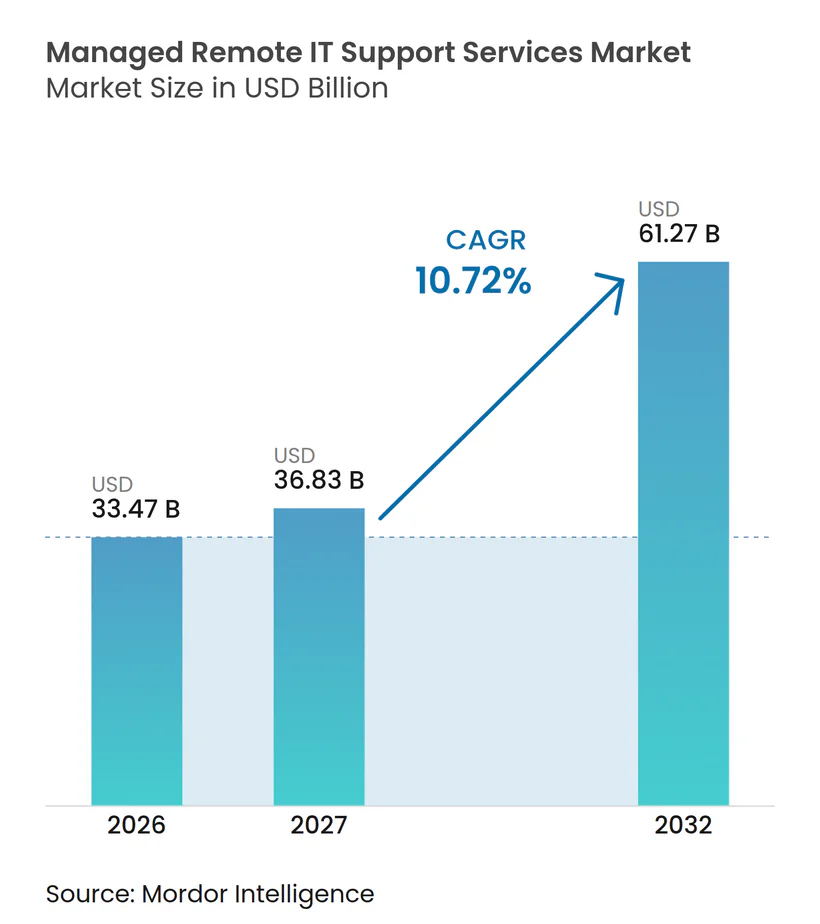
The managed remote IT support services market size is projected to expand from USD 33.47 billion in 2026 to USD 61.27 billion by 2032, registering a CAGR of 10.72% between 2027 and 2032. Growth reflects the move from reactive repair work toward continuous remote operations across cloud, endpoint, network, and security environments. Hybrid and multi-cloud estates require ongoing oversight because workloads, access controls, and data move across several environments. Compliance obligations are also moving from periodic checks toward continuous evidence collection and incident response. Providers can build longer contracts when customers combine service desk coverage, monitoring, cloud operations, and security operations in one service. Competition is shifting toward platforms that can automate routine work while retaining experienced staff for complex incidents.
Key Report Takeaways
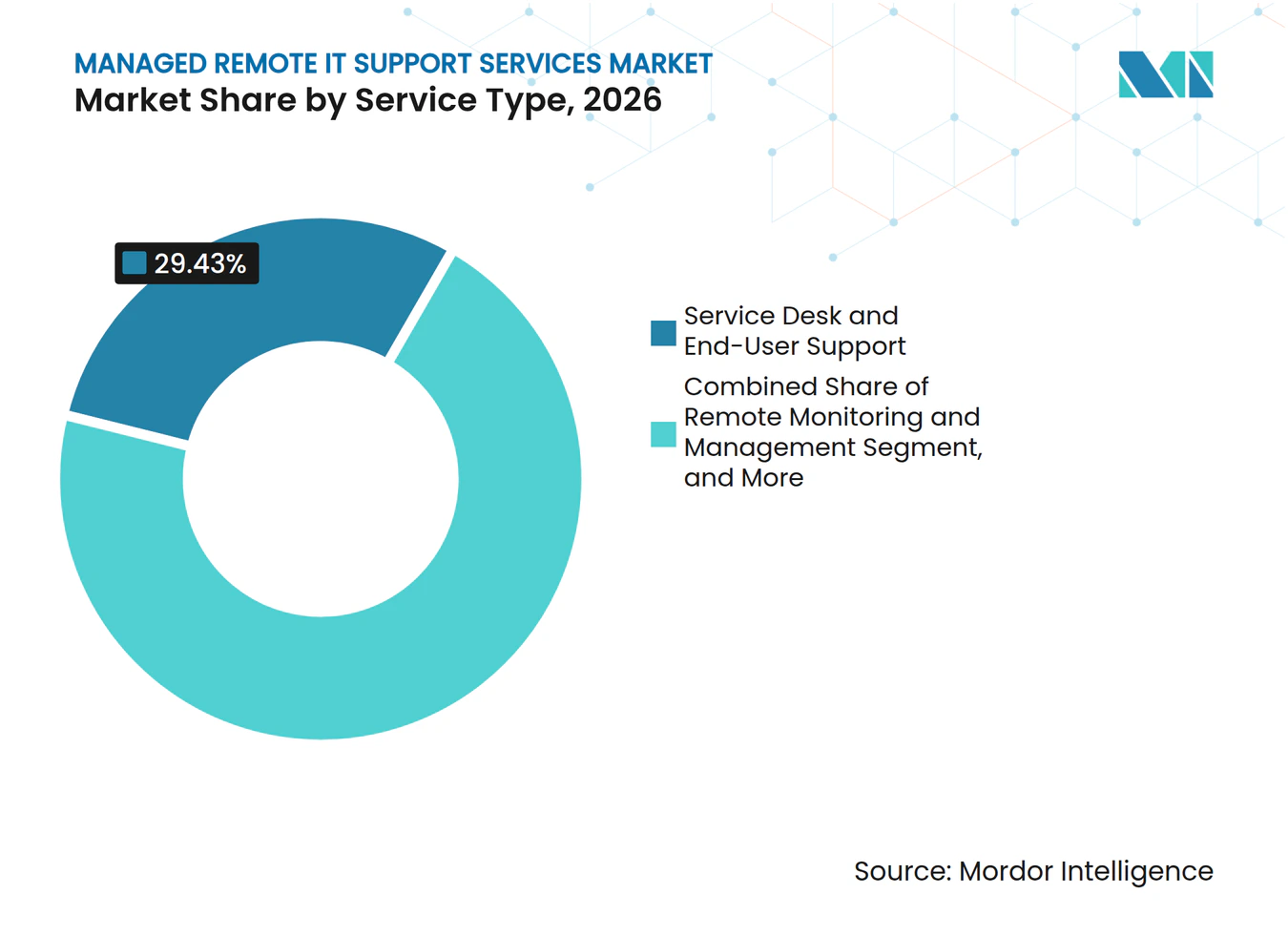
- By service type, service desk and end-user support held 29.43% of the managed remote IT support services market share in 2026, while managed security and compliance operations is projected to expand at an 11.47% CAGR through 2032.
- By service delivery model, fully remote delivery held 61.87% revenue share in 2026, while hybrid remote delivery is projected to expand at an 11.83% CAGR through 2032.
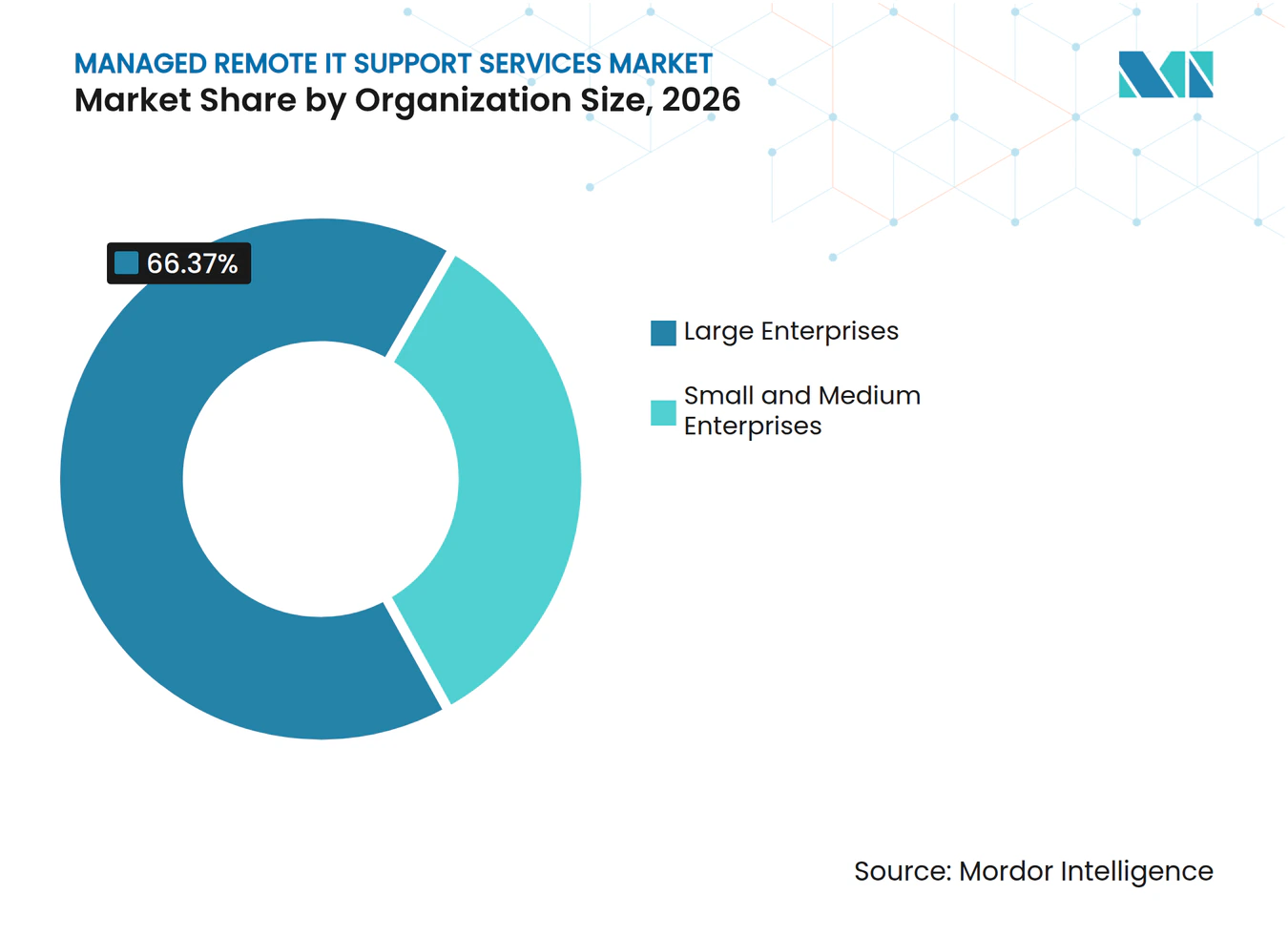
- By organization size, large enterprises held 66.37% revenue share in 2026, while small and medium enterprises are projected to expand at an 11.67% CAGR through 2032.
- By end-user industry, information technology and telecommunications held 24.83% revenue share in 2026, while healthcare is projected to expand at an 11.72% CAGR through 2032.
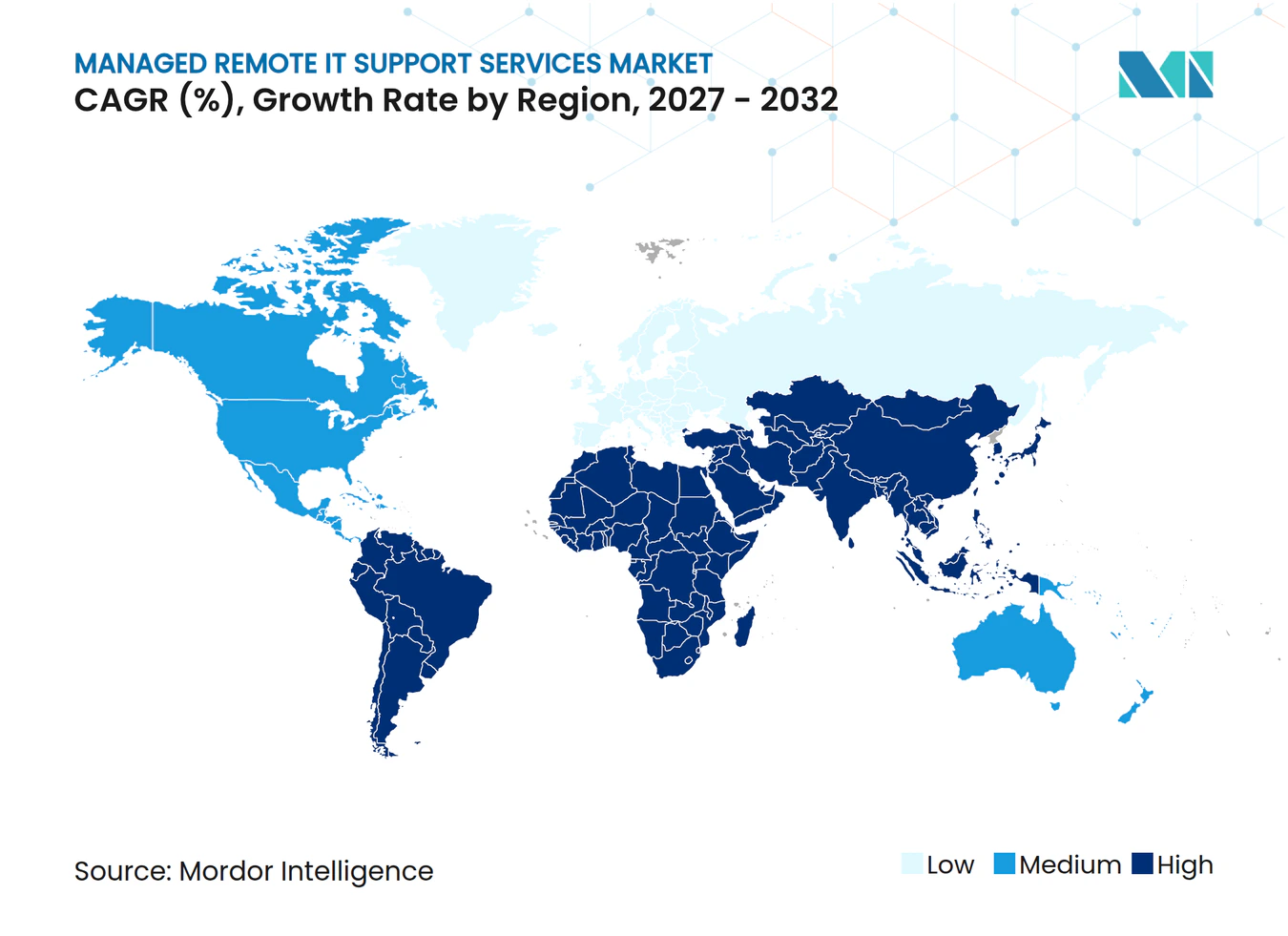
- By geography, North America held 37.63% of the managed remote IT support services market share in 2026, while Asia-Pacific is projected to expand at an 11.17% CAGR through 2032.
Note: Market numbers in this report are based on Mordor Intelligence's proprietary estimation framework, which combines nine months of actuals with Q4 projections for base year 2026.
Market Trends and Insights
Drivers Impact Analysis of Managed Remote IT Support Services Market*
| Driver | (~) % Impact on CAGR Forecast | Geographic Relevance | Impact Timeline |
|---|---|---|---|
| Hybrid and Multi-Cloud Operational Complexity | +2.8% | Global | Medium term (2-4 years) |
| Rising Cybersecurity and Compliance Requirements | +2.3% | Global | Short term (≤ 2 years) |
| Distributed and Hybrid Workforce Endpoint Expansion | +1.7% | North America and Europe | Medium term (2-4 years) |
| Cost-Optimization Pressure and Preference for Predictable IT Spend | +1.4% | Global | Short term (≤ 2 years) |
| Edge and Operational Technology Sites With Limited On-Site IT Staffing | +0.9% | North America and Asia-Pacific | Long term (≥ 4 years) |
| RMM-Enabled Technician Productivity and Autonomous Remediation | +0.7% | North America and Europe | Medium term (2-4 years) |
| Source: Mordor Intelligence | |||
Hybrid and Multi-Cloud Operational Complexity
Hybrid and multi-cloud architecture has made IT complexity a continuing requirement for managed service delivery rather than a short migration-stage issue. Flexera found that 73% of respondents operated hybrid-cloud environments in its 2026 survey, up 3 percentage points year over year, and its sample included 753 technical professionals and executive leaders.[1] These environments need consistent governance across private infrastructure, public clouds, applications, identity services, and data-management controls. Acquisitions and decentralized technology choices can also create cloud dependencies without a unified control model, an issue often described as accidental multi-cloud adoption. That position creates remediation work and continuing oversight that internal teams may struggle to provide at scale after migration work ends. The managed remote IT support services market benefits when migration projects develop into longer contracts for cloud operations, configuration management, cost oversight, access control, and incident response.
Rising Cybersecurity and Compliance Requirements
Compliance requirements increasingly require continuous operational work rather than periodic audit preparation, changing how providers define and price their services. Sophos reported that nearly all managed service providers offer at least 1 compliance service, while many manage customers’ full compliance programs. NIS 2, CMMC Level 2, PCI DSS v4.0, and the HIPAA Security Rule increase the need for evidence collection, incident reporting, documented controls, and retained audit records. ArmorPoint expanded its platform in August 2026 to map live security activity to CMMC Level 2, PCI DSS v4.0, the HIPAA Security Rule, SOC 2, and NIST CSF 2.0 within 1 workflow. The change broadens managed security work from threat detection into governance, audit readiness, remediation tracking, and regular reporting. This supports the managed remote IT support services market because buyers can purchase recurring compliance support alongside security operations instead of relying on isolated assessments.
Distributed and Hybrid Workforce Endpoint Expansion
Distributed work has increased the number of endpoints that need monitoring, patching, identity control, secure access, and remote remediation across home, branch, and customer locations. ControlUp reported that its work with Huws Gray Group across 335 branches saved a 15-person IT team more than 40 hours each month and reduced on-site visits through real-time monitoring. Remote work also creates a separate risk from employee-owned devices that access enterprise applications outside traditional perimeter controls and may not use the same configuration standards. Many remote monitoring agents cannot be installed on those devices, leaving a coverage gap for conventional tools. Providers therefore combine zero-trust access, cloud-native identity management, endpoint policies, and monitoring approaches that do not always require an agent. This wider endpoint estate creates recurring demand in the managed remote IT support services market for providers that can cover users, devices, and applications across locations.
Cost-Optimization Pressure and Preference for Predictable IT Spend
Organizations facing operating cost pressure use managed remote support to replace uneven technology spending with per-device or per-user service fees that finance teams can plan against. Buyers are also dividing large technology towers among specialist providers to introduce competition, secure targeted expertise, and control structural costs. This purchasing approach can separate application work, infrastructure management, cloud operations, and cybersecurity services rather than keeping them under 1 vendor contract. Microsoft reported that Wipro’s internal use of Microsoft 365 Copilot saved more than 250,000 FTE days each quarter. Automation can lower the delivered cost per ticket when providers can verify the result for customers and apply it across repeated workflows. The managed remote IT support services market is supported by customers seeking predictable spending while they direct more discretionary budgets toward AI infrastructure, cloud modernization, and security controls.
Restraints Impact Analysis of Managed Remote IT Support Services Market*
| Restraint | (~) % Impact on CAGR Forecast | Geographic Relevance | Impact Timeline |
|---|---|---|---|
| Shortage of Remote Operations, Cloud, and Cybersecurity Skills | -1.5% | Global | Short term (≤ 2 years) |
| Data Sovereignty, Privacy, and Cross-Border Delivery Constraints | -1.1% | Europe and Asia-Pacific | Long term (≥ 4 years) |
| RMM Platform Concentration and Contractual Switching Costs | -0.7% | North America and Europe | Medium term (2-4 years) |
| Security Exposure From Privileged Remote Access and MSP Supply-Chain Risk | -0.5% | Global | Short term (≤ 2 years) |
| Source: Mordor Intelligence | |||
Shortage of Remote Operations, Cloud, and Cybersecurity Skills
A shortage of experienced cloud operations and cybersecurity staff limits providers’ ability to increase delivery capacity as contracts grow and customer environments become more specialized. The constraint concerns skills as well as headcount because practitioners who can govern multi-cloud estates, interpret security events, and handle endpoint threats remain difficult to retain. ConnectWise expanded Asio RMM to cover more than 7,000 applications for automated patching in November 2025, reducing the amount of repetitive work required for software maintenance.[2] Automation reduces manual remediation work per device, but senior staff are still needed during complex incidents, customer escalation, and security investigations. Providers must balance labor costs against subscription prices while maintaining service quality and response commitments. This can limit the managed remote IT support services market, where provider capacity does not keep pace with new demand.
Data Sovereignty, Privacy, and Cross-Border Delivery Constraints
Data localization and cross-border transfer rules complicate centralized service delivery in Europe, the Middle East, and parts of Asia-Pacific, where customer information may move across multiple systems. Saudi Arabia’s Personal Data Protection Law requires companies to store sensitive data inside the Kingdom unless a specific exemption applies. Providers may need local data storage, local staff, separate support processes, and regionally configured service environments to meet jurisdictional requirements. These requirements reduce some of the scale advantages of a single global delivery model and add administrative work to compliance reviews. They also influence supplier selection for regulated workloads and public-sector contracts where data handling and access controls are scrutinized. The managed remote IT support services market must therefore accommodate country-specific controls without weakening service consistency, cybersecurity, or customer response times.
*Our forecasts treat driver/restraint impacts as directional, not additive. The impact forecasts reflect baseline growth, mix effects, and variable interactions.
Managed Remote IT Support Services Market Segment Analysis
By Service Type:
Security Operations Define the Next Growth CycleService desk and end-user support held 29.43% revenue share in 2026. The managed remote IT support services market retains this segment because outsourced helpdesk coverage can support users across time zones at a cost that many internal teams cannot match. Managed security and compliance operations is projected to grow at an 11.47% CAGR through 2032. The segment is gaining relevance as organizations put continuous monitoring, compliance evidence, and security operations center services into core managed service contracts. ArmorPoint’s August 2026 platform update combined governance mapping, threat intelligence, AI-supported triage, and 24/7 security operations center response.
Remote monitoring and management, network operations, and cloud and infrastructure operations are also expanding with hybrid infrastructure. Cloud and infrastructure work is supported by demand for oversight of cloud costs and configuration drift across more than 1 vendor environment. NinjaOne reported USD 500 million in annualized recurring revenue in fiscal 2025, with 70% year-over-year growth and more than 35,000 customers. Its model combines monitoring, patching, backup, and identity management through 1 agent. The managed remote IT support services industry is widening from recurring infrastructure coverage into more complex, outcome-focused support arrangements.



By Service Delivery Model:
Hybrid Delivery Gains Ground on Structural DemandFully remote delivery held 61.87% of revenue in 2026. Helpdesk, monitoring, and patch management can usually be performed without a physical visit, which supports this delivery model. Hybrid remote delivery is projected to expand at an 11.83% CAGR through 2032. Operational technology sites and edge deployments still require hardware inspection and response in some situations. ControlUp’s deployment at Huws Gray Group showed the value of remote monitoring across a dispersed branch network.
The managed remote IT support services market benefits because this design preserves remote-support cost advantages while providing assurance for physical and operational environments. It can be relevant for sites where equipment failure has a direct effect on production, logistics, or customer service. Customers can set clear rules for when an on-site visit is needed. This may reduce disruption without requiring permanent local staffing. The managed remote IT support services market is likely to retain fully remote delivery as the main model while hybrid delivery gains importance in complex environments.
By Organization Size:
SME Demand Narrows the Enterprise GapLarge enterprises held 66.37% revenue share in 2026. Their multi-site and multi-cloud environments support large recurring contracts that cover several technology towers. Small and medium enterprises are projected to grow at an 11.67% CAGR through 2032. Subscription models from NinjaOne, Kaseya, and ConnectWise make monitoring and service desk tools more accessible to smaller organizations. NinjaOne’s fiscal 2025 performance demonstrates the scale that unified endpoint platforms can reach across a broad customer base.
The managed remote IT support services market benefits as AI-assisted triage and automated remediation reduce technician time for common support tasks. This allows providers to extend enterprise-grade capabilities to customers that have smaller internal technology teams. The opportunity is not limited to very small organizations because midmarket buyers also need support for growing cloud and security estates. The managed remote IT support services market can gain from this coverage because the midmarket needs a model that sits between basic managed service provider pricing and large integrator contracts. Large enterprises remain the revenue base, while smaller customers add growth through scaled service platforms.

By End-User Industry:
Healthcare Growth Reflects Compliance and Care ComplexityInformation technology and telecommunications held 24.83% revenue share in 2026. The vertical has high availability needs and extensive cloud-native adoption, which expands the scope of managed operations. Healthcare is projected to grow at an 11.72% CAGR through 2032. Healthcare organizations must maintain fragmented technology estates while supporting clinicians, administrators, telehealth platforms, and patient data. The U.S. Department of Health and Human Services extended telehealth flexibilities through December 31, 2027.
The managed remote IT support services market can support healthcare organizations that need HIPAA-compliant remote operations without building every capability internally. Compliance and service continuity remain important because technology downtime can affect care delivery and administration. BFSI, manufacturing, retail and e-commerce, and government and defense also contribute to demand. Kyndryl received a Texas Department of Information Resources contract in March 2026 covering cybersecurity, cloud modernization, applications, and data and AI capabilities. The managed remote IT support services industry gains from vertical requirements that combine security, resilience, compliance, and user support.
Geography Analysis
North America held 37.63% revenue share in 2026. The region has a large enterprise customer base, established providers, and regulations that raise cybersecurity outsourcing demand in financial services, healthcare, and critical infrastructure. Kyndryl Canada received a federal service desk award valued at CAD 111,023,933.97 (USD 81.7 million) in February 2025. Kyndryl also received a Texas Department of Information Resources award in March 2026 for technology services that include cybersecurity, cloud, and AI capabilities.
The managed remote IT support services market remains important in Europe because regulatory obligations and skills shortages encourage outsourcing across a broader set of organizations. NIS 2 raises requirements for incident reporting and supply-chain security across several European countries. BSI C5 requirements are also influencing cloud supplier selection for public-sector and healthcare work in Germany. These factors support security and compliance operations, but they also increase the need for local delivery controls.
Asia-Pacific is projected to grow at an 11.17% CAGR through 2032. Digital transformation in China, India, Japan, South Korea, and Australia supports demand across financial services, manufacturing, healthcare, and technology. Microsoft reported in June 2026 that Infosys, Tata Consultancy Services, and Wipro had scaled Microsoft 365 Copilot to more than 300,000 employees combined.[3] The region’s providers are packaging AI-supported operations into managed contracts rather than relying only on time-and-material engagements. South America is developing through financial services and manufacturing demand, while Brazil’s data-residency needs and Middle East and Africa localization requirements influence contract design.
Competitive Landscape
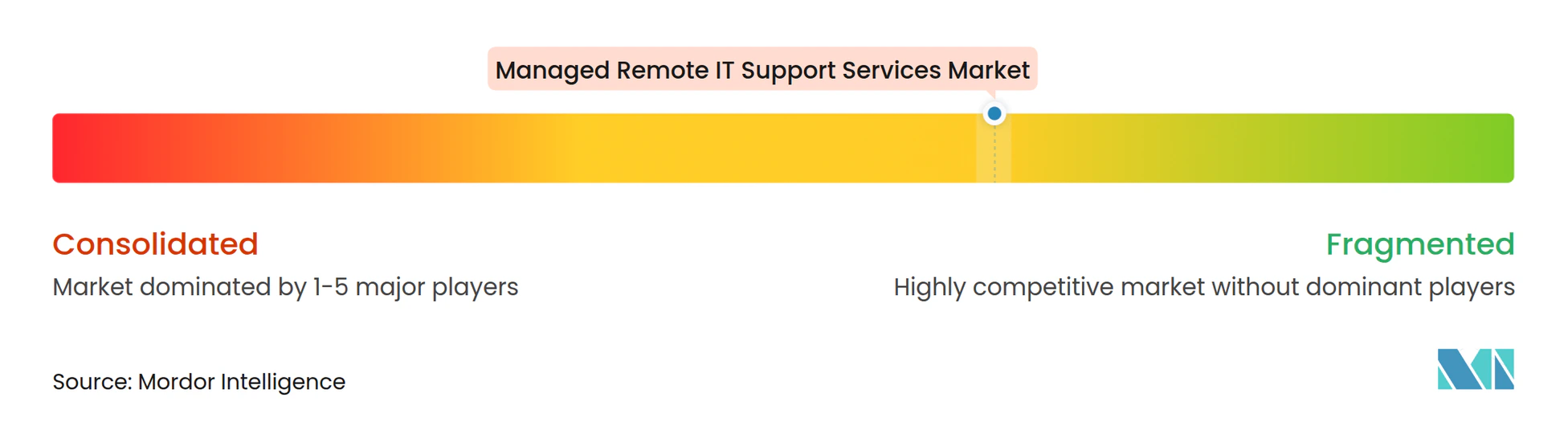
Market Concentration
The managed remote IT support services market includes global system integrators, specialist managed service providers, and remote monitoring and management platform vendors. Kyndryl, Accenture, Tata Consultancy Services, Infosys, and Capgemini compete for enterprise contracts through geographic coverage, vertical capabilities, and AI-supported operations. Kyndryl renewed its Azure Expert MSP designation in July 2025, a credential held by fewer than 2% of Microsoft’s partner ecosystem. It also launched the Kyndryl Microsoft Acceleration Hub with Microsoft to support AI-led technology transformation.
At the platform level, NinjaOne, ConnectWise, and Kaseya compete to provide unified tools for endpoint monitoring, patching, backup, security, and identity. NinjaOne’s annualized recurring revenue reached USD 500 million in fiscal 2025, after 70% year-over-year growth. ConnectWise expanded third-party patching coverage to more than 7,000 applications and introduced robotic process automation capabilities in November 2025. The company reported that early adopters achieved more than 165 technician hours saved each month and 75% faster client onboarding. These platform features can raise switching costs when providers standardize their client operations on 1 software environment.
The midmarket is a central opportunity because buyers need more coverage than a basic managed service contract, but may not meet the minimum scale for global integrators. Kaseya acquired INKY in October 2025 to add AI-based email security capabilities to the Kaseya 365 platform. NinjaOne completed its USD 270 million acquisition of Dropsuite in June 2025 to add SaaS backup and email archiving.[4] The managed remote IT support services market remains competitive because buyers can select among integrated platforms, specialist providers, and large service firms.
Managed Remote IT Support Services Industry Leaders
-
ConnectWise, LLC
-
Kaseya Limited
-
IBM Corporation
-
Accenture plc
-
Microsoft Corporation
- *Disclaimer: Major Players sorted in no particular order
Managed Remote IT Support Services Market Companies Covered in this Report
- Accenture plc
- IBM Corporation
- Microsoft Corporation
- Cisco Systems, Inc.
- Fujitsu Limited
- Kyndryl Holdings, Inc.
- DXC Technology Company
- Hewlett Packard Enterprise Company
- Capgemini SE
- Tata Consultancy Services Limited
- Infosys Limited
- HCL Technologies Limited
- Cognizant Technology Solutions Corporation
- NTT DATA Group Corporation
- Wipro Limited
- Rackspace Technology, Inc.
- ConnectWise, LLC
- Kaseya Limited
- NinjaOne, Inc.
- N-able, Inc.
- Atera Networks Ltd.
Recent Industry Developments in Managed Remote IT Support Services Market
- September 2026: Kyndryl was awarded a 10-year NASPO ValuePoint Cloud and Software Solutions contract, providing state and local government entities across the United States with access to cloud, cybersecurity, and AI-driven managed services.
- August 2026: ArmorPoint expanded its cloud-delivered security operations platform to unify incident response, governance, compliance mapping, AI-accelerated triage, and 24/7 SOC support in a single workflow mapped to CMMC Level 2, PCI DSS v4.0, HIPAA Security Rule, SOC 2, and NIST CSF 2.0, enabling managed service providers to deliver enterprise-grade security operations without building SOC infrastructure.
- March 2026: Microsoft announced that Infosys, Tata Consultancy Services, and Wipro each scaled Microsoft 365 Copilot to over 100,000 employees, reaching a combined 300,000 seats in under 6 months, with Wipro reporting over 250,000 FTE days saved per quarter through AI-augmented managed IT operations.
- March 2026: Kyndryl was awarded a deliverables-based IT services contract by the Texas Department of Information Resources covering cybersecurity, cloud modernization, applications, and data and AI capabilities for state and local government agencies.
Global Managed Remote IT Support Services Market Report Scope
The Managed Remote IT Support Services Market comprises outsourced IT services that enable organizations to remotely monitor, maintain, troubleshoot, secure, and optimize their IT infrastructure, applications, endpoints, networks, and cloud environments. These services include remote monitoring and management (RMM), service desk and end-user support, managed network operations, managed cloud and infrastructure operations, and managed security and compliance operations. Service providers use remote access tools, automation, centralized monitoring platforms, and autonomous remediation capabilities to resolve technical issues, manage IT assets, maintain system availability, and support distributed workforces and geographically dispersed IT environments. The market covers fully remote and hybrid-remote service delivery models for organizations seeking external IT operational support.
The Managed Remote IT Support Services Market Report is Segmented by Service Type (Remote Monitoring and Management, Service Desk and End-User Support, Managed Network Operations, Managed Cloud and Infrastructure Operations, Managed Security and Compliance Operations, and Other Service Types), Service Delivery Model (Fully Remote, and Hybrid Remote), Organization Size (Large Enterprises, and Small and Medium Enterprises), End-User Industry (Information Technology and Telecommunications, BFSI, Healthcare, Retail and E-Commerce, Manufacturing, Government and Defense, and Other End-User Industries), and Geography (North America, South America, Europe, Asia-Pacific, Middle East, and Africa). The Market Forecasts are Provided in Terms of Value (USD).
Segmentation Overview
| Remote Monitoring and Management |
| Service Desk and End-User Support |
| Managed Network Operations |
| Managed Cloud and Infrastructure Operations |
| Managed Security and Compliance Operations |
| Other Service Types |
| Fully Remote |
| Hybrid Remote |
| Large Enterprises |
| Small and Medium Enterprises |
| Information Technology and Telecommunications |
| BFSI |
| Healthcare |
| Retail and E-Commerce |
| Manufacturing |
| Government and Defense |
| Other End-User Industries |
| North America | United States |
| Canada | |
| Mexico | |
| South America | Brazil |
| Argentina | |
| Rest of South America | |
| Europe | Germany |
| United Kingdom | |
| France | |
| Italy | |
| Spain | |
| Russia | |
| Rest of Europe | |
| Asia-Pacific | China |
| India | |
| Japan | |
| South Korea | |
| Australia | |
| Rest of Asia-Pacific | |
| Middle East | Saudi Arabia |
| United Arab Emirates | |
| Turkey | |
| Rest of Middle East | |
| Africa | South Africa |
| Egypt | |
| Nigeria | |
| Rest of Africa |
| By Service Type | Remote Monitoring and Management | |
| Service Desk and End-User Support | ||
| Managed Network Operations | ||
| Managed Cloud and Infrastructure Operations | ||
| Managed Security and Compliance Operations | ||
| Other Service Types | ||
| By Service Delivery Model | Fully Remote | |
| Hybrid Remote | ||
| By Organization Size | Large Enterprises | |
| Small and Medium Enterprises | ||
| By End-User Industry | Information Technology and Telecommunications | |
| BFSI | ||
| Healthcare | ||
| Retail and E-Commerce | ||
| Manufacturing | ||
| Government and Defense | ||
| Other End-User Industries | ||
| By Geography | North America | United States |
| Canada | ||
| Mexico | ||
| South America | Brazil | |
| Argentina | ||
| Rest of South America | ||
| Europe | Germany | |
| United Kingdom | ||
| France | ||
| Italy | ||
| Spain | ||
| Russia | ||
| Rest of Europe | ||
| Asia-Pacific | China | |
| India | ||
| Japan | ||
| South Korea | ||
| Australia | ||
| Rest of Asia-Pacific | ||
| Middle East | Saudi Arabia | |
| United Arab Emirates | ||
| Turkey | ||
| Rest of Middle East | ||
| Africa | South Africa | |
| Egypt | ||
| Nigeria | ||
| Rest of Africa | ||
Key Questions Answered in the Report
What is the managed remote IT support services market size?
The managed remote IT support services market is valued at USD 33.47 billion in 2026 and is projected to reach USD 61.27 billion by 2032 at a 10.72% CAGR. Demand comes from continuing cloud management, endpoint support, security operations, and compliance work. These activities require ongoing coverage, rather than one-time technology projects, for many organizations. The outlook also reflects customers’ need to manage cloud spending, configuration changes, identity access, software patching, and incident response through a coordinated service model.
Which service type leads managed remote IT support services?
Service desk and end-user support leads with a 29.43% revenue share in 2026. Managed security and compliance operations is the fastest-growing service type at an 11.47% CAGR through 2032 as customers need continuous monitoring, evidence collection, response support, and reporting. This reflects the shift toward security work as a contracted operating function.
Why are organizations adopting remote IT support services?
Organizations need continuing support for hybrid cloud operations, distributed endpoints, cybersecurity controls, and compliance evidence collection. Managed services can also provide broader operating coverage, standardized processes, specialist skills, and more predictable technology spending. They can also scale support without maintaining a large local team at every site.
Which region is growing fastest for managed remote IT support services?
Asia-Pacific is projected to grow at an 11.17% CAGR through 2032, supported by digital transformation across major regional economies. Providers are increasingly combining AI-supported operations with recurring managed service contracts for technology, manufacturing, healthcare, and financial-services customers. Local delivery models also matter where data and access requirements differ by country.
Which end-user sector is expanding fastest?
Healthcare is projected to grow at an 11.72% CAGR through 2032 as compliance, telehealth, and fragmented technology environments increase support needs. Providers can help maintain secure access, service continuity, endpoint availability, and operational support for clinical and administrative users. These requirements make reliable remote operations important for patient-facing and back-office services.