
Managed IP Telephony Services Market Size and Share
Market Overview
| Study Period | 2021 - 2032 |
|---|---|
| Market Size (2027) | USD 6.47 Billion |
| Market Size (2032) | USD 10.92 Billion |
| Growth Rate (2027 - 2032) | 11.04 % |
| Fastest Growing Market | Asia-Pacific |
| Largest Market | North America |
| Market Concentration | Medium |
Major Players *Disclaimer: Major Players sorted in no particular order Image © Mordor Intelligence. Reuse requires attribution under CC BY 4.0. | |
Managed IP Telephony Services Market Analysis by Mordor Intelligence
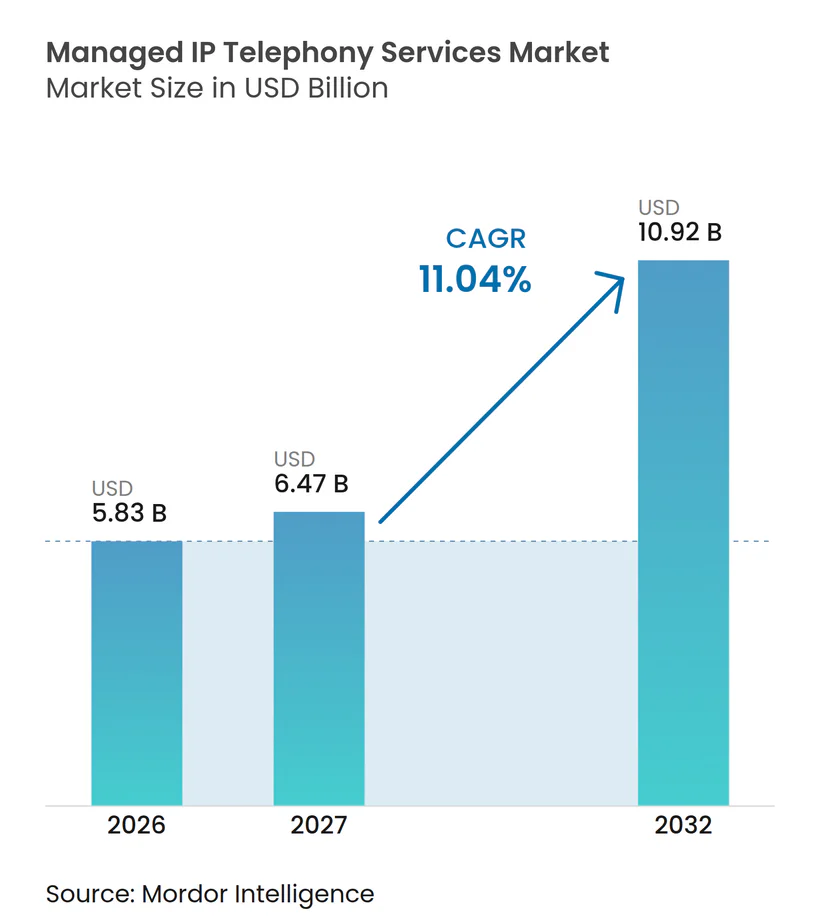
The managed IP telephony services market size is projected to expand from USD 5.83 billion in 2026 to USD 10.92 billion by 2032, registering a CAGR of 11.04% from 2027 to 2032. The managed IP telephony services market is moving away from standalone voice infrastructure toward managed services that combine availability, security, call handling, and flexible billing. The planned end of legacy public switched telephone network services is accelerating replacement decisions, particularly for businesses that must migrate from older phone systems. Hybrid work also keeps demand focused on voice services that work consistently across offices, homes, and mobile devices. Providers are competing on platform integration, data controls, and the ability to combine voice with network and security services. The managed IP telephony services market also has room to grow as more businesses adopt cloud-based contact centers and customer service systems.
Key Report Takeaways
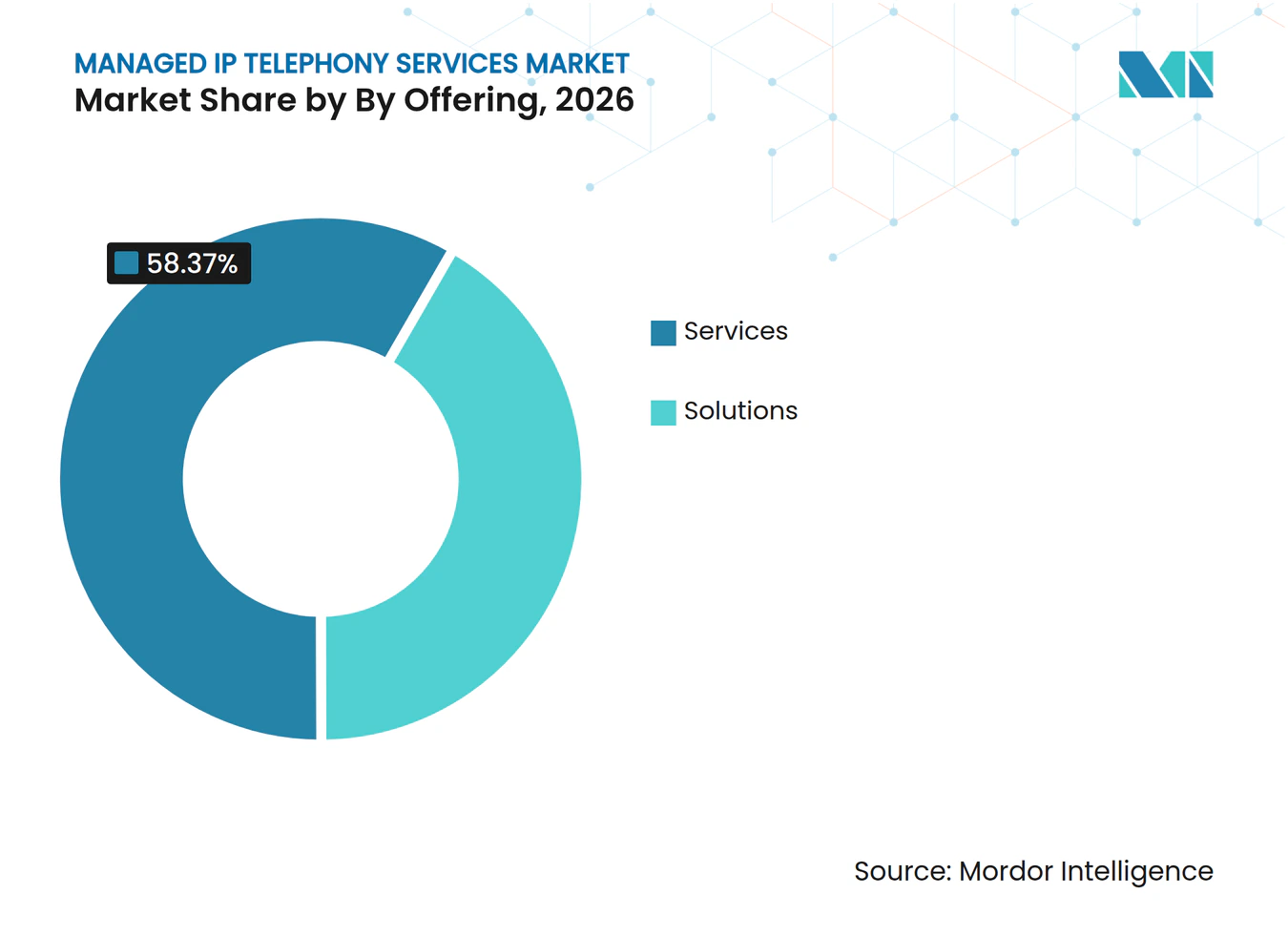
- By offering, services held 58.37% of revenue in 2026, while solutions are projected to expand at an 11.83% CAGR through 2032.
- By deployment model, cloud-based deployment accounted for 52.43% of revenue in 2026, while hybrid deployment is projected to grow at an 11.27% CAGR through 2032.
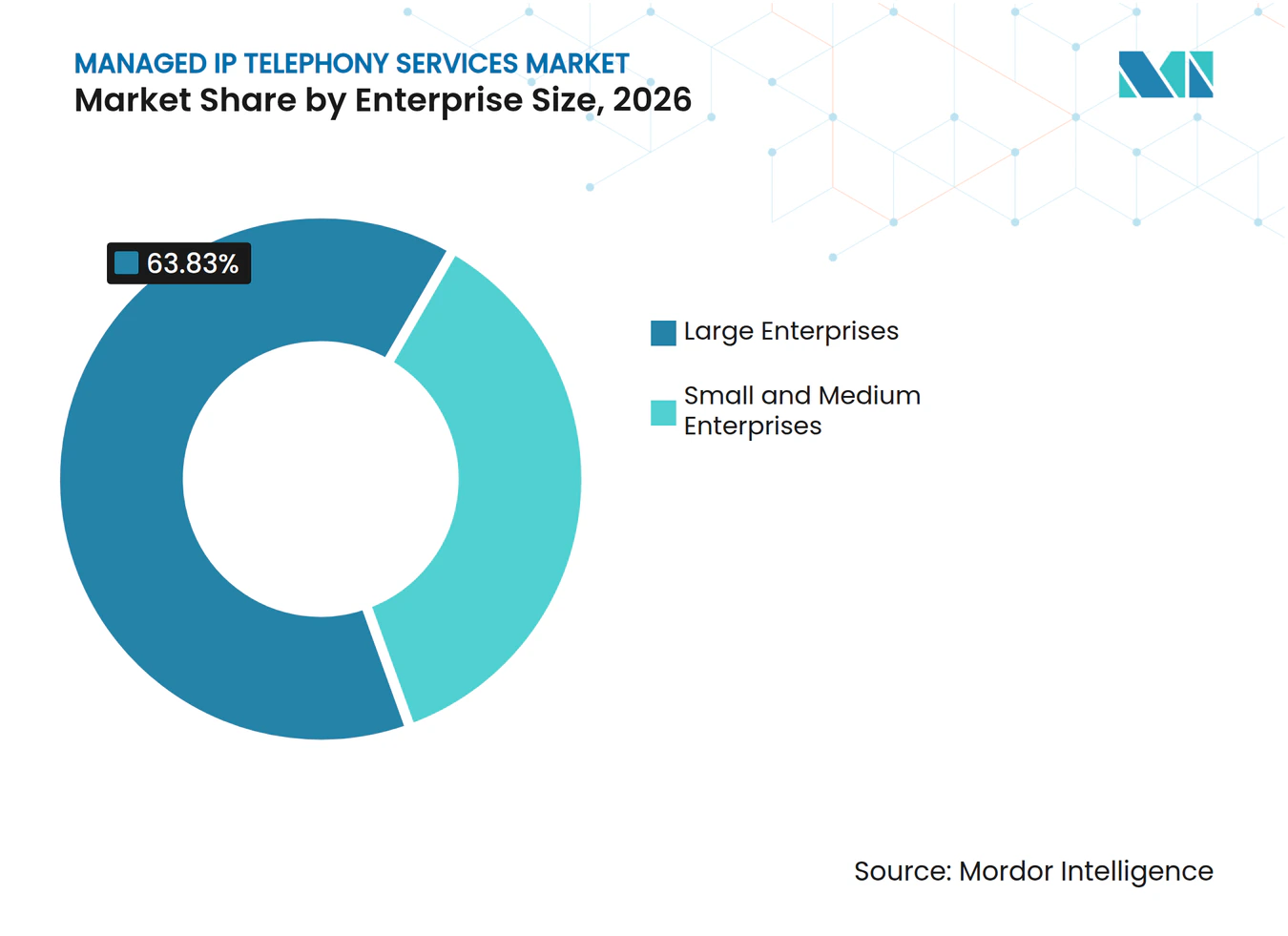
- By enterprise size, large enterprises held 63.83% of revenue in 2026, while SMEs are projected to grow at a 12.43% CAGR through 2032.
- By application, unified communication and collaboration accounted for 27.63% of revenue in 2026, while contact center and customer service is projected to advance at a 12.17% CAGR through 2032.
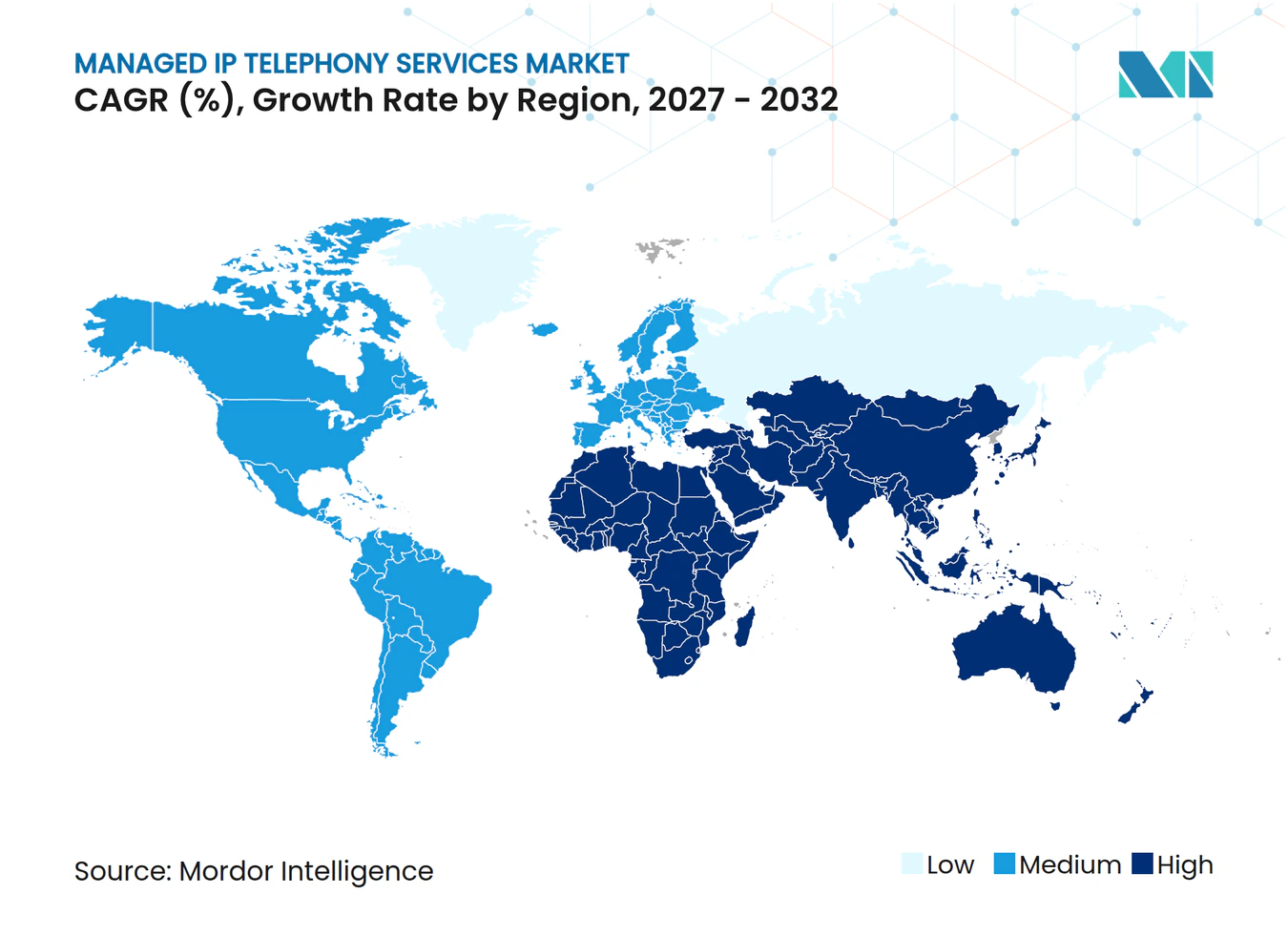
- By geography, North America held 37.87% of revenue in 2026, while Asia-Pacific is projected to expand at a 12.63% CAGR through 2032.
Note: Market numbers in this report are based on Mordor Intelligence's proprietary estimation framework, which combines nine months of actuals with Q4 projections for base year 2026.
Market Trends and Insights
Drivers Impact Analysis of Managed IP Telephony Services Market*
| Driver | (~) % Impact on CAGR Forecast | Geographic Relevance | Impact Timeline |
|---|---|---|---|
| Migration From On-Premises PBX to Cloud-Managed Voice | +2.8% | Global, with near-term acceleration in Europe and North America | Short term (≤ 2 years) |
| Hybrid and Distributed Workforce Communication Requirements | +2.3% | Global, with highest impact in North America, Western Europe, Australia, Japan, and Singapore | Medium term (2-4 years) |
| Voice Integration With Collaboration, CRM, and Contact Center Platforms | +1.6% | North America and Europe, extending to Asia-Pacific enterprise clusters | Medium term (2-4 years) |
| Pay-As-You-Go Pricing and OPEX-Based Procurement | +1.5% | Global, especially South America, Southeast Asia, and the Middle East | Short term (≤ 2 years) |
| 5G, Edge Networking, and Mobile-First Enterprise Voice | +0.9% | Asia-Pacific, the Middle East, North America, and later Europe | Long term (≥ 4 years) |
| Carrier Bundling of Connectivity, Security, and Managed Voice | +0.7% | North America, Western Europe, and Gulf Cooperation Council countries | Medium term (2-4 years) |
| Source: Mordor Intelligence | |||
Migration From On-Premises PBX to Cloud-Managed Voice Reaches a Forced Exit Phase
The retirement of older phone networks is making replacement less optional for many businesses. Openreach started protective migrations for affected BT Business customers in January 2026 and plans to close the PSTN network in January 2027. It also introduced quarterly increases in WLR and ISDN prices from April 2026, which raises the cost of retaining older services. The managed IP telephony services market benefits when companies replace aging PBX equipment and avoid operating old and new systems in parallel. Businesses are also looking for providers that can manage number transfers, routing, emergency calling, and service continuity during the change. This favors managed contracts because internal teams may not have the capacity to coordinate a multi-site migration, test every endpoint, update call flows, prepare users for changed dialing practices, and resolve issues without disrupting customer or employee communications.
Hybrid and Distributed Workforce Communication Requirements Support Managed Voice Adoption
Hybrid work has made reliable voice access a daily operating requirement rather than an office-only service. Employees need consistent calling, routing, presence, and recording functions across desk phones, computers, and mobile devices. Managed IP telephony services can shift these responsibilities from internal teams to a provider that offers dedicated monitoring and support. The managed IP telephony services market is therefore supported by organizations that want simpler user administration and predictable service levels. This model is particularly relevant where a business has many smaller locations or a distributed workforce. It also increases the value of tools that allow users to move a call between devices without losing the connection, apply the same calling policy regardless of location, provision new staff promptly, and give managers clearer responsibility for support and service performance.
Voice Integration with Collaboration, CRM, and Contact Center Platforms Broadens Service Scope
Businesses increasingly select voice services based on how well they connect with collaboration, customer relationship management, help desk, and contact center systems. Microsoft made Teams Phone Extensibility generally available in September 2025, allowing contact center vendors to integrate with Teams Phone through Azure Communication Services.[1] A closer integration between unified communications and contact center systems can reduce the number of separate calling environments an organization must manage. It can also make it easier to bring employee availability information into customer-service workflows. These connections make the managed IP telephony services market more valuable, where providers can support the full calling environment. They also raise the importance of governance for recordings, transcripts, and data passed between connected applications, especially where a customer must control access rights, retention periods, recording practices, audit information, and the responsibilities of each technology supplier.
Pay-As-You-Go Pricing and OPEX-Based Procurement Lowers Barriers for SMEs
Per-user subscriptions allow smaller businesses to adopt managed calling without buying a full PBX system and related network equipment. This structure allows companies to add or remove users as staffing levels change. It can reduce the cost and planning burden associated with dedicated hardware, private circuits, and capacity sized for peak demand. The managed IP telephony services market benefits as SMEs can access features once limited to larger organizations. Buyers still compare providers carefully on recurring cost, integration options, and the availability of practical AI functions. Providers that include call routing, transcription, or automated reception in standard packages may have an advantage in price-sensitive markets, particularly where customers want a clear monthly charge, quick activation, basic resilience features, and the ability to change their service without an extended procurement cycle.
Restraints Impact Analysis of Managed IP Telephony Services Market*
| Restraint | (~) % Impact on CAGR Forecast | Geographic Relevance | Impact Timeline |
|---|---|---|---|
| Data Sovereignty and Cross-Border Voice-Data Compliance Costs | -1.8% | European Union, India, Southeast Asia, and multinational operations in North America | Medium term (2-4 years) |
| Voice Quality Dependence on Last-Mile Broadband and Network Resilience | -1.3% | Africa, South America, South and Southeast Asia, and rural North America | Long term (≥ 4 years) |
| Proprietary APIs and Vendor Lock-In in Multi-Platform Environments | -0.9% | Global, with highest friction in large multi-vendor enterprises | Medium term (2-4 years) |
| PSTN Replacement, Emergency Calling, and Lawful-Intercept Compliance Burden | -0.7% | Europe and North America | Short term (≤ 2 years) |
| Source: Mordor Intelligence | |||
Data Sovereignty and Cross-Border Voice-Data Compliance Costs Constrain Deployments
Data localization rules can make multinational voice deployments harder to design and more expensive to operate. Call recordings, transcripts, metadata, support records, and AI outputs may be subject to different requirements in each location. Spain's data protection authority has stated that AI voice transcription involves the processing of personal data and requires the accountable handling of data protection obligations. Businesses in regulated sectors may require in-country processing, defined retention periods, and a clear list of subcontractors. These requirements can extend procurement cycles and restrict the pool of eligible providers. The managed IP telephony services market may therefore favor suppliers that can provide regional hosting, configurable retention settings, and documentation for data flows, while customers may need legal, security, procurement, and operational teams to review the same deployment before it can be approved.
Voice Quality Dependence on Last-Mile Broadband Limits Expansion in Emerging Economies
Cloud voice quality depends on the reliability of the last-mile network that connects each user to the service. Packet loss, delays, and outages can prevent a business from replacing a legacy voice system where broadband is inconsistent. This issue is more prevalent in parts of Africa and South America, as well as in secondary cities in South and Southeast Asia. Providers may need to add SD-WAN, cellular backup, and quality-of-service controls to deliver acceptable call performance. FirstComm launched FusionOne in August 2025 with primary broadband, 5G failover, cloud monitoring, and 24/7 support for USD 140 per month. These measures can improve resilience, but they can also increase the contract cost for smaller businesses, require local installation support, and make a reliable broadband connection a condition for service adoption rather than a separate issue for the customer to solve.
*Our forecasts treat driver/restraint impacts as directional, not additive. The impact forecasts reflect baseline growth, mix effects, and variable interactions.
Managed IP Telephony Services Market Segment Analysis
By Offering:
Managed Services Support Recurring Revenue While Solutions Grow FasterServices held 58.37% of the managed IP telephony services market share in 2026. These recurring contracts cover dial plans, network monitoring, service levels, administration, and staged transfers from older PBX systems. The managed IP telephony services industry uses them to create revenue linked to users, sites, and service usage. They also help customers preserve continuity while numbers, devices, and calling rules change. The segment remains important where internal IT teams need outside support for a complex phone estate.
Solutions are projected to grow at an 11.83% CAGR through 2032. They include UCaaS licenses, session border controller software, collaboration integrations, and call analytics tools. Buyers value intelligent routing, transcription, automated attendants, and customer-system integration. Microsoft Teams Phone Extensibility supports native connections between Teams Phone and contact center applications. The solution layer can improve employee and contact center workflows even when the underlying network is not visible to end users.


By Deployment Model:
Cloud Leadership Coexists With Hybrid Migration NeedsCloud-based deployment accounted for 52.43% of revenue in 2026. Its lead reflects the established adoption of cloud voice in North America and Western Europe, where many companies have already moved office users to hosted calling. The end of older telephone networks is reducing the appeal of investing in new on-premises equipment. Cloud deployments support centralized administration, access across locations, and feature releases without replacing equipment at every site. They must still accommodate existing systems and local operating requirements.
Hybrid deployment is projected to grow at an 11.27% CAGR through 2032. Companies may retain on-premises control for regulated workloads, specialized devices, or applications that cannot move with office users. Hybrid structures keep selected functions local while applying managed cloud services to remote employees and customer-facing teams. A staged architecture can preserve local control while enabling cloud collaboration where it is appropriate. The managed IP telephony services industry must support a gradual migration path rather than expect every customer to move at once.
By Enterprise Size:
Large Contracts Provide Scale While SMEs Expand FasterLarge enterprises accounted for 63.83% of revenue in 2026. Their deployments often span many sites and countries, address emergency calling requirements, and integrate with existing customer relationship management and contact center platforms. These requirements create demand for dedicated implementation teams, tailored service levels, and coordinated number transfers. The managed IP telephony services market retains substantial revenue from these customers because a global voice environment is difficult for internal teams to manage. Established suppliers can still lose accounts when buyers find a stronger cost case or more capable technology.
SMEs are projected to grow at a 12.43% CAGR through 2032. Cloud-native providers can provision managed phone services without on-site hardware, making deployment accessible for smaller organizations. Subscription pricing also allows customers to match spending to headcount and usage. RingCentral introduced AI Receptionist in 2025 to provide automated call handling, routing, and responses for business telephony users.[2] Mobile applications, call recording, and basic CRM connections are becoming more available to the mid-market.

By Application:
Unified Communications Leads While Contact Centers Grow FasterUnified communication and collaboration held 27.63% of revenue in 2026. The segment places managed calling within employee tools such as Microsoft Teams, Cisco Webex, and Google Workspace. It integrates calling, meetings, messaging, user presence, and collaboration in a single operating environment. This application is central for organizations that need a voice within a wider workplace platform. It remains relevant to companies replacing desk-phone estates while retaining established employee communication practices.
The contact center and customer service sectors are projected to grow at a 12.17% CAGR through 2032. Customer operations need calling services that support agents, supervisors, routing rules, and analytics within a single workflow. Zoom launched Zoom Contact Center in India in June 2025 with bring-your-own-carrier capabilities and support for voice, video, messaging, and virtual agents. The development shows how providers are tailoring customer service platforms to regional enterprise needs. The application supports higher-value service demand, particularly in the Asia-Pacific.
Geography Analysis
North America held 37.87% of regional revenue in 2026. Early adoption of cloud PBX and UCaaS gave the region a large base of hosted-calling users. Providers now differentiate through AI tools, contact center links, managed security, and support for complex deployments. AT&T and Cisco launched AT&T SASE with Cisco in August 2025, combining SD-WAN, secure access, multicloud connectivity, and network management into a single managed offering.[3] This type of offer connects voice decisions with a wider network and security purchasing.
Europe is experiencing demand related to the planned UK PSTN shutdown in January 2027. Openreach's protective migration program and changes to older-service pricing are increasing the urgency for affected organizations. Germany, France, and the United Kingdom are major markets, with regulated sectors often preferring hybrid models and locally controlled processing. South America is relevant, especially in Brazil and Argentina, where operating-expense pricing can support the adoption of hosted PBX and SIP trunking. Broadband variation in secondary cities remains a constraint on call quality.
Asia-Pacific is projected to grow at a 12.63% CAGR through 2032. Growth is supported by SME digitization, replacement of older systems, and deployment in cities with lower historic penetration. Providers are pursuing localized offerings that address local calling and compliance requirements. Australia, Japan, South Korea, and Singapore are mature markets, while India, Indonesia, Vietnam, and Thailand provide growth opportunities.
Competitive Landscape
Market Concentration
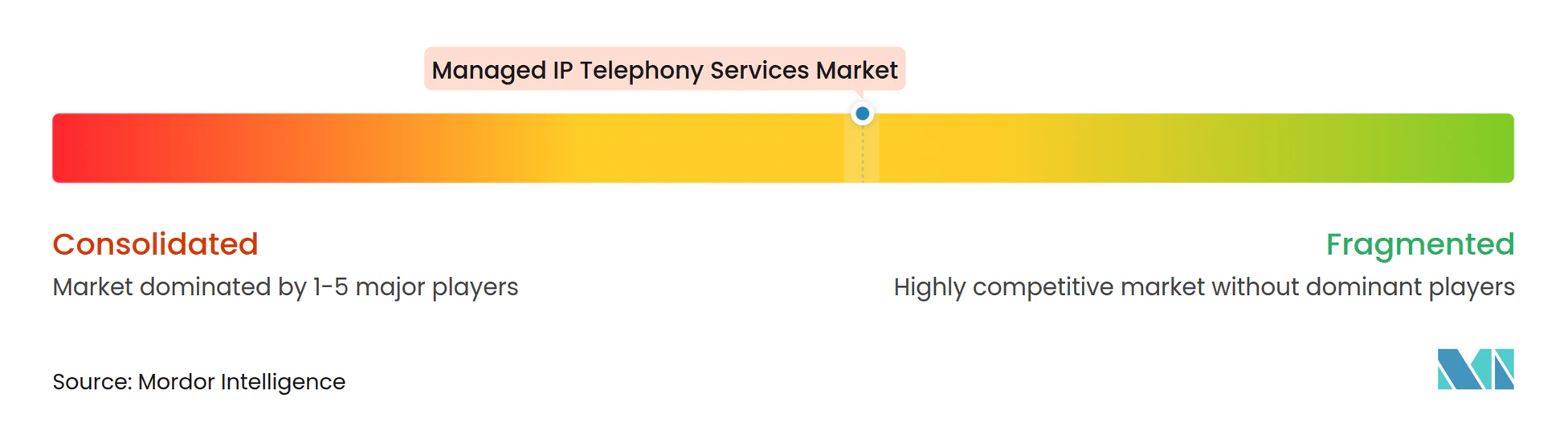
The managed IP telephony services market is moderately concentrated at the platform level and fragmented in managed delivery. Microsoft, Cisco, and Zoom held major shares of global UCaaS seats in mid-2025. The managed IP telephony services market includes carriers that combine voice with connectivity, SD-WAN, secure access, and managed security. Platform suppliers compete through software features, ecosystem connections, and adoption of their wider collaboration tools.
Strategic partnerships help vendors serve customers who cannot move entirely to the cloud. Microsoft made Teams Phone Extensibility generally available in September 2025, enabling contact center vendors to connect to Teams Phone via Azure Communication Services. AT&T and Cisco also combined secure access and network management in their August 2025 managed SASE launch. These moves make voice part of a broader communications and network service rather than an isolated product.
AI capabilities are becoming a practical point of competition in call and customer service environments. RingCentral acquired CommunityWFM in September 2025 for USD 25.2 million, adding workforce management capabilities to RingCX. Microsoft introduced a preview of Contact Center Intelligence in October 2026 with quality assurance, monitoring, dashboards, voice biometric authentication, and Copilot Studio agent reuse.[4] The managed IP telephony services industry has room for providers offering local hosting, compliance controls, and accessible pricing in Asia-Pacific and South America. Regional providers can compete through local support and regulatory knowledge.
Managed IP Telephony Services Industry Leaders
-
Microsoft Corporation
-
Cisco Systems, Inc.
-
Zoom Video Communications, Inc.
-
AT&T Inc.
-
Verizon Communications Inc.
- *Disclaimer: Major Players sorted in no particular order
Managed IP Telephony Services Market Companies Covered in this Report
- Microsoft Corporation
- Cisco Systems, Inc.
- Zoom Video Communications, Inc.
- AT&T Inc.
- Verizon Communications Inc.
- RingCentral, Inc.
- Comcast Corporation
- Deutsche Telekom AG
- Vodafone Group Plc
- BT Group plc
- Orange S.A.
- Telefonica S.A.
- NTT Communications Corporation
- Tata Communications Limited
- Mitel Networks Corporation
- Avaya LLC
- Dialpad, Inc.
- Vonage Holdings Corp.
- Google LLC
- Amazon Web Services, Inc.
- Twilio Inc.
- 3CX Limited
Recent Industry Developments in Managed IP Telephony Services Market
- October 2026: Microsoft launched the preview of Microsoft Contact Center Intelligence, embedding Microsoft AI into supported non-Microsoft CCaaS platforms via native connectors and APIs.
- June 2026: The University of California, Irvine's Office of Information Technology reported the completion of more than 3,500 phone number migrations to Microsoft Teams Phone as part of a multiyear program to replace its legacy Mitel infrastructure, with full campus completion targeted for December 2026.
- May 2026: VOIP Networks acquired TIG to expand its unified communications infrastructure and Mitel expertise, bringing broader resources to its managed VoIP services.
- April 2026: Pure IP acquired Vive Communications to strengthen its North American client reach and expand its integrated UCaaS capabilities under the Pure IP UCaaSone brand.
Global Managed IP Telephony Services Market Report Scope
The Managed IP Telephony Services Market includes services that enable businesses to manage voice communications over Internet Protocol (IP) networks. Managed service providers deliver, operate, monitor, maintain, and support IP-based telephony solutions, including hosted private branch exchange (PBX), Voice over Internet Protocol (VoIP), unified communications, session initiation protocol (SIP) trunking, and related services.
The Managed IP Telephony Services Market Report is Segmented by Service Type (Services, and Solutions), Deployment Model (On-Premises, Cloud-Based, and Hybrid), Enterprise Size (Large Enterprises, and Small and Medium Enterprises), Applications (Unified Communication and Collaboration, Hosted PBX and Cloud Calling, SIP Trunking and Call Routing, Contact Center and Customer Service, Mobility and Bring Your Own Device Enablement, Business Continuity and Disaster Recovery Communications, and Other Applications), and Geography (North America, South America, Europe, Asia-Pacific, Middle East, and Africa). The Market Forecasts are Provided in Terms of Value (USD).
Segmentation Overview
| Services |
| Solutions |
| On-Premises |
| Cloud-Based |
| Hybrid |
| Large Enterprises |
| Small and Medium Enterprises |
| Unified Communication and Collaboration |
| Hosted PBX and Cloud Calling |
| SIP Trunking and Call Routing |
| Contact Center and Customer Service |
| Mobility and Bring Your Own Device Enablement |
| Business Continuity and Disaster Recovery Communications |
| Other Applications |
| North America | United States |
| Canada | |
| Mexico | |
| South America | Brazil |
| Argentina | |
| Rest of South America | |
| Europe | Germany |
| United Kingdom | |
| France | |
| Italy | |
| Spain | |
| Russia | |
| Rest of Europe | |
| Asia-Pacific | China |
| India | |
| Japan | |
| South Korea | |
| Australia | |
| Rest of Asia-Pacific | |
| Middle East | Saudi Arabia |
| United Arab Emirates | |
| Turkey | |
| Rest of Middle East | |
| Africa | South Africa |
| Egypt | |
| Nigeria | |
| Rest of Africa |
| By Offering | Services | |
| Solutions | ||
| By Deployment Model | On-Premises | |
| Cloud-Based | ||
| Hybrid | ||
| By Enterprise Size | Large Enterprises | |
| Small and Medium Enterprises | ||
| By Applications | Unified Communication and Collaboration | |
| Hosted PBX and Cloud Calling | ||
| SIP Trunking and Call Routing | ||
| Contact Center and Customer Service | ||
| Mobility and Bring Your Own Device Enablement | ||
| Business Continuity and Disaster Recovery Communications | ||
| Other Applications | ||
| By Geography | North America | United States |
| Canada | ||
| Mexico | ||
| South America | Brazil | |
| Argentina | ||
| Rest of South America | ||
| Europe | Germany | |
| United Kingdom | ||
| France | ||
| Italy | ||
| Spain | ||
| Russia | ||
| Rest of Europe | ||
| Asia-Pacific | China | |
| India | ||
| Japan | ||
| South Korea | ||
| Australia | ||
| Rest of Asia-Pacific | ||
| Middle East | Saudi Arabia | |
| United Arab Emirates | ||
| Turkey | ||
| Rest of Middle East | ||
| Africa | South Africa | |
| Egypt | ||
| Nigeria | ||
| Rest of Africa | ||
Key Questions Answered in the Report
What is the size of the managed IP telephony services sector?
The managed IP telephony services market is projected to grow from USD 5.83 billion in 2026 to USD 10.92 billion by 2032, at an 11.04% CAGR from 2027 to 2032.
What is driving demand for managed IP telephony services?
The managed IP telephony services market is supported by legacy PBX replacement, hybrid work, system integration, and subscription pricing. These factors help businesses reduce infrastructure burdens while improving access to calling, routing, security, and support across distributed locations, including home offices, branch sites, and shared work settings, while maintaining common communication policies.
Which Offering leads managed IP telephony services?
Services led with 58.37% of revenue in 2026, while solutions are projected to grow at an 11.83% CAGR through 2032. The managed IP telephony services market uses managed contracts for administration and monitoring, while buyers use solutions to add analytics, automation, and application connections that improve everyday user and customer-service activities across the wider communications environment.
Which deployment approach is growing fastest?
Hybrid deployment is projected to grow at an 11.27% CAGR through 2032. It allows organizations to retain selected on-premises functions for regulated workloads or specialized devices while extending cloud voice functions to remote employees and customer-facing teams, without requiring every system to change at the same time or limiting a company to 1 deployment model.
Which region is expected to grow the fastest?
Asia-Pacific is projected to grow at a 12.63% CAGR through 2032. The managed IP telephony services market in the region is supported by SME digitization, modernization of legacy systems, and localized platform offerings in markets including India and Southeast Asia, where mobile-first operating models and growing enterprise demand support deployment across both established and emerging business centers.