
Managed CRM Application Services Market Size and Share
Market Overview
| Study Period | 2021 - 2032 |
|---|---|
| Market Size (2027) | USD 65.31 Billion |
| Market Size (2032) | USD 108.72 Billion |
| Fastest Growing Market | Asia-Pacific |
| Largest Market | North America |
| Market Concentration | Medium |
Major Players *Disclaimer: Major Players sorted in no particular order Image © Mordor Intelligence. Reuse requires attribution under CC BY 4.0. | |
Managed CRM Application Services Market Analysis by Mordor Intelligence
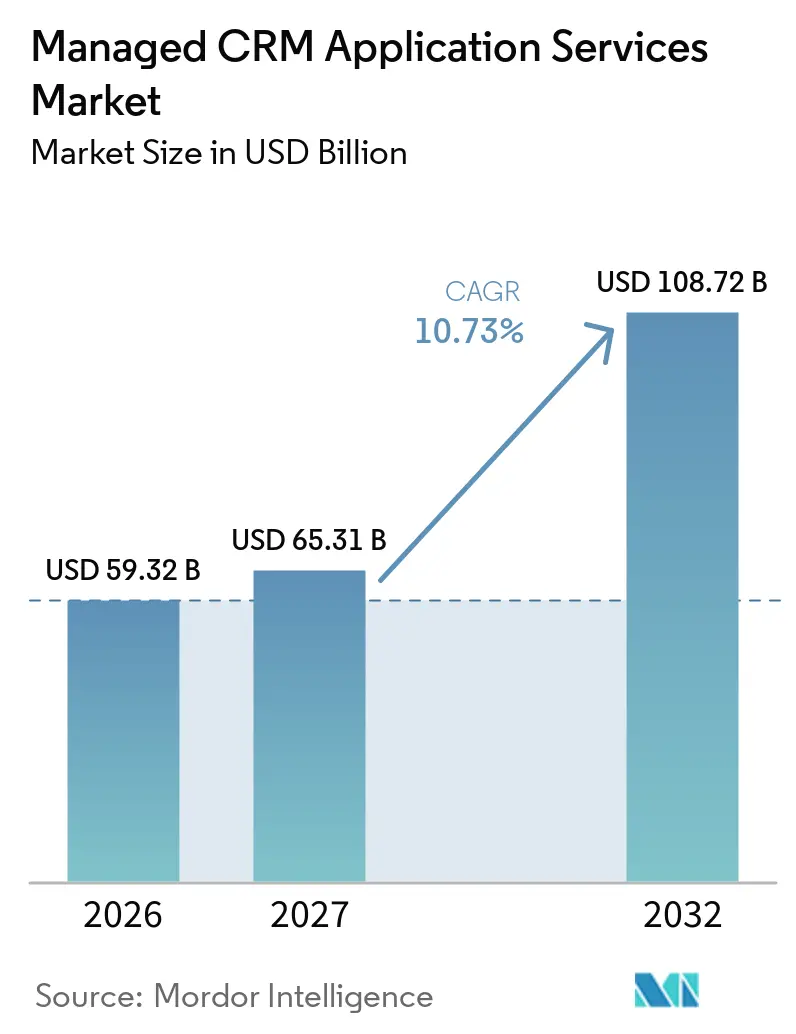
The managed CRM application services market size is projected to expand from USD 59.32 billion in 2026 and USD 65.31 billion in 2027 to USD 108.72 billion by 2032, registering a CAGR of 10.73% between 2027 to 2032. The managed CRM application services market is growing as enterprises seek external support for AI-enabled customer operations, cloud modernization, and ongoing platform management. Service providers are taking greater responsibility for performance, governance, and system releases, rather than only completing implementation projects. The managed CRM application services market also benefits when companies connect customer data, service workflows, and marketing activity across multiple platforms. Providers with industry knowledge and proven compliance processes can address opportunities in regulated customer environments. Data privacy obligations and fragmented legacy systems remain important limits on adoption.
Key Report Takeaways
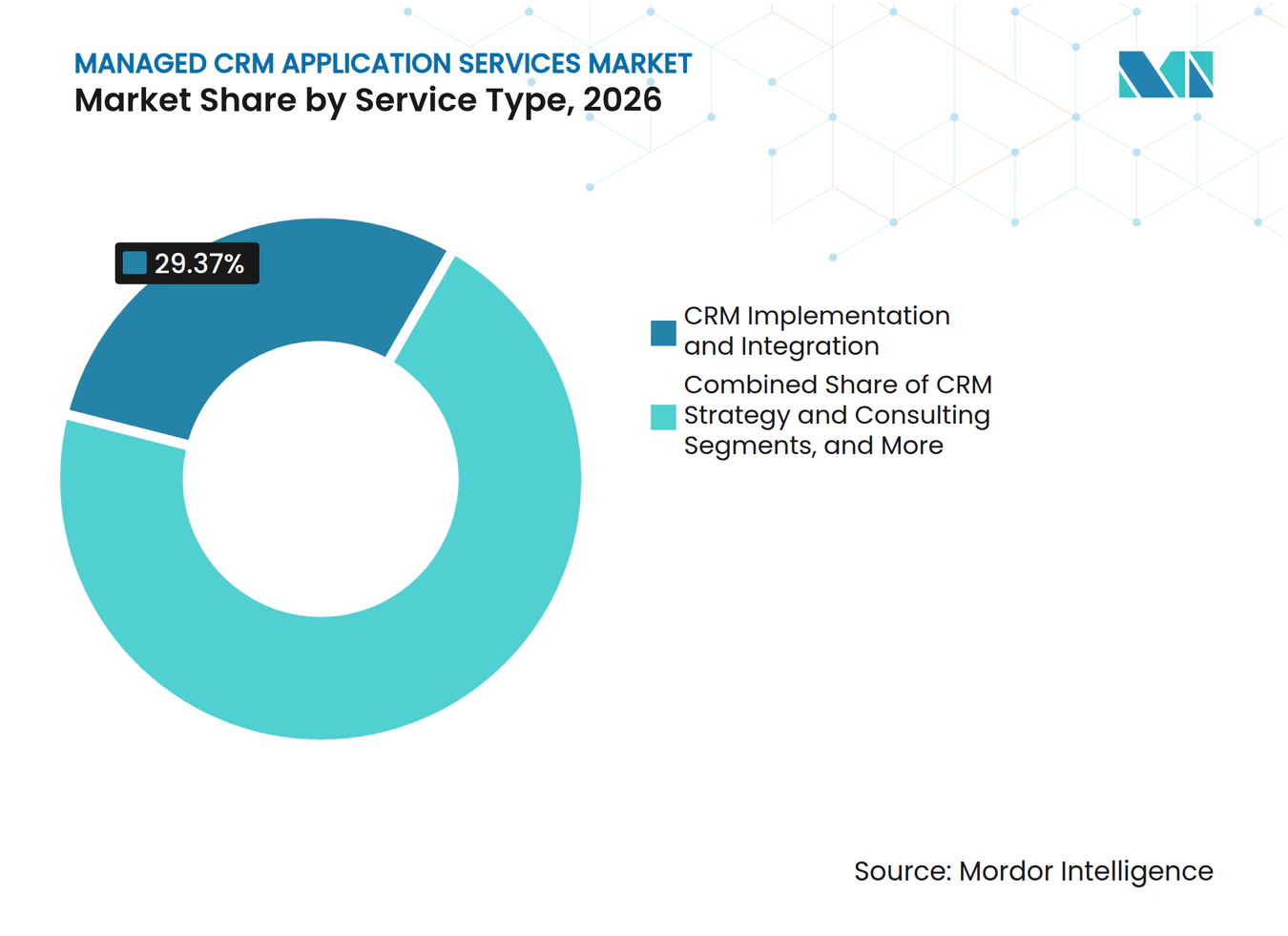
- By service type, CRM implementation and integration held 29.37% of the managed CRM application services market share in 2026, while CRM managed services is projected to expand at an 11.38% CAGR through 2032.
- By deployment model, cloud-based deployment accounted for 68.42% of the managed CRM application services market size in 2026 and is expected to grow at an 11.63% CAGR through 2032.
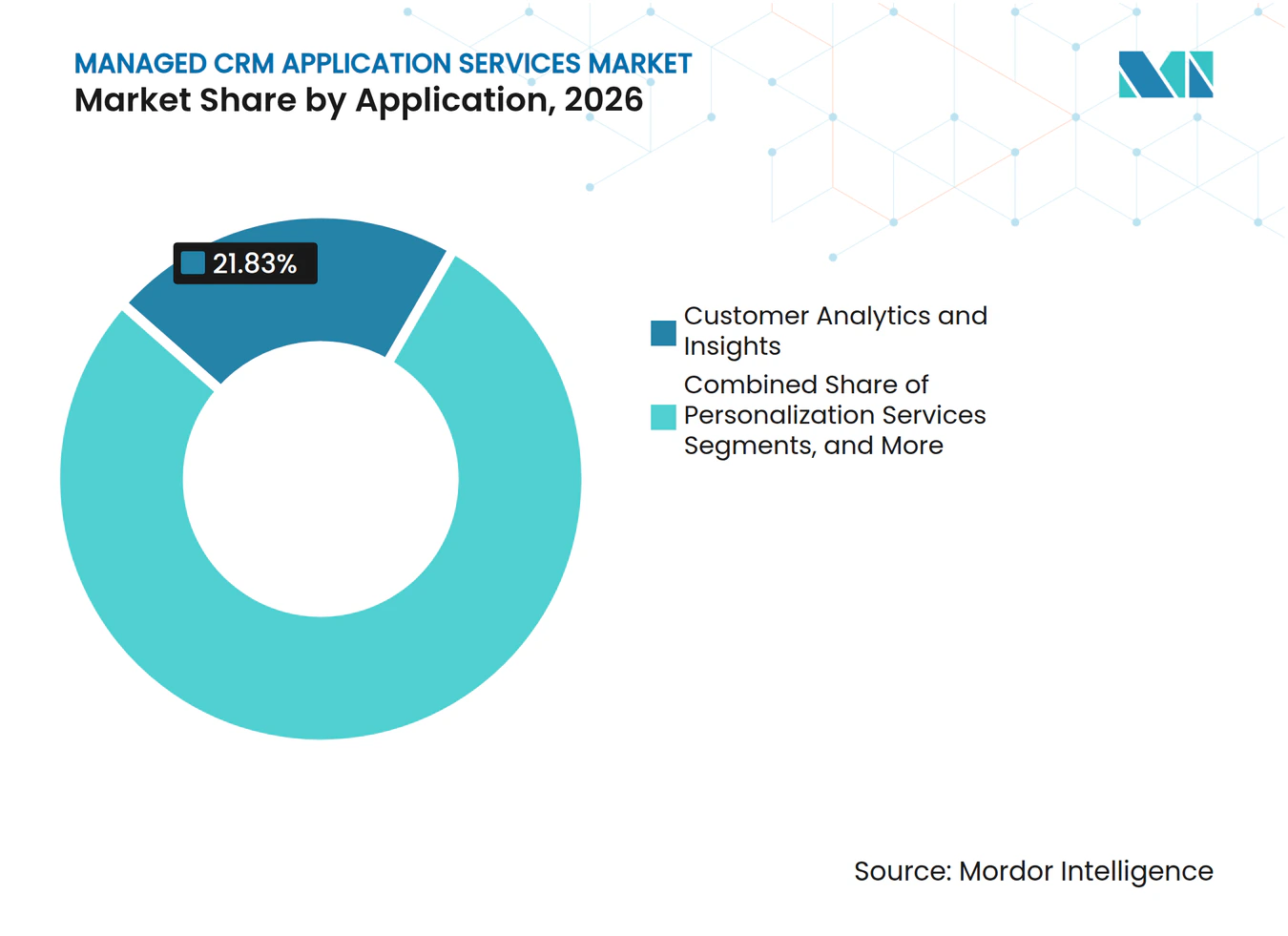
- By application, customer analytics and insights held 21.83% share in 2026, while personalization services is projected to advance at an 11.27% CAGR through 2032.
- By organization size, large enterprises accounted for 64.27% share in 2026, while small and medium enterprises are expected to expand at an 11.84% CAGR through 2032.
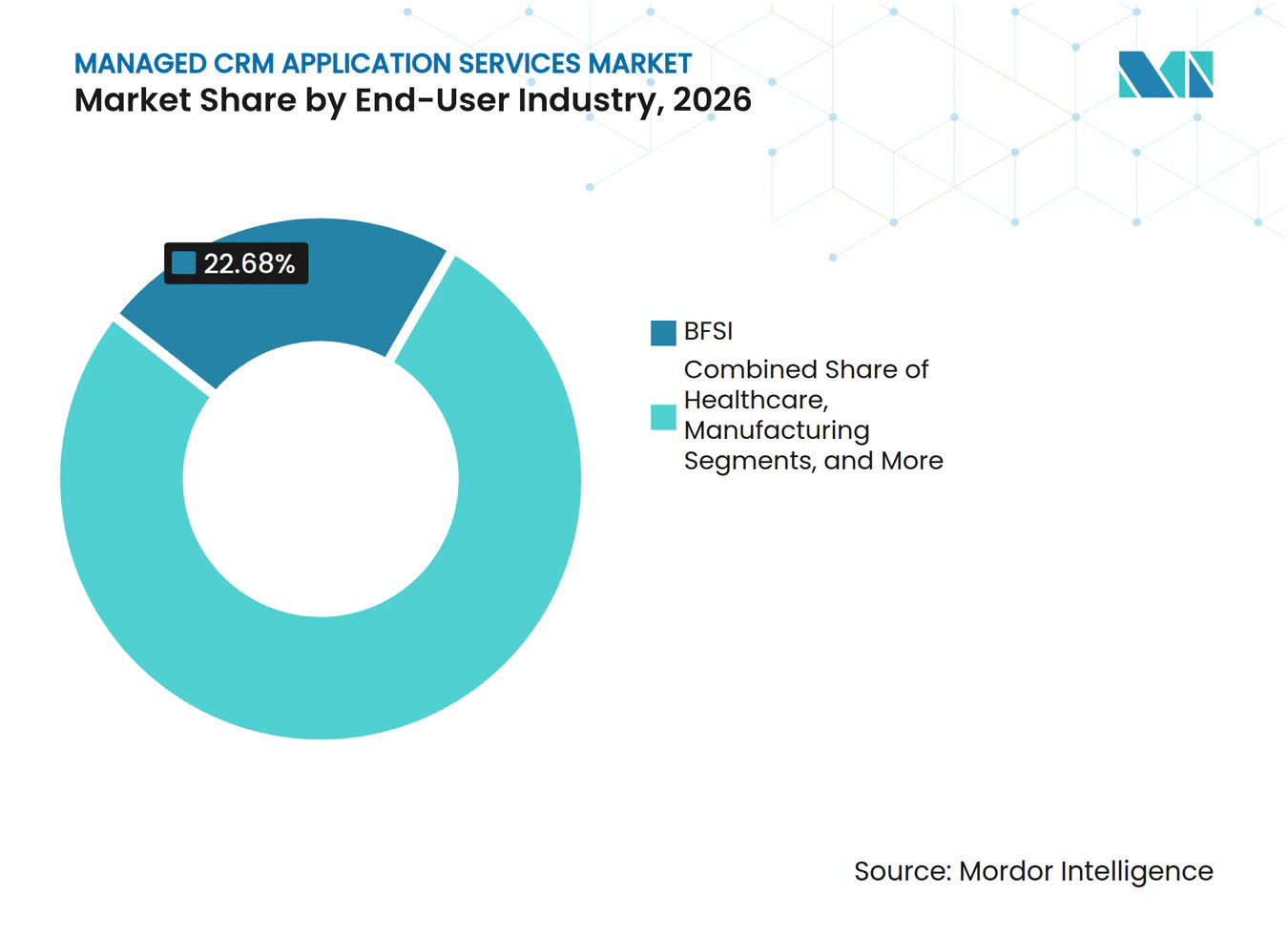
- By end-user industry, BFSI held 22.68% share in 2026, while healthcare is projected to grow at an 11.07% CAGR through 2032.
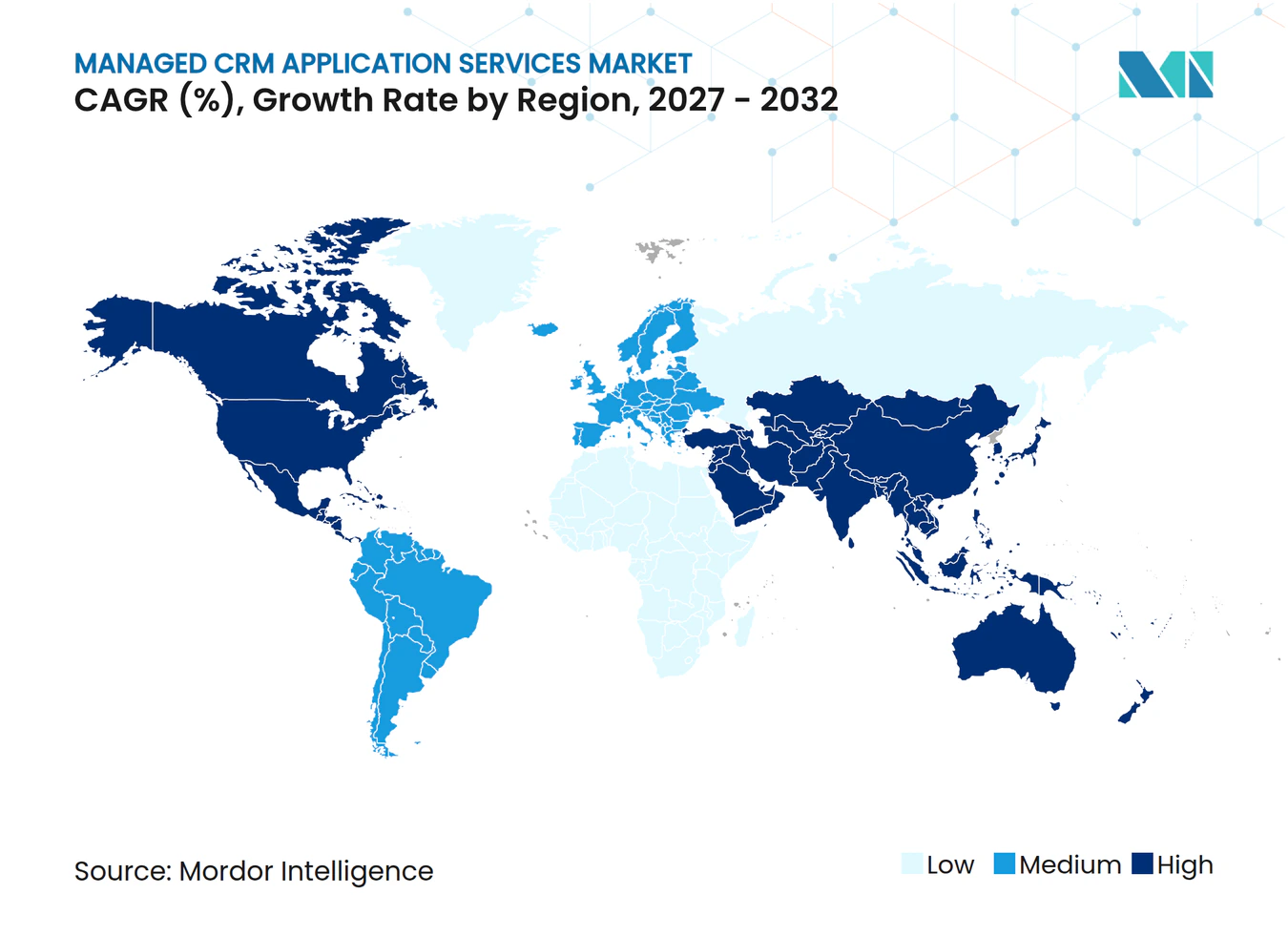
- By geography, North America accounted for 41.37% share in 2026, while Asia-Pacific is forecast to expand at an 11.93% CAGR through 2032.
Note: Market numbers in this report are based on Mordor Intelligence's proprietary estimation framework, which combines nine months of actuals with Q4 projections for base year 2026.
Market Trends and Insights
Drivers Impact Analysis of Managed CRM Application Services Market*
| Driver | (~) % Impact on CAGR Forecast | Geographic Relevance | Impact Timeline |
|---|---|---|---|
| AI-Assisted CRM Agent Adoption | +2.1% | Global, concentrated in North America and Western Europe, with rapid adoption in Asia-Pacific | Medium term (2-4 years) |
| Cloud CRM Migration and Modernization | +1.8% | Global, with the highest pace in Asia-Pacific and South America | Short term (≤ 2 years) |
| Rising Demand for Customer Experience Management | +1.5% | Global, led by BFSI and retail in North America and Europe | Medium term (2-4 years) |
| Omnichannel Customer Journey Orchestration | +1.2% | North America and Europe, with expansion in Asia-Pacific through super-app ecosystems | Medium term (2-4 years) |
| Continuous CRM Governance for Autonomous Workflows | +0.9% | North America and the European Union, with early adoption in regulated industries worldwide | Long term (≥ 4 years) |
| Outcome-Based Managed CRM Contracting | +0.6% | North America and European Union enterprise segments | Long term (≥ 4 years) |
| Source: Mordor Intelligence | |||
AI-Assisted CRM Agent Adoption
AI agent adoption is changing the scope of work in the managed CRM application services market. Salesforce reported that agent creation among first-mover organizations increased 119% between January and June 2025.[1] The company also reported that the average number of AI agents per enterprise rose from 5 in February 2025 to 13 in April 2026. Managed providers must now govern agents, connect them to enterprise systems, and monitor their results after deployment. IBM reported that 72% of surveyed Salesforce customers had AI initiatives that did not scale across business units.[2] This gap makes managed support more relevant when organizations move from pilots to company-wide use.
Cloud CRM Migration and Modernization
Cloud migration is shifting CRM work from fixed projects toward longer service relationships. Cloud-based deployment represented 68.42% of the managed CRM application services market in 2026 and is expected to grow at an 11.63% CAGR through 2032. Enterprises need support across data integration, release management, security controls, and platform optimization after a migration is completed. Fujitsu described its managed offering for Microsoft Business Applications as support spanning Level 1 through Level 4 across Dynamics 365 and Power Platform.[3] Hybrid environments remain relevant for banking and government users that need local data controls alongside cloud analytics. This requirement favors providers that can operate both cloud and on-premises CRM environments.
Rising Demand for Customer Experience Management
Customer experience management is widening the scope of managed CRM work beyond marketing support. Salesforce introduced Agentforce 360 in October 2025 and stated that it had 12,000 customers at launch. The company reported that OpenTable resolved 70% of inquiries autonomously and that 1-800Accountant reached a 90% case-deflection rate during peak tax week. These outcomes move buyer attention toward measurable service results, including case deflection and first-contact resolution. The managed CRM application services market therefore favors providers that can link platform operation to customer service performance. General IT outsourcers may face a disadvantage where deep CRM process knowledge is required.
Omnichannel Customer Journey Orchestration
Many enterprises are replacing disconnected customer tools with coordinated journey management. SAP rebranded SAP Emarsys as SAP Engagement Cloud in February 2026 and added controls for multi-brand and multi-region engagement programs. The product also brought operational data into customer communications through SAP Business Data Cloud. Microsoft reorganized Dynamics 365 Customer Insights in July 2026 around unified customer data and AI-powered journey orchestration. These product changes increase demand for partners that can manage data connections, customer context, and ongoing journey performance. The managed CRM application services market gains when buyers need a single operating model across sales, service, marketing, and digital channels.
Restraints Impact Analysis of Managed CRM Application Services Market*
| Restraint | (~) % Impact on CAGR Forecast | Geographic Relevance | Impact Timeline |
|---|---|---|---|
| Data Privacy and Consent Complexity | -1.2% | Global, with the highest compliance burden in the European Union, the United States, Brazil, Singapore, and South Africa | Short term (≤ 2 years) |
| Legacy CRM Integration and Data Fragmentation | -0.9% | Global, with the greatest challenge in North America and Europe | Medium term (2-4 years) |
| Shortage of Specialized CRM Operations Talent | -0.7% | Global, with the greatest shortfall in Asia-Pacific and South America | Medium term (2-4 years) |
| Multi-Vendor Cost and Accountability Friction | -0.5% | North America and European Union enterprise segments | Long term (≥ 4 years) |
| Source: Mordor Intelligence | |||
Data Privacy and Consent Complexity
Data privacy and consent obligations add operational work to every managed CRM engagement. Providers must manage data access, records of processing, security controls, subcontractor arrangements, and incident procedures across different jurisdictions. These requirements are especially demanding where providers support customers across the European Union, the United States, Brazil, Singapore, and South Africa. The managed CRM application services market rewards vendors that can document controls and apply them consistently across client environments. Compliance review can delay procurement when buyers need assurance that customer data will be handled correctly. It can also narrow the provider pool for regulated customers with strict data handling requirements.
Legacy CRM Integration and Data Fragmentation
Legacy environments can slow the rollout of modern CRM services. Large organizations often operate multiple CRM or CRM-related systems after acquisitions, business expansion, and separate technology decisions. These systems create fragmented data that limits the value of analytics, customer profiles, and personalized engagement. IBM found that two-thirds of surveyed organizations identified trusted data, governance, and integration gaps as barriers to scaling AI use cases. Providers that combine data unification with platform administration are better placed to address this constraint. Integration complexity may still extend project timelines and reduce the speed of modernization.
*Our forecasts treat driver/restraint impacts as directional, not additive. The impact forecasts reflect baseline growth, mix effects, and variable interactions.
Managed CRM Application Services Market Segment Analysis
By Service Type:
Recurring Managed Contracts Outpace One-Time ImplementationsCRM implementation and integration held 29.37% of the managed CRM application services market share in 2026. Its position reflects continued platform migrations and multi-cloud integrations among large enterprises. Companies still need initial design, configuration, data transfer, and process alignment before they can operate a modern CRM system. Migration and modernization work remains relevant as users retire older on-premises platforms. CRM strategy and consulting also helps buyers define governance and adoption priorities before larger service commitments. Training and support work remains necessary when new systems reach business users.
CRM managed services is projected to grow at an 11.38% CAGR through 2032, the fastest rate among service types. The managed CRM application services industry is moving toward recurring agreements that cover AI governance, releases, performance management, and daily platform administration. Accenture completed its acquisition of NeuraFlash in September 2025, adding CRM and generative AI capability to its Salesforce Business Group. Salesforce reported that AI agent-led customer service conversations grew 22 times in the first half of 2025. This growth increases the need for sustained oversight after implementation. Providers must define responsibilities for model changes, data access, release testing, and service quality across the client organization. They also need to help operational teams understand when automated actions should be reviewed by people. Recurring agreements give clients a way to manage these responsibilities without building a large specialist team internally. Providers that operate CRM as a business capability can build longer client relationships than providers focused only on project delivery.



By Deployment Model:
Cloud-Based Deployment Leads Share and GrowthCloud-based deployment accounted for 68.42% of the managed CRM application services market size in 2026. It is projected to grow at an 11.63% CAGR through 2032, leading both deployment share and forecast growth. Cloud delivery helps clients adopt new CRM functionality without maintaining all supporting infrastructure internally. It also enables more frequent updates to customer data platforms, marketing tools, and service applications. Singapore’s enhanced SMEs Go Digital program supports approved cloud CRM costs for eligible small businesses. The program strengthens the case for cloud CRM adoption among smaller organizations.
On-premises deployment retains a role in regulated sectors that need local data processing and stronger control over system environments. Hybrid models combine on-premises data storage with cloud analytics, campaign tools, and AI-enabled services. This approach is relevant in BFSI and government environments where data residency requirements influence architecture choices. Security certifications and public-sector cloud requirements also shape the deployment model selected by buyers. Clients may retain selected records locally while making non-sensitive information available for approved cloud services. This can require clear integration rules, monitored data transfers, and shared responsibility across several technology teams. Managed providers must keep system changes aligned across the local and cloud elements of the CRM environment. The managed CRM application services market benefits from providers that can operate these mixed environments without disrupting customer workflows. A provider’s ability to manage integration between local systems and cloud tools can become a key selection factor.
By Application:
Analytics and Personalization Shape AI AdoptionCustomer analytics and insights accounted for 21.83% of the application segment in 2026. This application area turns customer data into lead scores, churn indicators, and next-best-action recommendations. It provides the information base that supports sales, service, and marketing teams. Managed providers help maintain data quality, reporting logic, and connections between source systems. They also help clients use analytics results in daily decisions instead of limiting them to periodic reporting. Strong analytics operations can improve the quality of customer engagement programs.
Personalization services is projected to grow at an 11.27% CAGR through 2032. Salesforce and NVIDIA announced Koa in September 2026 as a CRM reasoning model for Agentforce built on NVIDIA Nemotron. Salesforce stated that Koa achieved an 87% task success rate on CRMAgentBench with 3x fewer errors than general-purpose models in the reported test. Customer retention and loyalty, campaign management, marketing automation, customer acquisition, and omnichannel engagement remain part of the application mix. Personalized programs require current customer profiles, approved content rules, and careful coordination between business teams. Providers must review how data is used in messages and how automated decisions affect customer interactions. They can also monitor outcomes after campaigns are launched and adjust workflows as conditions change. The managed CRM application services market needs providers that can supervise AI-generated content and keep personalization aligned with customer data controls. This work becomes more important as organizations seek individualized communication at scale.

By Organization Size:
Large Enterprises Lead While SMEs Expand AccessLarge enterprises accounted for 64.27% of the organization-size segment in 2026. Their share reflects complex CRM estates, multiple business units, and stronger regulatory requirements. These organizations often require integrations across regions and legacy systems. Multi-region managed CRM programs typically range from USD 2 million to USD 50 million per engagement. Buyers in this group need documented governance, coordinated delivery teams, and stable service processes. Their requirements support demand for large providers with broad platform capabilities.
Small and medium enterprises are projected to expand at an 11.84% CAGR through 2032. Cloud-native delivery models reduce the minimum scope required for a managed service arrangement. Managed CRM contracts for mid-market financial institutions typically range from USD 8,000 to USD 60,000 per month. This makes external CRM expertise more accessible to businesses that cannot build large internal operations teams. Smaller organizations still need reliable configuration, user support, and routine platform updates as customer-facing processes become more digital. A managed provider can provide these capabilities through defined service packages instead of a large customized engagement. This structure lets buyers scale their use of CRM support as their customer base or channel requirements change. Nordic Global reported that 61% of surveyed healthcare IT leaders considered application managed services central to IT strategy. The managed CRM application services industry can therefore serve SMEs that view managed support as an operating capability rather than a help-desk extension.
By End-User Industry:
BFSI Leads While Healthcare Builds MomentumBFSI held 22.68% of the end-user segment in 2026. Financial institutions use CRM systems to manage customer relationships across retail banking, wealth management, insurance, and capital markets. These environments require clear customer records, audit trails, and controlled access to sensitive information. External providers must meet detailed expectations for governance, data handling, and incident management. The combination of customer volume and compliance needs supports the segment’s leading position. Retail and e-commerce also remain important as direct customer channels require high-frequency campaign operations and real-time personalization.
Healthcare is projected to grow at an 11.07% CAGR through 2032. Healthcare organizations need CRM systems that connect with electronic health records, care coordination tools, and controlled data environments. Business associate requirements raise the importance of proven data protection processes among service providers. These providers must also coordinate system changes without interrupting essential customer, patient, or care coordination processes. Clear access controls and documented operating procedures become more important as CRM systems support more service interactions. IT and telecommunications, manufacturing, government and defense, education, energy and utilities, transportation and logistics, and hospitality and travel make up the remaining end-user base. Manufacturing customers are adopting CRM integrations that connect sales, service, and production data. The managed CRM application services market expands when sector-specific processes are built into managed operating models.
Geography Analysis
North America accounted for 41.37% of the managed CRM application services market share in 2026. The region benefits from a large base of enterprise buyers, early cloud CRM adoption, and many specialist service providers. BFSI, healthcare, and technology companies are prominent buyers of managed CRM support. Banking customers place significant weight on third-party governance and data controls. Healthcare customers also require partners that can support sensitive customer and care-related information. Large organizations in the region commonly operate complex customer processes across several business units and channels. Their service requirements can cover customer support, sales, marketing, analytics, and the interfaces between these functions. This creates demand for providers that can coordinate platform administration with business process knowledge. These needs favor established providers with robust compliance and delivery capabilities.
Europe is the second-largest regional market, with Germany, the United Kingdom, and France leading demand. The region’s privacy requirements influence provider selection and service design. Buyers often require documented processing arrangements, defined incident processes, and controls for customer data rights. These expectations make compliance capability a clear point of differentiation for managed providers. Financial institutions and other regulated organizations may also need local knowledge when selecting providers for multi-country deployments. Service partners must account for how customer records move between systems and where particular activities are performed. This can increase the value of providers with established regional delivery practices and experienced governance teams. The managed CRM application services market size in Europe is supported by financial-sector digital transformation and the need to update customer engagement processes. Providers that combine local regulatory understanding with CRM platform expertise have an advantage in this environment.
Asia-Pacific is projected to grow at an 11.93% CAGR through 2032, the highest rate among regions. Singapore supports cloud CRM adoption through its SMEs Go Digital program, which can subsidize up to 50% of approved costs for eligible small businesses. Salesforce committed USD 1 billion in Singapore over 5 years for Agentforce adoption, Hyperforce expansion, and AI development with Singapore Airlines. India is both a demand center and a delivery location for managed CRM work, with Tata Consultancy Services, Infosys, Wipro, and HCL Technologies competing for mandates. The region includes businesses at very different stages of cloud adoption, which supports demand for both implementation and ongoing management. Providers need local delivery capacity and an understanding of distinct customer channels, languages, and operating requirements. This makes regional execution an important part of provider positioning. Brazil and Argentina lead South American adoption, while South Africa, Nigeria, and Egypt are early-adopter markets in Africa. Saudi Arabia’s digital programs and local privacy requirements in Brazil and South Africa also support demand for locally compliant service models.
Competitive Landscape
Market Concentration
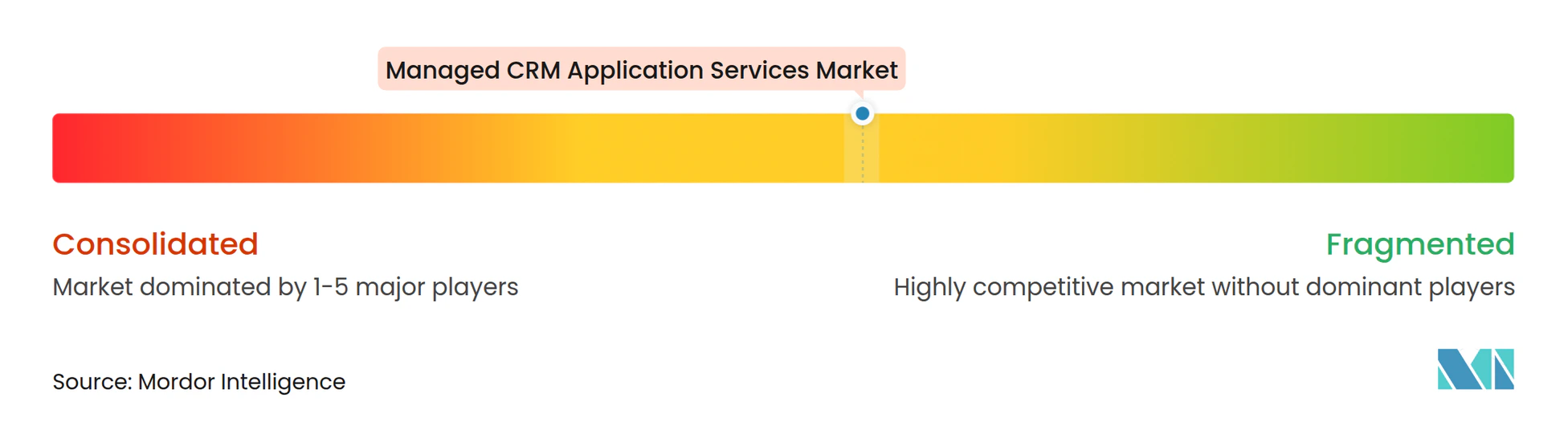
The managed CRM application services market has moderate to high concentration among the largest providers. Accenture, Tata Consultancy Services, Capgemini, Infosys, and IBM compete for large enterprise agreements through global delivery capacity and broad platform partnerships. These providers operate across Salesforce, Microsoft Dynamics, SAP, and Oracle environments. Their large talent pools and established centers of excellence support complex, multi-country deployments. Their delivery models also benefit from the ability to coordinate work across regions. They can offer clients a common operating approach across several platforms while retaining platform-specific teams. This is important when enterprise customers combine new cloud applications with existing systems and internal support functions. Scale also helps these firms staff ongoing programs that require coverage across multiple time zones. This places pressure on smaller firms that compete mainly on general CRM implementation services.
Accenture’s September 2025 acquisition of NeuraFlash added around 510 professionals and more than 2,000 certifications to its Salesforce Business Group. The transaction expanded its generative AI and managed CRM capabilities in North America, Colombia, and India. SAP introduced SAP Engagement Cloud in February 2026 with multi-brand orchestration controls and an API-first architecture. Microsoft reorganized Dynamics 365 Customer Insights in July 2026 to connect unified data with AI-powered journey orchestration. Platform vendors are adding functions that make customer data, AI-assisted actions, and campaign execution more closely connected. Managed service partners must translate these product capabilities into controlled business processes for their clients. They must also maintain the operational knowledge needed to support changes as vendor platforms develop. These moves make platform-specific AI expertise more important for managed service partners. They also encourage providers to invest in operational tools for governance, testing, and adoption management.
Specialist providers can compete by focusing on regulated sectors and targeted service outcomes. Healthcare-focused firms can offer CRM governance that aligns with data protection requirements. BFSI specialists can provide structured documentation for third-party review and customer data controls. Smaller teams may also compete through senior-led delivery and narrow vertical knowledge. Technology-led providers are using automation for release readiness testing and adoption analytics to lower delivery effort. Their narrower scope can be useful where buyers need support for a specific regulated process rather than a broad transformation program. Specialist firms can also respond to client needs for detailed operating knowledge within a particular customer environment. The global providers and vertical specialists therefore serve different buyer requirements across the managed CRM application services market.
Managed CRM Application Services Industry Leaders
-
Accenture plc
-
International Business Machines Corporation
-
Capgemini SE
-
Cognizant Technology Solutions Corporation
-
Tata Consultancy Services Limited
- *Disclaimer: Major Players sorted in no particular order
Managed CRM Application Services Market Companies Covered in this Report
- Accenture plc
- Capgemini SE
- Cognizant Technology Solutions Corporation
- International Business Machines Corporation
- Deloitte Touche Tohmatsu Limited
- Tata Consultancy Services Limited
- Infosys Limited
- Wipro Limited
- HCL Technologies Limited
- NTT DATA Corporation
- Publicis Groupe S.A.
- PwC International Limited
- Ernst and Young Global Limited
- KPMG International Cooperative
- Salesforce, Inc.
- Microsoft Corporation
- Oracle Corporation
- SAP SE
- Adobe Inc.
- ServiceNow, Inc.
- Persistent Systems Limited
Recent Industry Developments in Managed CRM Application Services Market
- September 2026: Salesforce and NVIDIA announced Koa, Salesforce's first CRM domain-specific reasoning model for Agentforce, built on NVIDIA Nemotron. Trained on 27 years of synthetic CRM workflow scenarios across more than 14 industries, Koa achieves an 87% task success rate on CRMAgentBench, outperforming GPT-4.1 at 82%, with 3x fewer errors on standard CRM tasks. Pilot customers include UChicago Medicine, Formula 1, and Baxter Credit Union, with general availability targeted for winter 2026 in U.S. regions.
- August 2026: Salesforce announced Claudeforce, a collaboration with Anthropic integrating Claude models natively into the Agentforce platform, expanding enterprise model choice within managed CRM environments and accelerating multi-agent workflow deployment for managed service providers building on Salesforce's technology stack.
- July 2026: Microsoft restructured Dynamics 365 Customer Insights around Customer Insights Data, a unified customer data foundation, and Customer Insights Journeys, AI-powered journey orchestration converting unified data into real-time personalized engagement, expanding the addressable scope for Microsoft-aligned managed CRM service providers.
- April 2026: Nordic Global published its 2026 healthcare application managed services survey finding that 61% of healthcare IT leaders now view AMS as central to IT strategy, with 70% of urban health systems deploying it as a transformation lever, signaling a structural shift in how healthcare organizations budget for and procure managed CRM services.
Global Managed CRM Application Services Market Report Scope
The Managed CRM Application Services Market encompasses outsourced consulting, implementation, integration, migration, management, and support of CRM applications, enabling customer acquisition, retention, marketing automation, analytics, and omnichannel engagement globally. The market is Segmented by Service Type (CRM Strategy and Consulting, CRM Implementation and Integration, CRM Migration and Modernization, CRM Managed Services, CRM Training and Support, and Other Service Types), Deployment Model (On-Premises, Cloud-Based, and Hybrid), Application (Customer Acquisition, Customer Retention and Loyalty, Campaign Management Services, Marketing Automation Services, Customer Analytics and Insights, Omnichannel Customer Engagement, and Personalization Services), Organization Size (Small and Medium Enterprises, and Large Enterprises), End-User Industry (Information Technology and Telecommunications, BFSI, Healthcare, Retail and E-Commerce, Manufacturing, Government and Defense, and Other End-User Industries), and Geography (North America, South America, Europe, Asia-Pacific, Middle East, and Africa). The Market Forecasts are Provided in Terms of Value (USD).
Segmentation Overview
| CRM Strategy and Consulting |
| CRM Implementation and Integration |
| CRM Migration and Modernization |
| CRM Managed Services |
| CRM Training and Support |
| Other Service Types |
| On-Premises |
| Cloud-Based |
| Hybrid |
| Customer Acquisition |
| Customer Retention and Loyalty |
| Campaign Management Services |
| Marketing Automation Services |
| Customer Analytics and Insights |
| Omnichannel Customer Engagement |
| Personalization Services |
| Small and Medium Enterprises |
| Large Enterprises |
| Information Technology and Telecommunications |
| BFSI |
| Healthcare |
| Retail and E-Commerce |
| Manufacturing |
| Government and Defense |
| Other End-User Industries |
| North America | United States |
| Canada | |
| Mexico | |
| South America | Brazil |
| Argentina | |
| Rest of South America | |
| Europe | Germany |
| United Kingdom | |
| France | |
| Italy | |
| Spain | |
| Russia | |
| Rest of Europe | |
| Asia-Pacific | China |
| India | |
| Japan | |
| South Korea | |
| Australia | |
| Rest of Asia-Pacific | |
| Middle East | Saudi Arabia |
| United Arab Emirates | |
| Turkey | |
| Rest of Middle East | |
| Africa | South Africa |
| Egypt | |
| Nigeria | |
| Rest of Africa |
| By Service Type | CRM Strategy and Consulting | |
| CRM Implementation and Integration | ||
| CRM Migration and Modernization | ||
| CRM Managed Services | ||
| CRM Training and Support | ||
| Other Service Types | ||
| By Deployment Model | On-Premises | |
| Cloud-Based | ||
| Hybrid | ||
| By Application | Customer Acquisition | |
| Customer Retention and Loyalty | ||
| Campaign Management Services | ||
| Marketing Automation Services | ||
| Customer Analytics and Insights | ||
| Omnichannel Customer Engagement | ||
| Personalization Services | ||
| By Organization Size | Small and Medium Enterprises | |
| Large Enterprises | ||
| By End-User Industry | Information Technology and Telecommunications | |
| BFSI | ||
| Healthcare | ||
| Retail and E-Commerce | ||
| Manufacturing | ||
| Government and Defense | ||
| Other End-User Industries | ||
| By Geography | North America | United States |
| Canada | ||
| Mexico | ||
| South America | Brazil | |
| Argentina | ||
| Rest of South America | ||
| Europe | Germany | |
| United Kingdom | ||
| France | ||
| Italy | ||
| Spain | ||
| Russia | ||
| Rest of Europe | ||
| Asia-Pacific | China | |
| India | ||
| Japan | ||
| South Korea | ||
| Australia | ||
| Rest of Asia-Pacific | ||
| Middle East | Saudi Arabia | |
| United Arab Emirates | ||
| Turkey | ||
| Rest of Middle East | ||
| Africa | South Africa | |
| Egypt | ||
| Nigeria | ||
| Rest of Africa | ||
Key Questions Answered in the Report
What is the managed CRM application services market size?
The managed CRM application services market is projected to grow from USD 59.32 billion in 2026 and USD 65.31 billion in 2027 to USD 108.72 billion by 2032, at a 10.73% CAGR. The forecast reflects greater demand for cloud delivery, AI governance, and ongoing CRM operations.
What is driving demand for managed CRM application services?
AI agent adoption, cloud modernization, customer experience programs, and omnichannel journey management are expanding the need for ongoing CRM support. Buyers also need help connecting customer data, operating workflows, and platform updates across existing systems.
Which service type is growing fastest?
CRM managed services is projected to grow at an 11.38% CAGR through 2032 as buyers shift toward recurring support for governance, releases, and platform operations. This model is relevant when firms need sustained oversight after a CRM deployment is complete.
Which deployment model leads CRM service demand?
Cloud-based deployment held 68.42% share in 2026 and is projected to grow at an 11.63% CAGR through 2032. Hybrid approaches remain relevant for organizations that retain local data environments while using cloud analytics and campaign tools.
Which end-user sector has the largest share?
BFSI held 22.68% share in 2026 because financial institutions need controlled CRM systems, auditability, and strong customer data governance. Healthcare is projected to grow fastest among end users at an 11.07% CAGR through 2032.
Which region is expected to grow fastest?
Asia-Pacific is projected to expand at an 11.93% CAGR through 2032, supported by cloud adoption programs and growing AI-enabled CRM deployments. India also serves as a demand center and a delivery location for managed CRM services.