
Managed Cloud Storage Operations Services Market Size and Share
Market Overview
| Study Period | 2021 - 2032 |
|---|---|
| Market Size (2027) | USD 8.71 Billion |
| Market Size (2032) | USD 16.47 Billion |
| Growth Rate (2027 - 2032) | 13.59 % |
| Fastest Growing Market | Asia-Pacific |
| Largest Market | North America |
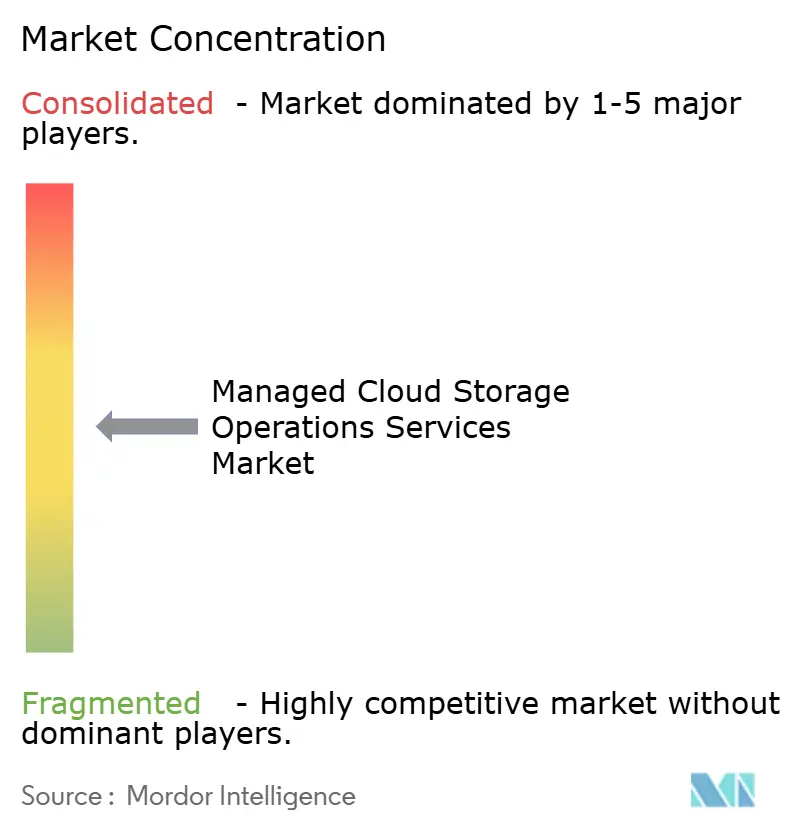
| Market Concentration | Medium |
Major Players *Disclaimer: Major Players sorted in no particular order Image © Mordor Intelligence. Reuse requires attribution under CC BY 4.0. | |
Managed Cloud Storage Operations Services Market Analysis by Mordor Intelligence
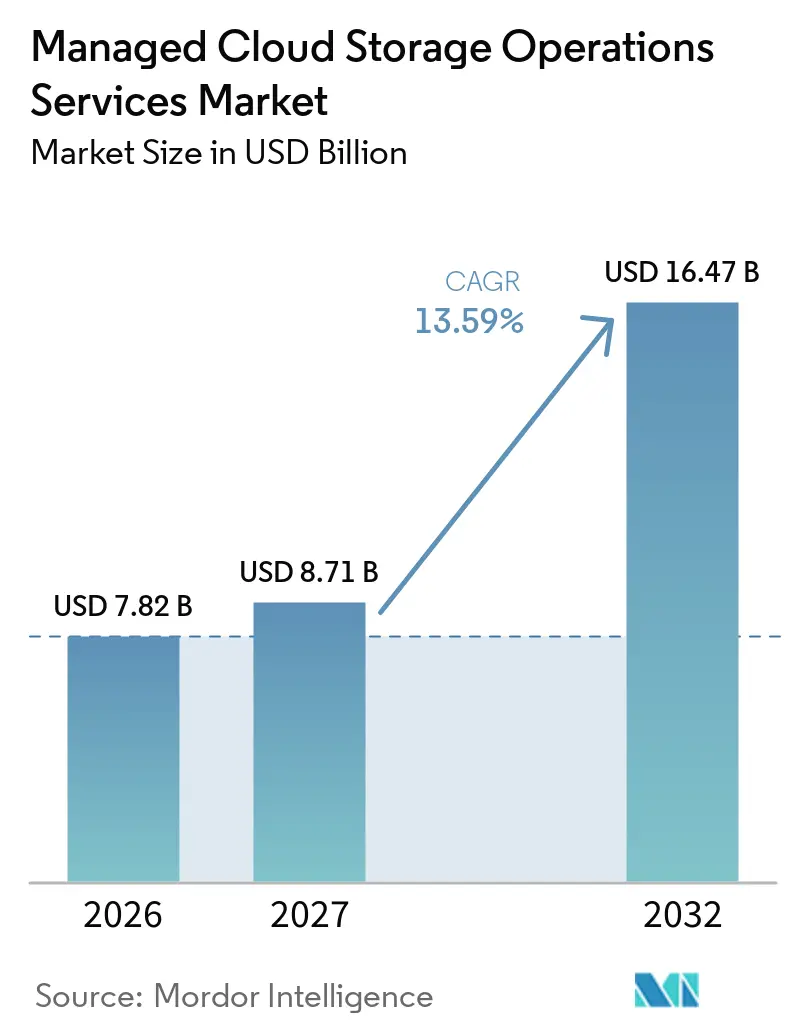
The Managed cloud storage operations services market size is projected to expand from USD 7.82 billion in 2026 to USD 8.71 billion in 2027, and to USD 16.47 billion by 2032, registering a CAGR of 13.59% between 2027 and 2032. The Managed cloud storage operations services market is benefiting from enterprise decisions to place storage operations with specialist providers as AI workloads exceed internal infrastructure capacity. AI workloads are also changing how stored information is used, as archived data must be retrieved quickly for inference. This shift increases demand for services that combine provisioning, retention, protection, and recovery under clear service commitments. Providers are responding with cyber-recovery, sovereign deployment, and multi-cloud management capabilities rather than relying on storage capacity alone. Competitive advantage, therefore, depends on delivery networks, recovery assurance, and compliance support, while opaque operating fees and cross-border requirements remain material constraints.
Key Report Takeaways
- By service type, Managed Storage Provisioning and Operations held 25.43% of the Managed cloud storage operations services market share in 2026, while Managed Cyber-Recovery Operations is projected to expand at a 19.95% CAGR through 2032.
- By organization size, large enterprises held 66.36% of revenue in 2026, while SMEs are expected to expand at a 15.74% CAGR through 2032.
- By end-user industry, BFSI accounted for 22.87% of revenue in 2026, while Healthcare and Life Sciences are projected to expand at a 15.59% CAGR through 2032.
- By geography, North America held 37.14% of revenue in 2026, while the Middle East is expected to expand at a 16.00% CAGR through 2032.
Note: Market numbers in this report are based on Mordor Intelligence's proprietary estimation framework, which combines nine months of actuals with Q4 projections for base year 2026.
Market Trends and Insights
Drivers Impact Analysis of Managed Cloud Storage Operations Services Market*
| Driver | (~) % Impact on CAGR Forecast | Geographic Relevance | Impact Timeline |
|---|---|---|---|
| Enterprise Data Growth and AI Workloads | +3.2% | Global, particularly North America and the Asia-Pacific | Long term (≥ 4 years) |
| Ransomware-Resilient Backup and Cyber-Recovery | +2.9% | Global, with elevated intensity in North America and Europe | Medium term (2-4 years) |
| SaaS and Cloud-Native Workload Protection Gaps | +2.1% | Global, especially North America and Europe | Short term (≤ 2 years) |
| Regulatory Retention, Residency, and Recovery Mandates | +1.7% | EU, North America, and Middle East data sovereignty zones | Medium term (2-4 years) |
| Recovery Assurance as a Board-Level Metric | +1.4% | Global, concentrated in regulated industries | Medium term (2-4 years) |
| AI-Assisted Backup Policy and Capacity Optimization | +1.1% | Global, early gains in North America and Asia-Pacific | Long term (≥ 4 years) |
| Source: Mordor Intelligence | |||
Explosive Enterprise Data Growth and AI Workloads
AI and ML workloads used an average of 24% of storage infrastructure in the February 2025 Foundry survey conducted for Western Digital, which shows that capacity planning now includes demanding compute-adjacent storage needs. In that survey, 68% of respondents identified AI and ML as the main cause of higher storage needs. Enterprises are retaining information for longer periods because AI work often requires access to historical records, not only the most recently created files. These requirements make static cold-tier designs less suitable for organizations that need repeated access to older data, with retrieval speed becoming an operating consideration rather than an archival afterthought. The Managed cloud storage operations services market gives providers an opportunity to manage tiering, retrieval, capacity planning, and data movement as continuing operational services for customers that cannot maintain specialized skills internally.
Ransomware-Resilient Backup and Cyber-Recovery Requirements
Ransomware has shifted backup decisions into operational risk planning, as an incident can disrupt core business systems, expose sensitive information, and delay customer-facing activities. Rackspace Technology reported that 92% of ransomware victims experienced data encryption and 60% experienced data theft.[1] HYCU found that average downtime costs reached USD 405,770 per day and USD 2.3 million over a five-day recovery period. These costs support demand for isolated, immutable recovery environments with defined recovery-time commitments, tested restoration procedures, and clear accountability for the service provider. The Managed cloud storage operations services market is therefore shifting toward services that connect data protection with incident response, tested restoration procedures, and ongoing evidence that recovery plans are usable. This change favors providers that can manage recovery processes rather than simply retain backup copies, particularly when customers need support during a high-pressure incident and must coordinate technical, security, legal, and business teams.
SaaS and Cloud-Native Workload Protection Gaps
SaaS adoption has often outpaced backup policies that protect business information, leaving application data exposed even in organizations with mature infrastructure teams. HYCU found that 87% of organizations had at least 1 SaaS application at risk due to inadequate data protection. The report also found that only 30% performed policy-based backups for SaaS applications. HYCU reported that 66% believed their SaaS provider was solely responsible for protection, although many respondents lacked confidence in those capabilities.[2] Spanning found that 8% of organizations did not back up public cloud data at all. The Managed cloud storage operations services market can address this gap through API-based backup, policy administration, retention oversight, and recovery support for data that may otherwise expire under platform retention rules.
Regulatory Retention, Residency, and Recovery Mandates
Data retention, residency, and recovery requirements are making compliance capability a central part of provider selection, alongside technical capacity, service price, and standard availability commitments. The EU Data Act has been in effect since September 2025, and its cloud-switching and data portability requirements underscore the importance of documented operating processes. In the Middle East, sovereign cloud expectations are encouraging enterprises to specify in-region service delivery rather than depend on global multi-tenant platforms, especially for workloads that include sensitive national or regulated information. The UAE News Agency reported a AED 545 million commitment to national data centers and sovereign cloud infrastructure in October 2025.[3] The Managed cloud storage operations services market benefits when providers can combine regional infrastructure, customer-controlled encryption keys, recovery operations, and documentation that supports a customer's own governance process. These capabilities are becoming more relevant in sectors that must demonstrate how sensitive data is stored and restored.
Restraints Impact Analysis of Managed Cloud Storage Operations Services Market*
| Restraint | (~) % Impact on CAGR Forecast | Geographic Relevance | Impact Timeline |
|---|---|---|---|
| Data Sovereignty and Cross-Border Transfer Complexity | -1.4% | EU, Asia-Pacific, and the Middle East core, with spillover to global multinationals | Long term (≥ 4 years) |
| Multi-Tenant Security and Privacy Concerns | -1.1% | Global, elevated in BFSI and government verticals | Medium term (2-4 years) |
| Cloud Egress Costs and Recovery Economics | -0.7% | Global, pronounced in multi-cloud and hybrid deployments | Short term (≤ 2 years) |
| Limited Edge-Grade Protection for Operational Technology | -0.4% | Manufacturing, energy, and utilities, especially Asia-Pacific and North America | Long term (≥ 4 years) |
| Source: Mordor Intelligence | |||
Data Sovereignty and Cross-Border Transfer Complexity
Data sovereignty can slow expansion because providers must adapt their operations to each jurisdiction, even when the underlying storage technology is already available globally. Regional delivery may require separate infrastructure, in-region personnel, customer-controlled keys, and operating designs that limit remote system contact. Veeam stated that its Sovereign Service Providers Program connects customers with local providers that meet jurisdictional control, in-region operations, and governance criteria. These needs increase the capital and operating requirements of sovereign services, which can make smaller market entries less commercially attractive. They also lengthen the time needed to enter new countries or serve multinational customers consistently. The Managed cloud storage operations services market may therefore favor providers with established regional infrastructure, qualified local delivery partners, and proven controls that buyers can assess before signing a contract.
Multi-Tenant Security and Privacy Concerns
Multi-tenant delivery lowers costs, but it can raise concerns for buyers who manage sensitive information and need clear evidence of separation from other customers. This is particularly relevant for BFSI, healthcare, and government organizations that need robust isolation and clear control over access. Wasabi found that 81% of organizations used more than 1 public cloud provider for object storage in 2026.[4] Multiple cloud environments can add policy gaps if governance is not applied consistently across platforms. Providers must therefore offer unified governance and recovery controls, even where the storage infrastructure remains distributed across several cloud services and deployment locations. Stricter isolation requirements can reduce the scale advantages of fully shared environments.
*Our forecasts treat driver/restraint impacts as directional, not additive. The impact forecasts reflect baseline growth, mix effects, and variable interactions.
Managed Cloud Storage Operations Services Market Segment Analysis
By Service Type:
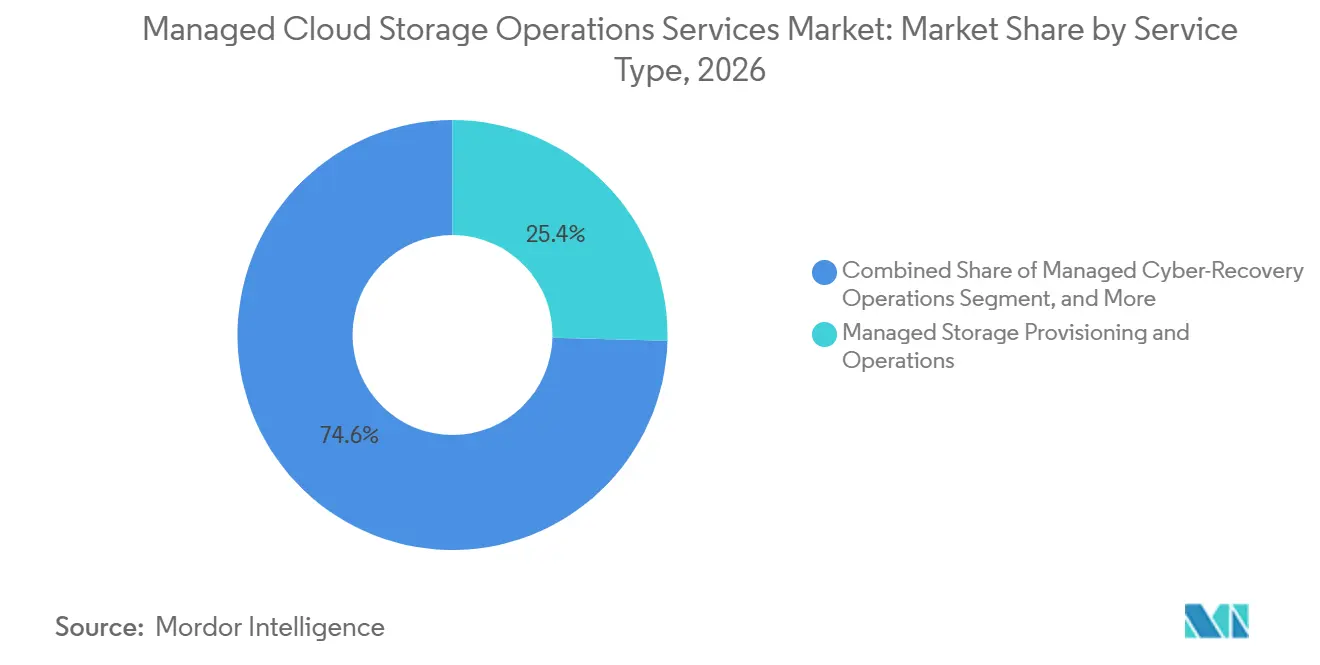
Cyber-Recovery Changes the Service Tier HierarchyManaged Storage Provisioning and Operations accounted for 25.43% of 2026 revenue, giving it the leading position in the Managed cloud storage operations services market. The service addresses the hybrid NAS and SAN environments that many enterprises manage alongside cloud object storage, including the practical work of monitoring utilization, setting policies, handling capacity changes, and coordinating storage across separate technical teams. These Managed cloud storage operations services market environments require ongoing oversight as storage policies, data placement, and recovery procedures span multiple platforms, because operational mistakes can affect system performance, compliance records, user access, and the ability to restore information when it is needed. In the Managed cloud storage operations services market, Managed Backup and Restore Operations and Managed Disaster Recovery Operations remain important because documented, tested recovery capabilities are common compliance requirements. Managed Data Archiving and Retention is gaining relevance as organizations use older data for AI inference and retrieval-augmented generation workflows, requiring providers to balance long retention periods with retrieval needs, access controls, cost visibility, and the reliable movement of information between storage tiers.
Managed Cyber-Recovery Operations is projected to expand at a 19.95% CAGR through 2032, the highest rate among service types. The Managed cloud storage operations services industry is moving beyond passive backup toward recovery operations that can be activated during a security incident, allowing clients to treat recovery readiness as an ongoing service discipline rather than an untested procedure only considered after an attack. Managed Storage Security and Compliance also becomes relevant when cyber insurers require certified controls for backup environments. Full-service providers can combine provisioning, backup, and cyber-recovery under a unified service-level agreement. Point providers face pressure when they cannot demonstrate coordinated recovery across the service stack.

By Organization Size:
SME Adoption Narrows the Managed Services GapLarge enterprises accounted for 66.36% of 2026 revenue and held the largest share of the managed cloud storage operations services market. Their scale reflects high data volumes, complex compliance needs, and multi-cloud operating models. Many large organizations run legacy SAN and NAS systems together with cloud object storage. This mix can make policy management, tiering, and recovery planning difficult for generalist internal teams, especially where each system has different management tools, operating procedures, and retention settings. IBM introduced Secure Automated Backup with Compass in March 2026 for workloads across AWS, Azure, Google Cloud, Alibaba Cloud, Windows, Linux, AIX, IBM Power, and VMware.
SMEs are projected to expand at a 15.74% CAGR through 2032, making them the fastest-growing organization-size segment. In the Managed cloud storage operations services market, consumption-based pricing reduces the upfront infrastructure commitments that previously restricted access to enterprise-grade operations, while allowing smaller organizations to purchase specialist administration, protection, and recovery support in a form that can be matched to changing requirements. Wasabi found that 49% of organizations exceeded cloud storage budgets in 2025. The same research found that 42% attributed these overruns to data operations fees rather than capacity costs. For the managed cloud storage operations services market, fixed-fee services can make these costs easier for SMEs to manage. Veeam stated that its VCSP program has more than 12,000 MSP partners, providing a delivery channel for managed recovery services.[5]
By End-User Industry:
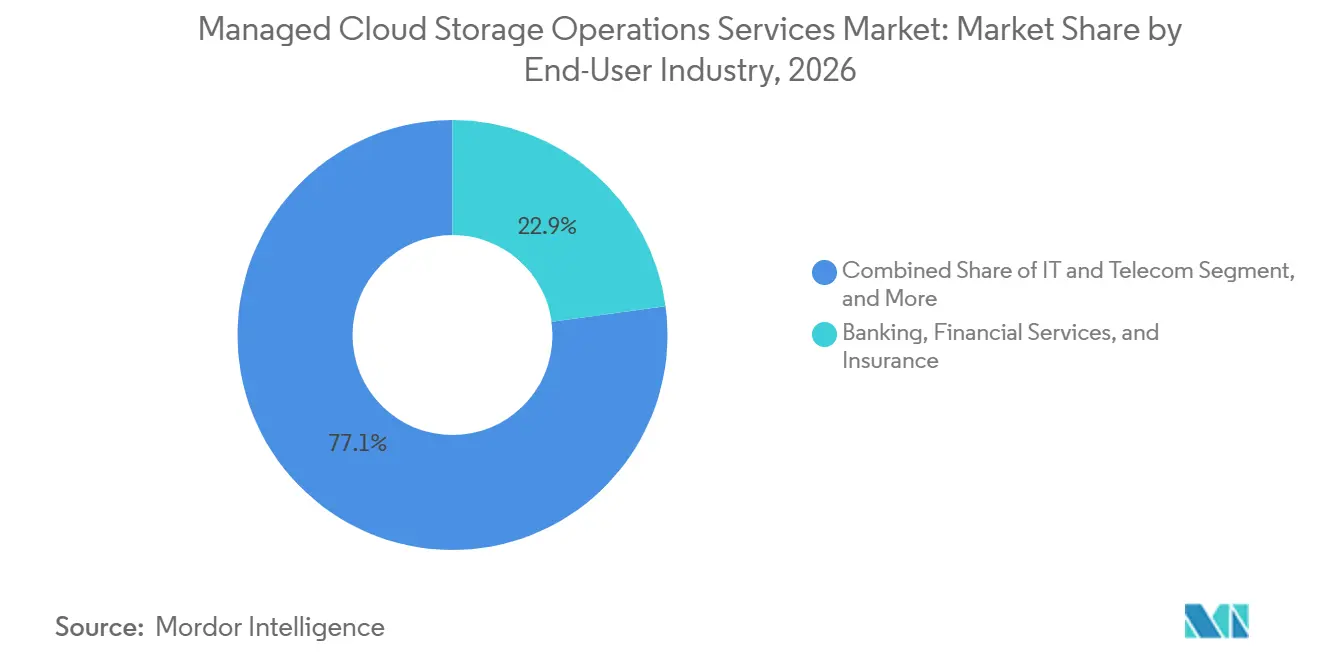
Compliance and AI Shape Vertical DemandBFSI accounted for 22.87% of 2026 revenue, making it the largest end-user segment. Within the managed cloud storage operations services market, its position reflects data retention obligations and the need for isolated recovery environments. DORA, GDPR, and related requirements make validated backup copies a procurement requirement for many financial institutions. Cyber insurance conditions can also require air-gapped recovery capability. IT and Telecommunications remain major user groups because they operate data-intensive platforms and need capacity optimization across cloud environments.
Healthcare and Life Sciences are projected to expand at a 15.59% CAGR through 2032, the fastest rate among end-user industries. For the managed cloud storage operations services market, clinical record digitization and diagnostic imaging increase the volume and sensitivity of information that must be retained. Healthcare buyers also need services that meet HIPAA and HITECH requirements and support clinical standards, because patient information, imaging records, research data, and care coordination systems must remain protected while being available to authorized users. Government and Public Administration is gaining attention in the Middle East because sovereign cloud policies favor in-region services, creating a preference for providers that can show how data location, operational control, and recovery obligations are managed within national boundaries. Manufacturing, retail, energy, and utilities each require specialized protection approaches for operational technology, distributed pipelines, or critical infrastructure data.
Geography Analysis
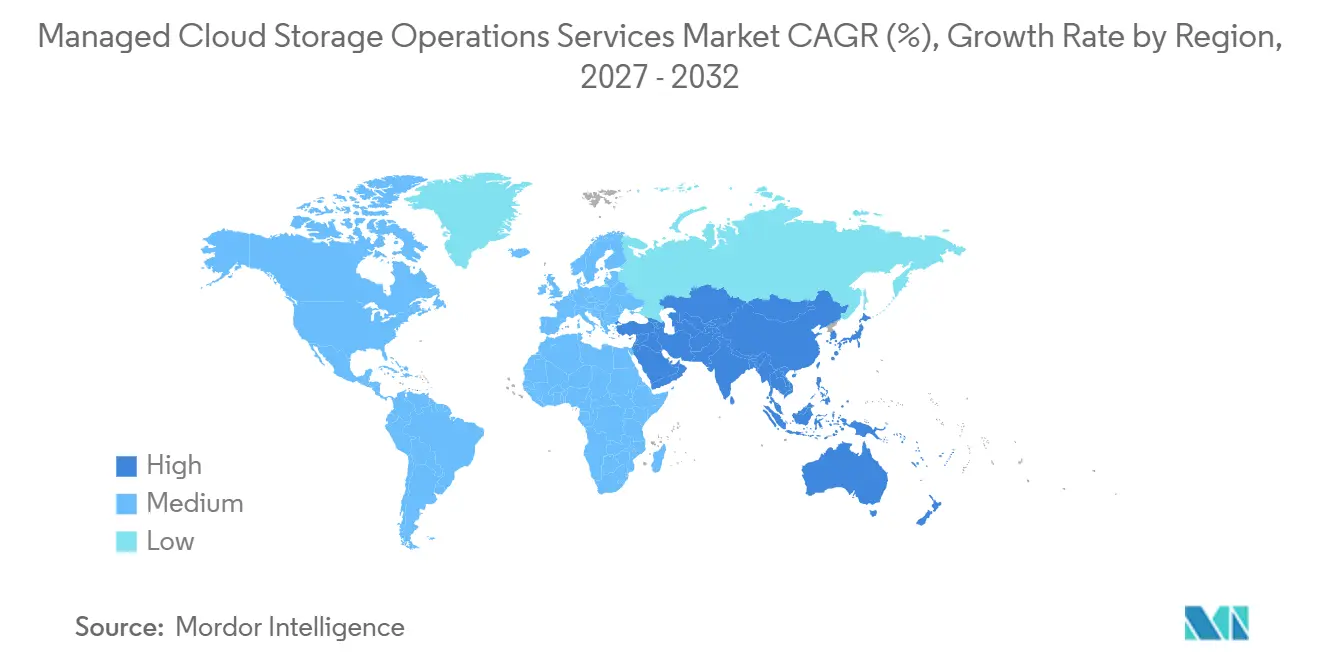
North America held 37.14% of 2026 revenue, the largest share in the Managed cloud storage operations services market. The Managed cloud storage operations services market in the region benefits from a high concentration of hyperscale infrastructure and mature enterprise cloud adoption. Healthcare, payment, and securities requirements also increase demand for documented storage and recovery processes, particularly where buyers must demonstrate that critical records can be restored within defined time frames. AWS introduced automated storage migration assessments in October 2026 for Amazon S3, EBS, EFS, and FSx, showing how cloud providers are embedding advisory support into migration workflows.
Europe is the second-largest Managed cloud storage operations services market region and operates within a dense regulatory environment, where buyers must consider how providers will manage portability, local operations, recovery testing, and encryption controls. GDPR, NIS2, DORA, and the EU Data Act favor providers that can demonstrate local infrastructure and encryption key management, creating practical advantages for firms with established regional delivery models. Germany, the United Kingdom, France, and Italy are the largest national markets within the region. Veeam's sovereign service provider initiative indicates that jurisdictional control and in-region operations are gaining greater weight in European buyer decisions.
The Middle East is projected to expand at a 16.00% CAGR through 2032, the fastest pace among regions. The UAE's AED 545 million commitment to national data centers and sovereign cloud infrastructure supports regional capacity development and provides local organizations with a broader range of in-region options for managed delivery. Managed cloud storage operations services market demand in Asia-Pacific is supported by cloud adoption across China, India, Japan, and South Korea. South America is supported by financial services digitization and LGPD compliance, while Africa is gaining cloud connectivity as carrier-neutral data center capacity expands, though service availability remains less mature than in the largest regional markets.
Competitive Landscape
The Managed cloud storage operations services market includes hyperscalers, storage hardware suppliers, data-protection specialists, and managed service integrators. Amazon Web Services, Microsoft Corporation, and Google LLC benefit from platform integration and global infrastructure, allowing them to connect storage services with broader compute, security, data, and application offerings. NetApp, Dell Technologies, and Hewlett Packard Enterprise bring storage platform expertise, particularly for customers that continue to operate hybrid environments with both on-premises and cloud-based systems. Veeam, Rubrik, Commvault, and Cohesity focus on data protection and cyber-recovery, where the quality of recovery orchestration can be more important than raw storage capacity alone. IBM, Rackspace Technology, Tata Consultancy Services, and DXC Technology provide broader managed service delivery across client environments, appealing to buyers seeking a single operating partner for infrastructure and recovery activities.
Competition in the Managed cloud storage operations services market is based on ecosystem reach, recovery assurance, sovereign compliance, and the ability to support complex workloads, with buyers also assessing implementation support, contractual responsibility, service continuity, and the practical ease of managing data across cloud and on-premises settings. Veeam stated that its VCSP program includes more than 12,000 MSP partners, which supports reach among smaller customers and local markets, while enabling partners to apply their service expertise to client environments that may be too small for direct enterprise delivery models. IBM and Google Cloud launched a Google Cloud Practice in June 2026 that combines IBM Consulting Advantage with Google Cloud's Gemini Enterprise Agent Platform across cybersecurity and data capabilities. These moves show that alliances can help suppliers offer managed storage without requiring customers to redesign every application, reducing implementation friction for organizations with established data and application estates, where migration risk and operational disruption can slow technology decisions.
Opportunities in the Managed cloud storage operations services market remain in managed cyber-recovery for SMEs, sovereign services for regulated mid-market firms, and protection for edge and operational technology data, where conventional central storage approaches may not meet location or latency needs. Rackspace Technology and Rubrik launched Rackspace Cyber Recovery Cloud in April 2025 with a managed, air-gapped recovery service for mission-critical workloads. Rubrik and Rackspace Technology also launched a cyber-recovery service in May 2025 that includes DevOps automation, immutable backups, and Recovery as Code. The Managed cloud storage operations services market structure remains moderately concentrated among large suppliers, while specialist providers continue to compete through focused recovery and compliance capabilities.
Managed Cloud Storage Operations Services Industry Leaders
-
Rackspace Technology, Inc.
-
IBM Corporation
-
NTT DATA, Inc.
-
Fujitsu Limited
-
Tata Consultancy Services Limited
- *Disclaimer: Major Players sorted in no particular order
Managed Cloud Storage Operations Services Market Companies Covered in this Report
- Rackspace Technology, Inc.
- International Business Machines Corporation
- Fujitsu Limited
- NTT DATA, Inc.
- Tata Consultancy Services Limited
- Wipro Limited
- DXC Technology Company
- Capgemini SE
- Atos SE
- Hewlett Packard Enterprise Company
- Dell Technologies Inc.
- Amazon Web Services, Inc.
- Microsoft Corporation
- Google LLC
- NetApp, Inc.
- Veeam Software Group GmbH
- Rubrik, Inc.
- Commvault Systems, Inc.
- Cohesity, Inc.
- Iron Mountain Incorporated
Recent Industry Developments in Managed Cloud Storage Operations Services Market
- October 2026: Amazon Web Services launched storage migration assessments within AWS Transform on October 21, 2026, for Amazon S3, EBS, EFS, and FSx, automating on-premises volume mapping to best-fit AWS services with TCO projections and significantly reducing advisory cost barriers for enterprise migration from legacy NAS and SAN environments.
- October 2026: Veeam launched the Veeam Sovereign Service Providers Program on October 20, 2026, adding a Data Sovereignty Competency to its VCSP program that connects customers with local service providers meeting jurisdictional control, in-region operations, and governance criteria for data-residency-sensitive markets in the EU and the Middle East.
- June 2026: IBM and Google Cloud launched a new Google Cloud Practice on June 4, 2026, combining IBM Consulting Advantage with Google Cloud's Gemini Enterprise Agent Platform across cybersecurity and data capabilities in a collaboration IBM described as a multi-billion-dollar opportunity, deploying thousands of certified consultants to support enterprise hybrid cloud and storage modernization.
- April 2026: NetApp and Google Cloud made Google Cloud NetApp Volumes Flex Unified Service Level generally available across all Google Cloud regions on April 22, 2026, providing a single managed storage pool for file and block workloads and enabling enterprises to migrate AI and database workloads into managed cloud storage without rearchitecting applications.
Global Managed Cloud Storage Operations Services Market Report Scope
The Managed Cloud Storage Services Market covers third-party managed services that support the provisioning, administration, protection, optimization, security, and recovery of enterprise data across public, private, hybrid, and multicloud storage environments. The market includes Managed Storage Provisioning and Operations, Managed Backup and Restore Operations, Managed Disaster Recovery Operations, Managed Data Archiving and Retention, Managed Storage Security and Compliance, Managed Storage Capacity Planning and Optimization, and Managed Cyber-Recovery Operations. These services encompass storage infrastructure administration, automated backup management, data replication, disaster recovery orchestration, ransomware-resilient recovery, immutable storage management, data lifecycle governance, capacity forecasting, performance optimization, and regulatory compliance monitoring. Market revenue includes recurring managed service fees and directly associated operational support charges, while excluding standalone storage hardware sales, software license and subscription revenue, raw cloud storage consumption charges, and one-time consulting or implementation services not bundled with ongoing managed operations.
The Managed Cloud Storage Services Market Report is segmented by Service Type (Managed Storage Provisioning and Operations, Managed Backup and Restore Operations, Managed Disaster Recovery Operations, Managed Data Archiving and Retention, Managed Storage Security and Compliance, Managed Storage Capacity Planning and Optimization, and Managed Cyber-Recovery Operations), Organization Size (Large Enterprises and Small and Medium-Sized Enterprises), End-User Industry and Geography, with country-level coverage across major markets within each region. The market sizes and forecasts are presented in value terms (USD).
Segmentation Overview
| Managed Storage Provisioning and Operations |
| Managed Backup and Restore Operations |
| Managed Disaster Recovery Operations |
| Managed Data Archiving and Retention |
| Managed Storage Security and Compliance |
| Managed Storage Capacity Planning and Optimization |
| Managed Cyber-Recovery Operations |
| Large Enterprises |
| Small and Medium-Sized Enterprises |
| Banking, Financial Services, and Insurance |
| IT and Telecommunications |
| Healthcare and Life Sciences |
| Government and Public Administration |
| Industrial Manufacturing |
| Retail and E-Commerce |
| Energy and Utilities |
| Other End-User Industries |
| North America | United States |
| Canada | |
| Mexico | |
| South America | Brazil |
| Argentina | |
| Rest of South America | |
| Europe | Germany |
| United Kingdom | |
| France | |
| Italy | |
| Rest of Europe | |
| Asia-Pacific | China |
| Japan | |
| India | |
| South Korea | |
| Australia and New Zealand | |
| Rest of Asia-Pacific | |
| Middle East | Saudi Arabia |
| United Arab Emirates | |
| Rest of Middle East | |
| Africa | South Africa |
| Nigeria | |
| Rest of Africa |
| By Service Type | Managed Storage Provisioning and Operations | |
| Managed Backup and Restore Operations | ||
| Managed Disaster Recovery Operations | ||
| Managed Data Archiving and Retention | ||
| Managed Storage Security and Compliance | ||
| Managed Storage Capacity Planning and Optimization | ||
| Managed Cyber-Recovery Operations | ||
| By Organization Size | Large Enterprises | |
| Small and Medium-Sized Enterprises | ||
| By End-User Industry | Banking, Financial Services, and Insurance | |
| IT and Telecommunications | ||
| Healthcare and Life Sciences | ||
| Government and Public Administration | ||
| Industrial Manufacturing | ||
| Retail and E-Commerce | ||
| Energy and Utilities | ||
| Other End-User Industries | ||
| By Geography | North America | United States |
| Canada | ||
| Mexico | ||
| South America | Brazil | |
| Argentina | ||
| Rest of South America | ||
| Europe | Germany | |
| United Kingdom | ||
| France | ||
| Italy | ||
| Rest of Europe | ||
| Asia-Pacific | China | |
| Japan | ||
| India | ||
| South Korea | ||
| Australia and New Zealand | ||
| Rest of Asia-Pacific | ||
| Middle East | Saudi Arabia | |
| United Arab Emirates | ||
| Rest of Middle East | ||
| Africa | South Africa | |
| Nigeria | ||
| Rest of Africa | ||
Key Questions Answered in the Report
What is the managed cloud storage operations services market size?
The managed cloud storage operations services market is projected to expand from USD 7.82 billion in 2026 and USD 8.71 billion in 2027 to USD 16.47 billion by 2032, at a 13.59% CAGR.
Which managed cloud storage operations services is expanding fastest?
Managed Cyber-Recovery Operations is projected to expand at a 19.95% CAGR through 2032 as organizations seek tested, security-integrated recovery services.
Why are organizations outsourcing cloud storage operations?
AI workloads, complex hybrid environments, recovery requirements, and compliance obligations are increasing the operational burden of managing storage internally.
Which customer group is expected to adopt managed cloud storage most quickly?
SMEs are expected to expand at a 15.74% CAGR through 2032 because consumption-based services reduce up-front infrastructure requirements.
Which end-user sector is expanding fastest?
Healthcare and Life Sciences is projected to expand at a 15.59% CAGR through 2032, supported by digitized clinical records, imaging data, and compliance needs.
Which region is expanding fastest for managed cloud storage operations services?
The Middle East is expected to expand at a 16.00% CAGR through 2032 as sovereign cloud and national data center investments increase.