
Maltodextrin Market Size and Share
Market Overview
| Study Period | 2022 - 2032 |
|---|---|
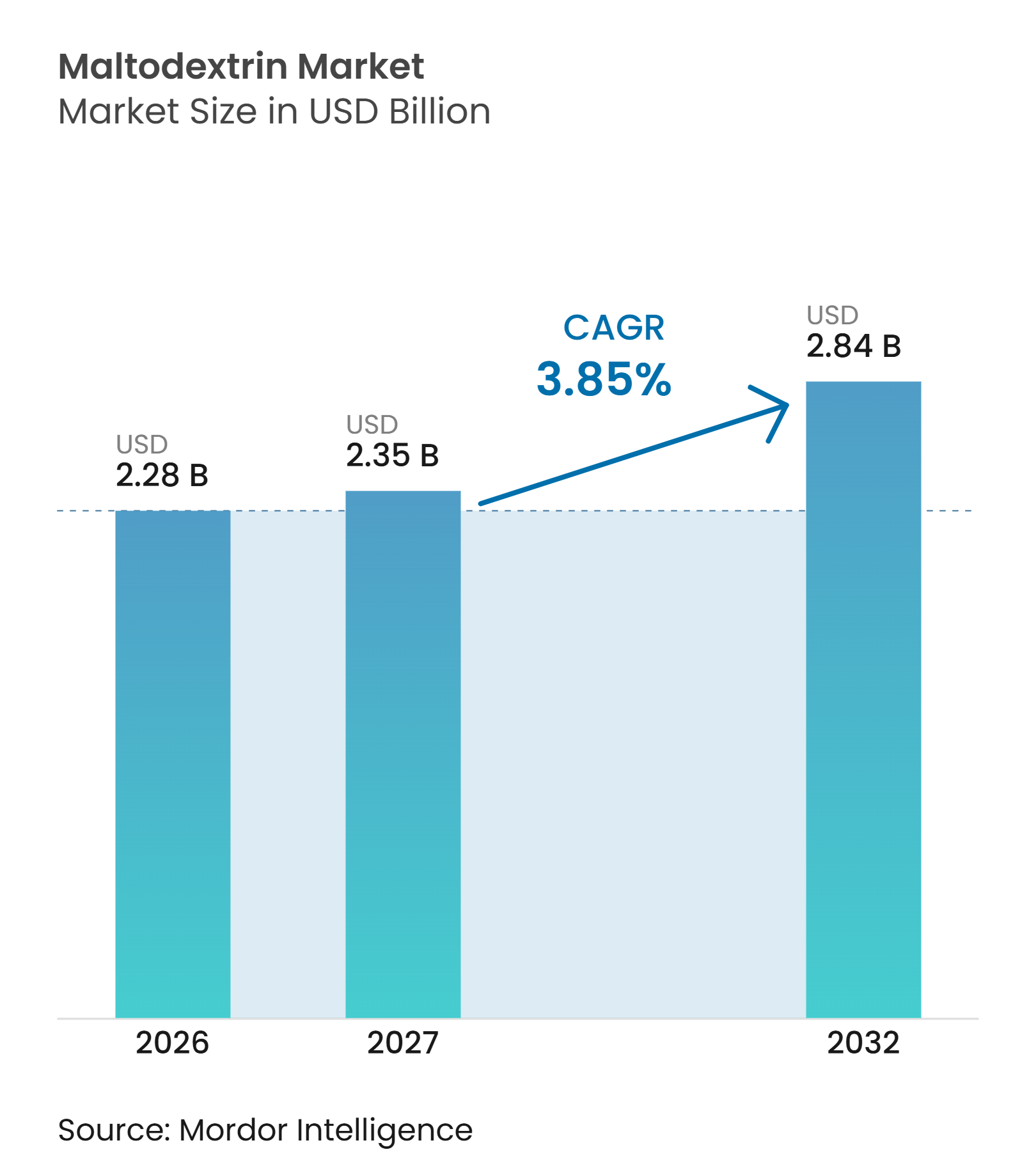
| Market Size (2027) | USD 2.35 Billion |
| Market Size (2032) | USD 2.84 Billion |
| Growth Rate (2027 - 2032) | 3.85 % |
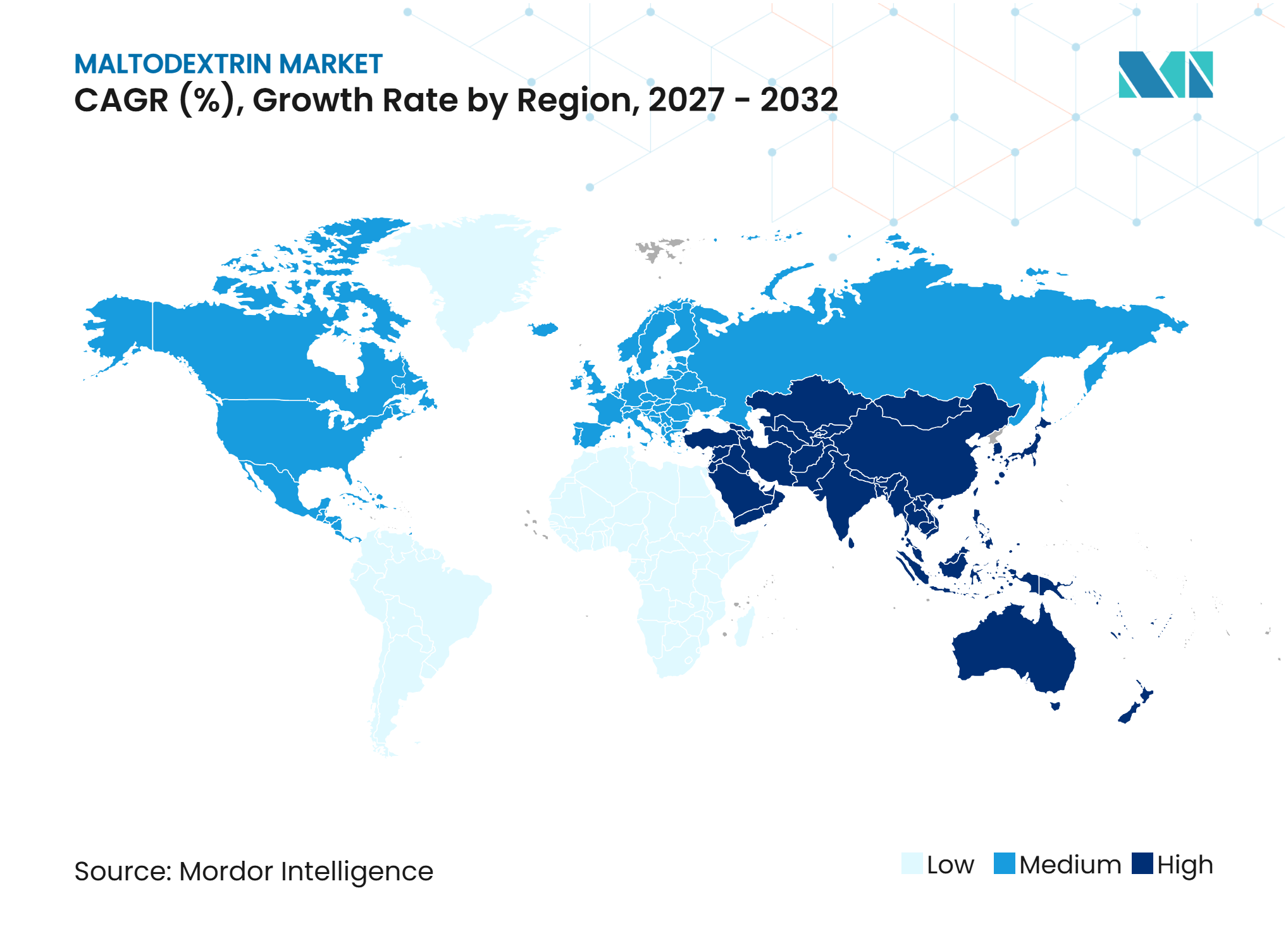
| Fastest Growing Market | Asia-Pacific |
| Largest Market | Asia-Pacific |
| Market Concentration | Medium |
Major Players *Disclaimer: Major Players sorted in no particular order Image © Mordor Intelligence. Reuse requires attribution under CC BY 4.0. | |
Maltodextrin Market Analysis by Mordor Intelligence
The maltodextrin market size is projected to expand from USD 2.28 billion in 2026 and USD 2.35 billion in 2027 to USD 2.84 billion by 2032, registering a CAGR of 3.85% between 2027 and 2032. The maltodextrin market remains supported by functions that are difficult to replace at scale, including bulking, spray drying, encapsulation, and use as a pharmaceutical excipient. Food processors are reducing use in selected clean-label products, while pharmaceutical formulators, sports nutrition brands, and personal care companies are raising their specification requirements. This mix shifts demand toward documented and application-specific grades instead of producing a single pattern across all end uses. The maltodextrin market therefore has a stable base, although feedstock costs, health-related scrutiny, and price competition will shape supplier margins. Producers with qualified grades for resistant, slowly digestible, and pharmacopoeial uses have clearer opportunities to move beyond bulk supply.
Key Report Takeaways
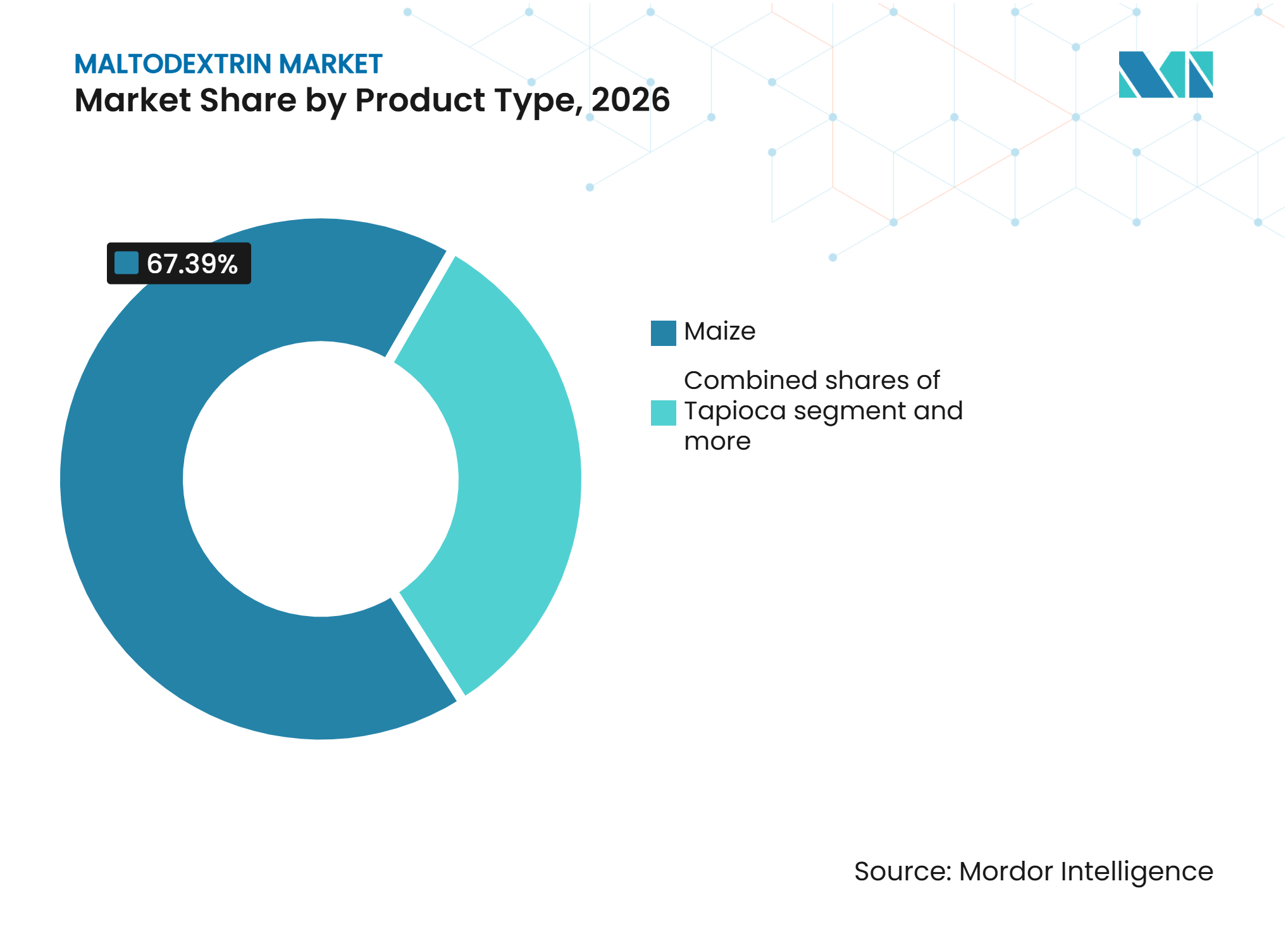
- By source, maize held 67.39% of the maltodextrin market share in 2026, while tapioca is forecast to grow at a 4.27% CAGR through 2032.
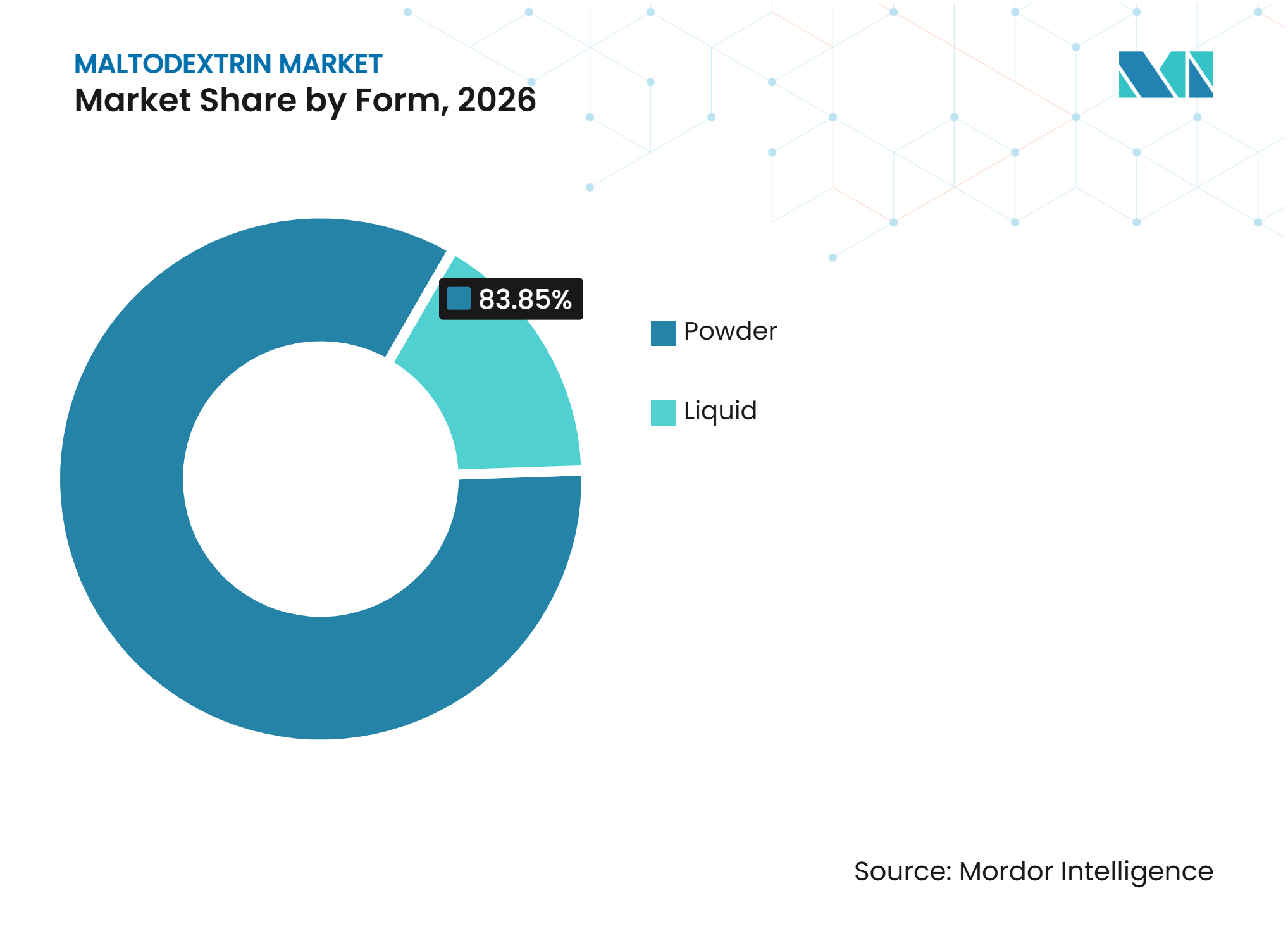
- By form, powder accounted for 83.85% of the maltodextrin market share in 2026, while liquid maltodextrin is expected to expand at a 5.22% CAGR through 2032.
- By application, food and beverage held 68.94% of the market in 2026, while pharmaceutical is projected to grow at a 4.35% CAGR through 2032.
- By geography, Asia-Pacific accounted for 35.11% of the market in 2026 and is forecast to grow at a 5.18% CAGR through 2032.
Note: Market numbers in this report are based on Mordor Intelligence's proprietary estimation framework, which combines nine months of actuals with Q4 projections for base year 2026.
Market Trends and Insights
Drivers Impact Analysis of Maltodextrin Market*
| Driver | (~) % Impact on CAGR Forecast | Geographic Relevance | Impact Timeline |
|---|---|---|---|
| Growing Adoption in Instant Powdered Food Formulations | +0.9% | Global | Medium term (2-4 years) |
| Increasing Utilization as a Flavor Encapsulation Carrier | +0.7% | Global | Medium term (2-4 years) |
| Rising Demand for Carbohydrate-Based Energy Supplements | +0.6% | North America and EU (European Union) | Short term (≤ 2 years) |
| Expanding Pharmaceutical Applications in Drug Formulations | +0.5% | Global, strong in US (United States) and EU | Long term (≥ 4 years) |
| Growing Demand for Maltodextrin in Nutritional Beverages | +0.4% | APAC (Asia-Pacific) core, spill-over to MEA (Middle East and Africa) | Short term (≤ 2 years) |
| Increasing Use in Skin Hydration and Conditioning Formulations | +0.3% | Global, strong in APAC and North America | Medium term (2-4 years) |
| Source: Mordor Intelligence | |||
Growing Adoption in Instant Powdered Food Formulations
Maltodextrin helps convert high-moisture systems into free-flowing powders while keeping the target flavor profile intact. Its film-forming role during spray drying protects active materials against oxygen, moisture, and heat. A 2025 study found that maltodextrin-based carriers improved beta-carotene storage stability in spray-dried systems under accelerated conditions [1]. Fortified dry mixes, ready-to-mix drinks, instant soups, and meal replacements depend on this processing role. The maltodextrin market gains from export-oriented powder production because lower water activity can improve handling across variable supply chains. This use also keeps demand tied to manufacturing needs rather than only to consumer-facing ingredient preferences.
Increasing Utilization as a Flavor Encapsulation Carrier
Maltodextrin is widely used as a wall material for spray-dried flavors because its dextrose equivalent affects skin formation during drying. A 2025 study reported higher d-limonene retention with higher dextrose equivalent grades, which formed more continuous particle walls in spray-dried emulsions, according to doi.org. Food and beverage manufacturers value the neutral taste profile when they work with sensitive flavor systems. Procurement is becoming more specific in professional flavor production, with requests for defined dextrose equivalent ranges, moisture levels, and particle properties. This supports a price ladder within the maltodextrin market that commodity grades cannot readily capture. The same function is relevant to nutraceutical formats that use oils, probiotic cultures, and botanical extracts.
Rising Demand for Carbohydrate-Based Energy Supplements
Rapidly digestible carbohydrates remain useful in intra-workout and post-workout formulations that support glycogen replenishment. Maltodextrin is used in energy gels, electrolyte drinks, and powdered protein blends because it supplies glucose quickly. This creates a different demand setting from reduced-sugar or clean-label packaged foods. Specialty nutrition manufacturers in North America and Western Europe can support higher prices for products built around rapid-energy positioning. Clinical nutrition and rehabilitation settings also broaden the potential customer base beyond conventional sports users. The maltodextrin market is therefore less exposed to food reformulation pressure in this application than in ambient processed foods.
Expanding Pharmaceutical Applications in Drug Formulations
Maltodextrin is moving from a conventional filler role toward use as a functional excipient in advanced oral delivery systems. A 2025 review described its use as a hydrophilic carrier for solid self-emulsifying drug delivery systems that convert liquid lipid formulations into stable powders [2]. Starch-based excipients are also being evaluated for orodispersible films, chewable matrices, and pediatric suspension vehicles. The maltodextrin market is supported by these applications because USP and European Pharmacopoeia requirements create a higher qualification threshold. Suppliers with evidence on reducing sugars, microbiological limits, and heavy metals are better placed to retain these accounts.
Restraints Impact Analysis of Maltodextrin Market*
| Restraint | (~) % Impact on CAGR Forecast | Geographic Relevance | Impact Timeline |
|---|---|---|---|
| Price Competition From Regional Starch Derivative Manufacturers | -0.6% | APAC, EMEA | Short term (≤ 2 years) |
| Fluctuating Maize and Tapioca Starch Procurement Costs | -0.5% | Global | Short term (≤ 2 years) |
| High Energy Consumption During Industrial Spray Drying | -0.4% | Europe, North America | Medium term (2-4 years) |
| Growing Consumer Concerns Regarding High Glycemic Index | -0.5% | North America and EU | Medium term (2-4 years) |
| Source: Mordor Intelligence | |||
Fluctuating Maize and Tapioca Starch Procurement Costs
Maize and tapioca starch are the principal feedstocks, so their cost movements directly affect producer margins. Roquette reported continued grain-cost pressure, elevated energy costs, and container rates 46% above 2019 averages in its June 2025 European starch update. These conditions lengthened procurement lead times for European processors and limited access to high-quality non-GMO corn and wheat. The maltodextrin market also faces price pressure when integrated production capacity in China can offer lower-cost material into regional and export channels. That situation limits pricing flexibility for producers without a feedstock or logistics advantage. Buyers may respond by qualifying more than one origin, which makes supply assurance as important as nominal purchase price.
Growing Consumer Concerns Regarding High Glycemic Index
Consumer concern is most relevant when maltodextrin appears in products positioned as natural, low sugar, or clean label. This pressure is linked to questions about its high glycemic response and its place in highly processed foods. A 2025 commentary in the Journal of the Norwegian Medical Association argued that maltodextrin should be evaluated as an additive because of concerns around intestinal microbiota and mucosal integrity[3]. Food and supplement brands are testing resistant or slowly digestible variants, inulin-type fructans, and other soluble fibers in the most exposed products. The restraint does not apply evenly across the maltodextrin market because pharmaceutical use, food-service demand, and spray-drying operations are less affected by front-of-pack perceptions. Any future labeling response in Europe would matter most for health-positioned consumer goods.
*Our forecasts treat driver/restraint impacts as directional, not additive. The impact forecasts reflect baseline growth, mix effects, and variable interactions.
Maltodextrin Market Segment Analysis
By Source:
Maize Leads but Tapioca Redefines the Premium TierMaize commanded 67.39% of the maltodextrin market size for the source segment in 2026. Its lead reflects long-established wet-milling assets in North America, Europe, and China. Food manufacturer procurement processes, testing protocols, and logistics systems are also built around maize-derived material. These established systems raise switching costs even where alternative inputs can provide similar technical performance. Wheat and potato variants have specialized roles in Europe, where non-GMO certification and origin claims can support price premiums. Roquette and AVEBE serve parts of this specialty demand, with AVEBE using integrated potato-starch production in the Netherlands for pharmaceutical and specialty food customers.
Tapioca is forecast to grow at a 4.27% CAGR through 2032, supported by plant-based, non-GMO, and allergen-free procurement requirements. Indonesia, Thailand, and India supply cassava and tapioca starch to export-oriented manufacturers. The maltodextrin market faces a marketing-led shift when specialty brands specify tapioca maltodextrin to signal naturalness. A 2025 review of tea and herbal powder encapsulation continued to identify maltodextrin as a leading wall material regardless of botanical source, according to MDPI. This keeps the underlying functional requirement in place even as preferences shift among feedstocks. Chinese producers, including Shandong Baolingbao Biotechnology, have broadened non-corn starch hydrolysate portfolios for domestic and export customers. For buyers, the practical comparison increasingly includes allergen declarations, identity-preservation requirements, and the language used on finished-product labels. That changes the commercial position of tapioca even when production performance remains broadly comparable with maize-derived material.



By Form:
Powder Dominates, Liquid Gains in Precision ApplicationsPowder held 83.85% of the maltodextrin market size for the form segment in 2026. The format fits dry mixing, encapsulation, and solid-dose pharmaceutical production. Instant-grade powders use granulation profiles that improve dispersibility and reduce dust during handling. Food and nutrition manufacturers increasingly assess these processing attributes alongside price and core functionality. Roquette’s GLUCIDEX IT range illustrates how suppliers differentiate powder grades for beverages, sports nutrition blends, and infant nutrition. Micro-granulated grades can also support more consistent wetting and simpler dosing on high-throughput production lines. This approach supports specification-based selling in a form that remains central to the maltodextrin market.
Liquid maltodextrin is projected to grow at a 5.22% CAGR through 2032 as users seek to avoid dry reconstitution in pharmaceutical, oral rehydration, and beverage applications. Its earlier limitation was microbiological shelf stability associated with high water activity. A July 2025 patent describes a combined alpha-amylase and pullulanase process designed to produce high-solids liquid maltodextrin with lower water activity. The process addresses the shelf-life constraint that restricted broader liquid use. Ambient distribution could simplify blending for industrial processors and pharmaceutical compounders. Adoption will still depend on quality documentation and purity standards for regulated customers.

By Application:
Pharma Uptake Rebalances the Food-Led Demand MixFood and beverage accounted for 68.94% of the maltodextrin market size in 2026, with bakery, confectionery, and powdered beverages anchoring demand. Bakery and confectionery producers use the ingredient for moisture management and shelf-life support. Beverage applications use it for body, mouthfeel, and spray-dried flavor delivery. Instant foods, functional beverages, sports nutrition, and fortified dairy products support demand where some processed foods reduce loading rates. The maltodextrin market thus has a broad food base even as customer requirements become more selective. Personal care, animal feed, paper coating, textile finishing, and industrial adhesives provide additional but smaller demand pools.
Pharmaceutical use is expected to grow at a 4.35% CAGR through 2032 as manufacturers use maltodextrin in orally disintegrating tablets, orodispersible films, and solid self-emulsifying drug delivery systems. These functions carry greater value than conventional tablet-binder use because they require qualified materials and supporting data. Personal care formulators also use maltodextrin as an encapsulation matrix for plant-derived active ingredients. This role positions the ingredient as an active-delivery material rather than only as a texturizing component. Animal feed uses remain linked to energy supplementation and palatability. Other industrial applications are stable, price-sensitive accounts that usually require standard food-grade or technical-grade supply.
Geography Analysis
Asia-Pacific
Asia-Pacific held 35.11% of the regional value in 2026 and is forecast to grow at a 5.18% CAGR through 2032. China is the production and consumption anchor, with capacity concentrated in Shandong, Hebei, and Heilongjiang near corn-processing corridors. India adds demand through its food and pharmaceutical manufacturing base, while local producers serve customers across the region. Food Safety and Standards Authority of India approvals provide a compliance foundation for maltodextrin-containing products. Thailand’s cassava-processing position also supports tapioca-based export supply chains. Roquette opened a starch and polyol pilot center in Lianyungang, China, in March 2026 to support local formulation development and customer technical work.
North America
North America relies on deeply integrated wet-milling networks operated by ADM, Cargill, and Ingredion, largely within the U.S. Corn Belt. This structure gives processors feedstock proximity and scale, although global grain and demand conditions still affect margins. ADM reported that its Starches and Sweeteners subsegment operating profit fell 21% in FY2025, citing softer global demand and elevated corn costs in EMEA. Food demand is shifting as legacy processed-food applications face clean-label pressure while sports nutrition, protein supplements, and functional foods remain active buyers. The Food and Drug Administration GRAS (Generally Recognized As Safe) classification and USP (United States Pharmacopeia) support allow pharmaceutical customers to use qualified maltodextrin in oral dosage forms. This combination favors suppliers that can serve both large-volume food accounts and customers seeking controlled specifications. Canada and Mexico add regional demand through food manufacturing and cross-border ingredient flows.
Emerging Markets Extend the Maltodextrin Market Reach
Europe serves specialty pharmaceutical and clean-label food accounts through wheat and potato starch processing, particularly in France, Germany, the United Kingdom, Ireland, and Belgium. EU food-additive rules influence grade selection, while high grain, energy, and freight costs have kept pressure on processor margins. The maltodextrin market has a growing opportunity in resistant and slowly digestible variants used in functional food, clinical nutrition, and supplements. South America has corn and cassava capacity in Brazil and Argentina, which supports both domestic demand and export supply. The Middle East and Africa remain smaller consumption areas, but food and pharmaceutical manufacturing in Saudi Arabia, the UAE, and South Africa is increasing import demand. Halal certification and import-quality documentation can influence supplier selection in these markets.
Competitive Landscape
Market Concentration
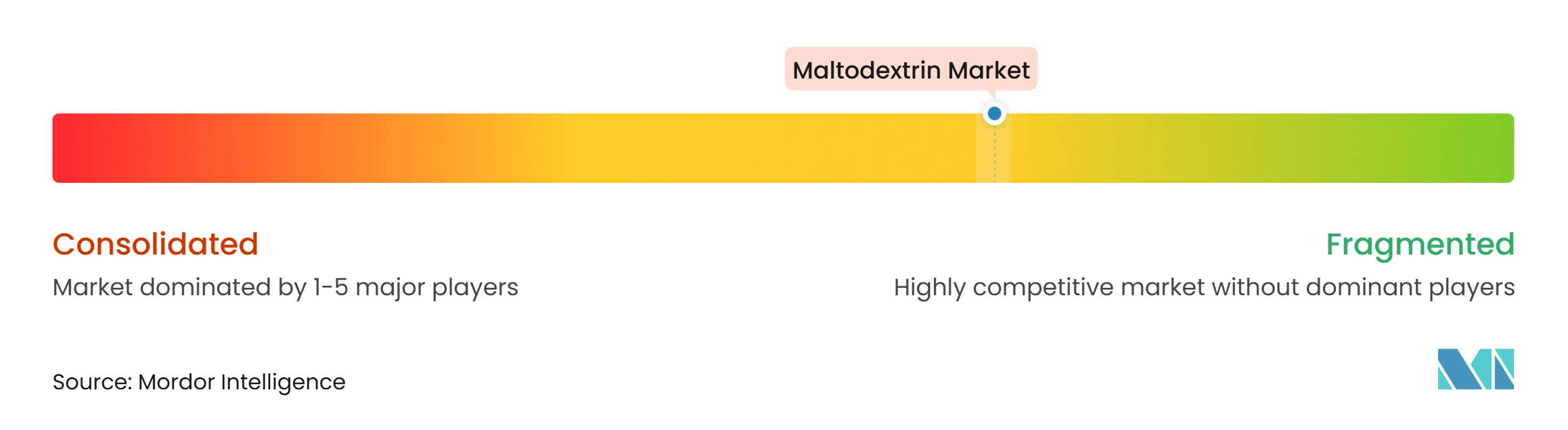
The maltodextrin market is medium, with global agri-processors and regional producers competing at different specification and price levels. ADM, Cargill, Ingredion, Roquette, and Tate & Lyle have advantages in wet-milling scale, application support, pharmacopoeial documentation, and proprietary grades. Tereos, AVEBE, Grain Processing Corporation, Matsutani Chemical, Pioneer Industries, Himalayan Foods and Derivatives, and Maple Biotech add further competitive depth in selected starch and ingredient categories. Regional suppliers in China, India, and Southeast Asia compete more directly on cost for bulk food-grade demand. Companies such as Shandong Baolingbao Biotechnology, Qinhuangdao Lihua Starch, Gulshan Polyols, Gujarat Ambuja Exports, Angel Starch, and PT Satoria Agro Industri serve these price-sensitive accounts.
ADM has responded with a USD 500 million to USD 750 million cost-reduction program targeting manufacturing efficiency by 2028. The maltodextrin market retains a clear divide between bulk supply and qualified materials for higher-value uses. Ingredion reported a tenth consecutive quarter of net sales volume growth for Texture & Healthful Solutions in Q3 2026, attributed to global clean-label demand. The combined company will seek deeper positions in texture, sweetening, and health-oriented formulation work. Smaller suppliers may face more pressure to differentiate through feedstock access, local service, or application knowledge.
Roquette's AMYSTA L 123 is a thermally soluble pea starch made without enzymes or chemicals for ready-to-mix beverages, soups, and condiment mixes. The product can be declared as pea starch in the U.S., making it a label-friendly alternative in applications where conventional carriers face reformulation pressure. Innovation in shelf-stable liquid formats also presents an opportunity for suppliers that can meet appropriate quality requirements. Quality systems and audit-ready documentation are becoming access requirements for pharmaceutical and specialty accounts. Price alone is therefore less decisive for suppliers serving the most regulated end uses.
Maltodextrin Industry Leaders
-
Archer Daniels Midland Company
-
Cargill, Incorporated
-
Ingredion Incorporated
-
Tate & Lyle PLC
-
Roquette Frères S.A.
- *Disclaimer: Major Players sorted in no particular order
Maltodextrin Market Companies Covered in this Report
- Archer Daniels Midland Company
- Cargill, Incorporated
- Ingredion Incorporated
- Tate & Lyle PLC
- Roquette Frères S.A.
- Angel Starch & Food Private Limited
- Tereos S.A.
- Coöperatie Koninklijke Avebe U.A.
- Grain Processing Corporation
- Gujarat Ambuja Exports Limited
- Matsutani Chemical Industry Co., Ltd.
- Sunar Group
- Shandong Baolingbao Biotechnology Co., Ltd.
- Pioneer Industries Private Limited
- Himalayan Foods and Derivatives Limited
- Gulshan Polyols Limited
- Maple Biotech Private Limited
- Qinhuangdao Lihua Starch Co., Ltd.
- Shandong Starlight So True Biological Technology Co., Ltd.
- PT Satoria Agro Industri
Recent Industry Developments in Maltodextrin Market
- July 2026: Ingredion's USD 3.6 billion acquisition of Tate & Lyle was approved by Tate & Lyle shareholders on 28 July 2026, with 98.64% voting in favor. The deal, expected to close in the second half of 2027, will combine Ingredion's texture and healthful solutions portfolio with Tate & Lyle's specialty starch and sweetener expertise, creating a combined entity targeting revenue exceeding USD 10 billion with more than 50% of its portfolio in higher-margin specialty ingredients.
- October 2025: Roquette launched AMYSTA L 123, a thermally soluble pea starch, produced via heat treatment and spray drying without enzymes or chemicals. Positioned as a label-friendly alternative to conventional carrier starches, it serves ready-to-mix beverages, soups, and condiment mixes, and is declarable as "pea starch" in the US, a direct competitive move against maltodextrin's carrier-functionality stronghold in clean-label food applications.
- April 2025: A Journal of Pharmaceutical Sciences study described the use of Roquette's Glucidex IT 19D maltodextrin as a binder in 3D-printed dose-flexible crystalline solid dispersion tablets, confirming pharmaceutical-grade maltodextrin's compatibility with continuous and additive manufacturing platforms for personalized medicines.
Global Maltodextrin Market Report Scope
Maltodextrin is a tasteless, easily digestible carbohydrate produced through the partial hydrolysis of starch derived from sources such as corn, wheat, potato, and tapioca, and is widely used as a thickener, stabilizer, and bulking agent. The maltodextrin market is segmented by source (maize, wheat, potato, tapioca, and other sources), form (powder and liquid), application (food and beverage, pharmaceuticals, personal care and cosmetics, animal feed, and other applications), and geography (North America, Europe, Asia-Pacific, South America, and the Middle East and Africa). The market forecasts are provided in terms of value (USD).
Segmentation Overview
| Maize |
| Wheat |
| Potato |
| Tapioca |
| Other Sources |
| Powder |
| Liquid |
| Food and Beverage | Bakery |
| Confectionery | |
| Beverage | |
| Other Food and Beverages | |
| Pharmaceutical | |
| Personal Care and Cosmetics | |
| Animal Feed | |
| Other Application |
| North America | United States |
| Canada | |
| Mexico | |
| Rest of North America | |
| Europe | Germany |
| United Kingdom | |
| Italy | |
| France | |
| Spain | |
| Netherlands | |
| Rest of Europe | |
| Asia-Pacific | India |
| Japan | |
| Australia | |
| China | |
| Rest of Asia-Pacific | |
| South America | Brazil |
| Argentina | |
| Rest of South America | |
| Middle East and Africa | South Africa |
| Saudi Arabia | |
| United Arab Emirates | |
| Rest of Middle East and Africa |
| By Source | Maize | |
| Wheat | ||
| Potato | ||
| Tapioca | ||
| Other Sources | ||
| By Form | Powder | |
| Liquid | ||
| By Application | Food and Beverage | Bakery |
| Confectionery | ||
| Beverage | ||
| Other Food and Beverages | ||
| Pharmaceutical | ||
| Personal Care and Cosmetics | ||
| Animal Feed | ||
| Other Application | ||
| By Geography | North America | United States |
| Canada | ||
| Mexico | ||
| Rest of North America | ||
| Europe | Germany | |
| United Kingdom | ||
| Italy | ||
| France | ||
| Spain | ||
| Netherlands | ||
| Rest of Europe | ||
| Asia-Pacific | India | |
| Japan | ||
| Australia | ||
| China | ||
| Rest of Asia-Pacific | ||
| South America | Brazil | |
| Argentina | ||
| Rest of South America | ||
| Middle East and Africa | South Africa | |
| Saudi Arabia | ||
| United Arab Emirates | ||
| Rest of Middle East and Africa | ||
Key Questions Answered in the Report
What is driving growth in the maltodextrin market?
Powdered foods, flavor encapsulation, sports nutrition, and pharmaceutical delivery systems support demand through 2032.
What is the forecast for maltodextrin through 2032?
The value is projected to reach USD 2.84 billion by 2032, growing at a 3.85% CAGR from 2027.
Which source is used most widely for maltodextrin?
Maize is the leading source, supported by established wet-milling capacity and supply networks.
Why is tapioca maltodextrin gaining attention?
Its non-GMO and allergen-free positioning helps brands meet selected plant-based and clean-label procurement needs.