
Malaysia Data Center Storage Market Size and Share
Market Overview
| Study Period | 2020 - 2031 |
|---|---|
| Forecast Data Period | 2026 - 2031 |
| Base Year Market Size (2025) | USD 0.90 Billion |
| Market Size (2026) | USD 1.01 Billion |
| Market Size (2031) | USD 1.79 Billion |
| Growth Rate (2026 - 2031) | 12.18 % |
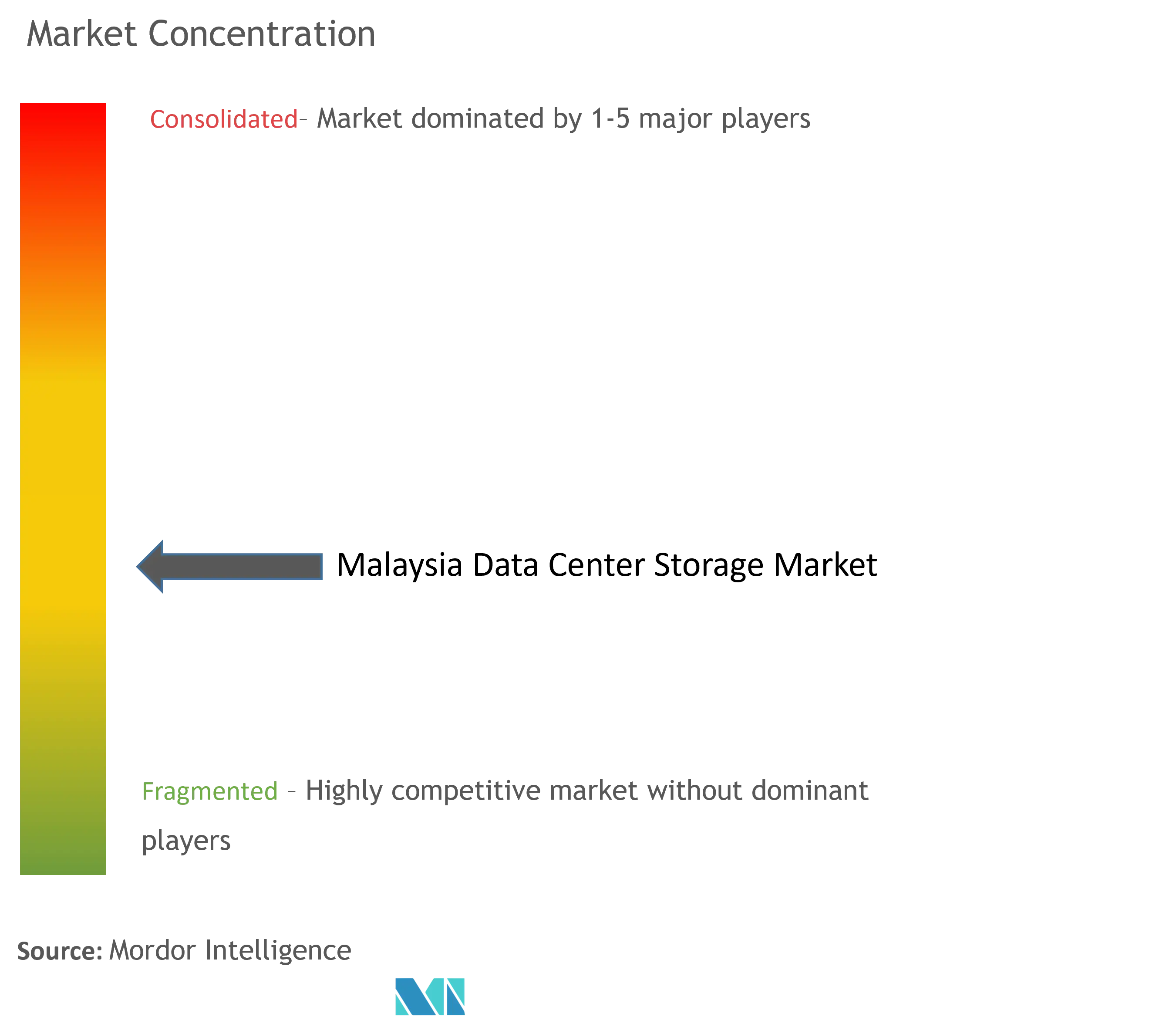
| Market Concentration | Medium |
Major Players *Disclaimer: Major Players sorted in no particular order Image © Mordor Intelligence. Reuse requires attribution under CC BY 4.0. | |
Malaysia Data Center Storage Market Analysis by Mordor Intelligence
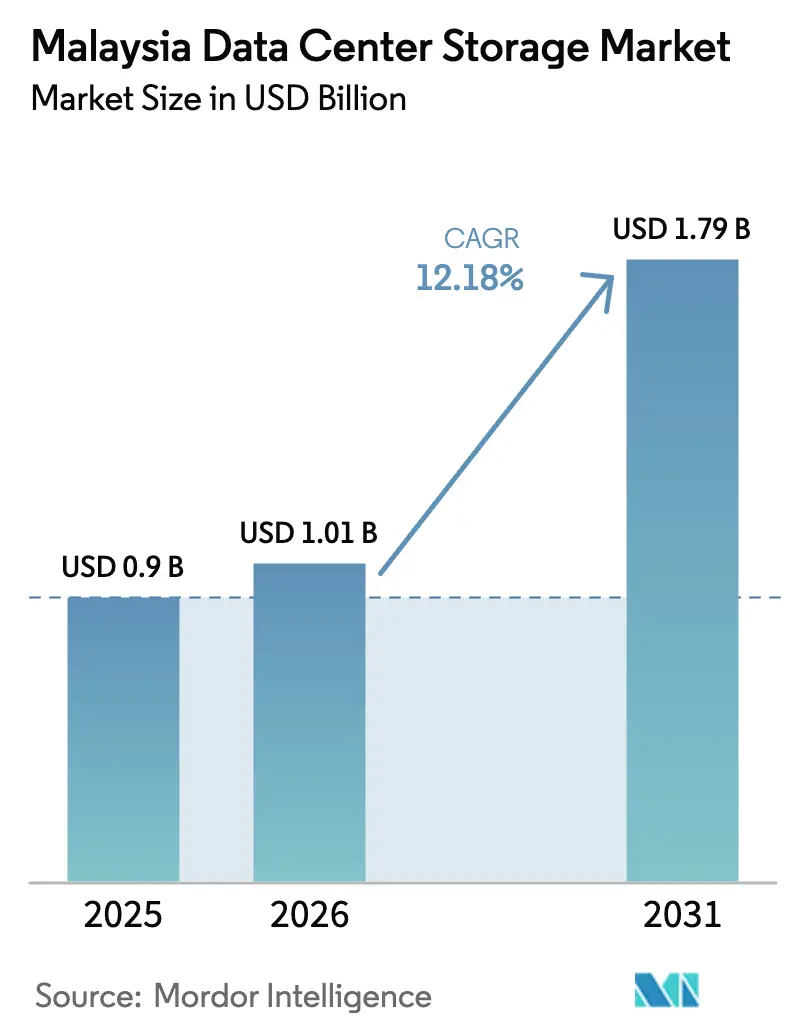
The Malaysia data center storage market size is expected to grow from USD 0.90 billion in 2025 to USD 1.01 billion in 2026 and is forecast to reach USD 1.79 billion by 2031 at 12.18% CAGR over 2026-2031. Surging hyperscale capital expenditure, a nationwide fiber backbone, and the country’s first full-stack sovereign AI platform place the Malaysia data center storage market on a steeper growth trajectory than any other ASEAN peer. AI-centric workloads, 5G standalone core roll-outs, and strict data-residency amendments accelerate the transition from HDD arrays to flash-centric and software-defined architectures. Hyperscale build-outs in Johor Bahru alone exceed 1.6 GW of capacity, fueling multi-petabyte demand for enterprise-grade storage while amplifying competition among vendors to supply NVMe-enabled systems. Talent deficits in storage architecture and volatile NAND pricing remain the primary constraints, yet government skills funds and fiscal incentives for high-performance computing soften the impact.
Key Report Takeaways
- By storage technology, Storage Area Networks led with 38.05% revenue share in 2025, whereas Network Attached Storage is forecast to expand at a 15.72% CAGR through 2031.
- By storage type, traditional HDD arrays accounted for 46.55% of the Malaysia data center storage market size in 2025, while all-flash arrays are advancing at a 16.92% CAGR to 2031.
- By data center type, colocation facilities held 53.55% Malaysia data center storage market share in 2025; hyperscalers and CSPs post the fastest-growing CAGR at 17.86% through 2031.
- By end user, IT and Telecommunications commanded 30.95% share in 2025, yet BFSI is set to grow at a 19.05% CAGR up to 2031.
- By form factor, rack-mounted systems dominated with 62.70% revenue share in 2025, whereas disaggregated and composable platforms will post a 14.78% CAGR through 2031.
- By interface, SAS/SATA retained 53.85% share in 2025; NVMe is projected to rise at a 16.12% CAGR across the forecast period.
Note: Market size and forecast figures in this report are generated using Mordor Intelligence’s proprietary estimation framework, updated with the latest available data and insights as of 2026.
Malaysia Data Center Storage Market Trends and Insights
Drivers Impact Analysis*
| Driver | (~) % Impact on CAGR Forecast | Geographic Relevance | Impact Timeline |
|---|---|---|---|
| Rapid hyperscale and colocation build-outs | +3.2% | Johor and Selangor | Medium term (2-4 years) |
| JENDELA Phase 2 fiber backbone expansion | +1.8% | Nationwide | Short term (≤ 2 years) |
| 5G SA core rollout and private 5G campuses | +2.1% | Urban and industrial zones | Medium term (2-4 years) |
| Government cloud-first initiatives | +1.5% | Nationwide | Long term (≥ 4 years) |
| Edge-ready plantations and smart factories | +0.9% | Peninsula, Sabah, Sarawak | Long term (≥ 4 years) |
| Strict PDPA data-residency compliance | +1.3% | Nationwide | Short term (≤ 2 years) |
| Source: Mordor Intelligence | |||
Rapid Hyperscale and Colocation Build-outs
Johor Bahru doubled operational capacity in 2024 and now exceeds 1.6 GW, attracting Google, Microsoft, Oracle, and NTT to commit more than USD 10 billion to new campuses. Oracle’s USD 6.5 billion plan, Princeton Digital Group’s 150 MW AI-ready facility, and the Johor-Singapore Special Economic Zone signal an escalating need for petabyte-scale all-flash arrays that can sustain AI training throughput. This influx drives the Malaysia data center storage market toward NVMe architectures that synthesize low latency with high bandwidth, giving vendors with AI-optimized offerings a competitive edge
JENDELA Phase 2 Fiber Backbone Expansion
By early 2024, 81.5% population coverage and nearly 40,000 upgraded transmitters under the RM 21 billion JENDELA program produced gigabit links to 7.5 million premises. The extended backbone empowers SMEs in Penang’s semiconductor cluster to adopt distributed storage nodes for latency-sensitive process control. Rural edge nodes in palm-oil plantations leverage JENDELA’s reach to stage IoT sensor data locally before replicating to colocation hubs, stretching the Malaysia data center storage market into previously underserved districts.[1]
5G Stand-Alone Core and Private 5G Campuses
Digital Nasional Berhad’s multi-operator 5G core delivers 99.8% uptime and ultra-low latency, enabling factories to run machine-vision analytics that depend on local cache arrays for split-second inference. Private 5G licenses spur automotive test tracks and industrial parks to embed micro-data centers near base stations, inflating demand for ruggedized flash clusters certified for harsh environments and pushing the Malaysia data center storage market beyond metro zones.[2]
Government Cloud-First and Digital Nasional Initiatives
A USD 356 million national electronic health-records platform and the sovereign AI infrastructure outfitted with 3,000 GPUs mandate on-premises, compliance-grade storage tiers that interoperate with public cloud. Agencies migrating legacy databases to SaaS still need local vaults for citizen data protected by the amended PDPA, broadening hybrid and object storage uptake across the Malaysia data center storage market
Restraints Impact Analysis*
| Restraint | (~) % Impact on CAGR Forecast | Geographic Relevance | Impact Timeline |
|---|---|---|---|
| High capex for Tier III/IV infrastructure | -2.1% | Nationwide, SME centric | Medium term (2-4 years) |
| Skilled storage-architect talent shortage | -1.8% | Kuala Lumpur and Johor | Short term (≤ 2 years) |
| Global NAND/HDD supply-chain volatility | -1.4% | Import-dependent Malaysia | Short term (≤ 2 years) |
| Ringgit-dollar exchange risk | -0.9% | Nationwide | Short term (≤ 2 years) |
| Source: Mordor Intelligence | |||
High Capex for Tier III/IV Infrastructure
Meeting Tier III redundancy elevates initial storage costs by 40-60%, a hurdle for Malaysia’s 3,000 Penang-based SMEs that rarely budget RM 500,000 per project. Although the Industry4WRD fund subsidizes upgrades, many firms delay transitions, limiting near-term penetration of advanced all-flash arrays within the Malaysia data center storage market
Global NAND/HDD Supply-Chain Volatility
AI-triggered demand spikes have prompted multinationals to signal 5–10% list-price increases on flash and HDD media. Malaysian buyers, already cost-sensitive, now renegotiate procurement calendars or down-scope capacity, postponing refreshes across the Malaysia data center storage market.[3]
*Our forecasts treat driver/restraint impacts as directional, not additive. The impact forecasts reflect baseline growth, mix effects, and variable interactions.
Segment Analysis
By Storage Technology: SAN Dominance Amid NAS Acceleration
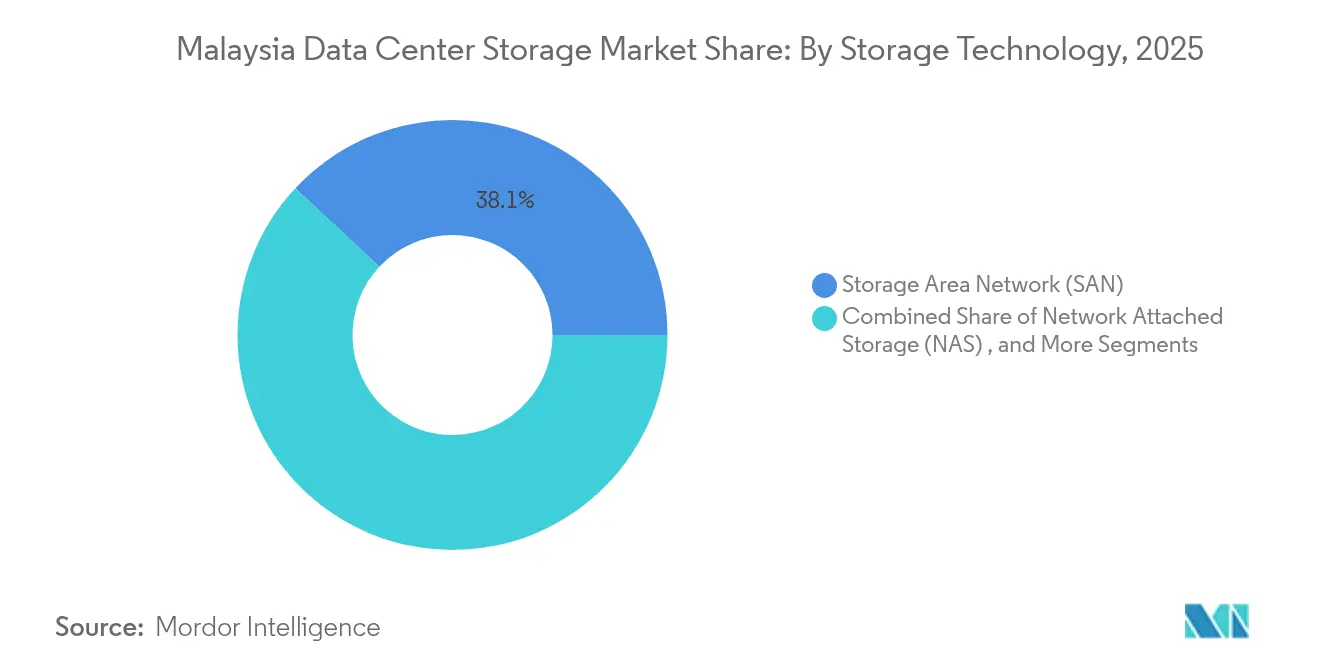
Storage Area Networks captured 38.05% of Malaysia data center storage market share in 2025, confirming entrenched demand for block-level performance in financial services and smart-factory ERP clusters. High-availability SAN fabrics synchronized across Cyberjaya and Johor underpin regulatory DR mandates. Network Attached Storage, growing at a 15.72% CAGR, appeals to SMEs that prioritize simplified file shares and scalable capacity without FC licensing. The Malaysia data center storage market size for NAS solutions is projected to double by 2030, aligning with expanding creative-content workloads and collaboration suites.
Adoption of software-defined storage overlays amplifies both SAN and NAS flexibility. Dell’s PowerScale, already deployed by more than 16,000 GPU users globally, gains traction among AI start-ups seeking petabyte consolidation without forklift migrations. NetApp’s distributed cloud fabric with Google Cloud grants CIOs a single namespace across on-prem, Johor hyperscale nodes, and sovereign AI clusters, reinforcing hybrid leadership in the Malaysia data center storage market.

By Storage Type: Traditional HDD Resilience Versus Flash Uptake
Conventional HDD arrays held 46.55% share of the Malaysia data center storage market in 2025, leveraged for video surveillance archives and low-frequency medical images that tolerate higher latency. Yet all-flash arrays are sprinting at 16.92% CAGR as AI training, real-time payments, and high-frequency analytics dictate sub-millisecond latency. The Malaysia data center storage market size for flash is forecast to surpass USD 782.6 million by 2031, despite macro headwinds.
Hybrid platforms mitigate cost and performance tension: automatic tiering drives hot data onto NVMe SSD pools while cold blocks remain on nearline HDD. Seagate’s 40 TB HAMR drives and NVMe HDD prototypes could further compress TCO, delaying full flash substitution but expanding total terabytes shipped within the Malaysia data center storage market.
By Data Center Type: Colocation Primacy with Hyperscale Surge
Colocation suites represented 53.55% of revenue in 2025 as enterprises outsource resilience and compliance to specialized operators. Hyperscalers, however, clock an 17.86% CAGR through 2031, propelled by Google’s USD 2 billion Elmina facility and Microsoft’s tri-zone launch. Hyperscale investors integrate liquid cooling and composable fabrics that redefine density norms, steering the Malaysia data center storage market toward rack-level flash enclosures exceeding 700 kW per hall.
Meanwhile, edge micro-data centers install 42U cabinets in factories and plantations to localize AI inference. These deployments, though individually modest, aggregate to double-digit contribution by 2030, underscoring the Malaysia data center storage market’s diversification beyond traditional metros.
By End User: IT and Telecoms Lead, BFSI Accelerates
Operators such as Telekom Malaysia and Maxis, combined with cloud platforms, secured 30.95% 2025 revenue through fiber backhaul expansions and private 5G offerings. Banking and Financial Services, under Bank Negara’s refreshed RMiT framework, records a 19.05% CAGR as digital-bank licensees and incumbent institutions encrypt core databases on Tier IV SAN clusters. The Malaysia data center storage market size for BFSI is expected to approach USD 332.4 million by 2031, driven by open-API ecosystems and real-time fraud analytics.
Government ministries modernize census and taxation workloads onto sovereign clouds while retaining sensitive rows in on-prem flash vaults. Manufacturing SMEs adopting OEE dashboards and AI-assisted quality inspection equally stimulate incremental array shipments in the Malaysia data center storage market.
By Form Factor: Rack-Mounted Dominance with Composable Innovation
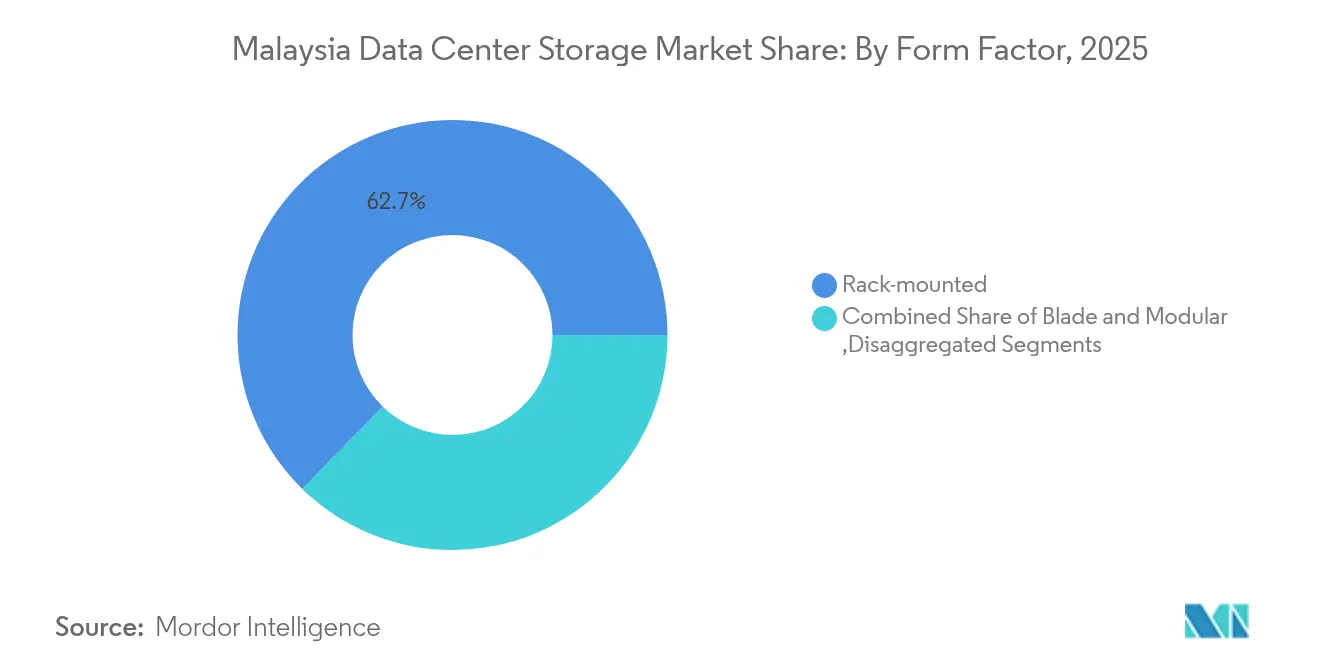
Rack-mounted arrays controlled 62.70% of 2025 spend due to universal cabinet dimensions and re-use of existing PDUs. Composable disaggregated infrastructure, posting 14.78% CAGR, grants hyperscalers dynamic assignment of GPU, CPU, and NVMe pools, slashing over-provisioning by some 45%. Malaysia data center storage market entrants that certify against liquid cooling and Open Compute Project specs are poised to outpace legacy chassis vendors.
Blade and modular enclosures survive in telecom huts and disaster-recovery bunkers where space and serviceability override other factors. Their persistent share safeguards multi-vendor competition inside the Malaysia data center storage market.
By Interface: SAS/SATA Stability with NVMe Transformation
Legacy SAS/SATA counted for 53.85% 2025 port shipments. NVMe’s 16.12% CAGR is anchored by GPU clusters that saturate PCIe 5.0 lanes and require microsecond access. Prototype NVMe HDDs may bridge protocol gaps, allowing operators to converge management stacks across flash and magnetic media—a development likely to reconfigure cost models inside the Malaysia data center storage market.
Fibre Channel remains a mainstay in regulated BFSI zones. iSCSI persists in branch environments where 10 GbE switches capex is sunk. Even so, NVMe-over-Fabrics pilots in two Kuala Lumpur trading floors demonstrate the next performance step for the Malaysia data center storage market.
Geography Analysis
Johor Bahru anchors the Malaysia data center storage market with more than 1.6 GW of operational capacity in 2025, reflecting over USD 10 billion of disclosed hyperscale investments. The Johor-Singapore Special Economic Zone further institutionalizes cross-border cloud traffic under aligned compliance frameworks, encouraging metro-cluster SAN replications across the causeway. Selangor’s Cyberjaya corridor remains the nation’s enterprise nucleus, hosting Google’s inaugural Malaysian data center and a 256 MW campus by Vantage; its colocation halls report 82% utilization in Q1 2025, ensuring steady refresh cycles for flash arrays.
Kuala Lumpur drives transactional workloads and hybrid migrations from ministries embarking on cloud-first policies. The forthcoming Microsoft cloud region will swing substantial AI-training demand into nearby edge cache tiers, swelling flash and NVMe interface uptake across the Malaysia data center storage market. Penang’s 3,000 electronics SMEs accelerate Industry 4.0 pilots, each embedding modest yet proliferating NAS appliances that cumulatively add high-double-digit petabytes by 2030.
Sarawak and Sabah trail in current capacity yet show strongest percentage growth. State-funded fiber backbones and green-hydro PPAs lure operators seeking renewable power footprints, positioning East Malaysia as the next expansion wave. Distributed edge nodes in palm-oil estates and smart ports funnel streaming data into regional micro-data centers, enlarging geographic breadth for the Malaysia data center storage market.
Regulatory Landscape
Malaysia does not operate under a single data center-specific statute, so storage procurement and deployment are shaped by a layered approval and compliance environment spanning federal agencies (including MITI and MIDA), the Ministry of Digital (via Malaysia Digital status administered by MDEC), and local authorities. Sustainability screening has become more explicit through the national sustainable data center guidelines, including requirements for new facilities to declare PUE, CUE, and WUE using ISO/IEC 30134 metrics. This affects storage refresh choices toward higher-density flash and software-defined architectures that can reduce power per usable TB.
In 2026, policy emphasis tightened around resource management and high-tech positioning, with new data center applications steered toward AI or high-technology-aligned projects. That raises the bar for workload-critical, high-throughput storage. On the fiscal side, effective 1 January 2026, import duty and sales tax exemptions for Malaysia Digital (MD) companies moved to Ministry of Finance approval on a case-by-case basis, limited to direct specialised equipment, which can affect landed costs and bill-of-material decisions for imported arrays and components. For regulated end users, especially BFSI, Bank Negara Malaysia’s RMiT requirements continue to anchor controls for data security, resilience, and disaster recovery, reinforcing demand for compliant SAN replication, encryption, and immutable backup storage within Malaysia.
Value Chain Analysis
The Malaysia data center storage value chain relies on largely imported upstream components (NAND, HDD media, controllers, NICs/HCAs, and server platforms) before converging into storage system OEMs and ODMs. These suppliers provide all-flash arrays, hybrid systems, and software-defined stacks used by hyperscalers, colocation operators, and enterprise data centers. Distribution and solution delivery typically run through local channel partners and systems integrators that design architectures, integrate networking and compute, and provide installation, maintenance, and managed services, with procurement often bundled into wider data center build-outs in Johor and the Cyberjaya corridor.
Local value capture is stronger in engineering, integration, facilities work, and lifecycle operations than in core hardware manufacturing. Government-linked programs such as MIDA’s Digital Ecosystem Acceleration (DESAC) scheme (in effect until 31 Dec 2027) promote domestic capability building across network infrastructure, systems integration, cooling, and electrical power systems, which in turn shapes storage deployment, including configuration choices aligned to sustainable operations and higher-density halls. Large hyperscale investors have also highlighted domestic supplier participation, such as AirTrunk reporting RM423 million in contracts awarded to local suppliers with targets to scale to RM5 billion, reinforcing an environment where locally delivered services and infrastructure packages sit alongside imported storage hardware.
Competitive Landscape
The Malaysia data center storage market sits at a moderate concentration level, with Dell Technologies, Hewlett Packard Enterprise, and NetApp holding a collective leadership yet facing vigorous pursuits from Pure Storage and Huawei. Dell’s Partner-First Storage initiative, aligned with Johor hyperscale builds, aims to quadruple managed accounts by 2027. NetApp’s workload-aware fabric tightly integrates with Google Cloud’s dual-region strategy, carving a niche in regulated hybrid environments. Pure Storage invests in LandingAI and deploys FlashBlade//E in sovereign AI clusters, sharpening differentiation on low-carbon flash.
Huawei, riding sovereign AI contracts, offers ARM-based servers bundled with OceanStor arrays that rival established vendors on price-performance, injecting downward pricing pressure within the Malaysia data center storage market. Seagate’s HAMR roadmap secures future high-capacity HDD continuity, vital for cold archives in compliance-bound enterprises. White-label ODMs, meanwhile, cater to hyperscalers adopting open rack standards, fragmenting share beneath the Tier 1s and ensuring robust vendor competition.
Strategic moves include Equinix pursuing renewable PPAs to hedge tariff creep, and Vantage Data Centers’ RM 6 billion Cyberjaya project that embeds liquid-cool composable fabrics from inception, signaling an industry pivot toward density-optimized flash rows and GPU-linked NVMe fabrics across the Malaysia data center storage market.
Malaysia Data Center Storage Industry Leaders
-
Dell Inc.
-
Hewlett Packard Enterprise
-
NetApp Inc.
-
Huawei Technologies Co. Ltd.
-
Kingston Technology Company Inc.
- *Disclaimer: Major Players sorted in no particular order
Market Opportunities and Future Outlook
Malaysia’s shift toward AI-aligned data center approvals in 2026, alongside the rollout of sovereign AI infrastructure, creates whitespace for storage suppliers that can deliver high-throughput NVMe designs, GPU-adjacent parallel file systems, and object storage optimized for model training pipelines. At the same time, providers need to meet stricter sustainability reporting requirements under ISO/IEC 30134. The sovereign AI cloud initiative, backed by an RM2 billion government commitment, supports demand for compliant, on-shore storage tiers, including encrypted primary arrays and immutable backup, that can integrate with hybrid cloud operating models used by ministries and regulated industries.
A second opportunity is localization of the data center supply chain and services layer. DESAC-linked priorities to build domestic capability in network infrastructure, cooling, and electrical components create space for local systems integrators and managed service providers to package storage with higher-density racks, telemetry, and lifecycle optimization services. These services support energy and water efficiency reporting expectations under sustainable data center guidelines. Demand-side momentum also remains tied to hyperscale and colocation expansion in Johor, including AirTrunk developments such as JHB3 and JHB4, which sustains large-scale, multi-petabyte deployments where vendors that can secure supply, manage NAND/HDD price volatility, and provide predictable refresh and maintenance SLAs gain an edge.
Recent Industry Developments
- June 2026: Malaysian developer MRCB announced a collaboration with Perintis Akal Sdn Bhd to develop an AI-ready data center in Bukit Jalil with a gross development cost of RM2.1 billion. The project adds a high-density, AI-oriented site to the Kuala Lumpur corridor, expanding addressable demand for low-latency flash arrays, NVMe fabrics, and resilient backup tiers aligned to enterprise and sovereign workloads.
- May 2026: Equinix announced plans to develop a new purpose-built IBX facility (KL2) in Kuala Lumpur as part of an investment program of about USD 190 million, targeting more than 2,200 cabinets at completion. The addition strengthens carrier-neutral interconnection capacity in Malaysia, supporting hybrid architectures where enterprises combine colocated storage with cloud on-ramps for regulated and latency-sensitive applications.
- October 2024: Oracle announced plans for USD 6.5 billion in cloud infrastructure investment in Malaysia. The commitment reinforces hyperscale-led capacity build-outs that pull through storage demand across primary all-flash arrays, scalable object storage, and disaster recovery replication in Malaysian availability zones.
Research Methodology Framework and Report Scope
Market Definition and Coverage
For this study, the market covers spending in Malaysia on data center storage systems and related storage architectures that are deployed inside enterprise, colocation, and hyperscale facilities to store and serve digital workloads.
Scope exclusions: We exclude general compute servers, pure networking equipment, and building level data center construction costs that do not directly translate into storage system revenue.
Segmentation Overview
- By Storage Technology
- Network Attached Storage (NAS)
- Storage Area Network (SAN)
- Direct Attached Storage (DAS)
- Object and Tape Storage
- By Storage Type
- Traditional HDD Arrays
- All-Flash Arrays (AFA)
- Hybrid Storage
- By Data Center Type
- Colocation Facilities
- Hyperscalers/Cloud Service Providers
- Enterprise and Edge
- By End User
- IT and Telecommunication
- BFSI
- Government and Public Sector
- Media and Entertainment
- Healthcare and Life Sciences
- Manufacturing
- By Form Factor
- Rack-mounted
- Blade and Modular
- Disaggregated / Composable
- By Interface
- SAS / SATA
- NVMe
- Fibre Channel and iSCSI
Data Sources, Market Sizing, and Validation
Desk Research
Desk work starts with mapping the Malaysia data center footprint and demand drivers, and then translating that into storage needs that are realistic for local site conditions. We typically rely on public statistics and policy signals, such as data releases from Malaysia Digital Economy Corporation (MDEC), Department of Statistics Malaysia, Bank Negara Malaysia, and the Malaysian Communications and Multimedia Commission (MCMC), since these help frame IT spend, connectivity readiness, and enterprise digitization.
To ground infrastructure realities, we also refer to sources such as International Telecommunication Union indicators, customs and trade publications for Malaysia import patterns, and peer reviewed research on storage and flash adoption trends. Company annual reports, investor presentations, and reputable press coverage are used to cross-check capacity announcements and timing, and patent databases help spot technology direction shifts (for example, interface transitions). Where needed, paid subscriptions for company financials and intelligence, news and financials, and import or export shipment-level signals are used to validate market participants and check the realism of modeled ranges. The sources listed here are illustrative, and many other public documents and databases were also reviewed for collection, validation, and clarification.
Primary Interviews and Surveys
Primary work is used to pressure-test what the desk findings imply in terms of storage buying cycles, typical deployment choices, and the split between refresh and expansion demand. We speak with a mix of data center operators, storage channel partners, system integrators, and large end users, and inputs are checked across major demand clusters in Malaysia so assumptions do not lean on one buyer type too heavily.
Distribution of primary research fieldwork respondents
| Company type | Respondent position |
|---|---|
| Top tier: 25% | CXOs: 14% |
| Mid tier: 61% | Functional/Unit leaders: 34% |
| Smaller Players: 14% | Managers: 52% |
Market-Sizing & Forecasting
Sizing begins with a top-down build that uses Malaysia data center expansion signals as the demand pool, which are then converted into storage value through adoption and spend ratios that reflect local architecture choices. In practice, the model tracks variables such as announced and commissioned capacity additions, average rack density shifts (including AI-ready upgrades), the balance between hyperscale and colocation rollouts, storage interface mix changes (SAS and SATA versus NVMe), and the pace of HDD to all-flash transitions that alter average selling prices over time.
The totals are then corroborated through selective bottom-up checks using channel feedback on procurement cycles, sampled system pricing bands multiplied by likely unit volumes, and sanity checks against supplier and integrator revenue exposure to Malaysia. When some parts of the market cannot be directly observed, gaps are handled through conservative ranges that are anchored to known deployment patterns, followed by analyst review to keep assumptions consistent.
For forecasting, scenario analysis is used so growth is not forced into a single curve, and the scenarios are anchored to expected data center commissioning timelines, enterprise cloud migration pace, and storage price movements that respondents consider most plausible. The final forecast is chosen only after the outputs line up with what storage buyers report about refresh windows and what operators expect for new capacity ramp-ups.
Data Validation & Update Cycle
Validation is done through multiple checks so the numbers are not driven by one data series or one interview set. We compare modeled outputs against independent indicators such as data center capacity additions, public investment announcements, and observable shifts in storage technology preference, and then investigate outliers before sign-off.
A second analyst review is used to re-check arithmetic, unit consistency, and assumption logic, and we re-contact sources if a key input changes or if interview feedback diverges. Reports are refreshed annually, with interim updates when material events occur, and a final pre-delivery pass is completed so clients receive the latest updated view.
Mordor Intelligence's Malaysia Data Center Storage Market Sizing Compared With Other Published Estimates
Published market sizes for Malaysia data center storage can differ even when the same country is studied, because the market boundary is not always drawn the same way and forecast years are not aligned. Differences also show up when one estimate leans more on announcements and another leans more on installed base, which affects what gets counted as demand in the current year.
Evidence such as commissioned data center capacity additions, procurement timing shared by operators and integrators, and the observed shift toward NVMe and all-flash systems are the checks that keep Mordor Intelligence's 2026 estimate tied to actual deployment and refresh behavior in Malaysia. The remaining gaps usually come from adjacent scope choices (for example, counting broader storage software and services), different price decline assumptions for flash media, and refresh cadence differences that can miss late-year capacity starts or deferrals.
Benchmark comparison
| Source | Market Size | Gaps in Research Methodology |
|---|---|---|
| Mordor Intelligence | USD 1.01 B (2026) | |
| Regional Consultancy A | USD 0.92 B (2026) | Uses a narrower demand pool that weights only announced hyperscale projects, and applies conservative refresh assumptions for enterprise arrays, which can undercount colocation-driven expansion. |
| Industry Association B | USD 1.18 B (2026) | Appears to include a wider storage spend basket (such as software and support layers) and uses higher average system pricing that does not fully reflect flash price normalization. |
Across the three figures, the spread mainly comes from how storage scope is set and how pricing and refresh timing are treated in the model. By keeping the demand pool anchored to capacity rollouts and buyer refresh behavior, and then cross-checking totals with practical price and volume ranges, the final number stays explainable and repeatable for decision-making.
Key Questions Answered in the Report
What is the current size of the Malaysia data center storage market?
The Malaysia data center storage market stands at USD 1.01 billion in 2026 and is projected to grow to USD 1.79 billion by 2031.
Which storage technology leads in Malaysia?
Storage Area Networks are the leading technology, holding 38.05% revenue share in 2025, with Network Attached Storage growing fastest at a 15.72% CAGR.
How will hyperscale investments impact storage demand?
Hyperscale projects exceeding USD 10 billion, especially in Johor Bahru, are driving multi-petabyte demand for flash and NVMe-based systems across the Malaysia data center storage market.
Why are all-flash arrays gaining traction?
AI training, real-time analytics, and sub-millisecond application needs are pushing enterprises toward all-flash arrays, which are forecast to grow at a 16.92% CAGR to 2031.
What regional areas show the strongest growth?
Johor Bahru leads in absolute capacity, Selangor’s Cyberjaya remains the enterprise hub, and East Malaysia (Sarawak and Sabah) posts the highest percentage growth due to new green-energy data centers.
What are the main challenges facing the market?
High capital expenditure for Tier III/IV facilities, talent shortages in storage architecture, and volatile global NAND/HDD pricing are the key headwinds limiting rapid deployment.
- Africa Data Center Storage Market
- Asia-Pacific Data Center Storage Market
- Australia Data Center Storage Market
- Austria Data Center Storage Market
- Belgium Data Center Storage Market
- Canada Data Center Storage Market
- China Data Center Storage Market
- Hong Kong Data Center Storage Market
- India Data Center Storage Market
- Indonesia Data Center Storage Market
- Ireland Data Center Storage Market
- Artificial Intelligence (AI) Data Center Market Global AI facilities demand, split by facility type, component and tier.
- Data Center Construction Market Construction across all regions, split by tier, facility size and facility type.
- Data Center Server Market Servers across all regions, split by tier, facility size and facility type.