
Machine Vision Equipment Rental Market Size and Share
Market Overview
| Study Period | 2020 - 2031 |
|---|---|
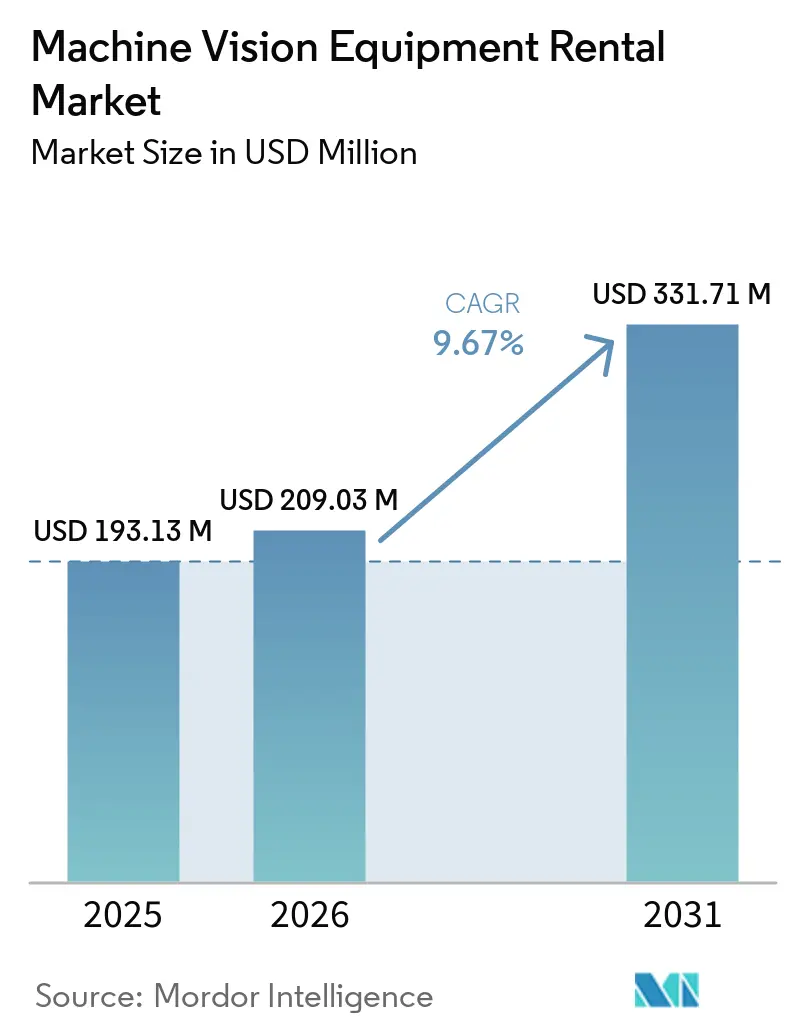
| Market Size (2026) | USD 209.03 Million |
| Market Size (2031) | USD 331.71 Million |
| Growth Rate (2026 - 2031) | 9.67 % |
| Fastest Growing Market | Asia-Pacific |
| Largest Market | North America |
| Market Concentration | Low |
Major Players *Disclaimer: Major Players sorted in no particular order Image © Mordor Intelligence. Reuse requires attribution under CC BY 4.0. | |
Machine Vision Equipment Rental Market Analysis by Mordor Intelligence
The machine vision equipment rental market size was USD 209.03 million in 2026 and is forecast to reach USD 331.71 million by 2031, expanding at a CAGR of 9.67% during 2026-2031. Manufacturers are using rental arrangements to access capital-intensive inspection equipment without committing to a full purchase before a process, defect type, or production volume has been confirmed, particularly when a line is being qualified or reconfigured. Faster changes in AI-enabled inspection hardware have shortened equipment evaluation cycles to 18-24 months in some cases, as new model architectures can make an earlier system less suitable before its conventional depreciation period ends. Semiconductor, EV battery, and advanced-packaging projects need certified inspection capacity during qualification and production ramps, when a facility needs to test equipment but may not yet know its final production requirements or the defect categories that will determine the final configuration. Rental periods also give customers time to validate inspection algorithms with production data, defect images, and process annotations before selecting an owned system or a longer access arrangement, turning an equipment trial into a structured data-collection period. Providers are therefore combining calibrated equipment, application support, software tools, and workflow management to remain relevant beyond a single rental term, support rent-to-own decisions, and develop recurring service relationships.
Key Report Takeaways
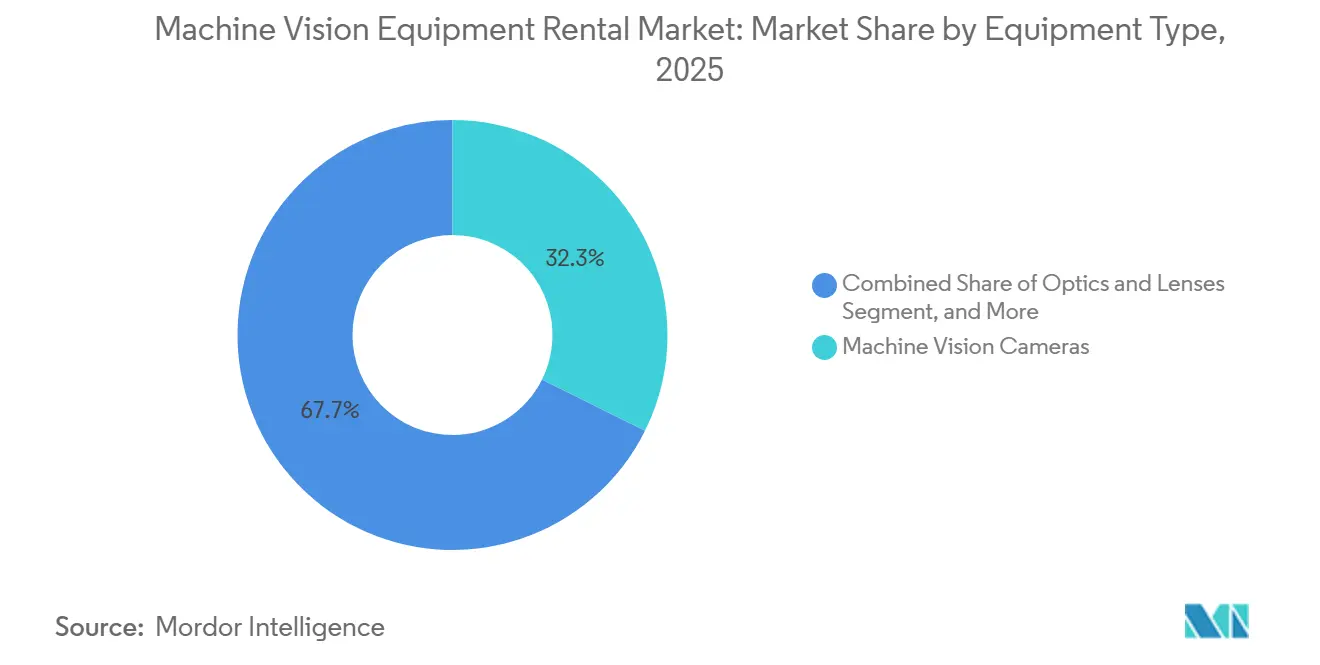
- By equipment type, machine vision cameras accounted for 32.34% of the machine vision equipment rental market in 2025, while specialized imaging equipment is projected to expand at a 12.25% CAGR through 2031.
- By vision type, 2D vision systems held 58.89% of the segment in 2025, while multispectral and hyperspectral systems are projected to expand at a 13.78% CAGR through 2031.
- By application, quality inspection and defect detection accounted for 34.46% of the segment in 2025, while R&D, prototyping, and testing are projected to expand at a 12.51% CAGR through 2031 in the machine vision equipment rental market.
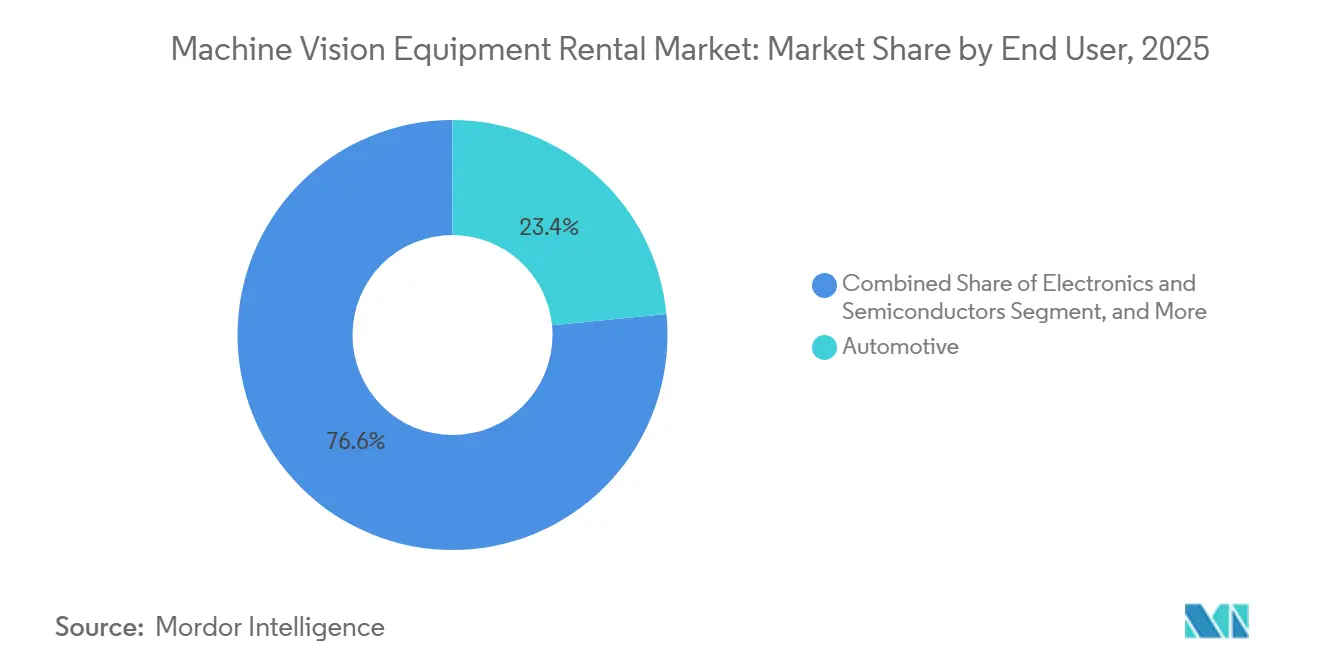
- By end user, automotive held 23.44% of the segment in 2025, while electronics and semiconductors are projected to expand at an 11.67% CAGR through 2031.
- By rental model, monthly and project-based rentals held 49.67% of the segment in 2025, while rent-to-own is projected to expand at an 11.56% CAGR through 2031.
- By geography, North America accounted for 32.19% of the machine vision equipment rental market in 2025, while Asia-Pacific is projected to expand at an 11.49% CAGR through 2031.
Note: Market size and forecast figures in this report are generated using Mordor Intelligence’s proprietary estimation framework, updated with the latest available data and insights as of January 2026.
Global Machine Vision Equipment Rental Market Trends and Insights
Drivers Impact Analysis*
| Driver | (~) % Impact on CAGR Forecast | Geographic Relevance | Impact Timeline |
|---|---|---|---|
| Manufacturing Automation and Zero-Defect Inspection | +2.5% | Global, concentrated in North America, Germany, Japan, and South Korea | Medium term (2-4 years) |
| Expansion of Electronics, Semiconductor, and Battery Production | +2.1% | Asia-Pacific core, including China, South Korea, India, and Vietnam, with spillover to North America | Short term (≤ 2 years) |
| Flexible Capacity Needs During Production Peaks and Equipment Downtime | +1.8% | Global, with the highest incidence in North America and Europe | Short term (≤ 2 years) |
| Rising Adoption of AI-Enabled and 3D Inspection | +1.4% | North America and the EU, expanding to Asia-Pacific | Medium term (2-4 years) |
| Shorter Technology Validation Cycles Before Capital Purchase | +1.0% | Global | Short term (≤ 2 years) |
| Rental Fleets as a Route to Edge-AI and High-Speed Imaging Access | +0.7% | North America and the EU | Long term (≥ 4 years) |
| Source: Mordor Intelligence | |||
Manufacturing Automation and Zero-Defect Inspection
OEM quality requirements increasingly make zero-defect inspection a contractual expectation for tier-1 and tier-2 suppliers, rather than a target that can be deferred when production schedules are under pressure. This requirement is expanding the need for flexible inspection capacity across more production lines and more product families in the machine vision equipment rental market. A 2026 study found that machine-learning-based vision systems achieved defect-detection accuracy above 95%, with some controlled implementations reaching 98%-100%. The same study found that 77% of deployments remained at the prototype or pilot scale, supporting the use of rental equipment during testing and validation. Rental records can also support process-compliance documentation during customer and OEM audits, giving temporary equipment a role in formal quality evidence. Cognex launched the In-Sight 3900 Vision System in May 2026, with 25 MP resolution and inspection capacity of up to 5,000 parts per minute, making project-based evaluation more practical for high-throughput operations.[1]
Expansion of Electronics, Semiconductor, and Battery Production
New semiconductor and EV battery capacity is increasing demand for inspection equipment during validation, equipment qualification, and early production ramp-up in the machine vision equipment rental market. HBM and advanced-packaging lines require multi-axis 3D imaging and specialized illumination to identify defects that can reduce yield or limit product reliability. These configurations are often evaluated before manufacturers select an owned system for a confirmed product design and a defined defect library. Rental contracts can support a 12-month validation program without requiring an early commitment to a fixed inspection configuration. Battery inspection capability is also moving toward semiconductor applications as suppliers develop additional wafer and glass-substrate solutions. This crossover increases the need for flexible equipment access during process testing, when specifications can change faster than conventional procurement cycles.
Flexible Capacity Needs During Production Peaks and Equipment Downtime
Production ramps, model changes, and unexpected failures create inspection gaps that owned fleets cannot always cover without delaying a line or shifting inspection work. These needs support short rental periods for production-ready systems in the machine vision equipment rental market that are available when internal equipment is unavailable or insufficient. Providers that can deliver calibrated equipment on the same day or the next day can charge higher rates for contingency work. The premium remains reasonable when customers compare it with the cost of a production interruption, delayed shipment, or missed quality check. AI-capable rental systems can include preloaded inspection models and remote model tuning. This turns a rental engagement into an operational support service rather than a simple hardware transaction, especially where a customer needs a working inspection process immediately.
Rising Adoption of AI-Enabled and 3D Inspection
AI-assisted inspection is changing machine vision equipment rental market fleet specifications, contract expectations, and the information that customers expect to retain after a project ends. SICK launched its Nova Machine Vision platform on August 3, 2026, combining 3D height data analysis with anomaly detection, classification, and object detection capabilities. Geometry-based inspection can help users examine surfaces where color and texture do not provide reliable contrast, such as in mixed-material production environments. Customers retain the defect images, annotations, and model-performance records created during a rental period. These records can inform later decisions on permanent deployment by connecting equipment performance to actual production conditions. ZEISS and MVTec also partnered in April 2026 to integrate HALCON software into the ZEISS Blockwise automated microscopy platform for semiconductor, microelectronics, and battery applications.
Restraints Impact Analysis*
| Restraint | (~) % Impact on CAGR Forecast | Geographic Relevance | Impact Timeline |
|---|---|---|---|
| Calibration, Configuration, and Metrology Traceability Requirements | -1.5% | Global, most acute in North America and EU regulated sectors | Medium term (2-4 years) |
| Integration Complexity With Customer Production Lines | -1.2% | Global, with higher severity in Asia-Pacific high-volume fabs | Short term (≤ 2 years) |
| Limited Availability of High-Specification Rental Fleets | -0.8% | Asia-Pacific and South America | Long term (≥ 4 years) |
| Data Security and Intellectual Property Concerns in Managed Inspection | -0.6% | Global | Long term (≥ 4 years) |
| Source: Mordor Intelligence | |||
Calibration, Configuration, and Metrology Traceability Requirements
Traceability requirements are more demanding in the machine vision equipment rental market because the measurement results, not just the equipment, must withstand audits, customer reviews, and formal supplier qualification. Suppliers must provide documentation that supports customer qualification, regulatory review, and quality management system checks across the full camera, lens, sensor, and software arrangement. ISO 10360-13:2021 addresses traceability for optical 3D coordinate measuring machines but does not fully resolve the challenge of complex geometric shapes. The EURAMET DI-VISION project is developing traceable material standards and digital-twin calibration methods for machine vision systems.[2] Providers therefore retain significant calibration responsibility for multi-sensor rental systems, even when the equipment is used only for a limited period. Higher compliance requirements can increase rental preparation time and effective costs in regulated production environments.
Integration Complexity With Customer Production Lines
A machine vision system in the machine vision equipment rental market requires mechanical installation, software configuration, illumination tuning, and PLC communication before production inspection can begin. Each customer site also has different line speeds, lighting conditions, component tolerances, data-transfer requirements, and quality procedures that influence how the system must be configured. This limits how quickly settings from a previous rental can be transferred to another site without further testing. INRIM noted that comprehensive calibration methods and uncertainty assessment for industrial machine vision systems were still lacking. Providers that lack on-site application engineering can lose productive rental days despite having equipment available in their fleet. The issue is particularly material in high-volume semiconductor fabs, where weeks of integration can weaken the economic case for rental and affect planned production output.
*Our forecasts treat driver/restraint impacts as directional, not additive. The impact forecasts reflect baseline growth, mix effects, and variable interactions.
Segment Analysis
By Equipment Type: Cameras Anchor Rental Revenue, Specialized Imaging Drives the Growth Edge
Machine vision cameras held 32.34% of the equipment-type segment in 2025. Their broad use in label verification, surface inspection, and defect detection supports this leading position across both simpler and more demanding factory tasks in the machine vision equipment rental market. Area-scan, line-scan, and smart-camera formats allow providers to deploy the same fleet across multiple industrial tasks, rather than holding equipment for a single, narrow application. This flexibility can improve utilization compared with equipment designed for one specialized use case. Optics, lenses, illumination systems, and processing equipment are usually rented with cameras as part of a working configuration selected for the customer's line. Integrated vision systems are also used in food, beverage, and pharmaceutical production, where a single unit can reduce installation effort and meet documentation requirements.
Specialized imaging equipment is projected to expand at a 12.25% CAGR through 2031. This specialized rental category serves semiconductor, battery, and materials applications that require imaging beyond the visible-light range and greater inspection precision. High-speed cameras are also used in prototype programs where frame rates and dynamic range must be verified with physical tests rather than supplier specifications alone. German integrator redi-Group introduced an AI camera system for 100% visual quality inspection in March 2026, aimed at the automotive and high-volume manufacturing sectors. Hexagon released VGSTUDIO MAX 2026.2 with batch CT scan processing and ISO 5459:2024 datum-fit compliance in 2026. Rental fleet operators serving electronics customers need to monitor such changes as inspection requirements become more precise and customers evaluate equipment for changing production programs.

By Vision Type: 2D Systems Define the Volume Base, Spectral Imaging Sets the Performance Frontier
2D vision systems held 58.89% of the vision-type segment in 2025. The installed base of compatible cameras, lighting, and software supports their leading position and makes it easier to assemble familiar rental configurations within the machine vision equipment rental market. These systems are used for dimensional checks, labels, barcodes, and surface appearance assessment on predictable parts across a range of industrial production lines. Their simpler configuration also helps suppliers mobilize equipment for short-term rentals when installation time is limited. 3D vision systems are increasingly used for robotic guidance, weld inspection, and EV battery cell assembly. These applications need volumetric measurement rather than surface-only data, which adds value where part geometry affects inspection results.
Multispectral and hyperspectral systems are projected to expand at a 13.78% CAGR through 2031. The technology can identify materials and contamination that RGB cameras cannot separate through conventional visible-light inspection. A 2026 Nature Scientific Data publication demonstrated conveyor-based foreign-object detection in food inspection across 147 samples and 11 defect categories. Specim line-scan cameras provide pixel-level chemical information for inline industrial sorting and quality control. These capabilities make short-term access more relevant for manufacturers in the machine vision equipment rental market that cannot justify the cost of a permanent spectral system before proving a specific use case. 1D vision systems remain useful for high-speed linear scanning of web materials, although they represent a slower-growth rental category with a narrower application base.
By Application: Defect Detection Dominates Utilization, R&D Prototyping Generates the Fastest Incremental Growth
Quality inspection and defect detection held 34.46% of the application segment in 2025. The segment leads because in-line inspection is needed in automotive, electronics, food processing, and pharmaceutical production, where missed defects can affect quality and compliance. Product changes and process adjustments often require vision-system requalification before a line returns to normal operation. This creates repeat rental engagements even where a facility owns its core inspection equipment and only needs additional capacity for a defined period. Measurement and metrology form another important application area, especially in aerospace and precision machining, where dimensional verification is a customer requirement. Robotic guidance, identification, traceability, and process monitoring are smaller applications that are gaining relevance as the machine vision equipment rental market automation expands across logistics and assembly.
R&D, prototyping, and testing are projected to expand at a 12.51% CAGR through 2031. The machine vision equipment rental market share for this use case benefits from development teams needing to test actual hardware against their own product data, line conditions, and defect examples. Tegakari offered 7-day free trials of depth cameras for R&D applications in 2025. StaabTEC offered ZEISS ScanCobot on flexible terms for 3D quality control in prototyping and series testing in 2026. AI capabilities extend these rental periods because teams must assess model and camera performance before preparing a procurement recommendation. Captic also offered complete AI camera hardware kits for development programs lasting weeks or months in 2026
By End User: Automotive Leads Established Demand, Electronics and Semiconductors Build Structural Rental Dependency
Automotive end users held 23.44% of the segment in 2025. The sector has a mature inspection culture, a multi-tier supply chain, and regular model-year changeovers that create recurring needs for supplemental equipment. Tier-1 suppliers often own their core inspection infrastructure for established production processes. They still rent supplemental systems during retooling periods and audit preparation, when primary equipment may not match a new requirement. This creates baseline demand that is less dependent on capital-spending cycles than demand in some other sectors. Automotive manufacturers are also deploying AI-based vision systems for electronics inspection and other high-volume quality tasks that require consistent inspection decisions.
Electronics and semiconductors are projected to expand at an 11.67% CAGR through 2031. The machine vision equipment rental market supports equipment evaluation and ramp phases in memory and advanced packaging production, where inspection criteria can change with the product design. Specialized inspection tools are needed as HBM and 3D packaging requirements increase and defect tolerance becomes more stringent. Food and beverage customers continue to use rentals for label checks, foreign-object detection, and fill-level inspection. Healthcare and pharmaceutical users require validated documentation, which extends preparation time and supports premium pricing. Logistics and warehousing create additional needs during autonomous mobile robot commissioning, while aerospace, defense, and industrial manufacturing provide stable demand with stringent calibration expectations.
By Rental Model: Monthly and Project-Based Terms Define the Market, Rent-to-Own Signals a Structural Transition
Monthly and project-based rentals held 49.67% of the rental-model segment in 2025. Production ramp-ups, qualification programs, model changes, and audits frequently last 1-6 months, which gives this model a close fit to how manufacturers plan temporary work. These timeframes align directly with project-based contract terms and give providers a clearer view of equipment utilization. Long-term leases serve manufacturers that need cost certainty without an upfront capital purchase, particularly when a system has been integrated at a single site. Daily and weekly rentals address equipment failure, short prototype trials, and audit preparation. They command the highest per-day rates because the customer has an immediate capacity need and limited time to find another solution.
Rent-to-own is projected to expand at an 11.56% CAGR through 2031. The model lets users collect production data and build ownership value while validating AI performance in operating conditions over a longer period. It can reduce hesitation where a customer is not ready to select a final configuration or commit to a capital purchase. The rent-to-own category is also supported by the need to manage technology refresh risk as AI-enabled systems evolve. Suppliers can bundle proprietary inspection software with the equipment agreement and continue to support the customer after the rental period. This approach can generate software revenue after the hardware payback period and moves the machine vision equipment rental market toward hybrid access models.
Geography Analysis
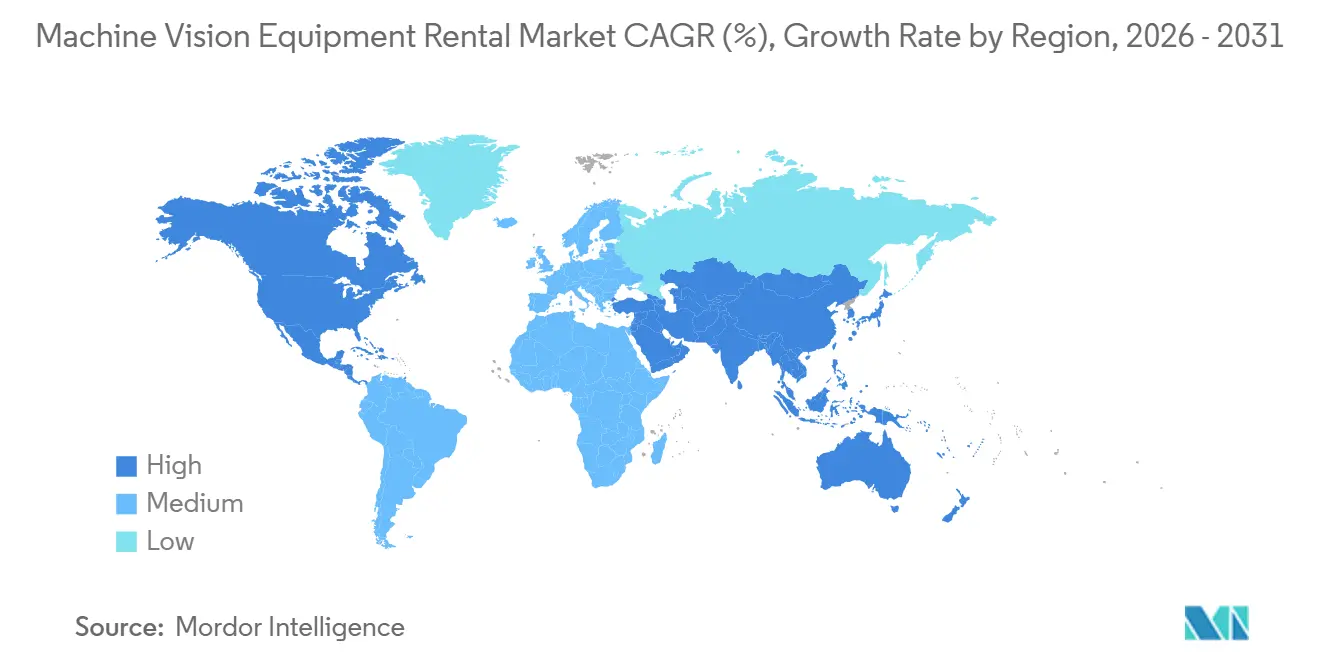
North America held 32.19% of the machine vision equipment rental market share in 2025, supported by established automation infrastructure, a strong compliance culture, and major automotive, aerospace, and semiconductor inspection programs. The United States is the regional center of demand, with automotive assembly in the Midwest, electronics fabrication in Texas and Arizona, and food-processing activity across the South and Midwest, creating different inspection requirements. The CHIPS and Science Act supports domestic semiconductor construction, and facilities require certified vision systems for process qualification before selecting permanent capital equipment. Customers in this phase need equipment that supports inspection, testing, documentation, and changes to production setup without requiring a final purchase decision. Canada contributes through automotive supply chains and natural-resources inspection, while Mexico provides an emerging opportunity as export-oriented electronics and automotive plants adopt more in-line quality controls.
Europe was the second-largest regional machine vision equipment rental market in 2025, supported by Germany's precision manufacturing base, the United Kingdom's MRO inspection services, French aerospace and defense requirements, and food processing and packaging in Italy and Spain. Germany combines demanding inspection standards with cost pressure from global competition, making rental a practical source of supplementary capacity without a lasting increase in equipment overhead. Fraunhofer IPK documented active machine vision development for quality control in automated production environments during 2025.[3] South America remains smaller, with Brazil driving demand for automotive assembly and agribusiness, Argentina supporting food and beverage applications, and fleet availability and import logistics limiting the wider use of high-specification systems.
Asia-Pacific is projected to expand at an 11.49% CAGR through 2031, making it the fastest-growing geographic segment in the machine vision equipment rental market. Semiconductor and battery investment in China, South Korea, India, and Vietnam is increasing demand for qualification-stage equipment and for systems that can be tested before a line reaches volume production. South Korea has a developed semiconductor inspection ecosystem, and further large-scale packaging investment is scheduled to begin operating in Cheongju from 2027. Japan supports demand for high-accuracy rental systems in electronics, automotive, and semiconductors, particularly where traceable documentation must fit local quality expectations. India is expanding electronics assembly under the Production Linked Incentive scheme; Vietnam is attracting production through supply-chain diversification; and the Middle East and Africa have opportunities in Gulf oil and gas inspection and in South African mining, despite limited local calibration infrastructure.
Competitive Landscape
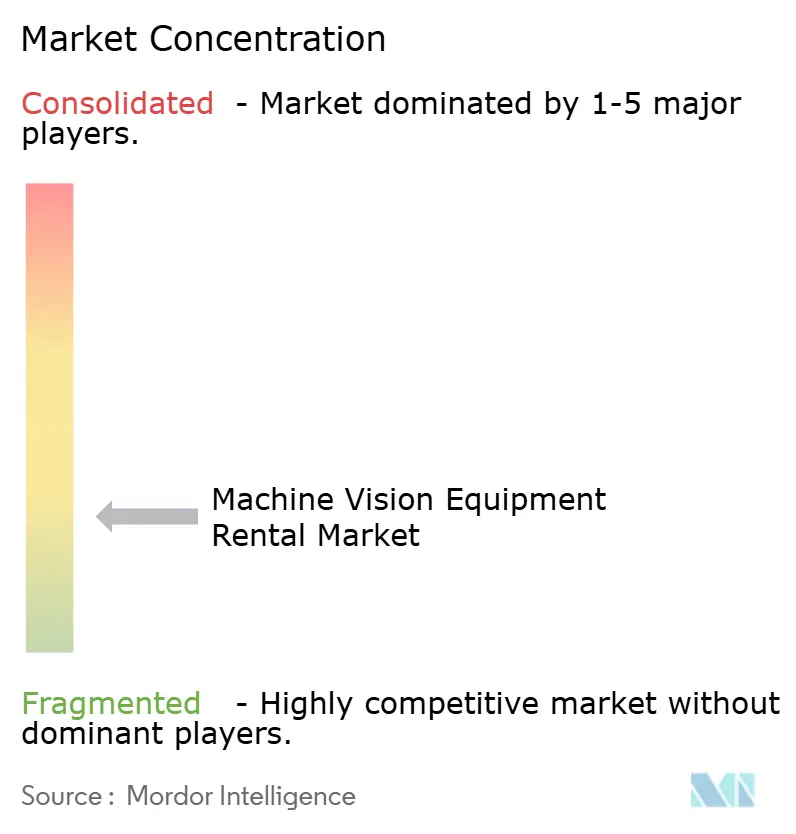
The machine vision equipment rental market is fragmented, with no single provider holding a dominant position across all equipment types, applications, and geographies. Dedicated specialists, including Inspectahire Instrument Company Limited, Dacon Inspection Technology BV, Nexxis Group Pty Ltd, Tech Imaging Services Inc., and Ashtead Technology Holdings plc, compete on fleet depth, calibration capability, and the speed at which they can deploy equipment at a customer site. Industrial metrology OEMs are also moving into flexible-access contracts that combine hardware, AI software, calibration, and workflow management into a single agreement. AMETEK completed its acquisition of FARO Technologies in July 2025 for USD 920 million, adding 3D metrology and digital reality capabilities to its portfolio. AMETEK also acquired Virtek Vision International in October 2024 for USD 117.5 million, adding another machine-vision capability to the group.
Managed-inspection contracts provide a point of differentiation because they can encompass calibration, data management, software maintenance, and equipment support for multi-site customers. This model can be particularly relevant when a customer needs the same inspection method across multiple facilities but does not want to build its own service and calibration capabilities. Few providers currently offer this approach at scale outside specialized subsea and aerospace activities, while traceability requirements create an entry barrier that favors providers with calibration laboratories, documented procedures, and established accuracy records. Patents for AI-assisted inspection are concentrated among industrial automation groups, while providers offering application-specific AI models with rented hardware can reduce installation work and accelerate the first inspection cycle in the machine vision equipment rental market.
Waygate Technologies deployed automated Menu Directed Inspection templates for GEnx-1B and GEnx-2B engine borescope inspections in April 2026 under its agreement with GE Aerospace. The templates can standardize inspection methods within a maintenance workflow and tie equipment to a certified customer procedure. Hexagon introduced VISIUS in April 2026 and expanded its portfolio with METRICAL and VGSTUDIO MAX 2026.2 during 2026, increasing the range of quality-metrology configurations available to manufacturers. Ashtead Technology acquired Seadraulics Pty Limited in June 2026, strengthening its Australia platform and ROV tooling capability. Together, these actions show that providers are extending coverage through specialized equipment, digital workflow tools, and regional service capacity rather than relying on fleet volume alone.
Machine Vision Equipment Rental Industry Leaders
-
METTLER TOLEDO International Inc.
-
Waygate Technologies (Baker Hughes Company)
-
ATEC, Inc.
-
Ashtead Technology Holdings plc
-
Cincinnati Automation Ltd.
- *Disclaimer: Major Players sorted in no particular order
Recent Industry Developments
- September 2026: Lumafield introduced Quality Agent, an agentic AI system that automates defect detection and root-cause analysis by learning known-good product characteristics and simultaneously monitoring X-ray, CT, and machine vision data streams. Unlike conventional predefined-failure-mode systems, the platform escalates novel deviations with supporting evidence to quality engineers, a shift that expands the use case for multi-modality rented inspection platforms in high-specification manufacturing environments.
- August 2026: SICK launched AI-powered 3D quality inspection within its Nova Machine Vision Platform, combining deep-learning algorithms with height-data analysis to enable geometry-based surface inspection independent of color or texture contrast. The platform targets automotive, electronics, and consumer goods production lines and consolidates a capability that previously required custom integration into a commercially standardized rental-ready configuration.
- June 2026: Ashtead Technology Holdings acquired Seadraulics Pty Limited, establishing a platform for expansion in Australia and strengthening ROV tooling capability within its 12-hub global rental and inspection services network. The acquisition expanded Ashtead's full-service offshore inspection offering in Asia-Pacific, adding specialized hydraulic ROV tooling to its existing remote visual inspection fleet.
- May 2026: Waygate Technologies launched the Everest Mentor Flex+, a next-generation videoscope for the mid-market remote visual inspection segment with interchangeable probe technology and advanced 3D measurement capabilities. The system integrates with the InspectionWorks cloud inspection management platform, extending the rental value proposition through software-connected workflow continuity and structured data reporting.
Global Machine Vision Equipment Rental Market Report Scope
The Machine Vision Equipment Rental Market refers to the market for the temporary rental, leasing, or rent-to-own provision of machine vision hardware and integrated vision systems used to capture, process, analyze, and interpret visual information for industrial, commercial, research, and other applications. The market encompasses equipment supplied to end users on a short-term, project-based, or long-term basis as an alternative to outright equipment purchase.
The Machine Vision Equipment Rental Market Report is Segmented by Equipment Type (Machine Vision Cameras, Optics and Lenses, Illumination Systems, Vision Processing Equipment, Specialized Imaging Equipment, and Integrated Vision Systems), Vision Type (1D Vision Systems, 2D Vision Systems, 3D Vision Systems, and Multispectral and Hyperspectral Systems), Application (Quality Inspection and Defect Detection, Measurement and Metrology, Identification and Traceability, Robotic Guidance, Process Monitoring, R&D / Prototyping and Testing, and Other Applications), End User (Automotive, Electronics and Semiconductors, Food and Beverage, Healthcare and Pharmaceuticals, Logistics and Warehousing, Aerospace and Defense, Industrial Manufacturing, and Other End-Users), Rental Model (Daily and Weekly Rental, Monthly and Project-Based Rental, Long-Term Lease, and Rent-to-Own), and Geography (North America, South America, Europe, Asia-Pacific, and Middle East and Africa). The Market Forecasts are Provided in Terms of Value (USD).
| Machine Vision Cameras |
| Optics and Lenses |
| Illumination Systems |
| Vision Processing Equipment |
| Specialized Imaging Equipment |
| Integrated Vision Systems |
| 1D Vision Systems |
| 2D Vision Systems |
| 3D Vision Systems |
| Multispectral and Hyperspectral Systems |
| Quality Inspection and Defect Detection |
| Measurement and Metrology |
| Identification and Traceability |
| Robotic Guidance |
| Process Monitoring |
| R&D / Prototyping and Testing |
| Other Applications |
| Automotive |
| Electronics and Semiconductors |
| Food and Beverage |
| Healthcare and Pharmaceuticals |
| Logistics and Warehousing |
| Aerospace and Defense |
| Industrial Manufacturing |
| Other End-Users |
| Daily and Weekly Rental |
| Monthly and Project-Based Rental |
| Long-Term Lease |
| Rent-to-Own |
| North America | United States | |
| Canada | ||
| Mexico | ||
| South America | Brazil | |
| Argentina | ||
| Rest of South America | ||
| Europe | Germany | |
| United Kingdom | ||
| France | ||
| Italy | ||
| Spain | ||
| Rest of Europe | ||
| Asia-Pacific | China | |
| Japan | ||
| India | ||
| South Korea | ||
| ASEAN | ||
| Rest of Asia-Pacific | ||
| Middle East and Africa | Middle East | Saudi Arabia |
| United Arab Emirates | ||
| Rest of the Middle East | ||
| Africa | South Africa | |
| Nigeria | ||
| Rest of Africa | ||
| By Equipment Type | Machine Vision Cameras | ||
| Optics and Lenses | |||
| Illumination Systems | |||
| Vision Processing Equipment | |||
| Specialized Imaging Equipment | |||
| Integrated Vision Systems | |||
| By Vision Type | 1D Vision Systems | ||
| 2D Vision Systems | |||
| 3D Vision Systems | |||
| Multispectral and Hyperspectral Systems | |||
| By Application | Quality Inspection and Defect Detection | ||
| Measurement and Metrology | |||
| Identification and Traceability | |||
| Robotic Guidance | |||
| Process Monitoring | |||
| R&D / Prototyping and Testing | |||
| Other Applications | |||
| By End-User | Automotive | ||
| Electronics and Semiconductors | |||
| Food and Beverage | |||
| Healthcare and Pharmaceuticals | |||
| Logistics and Warehousing | |||
| Aerospace and Defense | |||
| Industrial Manufacturing | |||
| Other End-Users | |||
| By Rental Model | Daily and Weekly Rental | ||
| Monthly and Project-Based Rental | |||
| Long-Term Lease | |||
| Rent-to-Own | |||
| By Geography | North America | United States | |
| Canada | |||
| Mexico | |||
| South America | Brazil | ||
| Argentina | |||
| Rest of South America | |||
| Europe | Germany | ||
| United Kingdom | |||
| France | |||
| Italy | |||
| Spain | |||
| Rest of Europe | |||
| Asia-Pacific | China | ||
| Japan | |||
| India | |||
| South Korea | |||
| ASEAN | |||
| Rest of Asia-Pacific | |||
| Middle East and Africa | Middle East | Saudi Arabia | |
| United Arab Emirates | |||
| Rest of the Middle East | |||
| Africa | South Africa | ||
| Nigeria | |||
| Rest of Africa | |||
Key Questions Answered in the Report
What is the machine vision equipment rental market size?
The machine vision equipment rental market size was USD 209.03 million in 2026 and is forecast to reach USD 331.71 million by 2031 at a 9.67% CAGR. This outlook reflects demand for flexible access to certified inspection equipment during qualification, production ramps, and technology validation.
Which equipment category leads equipment rentals?
Machine vision cameras led the equipment-type segment with 32.34% share in 2025 because they support label verification, surface inspection, defect detection, and several other production tasks. Area-scan, line-scan, and smart-camera formats also allow a rental fleet to support different customer applications.
Why do manufacturers rent machine vision systems?
Rental lets manufacturers address production peaks, test AI performance, and obtain specialized inspection capacity without an early capital commitment. It can also help a user compare a configuration with actual line conditions, production data, and defect images before selecting a long-term system.
Which vision technology has the strongest projected expansion?
Multispectral and hyperspectral systems are projected to expand at a 13.78% CAGR through 2031. Their ability to identify material composition and contamination supports uses in food, semiconductor, battery, and other production environments where conventional RGB inspection has limits.
Which end users create the strongest demand?
Automotive led with 23.44% share in 2025, supported by regular retooling, audit preparation, and a well-established inspection culture. Electronics and semiconductors are projected to expand at an 11.67% CAGR through 2031 as specialized tools are evaluated for memory and advanced packaging.
Which region is projected to expand fastest?
Asia-Pacific is projected to expand at an 11.49% CAGR through 2031, supported by semiconductor and battery investment. China, South Korea, India, and Vietnam contribute qualification-stage demand as manufacturing capacity and local production supply chains develop.