
Refurbished Machine Vision Equipment Market Size and Share
Market Overview
| Study Period | 2020 - 2031 |
|---|---|
| Market Size (2026) | USD 0.66 Billion |
| Market Size (2031) | USD 1.03 Billion |
| Growth Rate (2026 - 2031) | 9.31 % |
| Fastest Growing Market | Middle East and Africa |
| Largest Market | Asia-Pacific |
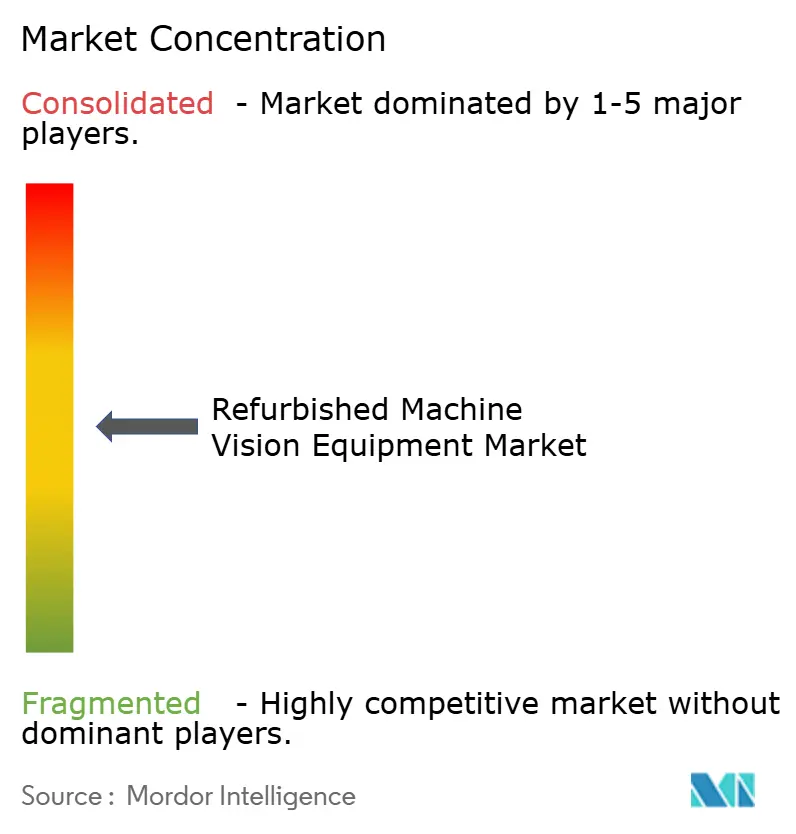
| Market Concentration | Medium |
Major Players *Disclaimer: Major Players sorted in no particular order Image © Mordor Intelligence. Reuse requires attribution under CC BY 4.0. | |
Refurbished Machine Vision Equipment Market Analysis by Mordor Intelligence
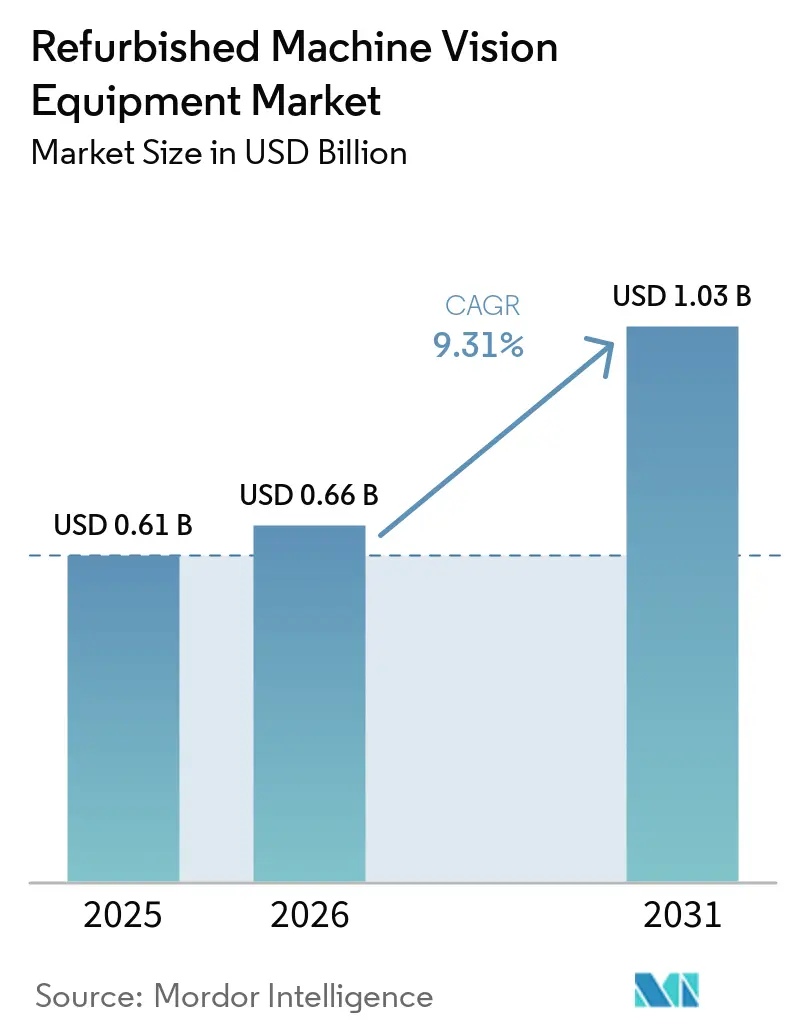
The refurbished machine vision equipment market size is projected to expand from USD 0.61 billion in 2025 to USD 0.66 billion in 2026, and to USD 1.03 billion by 2031, registering a CAGR of 9.31% between 2026 and 2031. Manufacturers are increasingly using refurbished systems to add automation capability while limiting upfront capital spending. Higher prices for new equipment and longer installation schedules make pre-owned systems more relevant for projects that do not require the newest specifications. Industry 4.0 adoption also extends vision inspection into production stages that previously relied on manual checks. Circular procurement requirements in Europe support maintenance and refurbishment as accepted purchasing options. Competition, therefore, depends on equipment availability, software support, documented testing, and warranty coverage.
Key Report Takeaways
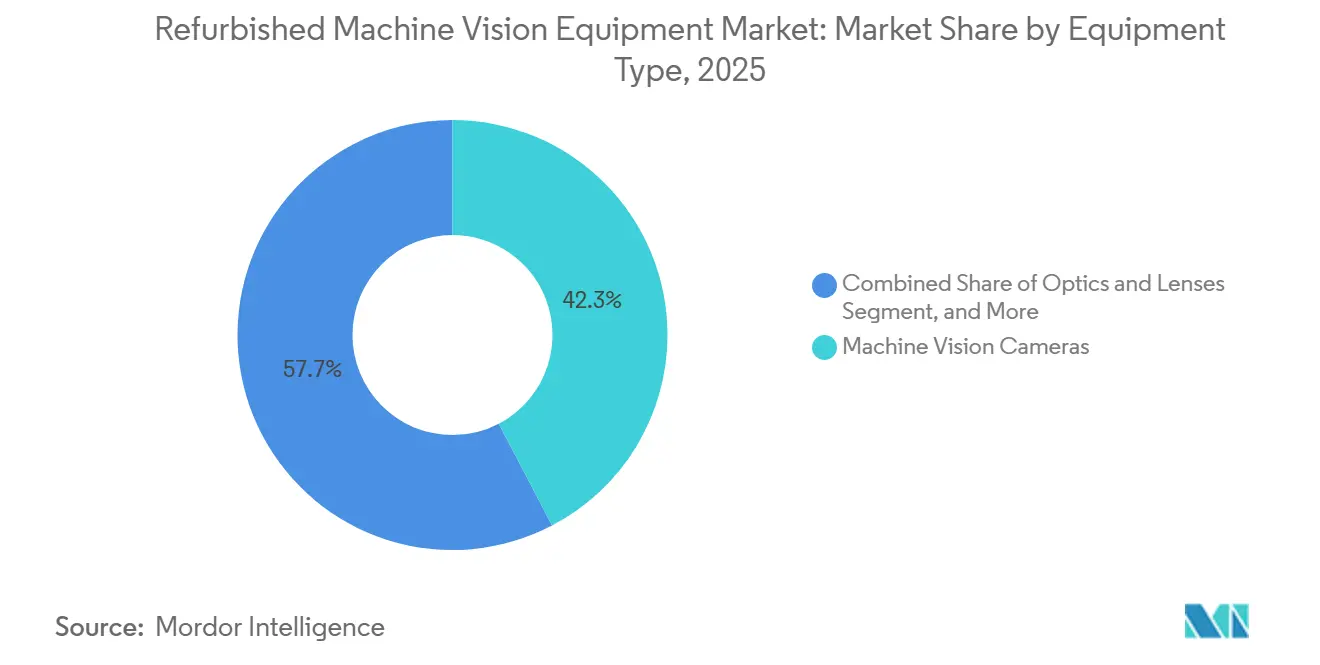
- By equipment type, machine vision cameras held 42.34% of the refurbished machine vision equipment market share in 2025, while integrated vision systems are projected to expand at a 10.51% CAGR through 2031.
- By refurbishment condition, certified refurbished equipment accounted for 35.51% of the refurbished machine vision equipment market size in 2025 and is projected to expand at a 10.09% CAGR through 2031.
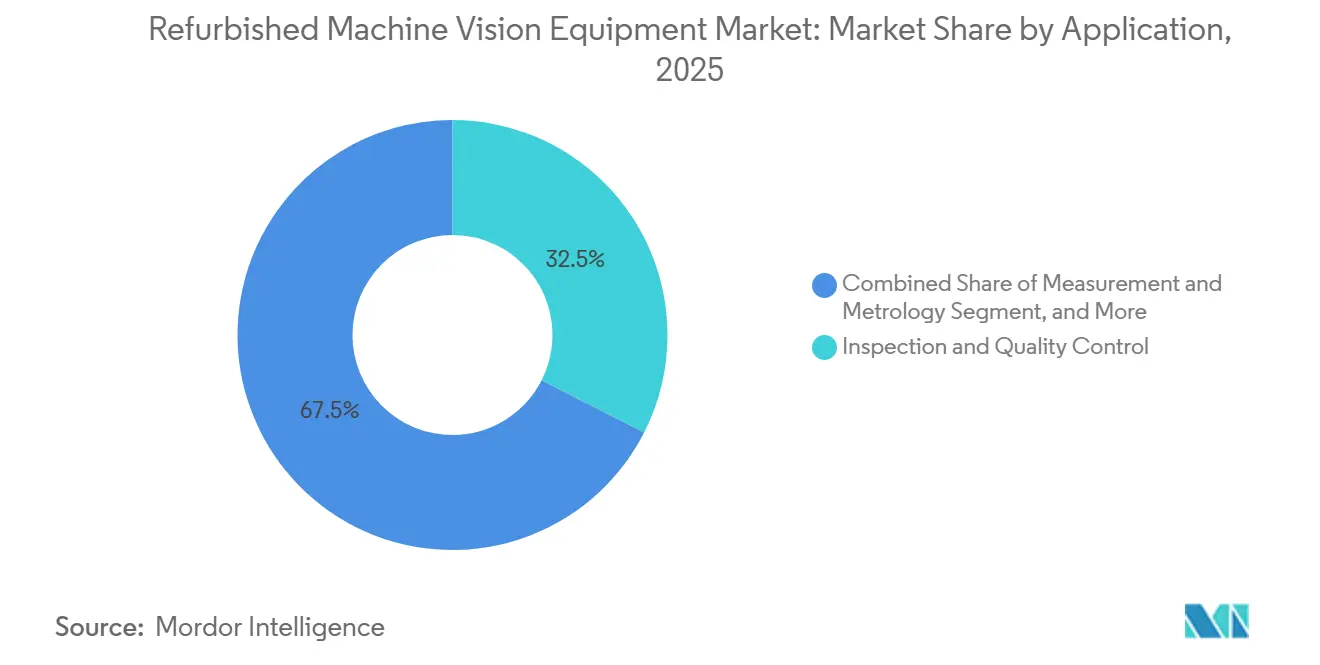
- By application, inspection and quality control held 32.49% of revenue in 2025, while guidance and positioning are expected to expand at a 10.48% CAGR through 2031.
- By end-use industry, electronics and semiconductors accounted for 25.57% of revenue in 2025, while logistics and warehousing are projected to expand at a 10.88% CAGR through 2031.
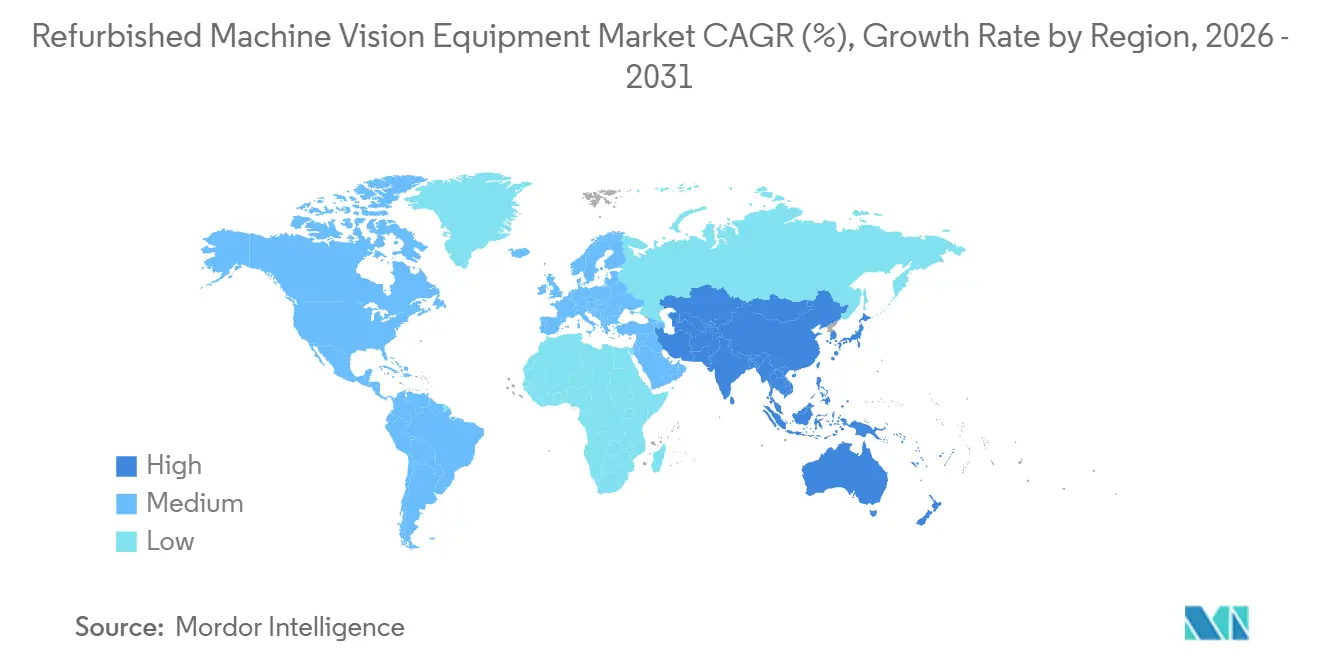
- By geography, Asia-Pacific held 33.21% of global revenue in 2025, while the Middle East and Africa are projected to expand at a 10.32% CAGR through 2031.
Note: Market size and forecast figures in this report are generated using Mordor Intelligence’s proprietary estimation framework, updated with the latest available data and insights as of January 2026.
Global Refurbished Machine Vision Equipment Market Trends and Insights
Drivers Impact Analysis*
| Driver | (~) % Impact on CAGR Forecast | Geographic Relevance | Impact Timeline |
|---|---|---|---|
| Factory Modernization Under Capital Spending Constraints | +2.5% | Global, concentrated in North America, Europe, and Asia-Pacific manufacturing corridors | Short term (≤ 2 years) |
| Electronics Manufacturing Capacity Expansion | +1.8% | Asia-Pacific core, including China, India, South Korea, and Vietnam, with spillover to North American near-shoring | Medium term (2-4 years) |
| Shorter Lead Times for Available Pre-Owned Systems | +1.2% | Global, most acute in North America and Europe during supply chain disruption cycles | Short term (≤ 2 years) |
| Circular Procurement and Carbon-Avoidance Goals | +0.9% | European Union and United Kingdom primary, with spillover to North America and Australia and New Zealand through multinational supply chains | Medium term (2-4 years) |
| Secondary Availability of Discontinued Inspection Platforms | +0.7% | Global, with highest volume in North America and Europe | Medium term (2-4 years) |
| Refurbishment-Enabled Data and Software Migration | +0.4% | North America and Europe, with early adopters in Asia-Pacific | Long term (≥ 4 years) |
| Source: Mordor Intelligence | |||
Factory Modernization Under Capital Spending Constraints
Capital budgets at mid-sized manufacturers were under pressure from tariff uncertainty, energy costs, and tighter credit conditions, which shifted refurbished machine vision equipment from an occasional choice to an active purchasing option. Higher new-equipment prices led some operators to defer installations or put projects on hold, especially where the inspection task did not require the latest performance specifications. Refurbished systems can allow plants to continue planned automation work and to use familiar equipment with less redesign of existing inspection lines. The initial purchase price is only part of the decision, because pre-owned systems may also support shorter installation schedules when buyers select platforms their teams already understand. Faster implementation can help manufacturers meet production needs while preserving capital for other priorities. Short product cycles at original equipment manufacturers can also release more near-current systems into the secondary channel, strengthening the refurbished machine vision equipment market through better available inventory when budgets are under pressure.
Electronics Manufacturing Capacity Expansion
Electronics production capacity is expanding through near-shoring activity and national semiconductor programs, creating demand for inspection systems during new-line ramp-ups. Operators must preserve capital for core process equipment, which makes refurbished vision tools relevant for capacity additions in electronics assembly and semiconductor production. India illustrates that this cost logic is a new production line may cost INR 8 crore, while a functionally equivalent refurbished alternative may be available for INR 2 crore. A 2025 analysis of India’s semiconductor ecosystem examined refurbished inspection and process tools as a capital-efficient route to modernization. The analysis reflected industry support for using refurbished equipment when expanding capacity without sacrificing defined production capability. Technology replacement also adds serviceable prior-generation inspection cameras to secondary supply, giving cost-sensitive manufacturers access to equipment that remains suitable for established tasks.
Shorter Lead Times for Available Pre-Owned Systems
Lead time is important for manufacturers facing demand increases or production bottlenecks, and pre-owned systems in stock can offer a faster route than new-equipment channels. New machine vision camera lead times can reach 12-24 weeks during supply chain disruptions, while configured and tested refurbished systems can be delivered within 1-2 weeks when the required platform is in stock. This advantage supports urgent line changes and helps buyers restore inspection capacity without waiting for new production. Secondary-market recovery plans can also expand supply, because manufacturers can lose significant asset value without a structured recovery process. The Investment Recovery Association cited Intel Corporation’s USD 800 million non-cash impairment and accelerated depreciation related to excess manufacturing tools in 2025. Inventory corrections can move usable systems into secondary channels at commercially attractive exit values, making lead-time advantages relevant to both procurement risk management and capital planning.
Circular Procurement and Carbon-Avoidance Goals
Circular purchasing has become more important in manufacturing procurement, especially in Europe, where regulatory conditions give refurbishment a clearer role in compliant purchasing decisions. The European Union’s Ecodesign for Sustainable Products Regulation entered into force on July 18, 2024, and Article 5 identifies durability, repairability, and the possibility of maintenance and refurbishment as product design criteria.[1]European Parliament and Council, “Regulation (EU) 2024/1781 Establishing a Framework for Ecodesign Requirements for Sustainable Products,” EUR-Lex, eur-lex.europa.eu. The European Commission adopted its first ESPR working plan in April 2025, setting product priorities for 2025-2030 and including electrical and electronic equipment among the categories subject to future requirements. Epiroc reported in 2025 that remanufactured components can be up to 70% less costly than new components and that steel reuse can reach 90%. These figures show why cost and resource considerations can align, although they relate to circular solutions more broadly than machine vision equipment. Certified refurbished equipment can therefore become more acceptable for organizations that include avoided material use and public net-zero commitments in procurement review.
Restraints Impact Analysis*
| Restraint | (~) % Impact on CAGR Forecast | Geographic Relevance | Impact Timeline |
|---|---|---|---|
| Obsolescence and Software-License Risk | -1.0% | Global, most acute in North America and Europe where original equipment manufacturer licensing enforcement is strongest | Short term (≤ 2 years) |
| Limited Warranty and Calibration Standardization | -0.8% | Global, most consequential in regulated industries across all regions | Medium term (2-4 years) |
| Inconsistent Condition Grading Across Resellers | -0.5% | Global, with highest effect on emerging-market buyers with limited technical evaluation capacity | Medium term (2-4 years) |
| Scarcity of Replacement Sensors and Proprietary Boards | -0.3% | North America and Europe for older discontinued platforms, and Asia-Pacific for Japan-sourced components | Long term (≥ 4 years) |
| Source: Mordor Intelligence | |||
Obsolescence and Software-License Risk
Software licensing can limit the usefulness of mechanically sound refurbished equipment because a buyer may need a new agreement even when the hardware remains functional. Cognex software terms state that a previous license expires when replacement software is installed and cannot be revived.[2]Cognex Corporation, “Cognex Software License Agreement,” Cognex Corporation, bluecrestinc.com. This may require separate licensing discussions for discontinued platforms, and original equipment manufacturers are not required to make licenses available for older products. Firmware compatibility adds a related problem, as older units may not support advanced inspection tools when their firmware cannot be updated. Cameras, frame grabbers, and embedded processors can reach end of life on schedules that do not align with production-line refreshes, while older embedded systems may require migration work to run current software. Resellers do not always disclose re-licensing and integration costs, so smaller buyers with limited technical resources may underestimate the total procurement cost.
Limited Warranty and Calibration Standardization
The refurbished machine vision equipment market lacks a universal grading system or mandatory certification framework, creating an information gap between sellers and buyers. A certified refurbished description can represent very different testing, calibration, and warranty practices, and this difference is particularly important in pharmaceutical, food, and automotive settings. A system failure can lead to downtime when compatible replacement equipment or support is unavailable, which makes formal records more important for regulated users. A specialist with calibrated test equipment and documented procedures can offer different assurance from a general electronics seller using the same certification label. Pharmaceutical manufacturers may also need requalification and documented validation following an equipment change, and incomplete provider records can add cost. The absence of a common standard constrains buyer confidence but gives suppliers an opportunity to compete through auditable certification, calibration evidence, and clearer warranty terms.
*Our forecasts treat driver/restraint impacts as directional, not additive. The impact forecasts reflect baseline growth, mix effects, and variable interactions.
Segment Analysis
By Equipment Type: Cameras Provide Scale While Integrated Systems Lead Expansion
Machine vision cameras held 42.34% of the refurbished machine vision equipment market share in 2025. The category has a large installed base and broad availability in the secondary channel. Standardized GigE Vision and USB3 Vision interfaces help cameras fit into varied inspection architectures. Familiar software platforms can also reduce the need for major reconfiguration. Equipment replacement cycles add prior-generation GigE and Camera Link models to resale inventories. These models can remain price competitive with new entry-level offerings while providing a known integration profile.
Integrated vision systems are projected to expand at a 10.51% CAGR from 2026 to 2031. They combine imaging, processing, and communication in a single unit. This format can suit logistics and pharmaceutical packaging lines that need self-contained inspection cells. Cognex launched the In-Sight 3900 embedded AI vision system in May 2026. The company stated that the system provides up to 4× faster inspection processing and 25 megapixel resolution at the edge. As newer embedded systems enter prime deployment, earlier platforms can later be added to the refurbished machine vision equipment market.



By Refurbishment Condition: Certification Supports Buyer Confidence
Certified refurbished equipment accounted for 35.51% of the refurbishment-condition segment in 2025. It is also projected to expand at a 10.09% CAGR through 2031. This combination shows the importance of documented testing and predictable equipment condition. Electronics, pharmaceutical, and food processing buyers increasingly request certification records during vendor qualification. These requirements can exclude lower-condition equipment from competitive bids for high-throughput production lines. The certified category can reduce uncertainty where the cost of downtime is high.
Certified equipment can include test records, calibration traceability, and remaining warranty coverage. These elements may reduce the requalification effort required by buyers operating under quality management systems. Reconditioned equipment serves cost-sensitive manufacturers that need functional assurance without the full cost of certification. Tested pre-owned equipment is intended for high-volume purchasers who can conduct their own further validation. Uncertified equipment faces pressure from supplier audit requirements and sustainability procurement policies. Demand for this category is therefore more likely to come from spot purchases by buyers with strong internal technical capability.
By Application: Quality Control Holds Scale While Guidance and Positioning Advances
Inspection and quality control represented 32.49% of application revenue in 2025. It remains the broadest and most essential use of vision systems across electronics, pharmaceuticals, and food manufacturing. Refurbished systems are used for printed circuit board defect detection, solder joint inspection, and pharmaceutical tablet verification. Established platforms such as Cognex In-Sight and KEYENCE IV-series have broad software support and familiar reseller channels. This installed-base depth supports secondary availability for routine inspection needs. Recurring requirements for reliable inspection capabilities drive the refurbished machine vision equipment market size for this use.
Guidance and positioning are projected to expand at a 10.48% CAGR from 2026 to 2031. Vision-guided robotics and autonomous mobile robots support this demand in warehouses and assembly operations. Basler and Orbbec announced a 2026 partnership for industrial 3D vision. Their Basler Stereo mini camera was introduced for autonomous mobile robot navigation, obstacle detection, and wider 3D robotics uses. Earlier 3D guidance products can subsequently become available to buyers seeking lower-cost deployment options. Networked facilities must also consider cybersecurity expectations when older firmware is used in connected inspection systems.
By End-Use Industry: Electronics Leads Demand While Logistics and Warehousing Expands Faster
Electronics and semiconductors accounted for 25.57% of end-use revenue in 2025. The sector needs consistent inspection throughput for automated optical inspection, wafer-edge inspection, and display testing. Refurbished cameras can be deployed alongside expensive new process tools when capital must be reserved for core production equipment. Secondary supply can expand during semiconductor inventory corrections. The 2025 Intel impairment, cited by the Investment Recovery Association, illustrates how excess manufacturing tools can enter recovery channels. This creates inventory for specialist refurbishers serving technically demanding buyers.
Logistics and warehousing are projected to expand at a 10.88% CAGR through 2031. Fulfillment operators and third-party logistics providers are adopting vision-guided sortation, palletization, and autonomous mobile robot navigation. Datalogic introduced the Matrix 830 and Matrix 930 readers in March 2026 for large-area conveyor scanning. The Matrix 930 Premium was described as AI-ready for logistics uses such as hazardous materials recognition and parcel classification. Automotive and mobility, food and beverage, pharmaceuticals and healthcare, packaging and printing, and metal, glass, and plastics also maintain replacement demand. Their established inspection requirements support continuing activity in the refurbished machine vision equipment industry.
Geography Analysis
Asia-Pacific accounted for 33.21% of the global refurbished machine vision equipment market share in 2025. China’s electronics and semiconductor manufacturing base, Japan’s precision engineering activity, and South Korea’s capital equipment ecosystem support regional demand. India is also becoming a significant destination for refurbished equipment. A 2025 Carnegie Endowment analysis discussed refurbished inspection tools as a capital-efficient route to expanding semiconductor capacity in India. Vietnam and Thailand add demand through electronics assembly and wider use of vision-enabled quality control.
North America and Europe have mature purchasing practices for industrial automation. In North America, tariff-related capital discipline can direct facility managers toward pre-owned systems that have shorter integration timelines. Automotive activity in the US South and semiconductor projects in the Southwest support demand for inspection and guidance systems. Canada and Mexico add activity through nearshoring in the automotive and food processing sectors. Europe has an additional regulatory reason to consider refurbishment. The ESPR framework and its 2025-2030 working plan support repairability and refurbishment in purchasing decisions for electrical and electronic equipment.[3]European Commission, “First ESPR Working Plan 2025-2030,” European Commission, environment.ec.europa.eu. Germany, the United Kingdom, and France each contribute through automotive, machinery, and industrial modernization activity.
The Middle East and Africa are projected to expand at a 10.32% CAGR from 2026 to 2031. National industrial programs in Gulf Cooperation Council states are increasing interest in automation for food processing, chemicals, and metal fabrication. Vision-guided inspection can be an accessible starting point for automation programs where total ownership cost matters. Saudi Vision 2030 and the United Arab Emirates Industry 4.0 strategy provide a supportive backdrop for these projects. The African Development Bank’s investment in agro-industrial processing can support demand for automation over a longer period. South America also contributes to developing demand, led by Brazil’s automotive and electronics manufacturing base, while Argentina and other countries add smaller volumes.

Competitive Landscape
The refurbished machine vision equipment market is moderately fragmented. Specialist refurbishment and resale providers include Unidec, Deterco, ASC International, Buy2Sell ApS, and Moov Technologies. These suppliers compete on available inventory, technical reconditioning, and warranty terms. Certified pre-owned programs connected to original equipment manufacturers include Cognex and OMRON. The two groups serve different buyer requirements with limited direct overlap. Independent specialists can provide breadth, while original equipment manufacturer programs can provide closer continuity in software and validation support.
Moov Technologies introduced its Seller platform with a Buyer Interaction feature in March 2025. The move supported direct messaging between buyers and sellers of semiconductor and industrial equipment. Cognex launched the In-Sight 6900 vision controller in April 2026, using NVIDIA Jetson technology for configurable imaging and AI processing at the production edge.[4]Cognex Corporation, “Cognex Launches In-Sight Vision Controller Powered by NVIDIA,” Cognex Investor Relations, investor.cognex.com. Cognex also made OneVision generally available in May 2026 after its beta phase included more than 100 customers. These products and software developments can widen the performance gap between new systems and earlier equipment. They can also release capable prior-generation systems into the secondary channel as customers upgrade.
SICK expanded its Nova platform with AI-powered 3D inspection capability in August 2026. The update combines deep learning with height-data analysis for deformation detection, missing-object checks, and assembly verification. Advances in equipment can improve the quality range of systems later available for refurbishment. Certification remains an important competitive gap for regulated users because no common, independently audited framework is described in the source material. Suppliers that offer calibration evidence, clearer warranties, and stronger documentation can address this buyer concern. The industry is characterized by a variety of providers rather than concentrated control by a small group of participants.
Refurbished Machine Vision Equipment Industry Leaders
ASC International
SMT Sales Group, LLC
Moov Technologies, Inc.
Unidec, Inc.
Deterco, Inc.
- *Disclaimer: Major Players sorted in no particular order

Recent Industry Developments
- August 2026: SICK AG expanded its Nova machine vision platform with AI-powered 3D inspection capability, combining deep learning with high-precision height-data analysis to enable detection of deformation, missing objects, and assembly verification tasks previously difficult to achieve with rule-based 3D inspection approaches. The update equips the Ranger NextGen and Ruler3000 cameras with on-device neural network inference, targeting food and beverage packaging, fulfillment logistics, and industrial manufacturing quality control.
- May 2026: Cognex Corporation announced the general availability of OneVision, its cloud-to-edge AI vision development platform, reporting more than 100 customers in the beta phase since the June 2025 announcement. OneVision enables centralized AI model training, cross-site collaboration, and local production-speed inference deployment, positioning Cognex toward software-defined inspection management across multi-site manufacturing networks.
- May 2026: Cognex Corporation launched the In-Sight 3900 Vision System, powered by Qualcomm Dragonwing platforms, delivering up to 4× faster inspection processing than prior-generation Cognex systems and up to 25 megapixel imaging resolution in a fully integrated, PC-free embedded form factor. The system targets packaging, automotive, and electronics inspection applications requiring high-speed AI inference at the edge, and participates in the Cognex OneVision cloud-to-edge ecosystem.
- March 2026: Basler AG and Orbbec Inc. announced a strategic technology partnership for industrial 3D vision at LogiMAT 2026 in Stuttgart, co-launching the Basler Stereo mini camera for AMR navigation, obstacle detection, and general 3D robotics applications in logistics and factory automation. The collaboration integrates Orbbec's chip-level depth sensing with Basler's pylon SDK industrial ecosystem, offering a single-source 3D vision solution for logistics system integrators.


Global Refurbished Machine Vision Equipment Market Report Scope
The refurbished machine vision equipment market comprises the sale of previously owned machine vision hardware that has undergone inspection, testing, repair, reconditioning, calibration, cleaning, component replacement, or other refurbishment processes to restore its functional performance and make it suitable for subsequent industrial or commercial use. The market includes equipment sold through manufacturers, authorized refurbishers, specialized distributors, equipment resellers, and other secondary-market channels.
The Refurbished Machine Vision Equipment Report is Segmented by Equipment Type (Machine Vision Cameras, Optics and Lenses, Illumination Systems, Vision Processing Equipment, Integrated Vision Systems, and Specialized Imaging Equipment), Refurbishment Condition (Certified Refurbished Equipment, Reconditioned Equipment, Tested Pre-Owned Equipment, and Used Equipment Without Certification), Application (Inspection and Quality Control, Measurement and Metrology, Identification and Traceability, Guidance and Positioning, Defect Detection, and Other Applications), End-Use Industry (Electronics and Semiconductors, Automotive and Mobility, Food and Beverage, Pharmaceuticals and Healthcare, Packaging and Printing, Metal, Glass, and Plastics, Logistics and Warehousing, and Other End-Use Industries), and Geography (North America, South America, Europe, Asia-Pacific, and Middle East and Africa). The Market Forecasts are Provided in Terms of Value (USD).
| Machine Vision Cameras |
| Optics and Lenses |
| Illumination Systems |
| Vision Processing Equipment |
| Integrated Vision Systems |
| Specialized Imaging Equipment |
| Certified Refurbished Equipment |
| Reconditioned Equipment |
| Tested Pre-Owned Equipment |
| Used Equipment Without Certification |
| Inspection and Quality Control |
| Measurement and Metrology |
| Identification and Traceability |
| Guidance and Positioning |
| Defect Detection |
| Other Applications |
| Electronics and Semiconductors |
| Automotive and Mobility |
| Food and Beverage |
| Pharmaceuticals and Healthcare |
| Packaging and Printing |
| Metal, Glass, and Plastics |
| Logistics and Warehousing |
| Other End-Use Industries |
| North America | United States | |
| Canada | ||
| Mexico | ||
| South America | Brazil | |
| Argentina | ||
| Rest of South America | ||
| Europe | Germany | |
| United Kingdom | ||
| France | ||
| Italy | ||
| Spain | ||
| Rest of Europe | ||
| Asia-Pacific | China | |
| Japan | ||
| India | ||
| South Korea | ||
| ASEAN | ||
| Rest of Asia-Pacific | ||
| Middle East and Africa | Middle East | Saudi Arabia |
| United Arab Emirates | ||
| Rest of the Middle East | ||
| Africa | South Africa | |
| Nigeria | ||
| Rest of Africa | ||
| By Equipment Type | Machine Vision Cameras | ||
| Optics and Lenses | |||
| Illumination Systems | |||
| Vision Processing Equipment | |||
| Integrated Vision Systems | |||
| Specialized Imaging Equipment | |||
| By Refurbishment Condition | Certified Refurbished Equipment | ||
| Reconditioned Equipment | |||
| Tested Pre-Owned Equipment | |||
| Used Equipment Without Certification | |||
| By Application | Inspection and Quality Control | ||
| Measurement and Metrology | |||
| Identification and Traceability | |||
| Guidance and Positioning | |||
| Defect Detection | |||
| Other Applications | |||
| By End-Use Industry | Electronics and Semiconductors | ||
| Automotive and Mobility | |||
| Food and Beverage | |||
| Pharmaceuticals and Healthcare | |||
| Packaging and Printing | |||
| Metal, Glass, and Plastics | |||
| Logistics and Warehousing | |||
| Other End-Use Industries | |||
| By Geography | North America | United States | |
| Canada | |||
| Mexico | |||
| South America | Brazil | ||
| Argentina | |||
| Rest of South America | |||
| Europe | Germany | ||
| United Kingdom | |||
| France | |||
| Italy | |||
| Spain | |||
| Rest of Europe | |||
| Asia-Pacific | China | ||
| Japan | |||
| India | |||
| South Korea | |||
| ASEAN | |||
| Rest of Asia-Pacific | |||
| Middle East and Africa | Middle East | Saudi Arabia | |
| United Arab Emirates | |||
| Rest of the Middle East | |||
| Africa | South Africa | ||
| Nigeria | |||
| Rest of Africa | |||


Key Questions Answered in the Report
What is the refurbished machine vision equipment market size?
The refurbished machine vision equipment market was valued at USD 0.66 billion in 2026 and is projected to reach USD 1.03 billion by 2031 at a 9.31% CAGR.
Why do manufacturers purchase refurbished machine vision equipment?
Buyers use it to limit upfront capital spending, shorten deployment time, and add inspection capability using familiar platforms.
Which equipment category held the largest share in 2025?
Machine vision cameras held 42.34% of revenue in 2025, supported by their large installed base and standardized interfaces.
Which end-use is projected to expand the fastest through 2031?
Logistics and warehousing is projected to expand at a 10.88% CAGR, supported by vision-guided sortation and autonomous mobile robot use.
What are the main risks when buying refurbished vision systems?
Key risks include software-license transfer limits, firmware compatibility, uneven condition grading, and inconsistent warranty or calibration records.
Which region held the largest share in 2025?
Asia-Pacific held 33.21% of global revenue in 2025, supported by electronics, semiconductor, and precision manufacturing activity.
Page last updated on:





