
Lysine Market Size and Share
Market Overview
| Study Period | 2021 - 2031 |
|---|---|
| Market Size (2026) | USD 1.88 Billion |
| Market Size (2031) | USD 2.67 Billion |
| Growth Rate (2026 - 2031) | 7.23 % |
| Fastest Growing Market | Asia-Pacific |
| Largest Market | Asia-Pacific |
| Market Concentration | Medium |
Major Players *Disclaimer: Major Players sorted in no particular order Image © Mordor Intelligence. Reuse requires attribution under CC BY 4.0. | |
Lysine Market Analysis by Mordor Intelligence
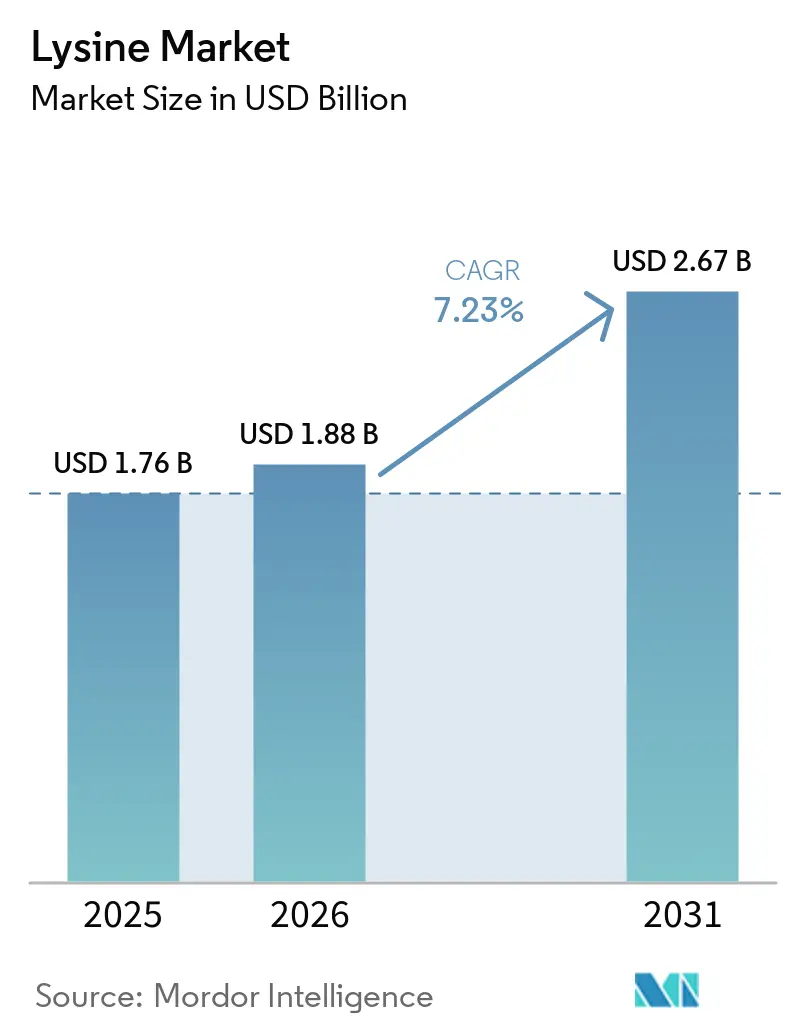
The Lysine Market size was valued at USD 1.76 billion in 2025 and is estimated to grow from USD 1.88 billion in 2026 to reach USD 2.67 billion by 2031, at a CAGR of 7.23% during the forecast period (2026-2031). The lysine market is supported by its role in balancing amino acid requirements in monogastric feed. Demand for animal protein is increasing the value of efficient feed formulation in Asia-Pacific, India, Southeast Asia, and Latin America. Lower crude-protein diets require amino acid supplementation when soybean meal inclusion falls, which supports lysine demand beyond changes in herd numbers. Producers are also pursuing higher-purity and easier-to-handle products for pharmaceutical, nutraceutical, and automated feed-milling uses. Trade measures in Europe, Chinese production capacity, and changes in corn, energy, and freight costs continue to shape sourcing decisions and margins in the lysine market.
Key Report Takeaways
- By type, Lysine Hydrochloride held 60.13% of the lysine market share in 2025, and is projected to record the highest projected CAGR at 8.14% through 2031.
- By grade, Feed Grade held 68.32% of the lysine market share in 2025, while Pharmaceutical Grade is forecast to expand at 8.25% CAGR through 2031.
- By form, Powder accounted for 60.67% of the lysine market size in 2025, while Granules recorded the highest projected CAGR at 8.78% through 2031.
- By application, Animal Feed held 67.85% of the lysine market size in 2025, while Pharmaceuticals and Nutraceuticals are projected to record the highest projected CAGR at 9.13% through 2031.
- By geography, Asia-Pacific held 39.91% of the global lysine market in 2025 and recorded the highest projected CAGR at 8.63% through 2031.
Note: Market size and forecast figures in this report are generated using Mordor Intelligence’s proprietary estimation framework, updated with the latest available data and insights as of January 2026.
Global Lysine Market Trends and Insights
Drivers Impact Analysis*
| Driver | (~) % Impact on CAGR Forecast | Geographic Relevance | Impact Timeline |
|---|---|---|---|
| Rising Demand for Efficient Animal-Protein Production | +2.00% | Global, with intensity in Asia-Pacific and Latin America | Long term (≥ 4 years) |
| Expansion of Low-Crude-Protein Feed Formulation | +1.50% | North America, EU, Asia-Pacific | Medium term (2-4 years) |
| Growth of Aquaculture and Specialty Animal Nutrition | +1.20% | Asia-Pacific core, spill-over to South America and MEA | Long term (≥ 4 years) |
| Increasing Demand for Pharmaceutical-Grade and Nutraceutical Lysine | +1.00% | North America, EU, APAC | Medium term (2-4 years) |
| Liquid and Encapsulated Lysine Adoption in Integrated Feed Mills | +0.80% | North America, EU, South Korea | Medium term (2-4 years) |
| Source: Mordor Intelligence | |||
Rising Demand for Efficient Animal-Protein Production
Rising protein consumption across emerging economies has strengthened lysine’s role as a core feed input in poultry, swine, and aquaculture systems. The Food and Agriculture Organization has stated that 1.5 tonnes of L-lysine HCl can replace the land required to produce 50 tonnes of soybean meal on an amino acid-equivalent nutritional basis[1]Food and Agriculture Organization of the United Nations, “Lysine and Other Amino Acids for Feed,” FAO Animal Production and Health Division, fao.org. This relationship highlights lysine’s relevance in improving feed efficiency, particularly as arable land availability per capita declines. It also demonstrates how amino acid supplementation can reduce the land required to provide equivalent protein nutrition. Feed typically accounts for 60-70% of livestock production costs, making feed conversion efficiency critical to producer margins. Consequently, the lysine market benefits as feed manufacturers seek to maintain animal performance while using protein inputs more efficiently.
Growth of Aquaculture and Specialty Animal Nutrition
Aquaculture is expanding the demand base for lysine beyond poultry and swine diets. ADM identifies shrimp and tilapia as key species driving aquafeed expansion, with strong activity expected in Southeast Asia and South America. In low-fishmeal diets, lysine helps maintain amino acid balance in species-specific feed formulations. A study published in Aquaculture Nutrition found that dietary lysine levels of approximately 4.19% supported weight gain and intestinal health in triploid rainbow trout fed low-fishmeal diets. Species-specific formulation requires suppliers to ensure reliable lysine concentrations, batch-to-batch consistency, and technical support for evolving feed recipes. These requirements create opportunities for suppliers that can deliver consistent specifications for specialty animal nutrition.
Increasing Demand for Pharmaceutical-Grade and Nutraceutical Lysine
Pharmaceutical-grade and nutraceutical lysine support clinical nutrition, antiviral supplements, and immune-support products. Health Canada recognizes L-lysine in licensed natural health products for reducing the recurrence of herpes simplex virus infections and supporting collagen formation. This regulatory recognition strengthens product positioning in licensed consumer health channels. Continuous fermentation and ion-exchange purification enable high purity levels in pharmaceutical supply chains. These production capabilities are particularly relevant for customers requiring documented purity and controlled material specifications for regulated formulations. Consequently, the lysine market can capture higher value from applications in which product specifications and regulatory documentation carry greater importance than commodity feed pricing.
Liquid and Encapsulated Lysine Adoption in Integrated Feed Mills
Integrated feed mills are increasingly adopting liquid and encapsulated formats to achieve more precise dosing and reduce handling losses. ADM provides liquid amino acid systems with enclosed tank-and-meter configurations and real-time inventory monitoring. Kemin offers encapsulation systems that control nutrient release and improve nutrient utilization in animal production. These formats can reduce dust exposure, manual dosing requirements, and packaging waste. The UK Food Standards Agency has concluded that liquid L-lysine base produced using specified Corynebacterium glutamicum strains is an efficacious lysine source for all animal species[2]UK Food Standards Agency, “Assessment on the Safety and Efficacy of a Modification of the Terms of Authorization Regarding the Feed Additive Consisting of Liquid L-Lysine Base,” Food Standards Agency, food.gov.uk. Their adoption provides the lysine market with an entry route into automated feed plants, where formulation precision is a key purchasing priority.
Restraints Impact Analysis*
| Restraint | (~) % Impact on CAGR Forecast | Geographic Relevance | Impact Timeline |
|---|---|---|---|
| Chinese Capacity Surplus and Commodity Price Pressure | -1.20% | Global (price transmission); China, Southeast Asia most acute | Short term (≤ 2 years) |
| Corn, Sugar, Energy, and Fermentation Input-Cost Volatility | -0.80% | Global, with intensity in North America and China | Medium term (2-4 years) |
| EU Trade Restrictions and Regional Supply Concentration | -0.50% | EU, North America, Southeast Asia (re-routing effects) | Medium term (2-4 years) |
| Source: Mordor Intelligence | |||
Chinese Capacity Surplus and Commodity Price Pressure
Chinese overcapacity continues to place persistent pressure on feed-grade lysine prices. As lysine is widely traded and standardized, export availability can rapidly transmit domestic oversupply to other feed-grade markets. This pricing environment favors producers with integrated feedstock supplies and diversified product portfolios. It also encourages non-Chinese suppliers to focus on high-purity grades, specialty formats, and technology-driven revenue streams. Consequently, this pressure limits pricing flexibility in the commodity segment of the lysine market.
Corn, Sugar, Energy, and Fermentation Input-Cost Volatility
Lysine fermentation relies on agricultural feedstocks, electricity, process heat, and transportation. Corn and glucose account for a significant share of variable production costs. Changes in ethanol demand, weather conditions, and export controls can affect corn availability and pricing. Fluctuations in energy and freight costs can further pressure production economics, even when end-market demand remains stable. Producers may mitigate these risks through input hedging, alternative feedstock development, or escalation clauses in supply agreements. While these measures can protect supply economics, they may also increase operational complexity and working capital requirements in the lysine market.
*Our forecasts treat driver/restraint impacts as directional, not additive. The impact forecasts reflect baseline growth, mix effects, and variable interactions.
Segment Analysis
By Type: Lysine Hydrochloride Sustains Commercial Primacy in Feed
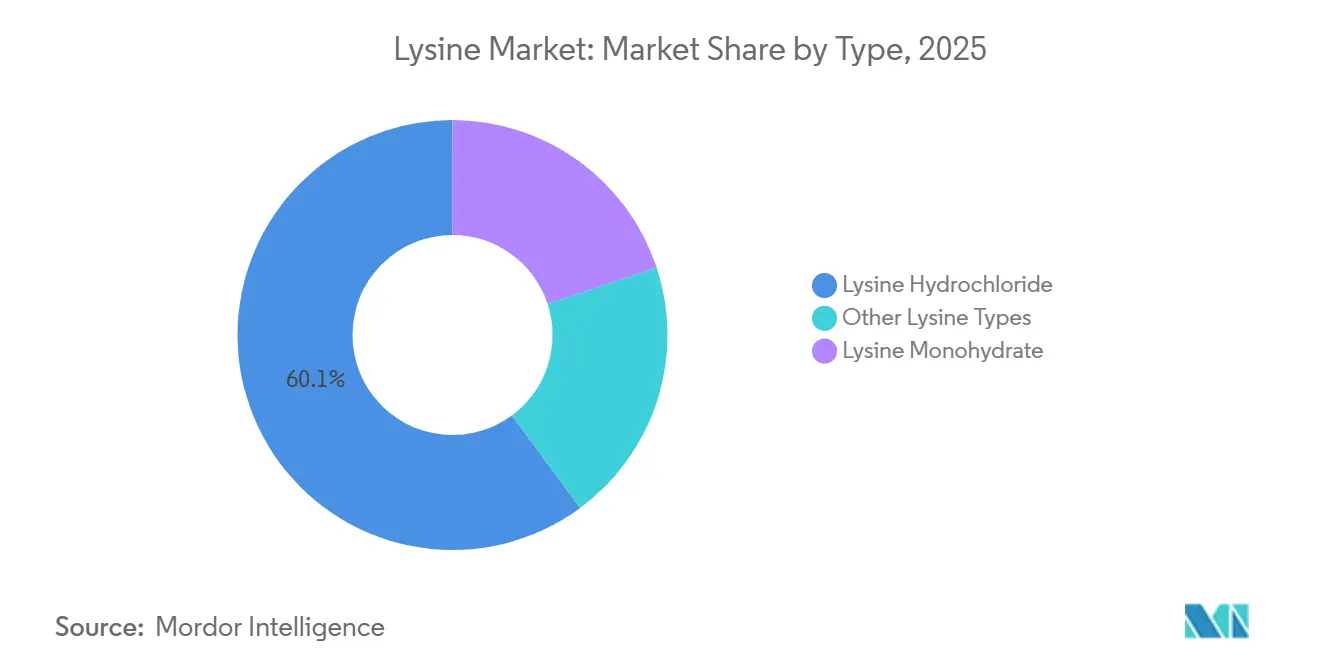
Lysine Hydrochloride accounted for 60.13% of the lysine market in 2025 and is forecast to grow at a CAGR of 8.14% during 2026-2031. It remains the standard commercial form for poultry, swine, and aquaculture feed applications due to its well-established production processes and quality specifications. Its dry form is familiar to feed manufacturers that procure large volumes for routine feed formulation. Global feed compounders also use it in established least-cost formulation systems. Lysine Monohydrate and other forms serve specialized nutrition and export applications where chloride content may create formulation constraints.
The lysine market continues to rely on Lysine Hydrochloride due to its mature logistics network and broad acceptance in feed formulations. The quality premium between standard- and high-purity Lysine Hydrochloride grades is narrowing, making product handling, purity, and application suitability increasingly important sources of differentiation. Suppliers must also maintain consistent specifications for customers who use lysine in tightly controlled feed programs. The lysine market is likely to experience increased demand for type-specific specifications as aquaculture and specialty nutrition formulations become more precise.



By Grade: Feed Grade Entrenched, Pharmaceutical Grade Rising Fastest
Feed Grade accounted for 68.32% of the lysine market in 2025, supported by its widespread use in compound feed and the routine inclusion of lysine in poultry and swine rations. Demand in this segment closely reflects high-volume purchasing patterns in commercial animal production. Pharmaceutical Grade is projected to grow at a CAGR of 8.25% during 2026-2031. Demand for Pharmaceutical Grade lysine is driven by parenteral nutrition, peptide-based drug development, and nutraceutical products. Purchasing decisions in this segment depend more on compliance and purity specifications than on spot commodity prices.
Food Grade lysine serves fortified staple foods and sports nutrition products, including products designed for populations with insufficient dietary protein intake. Pharmaceutical-grade manufacturing uses continuous fermentation and high-resolution ion-exchange chromatography to achieve high purity levels. Buyers in regulated applications may require more extensive documentation than feed-grade customers. Consequently, the lysine market addresses distinct demand patterns across feed, food, and regulated healthcare applications. Food Grade lysine may also benefit from nutrition labeling requirements and amino acid fortification regulations that support formulated food products.
By Form: Powder Leads on Infrastructure Lock-In; Granules Signal the Precision Premium
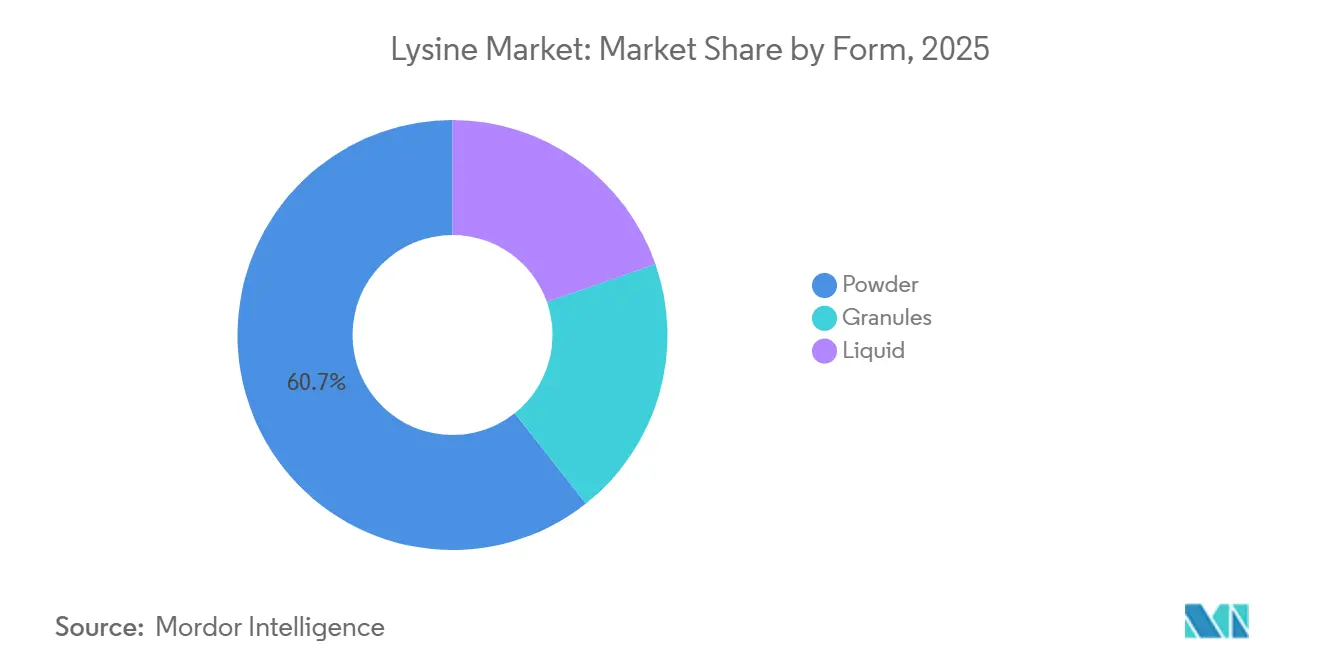
Powder accounted for 60.67% of the lysine market in 2025, while granules are forecast to grow at a CAGR of 8.78% during 2026-2031. Powder remains widely used because many existing feed mills operate powder-handling equipment. These established systems support continued demand for a familiar and readily available format. Granules offer improved flow properties and lower dust generation, making them suitable for automated weighing and batching operations. Although the installed base of powder-handling equipment sustains powder demand, it also slows the pace of conversion to alternative formats.
Evonik markets Biolys as a fermented granular lysine product containing a minimum of 62.4% L-lysine, along with additional nutrients from fermentation byproducts. Liquid lysine is also gaining adoption among integrated mills in North America and Europe that use tank-and-meter systems. These systems can enable more consistent dosing in high-throughput operations. The UK regulatory assessment supports the use of liquid L-lysine for all animal species under the evaluated authorization terms. Expanding automated feed production capacity in China, Vietnam, and India may further support demand for formats that enhance dosing accuracy and material handling.
By Application: Animal Feed Anchors the Base; Nutraceuticals Represent the Mix-Shift
Animal Feed accounted for 67.85% of the lysine market in 2025, while Pharmaceuticals and Nutraceuticals are projected to expand at a CAGR of 9.13% during 2026-2031. Demand from the feed segment reflects lysine’s role in precision livestock nutrition and lower-protein ration formulations, directly linking demand to the economics of commercial animal production. The European Commission stated that synthetic lysine enables more precise livestock nutrition and can reduce nitrogen losses, including ammonia and nitrates. Pharmaceuticals and Nutraceuticals benefit from demand for immune support, antiviral, sports recovery, and clinical nutrition formulations.
Food and Beverages, Personal Care, and other applications diversify demand beyond animal feed. Food-grade lysine is used in cereal fortification, while lysine peptide derivatives are incorporated into skin-care products positioned to support collagen formation. Although these applications account for lower volumes, they require more specialized formulations. Health Canada’s licensed product information provides a regulatory reference for L-lysine claims related to HSV recurrence and collagen formation. While smaller than the animal feed segment, these applications can reduce the lysine market’s exposure to the commodity feed cycle.
Geography Analysis
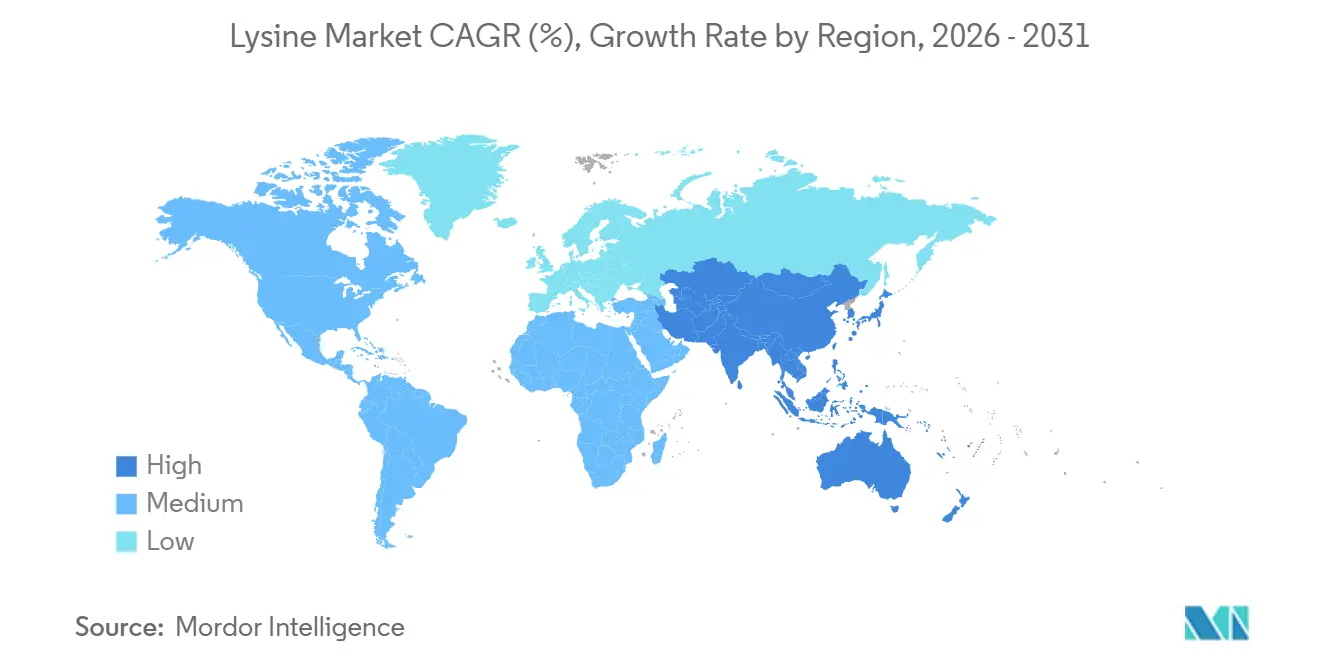
Asia-Pacific held 39.91% of the global lysine market in 2025 and is forecast to grow at a CAGR of 8.63% during 2026-2031. The region combines a large feed production base with expanding aquaculture activity. India’s poultry sector, along with aquaculture growth in Vietnam and Indonesia, supports additional lysine demand. Japan and South Korea have more mature consumption profiles but continue to drive demand for high-purity and pharmaceutical-grade products.
North America represents a mature yet evolving lysine market. Poultry feed inclusion rates are well established across much of the region. Future demand will depend primarily on aquaculture, nutraceuticals, pharmaceutical-grade products, and changes in feed formulation standards. ADM’s liquid amino acid systems demonstrate the role of precision dosing in integrated facilities. Canada and Mexico remain part of a regional feed system in which operational efficiency carries greater importance than rapid growth in basic lysine consumption.
In 2026, trade measures and domestic supply concerns shape the European lysine market. The European Commission’s 2025 regulation imposed duties on lysine imports originating in China. The reopening of the anti-absorption investigation in 2026 creates further uncertainty regarding supplier selection and procurement planning. South America can benefit from expanding livestock exports and aquaculture production, while demand in the Middle East and Africa remains at an earlier stage of development. Saudi Arabia’s agri-food investment plans and improving aquaculture infrastructure in Africa support long-term demand for specialty-grade lysine products.

Competitive Landscape
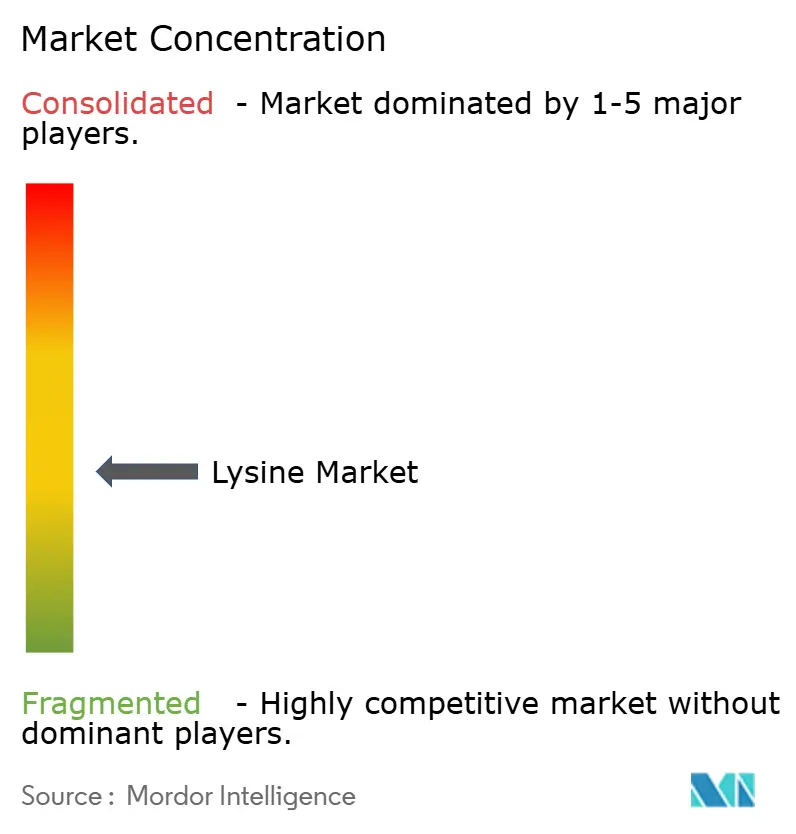
The lysine market is moderately concentrated. The market has a concentrated production base in East Asia, particularly China, while specialty segments remain more differentiated. Chinese suppliers exert considerable influence on feed-grade lysine prices. Japanese and Korean suppliers compete more directly through product quality, regulatory expertise, and specialty applications.
Leading companies use product differentiation, technology, and geographic diversification to protect returns. Evonik positions Biolys as a differentiated fermented granular product rather than a standard crystalline product. ADM offers liquid amino acid solutions for feed operations that prioritize enclosed handling and monitored inventory. These strategies demonstrate how suppliers can compete based on application performance rather than volume alone.
Regulated markets provide an important opportunity for high-purity lysine products. The European trade case has increased sourcing complexity for buyers and suppliers. The United Kingdom’s assessment of liquid L-lysine provides a compliance reference for liquid products used in animal nutrition. Suppliers that maintain consistent purity, traceability, and product-specific documentation are better positioned to serve these channels. The lysine market also favors firms that can manage feedstock costs, transport volatility, and regulatory changes without relying solely on commodity pricing.
Lysine Industry Leaders
Ajinomoto Co., Inc.
CJ CheilJedang Corp.
Meihua Holdings Group Co., Ltd.
Fufeng Group
Evonik Industries AG
- *Disclaimer: Major Players sorted in no particular order

Recent Industry Developments
- April 2026: The Official Journal published Notice C/2026/2557 reopening the anti-dumping investigation into Chinese lysine imports following Eurolysine’s complaint. The proceeding followed concerns that selling prices had declined after the imposition of duties. Its outcome may affect future duty levels and supply allocation decisions among EU feed buyers.
- February 2026: Eurolysine filed a formal complaint with the European Commission requesting an anti-absorption investigation into Chinese lysine. The company stated that exporters had reduced EU selling prices after definitive duties came into force. The complaint represented a further effort to address structural competition from imported material.


Global Lysine Market Report Scope
Lysine, also known as L-lysine, is an essential amino acid that the body cannot synthesize and must obtain through the diet. It supports normal growth and muscle turnover and contributes to the production of carnitine, a compound present in most cells of the body. Lysine also helps transport fats across cells for energy production. L-lysine is the biologically active form that the body utilizes and is available in foods and dietary supplements.
The Lysine Market is segmented by type, grade, form, application, and geography. By type, the market is segmented into lysine hydrochloride, lysine monohydrate, and other lysine types. By grade, the market is segmented into feed grade, food grade, and pharmaceutical grade. By form, the market is segmented into powder, liquid, and granules. By application, the market is segmented into animal feed, food and beverages, pharmaceuticals and nutraceuticals, personal care, and others. The report also covers the market size and forecasts for lysine in 15 countries across major regions. For each segment, the market sizing and forecasts have been done on the basis of value (USD).
| Lysine Hydrochloride |
| Lysine Monohydrate |
| Other Lysine Types |
| Feed Grade |
| Food Grade |
| Pharmaceutical Grade |
| Powder |
| Liquid |
| Granules |
| Animal Feed |
| Food and Beverages |
| Pharmaceuticals and Nutraceuticals |
| Personal Care |
| Others |
| Asia-Pacific | China |
| India | |
| Japan | |
| South Korea | |
| Rest of Asia-Pacific | |
| North America | United States |
| Canada | |
| Mexico | |
| Europe | Germany |
| United Kingdom | |
| France | |
| Italy | |
| Rest of Europe | |
| South America | Brazil |
| Argentina | |
| Rest of South America | |
| Middle-East and Africa | Saudi Arabia |
| South Africa | |
| Rest of Middle-East and Africa |
| By Type | Lysine Hydrochloride | |
| Lysine Monohydrate | ||
| Other Lysine Types | ||
| By Grade | Feed Grade | |
| Food Grade | ||
| Pharmaceutical Grade | ||
| By Form | Powder | |
| Liquid | ||
| Granules | ||
| By Application | Animal Feed | |
| Food and Beverages | ||
| Pharmaceuticals and Nutraceuticals | ||
| Personal Care | ||
| Others | ||
| By Geography | Asia-Pacific | China |
| India | ||
| Japan | ||
| South Korea | ||
| Rest of Asia-Pacific | ||
| North America | United States | |
| Canada | ||
| Mexico | ||
| Europe | Germany | |
| United Kingdom | ||
| France | ||
| Italy | ||
| Rest of Europe | ||
| South America | Brazil | |
| Argentina | ||
| Rest of South America | ||
| Middle-East and Africa | Saudi Arabia | |
| South Africa | ||
| Rest of Middle-East and Africa | ||


Key Questions Answered in the Report
How large is the lysine market in 2026?
The lysine market is valued at USD 1.88 billion in 2026 and is forecast to reach USD 2.67 billion by 2031 at a CAGR of 7.23%. The estimate reflects a forecast period running from 2026 to 2031.
Which lysine application has the largest share?
Animal Feed held 67.85% of the global lysine market in 2025. Feed demand is supported by poultry, swine, aquaculture, and the use of lysine in lower-protein ration designs.
Which lysine form is growing fastest?
Granules are forecast to grow at 8.78% CAGR through 2026-2031. Their growth is linked to automated weighing and batching systems that require reliable material flow and reduced dust generation.
Which region leads lysine consumption and growth?
Asia-Pacific held 39.91% of global demand in 2025 and is forecast to grow at 8.63% CAGR through 2031. The region has large feed production, growing aquaculture, and expanding poultry production.
Page last updated on:





