
Luxury Coaches Market Size and Share
Market Overview
| Study Period | 2020 - 2032 |
|---|---|
| Market Size (2027) | USD 8.28 Billion |
| Market Size (2032) | USD 10.78 Billion |
| Growth Rate (2027 - 2032) | 5.42 % |
| Fastest Growing Market | Asia-Pacific |
| Largest Market | Europe |
| Market Concentration | Medium |
Major Players *Disclaimer: Major Players sorted in no particular order Image © Mordor Intelligence. Reuse requires attribution under CC BY 4.0. | |
Luxury Coaches Market Analysis by Mordor Intelligence
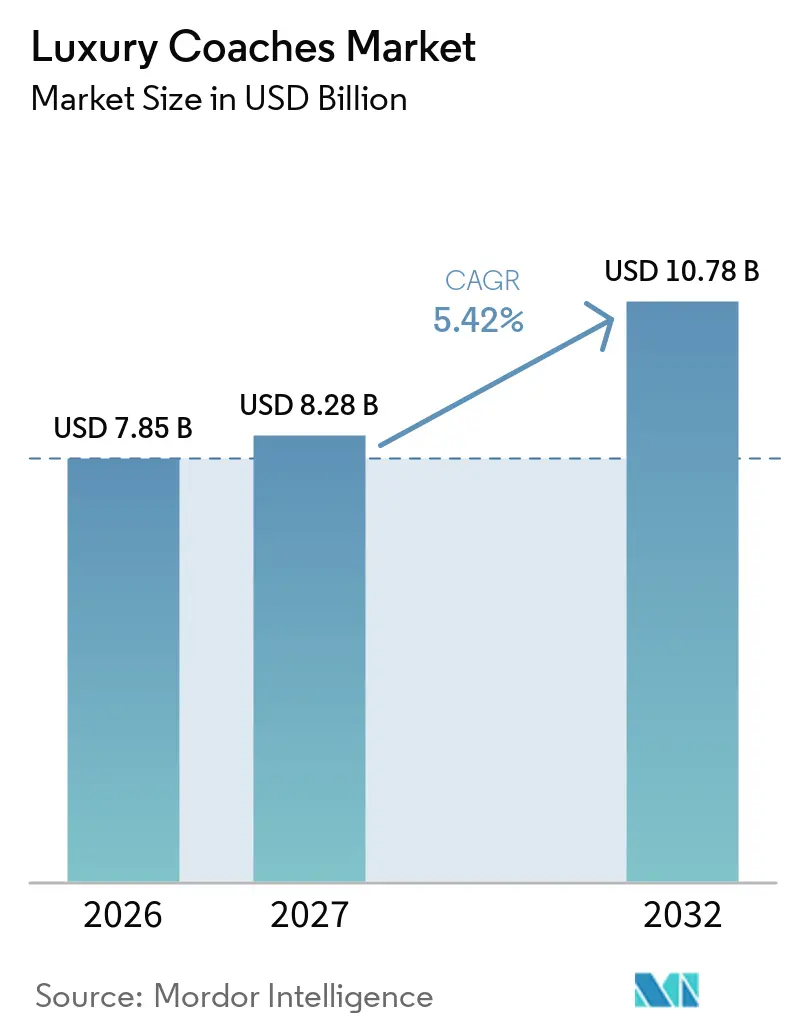
The luxury coaches market size was valued at USD 7.85 billion in 2026 and is expected to grow from USD 8.28 billion in 2027 to USD 10.78 billion by 2032, at a CAGR of 5.42% during 2027-2032. The luxury coaches market is being shaped by competition with short-haul aviation on routes below 600 km, where operators need to offer a reliable and comfortable alternative for group travelers. Deferred purchases during 2020 through 2022 have left many operators with older fleets, raising maintenance costs and strengthening replacement demand. Emission rules in Europe and Asia-Pacific are making fleet renewal a compliance decision as well as a commercial one. The luxury coaches market also benefits from passengers seeking consistent onboard amenities across tourism, charter, corporate, and pilgrimage travel. Manufacturers that combine lower-emission platforms with service support and adaptable interiors are better placed to secure replacement orders.
Key Report Takeaways
- By coach type, touring/long-distance coaches held a 42.33% share in 2026, while other coach types (VIP and custom formats) are projected to grow at a 7.24% CAGR through 2032.
- By length, 10–13 m coaches held a 63.15% share in 2026, while under 10 m coaches are projected to grow at a 6.81% CAGR through 2032.
- By seating capacity, 30- to 50-seat coaches held a 53.06% share in 2026, while under 30-seat coaches are projected to grow at a 6.44% CAGR through 2032.
- By propulsion, diesel held a 65.11% revenue share in 2026, while hydrogen fuel cell coaches are projected to grow at a 14.23% CAGR through 2032.
- By end user, tour operators held a 39.45% revenue share in 2026 and are projected to grow at a 5.97% CAGR through 2032.
- By geography, Europe accounted for 37.04% of revenue in 2026, while Asia-Pacific is projected to grow at a 7.82% CAGR through 2032.
Note: Market numbers in this report are based on Mordor Intelligence's proprietary estimation framework, which combines nine months of actuals with Q4 projections for base year 2026.
Market Trends and Insights
Drivers Impact Analysis of Luxury Coaches Market*
| Driver | (~) % Impact on CAGR Forecast | Geographic Relevance | Impact Timeline |
|---|---|---|---|
| Recovery in Premium Tourism and Group Travel | +1.2% | Global, concentrated in Europe, Asia-Pacific, and Middle East and Africa | Short term (≤ 2 years) |
| Route-Specific Electrification Creating New Procurement Cycles | +1.0% | Europe and Asia-Pacific, with early gains in South Korea, Japan, and the Netherlands | Long term (≥ 4 years) |
| Premium Intercity Travel Expanding Beyond Air-Rail Corridors | +0.9% | Europe, South Asia, and Southeast Asia | Medium term (2–4 years) |
| Fleet Replacement Following Deferred Coach Purchases | +0.7% | North America and Western Europe | Short term (≤ 2 years) |
| Premium Coach Demand from Cross-Border and Religious Tourism Corridors | +0.7% | Middle East, South Asia, and Europe | Medium term (2–4 years) |
| Higher Revenue per Seat from Premium Amenities | +0.6% | Europe, North America, and Middle East | Medium term (2–4 years) |
| Source: Mordor Intelligence | |||
Recovery in Premium Tourism and Group Travel
Premium tourism recovery is supporting demand for higher-specification vehicles rather than standard charter fleets. Custom itineraries place greater value on reliable seating, climate control, and onboard services. The luxury coaches market is therefore influenced by operators' ability to deliver consistent quality throughout an itinerary. Operators with mixed vehicle specifications can find it harder to meet tender requirements for premium group travel. The Makkah-Madinah corridor carries large volumes of coach passengers during the Hajj and Umrah seasons, making it a stable source of recurring fleet demand. These recurring journeys create a clearer operating case for well-maintained, high-rotation fleets.
Route-Specific Electrification Creating New Procurement Cycles
Zero-emission zones and European CO2 rules are accelerating procurement on predictable routes with depot returns. Regulation (EU) 2024/1610 requires heavy-duty vehicle manufacturers, with coaches now in scope, to cut average CO2 emissions by 45% from 2030, 65% from 2035, and 90% from 2040, relative to the 2019 reference period [1]. These rules make lower-emission fleet choices more urgent for operators serving regulated routes. Daimler Buses began public road testing of the Setra S 517 HD hydrogen fuel cell coach in September 2025. The vehicle has a stated minimum range of 800 km, a 46 kg hydrogen tank capacity, and a 300 kW fuel cell output. The luxury coaches market can gain from this development when long-distance operators see a practical option to replace diesel vehicles without changing route schedules.
Premium Intercity Travel Expanding Beyond Air-Rail Corridors
Premium coach services are expanding on intercity routes that lack direct air or high-speed rail links, where door-to-door convenience and onboard comfort compete with short-haul flights. Operators on these corridors need vehicles that can deliver consistent service across long daily duty cycles. Cross-border touring in Europe also favors coaches with reclining seats, Wi-Fi, and certified lavatories. In Asia-Pacific, the Johor Bahru-Singapore corridor and touring routes across Thailand, Vietnam, and Cambodia are creating early demand for premium services. Premium cross-border services between Singapore and Johor destinations such as Desaru indicate demand for smaller-group premium offerings. The luxury coaches market has a stronger utilization case on recurring corridors than on open-itinerary routes, although operators still need financing that recognizes this difference.
Fleet Replacement Following Deferred Coach Purchases
Operators in North America and Western Europe entered 2025 with fleets that had been retained longer than normal following purchase freezes between 2020 and 2022. Older vehicles can increase maintenance needs, compliance exposure, and the risk of service disruption. These pressures make replacement decisions more pressing even when passenger demand is uneven. MCI stated in March 2026 that its J4500 has remained North America's best-selling motorcoach since 2004, based on American Bus Association data [2]. MCI also introduced factory-installed 2+1 executive seating on the J4500 in September 2025, moving a premium interior option into regular production. The luxury coaches market is supported when replacement fleets can meet both fleet-age and passenger-experience requirements in a single purchase.
Restraints Impact Analysis of Luxury Coaches Market*
| Restraint | (~) % Impact on CAGR Forecast | Geographic Relevance | Impact Timeline |
|---|---|---|---|
| High Acquisition Costs and Fragmented Operator Financing | -1.1% | Global, acute in South Asia, South America, and Middle East and Africa | Medium term (2–4 years) |
| Long-Route Battery Range and Charging Dwell-Time Limitations | -0.9% | Global, acute in locations with limited charging infrastructure | Long term (≥ 4 years) |
| Driver Shortages and Skilled Technician Constraints | -0.7% | Western Europe, North America, and Australia | Short term (≤ 2 years) |
| Seasonal Utilization and Residual-Value Uncertainty | -0.6% | Europe, North America, and seasonal tourism locations | Medium term (2–4 years) |
| Source: Mordor Intelligence | |||
High Acquisition Costs and Fragmented Operator Financing
Hydrogen and high-specification battery-electric coaches have substantially higher unit costs. These high costs can place newer technologies beyond the reach of small and medium-sized charter operators. In India, luxury coaches also command premium prices, which can limit their affordability for operators. The funding gap is wider when lenders cannot set clear residual values for hydrogen or battery-electric vehicles. Longer payback periods can delay orders even when operating costs and emissions goals favor replacement. The luxury coaches market is consequently more dependent on fleet-finance programs in regions where operators do not have access to large balance sheets.
Long-Route Battery Range and Charging Dwell-Time Limitations
Battery-electric coaches are well suited to depot-return and urban shuttle duty but face different constraints in long-distance touring. Large battery packs can reduce luggage capacity and increase axle loads, limiting the passenger and baggage combination available to operators. Fast charging at 250 to 450 kW can still add 60 to 120 minutes to a long-distance round trip. This can interrupt published schedules and reduce daily vehicle utilization. Irizar stated that its second-generation i6S Efficient H2 FCEV entered passenger service with Alsa in Madrid in 2026, with a stated range of more than 1,000 km and a refueling time of about 10 to 15 minutes. Limited green hydrogen infrastructure outside Germany, the Netherlands, and South Korea still confines the luxury coaches market to route-specific applications for now.
*Our forecasts treat driver/restraint impacts as directional, not additive. The impact forecasts reflect baseline growth, mix effects, and variable interactions.
Luxury Coaches Market Segment Analysis
By Coach Type:
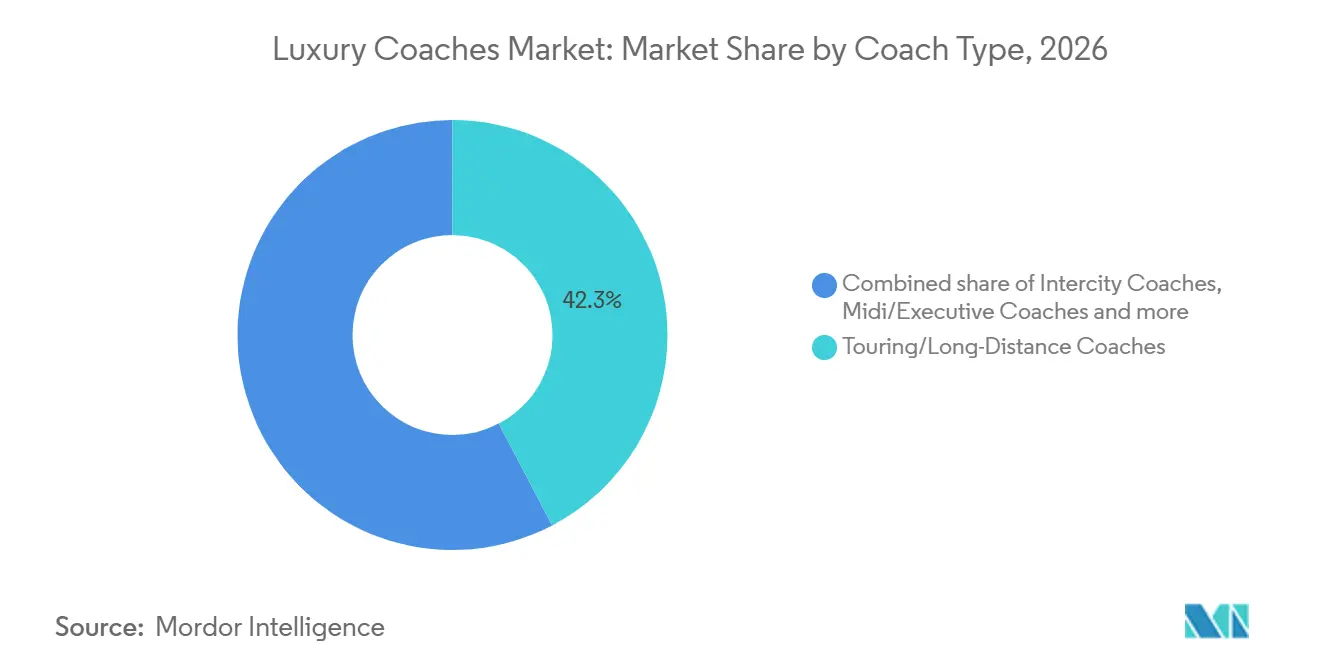
Touring Coaches Lead While VIP Formats ExpandTouring and long-distance coaches accounted for 42.33% of the luxury coaches market share in 2026. Their leading position in the luxury coaches market reflects demand from European charter networks and East Asian group-tourism operators. These fleets commonly serve multi-day tours, airport transfers, and cross-border itineraries. Their purchase cycles are linked to mileage, maintenance costs, tourism schedules, and licensing requirements. Intercity coaches serve route-licensed operators that emphasize frequency and reliable scheduling. Midi and executive coaches are used in corporate and airport-transfer work, where smaller groups can support higher revenue per seat. The luxury coaches industry depends on each format because customers have different route, capacity, and service requirements. Touring coaches remain the main volume platform for manufacturers that serve long-distance group travel.
Other coach types, including VIP and custom formats, are forecast to grow at a 7.24% CAGR through 2032. This growth reflects demand for aircraft-style seating, privacy partitions, and onboard service areas. Luxury charter operators in the Middle East, China, and North America are among the buyers seeking these features. Such orders generally require a closer link between the manufacturer, bodybuilder, and operator. Yutong's T14E received the Grand Award Coach at Busworld Europe 2025 and featured surround sound, NFC key access, and adaptive air suspension. The luxury coaches market gives suppliers with in-house fit-out capability an advantage in this higher-value work. Producers without customization access can find it difficult to participate at the same scale. Bespoke orders also require reliable aftersales support because premium operators cannot accept extended vehicle downtime.

By Length:
Standard Coaches Lead While Compact Formats Gain Use CasesThe 10 to 13 m category held 63.15% of the segment's 2026 revenue. This length has broad utility in intercity, charter, and tourism applications. It fits the road, parking, and passenger-capacity conditions found on many European and Asian routes. A standard luxury layout can carry 45 to 60 passengers in this format. Operators can also use these vehicles across several assignments during the year. That flexibility helps make the category the primary production platform for many original equipment manufacturers. Coaches longer than 13 m are used where operators prioritize passengers carried per trip on dense corridors. Their role grows with premium intercity services in China and India. Standard-length coaches remain central to the luxury coaches industry because they balance passenger capacity, luggage needs, and operating access. Volvo Bus UK and UNVI announced the Volvo B13R UNVI XL in March 2025 for the UK and Irish markets. The 12.8 m coach has a 9.5 m³ luggage compartment, safety systems meeting EU GSR2 requirements, and HVO biofuel compatibility [3]. The example shows that operators seek comfort-per-seat improvements even in mainstream sizes.
Under 10 m coaches are projected to grow at a 6.81% CAGR through 2032. Corporate shuttles, airport-hotel transfers, resort circuits, and VIP movements are supporting this demand. These services use smaller vehicles to provide high comfort for smaller groups. Operators serving resorts, heritage towns, and narrow mountain routes favor compact premium vehicles that can reach sites where a full-size coach is impractical. Smaller group itineraries can favor compact premium vehicles when capacity is not the primary objective. The luxury coaches market therefore has room for formats that fit sites and routes where a full-size coach is not practical. Manufacturers must maintain enough layout flexibility to serve both compact and standard-size demand.
By Seating Capacity:
Mid-Range Configurations Lead While Boutique Capacity RisesThe 30- to 50-seat category accounted for 53.06% of segment revenue in 2026. It aligns with standard group sizes and supports utilization levels on many licensed routes. This capacity band makes the luxury coaches market more predictable for major manufacturers. Common seating layouts allow purchasing scale across Europe and East Asia. Operators can adapt the interior for tourism, charter, and scheduled work without changing the basic platform. The category also offers sufficient luggage space for typical touring assignments. These attributes help stabilize demand for mid-range configurations. More than 50-seat coaches serve high-density premium intercity services and pilgrimage corridors. They are particularly relevant where operators focus on revenue per trip and have dependable passenger volumes.
The under 30-seat category is forecast to grow at a 6.44% CAGR through 2032. It is used by travelers who value privacy, flexible itineraries, and a more personal travel setting. China, Southeast Asia, and the Middle East are cited as important demand locations. Such buyers often seek bespoke layouts rather than standard fleet interiors. BYD formed a strategic alliance with Fosun Tourism Group in December 2025, connecting electric mobility with premium resort destinations across several countries. This arrangement indicates how vehicle choices can be incorporated into destination services. The luxury coaches market can benefit when hospitality operators treat ground transport as part of the guest experience. Smaller vehicles can achieve stronger unit margins through customization, but they usually require more careful order planning. Manufacturers also need to balance customization with serviceability across a dispersed fleet.
By Propulsion:
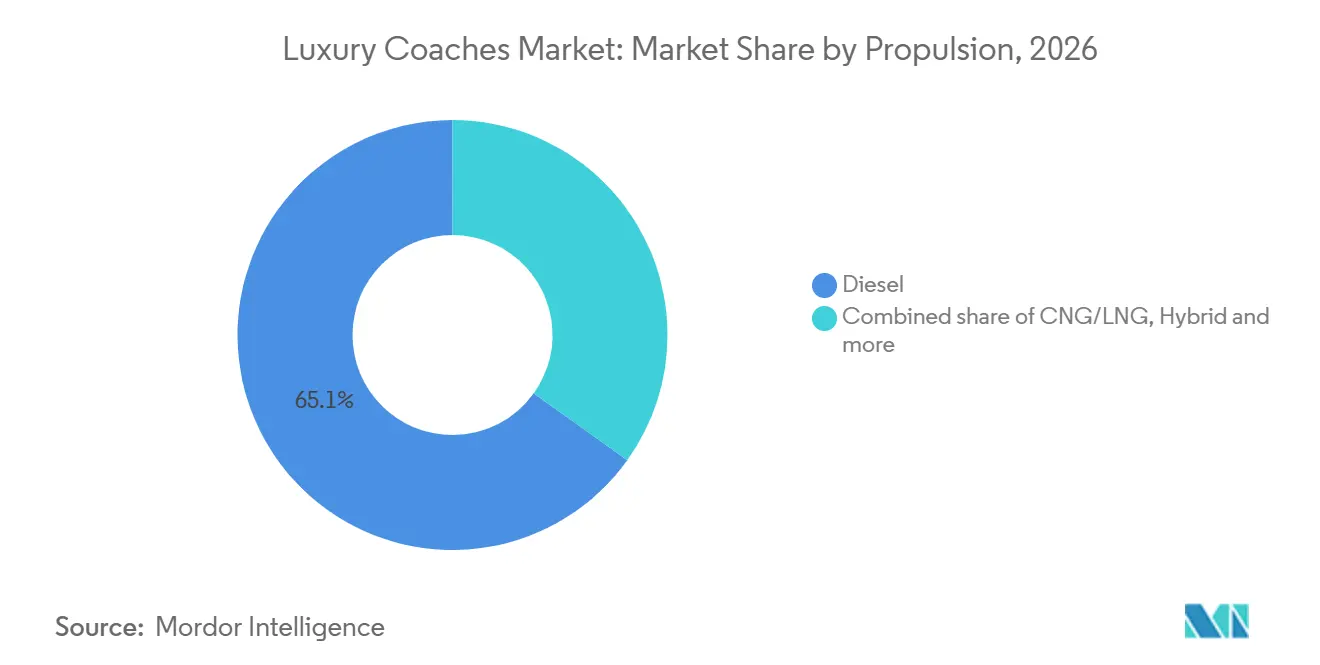
Diesel Leads While Hydrogen Supports Long-Distance DecarbonizationDiesel held 65.11% of segment revenue in 2026. Its position reflects range, payload, refueling speed, and widespread fuel availability. Diesel remains important on cross-border routes in South America, South Asia, and sub-Saharan Africa. CNG, LNG, and hybrid vehicles can reduce certain operating costs in markets with supporting infrastructure. However, these alternatives do not yet provide the same touring range characteristics as diesel. Battery-electric platforms are expanding their practical route coverage. Daimler presented the Mercedes-Benz eIntouro in October 2025 for intercity routes and excursions. The luxury coaches market is expected to retain diesel demand while route conditions, infrastructure, and fleet economics remain uneven across countries.
Hydrogen fuel cell coaches are expected to grow at a 14.23% CAGR through 2032. The technology aims to preserve the payload, luggage capacity, and refueling characteristics sought by touring operators. These attributes are important on routes where large battery packs create scheduling or loading constraints. Regulation (EU) 2024/1610 gives operators a direct reason to consider lower-emission models in fleet-average calculations. The luxury coaches industry is likely to depend on hydrogen supply access and financing terms before the technology can move beyond selected applications. Manufacturers must also show that maintenance networks can support fuel-cell fleets outside early-adopter locations. The segment's growth rate indicates strong interest, but deployment is expected to remain tied to route-level infrastructure readiness.
By End User:
Tour Operators Lead Demand and Fleet Quality UpgradesTour operators held 39.45% of end-user revenue in 2026. They are also forecast to grow at a 5.97% CAGR through 2032. This combination shows that fleet quality matters in a customer group that directly manages passenger expectations. Travelers increasingly compare coach interiors and service standards with hotels, airlines, and cruise operators. Tour operators with modern fleets can present a more consistent product to travel partners. Those with older assets can have less ability to charge a premium or retain contracts. Intercity transport operators procure vehicles for predictable fixed routes, with reliability and compliance as primary requirements. Corporate and charter operators are major buyers of VIP and custom specifications. Together, these end users sustain demand across both standard and customized coach designs.
Public-sector and commuter procurement continues to matter in North America. NFI Group's MCI received an expansion order from Metrolinx for 97 additional D45 CRT commuter coaches in July 2025. Resort shuttles, airport handlers, and event operators also create demand for high-specification vehicles. These customers often require flexibility in seating layouts and operating patterns. The luxury coaches market gains from this diversity because it is not limited to leisure tours alone. Specialized customers can favor sub-10 m vehicles with premium interiors. Manufacturers that can serve both large fleet orders and smaller customized orders have broader access to demand. After-sales capability remains important because these end users often operate on fixed schedules and cannot readily substitute vehicles.
Geography Analysis
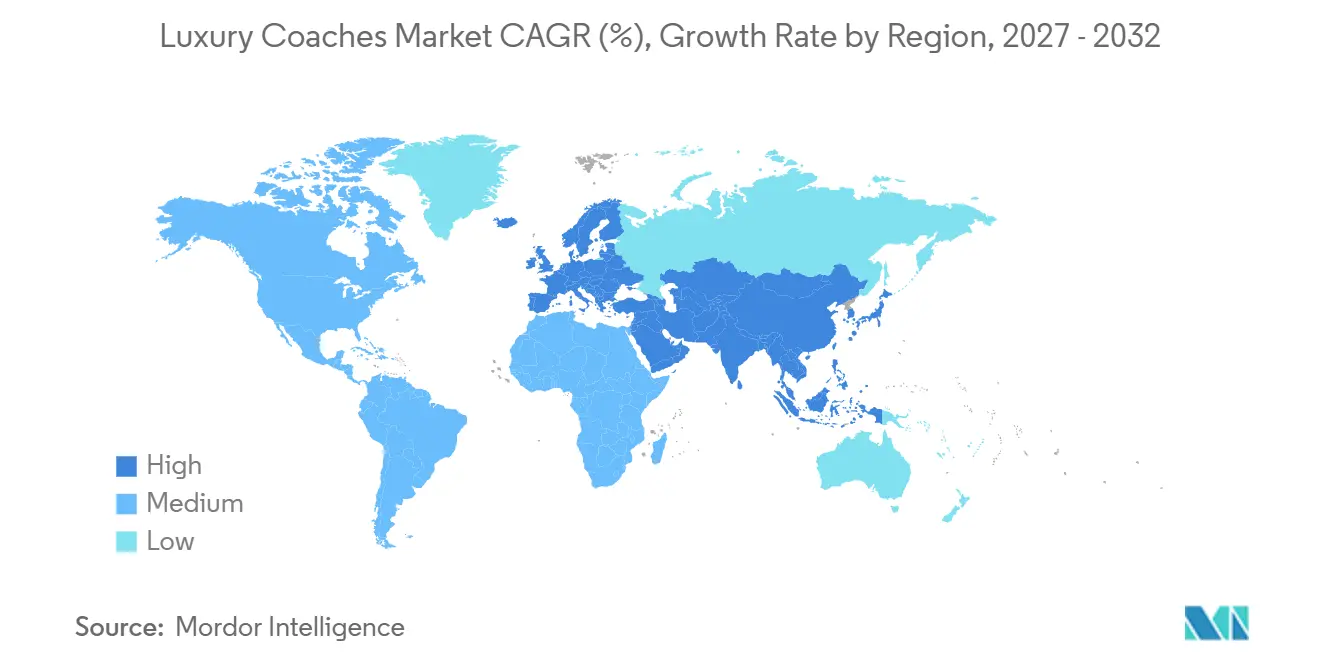
Europe accounted for 37.04% of the luxury coaches market share in 2026. The region has a dense network of heritage destinations, established operator licensing, and cross-border tourism routes. Germany, France, Italy, Spain, and the Netherlands are important sources of premium coach demand. Southern Europe benefits from leisure travel that supports charter utilization across much of the year. Volvo Buses relaunched the Volvo 9700 in October 2026 in 12.4 m, 13.1 m, and 13.9 m versions, with production in Mexico and deliveries planned from late 2026. Volvo Buses and Marcopolo also expanded their European coach offering through a partnership announced in October 2025, with the European production version of the Volvo B13R Marcopolo Paradiso G8 shown at FIAA Madrid in September 2026. These actions show that manufacturers view the region as a significant replacement and product-positioning market.
Asia-Pacific is projected to grow at a 7.82% CAGR through 2032. Its growth is linked to a larger affluent traveler base, highway investment, and domestic manufacturing capability. China benefits from extensive tourism fleets and the use of lower-emission vehicles on designated scenic routes. Yutong offers its T14E with battery options of up to 704 kWh and a claimed range of up to 850 km, and promotes its EV long-life technology for a 15-year or 1.5 million km service life. India is upgrading intercity fleets through private operators and state transport corporations. Tata Motors launched the LPO 1822 intercity chassis in October 2025 with full-air suspension and 36- to 50-seat configurations for premium long-haul routes. Japan, South Korea, and Australia are progressing with hydrogen and battery-electric pilot programs. The luxury coaches market in the region has both substantial domestic demand and a growing ability to offer premium products at lower ownership costs than imported alternatives.
South America has replacement potential where fleet ages are high, especially in Brazil, Argentina, Chile, Colombia, and Peru. Marcopolo is expanding its international presence through its partnership with Volvo Buses in Europe. The Middle East and Africa contain markets with different income levels, infrastructure quality, and operating conditions. Saudi Arabia has a major demand base in the Makkah-Madinah pilgrimage corridor. The UAE, Qatar, and Israel support demand for VIP and custom configurations. Nigeria, Morocco, and Egypt remain earlier-stage markets where highway investment is beginning to support premium long-distance services. The luxury coaches market has opportunities in these locations, but orders depend on route economics, financing, and reliable maintenance arrangements. The region's demand is likely to remain concentrated around high-utilization corridors and established tourism flows.
Competitive Landscape
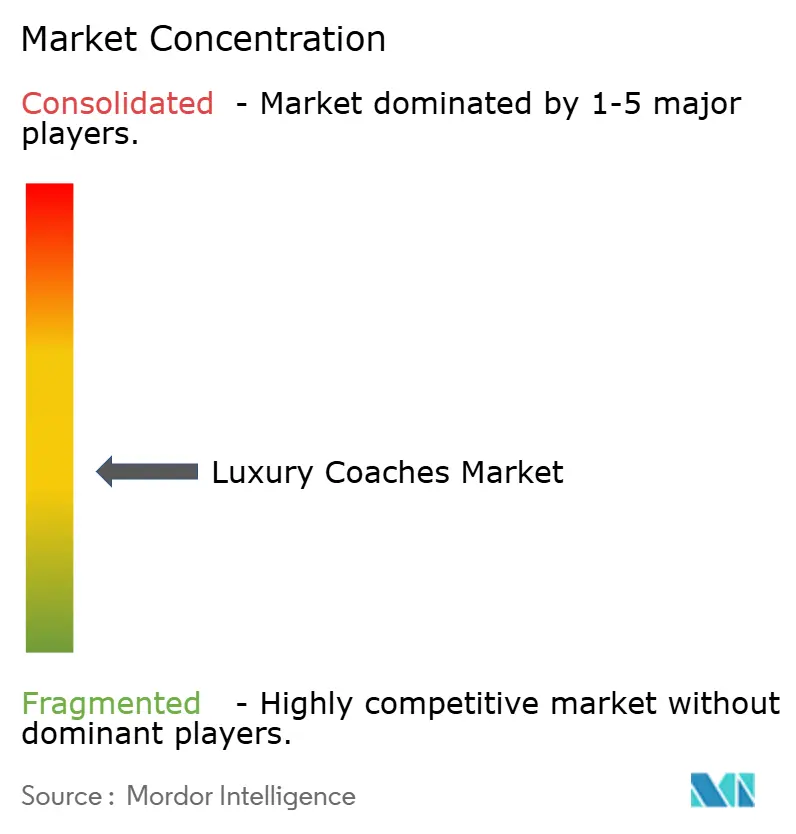
The luxury coaches market is moderately concentrated. Daimler Truck AG, Volvo AB, Irizar S.A., and VDL Groep have established positions in Western European premium touring and intercity applications. Yutong Bus Co., Ltd. and BYD Company Limited are gaining attention through battery-electric products and competitive export positioning. Competition is increasingly based on access to technology platforms, service support, and interior configurations rather than price alone. European manufacturers are progressing with hydrogen platforms for long-distance duty. Daimler's Setra hydrogen coach testing provides one example of this direction. Chinese manufacturers have an advantage in battery-electric scale and vertical integration. The luxury coaches market is therefore becoming more divided by propulsion strategy and route suitability.
Partnerships with bodybuilders are becoming an important route to broader product coverage. Volvo Buses also announced its European partnership with Marcopolo in October 2025. These arrangements let OEMs use specialized body expertise without developing every body format independently. They can also support local sales and after-sales networks. In the VIP and custom segment, no manufacturer has established clear scale dominance. This leaves room for suppliers that can meet demanding requirements for privacy, interior quality, and onboard systems. Manufacturers must manage the added production complexity that comes with a larger range of bespoke orders. The luxury coaches market increasingly rewards specialized capabilities as much as unit volumes.
Safety and emissions standards are raising the minimum specification expected in Europe. EU General Safety Regulation 2 requirements include advanced driver-assistance functions such as automatic emergency braking, lane-keeping support, and intelligent speed assistance. These requirements can create a higher entry threshold for low-specification manufacturers. BYD's alliance with Fosun Tourism Group in December 2025 also shows a strategy that links electric mobility to premium hospitality destinations. The luxury coaches market rewards manufacturers that can combine regulatory readiness with customer-specific product development. Service capacity matters alongside product design because fleets operate on time-sensitive schedules.
Luxury Coaches Industry Leaders
-
Daimler Truck AG
-
Volvo AB
-
Yutong Bus Co., Ltd.
-
MAN Truck & Bus SE
-
Irizar, S.A.
- *Disclaimer: Major Players sorted in no particular order
Luxury Coaches Market Companies Covered in this Report
- Daimler Truck AG
- Volvo AB
- MAN Truck & Bus SE
- VDL Bus & Coach BV
- Irizar, S.A.
- Iveco Group N.V.
- Yutong Bus Co., Ltd.
- Xiamen King Long Motor Group Co., Ltd.
- Zhongtong Bus Holding Co., Ltd.
- NFI Group Inc.
- Temsa Skoda Sabanci Ulasim Araclari A.S.
- Ashok Leyland Limited
- Tata Motors Limited
- Marcopolo S.A.
- Hyundai Motor Company
- BYD Company Limited
- Otokar Otomotiv ve Savunma Sanayi A.S.
- Isuzu Motors Limited
Recent Industry Developments in Luxury Coaches Market
- October 2026: Volvo Buses reintroduced the Volvo 9700 coach to Europe in 12.4 m, 13.1 m, and 13.9 m lengths for long-distance line-haul and charter service, with production in Tultitlán, Mexico, and customer deliveries scheduled from late 2026.
- September 2026: Marcopolo presented the European production version of the Paradiso G8 on a Volvo B13R chassis at FIAA in Madrid, after confirming orders for 21 coaches from customers in Italy, France, and Portugal, with first deliveries scheduled for January 2027.
- July 2026: JBM Electric Vehicles (JBM EV), a part of JBM Group, launched its next-generation GALAXY electric luxury coach at Prawaas 5.0 in Gandhinagar. The company designed the new coach for intercity travel and offers it in three configurations: seater, sleeper, and sleeper-seater.
- June 2026: Irizar’s second-generation i6S Efficient H2 FCEV, which uses a 190 kW Bosch fuel cell and has a stated range of more than 1,000 km, entered passenger service with Alsa on Madrid regional routes ahead of series production planned for the first half of 2027.
Global Luxury Coaches Market Report Scope
The scope includes segmentation by coach type (touring/long-distance coaches, intercity coaches, midi/executive coaches, and other coach types [VIP and custom]), length (under 10 m, 10–13 m, and over 13 m), seating capacity (under 30 seats, 30–50 seats, and over 50 seats), propulsion type (diesel, CNG/LNG, hybrid, battery-electric, and hydrogen fuel cell), and end user (tour operators, intercity transport operators, corporate and charter operators, and other end users). The analysis also covers geography (North America [United States, Canada, and Rest of North America], Europe [Germany, France, Italy, Spain, United Kingdom, Netherlands, Belgium, Russia, and Rest of Europe], Asia-Pacific [China, India, Japan, South Korea, Australia, Indonesia, Thailand, Malaysia, and Rest of Asia-Pacific], South America [Brazil, Argentina, Chile, Colombia, Peru, and Rest of South America], and Middle East and Africa [Saudi Arabia, United Arab Emirates, Qatar, Israel, South Africa, Egypt, Morocco, Nigeria, and Rest of Middle East and Africa]). Market size and growth forecasts are presented by value in USD and volume in units.
Segmentation Overview
| Touring/Long-Distance Coaches |
| Intercity Coaches |
| Midi/Executive Coaches |
| Other Coach Types (VIP, Custom) |
| Under 10 m |
| 10-13 m |
| Over 13 m |
| Under 30 Seats |
| 30-50 Seats |
| Over 50 Seats |
| Diesel |
| CNG/LNG |
| Hybrid |
| Battery Electric |
| Hydrogen Fuel Cell |
| Tour Operators |
| Intercity Transport Operators |
| Corporate/Charter Operators |
| Other End Users |
| North America | United States |
| Canada | |
| Rest of North America | |
| Europe | Germany |
| France | |
| Italy | |
| Spain | |
| United Kingdom | |
| Netherlands | |
| Belgium | |
| Russia | |
| Rest of Europe | |
| Asia-Pacific | China |
| India | |
| Japan | |
| South Korea | |
| Australia | |
| Indonesia | |
| Thailand | |
| Malaysia | |
| Rest of Asia-Pacific | |
| South America | Brazil |
| Argentina | |
| Chile | |
| Colombia | |
| Peru | |
| Rest of South America | |
| Middle East and Africa | Saudi Arabia |
| United Arab Emirates | |
| Qatar | |
| Israel | |
| South Africa | |
| Egypt | |
| Morocco | |
| Nigeria | |
| Rest of Middle East and Africa |
| By Coach Type | Touring/Long-Distance Coaches | |
| Intercity Coaches | ||
| Midi/Executive Coaches | ||
| Other Coach Types (VIP, Custom) | ||
| By Length | Under 10 m | |
| 10-13 m | ||
| Over 13 m | ||
| By Seating Capacity | Under 30 Seats | |
| 30-50 Seats | ||
| Over 50 Seats | ||
| By Propulsion | Diesel | |
| CNG/LNG | ||
| Hybrid | ||
| Battery Electric | ||
| Hydrogen Fuel Cell | ||
| By End User | Tour Operators | |
| Intercity Transport Operators | ||
| Corporate/Charter Operators | ||
| Other End Users | ||
| By Geography | North America | United States |
| Canada | ||
| Rest of North America | ||
| Europe | Germany | |
| France | ||
| Italy | ||
| Spain | ||
| United Kingdom | ||
| Netherlands | ||
| Belgium | ||
| Russia | ||
| Rest of Europe | ||
| Asia-Pacific | China | |
| India | ||
| Japan | ||
| South Korea | ||
| Australia | ||
| Indonesia | ||
| Thailand | ||
| Malaysia | ||
| Rest of Asia-Pacific | ||
| South America | Brazil | |
| Argentina | ||
| Chile | ||
| Colombia | ||
| Peru | ||
| Rest of South America | ||
| Middle East and Africa | Saudi Arabia | |
| United Arab Emirates | ||
| Qatar | ||
| Israel | ||
| South Africa | ||
| Egypt | ||
| Morocco | ||
| Nigeria | ||
| Rest of Middle East and Africa | ||
Key Questions Answered in the Report
What is the projected value of the luxury coaches market by 2032?
The market projects a value of USD 10.78 billion by 2032, from USD 7.85 billion in 2026, at a 5.42% CAGR for 2027 through 2032.
Which coach type leads demand?
Touring and long-distance coaches lead with 42.33% revenue share in 2026, supported by charter, cross-border, and group-tourism activity.
Which propulsion type is growing fastest?
Hydrogen fuel cell coaches are projected to grow at a 14.23% CAGR through 2032, supported by long-distance operating requirements and emissions rules.
Which region is growing fastest?
Asia-Pacific is projected to grow at a 7.82% CAGR through 2032 because of highway investment, a growing affluent traveler base, and domestic manufacturing capacity.