
Luxury Bedding Market Size and Share
Market Overview
| Study Period | 2020 - 2031 |
|---|---|
| Market Size (2026) | USD 14.07 Billion |
| Market Size (2031) | USD 19.01 Billion |
| Growth Rate (2026 - 2031) | 6.20 % |
| Fastest Growing Market | Asia-Pacific |
| Largest Market | North America |
| Market Concentration | Low |
Major Players *Disclaimer: Major Players sorted in no particular order Image © Mordor Intelligence. Reuse requires attribution under CC BY 4.0. | |
Luxury Bedding Market Analysis by Mordor Intelligence
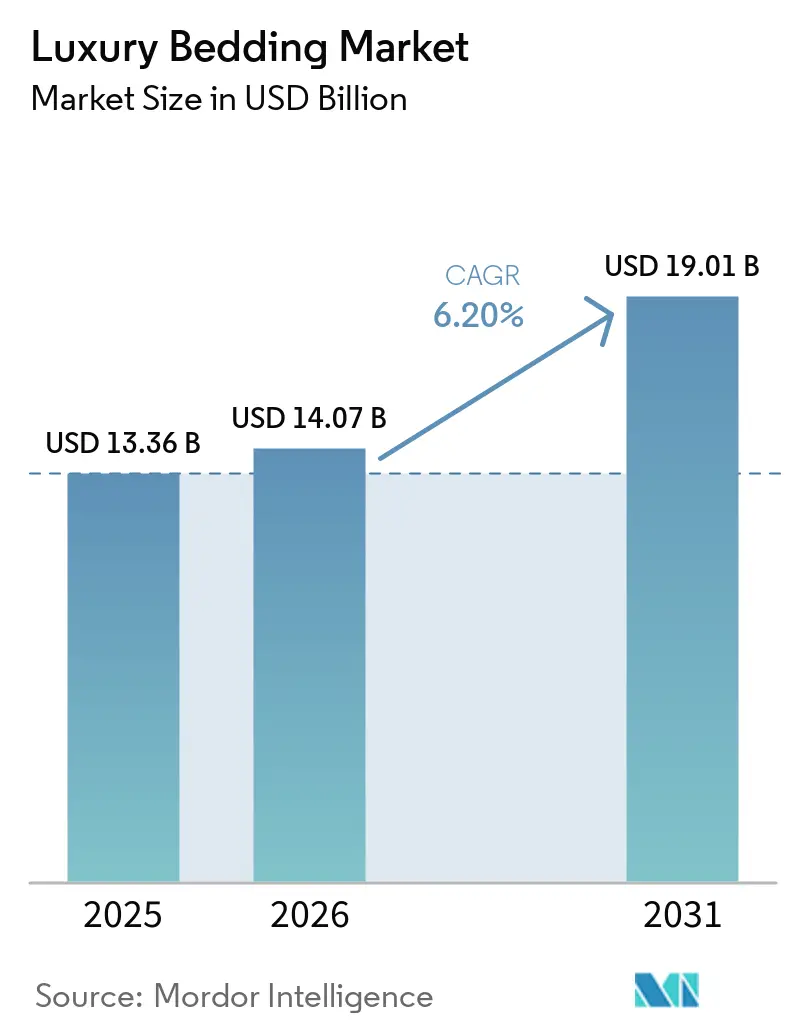
The luxury bedding market was valued at USD 13.36 billion in 2025 and is expected to reach USD 14.07 billion in 2026, and is forecast to rise to USD 19 billion by 2031, at a CAGR of 6.2% during the forecast period from 2026 to 2031. Sleep quality is becoming a more important purchase consideration, and the finding that 1 in 3 United States adults does not get enough sleep supports demand for products positioned around comfort, materials, and bedroom wellness[1]https://www.cdc.gov/sleep/data-and-statistics/adults.html. Premium home renovations, luxury hotel upgrades, and wider direct-to-consumer access are also expanding the occasions in which consumers replace or upgrade bedding. Brands are responding through certified materials, personalized product options, and more controlled retail experiences. Cost volatility in cotton, silk, and down remains a constraint because it can pressure margins or reduce product specifications. The luxury bedding market also faces higher compliance demands, while established certification programs can favor suppliers that already meet hospitality and retail requirements.
Key Report Takeaways
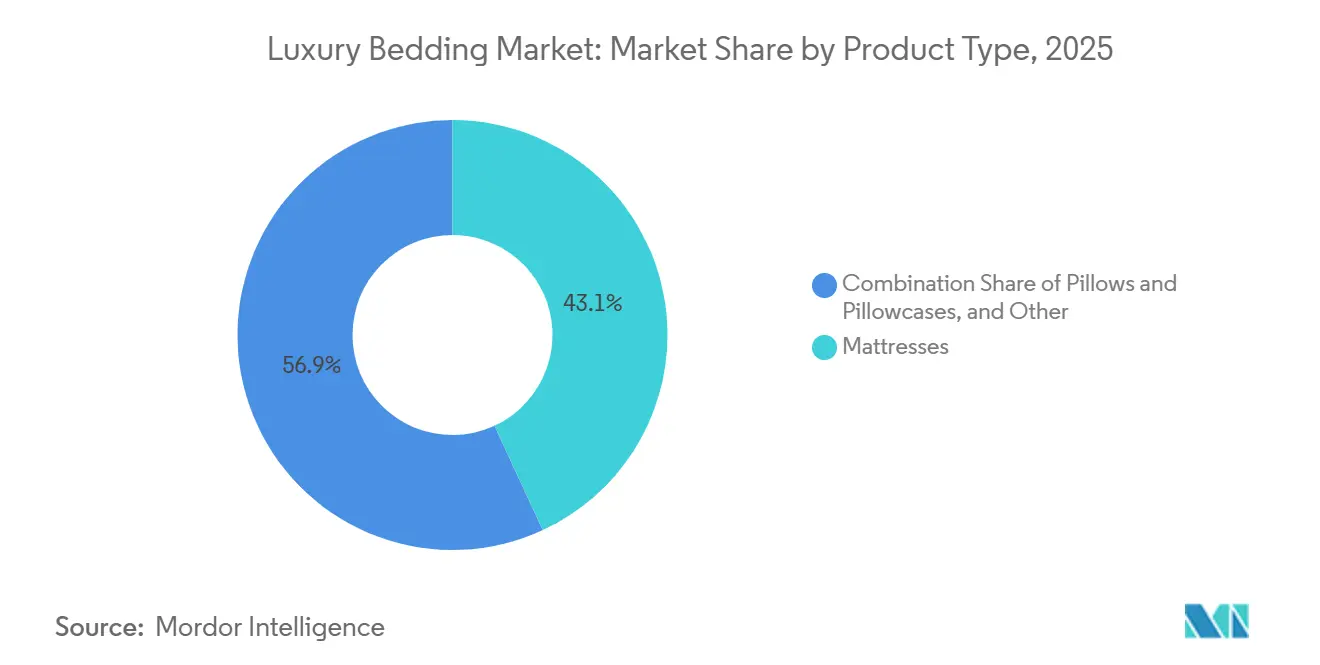
- By product type, mattresses held a 43.12% share in 2025, while bedlinen and bedsheets are forecast to register a 7.11% CAGR through 2031.
- By end-user, residential users held a 64.32% share in 2025, while commercial users are forecast to register a 6.72% CAGR through 2031.
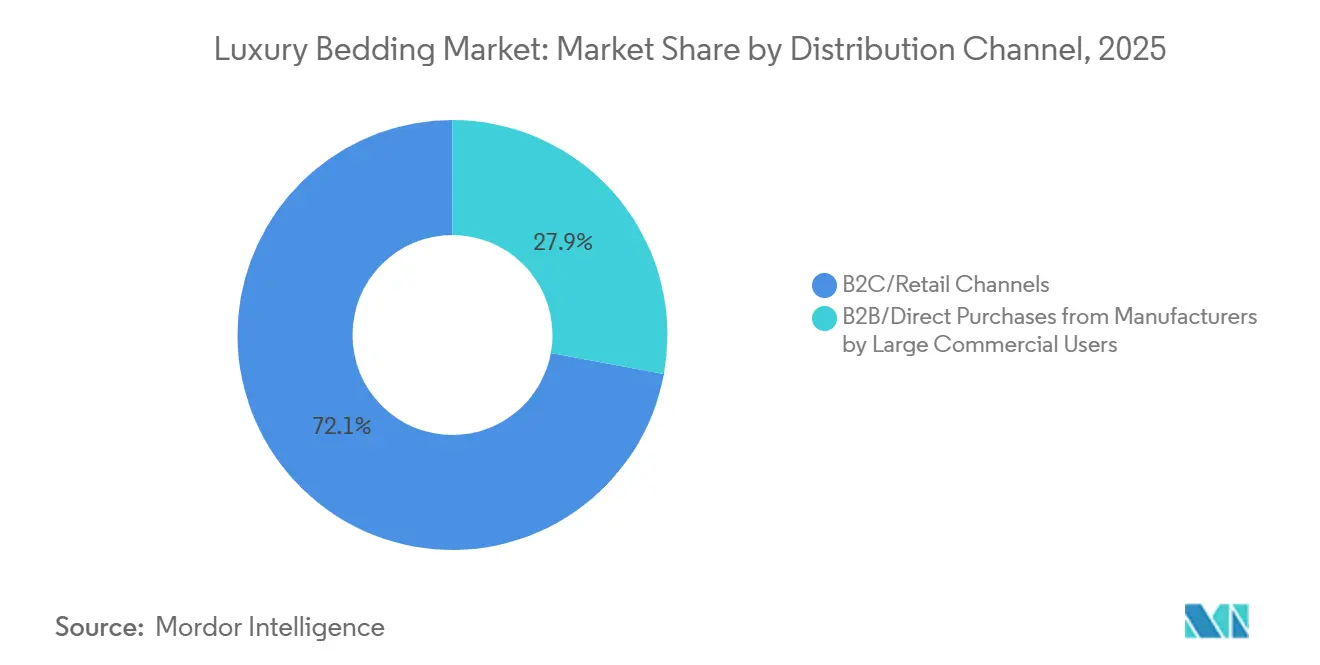
- By distribution channel, B2C and retail channels held a 72.13% share in 2025, while B2B direct purchases are forecast to register a 6.57% CAGR through 2031.
- By geography, North America held a 34.54% share in 2025, while Asia-Pacific is forecast to register a 6.85% CAGR through 2031.
Note: Market size and forecast figures in this report are generated using Mordor Intelligence’s proprietary estimation framework, updated with the latest available data and insights as of January 2026.
Global Luxury Bedding Market Trends and Insights
Drivers Impact Analysis*
| Driver | (~) % Impact on CAGR Forecast | Geographic Relevance | Impact Timeline |
|---|---|---|---|
| Sleep Health and Wellness Premiumization | +1.4% | Global, concentrated in North America and Western Europe, with fast growth in urban Asia-Pacific | Medium term (2-4 years) |
| Premium Home Décor and Renovation Spending | +0.8% | North America and Europe, with expansion in Asia-Pacific tier-1 cities | Short term (≤ 2 years) |
| Luxury Hospitality Room Upgrades and New Hotel Supply | +0.9% | Global, with strong demand in Asia-Pacific, the Middle East, and North America | Medium term (2-4 years) |
| E-Commerce and Direct-to-Consumer Accessibility | +0.7% | Global, with rapid digital-channel adoption in Asia-Pacific and Latin America | Short term (≤ 2 years) |
| Certification-Led Demand for Traceable Natural Fibers | +0.6% | North America and Europe, with spillover into Asia-Pacific and Middle East hospitality | Long term (≥ 4 years) |
| Bespoke Fit, Modular Layering, and Personalization | +0.5% | Global, especially in North American and Western European direct-to-consumer channels | Medium term (2-4 years) |
| Source: Mordor Intelligence | |||
Sleep Health and Wellness Premiumization
Sleep health is becoming a mainstream concern among affluent consumers and is supporting demand in the luxury bedding market. The U.S. Centers for Disease Control and Prevention states that 1 in 3 adults does not get enough sleep, which gives brands a recognized health context for products focused on comfort and rest. Buyers are increasingly looking for GOTS-certified organic cotton, temperature-regulating lyocell, and hypoallergenic down alternatives. These material choices make product credentials more central to purchase decisions than thread count alone. The Global Wellness Institute reported a global wellness economy worth more than USD 5.6 trillion in 2025, creating a broader spending environment for home products linked to personal well-being[2]https://globalwellnessinstitute.org/industry-research/global-wellness-economy-monitor. Japan’s Healthy Longevity Extension policy also places sleep environments within a wider public-health discussion, which supports wellness-oriented positioning in the region.
Premium Home Décor and Renovation Spending
Home renovation activity continues to support premium purchases for bedrooms and other private living spaces, because the luxury bedding market benefits when buyers seek a consistent finish across renovated rooms rather than treating bedding as a separate purchase. The 2026 Houzz & Home Study found that 54% of homeowners undertook renovation projects in 2025, while the median renovation spend was USD 20,000[3]https://www.houzz.com/press/1015/Home-Renovation-Activity-Held-Steady-in-2025-Slight-Decline-in-Plans-for-2026-Houzz-Study-Finds. The same study reported that spending by the top decile reached USD 150,000 or more, 7% above USD 140,000 in 2024. Harvard Joint Center for Housing Studies projects homeowner remodeling expenditures to reach USD 524 billion in early 2026, supporting demand for higher-specification furnishings[4]https://www.jchs.harvard.edu/blog/remodeling-expected-continue-slow-steady-growth-next-year. A newly renovated bedroom or adjacent primary bathroom can encourage consumers to replace older bedding so the room has a consistent standard of finish. Eurostat data also shows that furnishings and home maintenance form a meaningful part of household spending in major European economies.
Luxury Hospitality Room Upgrades and New Hotel Supply
Hotel operators increasingly use bedding specifications to support the guest experience and protect brand positioning. This shift gives the luxury bedding market a commercial demand source that is less dependent on individual replacement cycles, while hotel groups can standardize products across properties and refresh rooms on planned capital-investment schedules. Hospitality buyers often require reliable supply, consistent construction, and recognized material certifications. These requirements can favor suppliers that have hospitality references and can serve multi-property contracts. Premium linen is also more visible to guests than many other room furnishings, making its condition and feel relevant to reviews and repeat stays. Hotel renovation programs therefore create multi-year procurement opportunities for suppliers that can meet brand and compliance requirements.
E-Commerce and Direct-to-Consumer Accessibility
Digital channels make it easier for specialty bedding brands to reach consumers beyond major luxury shopping districts, allowing the luxury bedding market to serve customers who do not live near a dedicated store or established department-store location. The channel allows brands to explain material origin, product care, construction, and certification before a purchase decision. Boll & Branch had 15 standalone stores by November 2025 after opening 7 locations that year, while its retail-store revenue increased nearly 60% year over year. Its presence in more than 100 Bloomingdale’s and Nordstrom locations shows that direct retail and selective wholesale can operate together. Online sleep trials, clear return policies, and visualization tools can reduce hesitation around high-priced products. Direct customer relationships can also help brands understand repeat purchases and preferences by climate, material, and product category.
Restraints Impact Analysis*
| Restraint | (~) % Impact on CAGR Forecast | Geographic Relevance | Impact Timeline |
|---|---|---|---|
| Volatility in Cotton, Silk, Down, and Specialty Fiber Costs | -0.9% | Global, with higher exposure for Asian mills buying on spot markets and North American brands using Egyptian or Pima cotton | Short term (≤ 2 years) |
| Inflation-Driven Trading Down and Premium Demand Elasticity | -0.7% | North America and Western Europe, particularly the aspirational luxury tier | Short term (≤ 2 years) |
| Certification, Traceability, and Circularity Compliance Burden | -0.5% | Europe and North America, where compliance investment can pressure smaller brands | Long term (≥ 4 years) |
| Counterfeit, Parallel Trade, and Brand Dilution Risk | -0.4% | Global, especially emerging markets and online marketplaces | Medium term (2-4 years) |
| Source: Mordor Intelligence | |||
Volatility in Cotton, Silk, Down, and Specialty Fiber Costs
Raw-material volatility is a persistent operating risk for the luxury bedding market because premium products rely on fibers with limited substitution options, and buyers often expect the same touch, warmth, and durability from each replacement purchase. Higher input costs can narrow margins when brands choose not to pass the full increase to consumers. They can also lead manufacturers to change fill volumes or material mixes, which can weaken the product proposition. The greatest pressure falls on brands that have natural-fiber commitments but lack the purchasing scale or pricing power of the largest suppliers. Procurement teams therefore need closer control of supplier contracts, quality testing, and inventory planning. Stable sourcing is particularly important where a brand’s value rests on fiber provenance, durability, and a consistent sleep experience.
Inflation-Driven Trading Down and Premium Demand Elasticity
Inflation and tariff-related uncertainty can cause consumers to delay discretionary home purchases, even in the premium segment. A Federal Reserve working paper published in 2026 found that 2025 United States tariffs had a 15%-20% price pass-through on imported goods, while household spending fell by 4% at the mean increase in tariff exposure. The impact is likely to be strongest among aspirational buyers who can postpone an upgrade or move to a lower-priced alternative. Ultra-high-net-worth buyers remain less sensitive to short-term price changes, especially when product quality and service are clear. Brands can reduce this risk through better product differentiation, durable construction, and a stronger explanation of materials and care. The luxury bedding market may also benefit when retailers provide consultation and product selection support rather than competing only on promotional pricing, since this service can clarify why certified materials, construction, and care practices justify a higher purchase price.
*Our forecasts treat driver/restraint impacts as directional, not additive. The impact forecasts reflect baseline growth, mix effects, and variable interactions.
Segment Analysis
By Product Type: Mattresses Lead Value While Bedlinen Drives Future Growth
Mattresses accounted for 43.12% of the luxury bedding market share in 2025 and remained the category’s largest value contributor. Consumers typically research a mattress extensively because it is a long-term purchase with a direct link to comfort. Mattress makers use hand-tufted construction, natural materials, and personal comfort features to support premium pricing. Serta Simmons Bedding launched the 11-model Simmons Luxury Collection in July 2026, with retail prices ranging from the mid-USD 4,000s to USD 10,000. Mattress purchases can initiate later spending on sheets, pillows, and duvet products, allowing the luxury bedding market to capture a series of related purchases from consumers who want materials, colors, and comfort levels to work together across the full bed.
The luxury bedding market size for bedlinen and bedsheets is forecast to grow at a 7.11% CAGR from 2026 to 2031, the fastest rate among product categories. Bed linen is often the next upgrade after a consumer purchases a premium sleep surface. Consumers increasingly consider sheets and duvet sets part of a room’s appearance, temperature management, and perceived cleanliness. Egyptian cotton, European linen, and hotel-style duvet products address these needs. This product range allows brands to build repeat sales without requiring another major mattress purchase.



By End-User: Residential Demand Leads While Commercial Procurement Expands
Residential users held 64.32% share in 2025, making homes the largest demand base for the luxury bedding market, where replacement decisions are closely linked to renovation, room redesign, and changes in household preferences. Affluent homeowners replace bedding during renovation cycles and when they move into a new residence. The 2026 Houzz & Home Study recorded a USD 20,000 median renovation spend in 2025, supporting related spending on bedrooms and soft furnishings. Residential customers value tailored colors, layers, materials, and advice from sales staff. This favors brands that offer consistent design across sheets, duvets, pillows, and related home products.
Commercial end users are forecast to expand at a 6.72% CAGR from 2026 to 2031. The group includes hospitality, healthcare, elderly care, and institutional users with different purchasing criteria. In October 2025, Standard Textile and Accor announced that the Mascioni Hotel Collection would become the preferred linen standard across more than 350 luxury properties. The collection carries OEKO-TEX Standard 100 certification, showing how certifications can become part of commercial specifications. Healthcare and elderly-care buyers may seek hypoallergenic and antimicrobial features that overlap with premium home products.
By Distribution Channel: Retail Remains the Main Revenue Channel While B2B Direct Gains Ground
B2C and retail channels accounted for 72.13% share in 2025, showing that the luxury bedding market still depends heavily on channels that can demonstrate the physical qualities of premium products. Physical stores remain important because consumers often want to touch fabric, compare textures, and assess visual presentation. Specialty stores and exclusive brand outlets give companies more control over education and service. Frette opened its first standalone Canadian boutique in Toronto’s Yorkville in May 2026, extending direct retail presence in North America. This model supports a more controlled brand experience than a wholesale display alone.
B2B direct purchases are forecast to grow at a 6.57% CAGR from 2026 to 2031. Large hotels, healthcare networks, and institutional buyers increasingly use multi-year supply arrangements to secure consistent quality. Buyers may require OEKO-TEX, GOTS, or EU Ecolabel credentials before qualifying a supplier. The process can create an entry barrier for smaller manufacturers without verified traceability or enough capacity. The luxury bedding industry benefits from these relationships because they reward quality consistency, documentation, service, and price. For the luxury bedding market, these contracts can also support production planning, reduce order uncertainty, and build references that help suppliers compete for similar business from other premium commercial buyers.
Geography Analysis
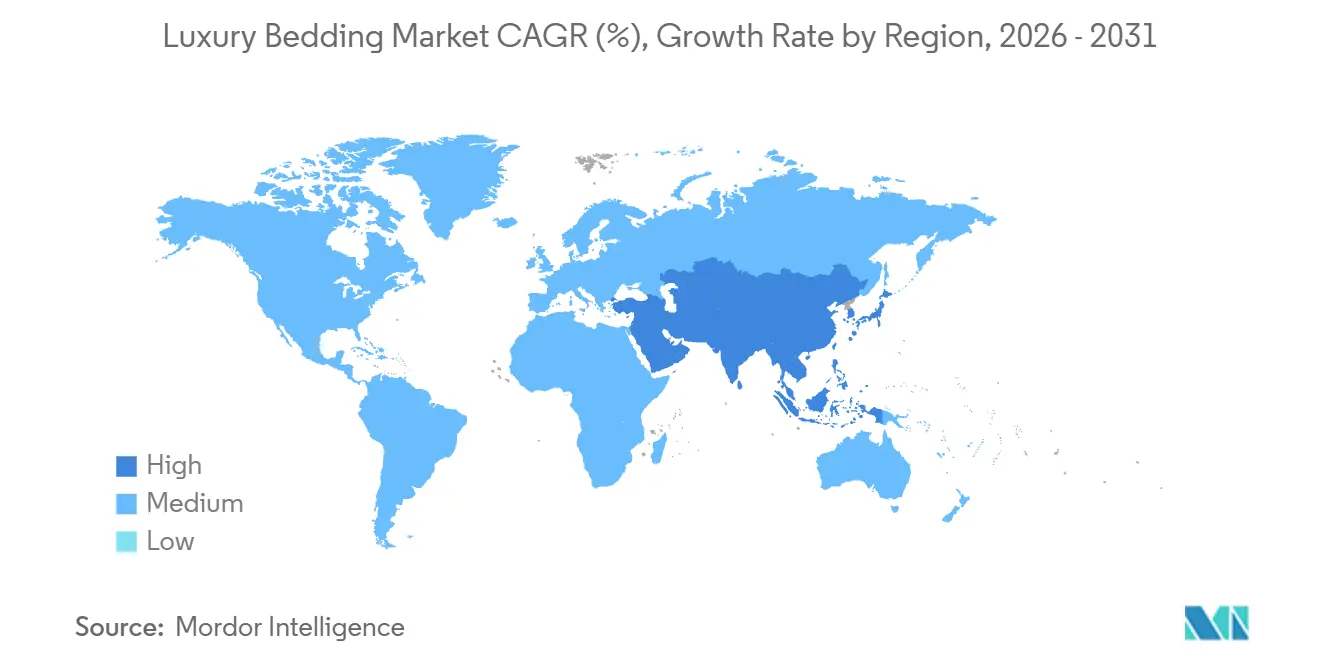
North America accounted for 34.54% of the luxury bedding market share in 2025 and remained the largest regional market. The United States is the central source of demand because high-income households have a strong renovation culture and access to direct-to-consumer brands. Harvard Joint Center for Housing Studies expects total homeowner remodeling expenditure to reach USD 524 billion in early 2026. Canada is receiving direct attention from luxury brands, illustrated by Frette’s first standalone Canadian boutique in Toronto in May 2026. Mexico has a smaller demand base but benefits from luxury hospitality and concentrated urban affluence.
Europe remains important to the luxury bedding market because of its heritage brands, certification systems, and high-value hospitality sector, which together reinforce demand for provenance, documented material quality, and durable construction. Eurostat reports that furnishings and home maintenance are a meaningful component of household consumption in major EU economies. Germany, the United Kingdom, and France support a major part of the regional value. Italy contributes production heritage and discerning domestic demand, while Spain supports commercial demand through hotels.
Asia-Pacific is projected to grow at a 6.85% CAGR from 2026 to 2031 and is the fastest-growing regional part of the luxury bedding market size. China is a leading contributor to regional value, while India and Southeast Asia provide room for further adoption. Japan’s Healthy Longevity Extension policy frames quality sleep environments within wider health and aging priorities. International luxury hotel openings in Vietnam, Indonesia, and Thailand can introduce high-end bedding standards to commercial buyers and consumers. The Middle East is principally hospitality-led, while African demand remains concentrated in higher-income urban areas and hotel destinations.

Competitive Landscape
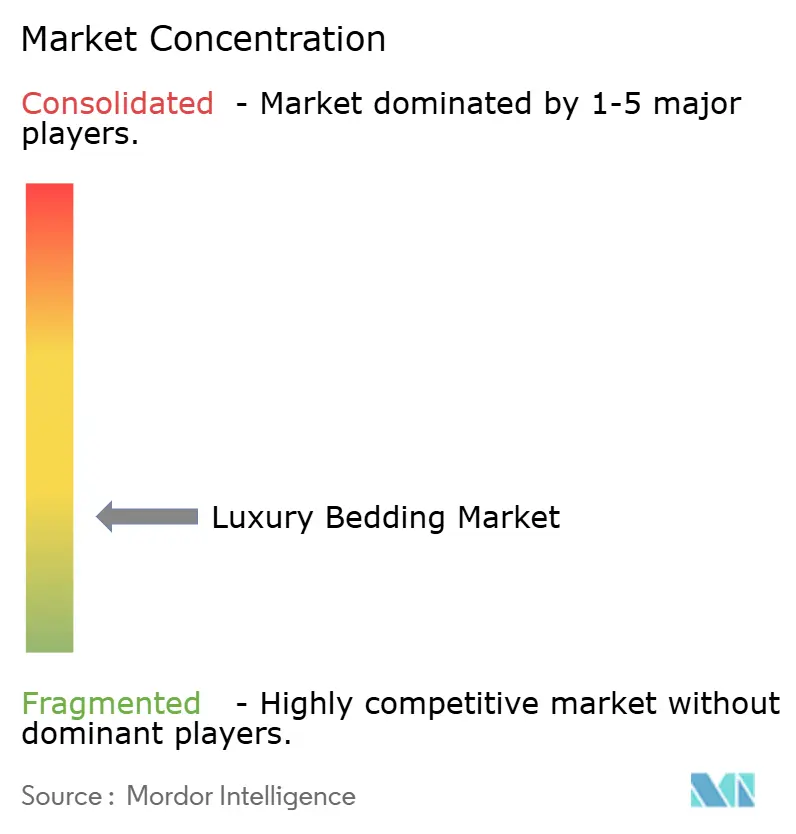
The luxury bedding market is fragmented, with no individual supplier identified as controlling prices or standards across all categories and regions. Frette, SFERRA, and Yves Delorme compete through heritage, material provenance, craftsmanship, and luxury-hotel relationships. Their position differs from direct-to-consumer organic brands that focus on traceability and a more accessible premium purchase process. Boll & Branch combined standalone stores with distribution in more than 100 Bloomingdale’s and Nordstrom locations by November 2025. The company reported nearly 60% year-over-year retail-store revenue growth at that point.
Hospitality partnerships are a central competitive tool because they can secure visible, multi-property demand. Standard Textile and Accor’s October 2025 arrangement placed the OEKO-TEX Standard 100-certified Mascioni Hotel Collection across more than 350 luxury properties. Frette expanded its direct retail strategy by opening a Toronto boutique in May 2026 with a residential-style retail concept. Its approach centers on customization, individual advice, and fabric comparison in a controlled setting. Serta Simmons Bedding added the Simmons Luxury Collection in July 2026, creating a higher-tier line with hand-tufted construction and elevated natural materials.
Certification and supply-chain documentation are important competitive requirements in the luxury bedding market, especially in commercial sales and markets where consumers value traceability, because buyers need evidence that materials and production practices meet stated standards. Established brands can use these capabilities to support higher prices and meet procurement standards. Smaller firms can find compliance costs more difficult to absorb when fiber prices are volatile. Counterfeit products and unauthorized distribution can weaken brand control in online and emerging markets.
Luxury Bedding Industry Leaders
WestPoint Home LLC
Pacific Coast Feather Company
Serta Simmons Bedding, LLC
Tempur Sealy International, Inc.
Frette
- *Disclaimer: Major Players sorted in no particular order

Recent Industry Developments
- July 2026: Serta Simmons Bedding launched the Simmons Luxury Collection, an 11-model mattress line priced from the mid-USD 4,000s to USD 10,000 retail. The collection revived Simmons' heritage identity through hand-tufted construction and elevated natural materials, targeting independent retailers and BrandSource members seeking higher average-ticket consultative selling opportunities.
- June 2026: Essentia Organic Mattress introduced the ProCor DNA system at the BEYOND Biohacking Conference in Boca Raton, Florida, a custom sleep system built only after analysis of an individual client's DNA, biometrics, posture mapping, and material-compatibility data, establishing a new personalization benchmark for the organic luxury segment.
- May 2026: Frette opened its first standalone Canadian boutique at 12 Hazelton Avenue, Toronto's Yorkville, marking the first North American implementation of its residential-inspired experiential retail concept. The store features Atelier Bespoke digital customization, one-on-one advisory services, and a curated fabric experience, deepening the brand's direct consumer relationships in a market previously served only through wholesale partners.
- October 2025: Standard Textile and Accor announced a global partnership making the Mascioni Hotel Collection the preferred linen standard across 350+ properties of Fairmont, Sofitel Legend, Sofitel, and MGallery Collection. The collection carries OEKO-TEX Standard 100 certification, with bespoke design identities tailored to each Accor brand's aesthetic positioning.


Global Luxury Bedding Market Report Scope
| Bedlinen/Bedsheets |
| Pillows and Pillowcases |
| Blankets and Quilts |
| Mattresses |
| Mattress Toppers and Pads |
| Duvets and Duvet Cases |
| Other Products (Comforters, Bedspreads, Coverlets, Shams, Throws, etc.) |
| Residential | |
| Commercial | Hospitality, Hotels and Resorts |
| Healthcare and Elderly-Care Facilities | |
| Institutional, Dormitories and Military | |
| Other Commercial End Users |
| B2C/Retail Channels | Multi-Brand Stores |
| Specialty Bedding Stores, Including Exclusive Brand Outlets | |
| Online | |
| Other Retail Distribution Channels | |
| B2B/Direct Purchases from Manufacturers by Large Commercial Users |
| North America | Canada |
| United States | |
| Mexico | |
| South America | Brazil |
| Peru | |
| Chile | |
| Argentina | |
| Rest of South America | |
| Europe | United Kingdom |
| Germany | |
| France | |
| Spain | |
| Italy | |
| BENELUX (Belgium, Netherlands, and Luxembourg) | |
| NORDICS (Denmark, Finland, Iceland, Norway, and Sweden) | |
| Rest of Europe | |
| Asia-Pacific | India |
| China | |
| Japan | |
| Australia | |
| South Korea | |
| South East Asia (Singapore, Malaysia, Thailand, Indonesia, Vietnam, and the Philippines) | |
| Rest of Asia-Pacific | |
| Middle East and Africa | United Arab Emirates |
| Saudi Arabia | |
| South Africa | |
| Nigeria | |
| Rest of the Middle East and Africa |
| By Product Type | Bedlinen/Bedsheets | |
| Pillows and Pillowcases | ||
| Blankets and Quilts | ||
| Mattresses | ||
| Mattress Toppers and Pads | ||
| Duvets and Duvet Cases | ||
| Other Products (Comforters, Bedspreads, Coverlets, Shams, Throws, etc.) | ||
| By End-User | Residential | |
| Commercial | Hospitality, Hotels and Resorts | |
| Healthcare and Elderly-Care Facilities | ||
| Institutional, Dormitories and Military | ||
| Other Commercial End Users | ||
| By Distribution Channel | B2C/Retail Channels | Multi-Brand Stores |
| Specialty Bedding Stores, Including Exclusive Brand Outlets | ||
| Online | ||
| Other Retail Distribution Channels | ||
| B2B/Direct Purchases from Manufacturers by Large Commercial Users | ||
| By Geography | North America | Canada |
| United States | ||
| Mexico | ||
| South America | Brazil | |
| Peru | ||
| Chile | ||
| Argentina | ||
| Rest of South America | ||
| Europe | United Kingdom | |
| Germany | ||
| France | ||
| Spain | ||
| Italy | ||
| BENELUX (Belgium, Netherlands, and Luxembourg) | ||
| NORDICS (Denmark, Finland, Iceland, Norway, and Sweden) | ||
| Rest of Europe | ||
| Asia-Pacific | India | |
| China | ||
| Japan | ||
| Australia | ||
| South Korea | ||
| South East Asia (Singapore, Malaysia, Thailand, Indonesia, Vietnam, and the Philippines) | ||
| Rest of Asia-Pacific | ||
| Middle East and Africa | United Arab Emirates | |
| Saudi Arabia | ||
| South Africa | ||
| Nigeria | ||
| Rest of the Middle East and Africa | ||


Key Questions Answered in the Report
What is the projected growth rate for luxury bedding through 2031?
The luxury bedding market is forecast to grow at a 6.2% CAGR from 2026 to 2031, reaching USD 19.01 billion by 2031, as wellness-led purchasing, renovation activity, and hospitality demand support higher-value bedding purchases.
Which product category holds the largest share of luxury bedding sales?
Mattresses held 43.12% of market value in 2025, making them the largest product category because consumers generally view the sleep surface as the most durable and consequential bedding purchase.
Which product category is growing fastest in luxury bedding?
Bedlinen and bedsheets are forecast to grow at a 7.11% CAGR through 2031, the highest rate among product types, as consumers make further upgrades after purchasing a premium mattress.
Which end-user group drives the most demand for premium bedding?
Residential users held a 64.32% share in 2025, supported by home renovations, new-home purchases, and demand for personalized interiors that use coordinated sheets, pillows, duvets, and related soft furnishings.
Why are hotels important buyers of luxury bedding?
Hotels use bedding to strengthen guest experience and brand standards, while preferred-supplier agreements can create recurring procurement demand, require consistent certifications, and reward suppliers that can provide reliable quality across multiple properties.
Page last updated on:


 Your data is secure and never sold or shared.


