
Luxury Bath Linen Market Size and Share
Market Overview
| Study Period | 2020 - 2031 |
|---|---|
| Market Size (2026) | USD 4.81 Billion |
| Market Size (2031) | USD 6.03 Billion |
| Growth Rate (2026 - 2031) | 4.62 % |
| Fastest Growing Market | Asia-Pacific |
| Largest Market | North America |
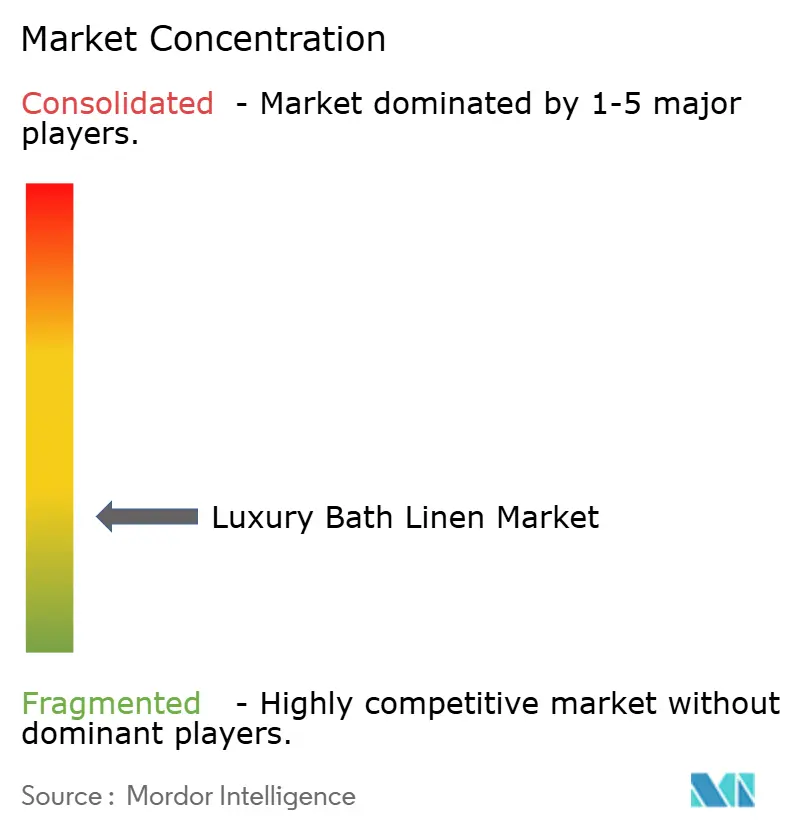
| Market Concentration | Low |
Major Players *Disclaimer: Major Players sorted in no particular order Image © Mordor Intelligence. Reuse requires attribution under CC BY 4.0. | |
Luxury Bath Linen Market Analysis by Mordor Intelligence
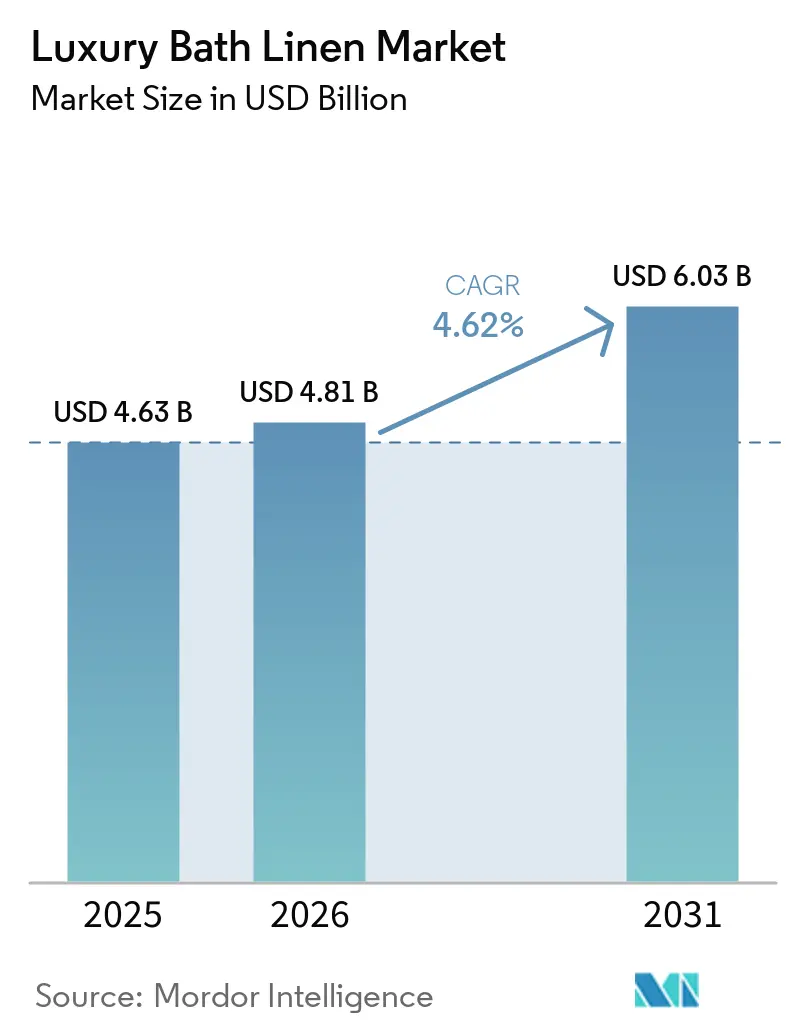
The luxury bath linen market size was valued at USD 4.6 billion in 2025 and is estimated to grow from USD 4.8 billion in 2026 to reach USD 6.03 billion by 2031, at a CAGR of 4.6% during the forecast period (2026-2031). Growth rests on premium hotel construction and refurbishment, which create sizable initial orders and recurring replacement demand for bath textiles. Residential buyers are also adopting hotel-grade specifications, including GSM, long-staple cotton, and third-party certification, when purchasing products for the home. This has broadened the luxury bath linen market beyond a hospitality supply category into a premium B2B and B2C business. Traceability, design, and wash durability are becoming more important to pricing and retail assortment decisions. Brands with established hotel relationships can use those placements to build recognition among residential buyers, while price transparency and fiber costs remain material pressures.
The link between commercial use and residential purchase also shapes the luxury bath linen market. Hotel placements allow guests to experience products before considering them for home use. This gives hospitality-focused suppliers a route to build consumer recognition without relying only on retail promotion. Product ranges that combine verified materials, coordinated design, and reliable laundering performance can serve both customer groups. Suppliers must still protect margins as premium fiber costs and online price comparison intensify.
Key Report Takeaways
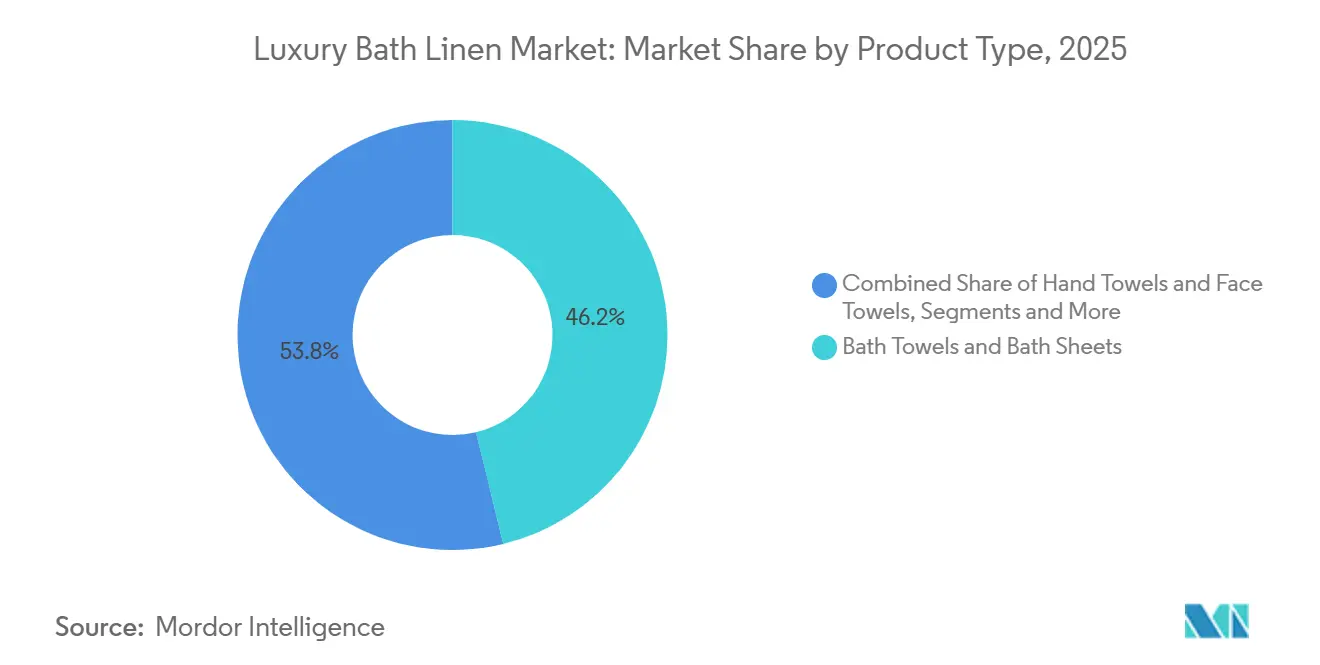
- By product type, bath towels and bath sheets held 46.2% of the luxury bath linen market share in 2025, while spa, pool, beach, and fitness towels are forecast to grow at a 5.8% CAGR through 2031.
- By material, cotton accounted for 63.1% of the luxury bath linen market share in 2025, while bamboo and other cellulosic fibers are forecast to expand at a 5.4% CAGR through 2031.
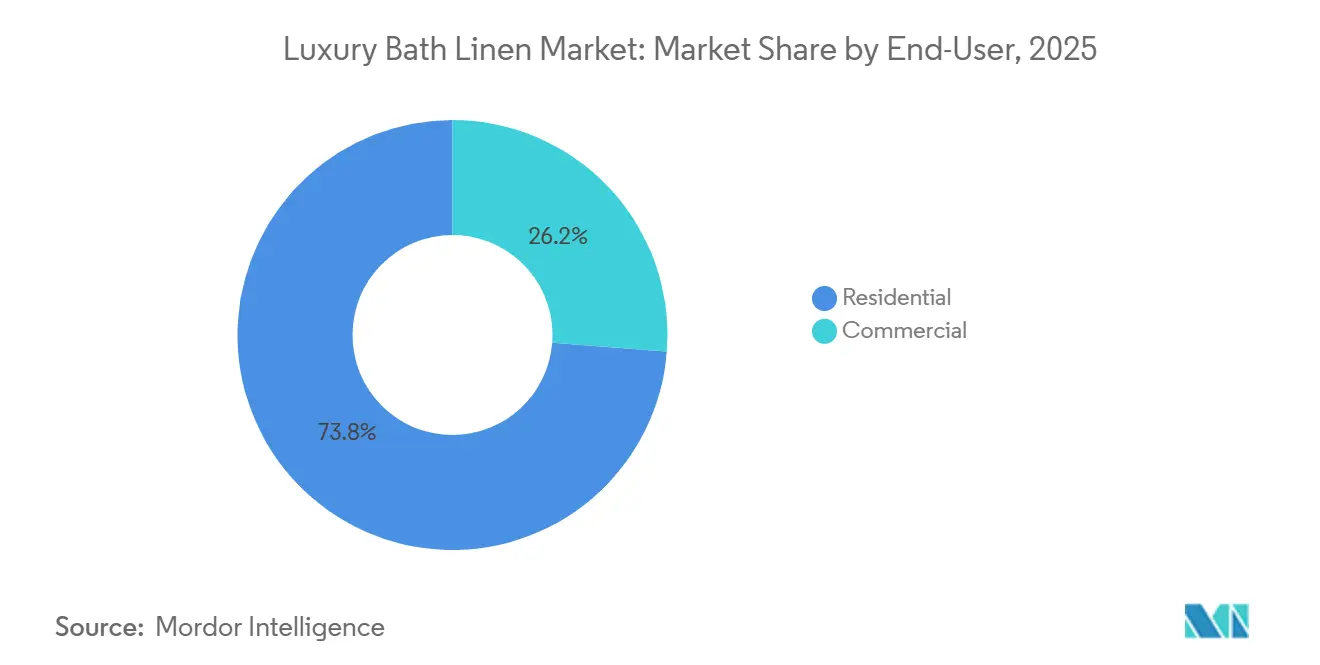
- By end-user, residential end-users held 73.8% of the luxury bath linen market share in 2025, while commercial end-users are forecast to register a 5.2% CAGR through 2031.
- By distribution channel, B2C and retail channels accounted for 78.1% of the luxury bath linen market share in 2025, while B2B direct purchases from large commercial users are forecast to register a 4.9% CAGR through 2031.
- By geography, North America accounted for 36.5% of the luxury bath linen market share in 2025, while Asia-Pacific is forecast to register a 5.6% CAGR through 2031.
Note: Market size and forecast figures in this report are generated using Mordor Intelligence’s proprietary estimation framework, updated with the latest available data and insights as of January 2026.
Global Luxury Bath Linen Market Trends and Insights
Drivers Impact Analysis*
| Driver | (~) % Impact on CAGR Forecast | Geographic Relevance | Impact Timeline |
|---|---|---|---|
| Premium Hospitality Refurbishment and Brand-Standard Upgrades | +1.2% | Global, concentrated in Asia-Pacific, the Middle East, and North America | Medium term (2-4 years) |
| Home Spa, Wellness, and Bathroom Aesthetic Premiumization | +0.9% | North America and Europe core, with spillover to urban Asia-Pacific | Medium term (2-4 years) |
| E-Commerce and Direct-to-Consumer Luxury Discovery | +0.7% | Global, strongest in North America and Western Europe | Short term (≤ 2 years) |
| Sustainable and Traceable Fiber Preference | +0.6% | Europe core, North America, and urban Asia-Pacific | Long term (≥ 4 years) |
| Commercial-Laundry Performance as a Premium Specification | +0.4% | Global, institutional, and hospitality buyers | Medium term (2-4 years) |
| Luxury-Tier Demand for Customization and Monogramming | +0.3% | North America and Europe, with select Middle East and Africa hospitality markets | Long term (≥ 4 years) |
| Source: Mordor Intelligence | |||
Premium Hospitality Refurbishment and Brand-Standard Upgrades
The luxury bath linen market benefits from new luxury hotel openings and refurbishment programs because both require large textile orders. Hotel operators also replace textiles through established brand standards, creating repeat demand after the initial purchase and reducing reliance on one-time project spending. Saudi Arabia’s tourism strategy includes a target of more than 320,000 new hotel rooms, which supports demand for premium terry and woven bath products [1]Saudi Tourism Authority, “Vision 2030 Tourism Strategy, Hotel Room Targets,” Saudi Tourism Authority, sta.gov.sa.. Welspun Living reported institutional hospitality supply relationships with Hyatt, IHG, Wyndham Hotels & Resorts, and Marriott International in its FY2026 earnings materials. These relationships give suppliers recurring commercial volume and help make their products visible to hotel guests across several types of luxury properties. The luxury bath linen market also gains when hotel placements encourage guests to seek similar products for their homes, which makes hospitality work relevant to both commercial sales and residential recognition.
Home Spa, Wellness, and Bathroom Aesthetic Premiumization
Bathrooms are increasingly treated as personal wellness spaces rather than solely functional rooms. This supports demand for high-GSM bath sheets, bathrobes, coordinated mats, and matching accessories that create a consistent bathroom setting. Consumers who have experienced luxury hotels often use those products as a reference point for home purchases and expect clearer information on performance. The opportunity is based on higher value per item as buyers select better materials, verified product claims, and stronger design credentials. Brands can support this choice by clearly disclosing GSM, fiber content, certification, care performance, and appropriate use. The luxury bath linen market is therefore expanding through premium product selection as well as replacement demand, particularly where products connect comfort with an established hospitality standard.
E-Commerce and Direct-to-Consumer Luxury Discovery
Digital channels have changed how shoppers find premium bath products and compare product features. Brand websites, online retail, lifestyle content, and certification details help customers identify products before visiting a store or making a repeat purchase. Physical retail remains valuable for higher-priced purchases because customers can assess softness, weight, color, and construction in person. Boll & Branch stated that it expanded its retail footprint after finding that store customers spent 4 to 5 times more than online customers. Frette’s Spring and Summer 2026 collection was released across its online and boutique channels, showing how luxury suppliers connect digital presentation with physical selling. In the luxury bath linen market, the two channels work together instead of replacing one another, with digital communication providing product information and stores providing tactile evaluation.
Sustainable and Traceable Fiber Preference
Sustainable fiber sourcing and product traceability are becoming important requirements in premium retail and hospitality procurement. OEKO-TEX Standard 100 tests textiles for harmful substances, while GOTS sets requirements for organic textile processing and traceability [2]OEKO-TEX Association, “OEKO-TEX Standard 100, Tested for Harmful Substances,” OEKO-TEX, oeko-tex.com.. These frameworks help buyers compare product claims and support procurement checks across suppliers and product lines. Welspun Living reported a 90 out of 100 score in the 2025 S&P Global Corporate Sustainability Assessment for textiles, apparel, and luxury goods [3]Welspun Living Limited, “ESG and Sustainability Score Disclosure, S&P Global CSA FY2025,” BSE India Filing, bseindia.com.. Certification can also make products easier to evaluate online, where customers cannot assess fabric by touch or confirm production practices directly. The luxury bath linen market favors suppliers that can document fiber origin and processing practices throughout their supply chain, especially when buyers require evidence before listing or approving products.
Restraints Impact Analysis*
| Restraint | (~) % Impact on CAGR Forecast | Geographic Relevance | Impact Timeline |
|---|---|---|---|
| Cotton and Specialty-Fiber Cost Volatility | -0.6% | Global, with pronounced exposure in North America and Europe-sourced brands | Short term (≤ 2 years) |
| Low-Cost Imports and Online Price Transparency | -0.5% | North America, Europe, and urban Asia-Pacific consumer markets | Medium term (2-4 years) |
| Sustainability Compliance and Chain-of-Custody Cost | -0.3% | Europe's core and North America | Long term (≥ 4 years) |
| Luxury-Towel Durability Loss Under High-Frequency Laundering | -0.2% | Global, concentrated in commercial hospitality | Medium term (2-4 years) |
| Source: Mordor Intelligence | |||
Cotton and Specialty-Fiber Cost Volatility
Long-staple Egyptian cotton and Turkish combed cotton remain important materials for premium bath products. Their costs can change because of weather disruption, geopolitical conditions, and export policy changes in growing regions. Silk, high-grade linen, and certified bamboo lyocell also have distinct supply limitations that can affect product availability and purchasing terms. Welspun Living reported FY2025 EBITDA margins of 9.1%, with input costs identified as a factor affecting profitability. Suppliers may need long-term purchasing arrangements or price adjustments with retail and hotel customers to manage cost movements across procurement cycles. The luxury bath linen market faces greater margin pressure when procurement contracts cannot absorb increases in premium fiber costs or when replacement orders are priced before cost movements occur.
Low-Cost Imports, Transparency, and Compliance Costs
Online marketplaces make prices and product claims easy to compare, even when products differ greatly in material quality and verification. A visually similar product can use claims such as Egyptian cotton, high-GSM, or hotel quality without offering the same level of testing or traceability. This makes it harder for established brands to explain the value of certified products through a product page alone, particularly when the fabric feel and construction cannot be inspected. Compliance programs also require investment in documentation, supplier monitoring, and chain-of-custody systems across the production process. High-frequency commercial laundering creates an additional challenge because hotel buyers need products that retain performance across repeated wash cycles. The luxury bath linen market, therefore, depends on credible certification, physical product presentation, and proven durability to distinguish higher-value products from lower-cost alternatives.
*Our forecasts treat driver/restraint impacts as directional, not additive. The impact forecasts reflect baseline growth, mix effects, and variable interactions.
Segment Analysis
By Product Type: Core Formats Hold Revenue While Wellness Formats Lead Growth
Bath towels and bath sheets accounted for 46.2% of luxury bath linen market revenue in 2025, making them the leading product category. They are widely purchased by households and specified by hotels, resorts, and other commercial buyers. Residential customers trade up through heavier weights, better fibers, and products supported by recognized certifications. Hospitality buyers often set product requirements for GSM, fiber grade, construction, and laundry performance. Jacquard weaving, embroidery, selvedge borders, and branded piping can move standard formats into higher price bands.
Spa, pool, beach, and fitness towels are projected to grow at a 5.8% CAGR through 2031. Demand in the luxury bath linen market is linked to wellness tourism, resort and villa development, and residential use near pools and spas. Commercial buyers purchase these formats in larger volumes than most household buyers, which can support revenue despite lower per-item prices. Bath mats and rugs also benefit when customers seek a coordinated bathroom appearance. Frette extended its Palazzo Cordusio Gran Meliá partnership in June 2025 to include the Oasis collection for an outdoor pool and terrace [4]Frette, “Frette Open Air, Terrazza Isola, Palazzo Cordusio Gran Meliá, Milan,” IFDM Design, ifdm.design..



By Material: Long-Staple Cotton Anchors Demand While Cellulosic Fibers Grow
Cotton accounted for 63.1% of the luxury bath linen market revenue in 2025. Manufacturing capacity in India, Turkey, Egypt, and Pakistan supports the large-scale processing of cotton fibers. Egyptian long-staple and Turkish combed cotton remain key premium materials across household and hospitality applications. Their established reputation allows suppliers to position these products above conventional cotton grades. OEKO-TEX Standard 100 provides a recognized framework for testing textiles for harmful substances.
Bamboo and other cellulosic fibers are forecast to grow at a 5.4% CAGR through 2031. Consumers associate these fibers with quick drying, softness, hypoallergenic positioning, and sustainability credentials. Certified bamboo lyocell gives luxury bath linen market suppliers an alternative to long-staple cotton in selected premium products. FSC certification provides a framework for responsible forest management that can support fiber sourcing claims. Synthetics and blends remain relevant in commercial laundry settings where institutional users prioritize wash-cycle durability.
By End-User: Residential Demand Provides Scale While Commercial Buyers Create Visibility
Residential end-users held 73.8% of the luxury bath linen market revenue in 2025. Household replacement needs and interest in hotel-style bathrooms support this broad customer base. Digital discovery introduces first-time premium customers to products, while stores help them assess performance and design. Wedding registries, corporate gifting, and life-event purchases create additional premium buying occasions. Boll & Branch launched a curated collection through Over The Moon in September 2025 for wedding, baby, and life-milestone gifting.
Commercial end-users are forecast to grow at a 5.2% CAGR through 2031. Luxury hotels, boutique resorts, cruise lines, and spas account for much of the luxury bath linen market’s premium commercial opportunity. Refurbishment programs and wellness amenity standards create recurring purchasing requirements for these customers. Healthcare and elderly-care facilities purchase large quantities but typically prioritize hygiene and durability over luxury positioning. Welspun Living described its institutional hospitality business as supporting both B2B supply and B2C brand visibility.
By Distribution Channel: Retail Supports Evaluation While Direct Sales Serve Large Buyers
B2C and retail channels accounted for 78.1% of the luxury bath linen market revenue in 2025. Department stores, specialty bedding retailers, exclusive outlets, online platforms, and other formats serve residential customers. Online retail supports discovery, product comparison, and direct communication of fiber, care, and certification details. Customers often prefer to assess premium towels and robes in person before making higher-value purchases. Exclusive outlets provide an opportunity to present a full range and give product guidance.
B2B direct purchases from large commercial users are forecast to grow at a 4.9% CAGR through 2031. Hotel groups in the luxury bath linen market increasingly use group-level supply arrangements for textile procurement. These agreements give suppliers steadier volume but increase the negotiating leverage of large buyers. Frette serves hospitality partners through products made for guest rooms and associated luxury spaces. Direct sales are particularly important where custom specifications, monogramming, durability requirements, and coordinated delivery are central to the transaction.
Geography Analysis
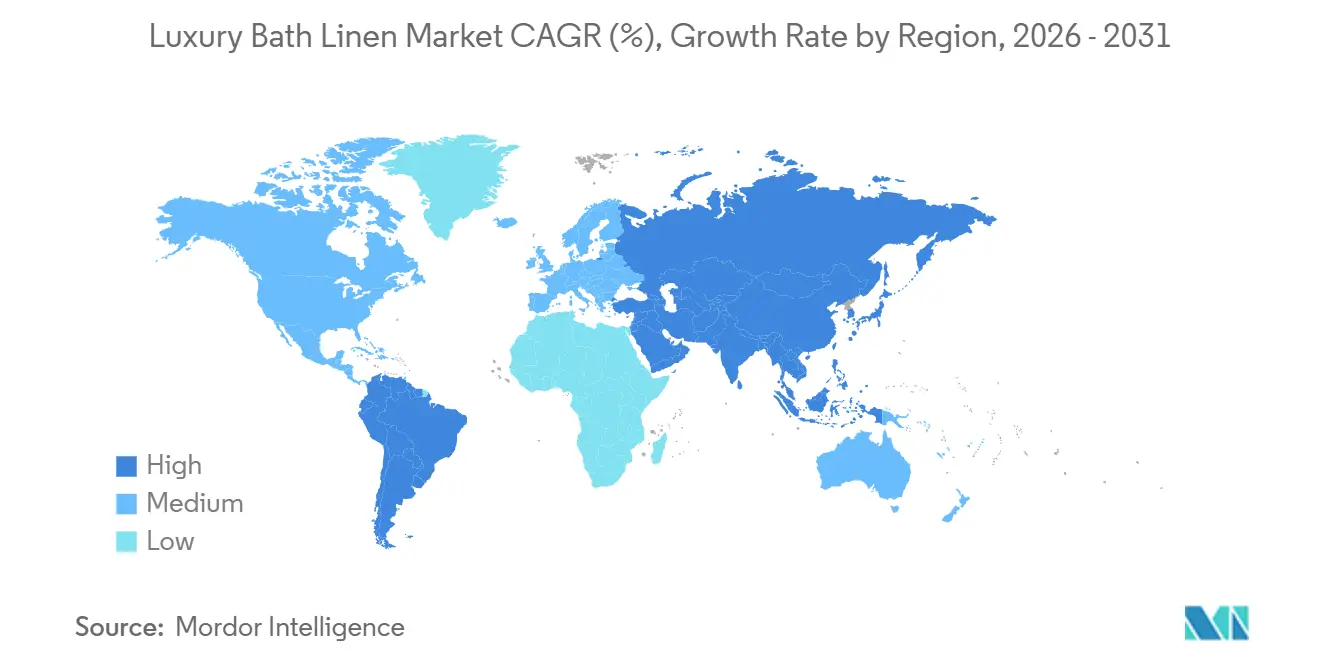
North America held 36.5% of the luxury bath linen market revenue in 2025. The region benefits from premium home-textile spending, established luxury hotels, specialty retail, and direct-to-consumer brands. The United States is the central market, where brands are expanding physical retail to support in-person purchasing. Boll & Branch planned to operate 20 stores by the end of 2026 after growing its store base in 2025. Canada contributes to demand in major urban areas with affluent household buyers.
Asia-Pacific is projected to be the fastest-growing luxury bath linen market geography at a 5.6% CAGR through 2031. China’s upper-tier urban consumers in Beijing, Shanghai, and Shenzhen support residential demand for premium products. India’s hotel construction supports institutional purchasing and benefits domestic textile manufacturers. The India-UK Comprehensive Economic Partnership Agreement, signed in July 2025, provides tariff-free access for Indian textile exporters to the United Kingdom. Japan and South Korea add demand for higher-quality cotton and specialty-weave products.
Europe remains a medium-growth geography and an important reference point for heritage manufacturing and premium positioning. Germany, France, the United Kingdom, and Spain form the main regional demand base. Nordic and Benelux markets have a strong preference for certified sustainable and organic-fiber materials. The United Arab Emirates and Saudi Arabia support demand through luxury hospitality investment and affluent consumers. Saudi Arabia’s hotel development plans are particularly relevant to institutional purchases.

Competitive Landscape
Vertically integrated manufacturers, including Welspun Living, Trident Group, and Himatsingka Seide, compete through manufacturing scale, certification, and branded portfolios. Welspun Living reported that the branded business contributed 19.3% of total FY2026 revenue. The company also reported 15% growth for Christy and USD 19.4 million in welhome revenue. Heritage houses, including Frette, SFERRA, Matouk, Graccioza, and VOSSEN, compete through product origin, design, hospitality relationships, and craft positioning. Frette states that it works with more than 1,000 hotels and restaurants worldwide.
Frette’s Autumn and Winter 2026 Design Reform collection extended its collaboration with Tara Bernerd through new colorways and geometric designs. SFERRA’s Winter 2026 collection included a collaboration with Scalamandré that adapted archival patterns for luxury linen formats. Frette also extended its Palazzo Cordusio Gran Meliá relationship to an outdoor terrace and pool setting in June 2025. Boll & Branch added physical stores and a registry partnership to reach household buyers across store and gifting occasions. These moves use design, product placement, and retail access to support premium pricing.
The clearest opening lies in products that combine high GSM performance, certified sustainable fibers, hospitality-grade customization, and residential presentation. Wellness brands and spa operators can enter through partnerships because they already have relationships with premium customers. Antimicrobial finishing has become more relevant where product performance matters alongside appearance. Suppliers that can document wash-cycle performance may have an advantage in hotel and institutional tenders.
Luxury Bath Linen Industry Leaders
Welspun Living Limited
Trident Group
Himatsingka Seide Limited
1888 Mills, LLC
Loftex China
- *Disclaimer: Major Players sorted in no particular order

Recent Industry Developments
- August 2026: Frette unveiled its Autumn/Winter 2026 “Design Reform” collection, featuring geometric modernist designs across bed linens, towels, and accessories, with an extended Frette × Tara Bernerd collaboration in a new palette of Pine Forest, Tan, and Rust. The release deepens Frette's strategy of high-profile designer partnerships to sustain design leadership and command pricing above the standard luxury assortment.
- January 2026: Frette launched its “My Sanctuary, Perfected by Frette” Spring/Summer 2026 collection, adding 4 new colorways, golden beige, indigo blue, misty blush, and amber glow, to its core Unito cotton terry towel assortment. The simultaneous rollout across frette.com and global boutiques reflects a maturing omnichannel strategy across residential and hospitality segments.
- December 2025: Welspun Living inaugurated the world’s largest terry towel manufacturing facility under a single roof at its Anjar plant in Gujarat, India. The expansion is projected to generate over 3,000 direct jobs and more than 10,000 indirect jobs, taking the total Anjar workforce to 30,000.
- November 2025: Boll & Branch opened its 14th store at SouthPark in Charlotte, North Carolina, and its 15th at Bethesda Row in Bethesda, Maryland, completing a near-doubling of its U.S. retail footprint within a 12-month period. The expansion strategy prioritizes affluent suburban markets with strong luxury-retail co-tenancy.


Global Luxury Bath Linen Market Report Scope
| Bath Towels and Bath Sheets |
| Hand Towels and Face Towels |
| Bathrobes and Spa Robes |
| Bath Mats and Bath Rugs |
| Spa, Pool, Beach, and Fitness Towels |
| Designer, Vanity, and Specialty Bath Linen |
| Cotton |
| Silk |
| Linen |
| Bamboo and Other Cellulosic Fibers |
| Synthetics and Blends |
| Other Materials |
| Residential | |
| Commercial | Hospitality and Travel |
| Spas, Wellness, and Fitness Centers | |
| Healthcare and Elderly-Care Facilities | |
| Corporate, Airline, and Institutional Buyers | |
| Other Commercial End Users |
| B2C/Retail Channels | Multi-Brand Stores |
| Specialty Bedding Stores, Including Exclusive Brand Outlets | |
| Online | |
| Other Distribution Channels | |
| B2B/Direct Purchases from Manufacturers by Large Commercial Users |
| North America | Canada |
| United States | |
| Mexico | |
| South America | Brazil |
| Peru | |
| Chile | |
| Argentina | |
| Rest of South America | |
| Europe | United Kingdom |
| Germany | |
| France | |
| Spain | |
| Italy | |
| BENELUX (Belgium, Netherlands, and Luxembourg) | |
| NORDICS (Denmark, Finland, Iceland, Norway, and Sweden) | |
| Rest of Europe | |
| Asia-Pacific | India |
| China | |
| Japan | |
| Australia | |
| South Korea | |
| South East Asia (Singapore, Malaysia, Thailand, Indonesia, Vietnam, and the Philippines) | |
| Rest of Asia-Pacific | |
| Middle East and Africa | United Arab Emirates |
| Saudi Arabia | |
| South Africa | |
| Nigeria | |
| Rest of the Middle East and Africa |
| By Product Type | Bath Towels and Bath Sheets | |
| Hand Towels and Face Towels | ||
| Bathrobes and Spa Robes | ||
| Bath Mats and Bath Rugs | ||
| Spa, Pool, Beach, and Fitness Towels | ||
| Designer, Vanity, and Specialty Bath Linen | ||
| By Material | Cotton | |
| Silk | ||
| Linen | ||
| Bamboo and Other Cellulosic Fibers | ||
| Synthetics and Blends | ||
| Other Materials | ||
| By End-User | Residential | |
| Commercial | Hospitality and Travel | |
| Spas, Wellness, and Fitness Centers | ||
| Healthcare and Elderly-Care Facilities | ||
| Corporate, Airline, and Institutional Buyers | ||
| Other Commercial End Users | ||
| By Distribution Channel | B2C/Retail Channels | Multi-Brand Stores |
| Specialty Bedding Stores, Including Exclusive Brand Outlets | ||
| Online | ||
| Other Distribution Channels | ||
| B2B/Direct Purchases from Manufacturers by Large Commercial Users | ||
| By Geography | North America | Canada |
| United States | ||
| Mexico | ||
| South America | Brazil | |
| Peru | ||
| Chile | ||
| Argentina | ||
| Rest of South America | ||
| Europe | United Kingdom | |
| Germany | ||
| France | ||
| Spain | ||
| Italy | ||
| BENELUX (Belgium, Netherlands, and Luxembourg) | ||
| NORDICS (Denmark, Finland, Iceland, Norway, and Sweden) | ||
| Rest of Europe | ||
| Asia-Pacific | India | |
| China | ||
| Japan | ||
| Australia | ||
| South Korea | ||
| South East Asia (Singapore, Malaysia, Thailand, Indonesia, Vietnam, and the Philippines) | ||
| Rest of Asia-Pacific | ||
| Middle East and Africa | United Arab Emirates | |
| Saudi Arabia | ||
| South Africa | ||
| Nigeria | ||
| Rest of the Middle East and Africa | ||


Key Questions Answered in the Report
What is the projected growth rate for luxury bath linen through 2031?
The category is forecast to grow at a 4.6% CAGR from 2026 to 2031, reaching USD 6.03 billion by 2031.
Which product category leads luxury bath linen sales?
Bath towels and bath sheets led with a 46.2% share in 2025.
Which material is used most in premium bath textiles?
Cotton held a 63.1% share in 2025, led by long-staple Egyptian and Turkish cotton.
Why are hotels important to luxury bath linen suppliers?
Hotel projects and refurbishment cycles create repeat orders and introduce products to household buyers.
Which region is expanding fastest through 2031?
Asia-Pacific is forecast to grow at a 5.6% CAGR, supported by hotel development and residential demand.
Why does physical retail remain relevant for premium towels and bathrobes?
Stores allow customers to assess texture, weight, color, and construction before purchase.
Page last updated on:


 Your data is secure and never sold or shared.


