
Low-Fat Content Kefir Market Size and Share
Market Overview
| Study Period | 2021 - 2031 |
|---|---|
| Market Size (2026) | USD 1.38 Billion |
| Market Size (2031) | USD 2.02 Billion |
| Growth Rate (2026 - 2031) | 7.88 % |
| Fastest Growing Market | Asia-Pacific |
| Largest Market | North America |
| Market Concentration | Low |
Major Players *Disclaimer: Major Players sorted in no particular order Image © Mordor Intelligence. Reuse requires attribution under CC BY 4.0. | |
Low-Fat Content Kefir Market Analysis by Mordor Intelligence
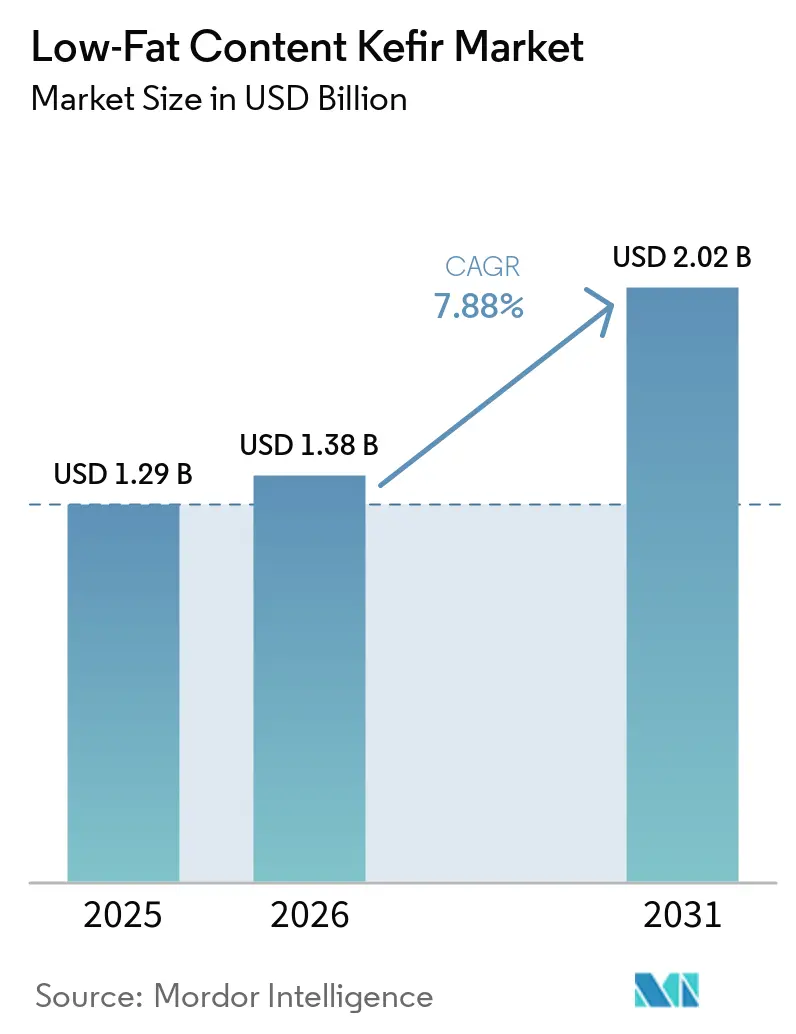
The low-fat content kefir market size was valued at USD 1.29 billion in 2025 to reach USD 1.38 billion in 2026, and is forecast to reach USD 2.02 billion by 2031 at a 7.88% CAGR over 2026-2031. Consumer interest in fermented dairy products that support digestive health and calorie-management routines drives demand. In March 2024, the United States Food and Drug Administration authorized a qualified health claim linking yogurt to a reduced risk of type 2 diabetes, increasing attention to evidence-based communication in fermented dairy[1]. Low-fat content kefir aligns with this interest in reduced-fat diets and offers companies opportunities to develop products for regular consumption. Product launches increasingly combine live cultures with protein, flavors, and portable formats, while refrigerated distribution requirements and the product’s tangy taste continue to limit broader adoption.
Key Report Takeaways
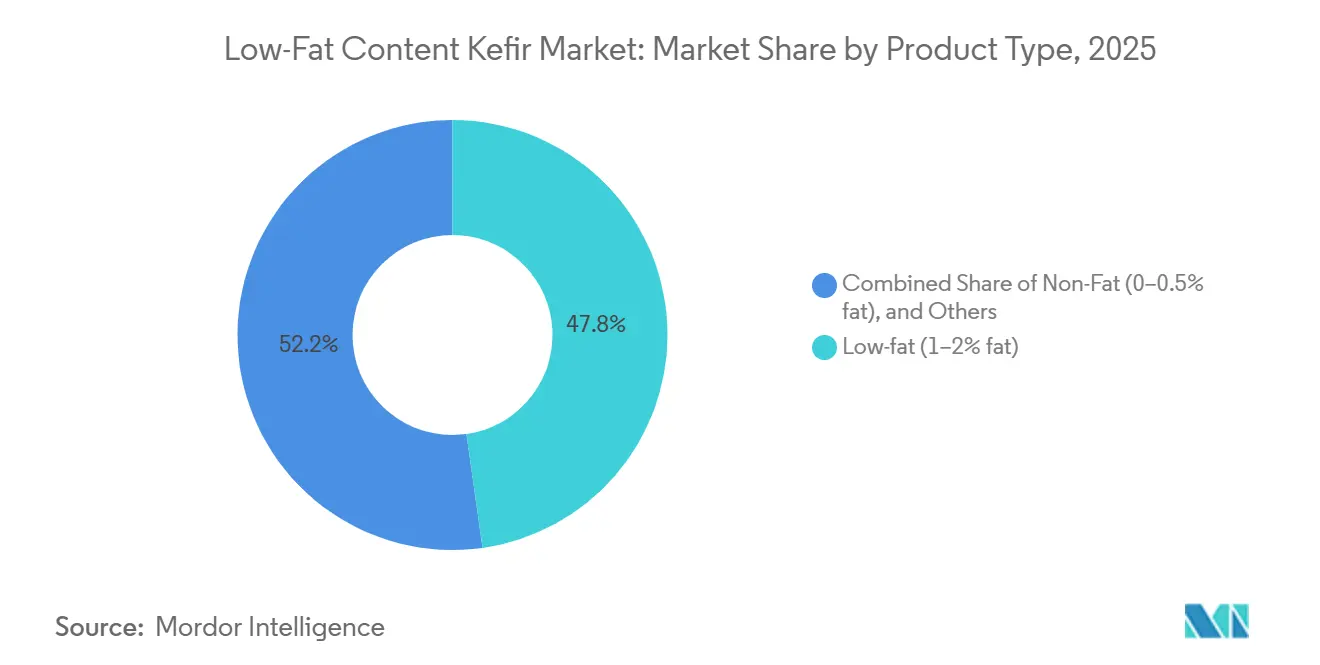
- By product type, low-fat (1–2% fat) led the low-fat content kefir market with a share of 47.78% in 2025, while non-fat (0–0.5% fat) is anticipated to register the fastest CAGR of 8.53% during 2026-2031.
- By source, cow milk retained a 52.42% share in 2025, whereas goat milk is forecast to expand at an 8.25% CAGR through 2031.
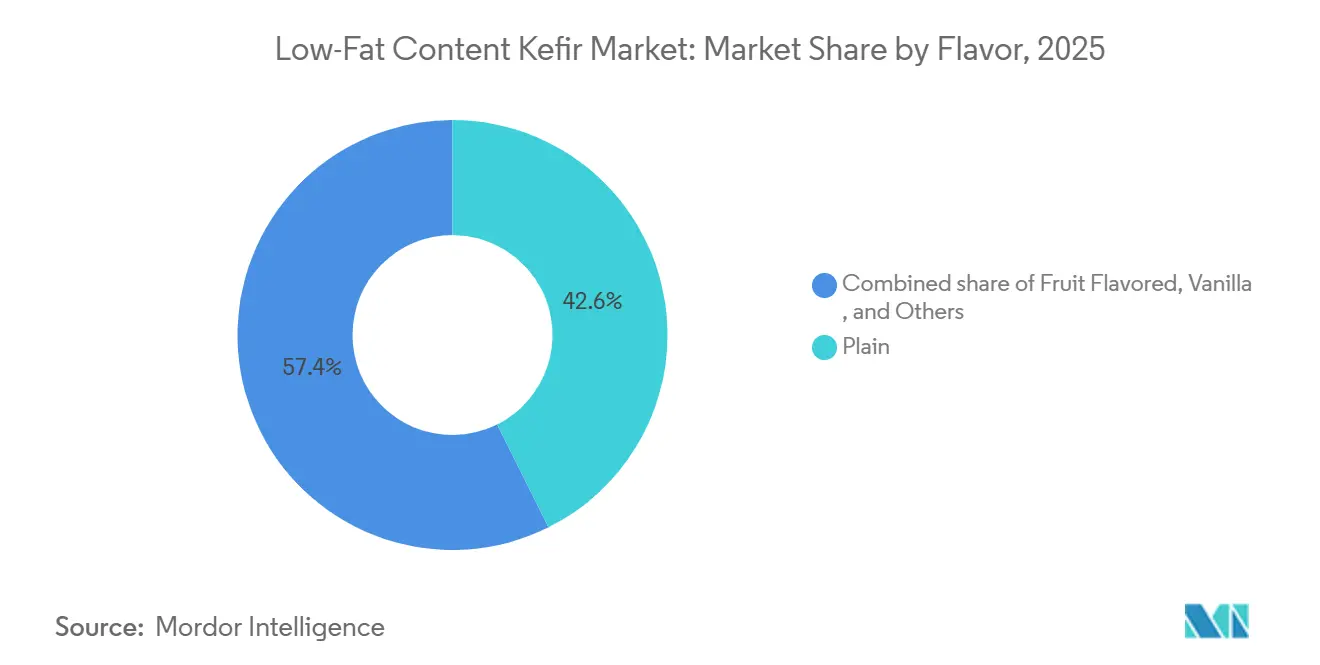
- By flavor, plain retained a 42.63% share in 2025, whereas fruit-flavored is forecast to expand at an 8.68% CAGR through 2031.
- By distribution channel, hypermarkets and supermarkets led the market with a share of 46.82% in 2025, while online retail is anticipated to register the fastest CAGR of 8.43% during 2026-2031.
- By geography, North America led the low-fat content kefir market in 2025 with a 36.62% share, while Asia-Pacific is projected to advance at an 8.80% CAGR through 2031.
Note: Market size and forecast figures in this report are generated using Mordor Intelligence’s proprietary estimation framework, updated with the latest available data and insights as of January 2026.
Market Trends and Insights
Drivers Impact Analysis of Low-Fat Content Kefir Market*
| Driver | (~) % Impact on CAGR Forecast | Geographic Relevance | Impact Timeline |
|---|---|---|---|
| Rising consumer focus on gut and digestive health | +2.0% | Global, concentrated in North America and Northern Europe | Short term (≤ 2 years) |
| Shift toward low-fat alternatives within dairy | +1.7% | North America and Europe, with spillover to Asia-Pacific | Medium term (2-4 years) |
| Growing preference for nutrient-dense foods with controlled calorie intake | +1.1% | North America, Australia, and South Korea | Medium term (2-4 years) |
| Product diversification through flavors and consumption occasions | +0.9% | Global, strongest in Asia-Pacific and Western Europe | Medium term (2-4 years) |
| Mainstreaming of fermented foods | +0.8% | North America, the United Kingdom, France, and Asia-Pacific urban centers | Long term (≥ 4 years) |
| Expansion of probiotic-focused dairy portfolios | +0.7% | Global, highest in North America and Europe | Long term (≥ 4 years) |
| Source: Mordor Intelligence | |||
Rising Consumer Focus on Gut and Digestive Health
Gut health has become a more prominent purchase consideration in mainstream dairy. A January 2026 article published by Frontiers on a controlled 8-week human trial reported a 25% increase in Shannon gut microbial diversity and a 40% reduction in Enterobacteriaceae counts after kefir consumption[2]. This evidence gives the low-fat content kefir market a stronger basis for product communication than broad references to probiotics alone. The findings do not distinguish between fat levels; therefore, the live-culture rationale applies across kefir formats. Reduced-fat products can also appeal to consumers managing calorie intake who might otherwise avoid full-fat dairy. A randomized trial in children examined low-fat content kefir in relation to symptoms, sleep, and gut microbiota, highlighting the wider clinical interest surrounding the product category.
Shift Toward Low-Fat Alternatives Within Dairy
In March 2024, the Food and Drug Administration allowed yogurt manufacturers to communicate a qualified link between regular yogurt consumption and a reduced risk of type 2 diabetes. The authorization applied to yogurt, but it increased regulatory attention on substantiated messaging in fermented dairy. This development supports retail interest in fermented dairy products with clear nutrition positioning. Low-fat formats remain relevant because they combine fermented dairy consumption with familiar reduced-fat choices. The low-fat content kefir market can therefore benefit when retailers prioritize health claims, formulation, and nutrition quality in shelf decisions. The development also encourages manufacturers to strengthen evidence-backed nutrition communication when positioning fermented dairy products to health-conscious consumers.
Growing Preference for Nutrient-Dense Foods with Controlled Calorie Intake
The use of GLP-1 medications and the rising interest in protein-focused diets are reshaping consumer expectations for smaller meals. Lifeway Foods identified GLP-1 users as a potential customer group seeking nutrient-dense, gut-friendly foods within a controlled calorie intake. The low-fat content kefir servings provide 8-12 grams of protein and 25-30 billion CFUs, with 100-150 calories per 8-ounce serving. These attributes align with the needs of consumers who prioritize protein, digestive health, and portion control. This shift also extends demand beyond established natural food shoppers and creates an opportunity for manufacturers to position low-fat content kefir as a convenient option that delivers multiple nutritional attributes in a relatively small serving. The low-fat content kefir market may retain this demand if eating habits formed during treatment continue after prescriptions end.
Product Diversification through Flavors and Consumption Occasions
Fruit-flavored low-fat content kefir is the fastest-growing flavor segment, while innovation also aims to expand consumption occasions beyond breakfast. Biotiful Gut Health introduced high-protein drinks with 20 grams of protein in a 330-milliliter bottle, targeting food-to-go and workout recovery use cases. In March 2026, Lifeway Foods launched low-fat kefir butter in Unsalted, Sea Salt, and Honey Butter varieties, expanding its presence in cooking applications. Through a partnership with Barry's fitness chain, the company also introduced the Lifeway Power Play shake, positioning it as an exercise recovery product[3]. These initiatives broaden the ways consumers can consume fermented dairy throughout the day. The low-fat content kefir market has a clearer opportunity to increase purchase occasions when products remain easy to understand and fit established refrigerated retail routines.
Restraints Impact Analysis of Low-Fat Content Kefir Market*
| Restraint | (~) % Impact on CAGR Forecast | Geographic Relevance | Impact Timeline |
|---|---|---|---|
| Short shelf life and refrigerated distribution dependence | -1.3% | Global, most acute in South America, the Middle East and Africa, and rural Asia-Pacific | Long term (≥ 4 years) |
| Distinctive sour and tangy taste limits acceptance | -1.0% | Asia-Pacific, the Middle East and Africa, and Latin America | Medium term (2-4 years) |
| Higher costs than conventional dairy beverages | -0.9% | Global, most significant in lower-income markets | Medium term (2-4 years) |
| Competition from established functional dairy products | -0.8% | North America and Europe | Short term (≤ 2 years) |
| Source: Mordor Intelligence | |||
Short Shelf Life and Dependence on Refrigerated Distribution
Low-fat content kefir requires consistent refrigeration from production through retail, which increases costs compared to shelf-stable dairy drinks. This limitation most clearly affects the low-fat content kefir market in South America, the Middle East and Africa, and rural parts of Asia-Pacific. Retailers without dedicated cold storage cannot reliably stock a product with a short shelf life. The final delivery stage remains particularly challenging in areas with underdeveloped chilled logistics networks. Modified-atmosphere packaging and culture controls may help extend shelf life, but pricing acceptable for mid-tier markets remains unresolved. The need for temperature-controlled handling also limits distribution flexibility and makes expansion into smaller retail outlets more operationally demanding. These conditions continue to support the role of hypermarkets and supermarkets with established refrigerated shelves.
Distinctive Sour and Tangy Taste Limits Mainstream Acceptance
The sour taste of low-fat content kefir can limit repeat purchases among consumers unfamiliar with fermented dairy. This challenge is more pronounced in parts of Southeast Asia, sub-Saharan Africa, and Latin America, where consumption lacks a strong cultural tradition. Biotiful Gut Health addressed this issue with dessert-inspired flavors, including Banoffee Pie, Caramelised Biscuit, and Lemon Drizzle, offered in 500-milliliter packs at a recommended retail price of GBP 2.25. Familiar flavors can reduce the barrier for first-time consumers. However, heavier flavoring can conflict with the simple-ingredient and clean-label positioning that consumers value in mature low-fat content kefir categories. Therefore, the low-fat content kefir market continues to balance improved palatability, brand positioning, and price.
*Our forecasts treat driver/restraint impacts as directional, not additive. The impact forecasts reflect baseline growth, mix effects, and variable interactions.
Low-Fat Content Kefir Market Segment Analysis
By Product Type:
Non-Fat Products Gain Ground on the Volume LeaderLow-fat content kefir with 1-2% fat accounted for 47.78% of the market value in 2025. It combines a reduced-fat positioning with a familiar dairy texture, supporting its presence across grocery and hypermarket formats in North America and Western Europe. Dietary guidelines have historically directed many consumers in these regions toward dairy products with 1-2% fat. This trend gives the segment a broad consumer base among people seeking a moderate alternative to full-fat products. The low-fat content kefir market continues to rely on this tier for scale because consumers can easily understand it at the shelf. Its established distribution also gives it an advantage over newer formats.
Non-fat content kefir with 0-0.5% fat is forecast to grow at a CAGR of 8.53% through 2031. Calorie-restricted diets, GLP-1 use, intermittent fasting, and macronutrient tracking support demand for this format. The reduced-fat tier with 2-3% fat sits between full-fat products and mainstream low-fat options. It may face pressure if non-fat products improve taste through culture selection and natural flavor masking. Producers can use research on the live-culture matrix to differentiate non-fat products while keeping claims grounded in evidence.

By Source:
Cow Milk Remains Established While Goat Milk Builds a Premium PositionCow milk-based content kefir accounted for 52.42% of the market value in 2025. Its leading position reflects cost-efficient ingredients, established milk collection systems, and strong consumer familiarity. Dairy cooperatives in the United States, Europe, and Oceania have built extensive infrastructure for cow milk supply, giving producers a per-unit cost advantage in the low-fat content kefir market. Producers can also scale cow milk products more easily through established refrigerated dairy channels. These factors support the segment’s leadership, even as specialty sources gain more attention.
Goat milk content kefir is forecast to grow at a CAGR of 8.25% through 2031. Goat milk kefir appeals to lactose-sensitive consumers, and it contains lower alpha-S1-casein than cow milk, which helps form a softer curd. Goat milk production remains more seasonal and regionally concentrated, with the United States, France, and Spain serving as important commercial sources. Demand growth in Asia-Pacific is not matched by equivalent local goat dairy capacity. This supply limitation supports a premium position for low-fat goat milk content kefir.
By Flavor:
Plain Products Retain Scale While Fruit-Flavored Products Add VolumePlain content kefir accounts for 42.63% of market value in 2025. Regular content kefir consumers often prefer its distinct fermented taste and use it in smoothies or cooking. Health-focused buyers also view plain formats as simpler products with flexible applications. This preference gives plain products a stable position in organic and health-food stores. The low-fat content kefir market benefits from the purchase depth created by these repeat users. Plain formats also allow brands to emphasize the base dairy and live-culture profile without the complexity of added flavors.
Fruit-flavored content kefir is forecast to register an 8.68% CAGR through 2031. It offers a familiar entry point for consumers who find plain content kefir too acidic. Younger consumers may also choose it as a functional alternative to flavored yogurt drinks. The contrast between plain and fruit-flavored products reflects two channel needs rather than taste preferences alone. Plain products support frequent purchases among established health-oriented buyers, while flavored products attract more supermarket shoppers to the category. Biotiful Gut Health expanded its dessert-led and cleaner organic flavor options, including Blossom Honey and Vanilla Chai, demonstrating how a single portfolio can address these distinct needs.
By Distribution Channel:
Supermarkets Retain Scale While Online Retail Adds SpeedHypermarkets and supermarkets account for 46.82% of the distribution value in 2025. Their refrigerated shelf space and cold-chain controls make them particularly suitable for low-fat content kefir. Consumers also rely on these stores for planned dairy purchases, supporting consistent product availability. This channel remains important to the low-fat content kefir market because smaller stores find it difficult to replicate refrigerated distribution. Large-format retailers can offer multiple pack sizes and flavors in one location. They can also encourage product trial through visible category placement and coordinated promotions.
Online retail is forecast to grow at a CAGR of 8.43% through 2031. Online sales can support direct, recurring orders when cold-chain delivery operates reliably. Convenience and grocery stores serve a different role by enabling single-serve, proximity-driven purchases. Digital channels also give manufacturers greater opportunities to offer subscription-based purchases, wider product selections, and targeted promotions. These capabilities can improve repeat purchasing and strengthen consumer access to specialized low-fat content kefir variants that may have limited availability in physical retail stores.
Geography Analysis
North America Low-Fat Content Kefir Market
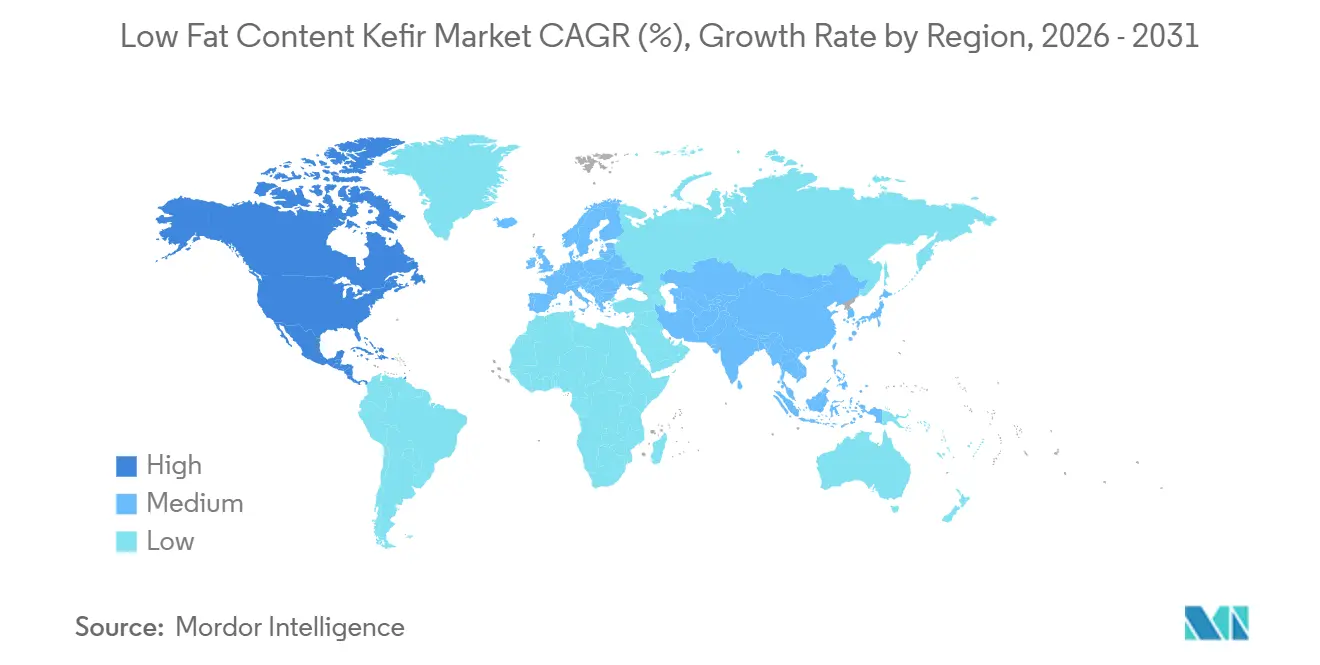
North America account for 36.62% of global value in 2025, maintaining its position as the largest regional base for the low-fat kefir market. The United States generates the strongest regional demand, supported by established health-food retail channels and broader grocery availability. Mexico contributes to demand through growing consumption among immigrant communities, while Canada adds volume through the expansion of natural-food retail. Lifeway Foods is expanding its Waukesha, Wisconsin, facility with an investment of USD 48 million, which is expected to double manufacturing capacity when completed in the fourth quarter of 2026.
Europe Low-Fat Content Kefir Market
Europe is the second-largest regional market for low-fat content kefir. Consumption traditions in Poland, Germany, Finland, and the United Kingdom provide an established base for the category. Poland supports regional supply through its export base, while the United Kingdom has recorded demand across liquid and potted content kefir formats. These markets provide companies with an environment where familiar fermented-dairy consumption habits can support both mainstream and premium products.
APAC and South America Low-Fat Content Kefir Market
Asia-Pacific is forecast to grow at a CAGR of 8.80% through 2031, making it the fastest-growing region in the low-fat content kefir market. China, India, Japan, South Korea, and Australia drive demand for different reasons. Chinese buyers view packaged probiotic dairy as an alternative to traditional fermented milks. Indian urban households are shifting toward packaged low-fat dairy as cold-chain conditions improve. In South America, Brazil has a shortage of local content kefir production relative to urban demand for functional dairy. Emmi's 2024 majority investment in Verde Campo added a premium high-protein dairy platform in Minas Gerais.
Competitive Landscape
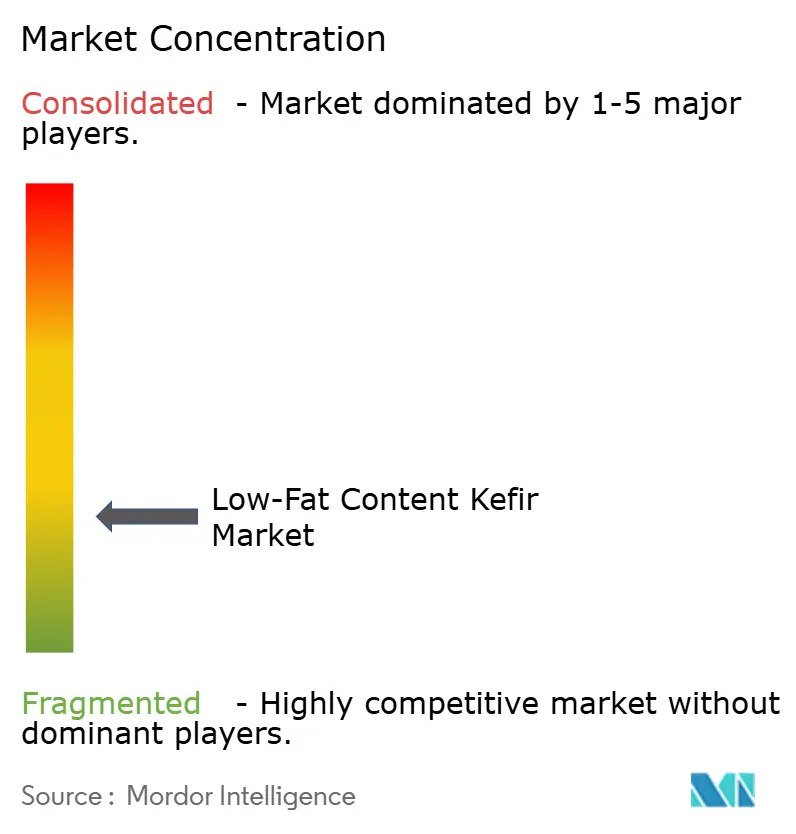
The low-fat content kefir market remains globally fragmented, although several brands hold strong national positions. Lifeway Foods reported in 2025 that it generated less than 1% of its revenue outside North America by destination shipment, highlighting the contrast between its regional strength and limited international sales. Biotiful Gut Health leads the United Kingdom low-fat content kefir market, while Valio holds a strong position in Nordic fermented dairy. Emmi operates across premium dairy segments and considers fermented dairy part of functional nutrition. These national and regional structures create opportunities for local producers in Asia-Pacific, Brazil, and the Middle East and Africa. As a result, the low-fat content kefir market combines concentrated national competition with a dispersed international landscape.
Companies are expanding their portfolios to create more consumption occasions for content kefir. Biotiful Gut Health introduced a high-protein content kefir drink range with 20 grams of natural protein per 330-milliliter bottle. The launch reflects a shift toward products that combine protein and live cultures in a portable format. Emmi launched nutrition+ as a fourth strategic niche in 2026 and identified its content kefir portfolio as part of its international strategy. In September 2025, Valio also expanded its drinkable low-fat content kefir formats with lactose-free and flavored products, offering consumers more convenient choices.
Smaller producers, including Kefir Lab Inc., Babushka Kefir, and Evolve Kefir, compete through artisan provenance and small-batch fermentation. This positioning can support premium pricing in specialty retail and direct sales. Private-label products increase price competition at the entry level, particularly as supermarkets expand their own fermented dairy ranges. Tesco introduced its Tesco Gut Sense Kefir range as part of a broader health-focused retail offering. These developments pressure brands to differentiate their products through flavor, source, protein content, culture selection, or convenience.
Low-Fat Content Kefir Industry Leaders
-
Lifeway Foods, Inc
-
Maple Hill Creamery, LLC
-
The Hain Celestial Group.
-
Chobani, LLC
-
Valio Ltd.
- *Disclaimer: Major Players sorted in no particular order
Low-Fat Content Kefir Market Companies Covered in this Report
- Lifeway Foods, Inc
- Nestlé S.A.
- Maple Hill Creamery, LLC
- Green Valley
- Biotiful Gut Health
- Valio Ltd.
- The Hain Celestial Group.
- Emmi Group
- Chobani, LLC
- Yeo Valley
- Straus Family Creamery
- Springfield Creamery, Inc.
- Evolve Kefir
- Harmonica
- Alexandre Family Farm
- Kalona SuperNatural
- Kefir Lab Inc.
- Brookford Farm
- Babushka Kefir
- Nourish Kefir
Recent Industry Developments in Low-Fat Content Kefir Market
- January 2026: 16 Handles introduced Strawberry Tart Kefir Probiotic Soft Serve, bringing kefir into the frozen dessert category for the first time for the brand. The product combines kefir’s characteristic tang with real strawberry flavor and positions it as a nutrient-focused dessert.
- October 2025: Lifeway Foods partnered with Erewhon Market to launch the Love Your Gut Pumpkin Spice Smoothie, which contains Lifeway Organic Plain Kefir, pumpkin puree, pumpkin spice seasoning, and cinnamon.
- August 2025: Lifeway Foods introduced three new conventional whole-milk kefir pouch flavors, Creamy Orange, Goo-Berry, and Strawanana- under its ProBugs brand. The products contain billions of live and active probiotic cultures and offer convenient, portable formats for children. This launch highlights the industry's shift toward single-serve, on-the-go kefir formats and new consumer age groups.
Global Low-Fat Content Kefir Market Report Scope
Low-fat content kefir is a fermented dairy beverage produced by culturing milk with content kefir grains and contains less milk fat than conventional whole-milk content kefir. It combines dairy’s nutritional properties with kefir’s characteristic tangy flavor and live cultures.
The low-fat content kefir market is segmented by product type, source, flavor, distribution channel, and geography. By product type, the market is segmented into non-fat (0-0.5% fat), low-fat (1-2% fat), reduced fat (2-3% fat), and other fat content levels. By source, the market is segmented into cow milk, goat milk, sheep milk, and other milk sources. By flavor, the market is segmented into plain, fruit-flavored, vanilla, and other flavors. By distribution channel, the market is segmented into supermarkets/hypermarkets, convenience/grocery stores, online retail stores, and other distribution channels. Based on geography, the market is classified into North America, Europe, South America, Asia-Pacific, and the Middle East and Africa. The market forecasts are provided in terms of value (USD).
Segmentation Overview
| Non-fat (0–0.5% fat) |
| Low-fat (1–2% fat) |
| Reduced-fat (2–3% fat) |
| Other fat content levels |
| Cow Milk |
| Goat Milk |
| Sheep Milk |
| Other Milk Sources |
| Plain |
| Fruit-Flavored |
| Vanilla |
| Other Flavors |
| Hypermarkets and Supermarkets |
| Convenience/Grocery Stores |
| Online Retail |
| Other Distribution Channels |
| North America | United States |
| Canada | |
| Mexico | |
| Rest of North America | |
| Europe | Germany |
| United Kingdom | |
| Italy | |
| France | |
| Spain | |
| Netherlands | |
| Poland | |
| Belgium | |
| Sweden | |
| Rest of Europe | |
| Asia-Pacific | China |
| India | |
| Japan | |
| Australia | |
| Indonesia | |
| South Korea | |
| Thailand | |
| Singapore | |
| Rest of Asia-Pacific | |
| South America | Brazil |
| Argentina | |
| Colombia | |
| Chile | |
| Peru | |
| Rest of South America | |
| Middle East and Africa | South Africa |
| Saudi Arabia | |
| United Arab Emirates | |
| Nigeria | |
| Egypt | |
| Morocco | |
| Turkey | |
| Rest of Middle East and Africa |
| By Product Type | Non-fat (0–0.5% fat) | |
| Low-fat (1–2% fat) | ||
| Reduced-fat (2–3% fat) | ||
| Other fat content levels | ||
| By Source | Cow Milk | |
| Goat Milk | ||
| Sheep Milk | ||
| Other Milk Sources | ||
| By Flavor | Plain | |
| Fruit-Flavored | ||
| Vanilla | ||
| Other Flavors | ||
| By Distribution Channel | Hypermarkets and Supermarkets | |
| Convenience/Grocery Stores | ||
| Online Retail | ||
| Other Distribution Channels | ||
| By Geography | North America | United States |
| Canada | ||
| Mexico | ||
| Rest of North America | ||
| Europe | Germany | |
| United Kingdom | ||
| Italy | ||
| France | ||
| Spain | ||
| Netherlands | ||
| Poland | ||
| Belgium | ||
| Sweden | ||
| Rest of Europe | ||
| Asia-Pacific | China | |
| India | ||
| Japan | ||
| Australia | ||
| Indonesia | ||
| South Korea | ||
| Thailand | ||
| Singapore | ||
| Rest of Asia-Pacific | ||
| South America | Brazil | |
| Argentina | ||
| Colombia | ||
| Chile | ||
| Peru | ||
| Rest of South America | ||
| Middle East and Africa | South Africa | |
| Saudi Arabia | ||
| United Arab Emirates | ||
| Nigeria | ||
| Egypt | ||
| Morocco | ||
| Turkey | ||
| Rest of Middle East and Africa | ||
Key Questions Answered in the Report
What is the current and projected size of the low-fat content kefir market?
The low-fat content kefir market was valued at USD 1.29 billion in 2025 and reached USD 1.38 billion in 2026. The market is further projected to grow to USD 2.02 billion by 2031, registering a cagr of 7.88% during 2026-2031.
Which product type held the largest share in the low-fat content kefir market in 2025?
The low-fat (1-2% fat) segment held the largest market share in 2025, accounting for 47.78% of the market.
Which source segment dominated the market in 2025?
Cow milk was the leading source segment in 2025, capturing 52.42% of the total market share.
Which flavor segment accounted for the largest share in 2025?
The plain flavor segment led the market in 2025, holding 42.63% of the market share.
Which distribution channel generated the highest revenue in 2025?
Hypermarkets and supermarkets dominated distribution in 2025, accounting for 46.82% of the market.
Which region held the largest share of the low-fat content kefir market in 2025?
North America was the largest regional market in 2025, representing 36.62% of revenue.