
Long Term Care Software Market Size and Share
Market Overview
| Study Period | 2020 - 2031 |
|---|---|
| Market Size (2026) | USD 6.13 Billion |
| Market Size (2031) | USD 9.49 Billion |
| Growth Rate (2026 - 2031) | 9.13 % |
| Fastest Growing Market | Asia Pacific |
| Largest Market | North America |
| Market Concentration | Medium |
Major Players *Disclaimer: Major Players sorted in no particular order Image © Mordor Intelligence. Reuse requires attribution under CC BY 4.0. | |
Long Term Care Software Market Analysis by Mordor Intelligence
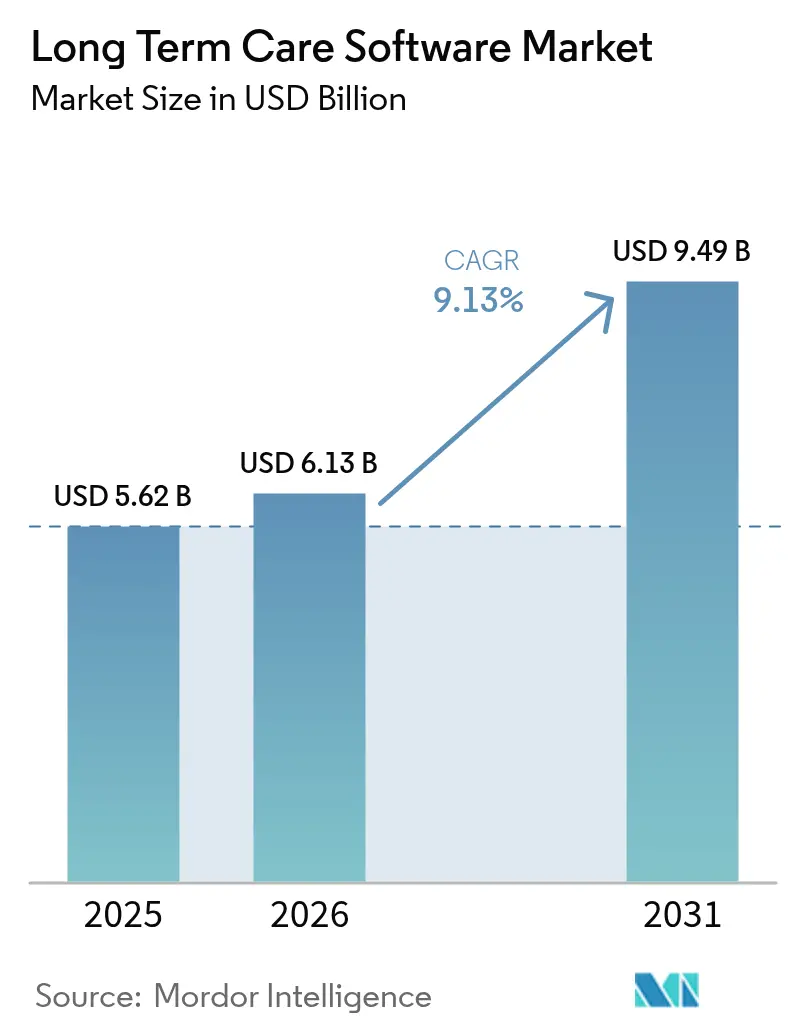
The long term care software market size is expected to grow from USD 5.62 billion in 2025 to USD 6.13 billion in 2026 and is forecast to reach USD 9.49 billion by 2031 at 9.13% CAGR over 2026-2031. Cloud-based interoperability mandates, workforce shortages, and value-based reimbursement models collectively reshape vendor strategies as facilities prioritize scalable, compliance-ready platforms. Consolidating operators seek enterprise-grade functionality that supports admissions through discharge, while smaller facilities favor subscription pricing that mitigates capital outlays. Analytics capabilities emerge as the leading purchase criterion because predictive insights directly influence reimbursement and quality scores. Competitive intensity increases as vendors embed artificial intelligence, mobile access, and cybersecurity safeguards to satisfy both regulatory scrutiny and clinical workflow needs.
Key Report Takeaways
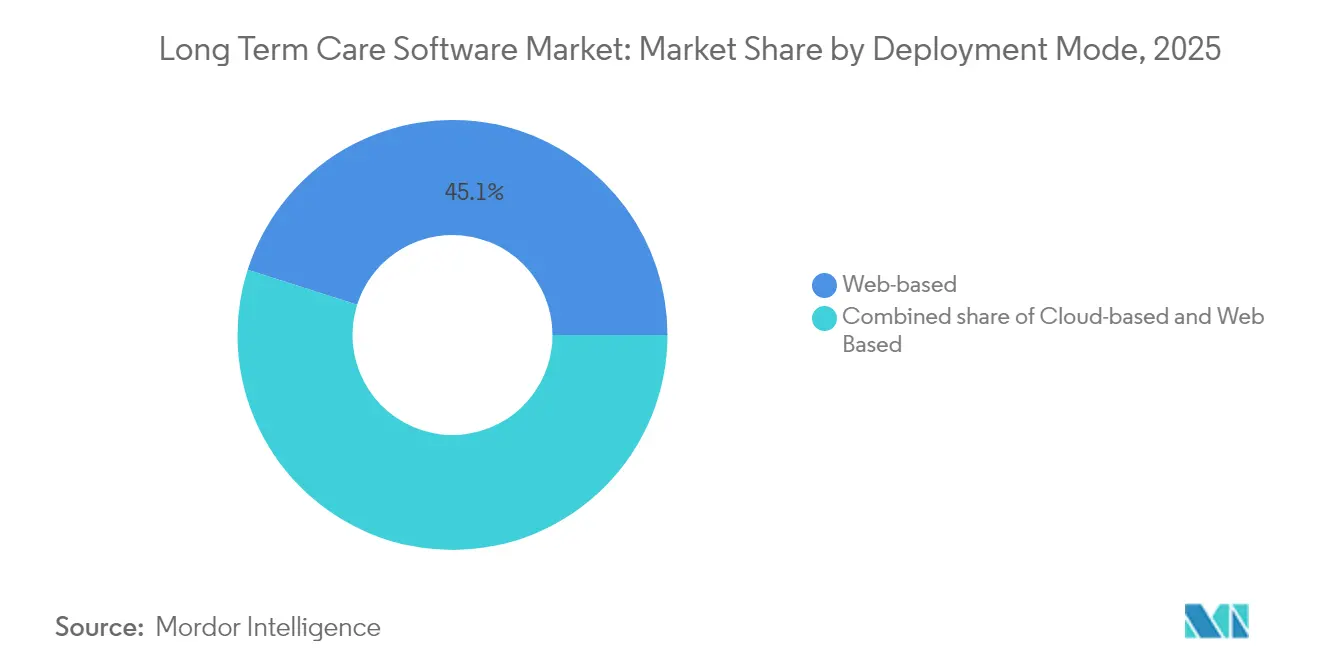
- By deployment model, web-based solutions led with 45.10% of long term care software market share in 2025, whereas cloud-based platforms are forecast to grow at a 9.41% CAGR through 2031.
- By product module, Electronic Health Records accounted for 37.80% of the long term care software market size in 2025, while Analytics & Business Intelligence modules are expanding at a 9.88% CAGR to 2031.
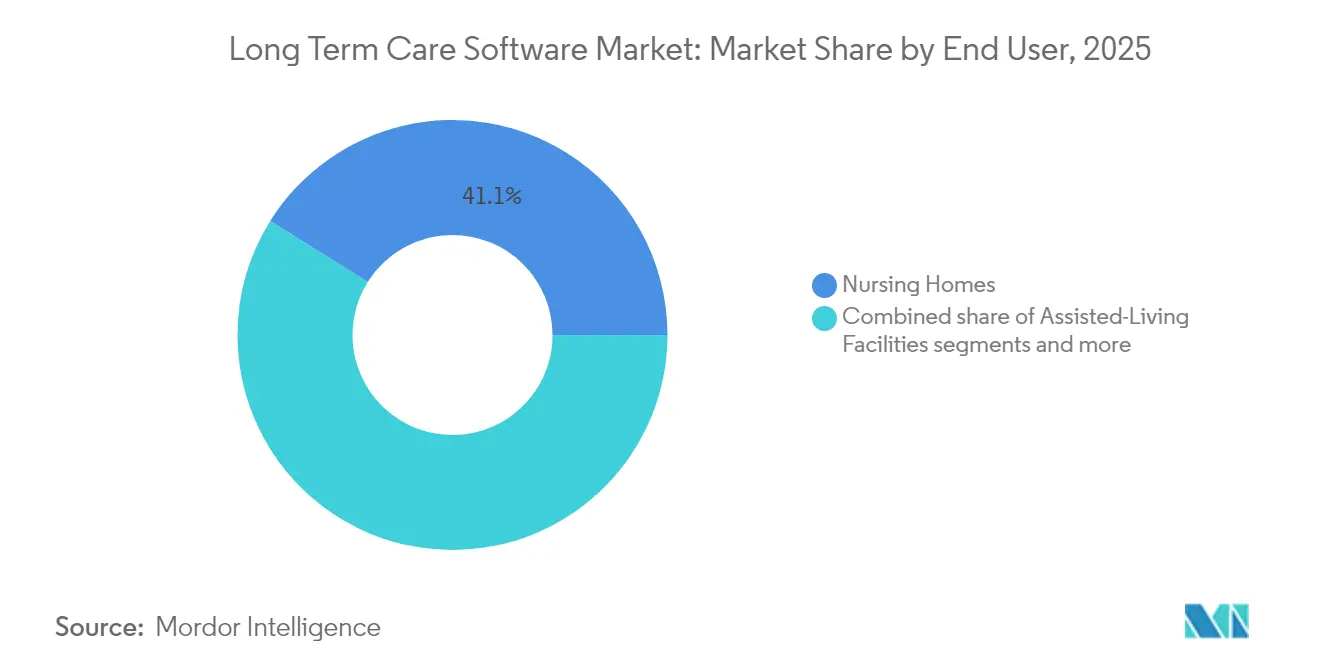
- By end-user facility type, nursing homes held 41.10% revenue share of the long term care software market in 2025; assisted-living facilities are projected to record the fastest CAGR at 10.44% through 2031.
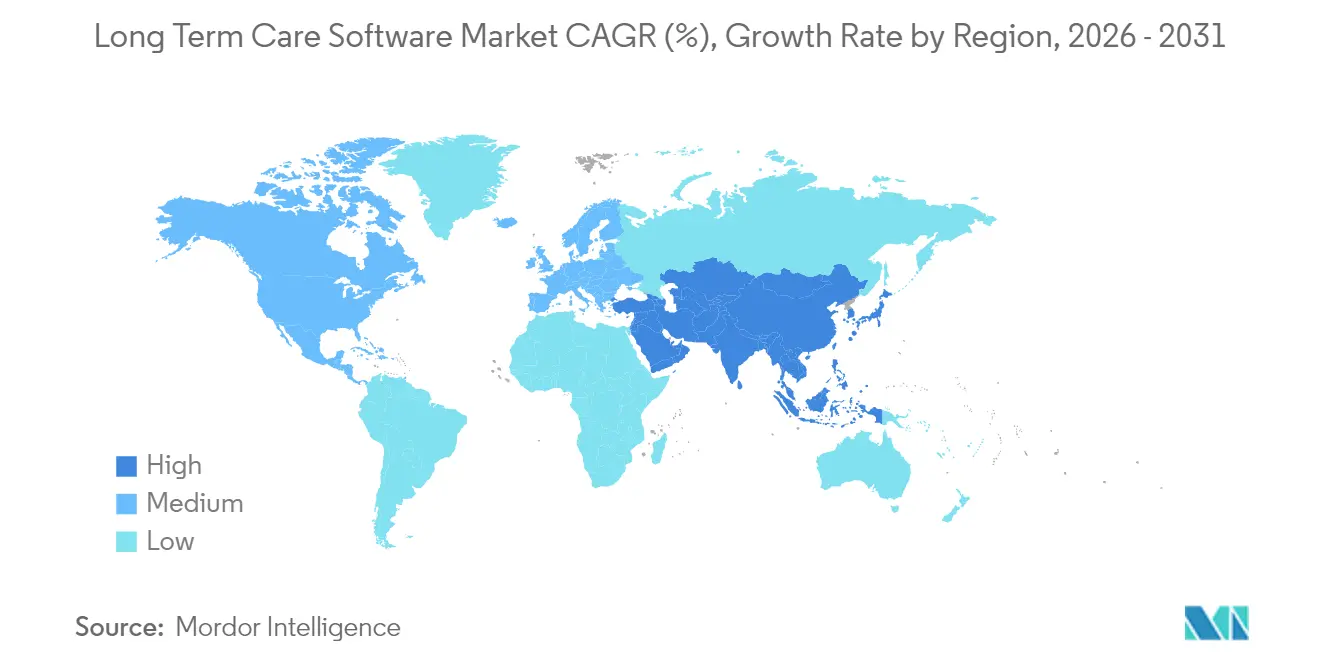
- By geography, North America commanded 41.80% of long term care software market share in 2025, whereas Asia-Pacific is anticipated to register the highest CAGR at 9.74% to 2031.
Note: Market size and forecast figures in this report are generated using Mordor Intelligence’s proprietary estimation framework, updated with the latest available data and insights as of 2026.
Market Trends and Insights
Drivers Impact Analysis of Long Term Care Software Market*
| Driver | (~) % Impact on CAGR Forecast | Geographic Relevance | Impact Timeline |
|---|---|---|---|
| Aging population & chronic-disease burden | +2.1% | Global, highest in Japan, Germany, United States | Long term (≥ 4 years) |
| Government incentives for post-acute EHR interoperability | +1.8% | North America, Europe | Medium term (2-4 years) |
| Shift to cloud-based SaaS lowering IT barriers | +1.4% | Global, strongest in APAC emerging markets | Short term (≤ 2 years) |
| Value-based reimbursement models demanding analytics | +1.2% | North America core, expanding to Europe | Medium term (2-4 years) |
| AI-driven fall/readmission risk prediction | +0.9% | United States, Western Europe, Australia | Short term (≤ 2 years) |
| Workforce shortages accelerating mobile workflow adoption | +1.1% | Global, acute in United States and Europe | Short term (≤ 2 years) |
| Source: Mordor Intelligence | |||
Ageing Population & Chronic-Disease Burden
Long-term care demand magnifies as older cohorts expand and comorbidities rise, forcing facilities to adopt software that unites documentation, predictive analytics, and remote monitoring. Brazil’s older-adult population is set to triple by 2050, and government technology grants already fund IoT-enabled monitoring pilots to sustain independent living[1]. Germany anticipates a nursing shortfall exceeding 1.9 million professionals by 2040, making technology-assisted workflows indispensable for maintaining care standards without proportional head-count growth. Facilities worldwide deploy fall-detection sensors, wearables, and AI triage tools that escalate alerts directly into Electronic Health Records, improving response times while reducing liability exposure. Regulatory frameworks such as HIPAA in the United States and GDPR in Europe require secure, interoperable systems, making the long term care software market a critical enabler of safe, compliant care management. Sustained demographic momentum underpins multi-year investment cycles and discourages deferral of software upgrades.
Government Incentives for Post-Acute EHR Interoperability
The HTI-1 final rule obliges long-term care facilities to implement certified health IT modules supporting USCDI v3 by January 2026, converting compliance pressure into capex prioritization. Information-blocking penalties accelerate platform replacement among operators reliant on closed systems. TEFCA’s trusted exchange framework broadens data-sharing incentives, favoring vendors with robust APIs and single-tenant security architectures. CMS quality initiatives reward demonstrable interoperability, making EHR adoption a direct revenue driver rather than an administrative chore. State Medicaid adjustments further stimulate purchases by boosting reimbursement for certified technology users, especially among high-Medicaid nursing homes confronting razor-thin margins.
Shift to Cloud-Based SaaS Lowering IT Barriers
Subscription-based deployment compresses upfront costs and provides automatic updates, allowing facilities without dedicated IT staff to maintain regulatory compliance. Capital requirements for on-premises platforms can exceed USD 600,000, but multi-tenant SaaS pricing typically averages USD 1,200 per user annually, equalizing access between rural homes and large chains. Cloud data centers deliver encryption, redundancy, and SOC 2 certification, alleviating cybersecurity fears while enabling real-time analytics. Interoperability is simplified through FHIR-enabled endpoints, catalyzing cross-continuum data flows that reduce readmission penalties. The long term care software market thus finds new addressable demand among operators that historically considered enterprise systems unreachable.
Value-Based Reimbursement Models Demanding Analytics
CMS ties Skilled Nursing Facility reimbursements to quality metrics such as rehospitalization rates and infection prevention, placing predictive analytics at the core of fiscal strategy. PDPM heightens the need for acuity-driven resource planning, and real-time dashboards now influence shift staffing, therapy minutes, and supply allocation. Managed Medicaid and commercial risk contracts impose financial bonuses and penalties linked to measured outcomes, making analytic functionality an essential procurement criterion. Facilities that leverage forecasting engines for high-risk resident identification report measurable gains in Five-Star Quality Ratings and reduced antipsychotic medication usage. The long term care software market thereby becomes integral to sustaining margins under value-based payment.
Restraints Impact Analysis of Long Term Care Software Market*
| Restraint | (~) % Impact on CAGR Forecast | Geographic Relevance | Impact Timeline |
|---|---|---|---|
| Cyber-security & data-privacy concerns | -1.3% | Global, heightened in Europe (GDPR), North America (HIPAA) | Short term (≤ 2 years) |
| High implementation & maintenance cost for smaller operators | -0.8% | Global, acute in rural and developing markets | Medium term (2-4 years) |
| Fragmented state-level regulations raising integration complexity | -0.7% | North America core, emerging in federated systems globally | Medium term (2-4 years) |
| Limited interoperability standards versus acute-care EHRs | -0.6% | Global, most acute in developing healthcare systems | Long term (≥ 4 years) |
| Source: Mordor Intelligence | |||
Cyber-Security & Data-Privacy Concerns
Healthcare ransomware events grew in 2024, and long-term care organizations now face average breach costs surpassing USD 10 million, including penalties and brand erosion. NIST’s 2024 guide sets stricter encryption and audit-log standards, raising integration complexity for older web-based applications. GDPR provisions on cross-border data transfers add legal uncertainty for multinational chains. Smaller facilities lacking full-time security personnel often postpone upgrades despite SaaS improvements, leaving legacy systems exposed. The resulting risk aversion tempers near-term long term care software market adoption until vendors demonstrate turnkey compliance tooling.
High Implementation & Maintenance Cost for Smaller Operators
Basic EHR projects can still require USD 20,000-65,000 in direct spend and another USD 25,000 in staff training, a heavy burden for facilities operating on 2% margins. Ongoing support averages 18% of purchase price annually, pressuring cash flows during census dips. Rural operators pay higher broadband fees and endure latency that hampers cloud reliability. Multi-module platforms demand integration expertise often outsourced to consultants, increasing total cost of ownership. Many independents therefore delay system replacement, reinforcing fragmentation within the long term care software market and creating acquisition targets for larger chains.
*Our forecasts treat driver/restraint impacts as directional, not additive. The impact forecasts reflect baseline growth, mix effects, and variable interactions.
Long Term Care Software Market Segment Analysis
By Deployment Model:
Cloud Infrastructure Drives TransformationThe long term care software market size for web-based deployments stood at USD 2.53 billion in 2025, representing 45.10% share of total revenue. Cloud platforms, however, are forecast to expand at a 9.41% CAGR, elevating the long term care software market share of SaaS offerings by the end of the decade. Operators migrate to cloud to reduce upgrade downtime, access AI modules, and centralize multi-facility reporting. PointClickCare’s Azure migration and WellSky’s partnership with Google Cloud showcase how hyperscale resources accelerate feature rollouts. Hybrid deployments persist among enterprise chains that segregate protected health information servers while leveraging cloud analytics for de-identified data sets. Over the forecast horizon, vendor roadmaps prioritize containerized microservices, ensuring feature parity across deployment options and smoothing transition pathways for bandwidth-limited sites.
Cloud dominance reshapes vendor economics by replacing perpetual licenses with recurring monthly revenue, improving predictability yet intensifying churn risk. Smaller suppliers unable to finance cloud redevelopment become acquisition candidates, accelerating consolidation. Facilities cite mobile accessibility and automatic security patching as top benefits, while remaining skeptics worry about internet outages and data-sovereignty rules. Market education campaigns from public cloud providers and regional broadband expansion programs alleviate many lingering objections, reinforcing the trajectory toward SaaS penetration.

By Product Module:
Analytics Emergence Reshapes PrioritiesElectronic Health Records retained a 37.80% revenue contribution to the long term care software market size in 2025 because compliance documentation remains the first prerequisite for licensure. Analytics & Business Intelligence modules are projected to account for USD 2.27 billion by 2031, reflecting a 9.88% CAGR. Facilities increasingly bundle fall-prediction engines and readmission risk scores into care pathways, triggering earlier interventions and limiting penalty exposure. eMAR adoption accelerates as medication error prevention tools integrate barcode scanning and predictive drug-interaction alerts. Revenue-cycle modules embed payer-latest rulesets to ensure PDPM accuracy, and many vendors now offer optional clearinghouse connections for instant claim edits.
AI-powered workforce scheduling platforms such as Kevala report 8% labor-cost reduction by matching staffing levels to acuity forecasts. Bundled procurement rises because chains prefer single-vendor suites that harmonize data models across clinical, financial, and operational domains. Open-API ecosystems retain relevance for specialized functions like lease asset tracking or advanced wound-care imaging, but interoperable vendors increasingly swallow niche markets through organic module launches and bolt-on deals.
By End-User Facility Type:
Assisted Living Accelerates GrowthNursing homes and skilled-nursing facilities generated USD 2.31 billion in software spend during 2025, equating to 41.10% of the aggregated long term care software market size. Assisted-living communities, however, are advancing at a 10.44% CAGR thanks to aging-in-place preferences and higher resident acuity. These sites demand hybrid care-hospitality platforms that unify health records, lifestyle scheduling, and resident engagement apps. Mobile POS devices now facilitate dining-room medication administration, enhancing compliance without medicalizing the environment.
Home-health and hospice agencies adopt cloud tools optimized for distributed workforces, integrating telehealth feeds, wound-image uploads, and GPS-verified visit logs. Regulatory complexity varies: U.S. nursing homes adhere to both CMS surveys and state mandates, while assisted-living rules differ considerably by jurisdiction, influencing procurement cycles. As payer networks extend bundled-payment pilots that encompass post-acute settings, cross-continuum data visibility becomes indispensable, steering all facility types toward comprehensive suites.
Geography Analysis
North America Long Term Care Software Market
North America captured 41.80% share of the long term care software market in 2025, anchored by Medicare and Medicaid incentives that reward certified EHR use. The January 2026 HTI-1 deadline accelerates refresh cycles, and information-blocking enforcement drives multi-state chains to harmonize on API-first platforms. Labor shortages propel adoption of virtual-nursing dashboards; 74% of hospital leaders now view remote monitoring as integral to future care delivery. Canada prioritizes operational efficiency over reimbursement optimization, whereas Mexico’s mid-income segment expands private long-term care demand, stimulating vendor localization efforts.
APAC Long Term Care Software Market
Asia-Pacific is projected to record a 9.74% CAGR, the fastest among major regions. Japan’s health ministry subsidizes sensor-equipped beds and robotic lifts to mitigate the projected 570,000 caregiver deficit by 2040. China’s long-term care facilities report an average nursing-service need score of 162.15, translating into rising software budgets for resident assessment and staffing tools. Australia’s digital-health strategy targets full electronic medication chart coverage by 2027, further enlarging the long term care software market.
Europe Long Term Care Software Market
Europe demonstrates sustained investor confidence, with EUR 2.3 billion in nursing-home property transactions during 2024. GDPR imposes strict data-processing rules that slow cross-border deployments, yet standardization efforts spur vendors to develop configurable consent-management modules. Germany’s hospital-funding reform boosts digital infrastructure grants, and France’s Ma Santé strategy earmarks funding for interoperable post-acute solutions. Switzerland’s trend toward home-based care intensifies demand for cost-effective SaaS.
MEA and South America Long Term Care Software Market
Emerging regions such as South America and the Middle East & Africa exhibit double-digit growth potential but face currency volatility and infrastructure gaps. Vendors often partner with telecom operators to bundle connectivity and hosting, reducing hurdles for early adopters.
Regulatory Landscape
In the United States, compliance requirements for long-term care software are increasingly shaped by CMS oversight and the ASTP/ONC Health IT Certification Program. CMS completed implementation of the revised Long-Term Care Survey Process (LTCSP) software application and associated Critical Element (CE) Pathways by April 28, 2025, which increases the priority of survey-readiness capabilities such as traceable documentation, audit logs, and policy-aligned workflows within EHR and quality modules.
CMS also issued QSO-26-03-NH on January 30, 2026, updating nursing home oversight, investigation procedures, and Civil Money Penalty guidance aligned with the FY 2025 SNF PPS final rule. This reinforces the need for defensible clinical and operational records. On the interoperability side, ASTP/ONC communications during March 2026 provided developers additional time until March 1, 2026 to update Health IT Modules for HTI-1-related needs. The 2026 Standards Version Advancement Process (SVAP) fact sheet (June 2026) set an August 29, 2026 pathway for voluntarily adopting newer standard versions, supporting faster incorporation of updated exchange standards into long-term and post-acute care workflows.
Value Chain Analysis
The long-term care software value chain begins with standards and policy inputs, including CMS requirements for post-acute data exchange and quality reporting, as well as HL7 implementation guides such as eLTSS. It then moves into product development by EHR and module vendors that package clinical documentation, eMAR, billing, scheduling, and analytics for nursing homes, assisted living, and home health and hospice providers. Interoperability layers connect these platforms to external stakeholders such as state Medicaid systems (MMIS), Health Information Exchanges (HIEs), and adjacent provider EHRs. Implementation and managed services, including integration, training, regulatory updates, and security monitoring, make up a substantial portion of delivered value for resource-constrained facilities.
Integration and data-standardization remain key bottlenecks. LTPAC has historically lacked hospital-style federal financial incentives for interoperability adoption, while disparate state-level rules and uneven data codification complicate cross-setting exchange. The CMS Interoperability and Prior Authorization final rule (CMS-0057-F) and ONC baseline data requirements increase the importance of US Core Profiles and FHIR-aligned interfaces, pushing vendors and implementers to invest in API enablement, mapping, and testing. Industry feedback, including AHCA/NCAL comments submitted in February 2026 on the HTI-5 proposed rule, also points to how certification changes can cascade through the chain by affecting baseline exchange and medication-safety capabilities relied on by LTPAC providers and their integration partners.
Competitive Landscape
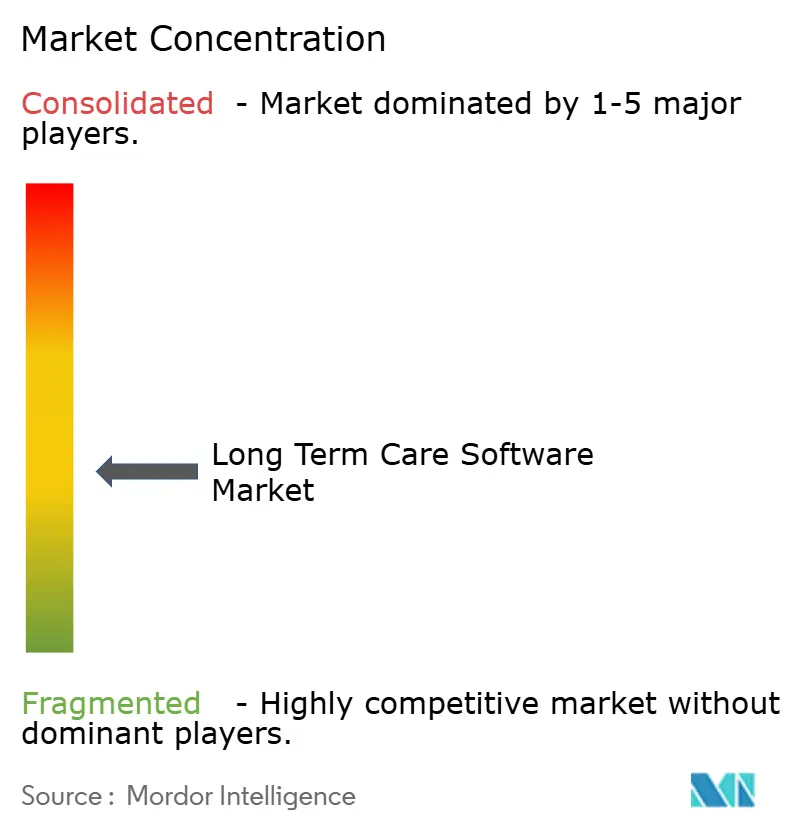
The long term care software market remains moderately fragmented; the top five vendors controlled close to 35% revenue in 2024, yet M&A activity is rising as larger players pursue portfolio breadth. PointClickCare’s acquisition of American HealthTech extended its footprint across skilled-nursing, assisted-living, and critical-access hospital segments. WellSky invested in generative-AI documentation tools co-developed with Google Cloud, underscoring the strategic imperative to automate charting and free clinical time. MatrixCare partnered with Health Gorilla to unlock nationwide exchange via TEFCA-aligned networks, positioning itself as an interoperability frontrunner.
Private-equity involvement intensifies: Nordic Capital’s majority stake in Sensio adds smart-sensor capabilities that complement analytics suites. Valsoft’s acquisition of American Data shows investor appetite for niche vendors with loyal customer bases. Disruptors such as Kevala leverage AI scheduling agents to win share among staffing-constrained facilities. Differentiation now hinges on total cost of ownership, security posture, and the depth of predictive analytics; features alone no longer secure contracts.
Cybersecurity capabilities influence RFP outcomes as facilities scrutinize SOC 2 reports and incident-response playbooks. Vendors offering end-to-end managed services—including training, regulatory updates, and analytics concierge—gain renewal advantages. Platform ecosystems continue expanding through API marketplaces that invite third-party applications for wound imaging, resident engagement, and family communications.
Long Term Care Software Industry Leaders
-
McKesson Corporation
-
Allscripts Healthcare Solutions
-
Netsmart Technologies Inc.
-
Cerner Corporation (Oracle)
-
Epic Systems Corporation
- *Disclaimer: Major Players sorted in no particular order
Long Term Care Software Market Companies Covered in this Report
- PointClickCare
- MatrixCare (ResMed)
- WellSky
- Cerner
- Epic Systems
- Allscripts (Veradigm)
- Mckesson
- Omnicare (CVS Health)
- AlayaCare
- American HealthTech
- Netsmart Technologies
- Experience Care
- August Health
- CareCenta
- Eldermark
- SigmaCare
- Yardi Senior Living Suite
- Medtelligent (Alis)
- Optimus EMR
- AccuPoint
Market Opportunities and Future Outlook
Interoperability and digital quality measurement upgrades continue to be a core whitespace opportunity where long-term care software platforms can expand module adoption and services revenue. The CMS FY 2026 SNF Prospective Payment System final rule advances digital quality measurement and the use of FHIR in the SNF Quality Reporting Program. In parallel, 42 USC 1395lll requires standardized, interoperable post-acute care assessment data, which favors vendors that can operationalize structured assessment capture, measure calculation, and exchange-ready outputs across the post-acute continuum.
Policy and standards evolution also supports modernization in legacy deployments. ASTP/ONC HTI-5 proposals, including adoption paths tied to newer USCDI and updated health IT standards under 45 CFR 170.215, with proposed January 1, 2028 expiration dates for older standard versions, raise the bar for vendors offering certified, upgradeable modules that reduce compliance overhead for facilities. On care delivery, legislative activity around AI and aging-in-place tools, including S. 4916 directing a federal task force to evaluate AI for fall detection, medication management, and remote monitoring, and state-level moves such as Connecticut HB-5142 enabling virtual monitoring technology in residential care homes, point to demand for software that embeds consent, notification, and monitoring workflows alongside clinical documentation and analytics.
Recent Industry Developments in Long Term Care Software Market
- July 2026: The California Department of State Hospitals selected Netsmart CareFabric as its modernized, data-driven technology platform. The selection points to growing demand for unified platforms that strengthen clinical and operational visibility across large, complex care organizations, reinforcing vendor emphasis on enterprise-grade interoperability and analytics.
- May 2025: AccentCare selected Netsmart CareFabric, including the myUnity EHR, to support value-based care and population health initiatives for AccentCare Medical Group. The deployment reflects provider preference for platforms that connect clinical documentation with analytics and reporting needed for performance-linked reimbursement models.
- July 2024: Nordic Capital acquired a majority stake in Sensio, expanding its footprint in European long-term care technology. The deal signals continued investor focus on combining smart-sensor capabilities with software analytics to address staffing constraints and safety monitoring in care facilities.
Long Term Care Software Market Report Scope and Research Methodology
Market Definition and Coverage
This market covers software used by long-term care providers to run day to day clinical and administrative work, such as resident records, care documentation, medication workflows, billing, scheduling, and monitoring. Revenue reflects software and related services sold to nursing homes, assisted living centers, hospice facilities, and home care agencies.
Scope exclusions: We exclude general hospital information systems and hardware-only devices that are sold without a software subscription or licensing component.
Segments Covered in This Report
- By Deployment Model
- Cloud-based
- Web-based
- On-premises
- By Product Module
- Electronic Health Record (EHR)
- eMAR / Medication Management
- Revenue-Cycle & Financial Management
- Workforce & Scheduling
- Analytics & Business Intelligence
- By End-User Facility Type
- Nursing Homes / Skilled-Nursing Facilities
- Assisted-Living Facilities
- Home-Health & Hospice Agencies
- By Geography (Value)
- North America
- United States
- Canada
- Mexico
- Europe
- Germany
- United Kingdom
- France
- Italy
- Spain
- Rest of Europe
- Asia-Pacific
- China
- India
- Japan
- South Korea
- Australia
- Rest of Asia-Pacific
- South America
- Brazil
- Argentina
- Rest of South America
- Middle East and Africa
- GCC
- South Africa
- Rest of Middle East and Africa
- North America
Data Sources, Market Sizing, and Validation
Desk Research
Desk work starts with building a clean demand and supply view of long-term care settings and their digital adoption. We use public health and aging statistics to understand the addressable provider base and resident load, and then align that with software spending behavior over time.
Examples of sources we refer to include CMS and the National Center for Health Statistics for facility and utilization indicators, the U.S. Bureau of Labor Statistics for staffing trends, OECD aging and long-term care datasets for cross-country direction, and peer-reviewed journals that discuss EHR and care coordination adoption in post-acute care. We also review company filings and investor presentations, association websites, and reputable press, and then connect the dots with company financials and intelligence databases plus patent databases when product roadmaps or category overlap needs clarification. These examples are illustrative, and many other public sources are used for collection, validation, and research clarification.
Primary Interviews and Surveys
Primary work is used to pressure test pricing, deployment mix, and buyer behavior across long-term care settings, so assumptions do not sit only on published narratives. We speak with software providers, implementation partners, and long-term care operators across APAC, EMEA, and the Americas, and we also recheck inputs with functional owners who manage clinical documentation, billing, and staffing workflows.
Distribution of primary research fieldwork respondents
| Company type | Respondent position | Region |
|---|---|---|
| Top tier: 31% | CXOs: 13% | APAC: 48% |
| Mid tier: 49% | Functional/Unit leaders: 29% | EMEA: 34% |
| Smaller Players: 20% | Managers: 58% | Americas: 18% |
Market-Sizing & Forecasting
Sizing is built using a top-down approach where provider counts, resident volumes, and long-term care digital adoption are converted into a spending pool by applying software penetration and a realistic annual spend per provider. Those totals are then checked with selective bottom-up approximations, such as sampled price points for core modules (EHR documentation, eMAR and medication management, billing and scheduling) multiplied by likely seat counts and facility volumes, followed by channel checks on implementation and support revenue.
Key inputs that shape the model include the number of nursing and assisted living facilities, home care agency counts, staff-to-resident ratios, the mix of cloud versus on-premise deployments, average contract lengths, and the typical bundle mix between clinical and back-office modules. Where small-provider pricing or usage is not consistently disclosed, the gaps are handled using ranges agreed in interviews, and the midpoint is accepted only after it fits the independent demand signals.
For forecasting, we use scenario analysis supported by a light multivariate regression on drivers like aging population growth, labor availability pressure, and digitization and compliance intensity in long-term care. Assumptions on ASP progression are kept practical by modeling renewals and upsell separately, rather than applying one blanket price increase across all buyers.
Data Validation & Update Cycle
Outputs are validated through several rounds of checks where market totals are compared against independent signals, such as facility growth, staffing trends, and adoption indicators for clinical documentation and medication workflows. When a region or deployment type shows a sharp change, the inputs are reopened, outliers are explained, and expert callbacks are triggered before numbers move forward.
A structured review is done internally so that assumptions, calculations, and conversions are consistent across the time series. Reports are refreshed annually, and interim updates are added when there is a material shift in regulation, reimbursement, or buying cycles, and then a final pre-delivery pass is performed to make sure clients receive the latest updated view.
Mordor Intelligence's Long Term Care Software Market Size Compared With Other Published Estimates
Published market sizes for long-term care software often do not match because the math depends on what is counted as software revenue, which settings are included, and how pricing is carried forward over the forecast years. Differences also show up when base years are not aligned or when currency conversion is done using different timing.
The spread below is mostly explained by refresh cadence, FX timing, and how average contract value is pushed forward as cloud adoption rises, which is why the 2025 total lands at USD 5.62 B in the model maintained by Mordor Intelligence after rechecking module mix, renewal behavior, and regional adoption signals.
Benchmark comparison
| Source | Market Size | Gaps in Research Methodology |
|---|---|---|
| Mordor Intelligence | USD 5.62 B (2025) | |
| Global Consultancy A | USD 5.58 B (2025) | Uses a 2024 estimation base and projects 2025 with a shorter step-forward, which can understate mid-year contract repricing and the shift toward higher-value cloud bundles. |
| Data Provider B | USD 5.51 B (2024) | Anchors the series on 2024 and carries forward a higher growth rate to 2032, which can widen totals if module scope includes adjacent compliance tools and if FX conversion is not aligned to the same averaging window. |
Taken together, the table shows that small base-year and pricing treatment choices can move the market by meaningful amounts even when the product theme is the same. We keep the steps traceable by tying demand to facility and resident indicators, and then confirming ASP and deployment mix through repeated validation checks, so the final number can be reproduced and explained cleanly.
Key Questions Answered in the Report
What is the projected revenue for Long Term Care Software providers by 2031?
The long term care software market size is forecast to reach USD 9.49 billion by 2031 based on a 9.13% CAGR.
Which deployment model is growing fastest among senior-care operators?
Cloud-based SaaS platforms are expanding at a 9.41% CAGR as facilities seek scalability and automatic updates.
Why are analytics modules becoming critical in long-term care?
Analytics & Business Intelligence tools support fall prevention, readmission reduction, and value-based reimbursement optimization, making them the fastest-growing module at a 9.88% CAGR.
Which region offers the highest growth potential through 2031?
Asia-Pacific leads with a projected 9.74% CAGR due to rapid aging demographics and government technology incentives.
How are staffing shortages influencing software purchasing decisions?
Facilities increasingly adopt AI-powered scheduling and mobile workflows to offset caregiver deficits, driving demand for integrated workforce management features.
What competitive moves are reshaping vendor positioning?
Notable actions include PointClickCare's acquisition of American HealthTech and WellSky's generative-AI partnership with Google Cloud, both aimed at broadening platform capabilities.