
Logical Security Market Size and Share
Market Overview
| Study Period | 2020 - 2031 |
|---|---|
| Market Size (2026) | USD 141.90 Billion |
| Market Size (2031) | USD 237.42 Billion |
| Growth Rate (2026 - 2031) | 10.84 % |
| Fastest Growing Market | Asia-Pacific |
| Largest Market | North America |
| Market Concentration | Medium |
Major Players *Disclaimer: Major Players sorted in no particular order Image © Mordor Intelligence. Reuse requires attribution under CC BY 4.0. | |
Logical Security Market Analysis by Mordor Intelligence
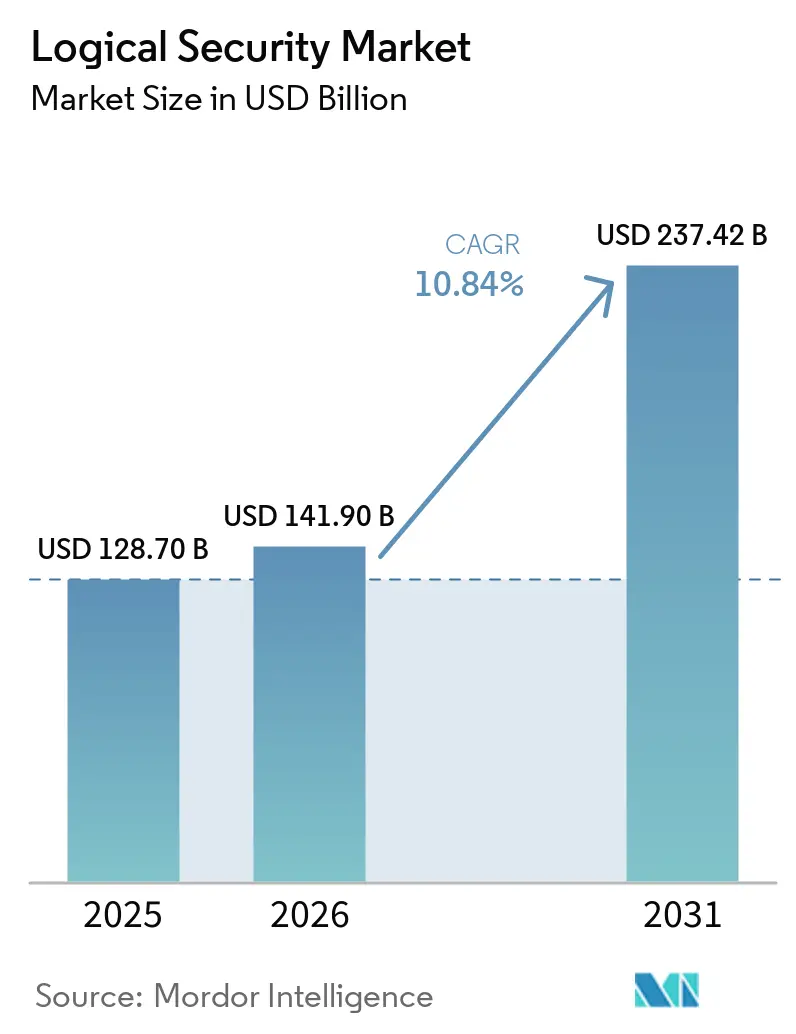
The logical security market size was valued at USD 128.70 billion in 2025 and estimated to grow from USD 141.90 billion in 2026 to reach USD 237.42 billion by 2031, at a CAGR of 10.84% during the forecast period (2026-2031). Growth reflects persistent cybercrime, wider cloud use, and compliance requirements that make security spending more necessary for many organizations across regulated and digitally connected operations. Attackers are moving faster across identity, cloud, and software-as-a-service environments, which shortens the time available for security teams to find and contain incidents. Buyers are responding by favoring managed detection, identity controls, and platforms that bring separate security functions together. The logical security market also benefits when vendors show that automated tools can improve detection and response without increasing an already strained security workforce. Competition is increasingly based on the ability to integrate network, endpoint, cloud, and identity protections in one operating model that reduces avoidable operational complexity.
Key Report Takeaways
- By solution type, Network Security Software held 25.50% share of the logical security market in 2025, while Identity and Access Management is projected to expand at a 12.11% CAGR through 2031.
- By service type, Managed Security Services and Managed Detection and Response held 61.23% of revenue in 2025 and are projected to expand at an 11.83% CAGR through 2031.
- By deployment mode, cloud-based deployment held 52.20% share of the logical security market in 2025 and is projected to expand at a 13.24% CAGR through 2031.
- By organization size, large enterprises held 66.45% of revenue in 2025, while small and medium-sized enterprises are projected to expand at a 12.15% CAGR through 2031.
- By end-user industry, BFSI held 22.32% share of the logical security market in 2025, while healthcare and life sciences are projected to expand at a 12.21% CAGR through 2031.
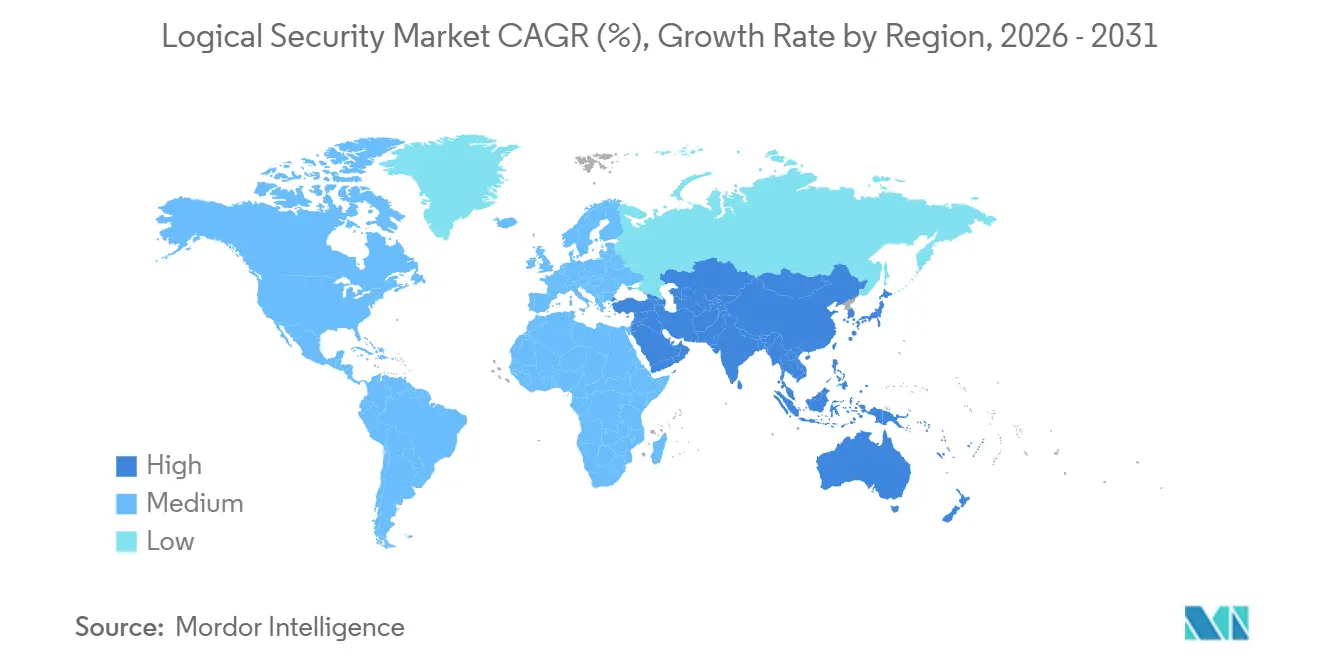
- By geography, North America held 34.80% of the logical security market in 2025, while Asia-Pacific is projected to expand at a 12.87% CAGR through 2031.
Note: Market size and forecast figures in this report are generated using Mordor Intelligence’s proprietary estimation framework, updated with the latest available data and insights as of January 2026.
Market Trends and Insights
Drivers Impact Analysis of Logical Security Market*
| DRIVER | (~) % IMPACT ON CAGR FORECAST | GEOGRAPHIC RELEVANCE | IMPACT TIMELINE |
|---|---|---|---|
| Escalating Volume and Sophistication of Cyber Threats | +2.9% | Global | Short term (≤ 2 years) |
| Rise of AI-Powered Attacks Driving Demand for AI-Powered Defenses | +2.3% | Global, with highest urgency in North America and Europe | Short term (≤ 2 years) |
| Enterprise Migration to Cloud Expanding Attack Surface | +1.8% | Global, with primary concentration in North America and Asia-Pacific | Medium term (2-4 years) |
| Increasing Regulatory Mandates for Access Controls | +1.5% | Europe, North America, and Asia-Pacific | Medium term (2-4 years) |
| Accelerating Digital Identity and Identity-Centric Security Adoption | +1.1% | Global, led by North America | Medium term (2-4 years) |
| Proliferation of Remote and Hybrid Work Models | +0.7% | Global, primarily North America and Europe | Short term (≤ 2 years) |
| Source: Mordor Intelligence | |||
Escalating Volume and Sophistication of Cyber Threats
The logical security market is supported by a threat environment that gives defenders less time to act. Rapid7 reported that highly exploitable vulnerabilities increased 105% in 2025, while the median time from public disclosure to listing in the U.S. Cybersecurity and Infrastructure Security Agency's Known Exploited Vulnerabilities catalog fell from 8.5 days to 5 days.[1] Attackers increasingly use valid credentials, session tokens, and federated access paths to resemble legitimate users rather than relying only on malware. This approach requires behavior-based monitoring across connected identity, cloud, and software-as-a-service layers, rather than inspection of network packets alone. Ransomware groups are also using automated and AI-assisted techniques to move from initial access to data theft more quickly. These conditions sustain demand for managed detection, behavioral analytics, and identity threat detection and response across the logical security market, particularly where incident response teams are small.
Rise of AI-Powered Attacks Driving Demand for AI-Powered Defenses
AI has become part of phishing, reconnaissance, malware adaptation, and social engineering activity. CrowdStrike reported that attacks by AI-enabled threat actors increased 89% in 2025.[2] Security buyers are responding by seeking platforms that can correlate endpoint, identity, and cloud data in real time across increasingly distributed enterprise environments. This has increased attention on automated investigation and containment, while human analysts remain responsible for review, escalation, and decisions involving material business risk. Microsoft reported that its multi-model agentic scanning system found 16 vulnerabilities, including 4 critical remote code execution flaws, during a single autonomous scan in May 2026. The logical security market therefore rewards providers that can show reliable response improvements rather than simply adding AI features.
Enterprise Migration to Cloud Expanding Attack Surface
Cloud adoption has changed where organizations must apply security controls. Palo Alto Networks reported that 99% of surveyed organizations experienced at least 1 attack on their AI systems in 2025, while API attacks rose 41%. Google Cloud identified weak or absent credentials as the largest cloud attack vector in its second-half 2025 report, accounting for 47.1% of incidents. These findings direct spending toward cloud identity governance and privileged access management rather than perimeter controls alone. Organizations are also investing in cloud security posture management, workload protection, secure access service edge, and controls for AI-agent access that connect these environments. The logical security market gains as buyers address software-as-a-service connections, developer tools, and AI pipelines alongside infrastructure security.
Increasing Regulatory Mandates for Access Controls
Compliance requirements create demand even when an organization has not experienced a major incident. The Digital Operational Resilience Act has applied to European Union financial entities since January 17, 2025, which increases attention to ICT third-party risk, resilience testing, and incident response. The U.S. Department of Health and Human Services proposed updates to the HIPAA Security Rule that include multifactor authentication, encryption, and stronger access controls for electronic protected health information. These requirements favor continuous monitoring and tested response capabilities instead of a checklist-only approach. ISO 27001 and SOC 2 Type II credentials are also important procurement requirements in regulated business-to-business supply chains where suppliers must demonstrate dependable security practices. The logical security market benefits when access controls become part of compliance programs across financial services, healthcare, and critical infrastructure.
Restraints Impact Analysis of Logical Security Market*
| RESTRAINT | (~) % IMPACT ON CAGR FORECAST | GEOGRAPHIC RELEVANCE | IMPACT TIMELINE |
|---|---|---|---|
| Complexity of Integrating Security Across Heterogeneous IT | -1.9% | Global | Long term (≥ 4 years) |
| Global Shortage of Cybersecurity Professionals | -1.5% | Asia-Pacific, North America, and Europe | Long term (≥ 4 years) |
| Alert Fatigue and High False Positive Rates in Security Operations | -1.0% | Global, most acute in large enterprise security operations centers | Medium term (2-4 years) |
| Budget Constraints Among Small and Medium-Sized Enterprises | -0.7% | South America, Middle East and Africa, and Asia-Pacific | Medium term (2-4 years) |
| Source: Mordor Intelligence | |||
Complexity of Integrating Logical Security Across Heterogeneous IT
Mixed on-premises, cloud, and legacy operational technology environments complicate security deployments. Many buyers must connect security tools across systems that were not designed to share policy, identity, or telemetry data. Every additional tool can add configuration dependencies and create another source of error. This can delay deployments and reduce the value of tools that work well on their own but do not fit the wider technology estate. The resulting friction favors vendors that take responsibility for integration and offer a unified control plane. It also supports platform consolidation and outcome-based service agreements within the logical security market.
Global Shortage of Cybersecurity Professionals
The workforce shortage limits many organizations' ability to operate complex security programs. The SANS Institute reported that 60% of organizations identified skills gaps as their main workforce challenge, compared with 40% that cited insufficient staffing.[3] The draft identifies a 4.8 million global gap and a 3.4 million gap in Asia-Pacific, which constrains internal security maturity and increases demand for external support. Products that need deep configuration skills can face longer sales and deployment cycles. Managed services and automated platforms can reduce this burden, but they do not eliminate the need for knowledgeable internal oversight, clear escalation paths, and accountable management. This restraint makes simple implementation and clear operating procedures important buying criteria in the logical security market.
*Our forecasts treat driver/restraint impacts as directional, not additive. The impact forecasts reflect baseline growth, mix effects, and variable interactions.
Logical Security Market Segment Analysis
By Solution Type:
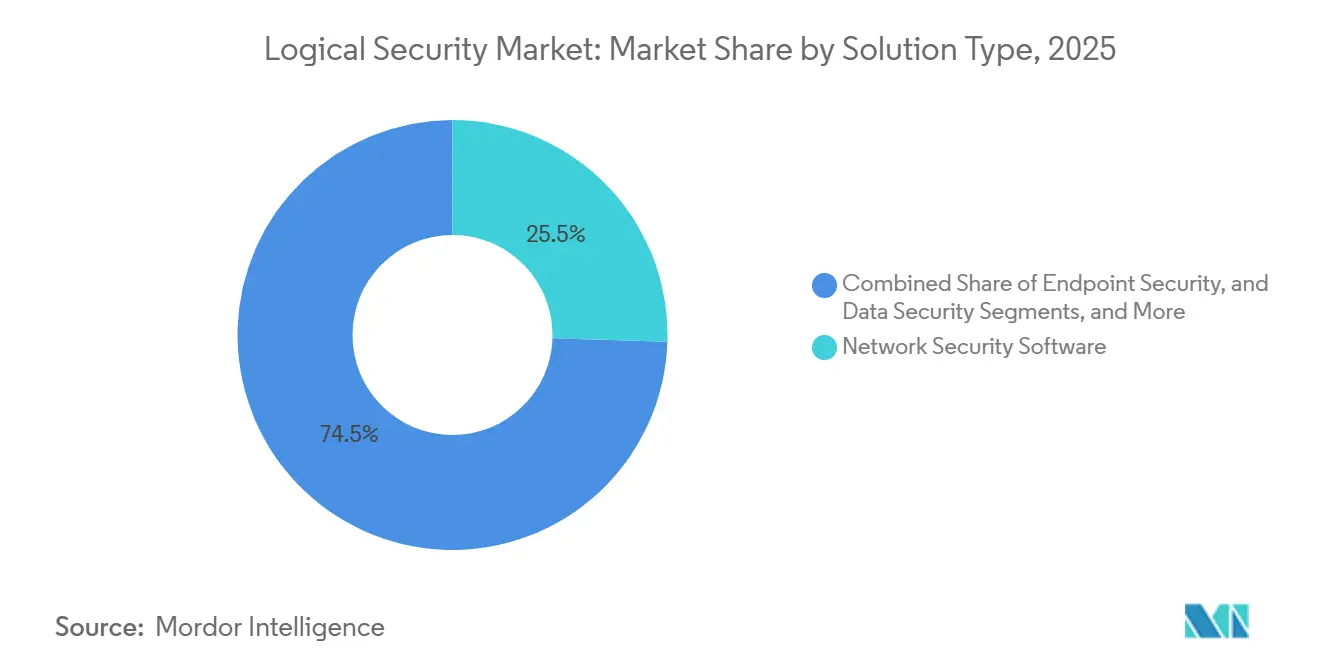
Identity Security Gains Importance Alongside Network ProtectionIdentity and Access Management is projected to expand at a 12.11% CAGR through 2031, making it the fastest-growing solution area in the logical security market. Identity is becoming a primary trust boundary as employees, devices, services, and AI agents connect across hybrid environments. Network Security Software accounted for 25.50% of segment revenue in 2025 and remains essential for firewall, secure access service edge, and network detection deployments. Endpoint Security continues to develop around extended detection and response capabilities that connect device signals with broader security operations, threat intelligence, and response workflows, while Data Security is increasingly concerned with training-data governance and the protection of sensitive information in large language model workflows. Application Security is focusing more closely on API protection because AI workloads depend on API-mediated communications.
RSA reported that 91% of respondents planned to add AI to their identity technology stack within the next year, while 93% had not reached optimal Zero Trust maturity.[4] This gap can sustain implementation programs rather than one-time identity purchases. Network Security Software retains a large installed base because hybrid organizations continue to refresh perimeter controls, and its leadership also reflects existing contracts, while identity programs are often funded as new projects. Non-human identity governance is an important area because machine accounts, service accounts, and AI agents can carry privileged access. Sophos identified non-human identities as a leading attack vector that many current identity tools were not designed to manage.

By Service Type:
Managed Security Supports Continuous OperationsManaged Security Services and Managed Detection and Response accounted for 61.23% of the logical security market share within the service type in 2025 and are projected to expand at an 11.83% CAGR through 2031. The combination of scale and growth shows that many organizations in the logical security market prefer external 24/7 monitoring over building and staffing a full internal security operations center. Managed providers can spread specialist skills, threat intelligence, and automation investments across multiple customers, which is particularly important when the internal team is small or lacks advanced response capabilities. Professional Services remain necessary for platform migrations, regulatory readiness work, incident recovery, and security program design, especially when a buyer needs customized advice or a complex deployment plan.
The service model is changing as providers combine automated investigation with human review. Providers that can contain routine threats quickly and escalate higher-risk cases to analysts can stand apart from legacy managed firewall services. Zscaler's 2025 agreement to acquire Red Canary showed a move to combine cloud security data with managed detection and response capabilities.[5] The logical security market is also moving toward broader exposure management and cloud protection within managed offerings. Buyers are likely to compare providers on integration, response accountability, and the clarity of their service-level commitments. This model can reduce internal workload, but customers still need governance over access rights, data handling, and incident decisions.
By Deployment Mode:
Cloud Use Expands While Hybrid Operations Remain NecessaryCloud-based deployment accounted for 52.20% of segment revenue in 2025 and is projected to grow at a 13.24% CAGR through 2031. The logical security market size for cloud deployment is supported by subscriptions for secure access service edge, cloud-native application protection, and cloud-delivered security information and event management. Many security budgets now favor cloud-delivered tools at the network edge and centralized detection and response services, reducing reliance on separate hardware appliances and giving teams faster access to updated controls. Cloud platforms can apply more consistent policies across distributed users and workloads, but cloud environments still need strong operational controls, access governance, and visibility across changing workloads.
Trend Micro found that 58% of surveyed security teams cited malware and ransomware as a major cloud threat in 2025, compared with 38% in 2024. On-premises deployments remain relevant in defense, financial services, and critical infrastructure, where sovereignty rules, air-gap needs, and supervisory expectations limit full cloud migration. Hybrid environments are growing because most organizations will run mixed infrastructure for years. Vendors that provide a single policy framework across on-premises, private cloud, and hyperscale environments have a clear advantage. Fragmented tools can leave policy gaps and increase the chance of misconfiguration. ISO 27017 and SOC 2 Type II requirements can further shape architecture choices for multinational buyers.
By Organization Size:
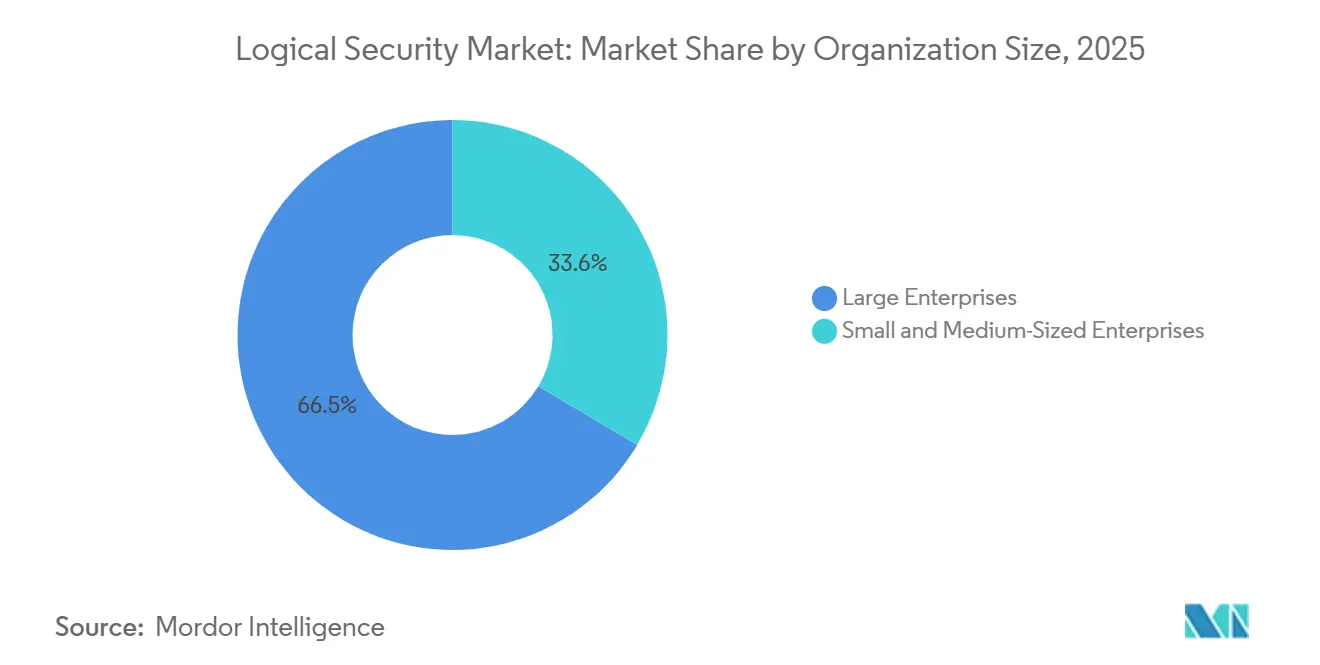
Managed Services Broaden Access for Smaller BuyersLarge enterprises held 66.45% of segment revenue in 2025 because they have larger security budgets, internal operations teams, and established vendor relationships. Small and medium-sized enterprises are projected to expand at a 12.15% CAGR through 2031. Their growth is mainly linked to managed services rather than direct purchases of complex products. Smaller buyers often need enterprise-grade protection that is affordable and simple to operate, and subscription pricing can make advanced monitoring more accessible to firms that cannot fund large internal operations teams. This creates an opportunity within the logical security market for providers that reduce configuration and staffing requirements.
CrowdStrike reported that 67% of surveyed small and medium-sized businesses identified affordability as the main selection criterion, while only 6.5% considered their security budget sufficient. Two-thirds said cost prevented them from upgrading security tools. These findings explain why a fully self-managed model is difficult for many smaller organizations, which also form part of the supply chain for larger enterprises and can become a route into larger networks. Supply-chain requirements under NIS2 can make adequate security a condition for retaining business relationships. Hiscox reported that 94% of surveyed small businesses planned to increase cybersecurity and data protection spending, with 81% citing compliance as a reason.
By End-User Industry:
Financial Services Leads While Healthcare Grows FasterBFSI held 22.32% of end-user revenue in 2025, representing the largest logical security market share among the listed verticals. Financial institutions face requirements related to operational resilience, third-party risk, continuous monitoring, and documented response plans. These obligations make security programs a central part of their technology and risk management processes, rather than a separate administrative function. The Digital Operational Resilience Act has further increased attention to testing and oversight of ICT providers among European financial entities. Banks also need to protect high-value transactions, customer data, and digital channels from fraud and account takeover, supporting demand for identity, network, data, and managed security capabilities.
Healthcare and life sciences are projected to expand at a 12.21% CAGR through 2031. The proposed changes to the HIPAA Security Rule would strengthen requirements for multifactor authentication, encryption, vulnerability management, and asset inventories. Medical records, connected clinical systems, and research data are high-value targets for ransomware groups. Government and defense organizations are advancing Zero Trust programs under formal mandates, while IT and telecom providers are protecting 5G core networks and cloud services and manufacturers are addressing linked IT and operational technology risks. Retail, e-commerce, energy, and utilities also require application security, fraud controls, and protections against infrastructure disruption.
Geography Analysis
North America Logical Security Market
North America held 34.80% of the logical security market in 2025. The region has a mature buying environment supported by concentrated demand for technology, federal procurement programs, and a developed vendor base. The United States provides most regional revenue, while Canada and Mexico have growing needs in financial services and critical infrastructure, and FedRAMP and the Cybersecurity Maturity Model Certification support structured procurement in government-related environments. North American buyers also face pressure to protect large cloud estates, extensive digital supply chains, and remote workforces that use many external applications.
EMEA Logical Security Market
Europe is shaped by overlapping requirements from NIS2, the Digital Operational Resilience Act, and the Cyber Resilience Act. These frameworks place security obligations on essential sectors, financial entities, and connected-product manufacturers. Different national implementation timelines can create compliance complexity for organizations that operate in more than 1 country. This drives demand for continuous monitoring, access control, testing, and incident reporting tools as the United Kingdom, France, Italy, and Spain advance at different stages of national implementation. The Middle East and Africa remain important growth areas as Saudi Arabia and the United Arab Emirates invest in digital infrastructure and cybersecurity capabilities. Africa has lower penetration but can gain demand as financial inclusion expands digital services, online payments, and connected public and private infrastructure.
APAC Logical Security Market
Asia-Pacific is projected to expand at a 12.87% CAGR through 2031, the fastest regional rate in the logical security market. The 3.4 million cybersecurity workforce gap identified in the draft makes managed services especially relevant across the region. Microsoft committed USD 10 billion to Japan for 2026-2029, including AI infrastructure, threat intelligence sharing, and security workforce training.[6] Japan is strengthening cyber defense policy, while India, South Korea, and ASEAN countries are adopting cloud-native platforms that can avoid some legacy replacement needs found in mature markets. Regional cybersecurity mandates and wider 5G use add to the need for identity, cloud, and network security controls across governments, enterprises, and service providers.
Competitive Landscape
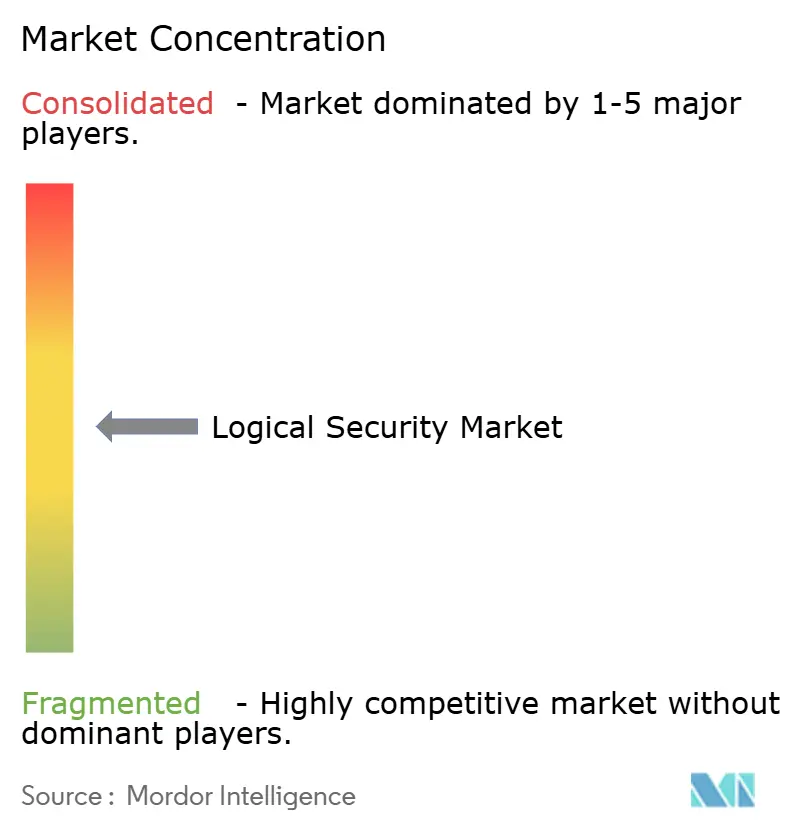
The logical security market has moderate concentration among leading vendors and remains open to focused providers, while thousands of specialized providers compete for niche needs, regional requirements, and specialized capabilities. The main competitive pattern in 2025 and 2026 was platformization, with vendors bringing endpoint, network, cloud, and identity functions into fewer commercial relationships. Palo Alto Networks completed its USD 25 billion acquisition of CyberArk in February 2026, adding identity security to its broader platform. This strategy addresses buyers' concerns about managing too many tools, overlapping alerts, and integration points that can slow security operations, while making identity governance more central to platform competition.
CrowdStrike announced the acquisition of SGNL for USD 740 million in January 2026 to add continuous authorization for human, non-human, and AI identities. The company also announced an agreement to acquire Seraphic Security for browser runtime protection. Zscaler completed its acquisition of SquareX in February 2026, extending browser-level protection across managed and unmanaged devices. These moves show how major vendors are expanding into adjacent security layers rather than relying on a single product area, while non-human identity governance and open-source software supply chain security remain areas for differentiation as AI agents and dependencies become more common. IBM, Red Hat, and Palo Alto Networks expanded Project Lightwell in June 2026 to address software vulnerability response across open-source, commercial, operational technology, and healthcare systems.
AI-specific capability is another important point of competition in the logical security market. Providers are seeking to improve detection and remediation through multi-model tools rather than adding AI to older rule-based products without changing their underlying operating model. Microsoft introduced Project Perception in July 2026 as a multi-model framework for vulnerability discovery and remediation. Vendors with FedRAMP authorization, FIPS 140-2 validation, or Common Criteria certification can have an advantage in government and regulated financial services procurement because these credentials take time to obtain.
Logical Security Industry Leaders
-
Microsoft Corporation
-
IBM Corporation
-
Palo Alto Networks, Inc.
-
CrowdStrike Holdings, Inc.
-
Cisco Systems, Inc.
- *Disclaimer: Major Players sorted in no particular order
Logical Security Market Companies Covered in this Report
- Microsoft Corporation
- IBM Corporation
- Palo Alto Networks, Inc.
- CrowdStrike Holdings, Inc.
- Cisco Systems, Inc.
- Fortinet, Inc.
- CyberArk Software Ltd.
- Okta, Inc.
- Broadcom Inc. (includes Symantec Enterprise Security business)
- SailPoint, Inc. (official company name since the 2022 privatization)
- Trend Micro Incorporated
- Check Point Software Technologies Ltd.
- Trellix, Inc. (formed from the merger of McAfee Enterprise and FireEye)
- Zscaler, Inc.
- Sophos Ltd. (operating under Thoma Bravo ownership)
- SentinelOne, Inc.
- Proofpoint, Inc. (operating under Thoma Bravo ownership)
- Cloudflare, Inc.
- RSA Security LLC
- Rapid7, Inc.
Recent Industry Developments in Logical Security Market
- June 2026: IBM, Red Hat, and Palo Alto Networks expanded Project Lightwell, a cybersecurity initiative backed by a USD 5 billion commitment from IBM and Red Hat, integrating Palo Alto Networks' virtual patching with open-source software remediation to reduce enterprise exposure to emerging vulnerabilities across open-source, commercial, operational technology, and healthcare technologies.
- June 2026: IBM joined the OpenAI Daybreak Cyber Partner Program, launching an AI-powered application security service that leverages OpenAI's frontier models to identify and validate software vulnerabilities with greater speed and precision, as part of IBM's broader USD 5 billion Project Lightwell initiative.
- June 2026: Zscaler introduced the ZAgent Framework at Zenith Live Las Vegas, enabling agentic AI administration for its Zero Trust SASE platform, including autonomous root cause analysis, policy drift detection, and automated security policy validation to reduce security operations center overhead.
- April 2026: Microsoft announced its largest-ever investment in Australia, AUD 25 billion (USD 18 billion) by end-2029, covering AI supercomputing infrastructure, expansion of the Microsoft-ASD Cyber-Shield to additional government agencies, and national cyber defense capability development.
Global Logical Security Market Report Scope
The logical security market encompasses technologies, software, and services that protect an organization’s digital assets, including IT systems, networks, applications, databases, cloud environments, and sensitive data, from unauthorized access, cyberattacks, data breaches, and misuse. It includes solutions such as identity and access management, multi-factor authentication, encryption, firewalls, endpoint protection, intrusion detection and prevention systems, security information and event management, and security monitoring services. These solutions enable organizations to establish access controls, detect and respond to security threats, protect confidential information, maintain business continuity, and comply with cybersecurity and data protection regulations. The market serves enterprises, government agencies, and critical infrastructure operators seeking to strengthen their cybersecurity posture and safeguard digital operations.
The Logical Security Market Report is Segmented by Solution Type (Identity and Access Management (IAM), Network Security Software, Endpoint Security, Data Security, and Application Security), Service Type (Professional Services, and Managed Security Services (MSS / MDR)), Deployment Mode (On-Premise, Cloud-Based, and Hybrid), Organization Size (Large Enterprises, and Small and Medium-Sized Enterprises), End-User Industry (Banking, Financial Services and Insurance (BFSI), Healthcare and Life Sciences, Government and Defense, IT and Telecom, Retail and E-Commerce, Industrial Manufacturing, Energy and Utilities, and Other End-User Industries), and Geography (North America, South America, Europe, Asia-Pacific, and Middle East and Africa). The Market Sizes and Forecasts are Provided in Terms of Value in (USD).
Segmentation Overview
| Identity and Access Management (IAM) |
| Network Security Software |
| Endpoint Security |
| Data Security |
| Application Security |
| Professional Services |
| Managed Security Services (MSS / MDR) |
| On-Premise |
| Cloud-Based |
| Hybrid |
| Large Enterprises |
| Small and Medium-Sized Enterprises |
| Banking, Financial Services and Insurance (BFSI) |
| Healthcare and Life Sciences |
| Government and Defense |
| IT and Telecom |
| Retail and E-Commerce |
| Industrial Manufacturing |
| Energy and Utilities |
| Other End-User Industries |
| North America | United States | |
| Canada | ||
| Mexico | ||
| South America | Brazil | |
| Argentina | ||
| Rest of South America | ||
| Europe | Germany | |
| United Kingdom | ||
| France | ||
| Italy | ||
| Spain | ||
| Rest of Europe | ||
| Asia-Pacific | China | |
| Japan | ||
| India | ||
| South Korea | ||
| ASEAN | ||
| Rest of Asia-Pacific | ||
| Middle East and Africa | Middle East | Saudi Arabia |
| United Arab Emirates | ||
| Turkey | ||
| Rest of the Middle East | ||
| Africa | South Africa | |
| Nigeria | ||
| Rest of Africa | ||
| By Solution Type | Identity and Access Management (IAM) | ||
| Network Security Software | |||
| Endpoint Security | |||
| Data Security | |||
| Application Security | |||
| By Service Type | Professional Services | ||
| Managed Security Services (MSS / MDR) | |||
| By Deployment Mode | On-Premise | ||
| Cloud-Based | |||
| Hybrid | |||
| By Organization Size | Large Enterprises | ||
| Small and Medium-Sized Enterprises | |||
| By End-User Industry | Banking, Financial Services and Insurance (BFSI) | ||
| Healthcare and Life Sciences | |||
| Government and Defense | |||
| IT and Telecom | |||
| Retail and E-Commerce | |||
| Industrial Manufacturing | |||
| Energy and Utilities | |||
| Other End-User Industries | |||
| By Geography | North America | United States | |
| Canada | |||
| Mexico | |||
| South America | Brazil | ||
| Argentina | |||
| Rest of South America | |||
| Europe | Germany | ||
| United Kingdom | |||
| France | |||
| Italy | |||
| Spain | |||
| Rest of Europe | |||
| Asia-Pacific | China | ||
| Japan | |||
| India | |||
| South Korea | |||
| ASEAN | |||
| Rest of Asia-Pacific | |||
| Middle East and Africa | Middle East | Saudi Arabia | |
| United Arab Emirates | |||
| Turkey | |||
| Rest of the Middle East | |||
| Africa | South Africa | ||
| Nigeria | |||
| Rest of Africa | |||
Key Questions Answered in the Report
What is the logical security market size?
The logical security market size was valued at USD 128.70 billion in 2025 and estimated to grow from USD 141.90 billion in 2026 to reach USD 237.42 billion by 2031, at a CAGR of 10.84% during the forecast period (2026-2031).
What is driving demand for logical security solutions?
Faster cyberattacks, cloud adoption, AI-enabled threats, and tighter access-control requirements are expanding demand for security platforms and managed services.
Which logical security solution is growing fastest?
Identity and Access Management is projected to grow at a 12.11% CAGR through 2031 as identity becomes a primary control point across hybrid environments.
Why are managed security services gaining adoption?
Managed Security Services and Managed Detection and Response held 61.23% of service revenue in 2025 because organizations need continuous monitoring without building large internal teams.
Which end-user sector has the highest logical security demand?
BFSI held 22.32% of end-user revenue in 2025, supported by extensive requirements for resilience, access control, and third-party risk management.
Which region is growing fastest for logical security?
Asia-Pacific is projected to grow at a 12.87% CAGR through 2031, supported by cloud adoption, cybersecurity mandates, and a shortage of skilled professionals.