
Lithium Iron Phosphate (LFP) Battery Materials Market Size and Share
Market Overview
| Study Period | 2021 - 2031 |
|---|---|
| Market Size (2026) | USD 9.55 Billion |
| Market Size (2031) | USD 17.69 Billion |
| Growth Rate (2026 - 2031) | 13.12 % |
| Fastest Growing Market | Asia-Pacific |
| Largest Market | Asia-Pacific |
| Market Concentration | High |
Major Players *Disclaimer: Major Players sorted in no particular order Image © Mordor Intelligence. Reuse requires attribution under CC BY 4.0. | |
Lithium Iron Phosphate (LFP) Battery Materials Market Analysis by Mordor Intelligence
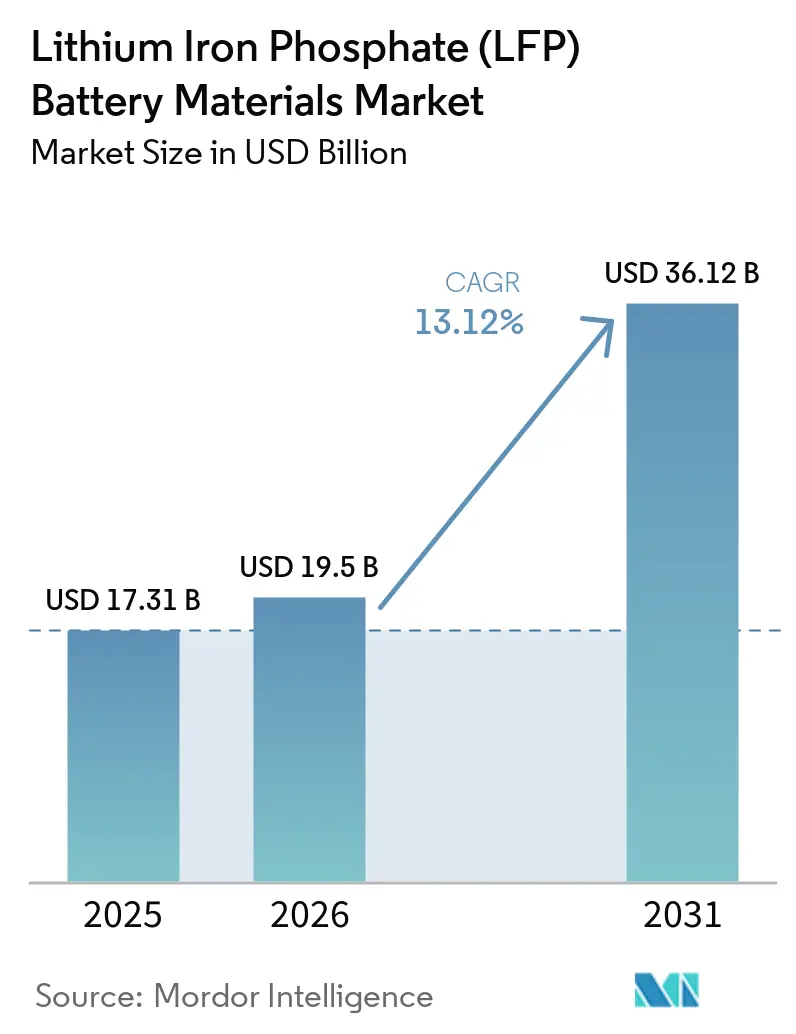
The Lithium Iron Phosphate Battery Materials Market size was valued at USD 8.45 billion in 2025 and is estimated to grow from USD 9.55 billion in 2026 to reach USD 17.69 billion by 2031, at a CAGR of 13.12% during the forecast period (2026-2031). The Lithium Iron Phosphate (LFP) battery materials market is driven by demand from electric vehicles and stationary energy storage applications, which utilize this chemistry for its thermal stability, long cycle life, and cobalt-free composition. Production scale in Asia-Pacific continues to shape material availability, cell manufacturing, and pricing across the LFP battery materials market, as established production networks link phosphate and lithium processing, cathode production, and cell manufacturing, and are supported by strong local demand in ways that are difficult for new regional supply chains to replicate quickly. Manufacturers are moving beyond standard products toward high-compaction LFP and Lithium Manganese Iron Phosphate (LMFP) materials that enable higher cell energy density, giving suppliers a way to compete on product capabilities as standard-grade capacity faces greater price pressure and lower processing fees. Supply-chain localization in North America and Europe is creating opportunities for licensed technology, joint ventures, and local processing capacity, while regulatory requirements are making supply-chain documentation and carbon-footprint data increasingly important alongside direct material cost and capacity availability. Lithium carbonate price movements and qualification requirements remain significant constraints on the LFP battery materials market, as they affect processor margins and the pace at which new suppliers can enter the market, particularly when a producer must finance new capacity while demonstrating that its material meets the consistent quality requirements of cell manufacturers.
Key Report Takeaways
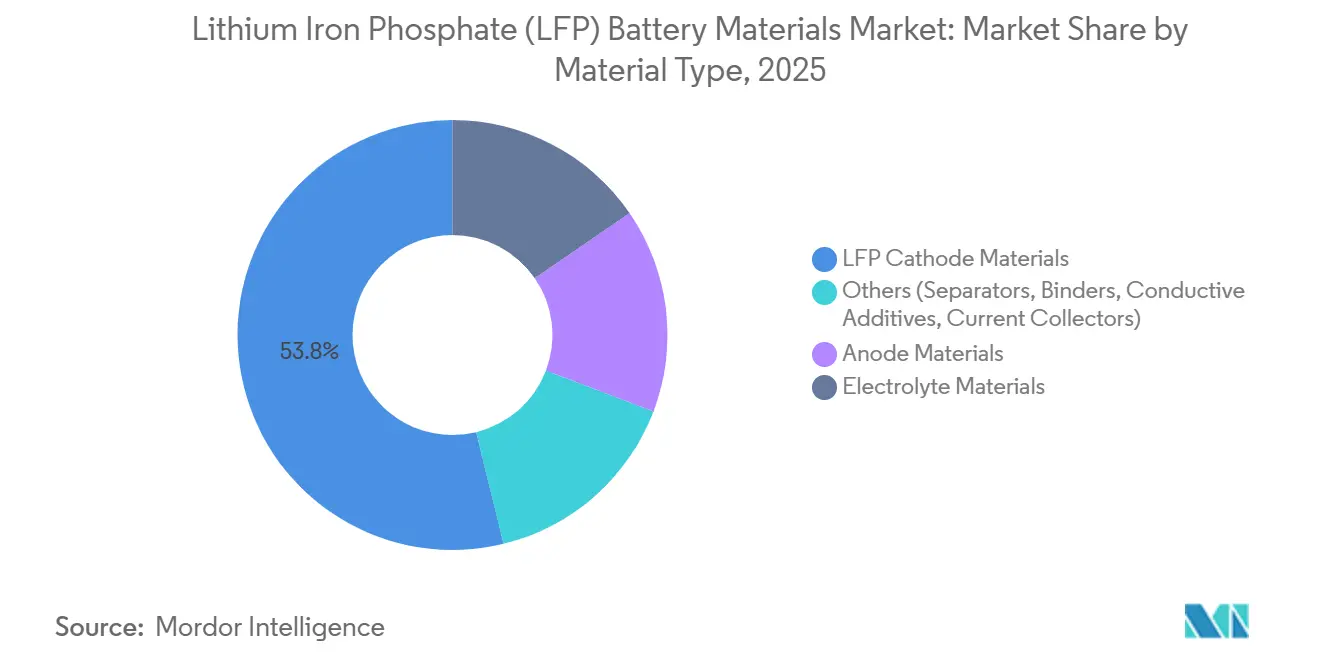
- By material type, LFP cathode materials held 53.82% of the Lithium Iron Phosphate (LFP) battery materials market share in 2025, while anode materials are forecast to grow at a 14.42% CAGR through 2031.
- By cell format, prismatic cells held 62.45% of revenue in 2025, while cylindrical cells are forecast to grow at a 13.78% CAGR through 2031.
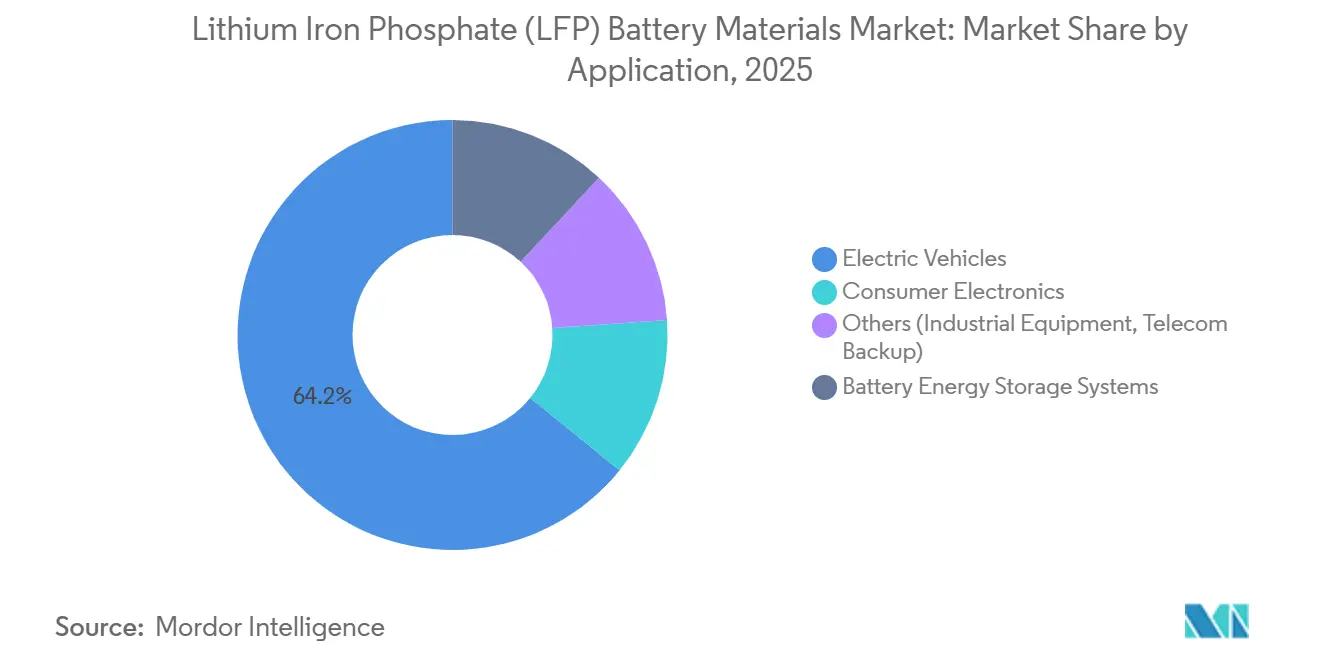
- By application, electric vehicles held 64.16% of revenue in 2025, while Battery Energy Storage System (BESS) is forecast to grow at a 14.86% CAGR through 2031.
- By geography, Asia-Pacific held 46.63% of revenue in 2025 and is forecast to grow at a 14.07% CAGR through 2031.
Note: Market size and forecast figures in this report are generated using Mordor Intelligence’s proprietary estimation framework, updated with the latest available data and insights as of January 2026.
Global Lithium Iron Phosphate (LFP) Battery Materials Market Trends and Insights
Drivers Impact Analysis*
| Drivers | (~) % Impact on CAGR Forecast | Geographic Relevance | Impact Timeline |
|---|---|---|---|
| EV and stationary storage adoption | +3.2% | Global: China, North America, and the EU as core demand centers | Medium term (2-4 years) |
| Lower cost and cobalt-free chemistry | +2.1% | Global, particularly cost-sensitive APAC and emerging markets | Short term (≤2 years) |
| Cell-to-pack and high-compaction design gains | +1.6% | China-led, spillover to the EU and North America | Short term (≤2 years) |
| Regional battery supply-chain localization | +1.8% | North America and Europe primarily | Long term (≥4 years) |
| Long-term procurement and capacity reservation agreements | +1.2% | Global, with EU and North America OEMs driving | Medium term (2-4 years) |
| LFP-to-Lithium Manganese Iron Phosphate (LMFP) upgrade path | +0.9% | China-led, spillover to Europe and APAC | Long term (≥4 years) |
| Source: Mordor Intelligence | |||
EV and Stationary Storage Adoption
Electric vehicles and stationary storage represent the two main demand channels for the lithium iron phosphate (LFP) battery materials market. LFP supplied close to half of global electric-car battery demand, up from less than 10% in 2020, reflecting its wider use in standard-range vehicles and storage systems. The chemistry offers thermal stability and a cycle life exceeding 3,000 charge-discharge events, supporting both transport and stationary applications with different operating needs. This allows producers to serve applications with distinct charging patterns from a common material platform.
This combination broadens the demand base for LFP battery materials across mobility, grid balancing, and backup power. Producers can balance exposure to vehicle programs with demand from stationary systems, where purchasing decisions are often shaped by long-duration operating requirements rather than vehicle range. The resulting mix does not eliminate cyclicality, but it provides the materials base with more than one substantial route to growth. It also reduces reliance on a single end-use cycle, even though vehicle and storage investment patterns can influence material purchasing, as both customer groups remain sensitive to financing conditions, policy support, and the availability of reliable manufacturing capacity.
Lower Cost and Cobalt-Free Chemistry
The absence of cobalt and nickel remains a central cost and sourcing advantage for LFP chemistry. Iron and phosphate are more widely available feedstocks than the metals used in nickel-manganese-cobalt chemistries. This composition reduces exposure to several metal supply chains and the scrutiny associated with cobalt sourcing, a consideration for buyers that assess raw-material availability alongside the technical properties of the finished cell. The LFP battery materials market benefits when automakers and storage developers seek simpler raw-material procurement.
Material cost movements depend strongly on lithium carbonate and phosphate prices, so the chemistry does not eliminate price risk, particularly for cathode processors whose pricing arrangements may not adjust immediately when inputs become more expensive. It can, however, simplify long-term contracting in the LFP battery materials market for downstream buyers, as fewer metal inputs must be managed simultaneously.
Cell-to-Pack and High-Compaction Design Gains
Cell-to-pack architecture removes the module layer and places cells directly within the pack structure. This design recovers 15-20% of the space previously used by module housing, wiring, and cooling hardware, allowing pack designers to improve space utilization without requiring a fundamental change to LFP chemistry. CATL, BYD, and Gotion High-Tech have entered mass production of fifth-generation LFP cells in 2026. These cells use compaction densities of at least 2.70 g/cm³ and cell-level energy densities of 205 Wh/kg.
Higher compaction enables greater material use per kilowatt-hour while improving cell performance, shifting the competitive focus from basic supply to the quality, density, and consistency of materials used in advanced cells. The LFP battery materials market also benefits from the development of lithium manganese iron phosphate (LMFP), which uses manganese to increase voltage and extend the chemistry toward longer-range vehicles and longer-duration storage.
Regional Battery Supply-Chain Localization
LFP cathode output remains heavily concentrated in China, prompting North American and European efforts to build alternative supply chains. The Inflation Reduction Act (IRA) expanded US cathode active material projects by 263% and anode active material pipeline capacity by 368% through 2030, compared with the pre-IRA baseline[1]. The EU Battery Regulation is encouraging local production through supply-chain due diligence and carbon-footprint disclosure requirements.
These policies provide a basis for technology licensing and joint ventures in the LFP battery materials market, especially where local producers require established process knowledge to meet automotive and storage customer specifications. New Western capacity remains dependent on process consistency, qualified equipment, and dependable upstream inputs, since announced capacity alone does not ensure that a producer can supply automotive or energy-storage customers at the required quality level.
Restraints Impact Analysis*
| Restraints | (~) % Impact on CAGR Forecast | Geographic Relevance | Impact Timeline |
|---|---|---|---|
| Lower gravimetric energy density in premium mobility | –1.8% | Global, particularly Europe and North America, premium Electric Vehicle (EV) segments | Medium term (2-4 years) |
| Lithium chemical price and margin volatility | –1.4% | Global; concentrated in China, where LFP processing occurs | Short term (≤2 years) |
| China-centric processing and trade-policy exposure | –1.2% | North America and Europe | Long term (≥4 years) |
| Qualification cycles and process consistency risk | –0.7% | Global | Medium term (2-4 years) |
| Source: Mordor Intelligence | |||
Lower Gravimetric Energy Density in Premium Mobility
Standard LFP cells deliver 160-170 Wh/kg at the cell level, compared with 250-280 Wh/kg for nickel-rich Nickel Manganese Cobalt (NMC) alternatives. This difference limits use in long-range passenger vehicles and in applications where weight per kilowatt-hour is a critical design factor, as a lower-energy-density cell may require more pack space or additional cell mass to achieve the same vehicle range. Premium European and North American vehicle programs have therefore continued to use NMC for high-specification models. LMFP offers a possible response, as manganese substitution can increase energy density to 200 Wh/kg. However, LMFP carries a 12-17% cost premium over standard LFP, which delays wider adoption. The LFP battery materials market will remain less exposed to premium mobility until LMFP reaches more competitive cost levels, even as the higher-voltage material provides a practical route to improve performance without abandoning the established phosphate-based chemistry.
Lithium Chemical Price and Margin Volatility
Lithium carbonate is the main lithium feedstock in the LFP battery materials market for LFP cathode synthesis, so abrupt price changes can affect cathode processor margins. Battery-grade lithium carbonate prices rose in 2025. This increase was difficult for processors to pass through, as processing fees had already fallen below break-even levels in 2025, leaving limited room to absorb a feedstock cost increase, with customer contracts and competing capacity constraining selling prices. Margin pressure was particularly acute for smaller producers selling standard LFP products. Better-capitalized suppliers responded by focusing on fourth- and fifth-generation high-compaction materials, where fees and margins were higher. This pattern can create supply constraints at the premium end while standard-grade capacity remains more readily available, dividing the market between advanced grades with stronger economics and commodity products that face greater competition on processing fees.
*Our forecasts treat driver/restraint impacts as directional, not additive. The impact forecasts reflect baseline growth, mix effects, and variable interactions.
Segment Analysis
By Material Type: Cathode Anchors Revenue, Anode Posts Fastest Expansion
LFP cathode materials held the largest revenue share at 53.82% in 2025. Each gigawatt-hour of LFP cell production requires 1,600-1,800 tons of LFP cathode powder, keeping cathode material demand closely tied to growth in vehicle and storage cell output. Each increase in LFP deployment translates directly into powder demand, rather than flowing through a separate downstream consumption category. Electrolyte materials accounted for the second-largest revenue share, supported by simultaneous expansion in vehicle and stationary storage cell production and by their essential role in enabling charge transfer within the cell. Separators, binders, conductive additives, and current collectors comprised the remaining materials category. These products grow with cell output, although their margins are often lower and more standardized than those of cathode or electrolyte materials, making their revenue contribution less dependent on premium chemistry specifications and more closely tied to overall cell production output.
Anode materials are forecast to grow at a 14.42% CAGR through 2031, the highest rate among material types. The LFP battery materials market for anodes benefits from demand for silicon-carbon composite products and high-compaction artificial graphite. These materials support fifth-generation cells that target higher energy density and faster charging performance, while higher-compaction designs increase the value of anode quality as cell makers pursue improved charging behavior and more efficient pack use. BTR New Energy Materials Co., Ltd (BTR) introduced its T-Max and T-Pro 6C ultra-fast-charging graphite anode series in March 2026.

By Cell Format: Prismatic Cells Lead Revenue, Cylindrical Challenges at the Margins
Prismatic cells accounted for 62.45% of revenue in 2025, owing to their compatibility with the cell-to-pack architecture. The LFP battery materials market benefits when this format is used with long-form blade designs for vehicle and stationary storage packs, as the shape supports direct pack integration and reduces the amount of non-cell material surrounding individual cells. Structural integration reduces unused space and improves volumetric energy density without altering the cathode chemistry, enabling manufacturers to enhance pack-level performance even when the underlying material retains LFP's established operating characteristics. This makes prismatic cells suitable for mainstream vehicle platforms that prioritize cost and packaging efficiency, as well as storage installations that value repeatable layouts and effective use of rack or container space. Pouch cells remain relevant when low dead weight and form-factor flexibility are important. LG Energy Solution has commercialized a pouch-type cell-to-pack process that it states provides 5% higher gravimetric energy density than prismatic cell-to-pack designs.
Cylindrical cells are forecast to expand at a 13.78% CAGR through 2031, making them the fastest-growing cell format. Standardized 46650 and 4680 designs are being validated for stationary storage as well as their established uses in power tools and consumer electronics. Automated winding supports high throughput and provides a cost advantage for large production lines, helping cylindrical formats compete when manufacturers can standardize production equipment across several high-volume applications. The LFP battery materials market is affected by these format choices because each design changes the required balance of cathode, anode, and pack materials and influences the manufacturing equipment and production methods that cell makers select. European development programs are also testing Lithium Manganese Iron Phosphate (LMFP) cells with European-sourced synthetic graphite, suggesting that cell format decisions may be tied to regional sourcing and compliance priorities.
By Application: Electric Vehicles Anchor Revenue, BESS Drives the Growth Differential
Electric vehicles accounted for 64.16% of revenue in 2025, making them the largest application segment in the LFP battery materials market. Standard-range electric vehicles benefit from the total cost-of-ownership advantages of LFP cells, particularly when automakers and fleet operators place greater value on usable cycle life and procurement simplicity than on maximum driving range. Fleet vehicles benefit from the chemistry's long cycle life, as their charging cycles can exceed 2,000 over the vehicle's operating life, making durability an important consideration for operators who prioritize predictable replacement schedules and operating costs. Western automakers have increased LFP adoption for entry and mid-range platforms. Consumer electronics, industrial equipment, and telecom backup applications make up the remaining demand base, with telecom backup benefiting from LFP's operating temperature range and float-charge tolerance in demanding deployment conditions.
Battery Energy Storage Systems (BESS) are forecast to grow at a 14.86% CAGR through 2031, the highest rate across applications. The LFP battery materials market for BESS is supported by storage systems that require long cycle life and lower C-rate operation. LFP accounted for more than 90% of new stationary storage chemistry installations in 2025, indicating that the chemistry is well suited to storage projects where safety, cycle life, and cost are more important than maximum gravimetric energy density. Storage-optimized LFP grades can offer at least 5,000 cycles at 80% depth of discharge. These grades can command a modest premium over power-grade LFP because their operating requirements differ from those of vehicle cells, with buyers placing greater weight on cycle count, calendar life, and stable performance at lower C-rates.
Geography Analysis
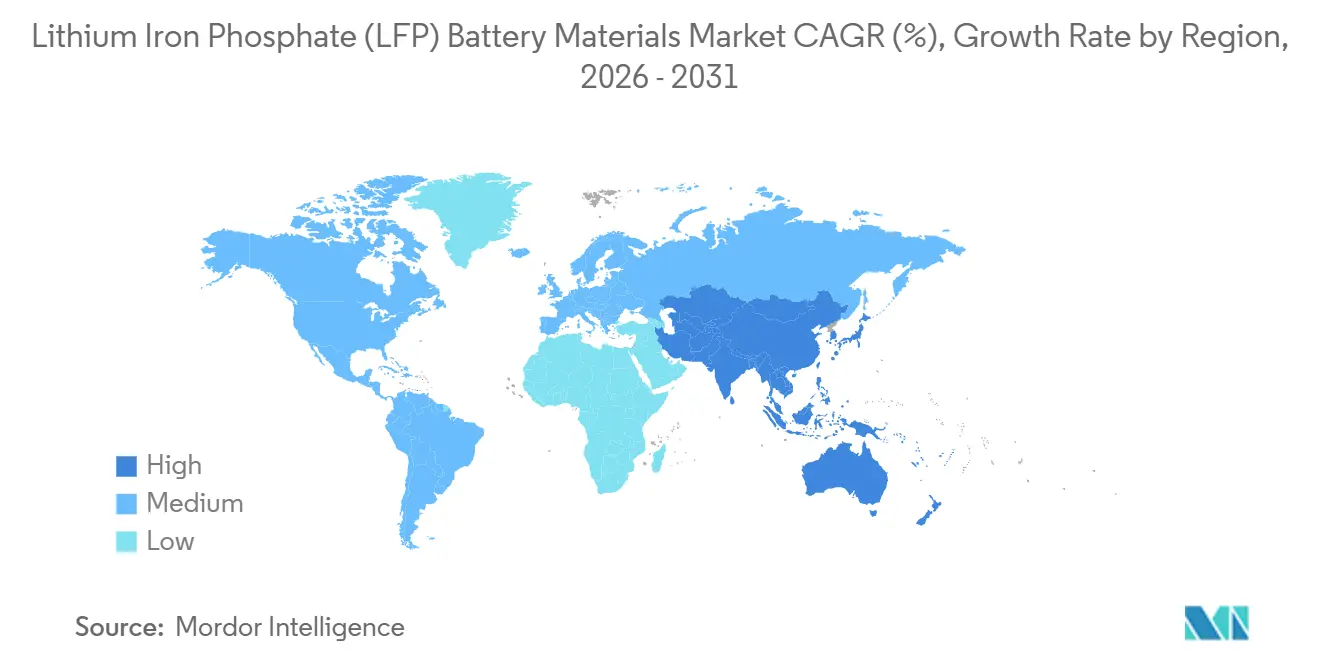
Asia-Pacific held 46.63% of global revenue in 2025 and is forecast to grow at a 14.07% CAGR through 2031. This position reflects the regional integration of materials production, cell manufacturing, and electric vehicle demand, enabling material suppliers to serve large domestic customers while benefiting from established upstream and midstream production networks. China's role in cathode and anode production anchors the Asia-Pacific LFP battery materials market, with the country producing 3.75 million tons of LFP material in 2025. India, Japan, South Korea, and ASEAN countries represent additional demand points, with their roles shaped by local cell manufacturing plans, vehicle demand, and links to broader regional supply chains. India's manufacturing plans and South Korean cell makers' qualification work connect regional suppliers with customers in North America and Europe, creating procurement links that extend Asia-Pacific's role beyond domestic demand into overseas factory supply chains.
North America and Europe together accounted for approximately one-third of global revenue. The US project pipeline has grown rapidly; however, domestic capacity covered only 47% of cathode active material demand and 23% of anode active material demand in 2025. This gap is likely to sustain import dependence for much of the forecast period, even as project announcements increase, because new materials capacity must be built, qualified, and supplied with reliable upstream inputs before it can displace established imports. LG Energy Solution entered an agreement with Tesla to supply prismatic LFP batteries for Megapack 3 from Lansing, Michigan, beginning in 2027[2]. In Europe, battery regulation requirements are strengthening the case for materials with local supply chain documentation, which can influence sourcing decisions even when imports may initially appear more competitive on direct material costs. The LFP battery materials market has therefore become more relevant to regional compliance planning, not only to cell cost.
South America, the Middle-East, and Africa remain smaller revenue contributors. Argentina and Chile are important as lithium-brine suppliers of lithium carbonate used in LFP synthesis. Brazil is emerging as a storage deployment location, particularly for renewable energy systems paired with batteries. Morocco is seeking to develop integrated battery manufacturing capacity, while Saudi Arabia is funding downstream manufacturing through Vision 2030. These regions are not expected to alter global share patterns during the forecast period, but they may become future demand nodes that support localization investments by established Asian producers, particularly as local cell manufacturing and renewable storage development create a clearer basis for regional materials consumption.
Competitive Landscape
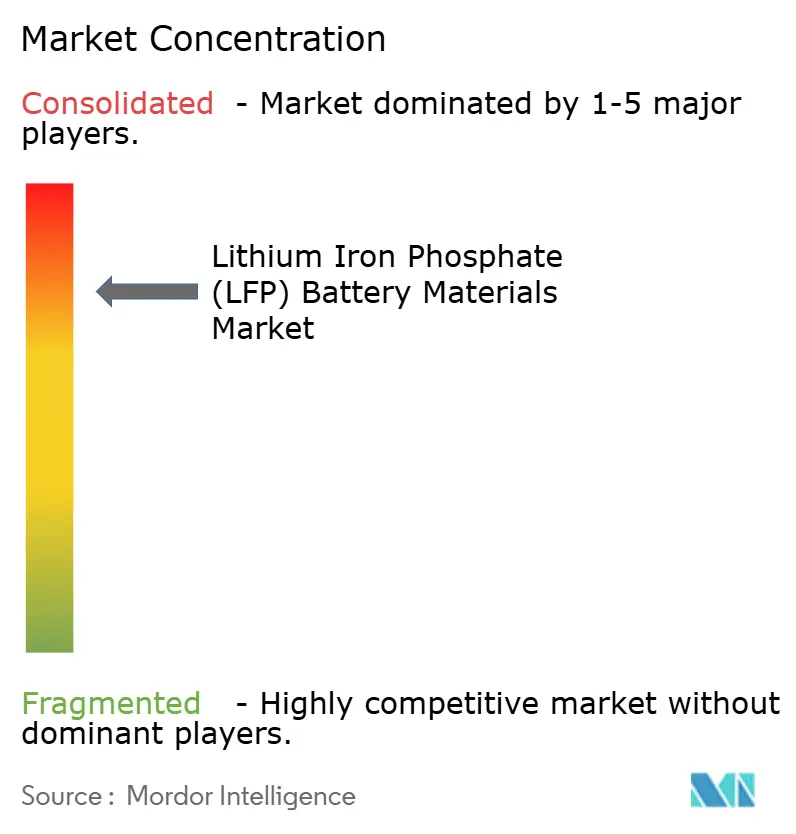
The Lithium Iron Phosphate (LFP) battery materials market is consolidated. Competition has shifted away from adding standard second- and third-generation capacity toward fourth- and fifth-generation high-compaction cathodes and Lithium Manganese Iron Phosphate (LMFP) products. These products have shorter approved supplier lists and higher processing fees than standard materials, as customers require evidence that production can consistently meet demanding specifications at a commercial scale. Early qualification of advanced products gives larger producers greater protection against the margin pressure affecting commodity suppliers, as approved relationships can support demand for products less exposed to standard-grade oversupply.
Nano One completed a Class 3 cost estimate with Worley Chemetics for its One-Pot LFP cathode technology package in June 2026. This approach could provide a technology route for non-Chinese licensees seeking regional cathode production, where access to a proven process can reduce the development burden for producers responding to local sourcing requirements. LG Energy Solution's pouch-type cell-to-pack process offers an alternative format path for higher gravimetric energy density. BTR's March 2026 launch of a fast-charging graphite anode indicates that suppliers are also competing on charging performance. The market is attracting investment in storage-specific grades that emphasize cycle count, calendar life, and system efficiency, reflecting that storage customers may evaluate materials differently from vehicle manufacturers focused on range and charging behavior. These product requirements differ from those of vehicle-grade materials.
Vertical integration is an additional competitive response to the volatility of lithium, phosphate, and iron costs. It gives producers a way to reduce procurement exposure and secure feedstock availability, which is particularly important when changes in lithium chemical prices can undermine the margins of processors that lack upstream support. Gotion's overseas factories illustrate how cell manufacturers are expanding across the materials value chain. Regional manufacturing projects can increase competition beyond cell assembly by integrating materials, cells, and recycling into a single operating model, enabling companies to align upstream inputs, technical production knowledge, and downstream customer requirements more closely. New entrants still face 12-18-month qualification cycles and must demonstrate consistent process performance, a requirement that slows customer switching and increases the value of existing technical approvals for established suppliers. These constraints favor established producers with customer approvals and technical capabilities. The market is therefore likely to retain a clear technology and scale advantage for larger suppliers, while specialized entrants will need credible technology, local supply chain positioning, and repeatable quality to secure customer business.
Lithium Iron Phosphate (LFP) Battery Materials Industry Leaders
-
Hunan Yuneng New Energy Battery Material Co., Ltd.
-
Hubei Wanrun New Energy Technology Co., Ltd.
-
Shenzhen Dynanonic Co., Ltd.
-
Guizhou Anda Energy Technology Co., Ltd.
-
Mianyang Fulin Precision Machining Co.,Ltd.
- *Disclaimer: Major Players sorted in no particular order
Recent Industry Developments
- July 2026: Hunan Yuneng announced a CNY 24 billion (~USD 3.3 billion) investment to build an integrated battery materials and recycling complex in Weng'an County, Guizhou. The project targets new LFP production capacity and covers upstream phosphate mining, LFP and iron phosphate synthesis, lithium carbonate processing, and battery recycling, with an estimated construction period of five years.
- April 2026: Ronbay New Energy Technology announced a CNY 4.3 billion (~USD 590 million) LFP cathode capacity expansion in Guizhou. The project includes 520,000 MT/year of iron phosphate precursors and 340,000 MT/year of LFP cathode output across two new facilities, aimed at addressing the high-end LFP capacity shortfall.
Global Lithium Iron Phosphate (LFP) Battery Materials Market Report Scope
Lithium iron phosphate serves as the cathode, graphite as the anode, and a lithium salt electrolyte completes the cell. This chemistry avoids the use of expensive nickel and cobalt, making it a cost-effective option for energy storage.
The lithium iron phosphate (LFP) battery materials market is segmented by material type, cell format, application, and geography. By material type, the market is segmented into LFP cathode materials, anode materials, electrolyte materials, and others (separators, binders, conductive additives, current collectors). By cell format, the market is segmented into cylindrical cells, prismatic cells, and pouch cells. By application, the market is segmented into electric vehicles, battery energy storage systems, consumer electronics, and others (industrial equipment, telecom backup). The report also covers market size and forecasts for lithium iron phosphate (LFP) battery materials across 15 countries in major regions. The market sizes and forecasts are provided in terms of value (USD).
| LFP Cathode Materials |
| Anode Materials |
| Electrolyte Materials |
| Others (Separators, Binders, Conductive Additives, Current Collectors) |
| Cylindrical Cells |
| Prismatic Cells |
| Pouch Cells |
| Electric Vehicles |
| Battery Energy Storage Systems |
| Consumer Electronics |
| Others (Industrial Equipment, Telecom Backup) |
| Asia-Pacific | China |
| India | |
| Japan | |
| South Korea | |
| ASEAN Countries | |
| Rest of Asia-Pacific | |
| North America | United States |
| Canada | |
| Mexico | |
| Europe | Germany |
| United Kingdom | |
| France | |
| Italy | |
| NORDIC Countries | |
| Rest of Europe | |
| South America | Brazil |
| Argentina | |
| Rest of South America | |
| Middle-East and Africa | Saudi Arabia |
| South Africa | |
| Rest of Middle-East and Africa |
| By Material Type | LFP Cathode Materials | |
| Anode Materials | ||
| Electrolyte Materials | ||
| Others (Separators, Binders, Conductive Additives, Current Collectors) | ||
| By Cell Format | Cylindrical Cells | |
| Prismatic Cells | ||
| Pouch Cells | ||
| By Application | Electric Vehicles | |
| Battery Energy Storage Systems | ||
| Consumer Electronics | ||
| Others (Industrial Equipment, Telecom Backup) | ||
| By Geography | Asia-Pacific | China |
| India | ||
| Japan | ||
| South Korea | ||
| ASEAN Countries | ||
| Rest of Asia-Pacific | ||
| North America | United States | |
| Canada | ||
| Mexico | ||
| Europe | Germany | |
| United Kingdom | ||
| France | ||
| Italy | ||
| NORDIC Countries | ||
| Rest of Europe | ||
| South America | Brazil | |
| Argentina | ||
| Rest of South America | ||
| Middle-East and Africa | Saudi Arabia | |
| South Africa | ||
| Rest of Middle-East and Africa | ||
Key Questions Answered in the Report
What is current market size of Lithium Iron Phosphate (LFP) Battery Materials Market?
The Lithium Iron Phosphate Battery Materials Market size was valued at USD 8.45 billion in 2025 and is estimated to grow from USD 9.55 billion in 2026 to reach USD 17.69 billion by 2031, at a CAGR of 13.12% during the forecast period (2026-2031).
Which material type leads LFP battery materials?
LFP cathode materials led with a 53.82% share of revenue in 2025, while anode materials are projected to grow at a 14.42% CAGR.
Why are electric vehicles important for LFP demand?
Electric vehicles accounted for 64.16% of revenue in 2025 and benefited from LFP's cycle life, thermal stability, and cobalt-free composition.
Which application is growing fast for LFP materials?
Battery Energy Storage System (BESS) is forecast to expand at a 14.86% CAGR through 2031, supported by demand for long-cycle stationary storage.