
Lithium-Ion Battery Handling Market Size and Share
Market Overview
| Study Period | 2022 - 2032 |
|---|---|
| Market Size (2027) | USD 1.55 Billion |
| Market Size (2032) | USD 2.79 Billion |
| Growth Rate (2027 - 2032) | 12.47 % |
| Fastest Growing Market | Asia-Pacific |
| Largest Market | Asia-Pacific |
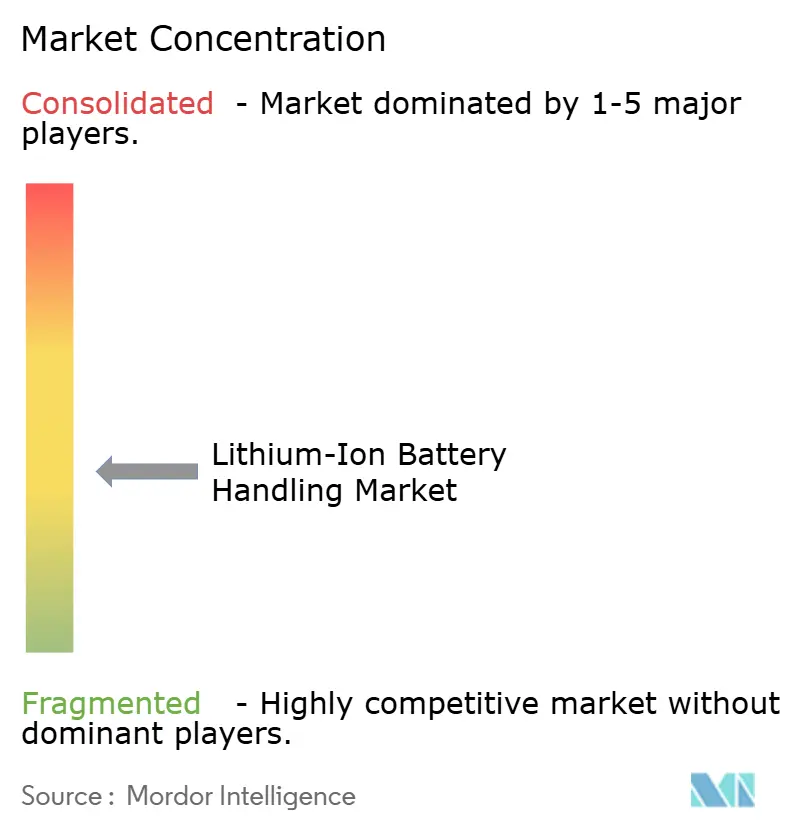
| Market Concentration | Medium |
Major Players *Disclaimer: Major Players sorted in no particular order Image © Mordor Intelligence. Reuse requires attribution under CC BY 4.0. | |
Lithium-Ion Battery Handling Market Analysis by Mordor Intelligence
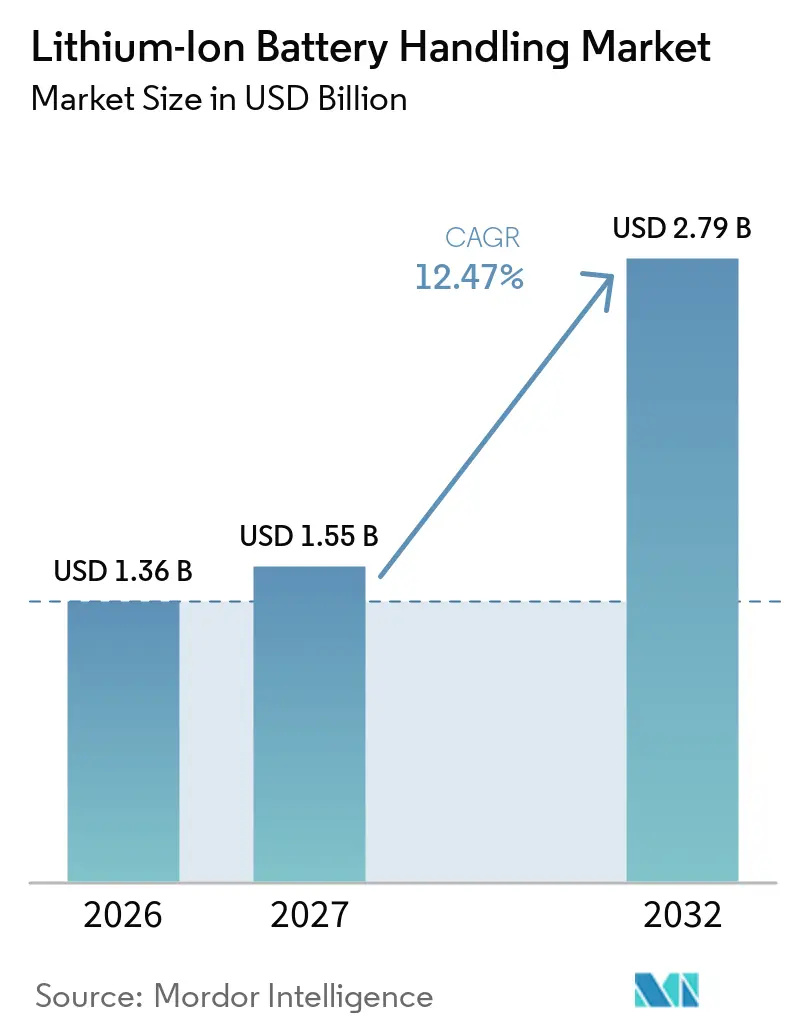
The Lithium-Ion Battery Handling Market size is projected to expand from USD 1.36 billion in 2026 and USD 1.55 billion in 2027 to USD 2.79 billion by 2032, registering a CAGR of 12.47% between 2027 and 2032. The lithium-ion battery handling market is expanding as new giga factories raise requirements for moving, sorting, storing, and tracking cells across production lines. Higher cell throughput makes handling equipment central to line use, product yield, and safety compliance. Manufacturers, pack assemblers, and recycling operators are upgrading equipment at the same time because each stage must keep pace with larger battery volumes. The lithium-ion battery handling market also benefits when suppliers provide flexible systems that support multiple cell formats and localized technical service.
Key Report Takeaways
- By handling equipment, forklifts and electric pallet trucks held 21.7% of the lithium-ion battery handling market share in 2026, while robotic handling systems are forecast to expand at a CAGR of 13.3% through 2032.
- By handling service, loading and unloading held 20.3% share in 2026, while recycling and end-of-life handling is forecast to grow at a CAGR of 13.8% through 2032.
- By automation level, semi-automated handling held 37.5% share in 2026, while fully automated handling is forecast to grow at a CAGR of 13.7% through 2032.
- By end user, battery manufacturers held 31.6% share in 2026, while battery recycling companies are forecast to grow at a CAGR of 12.9% through 2032.
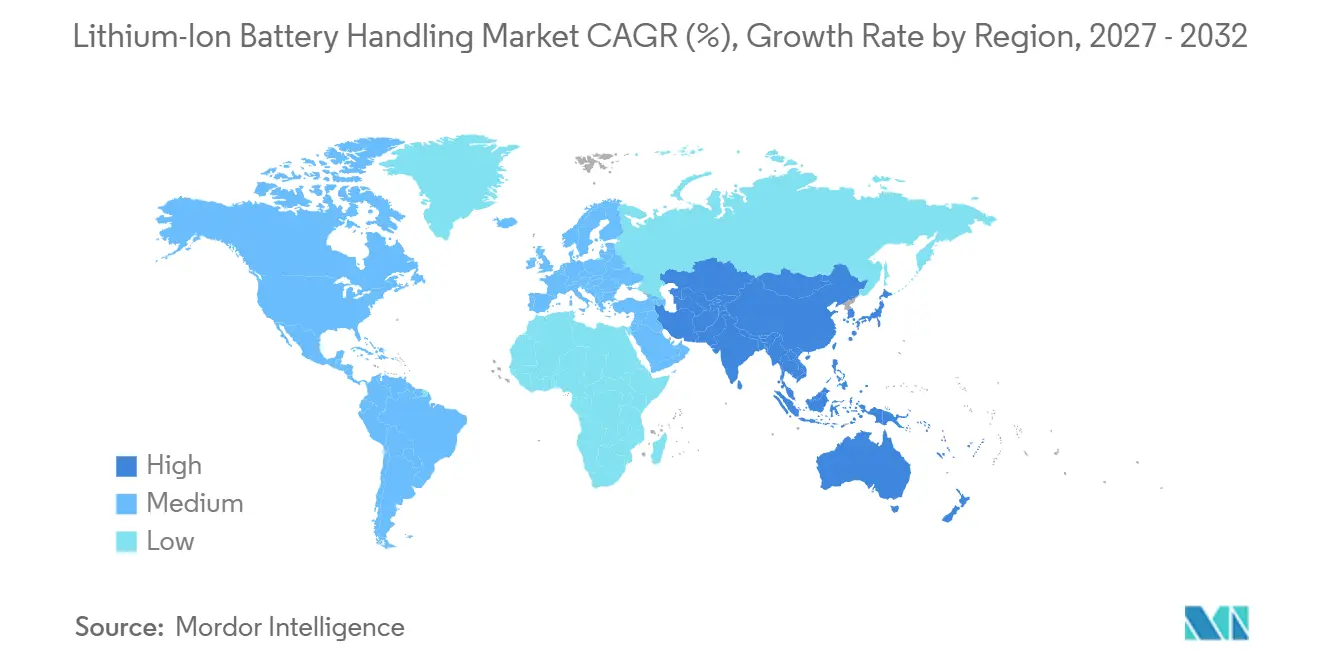
- By geography, Asia-Pacific held 54.2% of the lithium-ion battery handling market size in 2026 and is forecast to grow at a CAGR of 12.8% through 2032.
Note: Market numbers in this report are based on Mordor Intelligence's proprietary estimation framework, which combines nine months of actuals with Q4 projections for base year 2026.
Market Trends and Insights
Drivers Impact Analysis of Lithium-Ion Battery Handling Market*
| Driver | (~) % Impact on CAGR Forecast | Geographic Relevance | Impact Timeline |
|---|---|---|---|
| Electric-Vehicle and Energy-Storage Capacity Expansion | +3.2% | Global | Short term (≤ 2 years) |
| Factory Automation and Labor-Productivity Requirements | +2.8% | Global, APAC-led | Medium term (2-4 years) |
| Battery Safety, Traceability and Compliance Requirements | +1.9% | EU, China, North America | Short term (≤ 2 years) |
| Recycling, Remanufacturing and Circular-Flow Investments | +1.6% | EU, China, spill-over to South Korea | Medium term (2-4 years) |
| Dry-Room-Compatible, High-Throughput Transport Architectures | +1.2% | Global, APAC core | Medium term (2-4 years) |
| Battery Passport Data Creates a Handling-Control Layer | +0.8% | EU, with early gains in Germany and France | Long term (≥ 4 years) |
| Source: Mordor Intelligence | |||
Electric-Vehicle and Energy-Storage Capacity Expansion
Gigafactory construction is the main source of new equipment demand because every facility needs staging, transport, assembly logistics, and finished-cell warehousing. In September 2026, Volkswagen Group and Gotion High-Tech announced EUR 3.22 billion, or USD 3.66 billion, for 3 battery and cathode-material facilities in Spain, Slovakia, and Morocco, with 37.5 GWh of annual battery capacity planned. This expansion creates separate procurement requirements at each location rather than a single equipment purchase for one centralized plant. The lithium-ion battery handling market gains when manufacturers spread capacity across regions because local installation, commissioning, and maintenance become more valuable. Suppliers with regional service coverage can therefore compete for projects that have different local requirements but similar production needs.
Factory Automation and Labor-Productivity Requirements
Factory automation is changing the lithium-ion battery handling market because operators need stable material flow at higher production volumes. In April 2025, KUKA Systems commissioned a modular battery production hall for MAN Truck & Bus in Nuremberg with 35 KMP 3000P autonomous mobile robot platforms for fully automated material supply.[1] The hall has annual capacity for 50,000 battery packs and is designed to scale to 100,000 packs without a conventional conveyor belt or fixed production cycle. A 2025 iScience study found that high-level automation in battery cell production can reduce workforce requirements by up to 50%.[2] This supports demand for autonomous mobile robots and robotic handling where labor savings no longer offset the cost of manual operations.
Battery Safety, Traceability and Compliance Requirements
Safety and compliance requirements are increasing the specification level for equipment used in the lithium-ion battery handling market. China’s GB 38031-2025 standard requires traction batteries for electric vehicles not to catch fire or explode during or after thermal runaway, and it took effect for new vehicles on July 1, 2026. This requirement increases the need for damage prevention, controlled-environment transport, and isolation procedures during production, storage, and end-of-life work. The fifth edition of ANSI/CAN/UL (Underwriters Laboratories) 9540A, published in March 2025, sets test methods for evaluating thermal runaway fire propagation in battery energy storage systems.[3] These frameworks make safety-oriented handling equipment a requirement for access to important markets rather than an optional operating improvement.
Recycling, Remanufacturing and Circular-Flow Investments
Recycling is bringing new applications into the lithium-ion battery handling market because used packs arrive in many designs and conditions. Fraunhofer IWU and EDAG Production Solutions GmbH & Co. KGaA announced an AI-supported automated dismantling plant in Chemnitz, Germany, in September 2025. The plant is designed to handle active traction batteries down to cell level and use state-of-health assessment to direct parts toward reuse or recycling. Germany’s Battery Implementation Act became active in August 2025 and sets collection rates of 63% from 2027 and 73% from 2030.[4] Flexible disassembly and digital traceability are becoming important because recovery systems must process much greater design diversity than primary cell production.
Restraints Impact Analysis of Lithium-Ion Battery Handling Market*
| Restraint | (~) % Impact on CAGR Forecast | Geographic Relevance | Impact Timeline |
|---|---|---|---|
| High Capital Intensity and Long Qualification Cycles | -1.8% | Global | Short term (≤ 2 years) |
| Thermal-Runaway and Damaged-Battery Handling Risk | -1.4% | Global | Short term (≤ 2 years) |
| Chemistry, Cell-Format and Plant-Layout Variability | -1.0% | Global | Medium term (2-4 years) |
| Shortage of Battery-Handling Integration and Safety Talent | -0.8% | Europe, India, North America | Medium term (2-4 years) |
| Source: Mordor Intelligence | |||
High Capital Intensity and Long Qualification Cycles
Qualification periods of 18 to 24 months can delay projects because operators want systems proven for cell formats and controlled environments before placing an order. Full gigafactory handling systems typically require upfront commitments above USD 50 million. This creates a timing problem when equipment development and qualification extend beyond short-term changes in electric vehicle demand. The condition favors larger automation integrators that can fund long development cycles while continuing to invest in growth. Smaller suppliers face greater risk because they must carry on engineering and testing costs before revenue begins.
Thermal-Runaway and Damaged-Battery Handling Risk
Damaged or thermally compromised cells require costly containment, isolation, and transfer equipment. The International Air Transport Association Dangerous Goods Regulations and the International Maritime Dangerous Goods Code set transport requirements for these materials. SAE Recommended Practice J3303, published in October 2025, establishes test conditions for containment-device performance in different storage environments. Handling systems must work efficiently under normal conditions while also containing unpredictable thermal events. Unsettled insurance costs and liability allocation, especially for third-party logistics providers, can limit participation in higher-value specialist work.
*Our forecasts treat driver/restraint impacts as directional, not additive. The impact forecasts reflect baseline growth, mix effects, and variable interactions.
Lithium-Ion Battery Handling Market Segment Analysis
By Handling Equipment:
Robotics Redefines the Value FloorRobotic handling systems are forecast to grow at a CAGR of 13.3% through 2032, the fastest rate in the equipment category. The lithium-ion battery handling market is moving from general-purpose industrial platforms toward systems tailored for battery production. Robots can support cylindrical, prismatic, and pouch formats, which reduces the need for mechanical retooling when lines change format. ABB Robotics and JOT Automation delivered a 6-fold throughput increase at ABB Electronification’s battery energy storage system line in April 2025. The deployment used the IRB 4600 robot, which ABB rated 25% faster than the industry cycle-time benchmark.
Forklifts and electric pallet trucks held 21.7% of the lithium-ion battery handling market share in 2026 because raw-material staging and module logistics still require flexible ground transport. Cranes and hoists remain necessary for final assembly and installation tasks that exceed conventional robotic end-effector payload limits. Conveyors move material between cell-production steps, including designs adapted for dry rooms with dew points as low as −50°C. Autonomous guided vehicles and autonomous mobile robots can support facilities with changing floor plans and frequent format changeovers. Racks, cabinets, and fixtures complete the controlled-environment equipment layer between production and downstream logistics.
By Handling Service:
End-of-Life Pulls the Growth CurveLoading and unloading held a 20.3% share in 2026 because this service is required from cathode-powder receipt to finished-module dispatch. Recycling and end-of-life handling are forecast to grow at a CAGR of 13.8% through 2032, the fastest rate among service types. This difference reflects the rising need for disassembly and sorting infrastructure as collection and recovery rules take effect. The EU-funded Recirculate project completed its first phase in September 2025 and demonstrated robotic disassembly from battery pack to cell level. The project showed that automated recycling handling is progressing from research demonstration toward early industrial use.
Transportation within facilities and lifting and positioning connect discrete stages in multistep cell manufacturing. Installation and removal services are needed for utility-scale energy storage projects, where battery packs can exceed 1 metric ton. Sorting and inspection are becoming more demanding because one line may need to process nickel manganese cobalt (NMC), lithium iron phosphate (LFP), and emerging sodium-ion formats. Vision systems can help distinguish these formats and direct them to suitable process steps. Storage and inventory management must also support data-linked custody transfer requirements under Regulation (EU) 2023/1542.
By Automation Level:
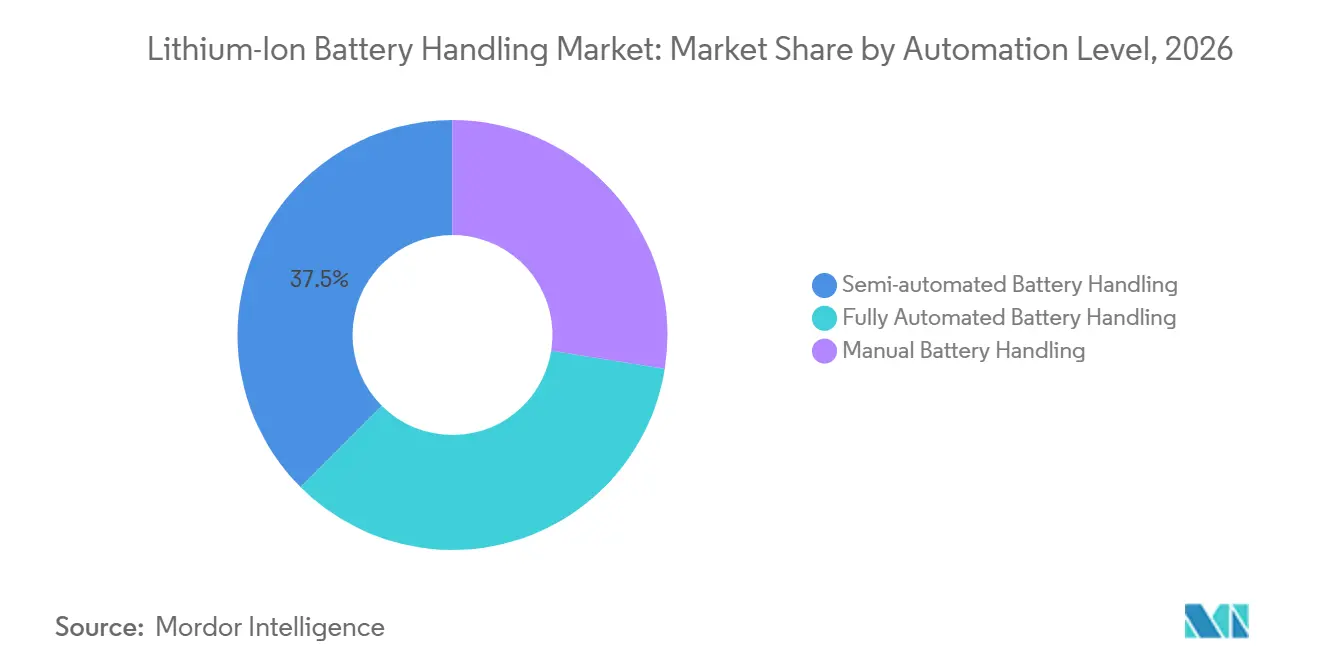
The Semi-Automated Majority and Its SuccessorSemi-automated handling held a 37.5% share in 2026, supported by an installed base that combines conveyors and guided vehicles with manual loading and inspection. Fully automated handling is forecast to grow at a CAGR of 13.7% through 2032, the fastest rate among automation tiers. The difference shows that the existing base reflects past equipment decisions rather than a preferred end state for greenfield projects. Cimcorp entered the electric vehicle battery manufacturing field in April 2025 with Murata Machinery and AGVE, offering gantry robots, automated storage and retrieval systems, autonomous guided vehicles, and conveyors. Its overhead gantry systems leave facility floors unobstructed in formation and aging areas, which can improve emergency access and fire-risk management.
Manual handling remains relevant for field service, recycling preprocessing, and installation of large industrial systems. KUKA’s mini-environment approach uses localized enclosures to recreate dry-room conditions for robotic cells. Fraunhofer ISI’s June 2025 analysis found that dry-room-compatible handling systems account for 25% to 40% of total gigafactory energy use, making transport design an operating-cost issue. The same analysis identified mini environments as a path for extending full automation at lower energy cost. Greenfield gigafactories are expected to favor full automation, while brownfield facilities can keep semi-automated demand in place as operators sequence upgrades around active production.
By End User:
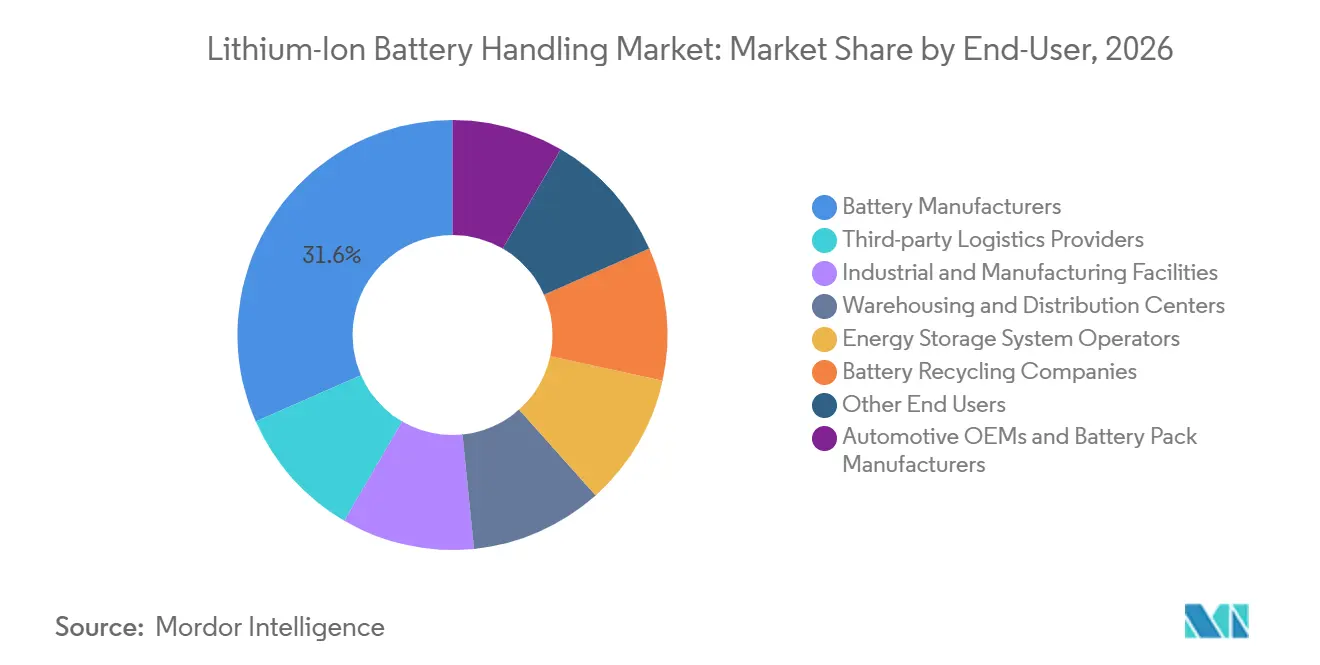
Manufacturers Lead, Recyclers AccelerateBattery manufacturers held a 31.6% share of end-user demand in 2026 because they use precision handling in electrode production, cell assembly, formation, and aging. Their requirements for throughput, contamination control, and data-linked traceability are shaping the lithium-ion battery handling industry. Automotive original equipment manufacturers and battery pack manufacturers are the second-largest user group. Their demand centers on module and pack assembly, where equipment must move heavy subassemblies without damaging cells. Third-party logistics providers are building battery-specific capabilities as cross-border cell shipping grows and compliance requirements add qualification work.
Battery recycling companies are forecast to grow at a CAGR of 12.9% through 2032, the fastest rate among end users. Fraunhofer IWU reported in September 2025 that the number of used traction batteries in Europe is expected to increase more than 10-fold by 2030. Energy storage system operators need specialized equipment for cabinet installation, maintenance, and replacement. Industrial sites and distribution centers manage batteries as finished goods and operating assets under stricter storage and insurance requirements. Recycling companies need flexible systems because incoming packs can have dozens of designs and standard format-specific equipment cannot manage every variant efficiently.
Geography Analysis
APAC Lithium-Ion Battery Handling Market
Asia-Pacific held 54.2% of the lithium-ion battery handling market in 2026 and is forecast to grow at a CAGR of 12.8% through 2032. China’s production concentration is the main regional demand base, with Jiangsu and Guangdong hosting dense clusters of battery production equipment. The country has more than 140 active GWh-scale production facilities, which supports demand across the battery value chain. Samsung SDI, LG Energy Solution, and SK On maintain high-automation production footprints in South Korea. Vietnam, Indonesia, and Thailand are also attracting manufacturing investment that expands the regional equipment base.
India and China Lithium-Ion Battery Handling Market
India is growing as a battery manufacturing location. Exide Energy Solutions commissioned a 6 GWh gigafactory in Bengaluru in 2025, with INR 48 billion, or USD 574 million, committed through full ownership investment. China’s GB 38031-2025 standard is also reshaping handling specifications across the regional production ecosystem. The lithium-ion battery handling market in Asia-Pacific therefore combines scale, automation investment, and tighter safety requirements.
The Americas and EMEA Lithium-Ion Battery Handling Market
Europe is the second-largest region, where compliance investment plays a larger role than production volume. Regulation (EU) 2023/1542 became applicable across Member States in August 2025, while a QR-code Battery Passport becomes mandatory from February 2027. Germany leads regional investment, illustrated by KUKA’s battery production hall for MAN Truck & Bus with 35 autonomous mobile robot platforms. North America is the third-largest region, with demand split between production handling at Inflation Reduction Act-supported gigafactories and field service for electric fleets. South America has early upstream demand from lithium extraction and refining investments, while the Middle East and Africa are at an earlier stage led by energy-storage projects in Saudi Arabia and the United Arab Emirates.
Competitive Landscape
The lithium-ion battery handling market is moderately concentrated because no supplier holds a majority across equipment categories and regions. Large-format automation specialists, including ABB, KUKA, and FANUC, compete with intralogistics integrators such as Daifuku, Dematic, and Cimcorp. Battery-equipment original equipment manufacturers, including Wuxi Lead Intelligent Equipment and Yinghe Technology, serve another part of the gigafactory value chain. These groups increasingly pursue the same client budgets as customers seek integrated systems rather than individual machines. The lithium-ion battery handling industry is therefore shaped by the ability to combine robotics, material movement, storage, and production data.
Cimcorp’s April 2025 entry into electric vehicle battery manufacturing shows how intralogistics specialists are moving toward full-facility integration. The company partnered with Murata Machinery and AGVE to offer gantry robots, automated storage and retrieval systems, autonomous guided vehicles, and conveyors for European gigafactories. KUKA’s April 2025 MAN Truck & Bus deployment used fleet management to support decoupled, flexible production without fixed conveyor infrastructure. ABB’s modular robotic cells delivered a 6-fold throughput increase at a battery energy storage manufacturer and enabled capacity expansion through additional cells rather than full line replacement.
Automated end-of-life and second-life applications remain open areas because recycling feedstock is becoming more diverse. Flexible disassembly systems that use artificial intelligence and vision technology are being developed to address pack-format variation. Large suppliers can benefit from long qualification periods because they have the capacity to support testing and engineering before orders become revenue. Regional service networks also matter as new facilities are developed in Europe, Asia-Pacific, North America, and emerging locations. The lithium-ion battery handling market remains competitive across several supplier groups rather than concentrated around one broad leader.
Lithium-Ion Battery Handling Industry Leaders
-
Bosch Rexroth AG
-
ABB Ltd.
-
Daifuku Co., Ltd.
-
Beckhoff Automation GmbH and Co. KG
-
Siemens AG
- *Disclaimer: Major Players sorted in no particular order
Lithium-Ion Battery Handling Market Companies Covered in this Report
- ABB Ltd.
- ATS Corporation
- Beckhoff Automation GmbH and Co. KG
- Bosch Rexroth AG
- Cimcorp Oy
- Comau S.p.A.
- Daifuku Co., Ltd.
- Dematic GmbH
- Dürr AG
- DWFritz Automation, LLC
- FANUC Corporation
- Kardex Holding AG
- Konecranes Plc
- KUKA AG
- Manz AG
- Schneider Electric SE
- Siemens AG
- Sovema Group S.p.A.
- Wuxi Lead Intelligent Equipment Co., Ltd.
- Yinghe Technology Co., Ltd.
Recent Industry Developments in Lithium-Ion Battery Handling Market
- September 2026: Volkswagen Group and Gotion High-Tech signed agreements to invest a combined EUR 3.22 billion, or USD 3.66 billion, in 3 lithium-ion battery and cathode-material production facilities in Spain, Slovakia, and Morocco, targeting 37.5 GWh of annual battery capacity. The project materially expands handling equipment procurement across 3 new geographies, positioning European and North African facilities as significant new demand nodes for battery intralogistics systems.
- May 2026: Tesla announced an additional investment of USD 250 million in battery cell production at its Gruenheide, Germany, gigafactory, raising the planned annual capacity target to 18 GWh from a previously planned 8 GWh. The capacity increase carries a proportional requirement for additional material-handling infrastructure across cell assembly and pack production stages.
- September 2025: Fraunhofer IWU and EDAG Production Solutions GmbH & Co. KGaA announced construction of a variant-flexible, AI-supported automated dismantling plant for active traction batteries at Chemnitz, Germany, incorporating state-of-health assessment to route components toward reuse or recycling, a reference architecture for commercial-scale recycling handling.
- September 2025: The EU-funded Recirculate project completed its first phase, demonstrating an AI and robotics-driven electric vehicle battery disassembly system capable of automated dismantling from pack to cell level. The milestone marked the transition of flexible robotic disassembly handling from research prototype to early industrial readiness.
Global Lithium-Ion Battery Handling Market Report Scope
Lithium-ion battery handling refers to the specialized process of safely moving, storing, installing, testing, and preparing lithium-ion batteries throughout their lifecycle while managing their electrical and chemical hazards. Due to their high energy density and flammable electrolytes, lithium-ion batteries require specific safety protocols, environmental controls, and specialized equipment to prevent mechanical damage, short circuits, and thermal runaway.
The global lithium-ion battery handling market is segmented by handling equipment, handling service, automation level, end user, and geography. By handling equipment, the market is segmented into forklifts and electric pallet trucks, cranes and hoists, conveyors and automated conveyor systems, robotic handling systems, automated guided vehicles (AGVs), autonomous mobile robots (AMRs), battery lifting and extraction equipment, battery racks, storage cabinets and handling fixtures, and other handling equipment. By handling service, the market is segmented into loading and unloading, transportation within facilities, lifting and positioning, installation and removal, sorting and inspection, storage and inventory management, packaging and palletization, and recycling and end-of-life handling. By automation level, the market is segmented into manual, semi-automated, and fully automated battery handling. By end user, the market is segmented into battery manufacturers, automotive original equipment manufacturers (OEMs) and battery pack manufacturers, third-party logistics providers, industrial and manufacturing facilities, warehousing and distribution centers, energy storage system operators, battery recycling companies, and other end users. The report also covers the market size and forecasts for the global lithium-ion battery handling market across 26 countries in key regions. For each segment, the market sizing and forecasts have been provided on the basis of value (USD).
Segmentation Overview
| Forklifts and Electric Pallet Trucks |
| Cranes and Hoists |
| Conveyors and Automated Conveyor Systems |
| Robotic Handling Systems |
| Automated Guided Vehicles (AGVs) |
| Autonomous Mobile Robots (AMRs) |
| Battery Lifting and Extraction Equipment |
| Battery Racks, Storage Cabinets, and Handling Fixtures |
| Other Handling Equipment |
| Loading and Unloading |
| Transportation Within Facilities |
| Lifting and Positioning |
| Installation and Removal |
| Sorting and Inspection |
| Storage and Inventory Management |
| Packaging and Palletization |
| Recycling and End-of-Life Handling |
| Manual Battery Handling |
| Semi-automated Battery Handling |
| Fully Automated Battery Handling |
| Battery Manufacturers |
| Automotive OEMs and Battery Pack Manufacturers |
| Third-party Logistics Providers |
| Industrial and Manufacturing Facilities |
| Warehousing and Distribution Centers |
| Energy Storage System Operators |
| Battery Recycling Companies |
| Other End Users |
| North America | United States |
| Canada | |
| Mexico | |
| Europe | Germany |
| France | |
| Italy | |
| Spain | |
| United Kingdom | |
| Poland | |
| Russia | |
| Rest of Europe | |
| Asia-Pacific | China |
| India | |
| Japan | |
| South Korea | |
| Australia | |
| Indonesia | |
| Vietnam | |
| Thailand | |
| Rest of Asia-Pacific | |
| South America | Brazil |
| Argentina | |
| Chile | |
| Rest of South America | |
| Middle East and Africa | Saudi Arabia |
| United Arab Emirates | |
| Egypt | |
| South Africa | |
| Morocco | |
| Rest of Middle East and Africa |
| By Handling Equipment | Forklifts and Electric Pallet Trucks | |
| Cranes and Hoists | ||
| Conveyors and Automated Conveyor Systems | ||
| Robotic Handling Systems | ||
| Automated Guided Vehicles (AGVs) | ||
| Autonomous Mobile Robots (AMRs) | ||
| Battery Lifting and Extraction Equipment | ||
| Battery Racks, Storage Cabinets, and Handling Fixtures | ||
| Other Handling Equipment | ||
| By Handling Service | Loading and Unloading | |
| Transportation Within Facilities | ||
| Lifting and Positioning | ||
| Installation and Removal | ||
| Sorting and Inspection | ||
| Storage and Inventory Management | ||
| Packaging and Palletization | ||
| Recycling and End-of-Life Handling | ||
| By Automation Level | Manual Battery Handling | |
| Semi-automated Battery Handling | ||
| Fully Automated Battery Handling | ||
| By End User | Battery Manufacturers | |
| Automotive OEMs and Battery Pack Manufacturers | ||
| Third-party Logistics Providers | ||
| Industrial and Manufacturing Facilities | ||
| Warehousing and Distribution Centers | ||
| Energy Storage System Operators | ||
| Battery Recycling Companies | ||
| Other End Users | ||
| By Geography | North America | United States |
| Canada | ||
| Mexico | ||
| Europe | Germany | |
| France | ||
| Italy | ||
| Spain | ||
| United Kingdom | ||
| Poland | ||
| Russia | ||
| Rest of Europe | ||
| Asia-Pacific | China | |
| India | ||
| Japan | ||
| South Korea | ||
| Australia | ||
| Indonesia | ||
| Vietnam | ||
| Thailand | ||
| Rest of Asia-Pacific | ||
| South America | Brazil | |
| Argentina | ||
| Chile | ||
| Rest of South America | ||
| Middle East and Africa | Saudi Arabia | |
| United Arab Emirates | ||
| Egypt | ||
| South Africa | ||
| Morocco | ||
| Rest of Middle East and Africa | ||
Key Questions Answered in the Report
What is the forecast growth rate for lithium-ion battery handling?
The lithium-ion battery handling market is forecast to grow at a CAGR of 12.47% from 2027 to 2032, reaching USD 2.79 billion by 2032.
Which lithium-ion battery handling equipment category is growing fastest?
Robotic handling systems are forecast to record the highest equipment CAGR at 13.3% through 2032.
Why is fully automated lithium-ion battery handling gaining adoption?
Fully automated handling is forecast to grow at a CAGR of 13.7% because new facilities seek continuous material flow, fewer manual touchpoints, and improved safety access.
Which lithium-ion battery handling end user has the largest equipment demand?
Battery manufacturers held 31.6% of end-user demand in 2026 because they need precision handling across electrode production, cell assembly, formation, and aging.
Which region leads lithium-ion battery handling demand?
Asia-Pacific held 54.2% of demand in 2026 and is forecast to grow at a CAGR of 12.8% through 2032.
How does battery recycling affect lithium-ion battery handling requirements?
Recycling and end-of-life handling is forecast to grow at a CAGR of 13.8% as operators need flexible disassembly, sorting, and safe containment for varied used battery designs.