
Market Overview
| Study Period | 2020 - 2031 |
|---|---|
| Market Volume (2026) | 116.22 Million tons |
| Market Volume (2031) | 142.86 Million tons |
| Growth Rate (2026 - 2031) | 4.22 % |
| Fastest Growing Market | Asia Pacific |
| Largest Market | Asia Pacific |
| Market Concentration | Medium |
Major Players *Disclaimer: Major Players sorted in no particular order Image © Mordor Intelligence. Reuse requires attribution under CC BY 4.0. | |
Linear Low-Density Polyethylene (LLDPE) Market Analysis by Mordor Intelligence
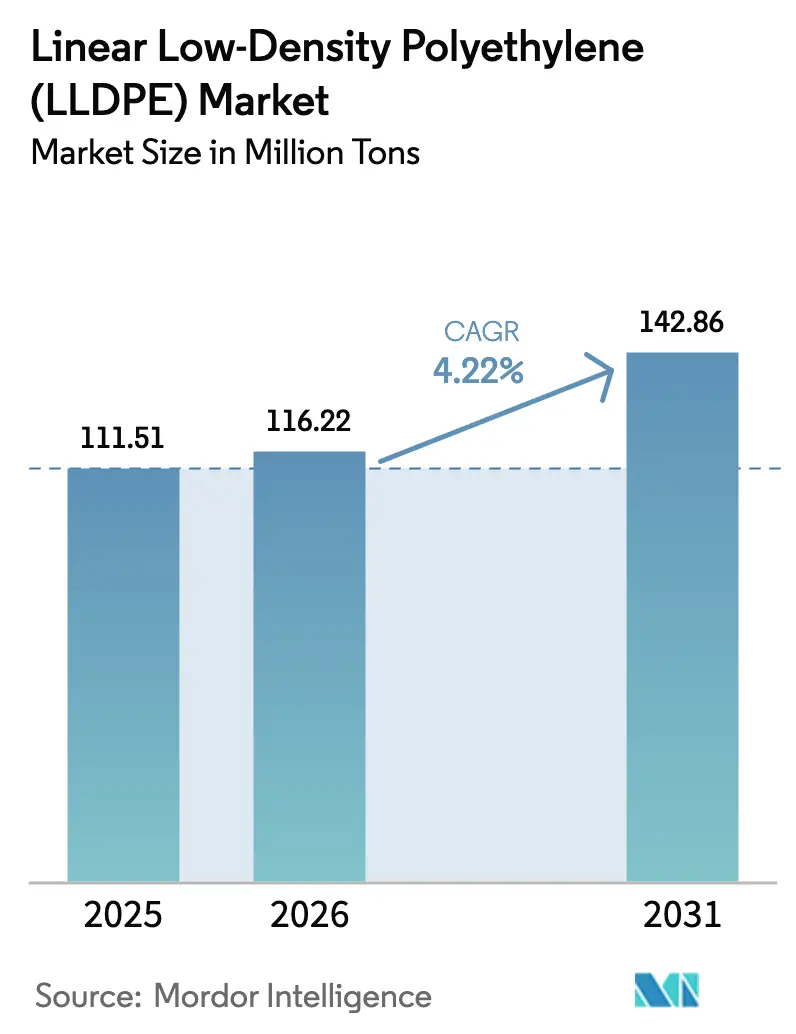
The Linear Low-Density Polyethylene Market size was valued at 111.51 million tons in 2025 and estimated to grow from 116.22 million tons in 2026 to reach 142.86 million tons by 2031, at a CAGR of 4.22% during the forecast period (2026-2031). Packaging downgauging, e-commerce logistics, and capacity expansions in the Asia-Pacific region are the structural forces sustaining long-term demand. Even as North American and European utilization rates hover near 80%, Asia-Pacific producers continue to operate newer assets at rates above 90% and are redirecting surplus resin toward Southeast Asia and Africa, thereby reshaping trade patterns. Cost competition is intensifying because US ethane prices remain low, while Asian naphtha costs have risen, compressing margins for integrated crackers. Meanwhile, sustainability mandates are driving converters toward mono-material film structures that favor LLDPE and higher-recycle-content grades, prompting investment in advanced recycling assets. Volatility in feedstock pricing and regulatory divergence across regions create both risks and opportunities for players positioned with flexible feedstock slates and differentiated catalyst portfolios.
Key Report Takeaways
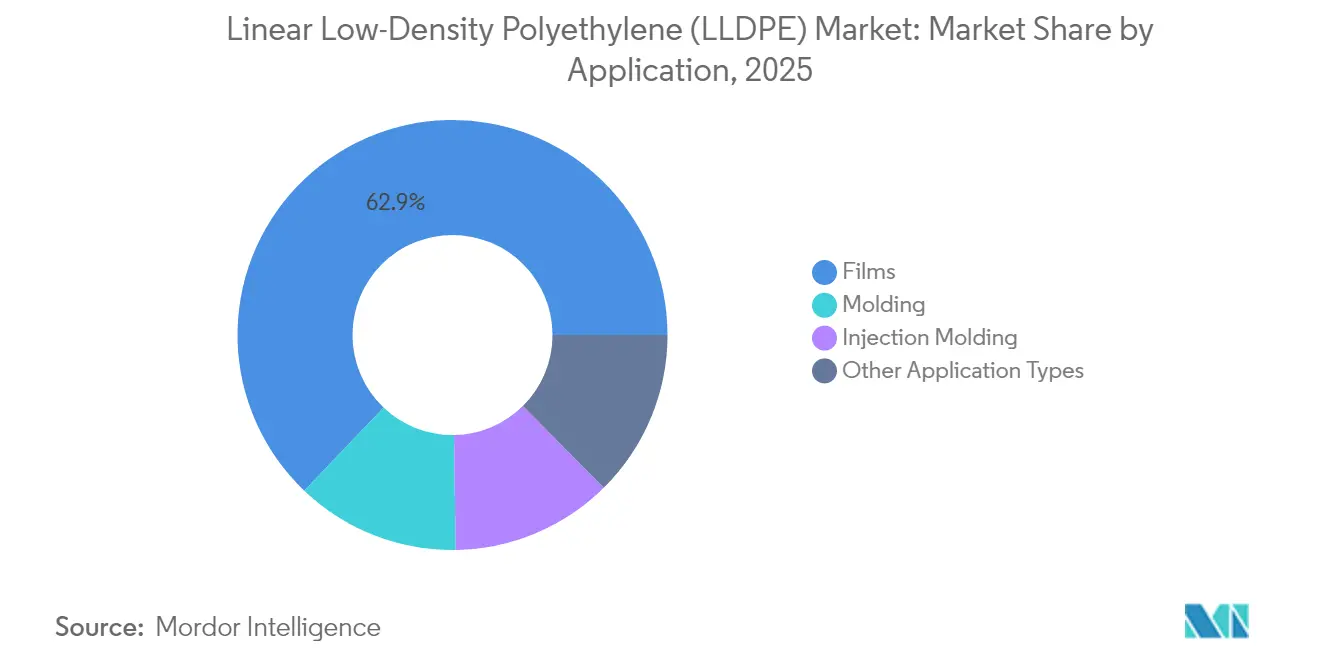
- By application, films commanded 62.89% of the Linear Low-Density Polyethylene market share in 2025, and other application types are forecast to register the fastest 5.68% CAGR between 2026 and 2031.
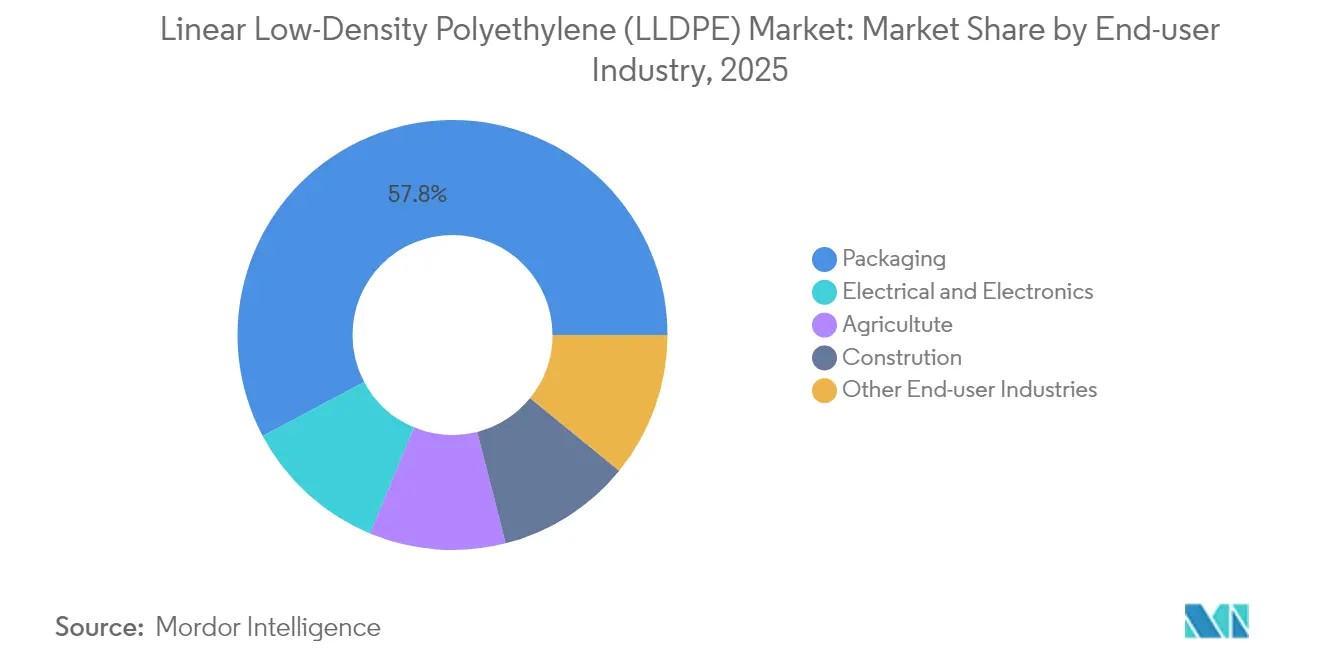
- By end-user industry, packaging accounted for 57.78% of the Linear Low-Density Polyethylene market size in 2025, while electrical and electronics is poised to grow the quickest at a 5.61% CAGR.
- By geography, the Asia-Pacific region led with 46.10% of the global volume in 2025. The Asia-Pacific region is anticipated to deliver the highest CAGR of 5.07% from 2021 to 2031.
Note: Market size and forecast figures in this report are generated using Mordor Intelligence’s proprietary estimation framework, updated with the latest available data and insights as of 2026.
Market Trends and Insights
Drivers Impact Analysis of Linear Low-Density Polyethylene (LLDPE) Market*
| Driver | (~) % Impact on CAGR Forecast | Geographic Relevance | Impact Timeline |
|---|---|---|---|
| Escalating packaged-food film demand | +0.9% | Global, led by Asia-Pacific and North America | Medium term (2–4 years) |
| E-commerce stretch-/shrink-film surge | +1.1% | Global, concentrated in Asia-Pacific, North America | Short term (≤ 2 years) |
| Solar-panel encapsulation film uptake | +0.3% | Asia-Pacific core, spill-over to Middle East-Africa | Long term (≥ 4 years) |
| Downgauging and circular-economy mandates | +0.8% | Europe, North America, early adoption in Asia-Pacific | Medium term (2–4 years) |
| Agricultural mulch and greenhouse films | +0.6% | Asia-Pacific, Middle East-Africa, South America | Medium term (2–4 years) |
| Source: Mordor Intelligence | |||
Escalating Packaged-Food Film Demand
Flexible snack and ready-meal packaging is shifting from rigid to lightweight pouches, trimming resin use by nearly 90% while preserving seal integrity through metallocene-enabled downgauging[1]LyondellBasell, “Flexible Packaging Film Trends,” lyondellbasell.com. ExxonMobil’s Exceed XP 7 grade introduced in 2024 delivers dart-impact values of 900 g and puncture energy reaching 2.3 J per mil at densities near 0.912 g/cc, allowing converters to thin film gauges by 15%–20% without sacrificing barrier performance. The performance leap is crucial in India, where polyethylene demand increased by 20% year-over-year in 2024 and landfill space is limited. Stand-up pouch adoption favors LLDPE over LDPE because short-chain branching supplies superior hot-tack strength for high-speed form-fill-seal lines. As middle-class food spending rises throughout Asia, brand owners view LLDPE’s downgauging capability as the primary lever for both cost and sustainability goals.
E-commerce Stretch-/Shrink-Film Surge
Global online retail continues to outpace GDP, driving the need for enhanced pallet-wrap and parcel-protection specifications. Stretch film incorporating metallocene LLDPE maximizes cling and puncture resistance, addressing load-stability demands that outweigh direct material costs. LyondellBasell’s 2023 venture with AFA Nord aims to produce 50,000 t/y of recycled LLDPE and LDPE flexible packaging by 2026, in line with extended producer responsibility rules. Although Northeast Asian cracker margins turned negative in late 2024, stretch-film consumption showed resilience due to its near-perfect correlation with parcel volumes. Retailers are also migrating from PVC to LLDPE blends for beverage and electronics shrink-bundling to eliminate chlorinated polymers and improve recycling yields.
Solar-Panel Encapsulation Film Uptake
Bifacial photovoltaic modules require white-pigmented backsheets to enhance albedo, and LLDPE offers the necessary moisture resistance and cost benefits for this emerging specification. A 1,500 GW utility-scale solar pipeline slated for commissioning between 2025 and 2030 across Asia-Pacific and the Middle East creates a multiyear runway for encapsulation films[2]International Energy Agency, “Oil 2024,” iea.org. LLDPE’s lower processing temperature compared with EVA curtails lamination energy, aligning with module makers’ carbon-reduction targets. However, strict IEC 61215 durability tests and entrenched supplier relationships temper near-term volume gains.
Downgauging and Circular-Economy Mandates
European single-use plastics rules, fully enforced since 2024, push converters toward mono-material LLDPE films that meet design-for-recycling criteria. Dow’s Path2Zero program pledges 2 million tons per year of low-carbon polyethylene and 3 million tons per year of recycled or renewable resins by 2030, underpinned by more than USD 1 billion in capital spending. PFAS-free processing aids launched in July 2024 enable gauge uniformity below 20 µm without melt fracture, resulting in up to 12% reduction in trimming resin use. Mechanical recycling studies show that LLDPE retains functionality through two cycles but loses 85% of its tear strength by the fourth cycle, underscoring the future importance of chemical depolymerization pathways.
Restraints Impact Analysis of Linear Low-Density Polyethylene (LLDPE) Market*
| Restraint | (~) % Impact on CAGR Forecast | Geographic Relevance | Impact Timeline |
|---|---|---|---|
| Shift toward m-LLDPE/HDPE for strength | -0.7% | Global, notably North America and Europe | Medium term (2–4 years) |
| Volatile naphtha/ethane feedstock cost | -0.9% | Asia-Pacific and Middle East-Africa (naphtha), North America (ethane) | Short term (≤ 2 years) |
| Global single-use-plastic restrictions | -0.5% | Europe, North America, early adoption in Asia-Pacific | Long term (≥ 4 years) |
| Source: Mordor Intelligence | |||
Shift Toward m-LLDPE/HDPE for Strength
Metallocene LLDPE and HDPE command 10%–15% price premiums by delivering higher puncture resistance and stiffness, displacing conventional grades in heavy-duty sacks and industrial liners. ExxonMobil’s data show that C6-metallocene LLDPE provides narrower molecular-weight distributions, which lower seal-initiation temperatures and reduce trim waste on high-speed lines. HDPE’s superior environmental stress-crack resistance favors chemical containers and IBCs, drawing share away from LLDPE in North America and Europe where converters can reconfigure equipment. Emerging markets with legacy extruders remain cost-sensitive, slowing the substitution effect.
Volatile Naphtha/Ethane Feedstock Cost
Asian naphtha-based crackers faced a 15%–20% increase in feedstock costs in early 2025, forcing producers to curb operating rates and eroding petrochemical margins. In contrast, US ethane prices softened on associated-gas oversupply, widening a USD 200–USD 300/t cash-cost gap versus Northeast Asia. The divergence complicates long-term contracts and drives a shift toward shorter pricing cycles, straining working-capital efficiency for integrated producers.
*Our forecasts treat driver/restraint impacts as directional, not additive. The impact forecasts reflect baseline growth, mix effects, and variable interactions.
Linear Low-Density Polyethylene (LLDPE) Market Segment Analysis
By Application:
Films Anchor Volume, Specialty Segments AccelerateFilms represented 62.89% of the global volume in 2025, as converters favored metallocene grades that enabled thinner gauges without compromising seal integrity. Metallocene catalyst systems provide enhanced hot-tack strength, enabling multilayer stand-up pouches to operate at higher line speeds and reduce total material consumption per package. Stretch-film producers are adopting pre-stretched rolls that reduce resin usage per pallet by up to 50%, further integrating LLDPE into supply-chain sustainability programs. Specialty shrink-film adoption in electronics bundling is advancing as PVC falls out of favor due to chlorine-related disposal liabilities.
Other application types are forecast to grow at a market-leading 5.68% CAGR through 2031. The Linear Low-Density Polyethylene market share of these specialty applications remains modest, yet the value proposition is rising. Rotomolded water tanks are gaining traction in off-grid African communities, leveraging LLDPE’s one-piece construction that eliminates leak points. Ultralight protective foams for consumer electronics packaging are another emerging outlet, supported by a method reported in Nature for producing ultrathin polyethylene sheets that preserve flexibility at micro-scale thicknesses. Semiconductor logistics are stimulating demand for antistatic films, a niche that benefits from LLDPE’s inherently low surface resistivity when compounded with conductive additives.



By End-User Industry:
Packaging Dominates, Electronics SurgesPackaging accounted for 57.78% of global demand in 2025 and continues to dictate price cycles, as film converters typically carry limited inventory. Brand-owner commitments to cut virgin resin usage by 20%–25% by 2030 are spurring accelerated downgauging, which paradoxically maintains LLDPE volume by opening new applications that replace rigid formats. A visible shift from multi-material laminates toward mono-material polyethylene pouches improves mechanical recyclability, a change that favors LLDPE due to its melt-strength characteristics.
Electrical and electronics is the fastest-growing end-use at a 5.61% CAGR. Antistatic and moisture-barrier films protect high-value wafers during global transit, and any defect can destroy semiconductor lots valued at USD 10,000 or more, justifying the use of premium metallocene LLDPE grades. Agriculture remains an essential yet regionally varied outlet, relying on mulch and greenhouse films to amplify yields in water-scarce regions. Construction continues to employ LLDPE for vapor barriers and geomembranes, benefiting from its puncture resistance and ease of installation. Healthcare is an emerging specialty, where single-use medical pouches leveraging LLDPE’s toughness are gaining approval under ISO 13485 frameworks, especially in Southeast Asia’s fast-growing hospital markets.
Geography Analysis
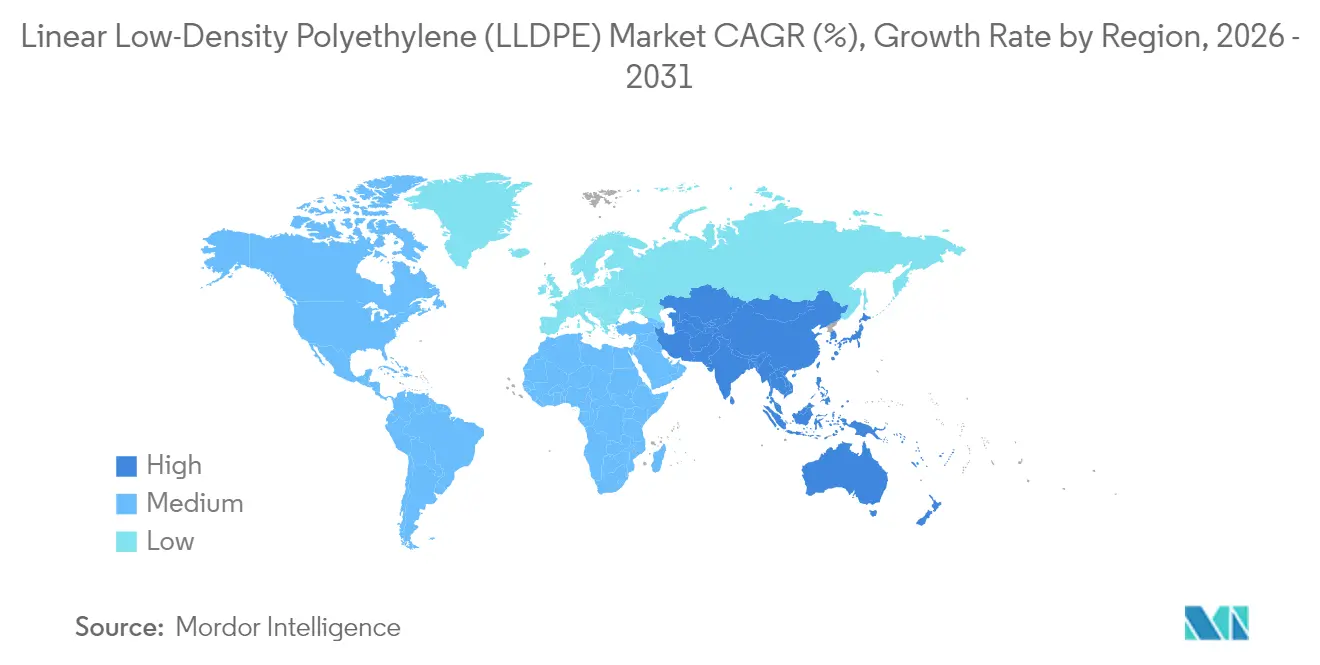
APAC Linear Low-Density Polyethylene (LLDPE) Market
The Asia-Pacific region accounted for 46.10% of the global 2025 volume and is expected to deliver a 5.07% CAGR through 2031. China’s commissioning of 5 million tonnes per year (t/y) of polyethylene capacity in 2025 and 6.5 million t/y in 2026 will narrow its import requirement to an average of 300,000 t/y, redirecting Middle Eastern and US cargoes toward Indonesia, Vietnam, and the Philippines. India is expected to bring 2.4 million tonnes per year online over the next three years, driven by 7% annual growth in petrochemical demand and an expanded virtual ethane pipeline that secures feedstock for Jamnagar. Japan and South Korea, while mature, are upgrading catalyst technology to serve agricultural-film niches and to hedge against naphtha volatility by integrating imported ethane.
The Americas and EMEA Linear Low-Density Polyethylene (LLDPE) Market
North America remains a swing supplier thanks to ethane-based cost advantages. Borealis started up its 640,000 t/y Baystar unit and gained rapid access to Gulf export terminals. ExxonMobil continues to evaluate a USD 8.6 billion complex in Point Comfort, yet the company shuttered its 400,000 tonnes per year Gravenchon line in France, highlighting the continental divergence in feedstock economics. Mexico’s re-export role is expanding under USMCA, while Canada’s growth is capped by permitting hurdles for greenfield petrochemical sites in Alberta and Ontario. Europe is contracting capacity amid high energy costs and stringent environmental rules. SABIC closed its 400,000 t/y Geleen cracker, and LyondellBasell is exploring USD 7–9 billion in asset divestitures to focus on recycling and bio-based resins. Nonetheless, the region leads circular-economy innovation; LyondellBasell’s flexible-packaging recycling venture targets 50,000 t/y by 2026, positioning Europe as a technology hub for chemical recycling. South America and the Middle East-Africa represent growth frontiers. Braskem is negotiating gas supply to expand its Rio complex beyond 540,000 t/y, while Borealis’s 1.4 million t/y polyethylene project in Abu Dhabi is more than halfway to mechanical completion, assuring low-cost supply to Asian and African converters.

Value Chain Analysis
The LLDPE value chain starts with upstream feedstocks, ethane and propane in North America and naphtha in parts of Asia-Pacific and Europe. Steam cracking produces ethylene, followed by polymerization using Ziegler-Natta and metallocene catalyst systems to make commodity and specialty LLDPE grades. Resin then moves through bulk logistics and regional distribution networks to converters, including film extrusion for food and e-commerce packaging, injection and blow molding for consumer and industrial goods, and extrusion coating and specialty films for agriculture, electronics protection, and solar-module components.
Midstream and downstream economics are being shaped by feedstock divergence and logistics. US cost-advantaged natural gas-based production supports export-oriented supply while Asia-Pacific capacity additions are reshaping intra-regional trade flows. Trade and distribution are increasingly central to competitiveness, because new capacity and changing utilization levels alter export availability by region. China has emerged as a notable exporter, with LLDPE exports reported at 478,289 tonnes from January to May 2026, changing how Middle Eastern and US volumes clear into Southeast Asia and other import-dependent markets. Geopolitical tension in the Middle East has also been cited as disrupting supply chains and redirecting flows, which increases the value of reliable ethane supply, export terminals, and flexible sales channels (spot and shorter pricing cycles) for producers and traders moving resin to film and packaging hubs.
Competitive Landscape
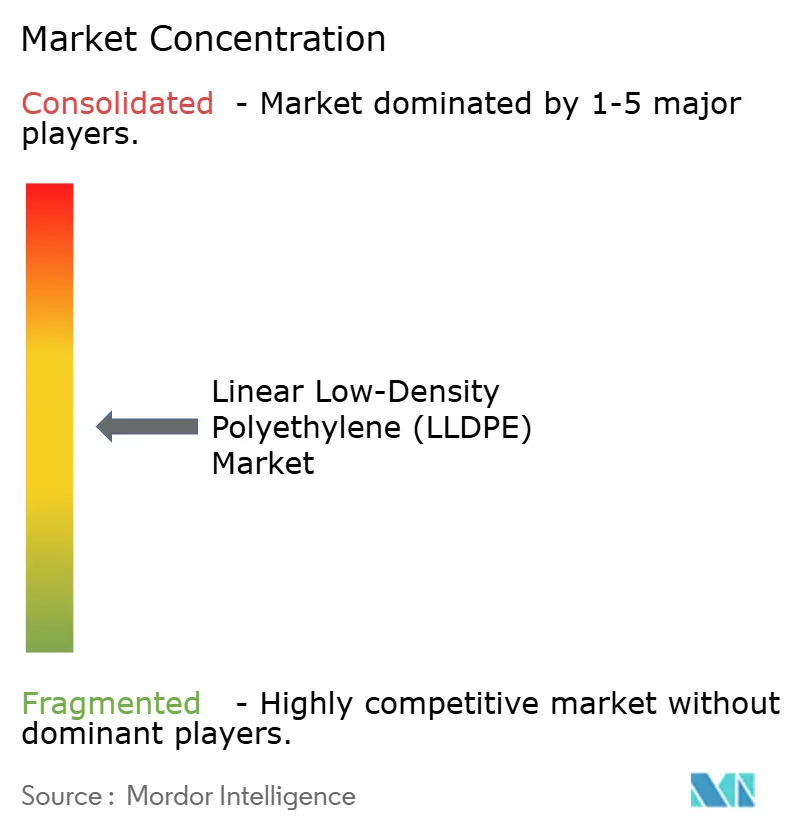
The Linear Low-Density Polyethylene (LLDPE) Market is moderately concentrated. State-owned enterprises, such as SINOPEC and Reliance Industries, leverage integrated feedstock chains and local distribution to sustain high utilization rates. In contrast, privately held and publicly traded majors in North America and Europe face margin pressure as naphtha prices rise and as regulatory costs mount. Strategic bifurcation is evident: Middle Eastern and US Gulf Coast players are scaling ethane-based assets to capture export share, while European incumbents focus on recycled-content and bio-based portfolios to align with circular economy mandates.
Linear Low-Density Polyethylene (LLDPE) Industry Leaders
Dow
Exxon Mobil Corporation
LyondellBasell Industries Holdings B.V.
SABIC
INEOS
- *Disclaimer: Major Players sorted in no particular order
Linear Low-Density Polyethylene (LLDPE) Market Companies Covered in this Report
- Borealis GmbH
- Braskem
- Chevron Phillips Chemical Company
- Dow
- Exxon Mobil Chemical
- Formosa Plastic Corporation
- INEOS
- LG Chem
- Lyonde Bassells Industries Holdings BV
- Mitsui Chemicals Inc.
- Nova Chemicals Corporate
- PTT Global Chemical Public Company Limited.
- Reliance Industries Limited
- Repsol
- SABIC
- SINOPEC (China Petroleum & Chemical Corporation)
- Tasnee
- TotalEnergies
- Westlake Corporation
Read Analysis of Linear Low-Density Polyethylene (LLDPE) Companies

Market Opportunities and Future Outlook
White space is emerging in cost-advantaged export corridors and in regions where trade actions are affecting sourcing decisions. India initiated an anti-dumping investigation in July 2025 into LLDPE imports from Kuwait, Malaysia, Oman, Qatar, Saudi Arabia, and the United Arab Emirates, and market commentary in 2026 has highlighted how such measures can shift incremental import share toward alternative suppliers. In parallel, Middle East supply disruptions cited in 2026 have reinforced the role of North American producers with natural gas-based feedstock positions, supporting opportunities tied to export logistics, customer qualification programs, and application development in film-heavy end markets.
Opportunity is also clustering around downgauged mono-material film structures and recycled-content LLDPE (rLLDPE) solutions as brand-owner and converter specifications tighten. Borealis introduced Borcycle M CWT120CL in March 2025, formulated for non-food flexible packaging with high post-consumer recyclate content, and it reflects the commercial push toward circular grades that still meet film-performance requirements. Another opportunity area is at the intersection of capacity growth and technology differentiation: China expanded LLDPE capacity to about 18.3 million tonnes/year in 2026 (around 10% higher than 2025). That increase raises the value of catalysts, process know-how, and specialty grade slates that help producers defend margins as trade flows become more competitive.
Recent Industry Developments in Linear Low-Density Polyethylene (LLDPE) Market
- May 2026: Dow and Pembina Pipeline finalized an amended ethane supply agreement to support the Path2Zero project in Fort Saskatchewan, Alberta, including 35,000 bpd ethane commencing in 2029; Pembina sanctioned Heartland Extraction Plant. The arrangement strengthens North American ethane feedstock security. It supports planned PE and ethylene derivatives capacity expansions and aligns with Path2Zero timelines.
- May 2026: Dow officially resumed construction of its Path2Zero polyethylene and ethylene derivatives project in Fort Saskatchewan, Alberta, after a 9 month suspension; Phase 1 startup targeted for late 2029. The project reinstates a major PE investment in a key North American hub. It adjusts the project risk profile and capex deployment for the 2029 to 2031 window.
- May 2026: LyondellBasell completed sale of four European assets as part of portfolio transformation. The transaction signals portfolio reshaping of major polyolefins players in Europe. It could prompt shifts in European production capacity and regional supply balance.


Linear Low-Density Polyethylene (LLDPE) Market Report Scope and Research Methodology
Market Definition and Coverage
This market covers linear low-density polyethylene (LLDPE) resin demand, tracked as volume consumption in metric tons across major end uses where LLDPE is processed into finished goods. Our sizing follows an apparent consumption logic by region so the model reflects real offtake patterns, not just installed capacity.
Scope exclusions: Recycled feedstock and downstream finished packaging products are excluded. The sizing stays at resin demand, not converter revenue.
Segments Covered in This Report
- By Application
- Films
- Molding
- Injection Molding
- Other Application Types
- By End-user Industry
- Agriculture
- Electrical and Electronics
- Packaging
- Construction
- Other End-user Industries
- By Geography
- Asia-Pacific
- China
- India
- Japan
- South Korea
- ASEAN Countries
- Rest of Asia-Pacific
- North America
- United States
- Canada
- Mexico
- Europe
- Germany
- United Kingdom
- Italy
- France
- Russia
- Rest of Europe
- South America
- Brazil
- Argentina
- Rest of South America
- Middle-East and Africa
- Saudi Arabia
- South Africa
- Rest of Middle-East and Africa
- Asia-Pacific
Data Sources, Market Sizing, and Validation
Desk Research
Desk research was used to build the factual base of the model, especially the market boundary and the regional split of polyethylene activity. We reviewed public statistics and references such as UN Comtrade trade data, USITC DataWeb, Eurostat Comext, the International Energy Agency for energy and petrochemical context, and World Bank macro indicators that help explain shifts in manufacturing and packaging demand.
On the industry side, we also used sources such as association publications and peer-reviewed polymer journals to cross-check the typical application mix and processing trends, including downgauging in films. Company annual reports and investor presentations were reviewed to understand capacity additions and operating rate commentary. A paid subscription covering import-export shipment-level data plus company financials and news was used selectively to verify trade direction and timing. These examples are not exhaustive, and many other sources were also used for data collection, validation, and clarification.
Primary Interviews and Surveys
Primary work focused on turning general resin and trade signals into a usable demand picture for LLDPE, and then pressure-testing it with people who see orders and operating realities. We spoke with producers, distributors, converters, and independent industry experts across APAC, EMEA, and the Americas to validate assumptions on utilization, regional pricing behavior, and how film demand and substitution with LDPE or HDPE is evolving by end use.
Distribution of primary research fieldwork respondents
| Company type | Respondent position | Region |
|---|---|---|
| Top tier: 26% | CXOs: 15% | APAC: 45% |
| Mid tier: 55% | Functional/Unit leaders: 42% | EMEA: 35% |
| Smaller Players: 19% | Managers: 43% | Americas: 20% |
Market-Sizing & Forecasting
Sizing starts with a top-down reconstruction of apparent consumption by region, where production capacity, estimated operating rates, and net trade flows are used to arrive at resin demand in tons. To keep totals grounded, results are corroborated with selective bottom-up approximations, such as sampled price bands applied to regional demand volumes, followed by channel checks on film share and ordering patterns.
A few inputs carry most of the weight in this market, so they are handled carefully, even when public reporting is uneven. These include new PE unit start-ups and shutdowns, utilization ranges during turnarounds, import-export balance shifts, film and packaging output trends, including downgauging, and feedstock-driven price moves that change purchasing behavior and inventory cycles. Where gaps show up, especially in smaller countries with limited production disclosure, demand is bridged using trade-based proxies and end-use intensity checks, and then adjusted using interview feedback.
For forecasting, we use scenario analysis supported by near-term operating rate signals and price direction, then filter it through packaging growth and industrial activity expectations. The forward view is built region by region first, and only then rolled up to the global total, so mix shifts toward APAC are reflected cleanly.
Data Validation & Update Cycle
Validation is done in several steps so one-off errors do not pass through into the final numbers. We compare model outputs against independent signals like net trade direction, announced capacity changes, and whether implied regional utilization looks feasible for the year.
When variances are large, assumptions are revisited, and follow-up calls are triggered with the most relevant participants, for example traders for sudden trade swings or converters for demand softness. Before sign-off, the work is reviewed by another analyst for unit consistency, conversion checks, and application logic. Reports are refreshed annually, with interim updates for material events, followed by a final pre-delivery pass so clients receive the latest view.
Mordor Intelligence's Linear Low Density Polyethylene Market Size Compared With Other Published Estimates
Published market sizes can vary a lot, even when the same resin family is being discussed, because the measurement choices are not always aligned. The biggest differences usually come from whether the estimate is volume-based or value-based, what is counted as LLDPE versus a broader linear polyethylene bucket, and how regional price levels are applied across grades.
Refresh timing also matters in LLDPE because feedstock moves can change resin pricing quickly, and currency rates can shift the same physical demand into a different USD total. By updating base-year regional price bands closer to the sizing window, aligning currency timing, and checking implied pricing against trade signals and typical contract behavior, Mordor Intelligence limits drift that can happen when older averages are carried forward.
Benchmark comparison
| Source | Market Size | Gaps in Research Methodology |
|---|---|---|
| Mordor Intelligence | USD 85.76 B (2025) | |
| Trade Analytics Bulletin A | USD 17.23 B (2025) | This figure is built from cross-border trade volume (LLDPE/EAOC) valued using a blended trade price, so domestic consumption that never enters trade is not captured, and grade mix is simplified to what appears in customs reporting. |
| Industry Statistics Digest B | USD 78.40 B (2026) | This number is presented as a global USD total, which can differ based on how average selling prices are progressed year to year, how regional spreads are treated, and whether the value conversion is tied to a clear volume base for the same definition of LLDPE. |
The table shows that one comparison is effectively a trade-only construct and another is a value estimate that depends heavily on price and currency assumptions. When the unit of measure, resin definition, and pricing timing are made explicit, the resulting market size is easier to trace back to repeatable variables and to use in planning.


Key Questions Answered in the Report
How large is the Linear Low-Density Polyethylene market in 2026 and how fast is it growing?
The market stands at 116.22 million tons in 2026 and is set to expand to 142.86 million tons by 2031 at a 4.22% CAGR.
Which application holds the dominant share of global LLDPE demand?
Films command 62.89% of 2025 volume, driven by stretch, shrink, and food-packaging uses.
Which end-use sector is expected to grow the quickest through 2031?
Electrical and electronics is projected to grow at 5.61% CAGR thanks to demand for antistatic and moisture-barrier films.
Which region leads global consumption and why?
Asia-Pacific accounts for 46.10% of 2025 volume, supported by rapid capacity additions in China and robust demand growth in India and Southeast Asia.
What key factor is squeezing producer margins in 2025?
Divergent feedstock costs—rising naphtha prices in Asia versus weak ethane prices in North America—are compressing integrated-cracker margins.
Page last updated on:





