
LIB Cathode Conductive Auxiliary Agents Market Size and Share
Market Overview
| Study Period | 2022 - 2032 |
|---|---|
| Market Size (2027) | USD 2.29 Billion |
| Market Size (2032) | USD 3.9 Billion |
| Growth Rate (2027 - 2032) | 11.25 % |
| Fastest Growing Market | Asia-Pacific |
| Largest Market | Asia-Pacific |
| Market Concentration | Medium |
Major Players *Disclaimer: Major Players sorted in no particular order Image © Mordor Intelligence. Reuse requires attribution under CC BY 4.0. | |
LIB Cathode Conductive Auxiliary Agents Market Analysis by Mordor Intelligence
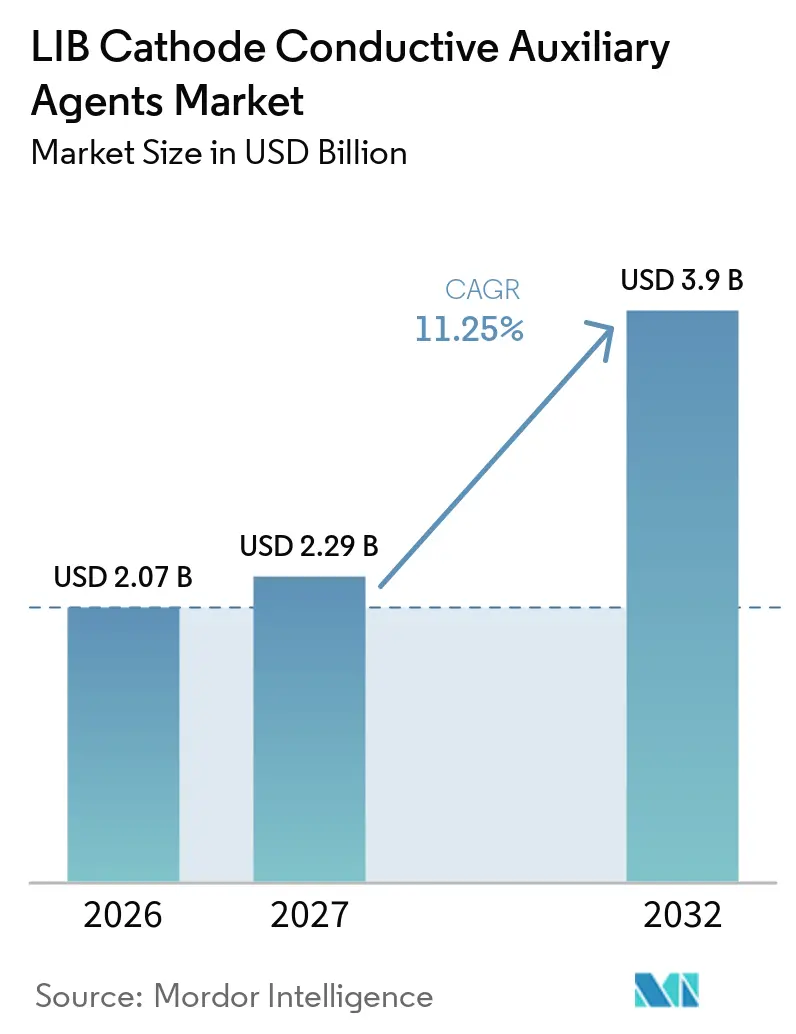
The LIB Cathode Conductive Auxiliary Agents Market size was valued at USD 2.07 billion in 2026 and is estimated to grow from USD 2.29 billion in 2027 to reach USD 3.90 billion by 2032, at a CAGR of 11.25% during the forecast period (2027-2032). Growth follows continued additions to lithium-ion battery manufacturing capacity, which exceeded 4 TWh at the end of 2025, while capacity in the European Union and the United States each increased by 50% during the year. Rising cathode throughput increases demand for conductive materials because they form electron transport networks within the electrode. The Lithium-Ion Battery (LIB) cathode conductive auxiliary agents market also benefits from the move toward lithium iron phosphate batteries, which require carefully dispersed conductive networks because of their lower inherent electronic conductivity. Carbon black remains the established choice in many battery platforms, while carbon nanotubes and hybrid formulations gain attention where higher conductivity, lower loading, or faster charging performance is needed.
Key Report Takeaways
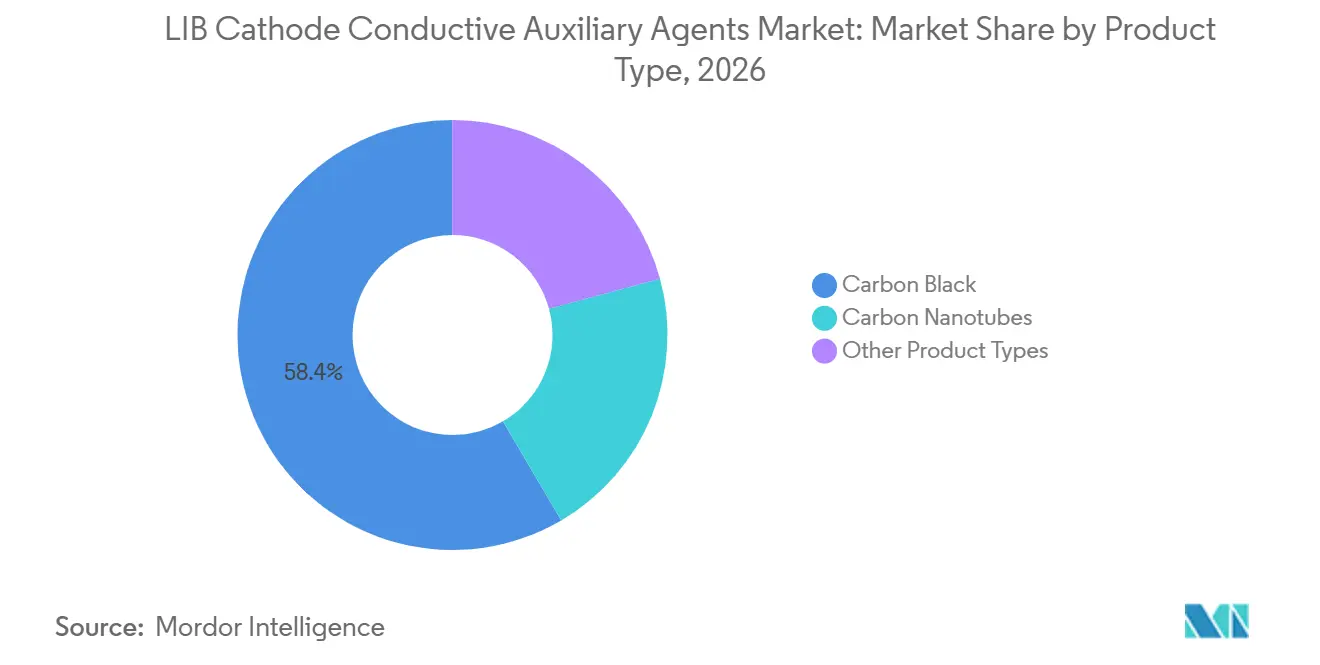
- By product type, carbon black held 58.44% of the LIB cathode conductive auxiliary agents market share in 2026, while carbon nanotubes are forecast to grow at a 12.67% CAGR through 2032.
- By chemistry, nickel manganese cobalt oxide (NMC) held 45.63% of the LIB cathode conductive auxiliary agents market share in 2026, while lithium iron phosphate (LFP) is forecast to grow at a 13.84% CAGR through 2032.
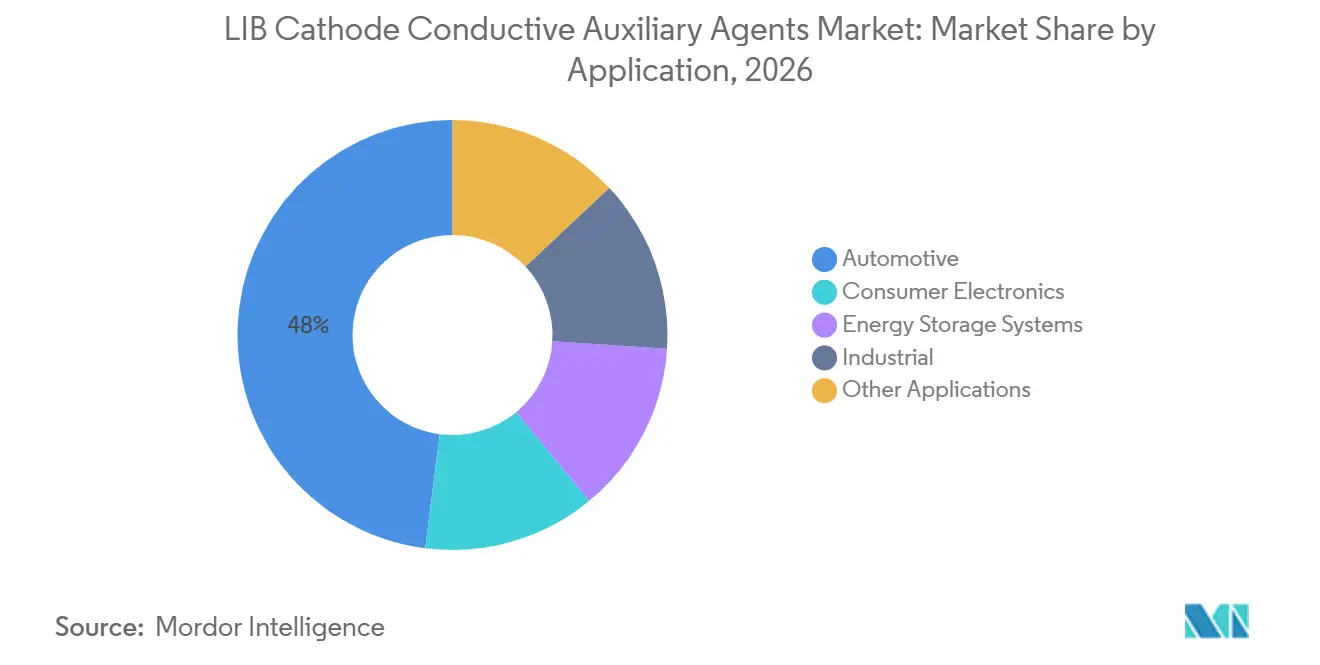
- By application, automotive held 47.97% of the LIB cathode conductive auxiliary agents market share in 2026 and is forecast to grow at a 14.78% CAGR through 2032.
- By geography, Asia-Pacific held 50.31% of the LIB cathode conductive auxiliary agents market share in 2026 and is forecast to grow at a 13.53% CAGR through 2032.
Note: Market numbers in this report are based on Mordor Intelligence's proprietary estimation framework, which combines nine months of actuals with Q4 projections for base year 2026.
Market Trends and Insights
Drivers Impact Analysis of LIB Cathode Conductive Auxiliary Agents Market*
| Driver | (~) % Impact on CAGR Forecast | Geographic Relevance | Impact Timeline |
|---|---|---|---|
| Accelerating EV Battery Production and Cathode Throughput | +3.2% | Global; peak intensity in China, South Korea, and EU gigafactory corridors | Short term (≤ 2 years) |
| Expansion of Grid-Scale Energy Storage | +2.5% | Global; concentrated in China, United States, Europe, and Australia | Short to medium term (1–4 years) |
| LFP Scale-Up and Cost-Optimized Battery Platforms | +2.1% | China (primary); spreading to North America and Europe via supply chain localization | Medium term (2–4 years) |
| Lower Conductive-Additive Loading Through CNT Percolation Networks | +1.8% | Global; advanced adoption concentrated in South Korea, Japan, and China | Medium to long term (2–6 years) |
| Localization of Battery-Material Supply Chains | +1.2% | North America (IRA-driven), Europe (EU Battery Regulation, NZIA targets), and India | Medium to long term (3–6 years) |
| Source: Mordor Intelligence | |||
Accelerating EV Battery Production and Cathode Throughput
Global lithium-ion battery nameplate manufacturing capacity exceeded 4 TWh by the end of 2025. This represented a 30% increase from 2024, while capacity growth in the European Union and the United States was faster than in China[1]. Each increase in cathode production creates demand for materials that maintain electrical contact across the electrode. High-mass-loading cathodes need optimized conductive networks because thicker electrodes can otherwise restrict charge movement. A 2025 study found that a carbon black and carbon nanofiber system supported 94.8% capacity retention after 100 cycles at 1C in a high-mass-loading nickel manganese cobalt oxide cathode. The LIB cathode conductive auxiliary agents market, therefore, favors suppliers that combine material supply with electrode formulation support.
Expansion of Grid-Scale Energy Storage
Global battery storage deployment reached 108 GW in 2025, 40% higher than in 2024, and lithium iron phosphate batteries accounted for 90% of deployments. The United States installed 5.6 GW of energy storage in the second quarter of 2025, including 4.9 GW of utility-scale capacity. These projects increase demand for conductive additives that meet demanding purity and reliability standards. Battery-based uninterruptible power supply capacity additions for artificial intelligence server infrastructure rose to 45 GW in 2025, creating another source of battery demand. Acetylene black grades are relevant in this use because low metallic impurity levels can support battery reliability over repeated cycling. The LIB cathode conductive auxiliary agents market gains a broader demand base as grid storage and data-center applications supplement automotive demand.
LFP Scale-Up and Cost-Optimized Battery Platforms
Lithium iron phosphate shipments accounted for 65.4% of global electric vehicle cathode output through August 2026, while their tonnage grew 31.8%. The chemistry has lower intrinsic conductivity than nickel manganese cobalt oxide and nickel cobalt aluminum oxide. This makes conductive additive choice and mixing quality more important in lithium iron phosphate electrode production. A 2025 study of a 10-GWh lithium iron phosphate cylindrical-cell facility found that cathode mixing time was the most cost-sensitive parameter, with an 80% reduction associated with annual savings of USD 12 million. Birla Carbon introduced Conductex i10 for high-energy battery applications in 2025 and reported a 5% to 15% improvement in lithium iron phosphate discharge performance. The LIB cathode conductive auxiliary agents market can benefit when suppliers help customers improve both material selection and dispersion methods.
Lower Conductive-Additive Loading Through CNT Percolation Networks
Carbon nanotubes can form long conductive pathways at loadings below 1 wt%, compared with the 1% to 3% range commonly used for carbon black. Their fibrous shape allows connections across longer distances in the electrode. A 2025 study reported that dispersion-assisted carbon nanotubes created effective conductive networks in dry-processed lithium iron phosphate cathodes. A 2026 study found that a carbon nanotube and Denka Black hybrid achieved 55.7% capacity retention at 5C, compared with 37% for carbon black alone. Jiangsu Cnano Technology Co., Ltd. has commenced commercial single-walled carbon nanotube paste shipments, and its investor materials state that solid-state batteries may use 3 to 5 times the loading used in liquid-electrolyte batteries. The LIB cathode conductive auxiliary agents market can increase in value even where carbon nanotubes reduce additive weight per cell.
Restraints Impact Analysis of LIB Cathode Conductive Auxiliary Agents Market*
| Restraint | (~) % Impact on CAGR Forecast | Geographic Relevance | Impact Timeline |
|---|---|---|---|
| High Cost and Energy Intensity of CNT and Graphene Production | -1.8% | Global; most acute outside China where production scale advantages are absent | Long term (≥ 4 years) |
| Cathode-Production Concentration in Asia | -1.3% | North America and Europe most exposed; APAC partly self-reinforcing | Medium term (2–4 years) |
| Stringent Purity, Dispersion, and Qualification Requirements | -0.9% | Global; elevated barriers in Japan, South Korea, and the EU | Short to medium term (≤ 3 years) |
| Source: Mordor Intelligence | |||
High Cost and Energy Intensity of CNT and Graphene Production
Chemical vapor deposition processes for carbon nanotube production can be 2 to 100 times more energy-intensive than aluminum smelting under the production conditions reviewed in a 2025 scientific study. Low-quality bulk carbon nanotubes with less than 95% purity were priced at USD 100 to USD 200 per kg, while high-purity material exceeded USD 60 per gram. Graphene made by chemical vapor deposition can cost more still. These cost differences limit the use of carbon nanotubes and graphene in battery platforms where carbon black already meets performance requirements. Electrochemical carbon dioxide-to-carbon nanotube routes may lower energy requirements, but scaled commercial validation remains limited. The LIB cathode conductive auxiliary agents market will continue to rely on carbon black in high-volume, cost-sensitive applications until advanced materials achieve a stronger cost-performance balance.
Cathode-Production Concentration in Asia
China held more than 80% of global lithium-ion battery manufacturing capacity, and more than 95% of lithium iron phosphate cathode material was produced there. This concentrates a major share of demand for conductive materials in one geography. China introduced export controls on several battery supply chain materials in October 2025, with measures effective from November 8, 2025. The controls created uncertainty for cathode supply and localization plans outside China. South Korea remains an important diversification center but continues to depend on Chinese cathode material imports. Battery qualification cycles of 12 to 24 months further slow the transition to newly localized additive supply relationships.
*Our forecasts treat driver/restraint impacts as directional, not additive. The impact forecasts reflect baseline growth, mix effects, and variable interactions.
LIB Cathode Conductive Auxiliary Agents Market Segment Analysis
By Product Type:
Carbon Black Leads, While Carbon Nanotubes ExpandCarbon black held 58.44% of the LIB cathode conductive auxiliary agents market share in 2026. Its installed base reflects years of electrode formulation work across nickel manganese cobalt oxide, nickel cobalt aluminum oxide, and lithium iron phosphate batteries. Competition centers on purity, particle structure, chemistry-specific performance, and processing support. Carbon black remains a practical option because it is widely qualified and generally less costly than carbon nanotubes. It can also support both anode and cathode formulations, which simplifies material sourcing for battery manufacturers.
Carbon nanotubes are projected to advance at a 12.67% CAGR through 2032 in the LIB cathode conductive auxiliary agents market. They are moving from specialist applications into high-specification cathodes where conductivity and fast charging are important. Single-walled carbon nanotubes are especially relevant for solid-state and sodium-ion batteries because their use per GWh can exceed that of conventional lithium-ion battery designs. ZEON CORPORATION is expanding single-walled carbon nanotube capacity, while Jiangsu Cnano Technology Co., Ltd. is developing commercial conductive paste supply. TORAY INDUSTRIES, INC. also supplies carbon nanotube materials to this field.

By Chemistry:
LFP Increases the Need for Conductive Network ControlNickel manganese cobalt oxide held 45.63% of the LIB cathode conductive auxiliary agents market share in 2026. The chemistry retains a key role in premium electric vehicles where energy density and power output remain important. Its active material has higher inherent conductivity than lithium iron phosphate, but electrode design still requires conductive additives to maintain performance. Carbon black and multi-walled carbon nanotubes are used in nickel manganese cobalt oxide formulations. A 2025 scientific study found that functionalized carbon nanotubes improved conductive network formation and cathode interface behavior in nickel-rich cathodes. Nickel cobalt aluminum oxide and lithium cobalt oxide are smaller, technically demanding battery chemistries that can require high-purity grades.
Lithium iron phosphate is projected to advance at a 13.84% CAGR through 2032. Its growth changes the demand profile for conductive additives because its olivine structure has lower electronic conductivity. Producers therefore need materials that distribute consistently through the cathode slurry. The International Energy Agency reported that more than 95% of lithium iron phosphate cathode output is produced in China. Localization efforts in North America and Europe may gradually create additional demand centers. Traceability expectations under European battery rules can favor suppliers with documented production and low-impurity material grades.
By Application:
Automotive Leads Both Share and GrowthAutomotive held 47.97% of the LIB cathode conductive auxiliary agents market share in 2026. It is also projected to advance at a 14.78% CAGR through 2032. Electric vehicle cathode material demand reached 4.79 million metric tons in 2025. Fast-charging lithium iron phosphate batteries increase the importance of high-performance conductive paste formulations. Single-walled carbon nanotube pastes can support rate capability in this application. The LIB cathode conductive auxiliary agents market consequently benefits when automotive battery producers seek a balance between lower cost, charging speed, and cell durability.
Energy storage systems add demand outside passenger electric vehicles. Utility-scale storage projects require reliable materials that can withstand frequent cycling over long operating periods. Data-center uninterruptible power supplies provide an additional application for battery-grade conductive materials as server capacity expands. These applications often favor acetylene black and premium carbon black grades because low metallic impurity levels are important for safety and lifetime performance. Consumer electronics provide a more mature demand base, mainly through lithium cobalt oxide batteries in phones, laptops, and wearables. Industrial uses include batteries for robotics, drones, and electric vertical takeoff and landing aircraft, which can require specialized conductive materials.
Geography Analysis
APAC LIB Cathode Conductive Auxiliary Agents Market
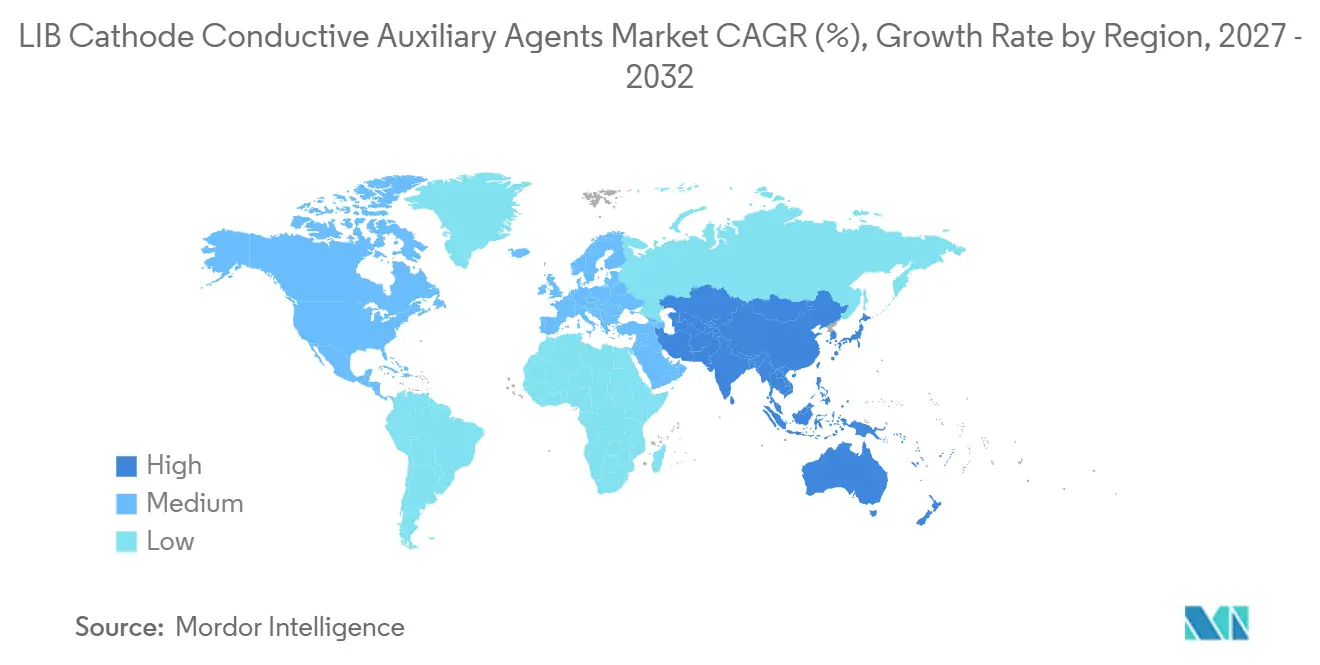
Asia-Pacific held 50.31% of the LIB cathode conductive auxiliary agents market share in 2026 and is projected to advance at a 13.53% CAGR through 2032. The region has the largest concentration of cathode production, battery manufacturing, and advanced conductive-material suppliers. China accounted for more than 80% of global lithium-ion battery manufacturing capacity at the end of 2025. This concentration places China at the center of demand for conductive carbon materials. Japan remains important for high-purity specialty carbons and single-walled carbon nanotubes. ZEON CORPORATION began construction of a new single-walled carbon nanotube facility at Tokuyama in August 2026, with full-scale operation scheduled for 2028[2].
North America LIB Cathode Conductive Auxiliary Agents Market
North America is an important growth area outside Asia-Pacific because battery supply chains and grid storage capacity are expanding. The United States installed 5.6 GW of energy storage in the second quarter of 2025, including 4.9 GW at utility scale. Orion S.A. is building an acetylene black plant in La Porte, Texas, with startup expected in the second quarter of 2026. Cabot Corporation agreed to acquire a carbon black facility in Tamaulipas, Mexico, for USD 70 million, subject to customary adjustments. Canada and Mexico are becoming part of an integrated North American battery materials chain. These developments support regional availability of conductive carbon materials.
EMEA and South America LIB Cathode Conductive Auxiliary Agents Market
Europe faces rising demand for traceable battery inputs and a need to strengthen local supply. The European Union battery passport becomes mandatory in February 2027 and extends traceability requirements across battery value chains. Imerys and Orion S.A. are among the suppliers with relevant European production positions. Jiangsu Cnano Technology Co., Ltd. plans capacity in Europe for carbon nanotube conductive paste. South America has early-stage demand linked to electric vehicle manufacturing ambitions and lithium resources. The Middle East and Africa have long-term potential from renewable energy integration and energy storage deployment. The LIB cathode conductive auxiliary agents market will depend on how quickly local cathode production and battery qualification develop in these regions.
Competitive Landscape
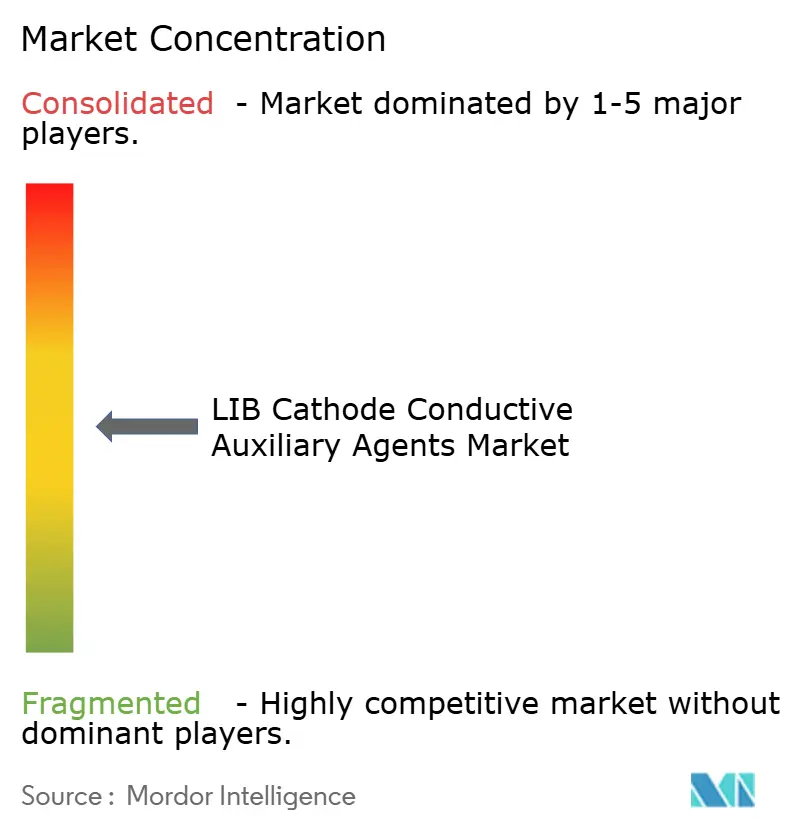
The LIB cathode conductive auxiliary agents market is moderately concentrated, with the top five players including Cabot Corporation, Birla Carbon, Imerys, Orion S.A., and LG Chem. ADEKA CORPORATION, Birla Carbon, Cabot Corporation, Denka Company Limited, Imerys, LION SPECIALTY CHEMICALS CO., LTD., Orion S.A., and Resonac Holdings Corporation are active across conductive carbon grades and specialty materials. BTR New Material Group Co., Ltd., LG Chem, Shenzhen Dynanonic Co., Ltd., and TPR Co., Ltd. operate within the wider cathode and battery materials ecosystem. Jiangsu Cnano Technology Co., Ltd., TORAY INDUSTRIES, INC., and ZEON CORPORATION have positions in carbon nanotube materials or conductive pastes. Suppliers compete on consistent purity, conductive performance, dispersion support, supply reliability, and qualification history.
Hybrid carbon black and carbon nanotube formulations are becoming more relevant as cell makers seek both cost control and improved conductivity. Imerys Graphite & Carbon Switzerland Ltd. and Jiangsu Cnano Technology Co., Ltd. announced a partnership in July 2025 to develop combined carbon black and carbon nanotube conductive additives for electric vehicle batteries. Birla Carbon presented its Conductex i carbon black, Nanocyl carbon nanotubes, and hybrid solutions for battery applications in 2026. These moves show that suppliers are building broader material portfolios rather than relying on a single carbon product. The LIB cathode conductive auxiliary agents market increasingly values formulation knowledge alongside the physical properties of the additive. This favors companies able to support customers through electrode development and battery qualification.
Cabot Corporation acquired certain battery materials technology assets for USD 27 million in October 2024, including USD 19 million in property, plant, and equipment and USD 8 million in intangible assets. It later entered a multiyear supply agreement with PowerCo SE for conductive carbons and dispersions for lithium-ion batteries. ZEON CORPORATION also invested in Sino Applied Technology in October 2025 to support single-walled carbon nanotube paste development and capacity expansion. Regulatory requirements for supply security, traceability, and material origin can influence supplier selection alongside technical performance. Companies with certified production, low-impurity processes, and established customer qualifications are better placed to serve regional battery supply chains.
LIB Cathode Conductive Auxiliary Agents Industry Leaders
-
Cabot Corporation
-
Birla Carbon
-
Imerys
-
Orion S.A.
-
LG Chem
- *Disclaimer: Major Players sorted in no particular order
LIB Cathode Conductive Auxiliary Agents Market Companies Covered in this Report
- ADEKA CORPORATION
- Birla Carbon
- BTR New Material Group Co., Ltd.
- Cabot Corporation
- Denka Company Limited
- Imerys
- Jiangsu Cnano Technology Co., Ltd.
- LG Chem
- LION SPECIALTY CHEMICALS CO., LTD.
- Orion Engineered Carbons
- Resonac Holdings Corporation
- Shenzhen Dynanonic Co., Ltd
- TORAY INDUSTRIES, INC.
- TPR Co., Ltd.
- ZEON CORPORATION
Recent Industry Developments in LIB Cathode Conductive Auxiliary Agents Market
- September 2026: Cabot Corporation announced plans to expand North American production of advanced battery conductive additives at its facilities in Franklin, Louisiana, and Pampa, Texas, supported by a USD 50 million U.S. Department of Energy grant and approximately USD 75 million in company investment. The expansion supports the LIB cathode conductive auxiliary agents market by increasing domestic supply of conductive carbon materials for lithium-ion battery electrodes.
- August 2026: ZEON CORPORATION began construction of a new single-walled carbon nanotube (SWCNT) production facility at its Tokuyama Plant in Shunan City, Japan, with full-scale operations scheduled for 2028 and planned capacity reaching tens of times its current level. The expansion supports the LIB cathode conductive auxiliary agents market by increasing the potential supply of SWCNTs used to enhance electrical conductivity in lithium-ion battery electrodes.
Global LIB Cathode Conductive Auxiliary Agents Market Report Scope
Lithium-ion battery (LIB) cathode conductive auxiliary agents are materials added to cathode formulations to improve electrical conductivity and support efficient electron transport within battery electrodes. They help reduce internal resistance and support battery performance across different energy storage applications.
The LIB Cathode Conductive Auxiliary Agents Market is segmented by product type, chemistry, application, and geography. By product type, the market is segmented into carbon black, carbon nanotubes, and other product types. By chemistry, the market is segmented into nickel manganese cobalt oxide (NMC), nickel cobalt aluminum oxide (NCA), lithium iron phosphate (LFP), lithium manganese oxide (LMO), and lithium cobalt oxide (LCO). By application, the market is segmented into automotive, consumer electronics, energy storage systems, industrial, and other applications. The report also covers the market size and forecasts for LIB cathode conductive auxiliary agents across 15 countries. For each segment, the market sizing and forecasts have been done on the basis of value (USD).
Segmentation Overview
| Carbon Black |
| Carbon Nanotubes |
| Other Product Types |
| Nickel Manganese Cobalt Oxide (NMC) |
| Nickel Cobalt Aluminum Oxide (NCA) |
| Lithium Iron Phosphate (LFP) |
| Lithium Manganese Oxide (LMO) |
| Lithium Cobalt Oxide (LCO) |
| Automotive |
| Consumer Electronics |
| Energy Storage Systems |
| Industrial |
| Other Applications |
| Asia-Pacific | China |
| India | |
| Japan | |
| South Korea | |
| ASEAN Countries | |
| Rest of Asia-Pacific | |
| North America | United States |
| Canada | |
| Mexico | |
| Europe | Germany |
| United Kingdom | |
| France | |
| Italy | |
| NORDIC Countries | |
| Rest of Europe | |
| South America | Brazil |
| Argentina | |
| Rest of South America | |
| Middle East and Africa | Saudi Arabia |
| South Africa | |
| Rest of Middle East and Africa |
| By Product Type | Carbon Black | |
| Carbon Nanotubes | ||
| Other Product Types | ||
| By Chemistry | Nickel Manganese Cobalt Oxide (NMC) | |
| Nickel Cobalt Aluminum Oxide (NCA) | ||
| Lithium Iron Phosphate (LFP) | ||
| Lithium Manganese Oxide (LMO) | ||
| Lithium Cobalt Oxide (LCO) | ||
| By Application | Automotive | |
| Consumer Electronics | ||
| Energy Storage Systems | ||
| Industrial | ||
| Other Applications | ||
| By Geography | Asia-Pacific | China |
| India | ||
| Japan | ||
| South Korea | ||
| ASEAN Countries | ||
| Rest of Asia-Pacific | ||
| North America | United States | |
| Canada | ||
| Mexico | ||
| Europe | Germany | |
| United Kingdom | ||
| France | ||
| Italy | ||
| NORDIC Countries | ||
| Rest of Europe | ||
| South America | Brazil | |
| Argentina | ||
| Rest of South America | ||
| Middle East and Africa | Saudi Arabia | |
| South Africa | ||
| Rest of Middle East and Africa | ||
Key Questions Answered in the Report
What is the size of the LIB cathode conductive auxiliary agents market?
The LIB cathode conductive auxiliary agents market size was valued at USD 2.07 billion in 2026 and is estimated to grow from USD 2.29 billion in 2027 to reach USD 3.90 billion by 2032, at a CAGR of 11.25% during the forecast period (2027-2032).
What materials are used as cathode conductive auxiliary agents?
Carbon black, carbon nanotubes, vapor-grown carbon fiber, and graphene-based materials are used to improve electrical pathways in battery cathodes.
Which product type held the largest share in 2026?
Carbon black held 58.44% of the LIB cathode conductive auxiliary agents market share in 2026 because it is widely qualified and cost-effective across battery chemistries.
Why are carbon nanotubes gaining use in battery cathodes?
Carbon nanotubes can create conductive pathways at very low loading levels and are projected to advance at a 12.67% CAGR through 2032.